Experience has shown that soft rhetoric and so-called “smart diplomacy” have served only to enable North Korea and Iran to produce more nuclear weapons and better ballistic missiles.
Not only has the International Atomic Energy Agency (IAEA) been prevented from monitoring Iranian compliance, but it is not pushing the issue for fear that “Washington would use an Iranian refusal as an excuse to abandon the JCPOA.”
During his first press conference after taking office in January 1981, US President Ronald Reagan called détente a “one-way street that the Soviet Union has used to pursue its own aims.” Echoing this remark while addressing reporters later the same day, Secretary of State Alexander Haig said that the Soviets were the source of much support for international terrorism, especially in Latin and Central America.
The following day, both Reagan and Haig were criticized for their remarks, with members of the media describing the president’s words as “reminiscent of the chilliest days of the Cold War,” and appalled that the administration’s top diplomat was accusing the Russians of backing terrorist activities.
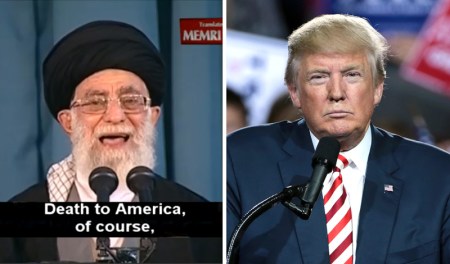
Nearly four decades later, in spite of the successful defeat of the Soviet empire, the White House is still frowned upon when it adopts a tough stance towards America’s enemies. Today’s outrage is directed at President Donald Trump’s warnings about — and to — North Korea and Iran. The Washington Post called his recent “fire and fury” threats to Pyongyang a “rhetorical grenade,” for example, echoing top Democrats’ attacks on his remarks for being “reckless” and “irresponsible.”
Critics of Trump’s attitude towards Tehran go equally far, describing his opposition to the Joint Comprehensive Plan of Action (JCPOA) — the nuclear deal with Iran — as “rushing headlong into war.”
Trump’s detractors, however, are just as wrong as those who berated Reagan in 1981. Experience has shown that soft rhetoric and so-called “smart diplomacy” have served only to enable North Korea and Iran to produce more nuclear weapons and better ballistic missiles.
Although the JCPOA stipulates that Iran is not permitted to produce more than a certain quantity of enriched uranium or to enrich uranium beyond a certain level, not only has the International Atomic Energy Agency (IAEA) been prevented from monitoring Iranian compliance, but it is not pushing the issue for fear that “Washington would use an Iranian refusal as an excuse to abandon the JCPOA.”
Furthermore, among its many other flaws, the JCPOA does not address Iran’s ballistic-missile capabilities or financing of global terrorism.
Nevertheless, it is the administration’s rhetoric that is under attack. Isn’t it high time for the media and foreign-policy establishment to wake up to the reality that seeing regimes as they are, rather than as we wish them to be, is the only way to confront our enemies effectively, and with the least number of casualties?
Peter Huessy is president of GeoStrategic Analysis, a defense consulting firm he founded in 1981
Judicial Watch obtained the files as part of a California Public Records Act request for information surrounding riots by the radical leftist Antifa movement against President Trump and conservative personalities scheduled to speak at the University of California Berkeley. Media reported that fires were set, fences and windows broken, firebombs launched and commercial-grade fireworks thrown at police.
The documents show a coordinated effort between Democratic city officials nationwide to “build the movement to resist Trump.” The operation is being financed by leftwing billionaire philanthropist George Soros through one of his groups called Center of Popular Democracy. Earlier this year Judicial Watch uncovered a scandal in which the U.S. government quietly gave millions of taxpayer dollars to destabilize the democratically elected, center-right government in Macedonia by colluding with Soros’ Open Society Foundation. The U.S. Ambassador to Macedonia, Jess L. Baily, worked behind the scenes with Open Society Foundation to funnel large sums of American dollars for the cause, constituting an interference of the U.S. Ambassador in domestic political affairs in violation of the Vienna Convention on Diplomatic Relations. The cash flowed through the State Department and the famously corrupt U.S. Agency of International Development (USAID) and Judicial Watch sued both agencies for records related to funding and political activities of the Open Society Foundation in Macedonia.
The Soros-backed, northern California movement includes a taxpayer-salaried physics professor at UC Berkeley who advises Mayor Arreguin on how to handle conservative protestors at a spring rally. The professor, James McFadden, tells the mayor in an electronic mail obtained by Judicial Watch to “create a corral” and ask the Trump supporters to “get in the corral.” He describes Trump supporters as “delusional and paranoid about the world around them” and says they’re “willing to use violence to impose that order on us, especially when they have the blessing of a narcissistic authoritarian president.” A professor at another California public university tells the Berkeley mayor that the arrest of Antifa leader/middle school teacher Yvette Felarca for assaulting a political opponent (captured on video) at a Sacramento rally, in which seven people were stabbed, was a “McCarthyist political persecution” and he condemned Felarca’s arrest and teaching suspension “in the strongest possible terms.”
****************************
Shortly after Donald Trump got elected president, a California mayor arranged a meeting with the Consul General of Mexico to assure the diplomat that his “sanctuary city” will continue providing safe spaces for illegal immigrants, according to records obtained by Judicial Watch. The documents show that Berkeley Mayor Jesse Arreguin’s top aide, Stefan Elgstrand, sent an electronic mail to the Mexican Consul General in San Francisco, Gemi Jose Gonzalez Lopez, stating the following: “The recent events around Trump’s executive order reminded me to reach out to you. We are a sanctuary city and will continue to be. I imagine you are very busy dealing with the concerns and fears of many residents in the Bay Area, and we want to assist in providing safe spaces for them.”
Judicial Watch obtained the files as part of a California Public Records Act request for information surrounding riots by the radical leftist Antifa movement against President Trump and conservative personalities scheduled to speak at the University of California Berkeley. Media reported that fires were set, fences and windows broken, firebombs launched and commercial-grade fireworks thrown at police. A renowned, San Francisco-based pop culture magazine wrote that the uprising raised some big questions about the future of the free speech movement. Judicial Watch requested the files to shed light into how city, police and university officials handled the lawlessness, which received global news coverage. The request asked for records of communications between officials in the Berkeley mayor’s office and the Berkeley Police Department as well as records of communications between the mayor’s office and officials at UC Berkeley, one of the nation’s top public research universities.
The documents show a coordinated effort between Democratic city officials nationwide to “build the movement to resist Trump.” The operation is being financed by leftwing billionaire philanthropist George Soros through one of his groups called Center of Popular Democracy. Earlier this year Judicial Watch uncovered a scandal in which the U.S. government quietly gave millions of taxpayer dollars to destabilize the democratically elected, center-right government in Macedonia by colluding with Soros’ Open Society Foundation. The U.S. Ambassador to Macedonia, Jess L. Baily, worked behind the scenes with Open Society Foundation to funnel large sums of American dollars for the cause, constituting an interference of the U.S. Ambassador in domestic political affairs in violation of the Vienna Convention on Diplomatic Relations. The cash flowed through the State Department and the famously corrupt U.S. Agency of International Development (USAID) and Judicial Watch sued both agencies for records related to funding and political activities of the Open Society Foundation in Macedonia.
The Soros-backed, northern California movement includes a taxpayer-salaried physics professor at UC Berkeley who advises Mayor Arreguin on how to handle conservative protestors at a spring rally. The professor, James McFadden, tells the mayor in an electronic mail obtained by Judicial Watch to “create a corral” and ask the Trump supporters to “get in the corral.” He describes Trump supporters as “delusional and paranoid about the world around them” and says they’re “willing to use violence to impose that order on us, especially when they have the blessing of a narcissistic authoritarian president.” A professor at another California public university tells the Berkeley mayor that the arrest of Antifa leader/middle school teacher Yvette Felarca for assaulting a political opponent (captured on video) at a Sacramento rally, in which seven people were stabbed, was a “McCarthyist political persecution” and he condemned Felarca’s arrest and teaching suspension “in the strongest possible terms.”
Ironically, Berkeley’s official government website brags about being a bastion of the free speech movement. “In Alameda County alone, Berkeley is ranked fourth in population behind Oakland, Fremont, and Hayward,” the website states. “And yet, we are famous around the globe as a center for academic achievement, scientific exploration, free speech and the arts.” Indeed, Berkeley is renowned as the birthplace of the free speech movement in in the 1960s. An opinion piece in a California newspaper points out that the city’s free speech movement has gone full circle, however. “Nowadays, Berkeley is rapidly becoming famed as one of the least tolerant cities in the country — where any challenge to left-wing orthodoxy is met with terrorist threats and mob violence.”
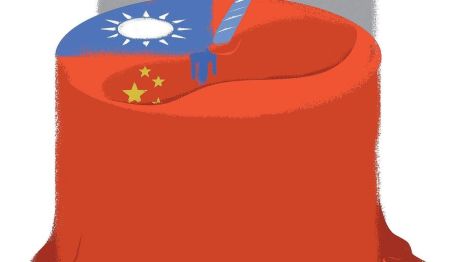
Illustration on Taiwan’s national day by Linas Garsys/The Washington Times
ANALYSIS/OPINION:
The New York Times, the U.S. equivalent of the People’s Daily, could barely contain its glee: “Panama Establishes Ties with China, Further Isolating Taiwan,” read the headline in the June 13 edition.
But Taiwan isn’t isolated, not where it counts. Bilateral trade with the United States was $65.3 billion in 2016, making the ROC our 10th-largest trading partner. According to the International Monetary Fund, Taiwan has the world’s 15th-largest economy (the seventh-largest in Asia). Not bad for a nation of 23 million. Its trade partners are delighted to do business with a country whose existence they won’t officially recognize.
Liberal media like The New York Times assume that resolving the conflict by grafting the ROC to the PRC would be better for everyone.
It wouldn’t be better for a people whose destiny would be taken out of their hands. It wouldn’t be better for the United States, which would see the end of a government that shares our values. And it would not be better for the world, marking the disappearance of the only Chinese democracy in history.
*****************************************
Tuesday is Taiwan’s national day (known as Double Ten Day), commemorating the Wuchang Uprising, which led to the establishment of the Republic of China (ROC) in 1912. The Republic of China on Taiwan is the true heir to Sun Yat-sen’s revolution.
Like the late Rodney Dangerfield, Taiwan gets no respect — at least in the world of international diplomacy.
In June, Panama severed diplomatic ties with Taiwan. Since 1970, most countries have opted for Beijing over Taipei, due to a combination of pressure and bribes. China refuses to have diplomatic relations with any nation that officially recognizes Taiwan. Most opt for pragmatism over principal.
The New York Times, the U.S. equivalent of the People’s Daily, could barely contain its glee: “Panama Establishes Ties with China, Further Isolating Taiwan,” read the headline in the June 13 edition.
But Taiwan isn’t isolated, not where it counts. Bilateral trade with the United States was $65.3 billion in 2016, making the ROC our 10th-largest trading partner. According to the International Monetary Fund, Taiwan has the world’s 15th-largest economy (the seventh-largest in Asia). Not bad for a nation of 23 million. Its trade partners are delighted to do business with a country whose existence they won’t officially recognize.
Besides its vibrant economy, Taiwan is one of the few genuine democracies in Asia. Despite its huge economy, the People’s Republic of China (PRC) remains what it was at the end of the civil war in 1949 — a brutal dictatorship ruled by a self-perpetuating oligarchy.
For Taiwan, trying to get along with the people’s republic is like living with a belligerent, bully of a neighbor, never knowing what will set him off.
In her inaugural address last year, Taiwan’s President Tsai Ing-wen infuriated Beijing by not paying lip service to the myth that both the ROC and PRC both are part of something called One China.
On Dec. 5, President-elect Donald Trump took a phone call from President Tsai. It was the first time since we withdrew recognition of the ROC in 1979 (under that foreign policy genius, President Jimmy Carter) that a U.S. president or president-elect spoke directly with the leader of Taiwan.
On one of his famous Twitter forays, Mr. Trump said he didn’t understand the fuss. (“Interesting how the U.S. sells Taiwan billions of dollars of military equipment but I should not accept a congratulatory call.”)
For the president, that 10-minute conversation may have been a calculated move to elicit Chinese cooperation on North Korea and bilateral trade, or it might have been a recognition of Taiwan’s strategic importance. Always friendly to America, the ROC was our ally from World War II until Nixon betrayed it in 1971, and Mr. Carter completed the process in 1979. Still, the United States has far more in common with the island democracy than with the totalitarian mainland.
Whoever controls both sides of the Taiwan Straits can restrict access to one of the busiest energy trade routes in the world. Do we want that control in the hands of an aggressive, highly volatile regime?
Only 15 nations have diplomatic relations with Taiwan. While few in number, they are steadfast in their support.
Risking Beijing’s displeasure, its 15 allies sent a joint letter to United Nations Secretary-General Antonio Guterres urging that Taipei be included in the 2030 Agenda for Sustainable Development and allowed to participate in the U.N. system, including subsidiary bodies like the World Health Organization. They also noted the absurdity of requiring Taiwanese to have a travel permit issued by China to enter U.N. premises.
Beijing believes that time is on its side — that sooner or later, Taiwan must succumb to pressure to reach a settlement that surrenders its sovereignty — and that it will eventually accept something like the deal Hong Kong got in 1997 (One Nation, Two Systems), on which China has repeatedly reneged.
But since the end of martial law and the transition to democracy, the Taiwanese have forged their own identity, one which makes their merger with the mainland impossible.
Liberal media like The New York Times assume that resolving the conflict by grafting the ROC to the PRC would be better for everyone.
It wouldn’t be better for a people whose destiny would be taken out of their hands. It wouldn’t be better for the United States, which would see the end of a government that shares our values. And it would not be better for the world, marking the disappearance of the only Chinese democracy in history.
The course of history often turns on the fate of small countries — Belgium in 1914 and Czechoslovakia in 1938.
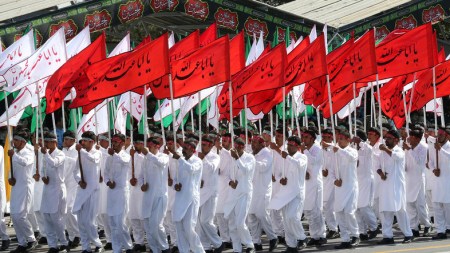
Members of Iranian armed forces march during a parade in Tehran, Iran, September 22, 2017. President.ir/Handout via REUTERS.
The new mentality sought by Washington is to address all of Iran’s belligerence and not allow its nuclear program and the JCPOA devour all of the international community’s attention.
The new US response, including blacklisting Iran’s notorious Revolutionary Guards, to be announced by Trump is said to cover missile tests, support for terrorism and proxy groups checkered across the Middle East, hopefully human rights violations at home, and cyberattacks.
Iran has a history of resorting to such measures, including targeting Saudi oil interests. Raising the stakes for Iran, Trump described a meeting with his top military brass on Thursday evening as “the calm before the storm.” Neither the US President nor the White House provided further details, yet rest assured Tehran received the message.
**************************
All eyes are on US President Donald Trump and his upcoming Iran speech later this week to clarify his decision to certify or decertify Tehran’s compliance with a nuclear agreement, officially known as the Joint Comprehensive Plan of Action (JCPOA), designed to curb the regime’s controversial atomic drive.
This has Iran’s regime on its toes, as senior elite in Tehran understand fully how the US can lead the international community in adopting strong measures against its broad scope of malign activities. Expected to be addressed is also a wide range of concerns over Iran’s dangerous policies in relation to its ballistic missile advances, meddling in Middle East states and supporting terrorist proxy groups as explained in a new video.
‘Iran’s unacceptable behavior’
Iran’s rogue behavior, currently imposing its influence on four major regional capitals of Baghdad, Beirut, Damascus and Sanaa, are the result of the Obama administration’s “overly lenient foreign policy, which sought to promote America’s priorities through consensus, rather than through the frank display of power,” as put by a recent The New Yorker piece.
“Lifting the sanctions as required under the terms of the JCPOA has enabled Iran’s unacceptable behavior,” US Secretary of State Rex Tillerson said in a late September meeting with his P5+1 counterparts and Iran’s top diplomat Mohammad Javad Zarif.
The Trump administration is also deeply concerned over Iran’s proxies mining the strategic Bab el-Mandeb Strait waterway, aiming its indigenous missiles from Yemen towards cities in Saudi Arabia and other Gulf countries, and from southern Lebanon towards Israel. This is Tehran in action with the objective of taking advantage of the destruction left behind by ISIS across the region, especially in Syria and Iraq.
“The Iranian regime supports terrorism and exports violence, bloodshed and chaos across the Middle East,” Trump told reporters before a Thursday evening meeting with senior military leaders at the White House. “That is why we must put an end to Iran’s continued aggression and nuclear ambitions,” he said. “They have not lived up to the spirit of their agreement.”
Trump has put Iran “on notice” over charges that Tehran violated a nuclear deal with the West by test-firing a ballistic missile. (Reuters)
Joint effort
Parallel to the White House there are voices on Capitol Hill advocating the new approach weighed by the administration.
“The president should decline to certify, not primarily on grounds related to Iran’s technical compliance, but rather based on the long catalog of the regime’s crimes and perfidy against the United States, as well as the deal’s inherent weakness,” Senator Tom Cotton said last week at a speech in the Council on Foreign Relations.
As the Trump administration seeks to place necessary focus on Iran’s illicit Middle East ambitions and actions, talks are also ongoing as we speak over how to amend the JCPOA’s restrictions.
“Sunset clauses,” Iran’s ballistic missile development and testing, and an inspections regime lacking the bite to gain necessary access into the regime’s controversial military sites. Under the current framework Iran can easily conduct nuclear weapons research and development in military sites and claim such locations do not fall under the JCPOA jurisdiction.
While it is expected of Trump to decertify Iran, he most likely will not go the distance to completely pull America out of the nuclear agreement. Obama refused to send the JCPOA to Congress for discussion and approval. Trump, however, seems set to place the decision to impose further sanctions on Iran upon the shoulders of US lawmakers.
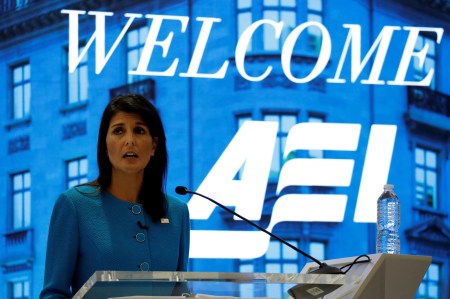
US Ambassador to the United Nations Nikki Haley speaks about the Iran nuclear deal at the American Enterprise Institute in Washington, on September 5, 2017. (Reuters)
More than ‘one piece’
The new mentality sought by Washington is to address all of Iran’s belligerence and not allow its nuclear program and the JCPOA devour all of the international community’s attention.
The new US response, including blacklisting Iran’s notorious Revolutionary Guards, to be announced by Trump is said to cover missile tests, support for terrorism and proxy groups checkered across the Middle East, hopefully human rights violations at home, and cyberattacks.
Iran has a history of resorting to such measures, including targeting Saudi oil interests. Raising the stakes for Iran, Trump described a meeting with his top military brass on Thursday evening as “the calm before the storm.” Neither the US President nor the White House provided further details, yet rest assured Tehran received the message.
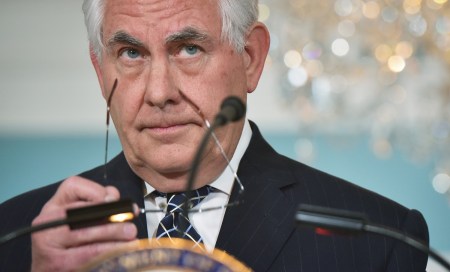
US Secretary of State Rex Tillerson delivering a statement on Iran in the Treaty Room of the State Department in Washington, DC, on April 19, 2017. (AFP)
Fear renders contradiction
Sensing an increasingly escalating tone from Washington, Tehran signaled its first sign of fear by expressing readiness to discuss its ballistic missile program, according to Reuters. And yet less than 24 hours later, Iranian officials said no offers were made to negotiate such restrictions.
“Iran regards defensive missile programs as its absolute right and will definitely continue them within the framework of its defensive, conventional and specified plans and strategies,” Iranian Foreign Ministry spokesman Bahram Qassemi said, according state media.
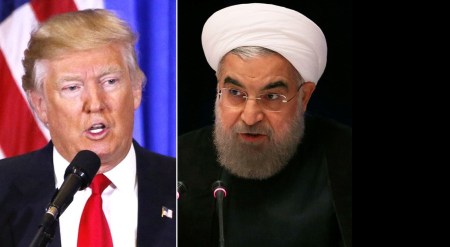
Iranian President Hassan Rouhani also felt the need to make remarks to save face before the regime’s already depleting social base. “In the nuclear negotiations and agreement we reached issues and benefits that are not reversible. No one can turn that back, not Mr. Trump or anyone else,” Rouhani said at a recent Tehran University ceremony, according to state media.
Of course, we all remember how prior to the JCPOA signing in 2015 senior Iranian officials went the limits in describing any “retreat” regarding their nuclear program as a “red line.” To make a long story short, Tehran is comprehending how the times are changing at a high velocity, endangering its domestic, regional and international interests. And unlike the Obama years, its actions will not go unanswered.
Senator Cotton made this crystal clear at his speech: “Congress and the President, working together, should lay out how the deal must change and, if it doesn’t, the consequences Iran will face.”
International Atomic Energy Agency (IAEA) director general Yukiya Amano delivers a speech during a meeting at Accademia dei Lincei in Rome on October 9, 2017. (AFP/ TIZIANA FABI)
The UN atomic agency chief on Monday affirmed Iran’s commitment to a 2015 nuclear deal, in a statement that comes as the US has argued that Tehran was violating the “spirit” of the accord, with US President Donald Trump looking to “decertify” it.
“I can state that the nuclear-related commitments undertaken by Iran under the (nuclear agreement) are being implemented,” International Atomic Energy Agency chief Yukiya Amano said in prepared remarks during a conference in Rome.
An IAEA report released last month had also affirmed Iran’s compliance with the program, which froze some of Tehran’s nuclear activities.
Iran’s stock of low-enriched uranium — used for peaceful purposes, but when further processed for a weapon — did not exceed the agreed limit of 300 kilograms (661 pounds), the report said.
It added that Iran “has not pursued the construction of the Arak… reactor” — which could give it weapons-grade plutonium — and has not enriched uranium above low purity levels.
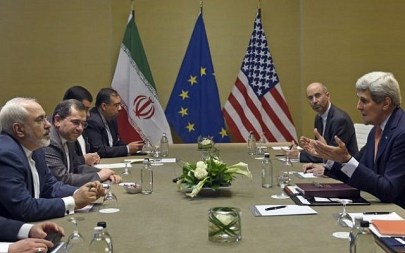
Then-US Secretary of State John Kerry talks with Iranian Foreign Minister Mohammad Javad Zarif on May 30, 2015 in Geneva. (AFP / POOL / SUSAN WALSH)
The landmark deal was signed in July 2015 by Iran and five permanent members of the United Nations Security Council (Britain, China, France, Russia and the United States) plus Germany — establishing controls to prevent Tehran from developing an atomic bomb.
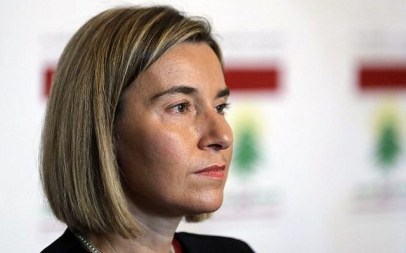
The EU’s diplomatic chief, Federica Mogherini, said Iran’s compliance with the accord had been verified on at least eight separate occasions.
High Representative of the European Union for Foreign Affairs, Federica Mogherini, holds a press conference with the Lebanese foreign minister after their meeting in Beirut on January 26, 2017. (AFP/Joseph Eid)
It is time to “invest in international cooperation” and “open new channels and not destroy the ones we already have,” she said by video conference.
It is “certainly not the time to dismantle them.”
‘Worst deal ever’
Faced with the growing threat from North Korea, “we cannot afford to open a new front,” Mogherini added.
Trump is a fierce critic of the 2015 accord, which he has called “the worst deal ever” and an “embarrassment,” and he is expected to announce that he is “decertifying” Iran’s compliance with it.
US officials insist this will not sink the deal itself but open the way for Congress to possibly develop new measures to punish other aspects of Iran’s behavior.
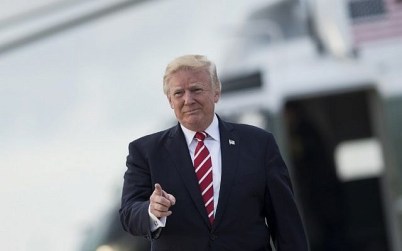
US President Donald Trump boards Air Force One at Andrews Air Force Base on October 7, 2017 in Maryland. (AFP PHOTO / Brendan Smialowski)
Congress requires the president to certify Iranian compliance with the deal every 90 days. The next certification date is October 15.
Under the law, Congress would then have 60 days to decide whether to reimpose sanctions lifted by the deal.
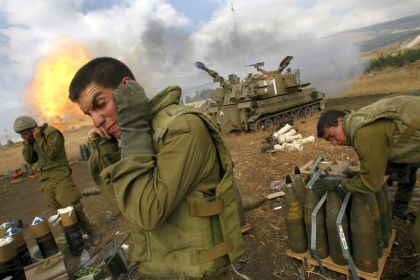
Israeli soldiers cover their ears as an artillery unit fires shells toward southern Lebanon from a position near Kiryat Shmona in northern Israel, near the border with Lebanon.
— AP Photo/David Guttenfelder, File
DAVID GUTTENFELDER
PILON MILITARY BASE, Israel — With President Bashar Assad seemingly poised to survive the Syrian civil war, Israeli leaders are growing nervous about the intentions of his Iranian patrons and their emerging corridor of influence across the region.
Prime Minister Benjamin Netanyahu is agitating against Iran in global forums like the U.N. General Assembly. The Israeli military is holding war games targeting the Iran-backed Lebanese Hezbollah, and generals are issuing tough threats in hopes of avoiding what could be another ruinous Israeli entanglement in Lebanon, this time with Iranian advisers and troops on Israel’s doorstep.
Israel has long identified Iran as its biggest threat, citing its suspect nuclear program, development of long-range missiles and hostile rhetoric. But gains by Syrian troops and their Iranian-backed allies have given those concerns new urgency.
Israel fears the establishment of a Shiite “corridor,” with land links from Iran to Lebanon, allowing the movement of fighters and weapons across the region. At the heart of those fears is Hezbollah, the Lebanese militia that battled Israel to a stalemate in a monthlong war in 2006. The group has greatly beefed up its arsenal of rockets and missiles since then, and after years of fighting in Syria, is more battle-tested than ever.
In his recent U.N. address, Netanyahu warned that Iran was spreading a “curtain of tyranny and terror” across the region, and said Israel would defend itself.
“We will act to prevent Iran from establishing permanent military bases in Syria for its air, sea and ground forces. We will act to prevent Iran from producing deadly weapons in Syria or in Lebanon for use against us. And we will act to prevent Iran from opening new terror fronts against Israel along our northern border,” he said.
Israel last month wrapped up its largest military exercise in two decades — mobilizing some 30,000 troops to train for the next war against Hezbollah.
In an exclusive interview with The Associated Press, the commander of the exercise, Maj. Gen. Tamir Hayman, said that despite Hezbollah’s gains, the balance of power has greatly shifted in favor of Israel since 2006.
“If Hezbollah’s capabilities have grown linearly, ours have grown exponentially, in intelligence, in targets and in the ability to attack,” he said. If fighting resumes, “the damage to Hezbollah will be severe, mortal and comprehensive.”
He said he was pleased with the performance of his troops, and said the two-week drill should send a powerful message of deterrence.
“We have no intentions at this time to go out and defeat Hezbollah. Our goal is to maintain the quiet and stability in the north,” said Hayman, the commander of the army’s Northern Corps.
Israeli forces last month shot down what Israel said was a Hezbollah surveillance drone that veered too close to the Syrian border with Israel. The military said the unmanned aircraft was Iranian-made and launched from a Damascus airport before it was shot down near the Israeli-controlled side of the Golan Heights.
After six years of fighting that claimed at least 400,000 lives, Assad’s forces appear to have finally gained the upper hand as they recapture territory from the Islamic State group and opposition fighters.
Russia, which is waging an air campaign on behalf of Assad, and Iran and Hezbollah, which have fighters on the ground, have provided crucial support and are expected to play a major role in postwar Syria.
“The vector is quite clear right now, with the Syrian army, Hezbollah and the Shiite militias gradually regaining control of large swaths of the country,” said Chagai Tzuriel, the director general of the Israeli Intelligence Ministry.
Israel has said any permanent presence of Iranian or Hezbollah troops along the Syrian border with Israel would be crossing a “red line,” hinting that it would be willing to take military action if needed. Tzuriel warned of a “regional conflagration.”
He said Russia could end up playing a positive role, because it wants to stabilize Syria. He said the Russians realize that Iran could create friction not only with Israel, but also with the Sunni majority in the region.
“I think there is a good chance that it will limit and restrain Iran, Hezbollah and the Shiite militias,” he said.
But that is far from clear. Netanyahu in August flew to Russia to discuss Syria with President Vladimir Putin, but apparently returned home emptyhanded. Israeli media last week said Russia had rejected an Israeli request to keep the Shiite forces at least 40 miles from the border. Neither side has commented on the reports.
Intelligence Minister Yisrael Katz recently claimed at a security conference that Iran and Syria are working on an agreement that could bring an Iranian naval base, airport or army bases to Israel’s doorstep, a major boost for Hezbollah.
“The Iranians may bring different kinds of missiles to Syria, and a large and well-equipped force of Shiite militias may settle there, including tens of thousands of Afghans, Pakistanis, Iraqis and Syrians whose goal is to threaten and battle Israel,” Katz said. “Hezbollah will train and command the Shiite militias.”
Israel has attempted to stay on the sidelines throughout the Syrian war. But it has admitted to carrying out dozens of airstrikes on what are believed to be shipments of “game changing” weapons, such as guided missiles or anti-aircraft systems, bound for Hezbollah. Syria accused Israel of carrying out a recent airstrike against a Syrian military facility, possibly linked to either missile production or chemical weapons.
Hayman said last week’s drill was only focused on Lebanon, and that Israel would try to keep any future fighting from spreading beyond Lebanon.
After years of fighting in Syria, Hezbollah does not appear to be in a rush to battle Israel. The group has lost an estimated 1,500 fighters in Syria and is also suffering from low morale and financial pressure. But as it withdraws from Syria, it is expected to look south, to its main nemesis. — (AP)
“Hezbollah now has a force similar to those of a conventional army without losing its experience in guerrilla warfare,” said Qassim Qassir, a Lebanese expert on Hezbollah. “Hezbollah today is stronger than before and this is what made Israel carry out this drill to show their force.” —
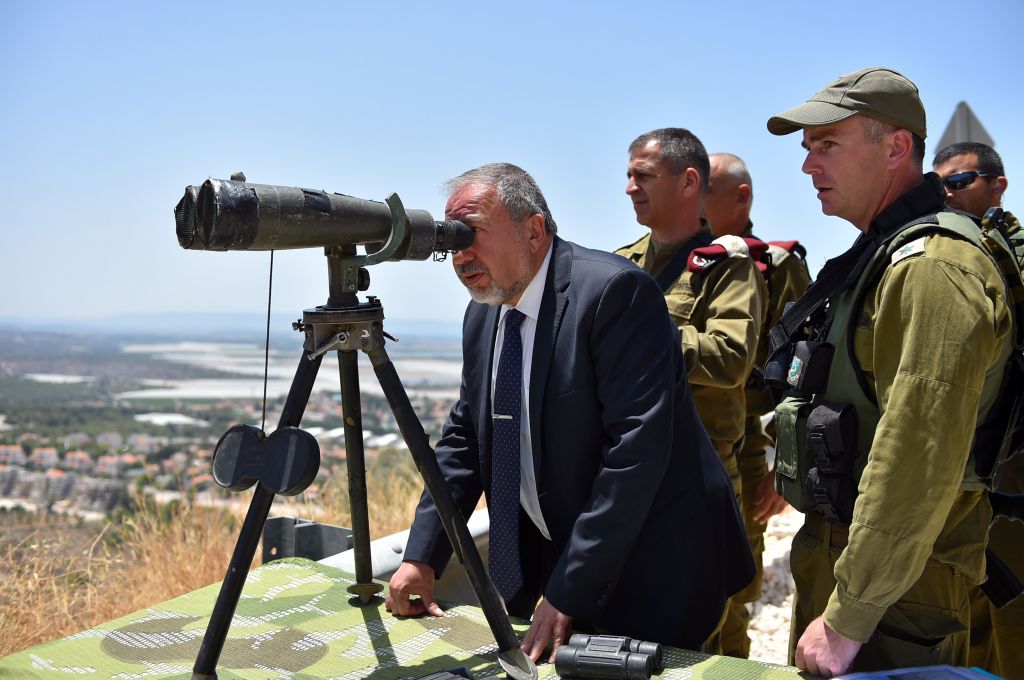
Defense Minister Avigdor Liberman tours Israel’s northern border on Tuesday, June 7, 2016 (Ariel Hermoni/Defense Ministry)
Defense Minister Avigdor Liberman on Tuesday said the next war in Israel will see the Israel Defense Forces facing both a unified Syrian and Lebanese foe and another front in the Gaza Strip.
He also declared Tuesday that the Lebanese army has been fully integrated with Hezbollah and now operates under the terror group’s command.
“When the next campaign begins, and it doesn’t matter where it begins, in the north or the south, it will immediately become a two-front campaign. There is no longer a single front, and that is our basic assumption. We are preparing the army for that,” said Liberman, addressing the Defense Ministry in Tel Aviv during an event for soldiers to mark the ongoing Sukkot festival.
“And also regarding the Lebanese front we are no longer talking about Hezbollah alone,” he added. “We are talking about Hezbollah and the Lebanese army; regrettably that is the reality. The Lebanese army has become an integral part of the Hezbollah apparatus under its command.”
The defense minister said that Israel’s northern front now included both Lebanon and Syria, where he predicted fighting against the Jewish state would be coordinated.
Defense Minister Avigdor Liberman, center, poses with IDF soldiers during an event at the Defense Ministry in Tel Aviv, October 10, 2017. (Defense Ministry)
“The new reality also prepares new challenges for us. If once we spoke about the Lebanese front — there is no longer such a front. There is the northern front. In any development there may be, it will be one front, Syria and Lebanon together, Hezbollah, the Assad regime and all the Assad regime supporters.”
Although Israeli and Syrian forces clashed in Lebanon during the 1982 First Lebanon War, the two countries have not fought across their common border since the 1973 Yom Kippur War.
Israel was working to prevent a war, but the situation was “fragile” and a confrontation could erupt at any moment, said Liberman.
“All of our effort is to prevent the next war, but in the ‘new’ Middle East the assessments that were familiar in the past, such as low likelihood [of war], are simply irrelevant assessments,” said Liberman. “The reality is fragile; it can happen from one moment to another, from today to tomorrow.”
“It’s all based on the fact that we have to prepare for a serious battle, and there is no battle without tremendous firepower,” the defense minister said. “My personal basic view is that ‘those who want peace should prepare for war.’ I hope that our enemies on the other side will think well about each step they take against Israel, in order that we not be required to demonstrate the full force and abilities of the IDF.”
Israel last fought a full-scale war with Hezbollah in 2006’s Second Lebanon War, and tensions have remained high even as the northern border has remained relatively quiet in the past decade.
Hezbollah is believed to have an arsenal of between 100,000 and 150,000 short-, medium- and long-range missiles and a fighting force of some 50,000 soldiers, including reservists.
A Hezbollah commander said last month that the group has more than 10,000 fighters in southern Syria ready to confront Israel. Hezbollah has been fighting on behalf of the Syrian regime as it tries to suppress a six-year long insurgency.
Israel worries Hezbollah and its backer Iran could launch a war against the Jewish state from southern Syria.
Recently, Israeli officials have warned that any attack by Hezbollah, which has seats in the Lebanese parliament, would be seen by Israel as an attack by Lebanon.
Ballistic missile launched and tested in undisclosed location, Iran Reuters
The Iranian regime made dozens of attempts to acquire technology critical for its nuclear weapons and ballistic missile programs, Fox News reported Monday night, a possible violation of the 2015 Joint Comprehensive Plan of Action (JCPOA), better known as the Iran nuclear deal.
Fox News cited three German intelligence reports which indicated that agents working on behalf of Tehran made “32 procurement attempts… that definitely or with high likelihood were undertaken for the benefit of proliferation programs.”
The attempted acquisitions, aimed at technology useful for advancing Iran’s military nuclear program and efforts by the regime to manufacture effective medium-to-long-range delivery systems for a future atomic weapon, reportedly took place in 2016 – after the JCPOA took effect in January of that year. Efforts to obtain such technology are prohibited under the JCPOA.
All of the procurement attempts took place in Germany’s North Rhine-Westphalia – a state in western Germany including major population centers like Cologne, Dusseldorf, and Essen.
In addition, German intelligence officials noted that not only Iran, but Pakistan, North Korea, and Sudan used “guest academics” to attempt to obtain uranium enrichment technology.
“An example for this type of activity occurred in the sector of electronic technology in connection with the implementation of the enrichment of uranium,” one of the German intelligence documents read.
The German intelligence reports also warned that Iranian efforts to acquire long-range ballistic missile technology continued “unabated”, and if obtained would enable Tehran to directly threaten Europe.







 anneinpt
 artaxes
 danmillerinpanama
 davidking1530
 Peter Hofman
 Joseph Wouk
 Peter
Peter Louisiana Steve
 WarSclerotic
Recent Comments