Archive for October 3, 2017

Trial begins in assassination of DPRK leader’s half-brother

October 3, 2017

Trial begins in assassination of DPRK leader’s half-brother, en.people, October 2, 2017

(Were the North Korean suspects who were allowed to go home executed or given rewards? Kim Jong-un’s estranged half-brother, Kim Jong Nam, was seen as his rival for the position of Dear Leader. — DM) 

(Photo/CGTN)

The women claim they were duped into believing they were playing a harmless prank for a hidden-camera reality TV show. The women will face the death penalty if convicted.

Aisyah and Huong were arrested just days after the murder. They are the only suspects in custody in a killing that ROK’s intelligence agency alleged was part of a five-year plot by DPRK leader Kim Jong Un to kill his estranged half-brother.

Malaysian police has gone on record saying several DPRK nationals suspected of involvement in the crime left the country on the day of the attack while others were allowed to leave later in a diplomatic deal with Pyongyang.

DPRK has vehemently denied the allegations.

The trial is expected to shed light on the many unanswered questions surrounding the murder. For instance, how two ordinary women struggling to make a living as migrant workers in Malaysia allegedly became involved in this high-profile assassination; or how a lethal nerve agent was used in the attack in a crowded airport that killed its target without harming anyone else. 

**********************

Two women suspects pleaded not guilty of murdering Kim Jong Nam, half-brother of DPRK leader Kim Jong Un, on Monday as trial began in the sensational case that shocked the world with its Cold War-style modus operandi and triggered a diplomatic crisis between the Democratic People’s Republic of Korea, the Republic of Korea and Malaysia.

Indonesian Siti Aisyah, 25, and Vietnamese Doan Thi Huong, 29, entered their pleas through interpreters at Shah Alam High Court, outside the Malaysian capital Kuala Lumpur, nearly eight months after the brazen airport assassination.

Indonesian Siti Aisyah is escorted by police as she arrives at the Shah Alam High Court on the outskirts of Kuala Lumpur, Malaysia, in this still image taken from a TV footage, October 2, 2017. /Reuters Photo

Prosecutor to use CCTV footage as evidence

The defendants are accused of smearing Kim Jong Nam’s face with the banned VX nerve agent on February 13 as he waited to board a plane to Macau at a crowded airport terminal in Kuala Lumpur, killing him within 20 minutes.

Prosecutor Muhamad Iskandar Ahmad read a statement giving details of the murder: “We will provide evidence that the dead victim was at (Kuala Lumpur International Airport) departure lounge when Siti Aisyah and Doan Thi Huong approached the dead victim and swiped a poisoned liquid on the face and eyes of the victim. The evidence clearly showed that their action to swipe the poison known as VX caused the death of the victim.”

The chemical agent VX is so lethal that it is listed as a weapon of mass destruction.

The attack was caught on airport CCTV. The footage is likely to be used as evidence by the prosecutor.

The women claim they were duped into believing they were playing a harmless prank for a hidden-camera reality TV show. The women will face the death penalty if convicted.

Judge denies request for other suspects’ identity

Aisyah and Huong were arrested just days after the murder. They are the only suspects in custody in a killing that ROK’s intelligence agency alleged was part of a five-year plot by DPRK leader Kim Jong Un to kill his estranged half-brother.

Malaysian police has gone on record saying several DPRK nationals suspected of involvement in the crime left the country on the day of the attack while others were allowed to leave later in a diplomatic deal with Pyongyang.

The defendants’ lawyers on Monday requested the court to provide them the identities of four people described in the charge sheet as having a common intention to kill Kim Jong Nam. Aisyah’s lawyer Gooi Soon Seng told the court: “A fair trial must include the right to know. The charge must be clear, not ambiguous.”

However, the judge denied the defense’s request after mulling over it for a while.

Defense lawyers say the real culprits have left Malaysia and that the women’s innocence will be proven in court. “We are fairly confident that at the end of trial, they will probably be acquitted,” Hisyam Teh Poh Teik, a lawyer for Huong, was quoted as saying by AFP.

Prosecutors insisted the women will get a fair trial as they began laying out their case, which is expected to take over two months as they examine 30 to 40 witnesses. The defense is then likely to be called.

Earlier, Aisyah and Huong arrived at the heavily guarded Shah Alam High Court, handcuffed and wearing bulletproof vests. About 200 police officers were deployed to guard the court premises.

The defendants arrived in a convoy of police cars with their sirens blaring. The diminutive pair bowed their heads as they were led into court past waiting journalists.

Suspects were ‘tricked’ and ‘used’ 

Meanwhile, Aisyah’s father said his daughter “would not have done such a thing, if she was not used by someone,” according to a CNN report.

“We didn’t see this coming at all. I don’t think she would have been in all this at all, if it wasn’t because of other people using her, getting her wrapped up in all this,” Asria Nur Hasan said.

Huong’s step-mother had also expressed similar apprehensions earlier, speaking to BBC’s Vietnamese service.

“Huong is not educated. We feel she was tricked into being in the situation she’s in,” Vy Thi Nguyen, 54, was quoted by BBC Vietnamese as saying. “We hope the court will be fair to her,” she added.

As the trial continued, Indonesia’s Ambassador to Malaysia, Rusdi Kirana, told reporters that his country is standing by its citizen Aisyah. “We can’t comment on the suspect, but what we can do is… to support our citizen. Regarding the law in Malaysia, we have to respect and let the court process how it should be,” he said.

Kirana said Indonesian officials will be monitoring the trial, including specialists in the field of poison.

Diplomatic row amid unanswered questions

The murder sparked a heated row between DPRK and Malaysia, which had been one of Pyongyang’s few allies, amid global concerns over the country’s nuclear weapons program, with both countries firing each other’s ambassadors.

Tensions later eased after Malaysia agreed to return Kim’s body, in March, and the DPRK let go some Malaysians stranded in the country.

However, an Asian Cup football qualifier between Malaysia and DPRK was postponed amid the crisis, and delayed this week for the third time after Kuala Lumpur imposed a ban on travel to DPRK citing heightened global concerns over Pyongyang’s nuclear program.

Also, ROK has accused the DPRK of plotting the assassination of Kim Jong Nam, who was known to be a critic of his government and was living in exile overseas.

DPRK has vehemently denied the allegations.

The trial is expected to shed light on the many unanswered questions surrounding the murder. For instance, how two ordinary women struggling to make a living as migrant workers in Malaysia allegedly became involved in this high-profile assassination; or how a lethal nerve agent was used in the attack in a crowded airport that killed its target without harming anyone else.

Netanyahu: Faux Palestinian reconciliation risks ‘our existence’

October 3, 2017

PM says Palestinians must disband Hamas armed wing, sever ties with Iran; Bennett proposes cutting payments to PA over negotiations with ‘murderous terror organization’

October 3, 2017, 4:30 pm

Source: Netanyahu: Faux Palestinian reconciliation risks ‘our existence’ | The Times of Israel

Prime Minister Benjamin Netanyahu (center) with mayor of Ma’ale Adumim Benny Kashriel (right) during a Likud faction meeting in Ma’ale Adumim, near Jerusalem on October 3, 2017. (Hadas Parush/Flash90)

Prime Minister Benjamin Netanyahu on Tuesday rejected ongoing reconciliation efforts between the Palestinian Authority and the Gaza-based Hamas terror group, saying any future Palestinian government must disband the terror organization’s armed wing and sever all ties with Iran.

“We expect anyone talking about a peace process to recognize Israel and, of course, recognize a Jewish state, and we won’t accept faux reconciliations in which the Palestinian side reconciles at the expense of our existence,” Netanyahu said during a special Likud faction meeting in the West Bank city of Ma’ale Adumim.

“We have a very straightforward attitude toward anyone who wants to effect such a reconciliation: Recognize the State of Israel, dismantle Hamas’s military wing, sever the relationship with Iran, which calls for our destruction,” he added.

The current Palestinian developments began in earnest on Monday, when a 300-person Palestinian Authority delegation entered Gaza in order to begin taking back administrative control of the Strip.

Palestinian Authority Prime Minister Rami Hamdallah (C) is surrounded by security as he waves following his arrival at the Erez border crossing in Beit Hanoun in the northern Gaza Strip on October 2, 2017. ( AFP PHOTO / MAHMUD HAMS)

Fatah, the faction that controls the PA, and the Hamas terror group have been at loggerheads since Hamas violently took control of the Strip in 2007, with the two groups operating separate administrations. The factions have unsuccessfully attempted to reconcile a number of times in the past.

Hamas said a week ago it had agreed to steps toward resolving the longstanding split with Abbas’s Fatah, announcing it would dissolve a body seen as a rival government — known as the administrative committee — and was ready to hold elections.

It remains unclear whether the steps will result in further concrete action toward ending the deep division with Fatah, as a number of previous reconciliation efforts have failed to bring the two sides together.

In the current talks, Palestinian Authority President Mahmoud Abbas has demanded full control of the PA in Gaza, including over security and the border, before he would form a unity government and reverse deep financial cuts to Gaza that have worsened already existed electricity and water crises.

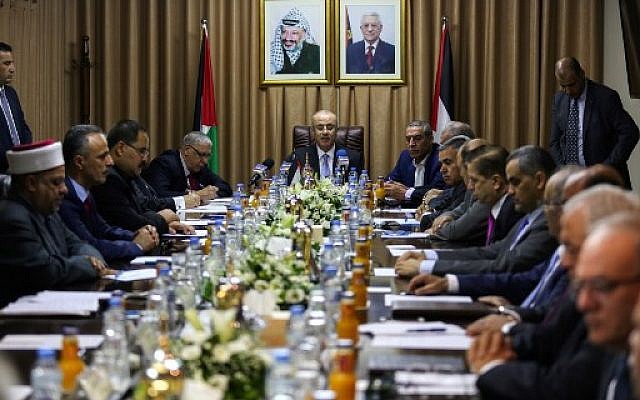
Palestinian Authority Prime Minister Rami Hamdallah (C) chairs a reconciliation government cabinet meeting in Gaza City on October 3, 2017. (MOHAMMED ABED / AFP)

Hamas, however, continues to affirm that it won’t give up its arms, and expects Abbas’s cuts to be reversed in the short term.

Earlier Tuesday, Jewish Home party chairman Education Minister Naftali Bennett said that in response to the reconciliation efforts, as well as the Palestinian Authority’s recent joining of the Interpol international police organization, Israel “must immediately stop transferring tax money to the Hamas government headed by Abbas.”

Education Minister Naftali Bennett attends a committee meeting in the Knesset in Jerusalem on August 23, 2017 (Yonatan Sindel/Flash90)

“Israel must stop being terror’s ATM. This isn’t about Palestinian reconciliation but about Mahmoud Abbas joining forces with a murderous terror organization. Transferring monies to a Hamas government is akin to transferring funds from Israel to IS – rockets will be fired at us in return,” Bennett said in a statement.

Bennett said Israel must insist that three conditions be met in order for the money to be transferred: The return of the bodies of slain IDF soldiers Oron Shaul and Hadar Goldin; Hamas’s recognition of Israel and “the ending of incitement”; and the Palestinian Authority ending all payments to terrorists imprisoned in Israel.

On Monday, Abbas said that he would not accept Hamas keeping its armed forces in Gaza like Hezbollah does in Lebanon and demanded “full control” of the Strip, including over the border, security and all the ministries.

“I won’t accept the reproduction of the Hezbollah experience in Lebanon” in Gaza, Abbas said in an interview late Monday with the Egyptian news station CBC, pointing to an early point of conflict with Hamas, which has vowed not to turn in its arms.

The latest reconciliation efforts come as US President Donald Trump has sought to revive peace talks between Israel and the Palestinians and met separately with Abbas and Netanyahu on the sidelines of the United Nations General Assembly in New York last month.

Also Monday, Jason Greenblatt, Trump’s envoy to the Middle East, said in a statement that while Washington welcomed the effort to put the PA back in control of Gaza, any resulting unity government “must unambiguously and explicitly commit to nonviolence, recognition of the State of Israel, acceptance of previous agreements and obligations between the parties, and peaceful negotiations.”

North Korea’s New Internet Link to Russia May Signal Fear of China Leaving Kim Jong Un in the Dark

October 3, 2017

North Korea’s New Internet Link to Russia May Signal Fear of China Leaving Kim Jong Un in the Dark, Newsweek,  , October 2, 2017

One of Russia’s leading telecommunications companies has reportedly secured a contract with one of the world’s most exclusive buyers: North Korea.

TransTeleKom, a conglomerate operated by Russia’s state-owned railroad company that boasts one of the biggest fiber optics networks on Earth, has begun providing internet service to Russia’s reclusive neighbor, according to a report by North Korea monitoring group 38 North. The move was uncovered as the U.S. leads an international campaign to isolate North Korea diplomatically and economically over leader Kim Jong Un’s refusal to abandon his nuclear and ballistic weapons programs.

With U.S. pressure mounting on China, North Korea’s greatest ally and owner of what was previously its only point of access to the internet, Pyongyang may have reached out to Moscow for fear that Beijing would cave to Washington’s interests, said Martyn Williams, who runs the North Korea Tech blog and authored the 38 North report.

“I’m sure the North Koreans saw the pressure on China and realized they could lose the existing link at any moment,” Williams told Newsweek.

North Korean children learn to use the computer in a primary school on April 2, 2011 in Pyongyang, North Korea. The relatively few number of Internet users in North Korea reportedly got a huge boost October 1, 2017, when Russia’s TransTeleKom provided the country with its second major line of Internet access. FENG LI/GETTY IMAGES

Using information gathered by internet routing databases, Williams was able to determine that the new connection first appeared just after 5 a.m. ET Sunday, which would have been seen in Pyongyang on Sunday evening. TransTeleKom, which is believed to have reached North Korea via the Friendship Bridge that links it to Russia, joins China’s state-owned Unicom as the only companies providing web access to a country of 25 million people, but one with few internet users.

The state wields near absolute control over the flow of information in North Korea, and internet access is generally limited to universities, major companies, foreigners with smartphones, government departments and the military’s cyberwarfare division. By bolstering the country’s bandwidth with a new international provider, Williams said it’s possible that North Korea may have just made its internet stronger and faster than ever before.

Since taking power after his father’s death in 2011, Kim Jong Un has continued his predecessor’s legacy of modernizing the country’s technology sector, including the expansion of the cellular network, distance learning systems and integrated circuit cards for banking and public transportation, Williams said. He has also rapidly advanced its military prowess, ordering the country’s first two intercontinental ballistic missile tests in July and its sixth nuclear weapons test last month.

North Korea has argued it needs nuclear weapons to deter an invasion, but its moves have angered many foreign countries. President Donald Trump and Kim have engaged in an escalating stand-off of insults and threats in recent months, and the Republican leader ordered a direct cyber assault on hackers tied to North Korea on Saturday, The Washington Post reported.

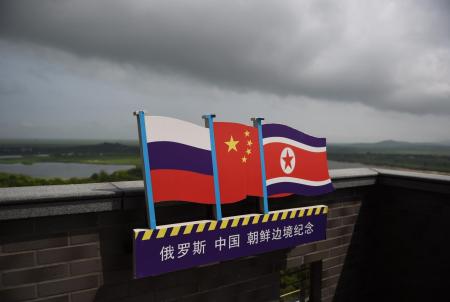
From left: The flags of Russia, China and North Korea on a viewing tower on the border between the three countries in Hunchun, in China’s northeast Jilin province, on June 25, 2015. China sided more closely with Russia than the U.S. on the North Korea nuclear crisis, but Beijing has taken action to punish Pyongyang over its nuclear program. GREG BAKER/AFP/GETTY IMAGES

TransTeleKom was not immediately available to speak when reached for comment by Newsweek, but a company spokesperson told The Financial Times Monday that the Russian firm “has historically had a backbone network interface with North Korea under an agreement with Korea Posts and Telecommunications Corp. struck in 2009.”

While China has opted to side more closely with Russia than the U.S. in the ongoing nuclear crisis between Pyongyang and Washington, Beijing has abided with U.S.-led sanctions at the U.N. China’s Ministry of Commerce announced Thursday that all North Korean businesses would have to close within 120 days in accordance with the latest sanctions adopted September 11 by the U.N. Security Council, and scores of North Korean workers have begun leaving the country, Reuters reported Monday.

Escobar: The Future Of The EU Is At Stake In Catalonia

October 3, 2017

Source: Escobar: The Future Of The EU Is At Stake In Catalonia | Zero Hedge

Authored by Pepe Escobar via The Asia Times,

Fascist Franco may have been dead for more than four decades, but Spain is still encumbered with his dictatorial corpse.

A new paradigm has been coined right inside the lofty European Union, self-described home/patronizing dispenser of human rights to lesser regions across the planet:

“In the name of democracy, refrain from voting, or else.”

Call it democracy nano-Franco style.

Nano-Franco is Spanish Prime Minister Mariano Rajoy, whose heroic shock troops were redeployed from a serious nationwide terrorist alert to hammer with batons and fire rubber bullets not against jihadis but … voters.

At least six schools became the terrain of what was correctly called The Battle of Barcelona.

Extreme right-wingers even held a demonstration inside Barcelona. Yet this was not shown on Spanish TV because it contradicted the official Madrid narrative.

The Catalan government beat the fascist goons with two very simple codes – as revealed by La Vanguardia. “I’ve got the Tupperware. Where do we meet?” was the code on a prepaid mobile phone for people to collect and protect ballot boxes. “I’m the paper traveler” was the code to protect the actual paper ballots. Julian Assange/WikiLeaks had warned about the world’s first Internet war as deployed by Madrid to smash the electronic voting system. The counterpunch was – literally – on paper. The US National Security Agency must have learned a few lessons.

So we had techno power combined with cowardly Francoist repression tactics countered by people power, as in parents conducting sit-ins in schools to make sure they were functional on referendum day. Some 90% of the 2.26 million Catalans who made it to the polls ended up voting in favor of independence from Spain, according to preliminary results. Catalonia has 5.3 million registered voters.

Roughly 770,000 votes were lost because of raids by Spanish police. Turnout at around 42% may not be high but it’s certainly not low. As the day went by, there was a growing feeling, all across Catalonia, all social classes involved, that this was not about independence any more; it was about fighting a new brand of fascism. What’s certain is there’s a Perfect Storm coming.

No pasarán

The “institutional declaration” of overwhelming mediocrity nano-Franco Rajoy, right after the polls were closed, invited disbelief. The highlight was a mediocre take on Magritte: “Ceci n’est pas un referendum.” This referendum never took place. And it could never take place because “Spain is a mature and advanced democracy, friendly and
tolerant”.
The day’s events proved it a lie.

Rajoy said “the great majority of Catalan people did not want to participate in the secessionist script”. Another lie. Even before the “non-existent” referendum, between 70% and 80% of Catalans said they wanted to vote, yes or no, after an informed debate about their future.

Crucially, Rajoy extolled the “unwavering support of the EU and the international community”. Of course; unelected EU “elites” in Brussels and the main European capitals are absolutely terrorized when EU citizens express themselves.

Yet the top nano-Franco lie was that “democracy prevailed because the constitution was respected”.

Rajoy spent weeks defending his repression of the referendum by invoking “the rule of law such as ours”. It’s “their” law, indeed. The heart of the matter are Articles 116 and 155 of a retrograde Spanish constitution, the first one describing how states of alarm, exception and siege work in Spain, and the latter applied in “order to compel the [autonomous community] forcibly to meet … obligations, or in order to protect the … general interests.”

Well, these “obligations” and “general interests” are defined by – who else, Madrid and Madrid only. The Spanish Constitutional Court is a joke – it couldn’t care less about the principle of separation of powers. The court congregates a bunch of legalistic Mafiosi/patsies working for the two parties of the establishment, the so-called “socialists” of the PSOE (Spanish Socialist Workers’ Party) and the medieval right-wingers of Rajoy’s People’s Party (PP).

Few outside Spain may remember the failed coup of February 23, 1981 – when there was an attempt to hurl Spain back into the long dark Francoist night. Well, I was in Barcelona when it happened – and that vividly reminded me of the South American military coups in the 1960s and 1970s. Since the coup, what passes for “justice” in Spain never ceased to be a mere lackey to these two political parties.

The Constitutional Court actually suspended the Catalan referendum law, arguing that it was violating the – medieval – Spanish constitution. This disgraceful collusion is crystal-clear for most people in Catalonia. What Madrid is essentially up to amounts to a coup as well – against the Catalan government and, of course, against democracy. So no wonder the immortal civil-war mantra was back in the streets of Catalonia: “¡No pasarán!” They shall not pass.

Brussels does demophobia

Rajoy, thuggish, mediocre and corrupt (that’s another long story), lied even more when he said he keeps the “door open to dialogue”. He never wanted any dialogue with Catalonia – always refusing a referendum in any shape or form or transferring any powers to the Catalan regional government. Catalonia’s regional president, Carles Puigdemont, insists he had to call the referendum because this is what separatist parties promised when they won regional elections two years ago.

And of course no one is an angel in this hardcore power play. The PDeCaT (the Democratic Party of Catalonia), the main force behind the referendum, has also been mired in corruption.

Catalonia in itself is as economically powerful as Denmark; 7.5 million people, around 16% of Spain’s population, but responsible for 20% of gross domestic product, attracting one-third of foreign investment and producing one-third of exports. In a country where unemployment is at a horribly high 30%, losing Catalonia would be the ultimate disaster.

Madrid in effect subscribes to only two priorities: dutifully obey EU austerity diktats, and crush by all means any regional push for autonomy.

Catalan historian Josep Fontana, in a wide-ranging, enlightening interview, has identified the heart of the matter: “What, for me, is scandalous is that the PP is whipping up public opinion by saying that holding the referendum means the secession of Catalonia afterwards, when it knows that secession is impossible. It is impossible because it would mean that the Generalitat would have to ask the Madrid government to be so kind as to withdraw its army, Guardia Civil and National Police from Catalonia, and to meekly renounce a territory that provides 20% of its GDP … so why are they using this excuse to stir up a climate reminiscent of a civil war?”

Beyond the specter of civil war, the Big Picture is even more incandescent.

The Scottish National Party is sort of blood cousins with Catalan separatists in its rejection of a perceived illegitimate central authority, with all the accompanying negative litany. SNP members complain they are forced to cope with different languages; political diktats from above; unfair taxes; and what is felt as outright economic exploitation. This phenomenon has absolutely nothing to do with the EU-wide rise of extreme right-wing nationalism, populism and xenophobia – as Madrid insists.

And then there’s the silence of the wolves. It would be easy to picture the EU’s reaction if the drama in Catalonia were happening in distant, “barbarian” Eurasian lands. The peaceful referendum in Crimea was condemned as “illegal” and dictatorial while a violent attack against freedom of expression of millions of people living inside the EU gets a pass.

The demophobia of Brussels elites knows no bounds; the historical record shows EU citizens are not allowed to express themselves freely, especially by using democratic practices in questions related to self-determination. Whatever torrent of spin may come ahead, the silence of the EU betrays the fact Brussels is puling the strings behind Madrid. After all the Brave New Euroland project implies the destruction of European nations to the profit of a centralized Brussels eurocracy.

Referenda are untamable animals. Kosovo was a by-product of the amputation/bombing into democracy of Serbia by the North Atlantic Treaty Organization; a gangster/narco mini-state useful as the host of Camp Bondsteel, the largest Pentagon base outside of the US.

Crimea was part of a legitimate reunification drive to rectify Nikita Khrushchev’s idiocy of separating it from Russia. London did not send goons to prevent the referendum in Scotland; an amicable negotiation is in effect. No set rules apply. Neocons screamed in vain when Crimea was reunited with Russia after shedding tears of joy when Kosovo was carved out of Serbia.

As for Madrid, a lesson should be learned from Ireland in 1916. In the beginning the majority of the population was against an uprising. But brutal British repression led to the war of independence – and the rest is history.

After this historic, (relatively) bloody Sunday, more and more Catalans will be asking: If Slovenia and Croatia, the Czech Republic and Slovakia, the tiny Baltic republics, not to mention even tinier Luxembourg, Cyprus and Malta, can be EU members, why not us? And a stampede might be ahead; Flanders and Wallonia, the Basque country and Galicia, Wales and Northern Ireland.

All across the EU, the centralized Eurocrat dream is splintering. It’s Catalonia that may be pointing toward a not so brave, but more  realistic, new world.