Archive for September 2017

Terror Victim Families: Israel Has Completely Lost Its Deterrence

September 27, 2017

Source: Terror Victim Families: Israel Has Completely Lost Its Deterrence | The Jewish Press | David Israel | 6 Tishri 5778 – September 26, 2017 | JewishPress.com

Dvorah Gonen and her son Danny z’l

Dozens of bereaved families this week announced the formation of a new organization through which they will seek to increase deterrence against would-be terrorists and fight against the “lavish conditions” received by terrorists in Israeli prisons.

The organization, “Choosing Life,” is comprised of over 40 bereaved families, the majority of whom lost their loved ones in the recent wave of terror that began in the fall of 2015.

Among those who have joined the organization include Rina Ariel, mother of 13-year-old Hallel Yaffe Ariel who was murdered in her Kiryat Arba bedroom in June 2016; Merav and Herzl Hajaj, parents of 22-year-old Shir Hajaj who was murdered in a truck-ramming attack in Jerusalem in January 2017; Noah Litman and Sarah Litman-Beigle, the wife and sister of 40-year-old Rabbi Yaakov and 18-year-old Netanel Litman who were murdered four days before Sarah’s wedding in November 2015; and Doron Mizrachi, father of 18-year old Ziv Mizrahi who was killed in a November 2015 stabbing attack on Route 443 and brother of 22-year-old Alon Mizrahi who was murdered in a suicide bombing at Jerusalem’s Cafe Hillel in September 2003.

Rina Ariel and her daughter Hallel z’l / courtesy of the family

The decision to establish an official, non-profit organization stemmed from a series of intensive activities conducted by the families over the past two years in which they’ve advocated for stricter conditions for terrorists in Israeli prisons and for harsher punishments against those complicit in the attacks, including family members of the terrorists.

The families have also been active in protesting the foreign government-funded legal defense provided by Israeli NGOs to terrorists and their families.

Dvorah Gonen, leader of the organization and mother of 25-year-old Danny Gonen who was murdered while hiking near the village of Dolev in June 2015, said: “Unfortunately, the voices of the bereaved families are not heard strongly enough. Since Danny was murdered two years and four month ago, there is no light in my life. I am dedicating my life to ensure that this does not happen to any more Israeli citizens.”

“The citizens of Israel don’t know the wide-range of benefits that terrorists and their families receive,” added Gonen. “It pays to be a terrorist today. It is absurd, we completely lost our deterrence.”

Hadas Mizrahi, wife of 47-year-old Chief Superintendent Baruch Mizrahi who was murdered in a drive-by-shooting in 2014 by a convicted terrorist freed in the 2011 Gilad Shalit prisoner swap, said: “The time has come to impose the death penalty on terrorists. It is inconceivable that convicted terrorists could be freed and could then go and murder our loved ones. We must wield an iron fist against terrorism.”

Matan Peleg, Chairman of the Zionist organization Im Tirtzu that has been accompanying the families and assisting them with establishing the organization, noted: “We have arrived at an absurd situation wherein terrorists know that it is more worthwhile for them to murder an Israeli than to steal his car.”

“Terrorists enjoy extravagant conditions in prisons and their families receive the finest legal defense courtesy of foreign governments and the New Israel Fund. This is an unacceptable phenomenon that ‘Choosing Life’ is seeking to end,” concluded Peleg.

PA accepted as INTERPOL member

September 27, 2017

The majority of INTERPOL voted in favor of accepting the Palestinian Authority as a member state Wednesday. Over the past few weeks, Israel and the US had been working together in order to thwart the vote. The Palestinians will now be able to issue international arrest warrants for IDF officers and obtain sensitive information about the fight against terrorism.

Becca Noy

Source: PA accepted as INTERPOL member | JerusalemOnline

The madness has reach a new level, terrorists as member of Interpol !!

PA President Mahmoud Abbas Photo Credit: Reuters/Channel 2 News

Despite the heavy diplomatic pressure from Israel’s National Security Council, Foreign Affairs Ministry and Strategic Affairs Ministry, the Palestinian Authority’s request to join the International Police Organization (INTERPOL) was approved today (Wednesday). 75% of the member states voted in favor of the bid while only 24 opposed it.

In accordance with its new status, the PA will be able to issue international arrest warrants for IDF officers and obtain sensitive information about the fight against terrorism.

Two days ago, JOL reported that INTERPOL’s board of directors decided that the PA’s request would be put to a vote. The discussion was temporarily delayed due to the claims of several countries, including Israel, regarding the PA not meeting the required criteria for becoming a member of the organization.

Many steps were recently taken, especially by Israeli Prime Minister Benjamin Netanyahu, in order to convince the INTERPOL member states to vote against the PA bid. However, Israel knew that it would be nearly impossible to prevent the Palestinians from joining the organization.

About two weeks ago, the UN’s World Tourism Organization announced that the vote on the PA’s request to become an official member has been postponed. The chairman of the UN agency announced at a conference in China that the vote will take place at the next UNWTO plenary session in 2019. The announcement came after the organization was pressured by Israel and the US regarding the matter.

Kurdish statehood

September 27, 2017

Source: Kurdish statehood – Opinion – Jerusalem Post

By JPost Editorial
September 26, 2017 23:46
The Kurdistan Regional Government gained relative independence in 1991, in the wake of the First Gulf War.
A man casts his vote during Kurds independence referendum in Erbil, Iraq September 25, 2017, beside

Conceiving an independent Kurdish state in northern Iraq is no easy matter. The obstacles seem insurmountable. But anyone who values democratic values and the right of a people to self-determination and who empathizes with the Kurds’ tragic history cannot help but be moved by Monday’s referendum and hope it will lead one day to international recognition of an independent and viable Kurdish state.

As a religious minority whose political independence is at best grudgingly recognized by the nations of the Middle East, Jews are natural allies of the Kurds. Cooperation – particularly military cooperation – dates back at least to 1966 when Israel, with Iranian help, aided Kurds in a battle against Iraq.

Kurdish society in northern Iraq is remarkably tolerant, though the Kurds’ de facto leader, Masoud Barzani, is no democrat.

Israeli flags could be seen on the streets of Erbil on Monday.

Earlier this month, Prime Minister Benjamin Netanyahu reiterated his support for “the legitimate efforts of the Kurdish people to achieve a state of their own.”

Netanyahu happens to be the only head of state who has come out in favor of an independent Kurdistan in northern Iraq.

Netanyahu has since honored Kurds’ request to tone down support. Ministers have reportedly been asked not to speak out on the referendum. Kurds are concerned that their many detractors will use Israel’s support for Kurdish independence against them. Nouri al-Maliki, Iraq’s vice president, said on Sunday during a meeting with US Ambassador to Iraq Douglas Sliman that his country “will not allow the creation of a second Israel in northern Iraq.”

But Israel’s natural and publicized affinity with the Kurdish cause in north Iraq should be the least of the Kurds’ worries. The Kurds have no international support for the referendum. The US, the UN and the EU have all opposed the timing of the referendum. Their central claim is that it shifts attention away from a unified battle against ISIS and sparks separatism and infighting.

Turkey and Iran, which share borders with northern Iraqi Kurdistan, are openly opposed. A fifth of Turkey’s population is Kurdish; a tenth of Iran’s population is. Neither country is interested in igniting Kurdish aspirations at home.

The Kurdistan Regional Government gained relative independence in 1991, in the wake of the First Gulf War. In 2005 it held a nonbinding referendum in which 98% voted in favor of independence. But the Kurds are hardly united. The more conservative Kurdish Democratic Party, which has relatively good ties with Turkey, is at odds with the Patriotic Union of Kurdistan. The two fought a civil war between 1994 and 1998 and control different parts of northern Iraq. Barzani, who heads the KDP, is not a unifying figure in Kurdistan. And his democratic mandate ran out four years ago. It was grudgingly extended twice but will run out again at the end of the year.

Also, it is not at all clear that northern Iraqi Kurdistan is capable of becoming a viable state. It has no access to the sea and is trapped between Iraq, Turkey and Iran, all of which oppose independence. Turkish President Recep Tayyip Erdogan hinted during a speech this week that he was considering cutting the Kurds’ only oil line, which runs through his country, and which supplies Kurds with source revenue.

Also, many Kurds living in Turkey are seeking equality and recognition as an ethnic minority and see the creation of an independent Kurdish state as endangering that quest.

Further complicating matters is the fate of Kirkuk, under Kurdish control, but with a large population of Sunnis and Turkmen and which is not considered a part of the Kurdish autonomous area by the Iraqi government.

A unilateral decision by the Kurds to take control of Kirkuk, home to rich oil reserves, could lead to conflict.

Still, the creation of an independent Kurdish state, ideally through dialogue and cooperation with local and international powers, would right a long-standing wrong. The Kurds, one of the largest stateless peoples in the world, have a shared language, culture and history. They have suffered the duplicities of American foreign policies; the barbarism of Saddam Hussein’s regime; and the atrocities of Turkish persecution. They have fought bravely against ISIS and have maintained a stable and tolerant political entity. We hope that Monday’s referendum will set in motion a process that, eventually, will lead to statehood.


Iraq warns Kurds as they claim victory in independence vote

September 27, 2017

Source: Iraq warns Kurds as they claim victory in independence vote | The Times of Israel

Iraqi PM orders Kurdish region to hand over control of its airports to federal authorities or face a flight ban

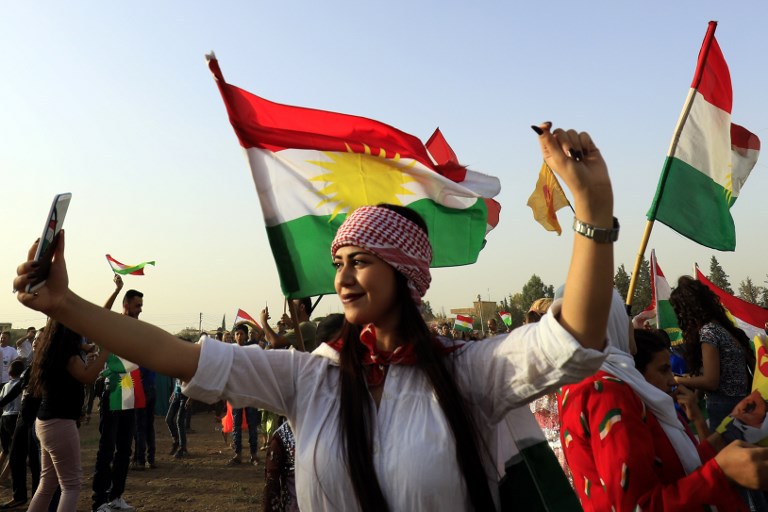
A Syrian Kurd takes a selfie, in the northeastern Syrian city of Qamishli on September 26, 2017, during a gathering in support of the independence referendum in Iraq's autonomous northern Kurdish region. ( AFP/ Delil souleiman)

A Syrian Kurd takes a selfie, in the northeastern Syrian city of Qamishli on September 26, 2017, during a gathering in support of the independence referendum in Iraq’s autonomous northern Kurdish region. ( AFP/ Delil souleiman)

IRBIL, Iraq (AP) — Iraq’s prime minister on Tuesday ordered the Kurdish region to hand over control of its airports to federal authorities or face a flight ban, as the Kurds claimed victory for the “yes” vote in an independence referendum rejected by Baghdad and Iraq’s neighbors.

The Iraqi Kurdish leadership billed Monday’s vote as an exercise in self-determination, but the Iraqi government is strongly opposed to any redrawing of its borders, and Turkey and Iran fear the move will embolden their own Kurdish populations.

Prime Minister Haider al-Abadi issued his ultimatum a day after the landmark vote, which he said was a “historic and strategic mistake by the Kurdish leadership.”

“I will not give up on the unity of Iraq, that is my national and constitutional duty,” he said, adding that any ban would still allow for humanitarian and other “urgent” flights.

Masoud Barzani, the Kurdish regional president who spearheaded the referendum, called for “dialogue” with Baghdad. “Negotiations are the right path to solve the problems, not threats or the language of force,” he said in a televised address.

Regional authorities in Iraq’s autonomous Kurdish north put the turnout at over 70 percent, but many voters reported irregularities, including cases of individuals voting multiple times and without proper registration. Official results are expected Wednesday.

For decades, Kurdish politics have hinged on dreams of an independent Kurdish state. When colonial powers drew the map of the Middle East after World War I, the Kurds, who now number around 30 million, were divided among Turkey, Iran, Syria and Iraq.

After polls closed in Iraq’s Kurdish region Monday night, the skies above Irbil filled with fireworks and families flocked to the center of town to celebrate. Across the border thousands of Iranian Kurds held rallies in support.

The non-binding vote is unlikely to lead to formal independence, to which virtually the entire international community is opposed, but could spark unrest at a time when Iraqi and Kurdish forces — both U.S. allies — are still battling the Islamic State group.

Iraqi troops are carrying out joint military exercises with Turkey along the border. Fearing the vote could be used to redraw Iraq’s borders, taking a sizeable part of the country’s oil wealth with it, al-Abadi has called the referendum an act of “sedition” that “escalated the ethnic and sectarian tension” across the country.

In Iran, thousands of Kurds poured into the streets in the cities of Baneh, Saghez and Sanandaj on Monday night. Footage shared online by Iranian Kurds showed demonstrators waving lit mobile phones in the air and chanting their support into the night. Some footage also showed Iranian police officers assembling nearby or watching the demonstrators.

Iranian state television on Tuesday acknowledged the rallies, a rarity in the Islamic Republic. Iran’s paramilitary Revolutionary Guard and its regular army have been running military exercises near the border with Iraq’s Kurdish region in a sign of Tehran’s displeasure at the Kurdish referendum.

Turkish President Recep Tayyip Erdogan reiterated on Tuesday that his country is considering all options, ranging from military intervention to economic sanctions against Iraq’s Kurdish region.
Erdogan said, however, that he hopes the Iraqi Kurdish leadership will abandon aims of creating a separate state and not force Turkey into enforcing sanctions.

“I hope the northern Iraqi administration gathers itself together and abandons this adventure with a dark ending,” Erdogan said, adding that the landlocked Iraqi Kurdish region would not be able to survive without Turkey’s support in helping export its oil.

“The moment we shut the valve it’s finished for them,” Erdogan said, referring to a pipeline through Turkey. The Turkish leader said no country other than Israel supports the Iraqi Kurdish referendum on independence, which he described as “invalid” and “fraudulent.” He said attempts by Kurds to form an independent state are doomed to fail.

The United States and United Nations both opposed the referendum, describing it as a unilateral and potentially destabilizing move that could detract from the war Iraqi and Kurdish forces are waging against the Islamic State group.

State Department spokeswoman Heather Nauert said the US wouldn’t alter its “historic relationship” with Iraq’s Kurds, but the referendum would increase hardships for them. She said IS and other extremists are hoping to “exploit instability and discord.”

Statements from UN Secretary-General Antonio Guterres expressed regret that the vote was held and said issues between Iraq’s federal government and Kurdish region should be resolved through dialogue.

Kurdish electoral commission spokesman Sherwan Zerar put the turnout at about 3.3 million of the eligible 4.5 million residents.


North Korea taps GOP analysts to better understand Trump and his messages

September 26, 2017

North Korea taps GOP analysts to better understand Trump and his messages, Washington PostAnna Fifield, September 26, 2017

Spectators listen to a television news broadcast of a statement by North Korean leader Kim Jong Un on a public television screen in Pyongyang on Friday. (Ed Jones/AFP/Getty Images)

 North Korean government officials have been quietly trying to arrange talks with Republican-linked analysts in Washington, in an apparent attempt to make sense of President Trump and his confusing messages to Kim Jong Un’s regime.

The outreach began before the current eruption of threats between the two leaders but will probably become only more urgent as Trump and Kim have descended into name-calling that, many analysts worry, sharply increases the chances of potentially catastrophic misunderstandings.

“Their number one concern is Trump. They can’t figure him out,” said one person with direct knowledge of North Korea’s approach to Asia experts with Republican connections.

There is no suggestion that the North Koreans are interested in negotiations about their nuclear program — they instead seem to want forums for insisting on being recognized as a nuclear state — and the Trump administration has made clear it is not interested in talking right now.

At a multilateral meeting here in Switzerland earlier this month, North Korea’s representatives were adamant about being recognized as a nuclear weapons state and showed no willingness to even talk about denuclearization.

(Video at the link. — DM)

But to get a better understanding of American intentions, in the absence of official diplomatic talks with the U.S. government, North Korea’s mission to the United Nations invited Bruce Klingner, a former CIA analyst who is now the Heritage Foundation’s top expert on North Korea, to visit Pyongyang for meetings.

Trump has close ties to Heritage, a conservative think tank that has influenced the president on everything from travel restrictions to defense spending, but no personal connection to Klingner.

“They’re on a new binge of reaching out to American scholars and ex-officials,” said Klingner, who declined the North Korean invitation. “While such meetings are useful, if the regime wants to send a clear message, it should reach out directly to the U.S. government.”

North Korean intermediaries have also approached Douglas Paal, who served as an Asia expert on the National Security Council under presidents Ronald Reagan and George H.W. Bush and is now vice president for studies at the Carnegie Endowment for International Peace.

They wanted Paal to arrange talks between North Korean officials and American experts with Republican ties in a neutral location such as Switzerland. He also declined the North Korean request.

“The North Koreans are clearly eager to deliver a message. But I think they’re only interested in getting some travel, in getting out of the country for a bit,” Paal said.

(Video at the link. — DM)

North Korea currently has about seven such invitations out to organizations that have hosted previous talks — a surprising number of requests for a country that is threatening to launch a nuclear strike on the United States.

Over the past two years in particular, Pyongyang has sent officials from its Foreign Ministry to hold meetings with Americans — usually former diplomats and think-tankers — in neutral places such as Geneva, Singapore and Kuala Lumpur.

They are referred to as “Track 1.5” talks because they are official (Track 1) on the North Korean side but unofficial (Track 2) on the American side, although the U.S. government is kept informed of the talks.

But since Trump’s election in November, the North Korean representatives have been predominantly interested in figuring out the unconventional president’s strategy, according to almost a dozen people involved in the discussions. All asked for anonymity to talk about the sensitive meetings.

Early in Trump’s term, the North Koreans asked broad questions: Is President Trump serious about closing American military bases in South Korea and Japan, as he said on the campaign trail? Might he really send American nuclear weapons back to the southern half of the Korean Peninsula?

But the questions have since become more specific. Why, for instance, are Trump’s top officials, notably Defense Secretary Jim Mattis and Secretary of State Rex Tillerson, directly contradicting the president so often?

“The North Koreans are reaching out through various channels and through various counterparts,” said Evans Revere, a former State Department official who dealt with North Korea and is a frequent participant in such talks. There are a number of theories about why North Korea is doing this.

“My own guess is that they are somewhat puzzled as to the direction in which the U.S. is going, so they’re trying to open up channels to take the pulse in Washington,” Revere said. “They haven’t seen the U.S. act like this before.”

Revere attended a multilateral meeting with North Korean officials in the picturesque Swiss village of Glion earlier this month, together with Ralph Cossa, chairman of the Pacific Forum of the Center for Strategic and International Studies and another frequent interlocutor with Pyongyang’s representatives.

The meeting is an annual event organized by the Geneva Centre for Security Policy, a government-linked think tank. But it took on extra significance this year due to the sudden rise in tensions between North Korea and the United States.

All the countries involved in the now-defunct six-party denuclearization talks — the United States, China, Japan, Russia, and the two Koreas — were represented, as were Mongolia, the Swiss government and the European Union. The Swiss invited the U.S. government to send an official, but it did not.

The North Koreans at the meeting displayed an “encyclopedic” knowledge of Trump’s tweets, to the extent that they were able to quote them back to the Americans present.

Pyongyang’s delegation was headed by Choe Kang Il, deputy director of the Americas division in the Foreign Ministry, and he was accompanied by three officials in their late 20s who wowed the other participants with their intellectual analysis and their perfect American-accented English. One even explained to the other delegates how the U.S. Congress works.

“They were as self-confident as I’ve ever seen them,” said Cossa. Revere added: “They may be puzzled about our intentions, but they have a very clear set of intentions of their own.”

The participants declined to divulge the contents of the discussions, as they were off the record.

But others familiar with the talks said the North Koreans completely ruled out the “freeze-for-freeze” idea being promoted by China and Russia, in which Pyongyang would freeze its nuclear and missile activities if the United States stopped conducting military exercises in South Korea. The United States, Japan and South Korea also outright reject the idea.

Participants left the day-and-a-half-long meeting with little hope for any improvement anytime soon.

“I’m very pessimistic,” said Shin Beom-chul, a North Korea expert at the South’s Institute of Foreign Affairs and National Security, after participating in the meeting in Glion. “They want to keep their nuclear weapons, and they will only return to dialogue after the United States nullifies its ‘hostile policy.’ They want the U.S. to stop all military exercises and lift all sanctions on them.”

Ken Jimbo, who teaches at Keio University in Japan and was also at the meeting, said that North Korea may still be interested in dialogue, but on terms that are unacceptable to the other side.

“North Korea wants to be recognized as a nuclear-weapons state,” Jimbo said. “But when is North Korea ready for talks? This is what I kept asking the North Koreans: How much is enough?”


The German AfD party has surged and Europe is falling apart

September 26, 2017

The German AfD party has surged and Europe is falling apart, Israel National News, Giulio Meotti, September 26, 2017

(Please see also, Misrepresenting Germany in ‘The New York Times’ — DM)

The German chancellors come and go. But their country is here to stay. And their ideological model, not the 13% so called “neo-Nazis”, is what is endangering Europe.

********************************

In the course of last year, the European Union has faced an emergency known as the so-called “populist wave”: Geert Wilders in the Netherlands, Marine Le Pen in France, Ernst Hofer in Austria, Brexit in the UK, AfD now in Germany.

The mainstream media repeats the mantra that behind this right-wing surge lies the xenophobic and fascist hate that has raised its head in Europe, citing Vladimir Putin with his hackers, Donald Trump and his tweets, and other children’s fairy tales. These are the real fake newsmongers.

What lies behind the right-wing surge is, instead, the big cultural shock that hit at the heart of the European democracies.

It is a shock caused by the multicultural disaster (Muslim ghettos, sexual rape during the night in Cologne, chaos in the suburbs), the Islamist massacres (Charlie Hebdo, Hyper Cacher, Bataclan, Theo van Gogh, Nice, Brussels, Copenaghen, Stockholm, Berlin…), the ideological shock (derision of the people by the élites and political correctness), rampant anti-Christian secularization and massive illegal immigration (2.2 million people illegally entered Europe in 2015-2016).

So many physical, cultural, demographic and social borders are in a state of collapse. If Europe stays under siege in its Berlaymont Palace in Brussels without realizing the roots of these political earthquakes, Europe’s walls will be the next to fall.

The main reason behind Brexit was the British fear of German’s immigration chaos. But what about the day all the Syrians Mrs. Merkel allowed in become German citizens? Will the UK still be able to reject and refuse them entry if London is still part of the EU?

Mr. Wilders’ political career is the result of two political assassinations linked to Islam: Pim Fortuyn and Theo van Gogh. He is a survivor.

The rising of Marine Le Pen is the fruit of 50 years of bad French integration policies.

And the AfD’s success is all related to Merkel’s decision to open the doors to one million Syrians.

Germany is a country sick of complacency (“a happy country” said one of Merkel’s slogans) and “frivolity” (the definition that comes from the newspaper Handelsblatt), a wealthy society based on suicidal multicultural ideology and cultural self-censorship (any German book critical of Islam has been demonized and marginalized, from Thilo Sarrazin to Rolf Peter Sieferle), a democracy built on pacifism (the German army is a joke) and a perennial sense of guilt-caused indigestion, which thinks that a border exists only to be overcome (Rudiger Safranski).

The German chancellors come and go. But their country is here to stay. And their ideological model, not the 13% so called “neo-Nazis”, is what is endangering Europe.

Misrepresenting Germany in ‘The New York Times’

September 26, 2017

Misrepresenting Germany in ‘The New York Times’, PJ MediaBruce Bawer, September 25, 2017

YouTube screenshot from New York Times documentary about a refugee in Germany

It is strange to think that there was a time when I bought The New York Times every morning and pored through it over my coffee, genuinely convinced that I was reading the most reliable news source on the planet. In my defense, I was very young. And The New York Times was a better paper then, although nowhere near as good as I thought it was. It has, in any event, long since become a travesty – a propaganda sheet that systematically, and dangerously, distorts the truth about the most crucial issues of our time.

Case in point: a 14-minute “Times documentary” entitled “Seeking Asylum in Germany – and Finding Hatred.” Credited to Ainara Tiefenthäler, Shane O’Neill, and Andrew Michael Ellis, and posted front and center on the Times website last Thursday, it’s about Abode, a tall, lanky 22-year-old Libyan refugee who, at the beginning of the film, has been living in the Saxon town of Bautzen (pop. 41,000) for over two years.

From the outset, Abode is presented as an innocent victim of racist hatred. We see him in his room at the Bautzen asylum center, talking softly, his large brown eyes oozing sensitivity. We see a cell-phone video in which a young white woman half his size kicks and hits him, apparently without provocation. We see him rehearsing for a hip-hop stage adaptation of Romeo and Juliet in which he plays Mercutio; the theater director, a middle-aged woman, speaks of him glowingly.

Providing contrast to this peaceable young man, we see a ragtag neo-Nazi group in Bautzen’s town square, waving flags and praising Donald Trump. And we see close-ups of racist online comments (in German) about refugees.

Abode says that when he used to see pictures of Europe on TV, he thought it looked wonderful. But now he hates it. “Libya is the land of good,” he says. Germany, by contrast, is a land of Nazis.

“Nazi” is a word he uses a lot. He says he’s had “problems with Nazis and the police” ever since his arrival in Germany. Eventually we discover that he’s been described in the local media as the head of a gang of refugees who engage in rioting and violence. We see a newspaper front page featuring a picture of him aiming a machine gun.

But Abode has explanations. The picture with the gun, he says, was taken at a wedding, where the guests fired rounds to celebrate. He claims that he’s never started a riot, but only acted in self-defense. He admits to having committed an act of violence, but only because he “blew up” at the sight of a Nazi rally. The theater director makes a curious statement: “He is someone who steps to the front when there is conflict.” She makes it sound as if he’s some kind of peacemaker, trying to put an end to conflict – not a gang leader, inciting conflict.

Toward the end of the documentary, we jump to “three months later.” An intertitle reads: “Since last year’s clashes between far-right locals and refugees in Bautzen, the police have opened up two dozen investigations of Abode.” Clashes? Why haven’t we see any of these “clashes”? Investigations? Two dozen? For what? The film doesn’t tell us.

We’re told Abode has been identified as “a public safety risk.” Why? The implicit message is that Abode is a victim of untiring police harassment. We’ve heard him complain about his “problems with Nazis and the police.” The film seems to want us to equate the two.

Finally, we’re shown Abode on the asylum center roof, threatening to jump. An end title informs us that he didn’t jump, has been relocated to an asylum center in another town, and is banned from Bautzen for three months. Finis.

After seeing Abode depicted as an undeserving object of hatred in a town full of neo-Nazis, I turned to the local German newspapers. They told a different story. Abode’s real name, I discovered, is apparently Mohamed Youssef. (The papers do him the favor of reducing his surname to an initial, “T” for Targi.) He came to Germany in 2014.

Here’s one detail omitted by the documentary: our hero calls himself “King Abode,” just as a Mafia don in a Sicilian village might call himself its king. One source points out something that’s obvious from the first moments of the film: while Abode claims to be from Libya, he doesn’t look Libyan – my guess would be he’s really from Somalia.

According to the German papers, Abode has caused plenty of trouble in Bautzen: he’s committed robberies, sold drugs, harassed women, thrown bottles at cops. And more, much more. But town authorities have gone soft on him in the name of “peaceful coexistence.” His asylum application was rejected, but he can’t be deported because it’s on appeal. What’s more, in defiance of the ban mentioned at the end of the film, Abode has returned repeatedly to the asylum center in Bautzen. Instead of punishing him for this, town officials have tried to work out a compromise, such as allowing Abode to stay at the Bautzen asylum center but asking him to stay away from the town square.

To read these stories about Abode is to see the narrative of the Times documentary completely unravel. Far from being a victim of police brutality, he turns out to be a thug who thumbs his nose at the law. Instead of being Nazi bullies, the folks that run Bautzen out of town prove to be toothless — scared to subject even the most dangerous of rejected asylum seekers to even the mildest of punishments. No surprise here, of course: if this town really were full of Nazis, as the film suggests, Abode would’ve beat a hasty retreat long ago — or ended up in a shallow grave in the woods.

The German newspapers make the facts crystal clear: this young man is a predator who’s been allowed to torment and terrorize an entire town for over two years, and whom multiculturalism-infatuated local officials, police, and courts have been terrified to touch.

That’s Germany today – the very opposite of what the New York Times wants you to believe.

TOP 10 most powerful weapons of the Israeli Army ( That we know of )

September 26, 2017

https://www.youtube.com/watch?v=RlR-HAZQLZw

This list leaves out the most important weapon of all: The brilliant and dedicated Jewish youngsters who fight to protect us…

Israel Defense Forces most powerful weapons.
0:00 Spike 1:15
F-15 2:43
Tavor 3:58
Namer 4:47
Delilah 6:04
Atmos 7:30
Merkava 4 8:13
Arrow 3 ABM 8:57
SAAR 5 10:24
Iron Dome

Support for a United Iraq Plays into the Hands of ISIS and Iran

September 26, 2017

Support for a United Iraq Plays into the Hands of ISIS and Iran, Front Page Magazine, Daniel Greenfield, September 26, 2017

(How would Secretary Tillerson respond to Greenfield’s highlighted question about “catering to the whims of our Islamist enemies anyway?” — DM)

Why is the State Department in the business of catering to the whims of our Islamist enemies anyway?

******************************

The State Department had a very predictable reaction to the Kurdish referendum.

The United States is deeply disappointed that the Kurdistan Regional Government decided to conduct today a unilateral referendum on independence, including in areas outside of the Iraqi Kurdistan Region…

The unilateral referendum will greatly complicate the Kurdistan Regional Government’s relationship with both the Government of Iraq and neighboring states. The fight against ISIS is not over, and extremist groups are seeking to exploit instability and discord. We believe all sides should engage constructively in a dialogue to improve the future of all Iraqis. The United States opposes violence and unilateral moves by any party to alter boundaries.

The United States supports a united, federal, democratic and prosperous Iraq and will continue to seek opportunities to assist Iraqis to fulfill their aspirations within the framework of the constitution.

1. The Iraqi constitution is a joke. Much like Iraqi democracy.

2. Iraqi federalism doesn’t exist in Iraqi Kurdistan. It’s mostly independent already.

3. Iraqi federalism is what created the latest incarnation of ISIS. Trying to uphold a united Iraq to fight ISIS is the same dumb, bankrupt foreign policy that made this mess under Bush and Obama.

A “united Iraq” means letting Iran’s Shiite puppets in Baghdad run the country. The Sunnis, unsurprisingly opt out, Al Qaeda, in some form or another, comes calling. And that’s how we ended up with ISIS. And then we have to choose between Iran and ISIS. Unfortunately, as the Hezbollah-ISIS convoy and the 9/11 report shows, they also have a secret relationship.

So it’s Catch 22. Either way the terrorists win and we lose.

The only “solution” is to support de facto partition of Iraq along demographic lines. It won’t be easy or smooth, but it’s going to keep happening in the form of outbreaks of violence anyway until it’s finally realized. Iraq, like Syria, is an imaginary country created by Western powers.

And that means letting the Kurds, who are the closest thing to a success story in Iraq, go their own way.

Iran and ISIS and Turkey will be most unhappy. Good.

Why is the State Department in the business of catering to the whims of our Islamist enemies anyway?

President Trump JUST Drops Executive Order NOW Kim Jong Un Is Panicking(VIDEO)!!!

September 26, 2017

President Trump JUST Drops Executive Order NOW Kim Jong Un Is Panicking(VIDEO)!!!, Global News via YouTube, September 26, 2017

(The title seems excessively dramatic, but Dear Leader Kim will feel the new sanctions China claims to support.  The more interesting segments of the video deal with our military options. — DM)

https://www.youtube.com/watch?v=5maJZEN_fXA

The blurb beneath the video states,

President Trump drops executive order now Kim Jong Un is panicking. President Trump signed an executive order targeting North Korea’s trading partners, calling it a powerful new tool aimed at isolating the regime. Foreign banks will face a clear choice. Do business with the United States or facilitate trade with the lawless regime in North Korea.