Archive for September 2017

The Future the US Military is Constructing: a Giant, Armed Nervous System

September 28, 2017

Source: The Future the US Military is Constructing: a Giant, Armed Nervous System – Defense One
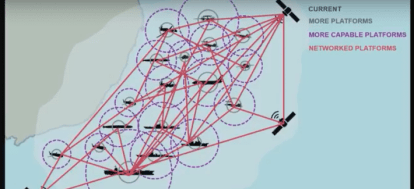
Chief of Naval Operations, Adm. John Richardson, gives a keynote address during the Naval Future Force Science and Technology (S&T) Expo, July 21, 2017. This is a slide from his presentation.

Service chiefs are converging on a single strategy for military dominance: connect everything to everything.

Leaders of the Air Force, Navy, Army and Marines are converging on a vision of the future military: connecting every asset on the global battlefield.

That means everything from F-35 jets overhead to the destroyers on the sea to the armor of the tanks crawling over the land to the multiplying devices in every troops’ pockets. Every weapon, vehicle, and device connected, sharing data, constantly aware of the presence and state of every other node in a truly global network. The effect: an unimaginably large cephapoloidal nervous system armed with the world’s most sophisticated weaponry.

In recent months, the Joint Chiefs of Staff put together the newest version of their National Military Strategy. Unlike previous ones, it is classified. But executing a strategy requiring buy-in and collaboration across the services. In recent months, at least two of the service chiefs talked openly about the strikingly similar direction that they are taking their forces. Standing before a sea of dark- blue uniforms at a September Air Force Association event in Maryland, Air Force Chief of Staff Gen. David Goldfein said he had “refined” his plans for the Air Force after discussions with the Joint Chiefs “as part of the creation of the classified military strategy.”

The future for the Air Force? The service needed to be more like a certain electric-car manufacturer.

“Every Tesla car is connected to every other Tesla car,” said Goldfein, referring to a presentation by Elon Musk about the ways his firm’s vehicles learn from their collective experience. “If a Tesla is headed down the road and hits a pothole, every Tesla that’s behind it that’s self-driving, it will avoid the pothole, immediately. If you’re driving the car, it automatically adjusts your shocks in case you hit it, too.”

What would the world look like… If we looked at the world through a lens of a network as opposed to individual platforms?
AIR FORCE CHIEF OF STAFF GEN. DAVID GOLDFEIN

Goldfein waxed enthusiastically about how Tesla was able to remotely increase the battery capacity of cars in the U.S.Southeast to facilitate evacuationbefore the recent hurricanes.

“What would the world look like if we connected what we have in that way? If we looked at the world through a lens of a network as opposed to individual platforms, electronic jamming shared immediately, avoided automatically? Every three minutes, a mobility aircraft takes off somewhere on the planet. Platforms are nodes in a network,” the Air Force chief said.

The idea borrows from the  “network centric warfare” concept that seized the military imagination more than a decade ago. But what leaders are today describing is larger by orders of magnitude. It’s less a strategy for integrating multiple networks into operations more efficiently than a plan to stitch everything, networks within networks, into a single web. The purpose: better coordinated, faster, and more lethal operations in air, land, sea, space, and cyberspace.

So the Air Force is making broad investments in data sharing. Maj. Gen. Kimberly A. Crider, the service’s first data officer, issetting up a series of experimental tests in the Nevada desert at Nellis Air Force Base near Las Vegas, seeking to better understand “what happens when we actually connect into this resilient and agile network” said Goldfein. The Air Force’s current experimentation with next-generation light tactical attack aircraft are as much about hardware as networks, he said. “Not only what can I buy and what can they do, but more importantly, can they connect? Can they actually share? And can we tie it to a new network that’s based on sharable information that gets me beyond the challenges I have right now in terms of security?”

The Air Force is also fielding new connected devices. The handheld “Android Tactical Assault kit” or ATAK, designed with special operations forces, provides a common operational picture of everything going on — basically, doing what a huge command-and-control station used to do a few years ago. “What we determined was that there were so many devices on the battlefield that had information that we weren’t collecting. Rather than build a system to pull that in, we actually went to a commercial entity and they created an algorithm. It’s user-defined and it pulls in whatever data you need and puts it on Google Maps,” said Goldfein.

The Air Force used the device during this year’s hurricane relief efforts, sending rescue teams to people reaching out for help on social media, Goldfein said.

Our scope would be in helping the Air Force to think about operations they would be conducting that would incorporate joint sensors and platforms, like destroyers.
JAMES CHOW, AIR FORCE SCIENCE BOARD

The Air Force Science Board is also launching a study into how to control a constellation of objects, some in the air, some in the sea, some on land, some piloted by humans and others more autonomous. James Chow, the board’s new head, said the study would also consider how to connect to other services.

Importantly, although the study would come out of the Air Force, it wouldn’t stop at just Air Force equipment but would extend to other weapons and vehicles in the battlespace, like Navy destroyers, said Chow.

“Our scope would be in helping the Air Force to think about operations they would be conducting that would incorporate joint sensors and platforms, like destroyers, I think that has to be part of it. And that is within the charter of the study,” Chow  said, adding that the study has “the highest priority level for Air Force leadership.”

The Multi-Domain Army and Marine Corps

The U.S. Army, too, is investing big dollars into figuring out how to connect everything on the battlefield. An Army Research Lab program called the Internet of Battle of Things will be led by researchers at the University of Illinois, with help from the Universities of Massachusetts, multiple California State branches, Carnegie Mellon, and SRI International.

The Army is currently revising its Operating Concept for itself the Marine Corps for 2025-2040. It basically forms the framework for writing future Army doctrine, which in turn shapes training, weapons acquisition, and operations. The final draft won’t be available until the Association of the United States Army conference in October, but sources close to the drafting process said it will focus on networked, multi-domain battle.

The Marines are already conducting experiments along these lines. In April, the Corps’ Warfighting Lab staged a beach assault, linking together robots, ships, satellites, amphibious assault vehicles to share targeting info and other situational intelligence.

The Marines are also looking at tanks that are digitally connected through their armor, according to Lt. Gen. Robert Walsh, who leads Marine Corps Combat Development Command and serves as Deputy Commandant for Combat Development and Integration. Speaking at a Navy event in July, Walsh recounted how he had recently emerged from a meeting with makers of new “reactive armor” for tanks.

When you start linking these platforms together, [the rate of progress is] not exponential…it’s factorial.
ADM. JOHN RICHARDSON, CHIEF OF NAVAL OPERATIONS

Walsh said that the armor — he declined to name the vendor— could heal itself while sending information about the direction of the attack to other units and back to headquarters. “It’s not, ‘we defeat a missile with a capability,’” Walsh said. “It’s ‘we quickly figure out where that came from.’ What I found was, after talking to Marines out there, that could bring out a much more offensive capability where we were originally talking about bringing a defensive capability to bear.”

Read that to mean faster clobbering of the enemy immediately after they shoot at you, rather than cowering from them.

The Navy: “Network Everything to Everything”

Navy leaders, too, are eager to connect every object on the sea, land, air, space and cyberspace. This is no exaggeration. As Adm. John Richardson, Chief of Naval Operations, put it during the Navy’s Future Force Expo in Washington, D.C., in July, “I want to network everything to everything.”

This is necessary to preserve the U.S. Navy’s advantage, even if Richardson gets the larger 355-ship fleet he seeks — hardly a given in today’s industrial and budgetary landscape. Adversaries are building more and better ships and weapons, and even the U.S. superiority in orbital and terrestrial sensing is diminishing. The cost of launching a constellation of spy sats is dropping asthe satellites become smaller and launches become cheaper.

“It’s going to be more and more difficult to find ranges and places where we can do exercises and practice without being observed,” the admiral said. “Think about the number of surveillance cameras that followed you on your way to this conference this morning. This idea of sensing is becoming ubiquitous and it’s shifting the competitive space in this [observe, orient, decide and act] loop so that no longer are we superior in that first mode, in the ability to observe. That’s becoming a very level playing field. Competition is shifting to ‘what do I do with that information.’ How do I manage…that avalanche of data?…The momentum of the game is not in our favor…We have to recapture that momentum.”

Nettworking everything is the way to win that competition. “When you start linking these platforms together, [the rate of progress is] not exponential…it’s factorial,” he said, meaning orders ofmagnitude greater than a rate of progress that is even orders of magnitude greater than a linear progression.

The Navy has already made some important progress. Last year, an experimental datalink allowed the pilot of a Marine Corps F-35B strike aircraft to send targeting data to an Aegis destroyer, which shot down the target drone with an SM-6 missile.
Interconnections

This push is too new, and still too developmental, to have attracted much concern from the public or Capitol Hill. But that will change. When Richardson’s remarks talk hit Twitter, arms-control watcher Jeffrey Lewis professed a touch of concern.

Certainly, “network everything to everything” sounds a bit like the setup for the Terminator franchise, wherein a fictional defense contractor, Cyberdyne Systems, convinces the Defense Department to link the U.S. arsenal to a single artificially intelligent entity. Skynet, of course, determines that humans are a threat to its existence and uses its ubiquitous command and control powers to launch a war on humankind.

Military leaders hate comparisons between their own tech projects and anything from the Terminator franchise. The reference usually comes up in discussions about individual drones with missiles or “killer robots.” Defense Department watchers are always keen to remind people that official policy is to keep humans at the top of the command-and-control loop, overseeing —or at least retaining veto power — over the decision to take life.

But artificial intelligence will play an important supporting role in helping commanders and operators makes sense of what’s happening on with all of these inter-linked devices and weapons, even as it steers and operates burgeoning fleets of near-autonomous drones, unmanned tanks, robot boats, and the like.

The effort to understand exactly how well all of these moving parts will co-ordinate has only barely begun. But it is the direction that the United States military is moving with both determination and speed.

Disappointed by good news from Puerto Rico

September 28, 2017

Disappointed by good news from Puerto Rico, Washington TimesDavid Keene, September 27, 2017

National Guardsmen arrive at Barrio Obrero in Santurce to distribute water and food among those affected by the passage of Hurricane Maria, in San Juan, Puerto Rico, Sunday, Sept. 24, 2017. Puerto Rico’s nonvoting representative in the U.S. Congress said

Based on what’s really been happening, Mr. Trump’s critics will not find their silver bullet in the wreckage of Puerto Rico — and would be better off trying to help rather than politicize this human tragedy.

****************************

ANALYSIS/OPINION:

They’re hoping for “deja vu all over again,” as Yogi Berra might have said. Liberals looking for a silver bullet to take down a president they can’t stand are hoping they’ve found it in the administration’s response to Hurricane Maria. After all, they found one in President George W. Bush’s perceived bungling of the Hurricane Katrina relief effort in 2005 and used it to almost terminally undermine his popularity.

Exploiting the Trump administration response to Maria may prove more difficult than they hope, however, as the Federal Emergency Management Agency (FEMA) and the administration are doing not just a better job, but a much, much better job today than the Bush administration did then. Liberal pundits, not deterred by mere facts, are almost unanimously suggesting that consistent with their ongoing belief that President Trump is an insensitive racist who simply doesn’t care about Puerto Rico. They see his criticism of NFL players who “diss” the National Anthem and the flag as proof of all this because if he really cared about Puerto Rico, he wouldn’t be tweeting about the NFL.

Mr. Trump’s critics are similarly outraged that he dared mention the island’s fiscal and budget crisis as a complicating factor that has to be dealt with to facilitate the rebuilding Puerto Rico’s infrastructure. Anyone familiar with Puerto Rico’s plight knows that this is dead-on accurate. Indeed, experts have been warning for years that the island’s electrical infrastructure is so old, weak and badly maintained that any storm could wipe it out. Restoring power is going to be very difficult and it is essential that the Trump administration recognize the difficulties our fellow citizens in Puerto Rico face. It’s why FEMA and the military immediately dispatched experts to the island to help determine just how and how soon power can be restored, relying on a system that doesn’t work very well in the best of times.

There are folks who will believe almost anything negative about the current administration, but to relive their past success, liberals are simply lying. The administration’s response to the humanitarian crisis that struck Puerto Rico has been quick and massive. Within days, FEMA and the Defense Department had more than 10,000 logistics experts on the island, supplies and food were being flown in, and mainland experts were working to re-establish communications with areas cut off by the storm.

After earlier accurately observing the total breakdown of the island’s communication’s infrastructure, one media report criticized the Trump response for taking several days to contact some local officials outside San Juan. Rescuers were trying to reach them and the officials were trying to contact the capital city, but both found communication impossible.

It is going to be quite a while before services are restored in Puerto Rico and emergency aid will continue to be needed, but those on the ground believe, in contrast to anti-Trump activists outside Puerto Rico and in the media, that the Trump administration and FEMA are doing a pretty good job.

Earlier this week, Puerto Rico’s governor was asked by a National Public Radio reporter how he would assess the administration’s response to Maria. The reporter may have been hoping for a different response, but Gov. Ricardo Rossello, who lines up nationally with Democrats, was having none of it. He said, “We are very grateful for the administration. They have responded quickly. The president has been very attentive to the situation, personally calling me several times. FEMA and the FEMA director have been here in Puerto Rico twice. As a matter of fact, they were here with us today, making sure that all the resources in FEMA were working in conjunction with the central government. We have been working together. We have been getting results.”

San Juan’s mayor has also praised the administration for its quick response and for the advance planning that had to have been behind the ability to respond as quickly as it did, and the island’s non-voting delegate in Congress agrees. Resident Commissioner Jennifer Gonzalez told a Politico reporter on Monday, “This is the first time we got this type of federal coordination.”

Based on what’s really been happening, Mr. Trump’s critics will not find their silver bullet in the wreckage of Puerto Rico — and would be better off trying to help rather than politicize this human tragedy.

Saudi women ‘thank God’ for end to driving ban

September 28, 2017

Saudi women ‘thank God’ for end to driving ban, Israel Hayom, September 28, 2017

(Old Chinese proverb: “A journey of a thousand miles begins with a single step.” — DM)

A woman drives a car in Saudi Arabia. Archives: Reuters

Women will be allowed to obtain licenses without the permission of a male relative.

A muted response from Saudi Arabia’s clergy, which has long backed the ban, suggested power shared between the Al Saud dynasty and the Wahhabi religious establishment could be shifting decisively in favor of the royals.

Many younger Saudis regard Prince Mohammed’s ascent as evidence their generation is taking a central place in running a country whose patriarchal traditions have for decades made power the province of the old and blocked women’s progress.

********************************

Saudi Arabian women rejoiced at their new freedom to drive on Wednesday, with some taking to the roads even though licenses will not be issued for nine months.

Hundreds of others chatted with hiring managers at a Riyadh job fair, factoring in the new element in their career plans: their ability to drive themselves to work.

“Saudi Arabia will never be the same again. The rain begins with a single drop,” Manal al-Sharif, who was arrested in 2011 after a driving protest, said in an online statement.

King Salman announced the historic change on Tuesday, ending a conservative tradition which limited women’s mobility and was seen by rights activists as an emblem of their suppression.

Saudi Arabia was the only remaining country in the world to bar women from driving.

At the jobs fair, Sultana, 30, said she had received four job offers since graduating from law school two years ago but turned them down because of transport issues.

“My parents don’t allow me to use Uber or Careem, so one of my brothers or the driver would need to take me,” she said, referring to dial-a-ride companies.

“I’m so excited to learn how to drive. This will be a big difference for me. I will be independent. I won’t need a driver. I can do everything myself.”

She plans to start taking driving lessons when her family travels abroad for vacation.

Other women weren’t waiting. Internet videos showed a handful of women driving cars overnight, even though the ban has not been officially lifted.

The move represents a big crack in the laws and social mores governing women in the conservative Muslim kingdom. The guardianship system requires women to have a male relative’s approval for most decisions on education, employment, marriage, travel plans and even medical treatment.

The new initiative recalls previous modernizing milestones that unnerved conservatives at first but were eventually accepted, such as the 1960s start of state education for girls and the introduction of television.

The decree is expected to boost the fortunes of 32-year-old Crown Prince Mohammed bin Salman, who has ascended to the heights of power in the kingdom with an ambitious domestic reform program and assertive foreign policy.

He said letting women drive is a “huge step forward” and that “society is ready.”

“This is the right time to do the right thing,” he told reporters. Women will be allowed to obtain licenses without the permission of a male relative.

A muted response from Saudi Arabia’s clergy, which has long backed the ban, suggested power shared between the Al Saud dynasty and the Wahhabi religious establishment could be shifting decisively in favor of the royals.

Many younger Saudis regard Prince Mohammed’s ascent as evidence their generation is taking a central place in running a country whose patriarchal traditions have for decades made power the province of the old and blocked women’s progress.

Sharif, the activist, described the driving ban’s removal as “just the start to end long-standing unjust laws [that] have always considered Saudi women minors who are not trusted to drive their own destiny.”

A driving instructor at a government-run center said women called all day to inquire about registering a license, but he had received no instructions yet from the government.

Um Faisal, a mother of six, said her daughters would get licenses as soon as possible.

“Years ago, there wasn’t work outside the house. But today women need to get out and go places. This generation needs to drive,” she said, clad in a long black abaya.

The Saudi ambassador to Washington said on Tuesday women would not need their guardians’ permission to get a license, nor to have a guardian in the car when driving.

In a country where gender segregation has been strictly enforced for decades in keeping with the austere Wahhabi form of Sunni Islam, the decree means women will have regular contact with unrelated men, such as fellow drivers and traffic police.

Other rules have loosened recently, with the government sponsoring concerts deemed un-Islamic by clerics, allowing women into a large sports stadium for the first time and permitting them to dance beside men in a central Riyadh street over the weekend.

Amnesty International welcomed the decree as “long overdue” but said there was still a range of discriminatory laws and practices that needed to be overturned.

That risks inflaming tensions with influential Wahhabi clerics with whom the ruling Al Saud has enjoyed a close strategic alliance since the kingdom’s founding.

The state-backed Council of Religious Scholars expressed support for the king’s decree. Grand Mufti Sheikh Abdulaziz Al Sheikh, who has repeatedly opposed women working and driving and said letting them into politics may mean “opening the door to evil,” has yet to comment.

On that note, meanwhile, a Saudi woman was named to a senior government post for the first time, authorities said on Wednesday.

Eman Al-Ghamidi was given the post “as part of plan to boost the number of females in leadership positions in line with Vision 2030,” the Center for International Communication at the Ministry of Culture and Information said in a statement.

The Saudi government has said Vision 2030, a vast plan of economic and social reforms, will raise women’s share of the labor market to 30% from 22% currently.

Still, some men expressed outrage at the about-face by prominent clerics, who in the past have sometimes justified the driving ban by saying women’s brains are too small or that driving endangered their ovaries.

“Whoever says this is permitted is a sinner. Women driving means great evils and this makes them especially sinful,” one Twitter user wrote.

Kawthar al-Arbash, a member of the Shura Council, a government advisory body, acknowledged that resistance, saying: “That’s how things go. Everything new is accompanied by fears.”

Lori Boghardt, a Gulf specialist at the Washington Institute for Near East Policy, said the change is yet another sign that the crown prince is intent on adopting social reforms that will transform the kingdom.

“Today it’s especially clear that this includes moves that’ve long been thought of by Saudis as politically risky,” she said.

Aziza Youssef, a professor at King Saud University and one of Saudi Arabia’s most vocal women’s rights activists, said, “I am really excited. This is a good step forward for women’s rights.”

Speaking to The Associated Press from Riyadh, she said women were “happy” but also that the change was “the first step in a lot of rights we are waiting for.”

GOTTA LOVE how China deals with its Muslim problem under the guise of protecting the country against Islamic terrorism

September 28, 2017

Chinese authorities in the northwestern predominantly Muslim region of Xinjiang have ordered all Muslim families to hand in religious items including prayer mats and all copies of the quran.

by

Source: GOTTA LOVE how China deals with its Muslim problem under the guise of protecting the country against Islamic terrorism

RFA , Officials across Xinjiang have been warning neighborhoods and mosques that ethnic minority Uyghur, Kazakh and Kyrgyz Muslims must hand in the religious items or face harsh punishment if they are found later, sources in the region said.

“Officials at village, township and county level are confiscating all Qurans and the special mats used for namaaz[prayer],” a Kazakh source in Altay prefecture, near the border with Kazakhstan told RFA on Wednesday. “Pretty much every household has a Quran, and prayer mats,” he said.

Dilxat Raxit, spokesman for the exile World Uyghur Congress group, said reports have emerged from Kashgar, Hotan and other regions of similar practices starting last week.

“We received a notification saying that every single ethnic Uyghur must hand in any Islam-related items from their own home, including Qurans, prayers and anything else bearing the symbols of religion,” Raxit said.

“They have to be handed in voluntarily. If they aren’t handed in, and they are found, then there will be harsh punishments,” he said.

China force Uighur Muslims in Xinjiang to turn in passports.

In China, Muslim men under the age of 65 are not allowed to have beards, Muslim women are not allowed to wear face-covering headbags or burqas.

Muslims in China are now forbidden from giving their babies religious names such as “Jihad,” “Islam,” “Mecca,” etc.

https://youtu.be/p9tT2u2ahfE

China bans Islamic religious activity of any kind in schools.

China bans Muslim civil servants and students from fasting during Ramadan.

https://youtu.be/mTCMAGWBPjc

Omni Ceren: Decertification Approaches

September 28, 2017

Omni Ceren: Decertification Approaches, Power Line,  Scott Johnson, September 28, 2017

Omri Ceren writes to comment on the Reuters story by Francois Murphy reporting that “IAEA chief calls for clarity on disputed section of Iran nuclear deal.” Omri’s commentary on the story — please check it out — should serve as a preview of coming attractions. He writes:

This is pretty close to game over on certification.

Condition 1 of Corker-Cardin requires the president to certify “Iran is transparently, verifiably, and fully implementing the agreement” [a]. One part of the agreement – Annex 1, Section T – prohibits Iran from conducting certain “activities which could contribute to the design and development of a nuclear explosive device” [b].

The IAEA has not been able to verify Iran is implementing Section T because the relevant activities would be occurring on military sites and Iran has barred the IAEA from inspecting those sites [c][d][e]. IAEA officials say they won’t even ask for access because they know Iran would say no and it would give the Trump administration an “excuse” on the deal [f].

The policy community has known about this failure for months: in August nuclear experts from FDD and ISIS published a report that concluded “it is likely that some of the conditions in Section T are not currently being met and may in fact be violated by Iran” [g].

Yesterday IAEA chief Amano confirmed the IAEA has indeed been unable to verify Iran is implementing Section T….Here are the Amano quotes:

“Our tools are limited,” Amano told Reuters when asked if his agency had the means to verify Section T. “In other sections, for example, Iran has committed to submit declarations, place their activities under safeguards or ensure access by us. But in Section T I don’t see any (such commitment).” Amano said he hoped the parties to the agreement would discuss the issue in the Joint Commission.

Advocates of the Iran deal respond that the IAEA hasn’t found any Iranian violations [h]. 1st, that’s not relevant for certification: condition 1 requires the president to certify Iran has implemented all parts of the agreement, not that Iran hasn’t been caught cheating on the parts they have implemented. 2nd, the IAEA hasn’t caught Iran cheating because they haven’t been able to look where Iran is cheating: last week lawmakers on Senate Intelligence suggested to the Weekly Standard they’ve seen classified reports that Iran is violating the deal [i].

[a] https://www.congress.gov/bill/114th-congress/senate-bill/615/text
[b] https://www.state.gov/documents/organization/245318.pdf
[c] https://financialtribune.com/articles/national/69753/us-demand-for-military-inspections-rejected
[d] http://kayhan.ir/en/news/42609
[e] http://en.farsnews.com/newstext.aspx?nn=1396052200040
[f] https://ca.reuters.com/article/topNews/idCAKCN1BB1JC-OCATP
[g] http://isis-online.org/isis-reports/detail/verifying-section-t-of-the-iran-nuclear-deal
[h] http://iranprimer.usip.org/blog/2017/sep/14/debate-nuclear-deal-us
[i] http://www.weeklystandard.com/cotton-on-iran-nuclear-deal-i-simply-do-not-see-how-we-can-certify/article/2009716

Israeli intel takes global approach, helps thwart dozens of terror attacks

September 28, 2017

Source: Israeli intel takes global approach, helps thwart dozens of terror attacks – Israel News – Jerusalem Post

By Anna Ahronheim
September 27, 2017 21:31
The November 2015 Paris attacks marked as the day defense establishment changed its perspective.
French army soldiers patrol near the Louvre Museum Pyramid's main entrance in Paris, France

French army soldiers patrol near the Louvre Museum Pyramid’s main entrance in Paris, France. (photo credit:REUTERS)

The defense establishment marks the November 2015 ISIS attacks in Paris, which killed 130 people, as the day the intelligence community changed its perspective to a more global one and tightened its coordination with international bodies.

Three years after Islamic State ran through the Middle East, once controlling nearly half of Syria and large parts of Iraq, the group is reported to have lost 85% of its territory in Syria, including almost all of its de facto capital of Raqqa, and has been largely dispersed across the deserts of Iraq.

The intelligence branch also changed its focus to collecting more information about the activities of jihadists who are not in the Middle East.

As the group’s territorial “caliphate” collapses, the group’s ideology remains popular among a large number of disenfranchised youths across the globe. The jihadists’ expertise in online propaganda allows them to continue to operate as a “virtual caliphate” urging their supporters to carry out attacks in their home countries.

With shared threats in the Middle East, cooperation between the intelligence communities of Israel and Western countries such as the United States has always been close and intensified since the early 2000s, despite Israel not being a part of the “Five Eyes” – a term used for the core countries involved in surveillance-sharing with Washington – Britain, Australia, Canada and New Zealand.

In May, The New York Times reported that Israel was the source of classified intelligence that President Donald Trump disclosed to Russian officials about a planned Islamic State operation to blow up passenger planes flying to Europe using explosive devices hidden in laptop computers.

Shortly afterward, Defense Minister Avigdor Liberman said that despite the intelligence cooperation between Jerusalem and Washington being “unprecedented,” Israel has nonetheless changed its intelligence-sharing apparatus.

Trump defended having shared “facts” with senior Russian officials, taking to Twitter to say he had an “absolute right” to do so and had been trying to get Moscow to be more active in combating Islamic State.

“As President I wanted to share with Russia (at an openly scheduled W.H. meeting) which I have the absolute right to do, facts pertaining to terrorism and airline flight safety,” he posted on Twitter. “Humanitarian reasons, plus I want Russia to greatly step up their fight against ISIS & terrorism.”

In January Yediot Aharonot reported that US officials had warned their Israeli counterparts to be cautious in sharing classified intelligence with the Trump administration, concerned that it could be leaked to Russia and to Iran.


In Kurdistan’s Erbil, the polling station head shouted out: ‘We are the second Israel!’

September 28, 2017

Source: In Kurdistan’s Erbil, the polling station head shouted out: ‘We are the second Israel!’ – Middle East News – Haaretz.com

Secular, oil-rich, battle-hardened and pro-Israel: Kurdistan is Jerusalem’s perfect ally. During the referendum I heard Kurds responding enthusiastically to the idea of an alliance with Israel – and little sympathy for the Palestinians

https://www.haaretz.com/polopoly_fs/1.814565.1506509240!/image/2602209183.jpg_gen/derivatives/headline_1434x807/2602209183.jpg
Kurds carry Israeli and Kurdish flags to show their support for the upcoming September 25th independence referendum in Erbil, Iraq September 22, 2017. AZAD LASHKARI/REUTERS

ERBIL –  “We are the second Israel!”

The man pumps his hand in the air for emphasis and glowers at me. He wants to be heard.

I am in a polling station in the regional capital of Erbil, as the people of Iraqi Kurdistan vote in a referendum for independence – and the message I am hearing is an overwhelming “Yes”. The time has come, they tell me again and again, for them to have their own state.

And it seems that, for many, Israel is a model. In the numerous pro-independence rallies that preceded the vote on 25 September, Israeli flags could be spotted waving amongst the sea of Kurdish red, white and green. Israel has gained many friends in Erbil as pretty much the only significant power to come out openly in support of Kurdish independence. “[Israel] supports the legitimate efforts of the Kurdish people to achieve their own state,” Prime Minister Benjamin Netanyahu declared recently.

Maruf Sadiq Maruf continues: “In 1988 I was listening to BBC Arabic. It was soon after Halabja [the chemical attack weapons attack by Saddam Hussein on the Kurds, which killed around 5,000 people] and the presenter asked three people, an Iranian, a Frenchman and a British guy if, as a result of this attack, the Kurds would become another Israel. And they all said ‘yes.'”

Maruf is 45 years old and the director of the polling station set up at the Erbil Science High School for Boys, and he is not done yet. The sense of kinship he feels toward Israel – because of a perception of shared suffering and the search for a homeland – were points he repeated and that I heard again and again at polling stations across Erbil.

Kurdish-Israeli ties are strong for a number of reasons: the wars against Arab states for Kurdish rights have given them a sympathy for Israel’s wars against their own Arab enemies – and in a sea of fundamentalism, Kurdish organizations remain largely secular archipelagoes.

In Kurdistan, Israel has that rarest and most precious of things: a potential regional ally of strategic importance. It is a point that Netanyahu seems to realize – but it wasn’t always this way.

The day after the vote, over breakfast at Erbil’s luxurious Divan Hotel, the French philosopher-cum-diplomat Bernard-Henri Levy told me of a meeting he had with Netanyahu and Shimon Peres in 2012. Levy had, he told me, tried to convince the two men just how valuable an ally Kurdistan could be. Neither seemed overly impressed with the idea.

But the realization has set in. In Kurdistan, Israel has several things. First, it has a Sunni Muslim ally, which is valuable at the ‘cosmetic’ level because Israeli-Turkish relations are all but destroyed – and while Egypt and Jordan remain official allies, both of their respective populations are vehemently anti-Israeli.

Second and more critically, Kurdistan’s geopolitical position could not be more favorable. It sits on the borders of Iran, Syria and Turkey and also opposes the U.S. policies that have allowed Iran to expand its influence across the region.

Kurdistan can’t quite be Israel’s south Lebanon (it cannot fight Iran or its proxies for a multitude of reasons) but it could do even better. Contrary to Hezbollah, the Kurds are Western allies with considerable (legitimate) financial clout – they control one third of Iraq’s oil – combined with their ability to create large reserves of goodwill in Western capitals, which, were they to they achieve independence, would translate into effective diplomatic capabilities. For these reasons they can help to check Iran’s growing influence across the Middle East.

Senior Kurdish figures are aware of what they can offer Israel, but are also realistic about what to expect in return.

Sarbast Hussain, a former Peshmerga commander and leading observer of the country’s politics, lays out the Kurdish view: “Israel will act only in favor of its national security – and that is fair enough. But as a center of democracy, an independent Kurdistan is automatically at odds with Shia and Sunni fundamentalists. Iran and Turkey will be hostile to us and we will make Iraq weaker. This will all benefit Israel.”

And what of the Palestinians – does the Kurdish struggle of statehood make him sympathize with Palestinian independence aspirations? “No,” he replies. “It’s not their state; in the years leading up to the late 1940s they sold their land to the Jews, now they want it back. They have rejected multiple peace offers because they want to throw the Israelis into the sea and that will never happen. I have no sympathy for them.”

Late on 26 September, Iraqi Kurdish leader Masoud Barzani declared that his people had voted “yes” in the referendum and called on world powers “to respect the will of millions of people.” Independence will not happen overnight; but the die has been cast.

An independent or even more autonomous Kurdistan – secular, oil-rich, battle-hardened and pro-Israel – is the perfect ally for Jerusalem in a Middle East where it is the perennial outsider.

For Israel as a Jewish nation, support for Kurdish independence is a moral imperative; for it as a Middle Eastern state it is a strategic necessity. No matter what the political opposition, Israel must hold fast; it must succeed where so many others have failed: it must not let the Kurds down.

David Patrikarakos is the author of Nuclear Iran: The Birth of an Atomic State and the forthcoming War in 140 characters: How Social Media is Reshaping conflict in the 21st Century. He is a contributing editor at The Daily Beast and contributing writer at Politico, Poynter Fellow at Yale University and an Associate Fellow at the School of Iranian Studies, University of St Andrews. Twitter: @dpatrikarakos


If It Weren’t for Israel…

September 28, 2017

Source: Articles: If It Weren’t for Israel…

September marked the beginning of the Jewish New Year and ends with Yom Kippur, known as the “Ten Days of Awe,” a period of introspection.  People throughout the world, not just Jews, need to consider: if it weren’t for Israel, the world would be a much less safe place.

No one should forget that in June 1981, a surprise Israeli air strike destroyed an Iraqi nuclear power plant.  If not for this courageous attack, al-Qaeda could have gained control of a nuclear arsenal in 2014 when it asserted control over the western Iraqi city of Fallujah, as it raised its flag over government buildings and declared an Islamic state in this crucial area.  Then, in 2007, it was déjà vu as Israel destroyed the Syrian nuclear plant.  As Vice President Dick Cheney previously told American Thinker, after seeing the photographs taken by Israeli intelligence, he pushed for U.S. air strikes to destroy the Syrian reactor, the al-Kibar complex.  But the Bush administration refused to act, forcing Israel to go it alone and destroy the reactor.

Consider that ISIS still controls large portions of eastern and central Syria.  It seems that without Israel’s existence the world will have to deal with not only the nuclear rogue regime of North Korea, but also many countries in the Middle East.

As Nikki Haley, the U.N. ambassador, pointed out, the Iranian regime has twice exceeded the amount of heavy water (a form of water in nuclear reactors) it was allowed to have.  Iran has refused to allow international inspectors to check all of its military facilities, and there are hundreds of undeclared sites that have suspicious activity that inspectors haven’t looked at.  In addition, the Iranians have tested ballistic missiles, continue to support terrorism, and have engaged in smuggling arms.

Although America is known as the “policeman of the world,” Israel should be known as the “policeman of the Middle East.”  The Gulf States are recognizing Israel’s role in deterring Iran.  These states know they need to work closely with Israel to confront Iran and are stepping up their cooperation with the Jewish State.  They are considering moving from mainly secret intelligence-sharing with Israel to steps that would include setting up direct telecommunications links over flight rights and the lifting of some restrictions on trade.

It is not just the Gulf States, but also the world that relies on Israel’s intelligence and sees this small country, the size of New Jersey, as a role model on how to deal with terrorism.  In recent years, Israel has provided intelligence that has prevented dozens of major terrorist attacks around the world, saving countless lives.  Governments are working closely with Israel to keep their countries and citizens safe.

Looking upon the past history of Israel, it becomes obvious that governments depended on this nation to help thwart evil in the Middle East.  After the president of Egypt, Gamal Abdel Nasser, nationalized the Suez Canal in July 1956, the English and French needed up-to-the-minute intelligence on the strength and location of the Egyptian formations, land, sea, and air, as they had decided to regain control of the Suez Canal.  So whom did they call?  Israel, of course!  This showed how Israel was and still is able to help other countries that could benefit from its expertise.

People should recognize the impact Israel has made on the world stage, and not just militarily.  The Israelis have initiated cutting-edge technology in agriculture, in water, in cyber-security, and in medicine.  The Negev, once uninhabitable, has now become a green land home to 445,000 Jews and 55,000 Bedouins, and more than 250 thriving agricultural settlements.  California is working with Israeli industrialists, government experts, and academics on advanced water technologies and long-term strategies to lessen the effects of drought.  One example is the $1-billion ocean-water desalination plant Israel’s IDE Technologies is building to provide 50 million gallons of water daily in the San Diego area starting in November.

Hopefully the world has awakened to the importance of this little nation.  It is innovative in finding ways to protect the environment; to promote literature, music, and the arts and sciences; to spread agricultural advances; and to fight terrorism within the rule of law.  No one should forget that if not for Israel, land would be barren; Iran would be controlling all of the Middle East, where the other countries would be its colonies; the world would be held hostage to Iraq, Syria, and possibly the terrorists who could have control of a nuclear weapon; and Jews would not have a safe haven to worship freely.  Jews should be proud of Israel –and so should others all over the world.

The Iranian Khoramshahr ballistic missile test did take place – although the US said “It didn’t happen” – DEBKAfile

September 28, 2017

Source: The Iranian Khoramshahr ballistic missile test did take place – although the US said “It didn’t happen” – DEBKAfile

The new Khoramshahr ballistic missile with a range of 2,000km and multiple warheads, which was paraded in Tehran on Sept 22, was indeed test fired, as reported by Iran’s Airspace chief, Gen. Amir Ajakozadeh. The launch shown filmed from a great distance on national television was genuine.

President Donald Trump tweeted: “Iran just test fired a ballistic missile capable of reaching Israel. They are also working with North Korea. Not much of an agreement we have!”

However, three days later, on Sept. 26, an administration official offered the opinion that the footage shown on Iranian television “appears most likely to be a re-run of a previous test launch.” He added: “the video was more than seven months old and dated back to a failed launch in late January, which resulted in the missile exploding shortly after lift-off. ” As to the latest launch, the US official said: “As far as we can see, it did not happen. Iran’s report “so far does not appear to be true.”

However, DEBKAfile’s intelligence and military sources in the Middle East, who examined the conflicting versions, found indications that refuted the US official’s disclaimer. The Khoramshahr was indeed test-launched, except that it happened a bit earlier than Tehran claimed – although very recently, and not seven months ago.

Those sources could not categorically confirm that it was a success – only that “it certainly did not fail.”

That the new missile is exceptionally accurate appears to be correct, since there is evidence that Iran has been able to develop a new control and guidance system for its ballistic missiles.

The Iranian general’s account of “several warheads” could refer to no more than two or three.

Of deep concern to Israel is the video reported to be fitted in the Khoramshahr’s nose cone, because that would make it possible to steer the missile precisely to target from a ground station in Iran – even if Israel prevented the missile’s delivery to Hizballah in Lebanon.
Our intelligence sources account for the extra long-distance shots of the launch by Iran’s need to disguise the location of the launching site deep in the desert.

But there were was another reason too. DEBKAfile’s sources reveal that in the same area, Iran is secretly developing special vehicles for carrying ballistic missiles across rugged desert or mountain terrain. This would make the missiles mobile, like North Korean rockets. Tehran has gone to great lengths to keep this project well hidden from alien eyes.


Netanyahu: ‘No settlement will ever be evacuated again’

September 28, 2017

Speaking at a controversial ceremony marking 50 years since Israel began settling Jews in the West Bank, the Jordan Rift Valley and the Golan Heights, Netanyahu made an ambitious vow never to evacuate a single settlement again.

Omri Ariel

Source: Netanyahu: ‘No settlement will ever be evacuated again’ | JerusalemOnline


Israel’s Prime Minister Benjamin Netanyahu vowed on Wednesday that no West Bank settlement will ever be evacuated again. He made this announcement during a controversial ceremony in Gush Etzion marking 50 years of settlements.

“We never got peace by uprooting settlements, we got terrorism and missiles instead,” he added, alluding to the 2005 Israeli disengagement from the Gaza Strip. “We will never repeat that. It was merely a promo for what is happening in the Middle East. Every territory that falls into the hands of radical Islam becomes a territory of death.”

Education Minister Naftali Bennett, the chairman of the right-wing HaBayit Hayehudi party, called for an Israeli annexation of Area C of the West Bank.

“This is the time to apply sovereignty over our very good land,” he said. “There’s no better time to do so than right now.”

image description
Supreme Court President Miriam Naor Photo credit: Flash 90/Channel 2 News

The ceremony was held amid a quarrel between Israel’s government and its Supreme Court. Just hours before the ceremony, Justice Minister Ayelet Shaked issued a letter to Miriam Naor, the court’s president, scolding her decision to cancel the participation of Justices in the event due to its political sensitivity.