Archive for September 2017

USA vs North Korea: This is the US military arsenal poised to WIPE OUT Kim’s threat

September 4, 2017

USA vs North Korea: This is the US military arsenal poised to WIPE OUT Kim’s threat, Express [UK]Will Kirby, September 4, 2017

[French] Foreign minister Jean-Yves Le Drian warned a nuclear strike on Europe was possible and said a world war could erupt in months.

He said: “The situation is extremely serious… we see North Korea setting itself as an objective to have, tomorrow or the day after, missiles that can transport nuclear weapons.

“In a few months that will be a reality.”

***********************

After ’s UN envoy said the country would never bow down to international pressure and give up its nuclear weapons program, diplomatic means of addressing the hostilities appear to have been sidelined in favour of military action.

’s UN ambassador Nikki Haley and the President himself have said “the time for talk is over”, despite China, Russia, and other members of the US administration claiming dialogue remains the main aim.

The US military has a huge presence in the area around North Korea, particularly in Japan and increasingly close allies South Korea.

There are almost 40,000 US troops serving in Japan, more than in any other country, and earlier this year the US Air Force lined up a huge array of helicopters, tactical fighter jets and surveillance aircraft in a show of force aimed to intimidate Kim Jong-un.

Among the aircraft were HH-60 Pave Hawks, a twin-turboshaft helicopter primarily used for the insertion and rescue of special operation personnel.

The aircraft’s versatility makes it incredibly useful in other operations too, including civilian rescue and disaster relief.

The F-15 Eagles, America’s twin-engine, all-weather tactile fighter jets, are also stationed in the region and are among the most successful modern fighters, with over 100 victories and no losses in aerial combat.

Also headquartered in Japan is the Seventh Fleet, the largest of the US navy’s deployed sea forces.

The flagship carrier is the USS Ronald Reagan, a nuclear-powered aircraft supercarrier that forms part of “the most effective and agile fighting force in the world”.
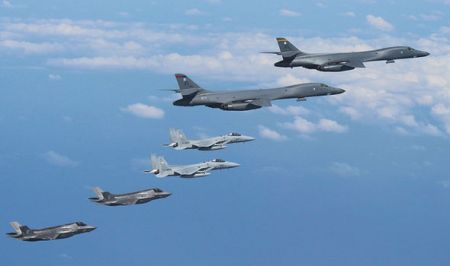
Two US Air Force B-1B Lancer bombers fly from Guam escorted by a pair of Japanese F-15 fighter jets. REUTERS

Also in the fleet are up to 14 destroyers and cruisers at any given time, some armed with ballistic missile interceptors.

A collection of long-range Tomahawk land missiles, which made headlines earlier this year when President Trump fired 59 of them at an airbase in Syria, joins the arsenal.

As if that wasn’t enough, there are also 12 nuclear-powered submarines available should war break out.

South of the demilitarised zone (DMZ), the US has 23,468 troops at 83 different sites as well as hundreds of tanks and armoured vehicles, meaning there is always a heavy military presence should North Korea decide to launch a land attack.

There is also the Terminal High-Altitude Area Defence (THAAD) system, which, despite criticism from Beijing and Pyongyang, is ready and waiting to intercept missiles and destroy the incoming projectiles while in mid-flight.

Guam, the US territory that Kim Jong-un has threatened to fire four ballistic missiles towards, is also host to a huge military presence.

Much of the island is controlled by the armed forces and the Andersen air base hosts a range of bombers, resulting in Guam being dubbed a “permanent aircraft carrier”.

Among the aircraft at the base are B-1B bombers, B-52 bombers and F-35B stealth fighters, some of the US Air Force’s most impressive jets.
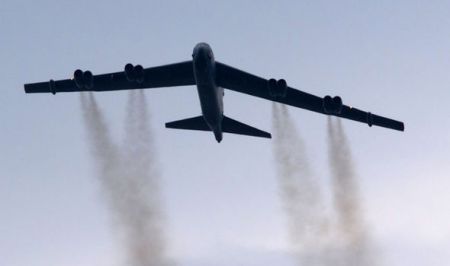
The revered B-52 bomber is capable of carrying more than 30 tonnes of weapons. GETTY

The B-1B bomber is heralded for its survivability and although initially designed to carry nuclear arms, it was converted to carry more conventional weaponry after the Cold War.

The US is believed to have at least six B-1B bombers stationed in Guam and is best suited to a ‘medium threat environment’, rather than a heavily defended airspace.

Speaking about plans for a possible preemptive strike on North Korea earlier this month, retired Admiral James Stavridis told NBC News: “The B-1b has also been selected because it has the added benefit of not being able to carry nuclear weapons.

“Military planners think that will signal China, Russia, and Pyongyang that the US is not trying to escalate an already bad situation any further.”

The B-52 was first introduced in 1955 and was originally designed to carry nuclear weapons during the Cold War. It remains one of the most superior aircraft in the US Air Force.

The long-range, subsonic, jet-powered strategic bomber is capable of carrying more than 30 tons of weapons. The aircraft’s fearsome appearance and reputation has resulted in the nickname BUFF, which stands for Big Ugly Fat F*****.

The US also maintains a smaller presence in other countries in the region, including Thailand, Singapore and the Philippines. US military aircraft use Thai runways while the US Navy will operate four warships out of Singapore by next year.

Tensions have been stepped across the region over recent days following North Korea firing a test missile over Japan.

The provocative action saw South Korea and US forces drop bombs on the border of the hermit state.

Earlier today France warned the situation was “extremely serious”.

Foreign minister Jean-Yves Le Drian warned a nuclear strike on Europe was possible and said a world war could erupt in months.

He said: “The situation is extremely serious… we see North Korea setting itself as an objective to have, tomorrow or the day after, missiles that can transport nuclear weapons.

“In a few months that will be a reality.”

Haley: North Korea ‘Begging For War’

September 4, 2017

Haley: North Korea ‘Begging For War’ NPR, September 4, 2017

(Finally, Kim has asked for something we can, and should, give him. — DM)

United Nations U.S. Ambassador Nikki Haley addresses a U.N. Security Council meeting on North Korea, on Monday.
Bebeto Matthews/AP

Updated at 12:05 p.m. ET

U.S. Ambassador to the United Nations Nikki Haley tells the U.N. Security Council that North Korean leader Kim Jong Un is “begging for war,” with the latest nuclear test that Pyongyang says is its first fusion device, a much more powerful weapon than it has exploded in the past.

“Enough is enough. War is never something the United States wants. We don’t want it now. But our country’s patience is not unlimited,” Haley told an emergency session of the 15-member Security Council in New York.

She said that incremental sanctions on North Korea imposed by the Security Council since 2006 had failed to stop Pyongyang’s march toward more powerful and dangerous weapons. She said Kim appeared to be “begging for war.”

“Despite our efforts the North Korea nuclear program is more advanced and more dangerous than ever,” she said.

“We must adopt the strongest possible measures,” Haley said.

As NPR’s Elise Hu reported on Sunday from Seoul, Pyongyang claims to have successfully tested a hydrogen bomb and said that it had also coupled the the new weapon with one of its long-range intercontinental ballistic missiles.

The U.S. Geological Survey says it detected a 6.3-magnitude “possible explosion” near Sungjibaegam, North Korea, Sunday afternoon that was “located near the sites where North Korea has detonated nuclear [devices] in the past.”

Shortly after the announcement out of North Korea, Defense Secretary James Mattis said President Trump wanted to be briefed on the “many” possible military options available to respond.

Part II: Tough Is Not Enough

September 4, 2017

Part II: Tough Is Not Enough, 38 North, September 4, 2017

(In what fantasy world does the author live? He states,

What sort of deployments (strategic systems, missile defense, precision strike conventional weapons, conventional land, sea, special and air forces) would be a function of both military and diplomatic would need to be hammered out in the National Security Council and with regional allies.

It is inconceivable that the UN Security Council, where each permanent member has a veto, would approve any “deployment of significant and visible assets [which] would make it clear to the DPRK that it cannot compete with the US in the nuclear field regardless of the size, scope, pace and duration of that effort.”  Even were it to happen, North Korea would be told, in advance, how to prepare for whatever America and perhaps our allies will do when North Korea again tests or uses a nuke or missile. 

Please see also, North Korea Nuclear Test Puts Pressure on China and Undercuts Xi. — DM)

North Korea Nuclear Test Puts Pressure on China and Undercuts Xi

In Part I of this seriesI argued that advocates for “getting tough on North Korea” were prone to adopt inappropriate models for a harsher sanctions regime and to ignore the risk of counterproductive North Korean reactions to such sanctions. This is not an argument for no more sanctions. Given North Korean progress on its ICBM and nuclear weapons capabilities, we remain in an ongoing cycle of actions and reactions that may lead to a major war. A very vigorous political/military effort to contain and eventually eliminate the DPRK nuclear threat is essential now before the tensions and ill-considered rhetoric once again create the risk of the US and North Korea bellowing and stumbling their way into a catastrophic conflict. But sanctions should be only one element of the effort. The final push for a stabilization[1] of the North Korean nuclear and missile issue has to include the following components.

Military Deterrence and Defense

The additional deployment of significant and visible assets would make it clear to the DPRK that it cannot compete with the US in the nuclear field regardless of the size, scope, pace and duration of that effort. What sort of deployments (strategic systems, missile defense, precision strike conventional weapons, conventional land, sea, special and air forces) would be a function of both military and diplomatic would need to be hammered out in the National Security Council and with regional allies. The purpose of these forces would be both to provide diplomatic leverage and to prevent Kim from believing a military gamble would pay off.

Sanctions and Targeted Secondary Sanctions

The sanctions campaign should begin with the enforcement of UNSCRs 2270 and 2371. The initial goal would be to get full compliance with some of the difficult-to-enforce provisions, notably the caps on joint ventures and on North Korean labor exports. To this end, the US should target secondary sanctions on Chinese and other third country entities that are violating the UN resolutions. Rather than seeking to squash every sanctions-evading gnat, it should inflict significant pain on one large and vulnerable entity to have a bracing effect on many more. And, it might well create massive ripple effects if it is a key node in North Korea’s sanctions evasion network—for example, Chinese companies outlined in the recent C4ADS report—that are clearly violating UN sanctions and making extensive use of the US banking system. The US may also wish to find a similar target outside the Chinese network of businesses—perhaps one in a friendly Middle Eastern or African country that has chosen to ignore past US efforts to cut connections to Pyongyang. The US should for now avoid steps to coerce others to accept its own definition of sanctions that go beyond the resolutions. It appears that the most recent sanctions by the US Treasury against Chinese, Russian and one Namibian entity, as well as a recent freeze on some aid to Egypt, may fit the model described above.

However, it is unlikely the UN sanctions as currently written will suffice. The US should be building the case now for significant sanctions tightening if North Korea does not shift its current direction. This should best be done in steps, perhaps starting with the change of the labor and investment caps and moving to a full ban as a first iteration with the dusted off version of UNSCR 661 as the final alternative to military conflict. As the risk of conflict moves closer, the US will have to consider when secondary sanctions as a coercive mechanism for third countries needs to be deployed more widely. This is a high-risk enterprise in an already risky situation, but when stacked up against nuclear war in Asia, surely secondary sanctions are preferable.

Many Tracks of Diplomacy

These tough military and sanctions components will do nothing but open the door to miscalculation and war if other “softer” components are ignored or—more likely—mishandled. A stabilization of the Korean nuclear and missile issue is going to require multilateral diplomacy—and only the US has the ability to be at the center of this effort. It cannot subcontract the effort primarily to China. The PRC does not have the entre with some of the players, nor could it speak for the US to the most difficult audience of all: Pyongyang. These rings of diplomatic activity have existed in one form or another for many years, but they will need to be greatly invigorated and placed in the service of a clear set of policy objectives. These rings include:

  • US-ROK and US-Japan: This ring will need to create a solid front on possible military deterrence force deployments and on a sanctions strategy in the United Nations. The Trump administration appears to be in the middle of such an effort.
  • US-PRC: This ring is key. It needs to be removed from undisciplined and uncoordinated public commentary and shifted to sustained bilateral dialogue. Washington will need to enlist Chinese assistance both to create sanctions pressure on Pyongyang and to generate multilateral negotiations and a viable US-DPRK diplomatic channel. The US cannot expect pressure without political dialogue and Beijing cannot expect dialogue without real pressure on Pyongyang. The less we hear about the content of this channel (not to mention the US-DPRK channel) in public the better.
  • UN Security Council: Iraq sanctions failed when P-5 unity in the UNSC failed. The Trump Administration deserves credit for maintaining P-5 unity with the passage of UNSCR 2371, but this will have to be the first of many efforts in the Council.
  • Six Party (US, ROK, China, Russia, Japan and DPRK): At some point this channel will have to generate the political agreements and the framework for a settlement. There is nothing sacred about this particular forum or format, but something like it will have to be active and available for the formal public structure of a diplomatic settlement.
  • A direct US-DPRK channel: With one exception in the second term of the George W. Bush administration, the most rapid and extensive progress I have seen in over 28 years of interchange with North Korea over the nuclear issue has always taken place in a US-DPRK bilateral channel. The potential causes of war lie between Washington and Pyongyang. The US would be well advised to put together a small, tight, empowered negotiating team to create a channel for bilateral discussions. If the leak-prone and undisciplined Trump administration could manage to do so without us all hearing about it, so much the better.

Orchestrating this diplomacy will be one of the most complex challenges of the past 50 years. It is unclear whether the US State Department—suffering from several levels of missing leadership, low morale and persistent and unhelpful interference from the White House—is up to the task. But a way will have to be found to perform it if there is to be success on this issue.

Clarity, Discipline and Accountability in Public Commentary

US diplomacy during the recent dust-up with North Korea over its July ICBM tests was clumsy and amateurish: the incendiary rhetoric coming out of the White House needlessly escalated tensions and the uncoordinated and incoherent public messaging sowed confusion among our allies over US goals and intentions. That said, it did signal that the United States was approaching the limit of its patience over North Korean missile developments. Nevertheless, a policy vacuum continues to exist.

The United States has not made clear to Pyongyang, the American public, or its allies how it would respond to North Korean nuclear intimidation or aggression. There may be a place for strategic ambiguity in deterrence policy under some circumstances but not strategic incoherence. As a result of the loose and imprecise US rhetoric and mixed messaging, all parties are groping for an understanding of what might trigger nuclear conflict in Korea and beyond. To end this confusion and uncertainty, an authoritative figure such as the Secretary of State or Defense should give a policy speech which lays out for the American public, our allies, the Chinese and the North Koreans what American nuclear deterrence policy is vis-a-vis North Korea—and then the White House needs to discipline itself and other agencies to hew scrupulously to this script in all their public messaging on the policy.

The speech or the press backgrounding around it should also designate a single, high level official who would be accountable for the North Korean issue; this is simply not an issue that can survive current White House tong wars, presidential pique or bureaucratic backstabbing. This speech will also be the best place to signal that toughness will be accompanied by dialogue. It needs to open the door to real negotiations with a concrete proposal. This could be done through a proposal to reopen Six Party Talks or through a prearranged signal to Pyongyang that certain words in the speech are an invitation to a private authoritative back-channel discussion.

Goals and Trade Bait

The Obama administration’s efforts on North Korea foundered on a couple of rocks. The first was its inability or unwillingness to commit political capital to an issue that was highly controversial, with a very small (or nonexistent) solution set and a timeline that was less pressing than the Iran nuclear issue. The second was that the only goal for resolving or even trying to resolve the crisis that could garner consensus support was complete DPRK denuclearization. However, given the Obama administration’s unwillingness to invest fully in the issue, the White House’s highly constrained room for political maneuvering and Pyongyang’s commitment to its nuclear strategy, the goal of denuclearization became an obstacle to even starting a process for dealing with Pyongyang’s nuclear and missile progress.

Denuclearization remains a worthy goal and it is the only one that preserves the global nonproliferation regime and the long-term security of the US and its allies. But the first goal of renewed diplomatic engagement needs to be more focused and urgent: to stabilize peace in Northeast Asia and to prevent a stumble into a nuclearized second Korean War. Achieving this goal, by definition, will require North Korea to put limits on its ICBM program, which is the essential immediate need for American security policy. There are interim steps that would be of value in preserving peace and security. The parties might wish to develop mechanisms to prevent accidental war. It might also be a worthy tactical goal to create geographic limits on North Korean missile testing targets, thus putting US territories like Guam and Japanese waters off limits. The US might, at some point, trade off a particular sanction in return for a firm ICBM testing ban or moratorium or a halt to nuclear tests.

At no point should the US take ultimate denuclearization off the table, but it is necessary first to identify immediate steps to stabilize what is a dangerous dynamic. The two great dangers to pursuing more modest, immediate goals will be the accusation the US has “accepted” a nuclear DPRK and the concessions the DPRK may want. Sanctions should be considered legitimate items to trade. Our alliances should not. Our political relationship with the DPRK—including at some point a peace treaty ending the Korean War—should be legitimate points of discussion. Tangible payments to the DPRK should not, given the unfortunate experiences the ROK and US had with such payments in past agreements.

Conclusion

In a policy with any hope of resolving US and global concerns about North Korea’s nuclear and missile threat, sanctions play an important but supporting role. The key to a successful effort to deal with the North Korean threat without war is a combination of military deterrence, sanctions, a complex diplomatic offensive with clear and realistic short-term goals, and perhaps most importantly, a disciplined, clear public elucidation of US deterrence and diplomatic policy for Korea. The “tough” part of this approach (military deterrence and sanctions) is well within the reach of the Trump administration. Whether it has the personnel, structure and capacity for discipline for the diplomatic and public components of the effort is yet unproven.


  1. [1]

    Stabilization is chosen deliberately in this sentence. Denuclearization should be the long term stated goal of the effort but that goal should be placed in the same context as “general and complete disarmament” as used in Article VI of the Nuclear Nonproliferation Treaty. It is a legitimate goal, but one that is far over the horizon. The key goal at this moment is to halt momentum towards having North Korean nuclear weapons capable of reaching the US homeland.

North Korea Nuclear Test Puts Pressure on China and Undercuts Xi

September 4, 2017

North Korea Nuclear Test Puts Pressure on China and Undercuts Xi, New York Times

(Assuming the accuracy of the analysis, it is doubtful that President Trump has much economic or other leverage with China vis a vis North Korea. — DM)

President Xi Jinping of China arriving on Sunday for the opening ceremony of a business forum in Fujian Province. Credit Pool photo by Mark Schiefelbein

The biggest concern for China’s leadership is the possibility of North Korea turning on China, the country’s only ally. “If cornered, North Korea could take military action against China, given the relationship has reached a historic low,” Mr. Zhao said.

China supplies more than 80 percent of the North’s crude oil, and suspending delivery would be the ultimate economic sanction, more far-reaching than those imposed, with China’s support, by the United Nations.

 ****************************

BEIJING — It was supposed to be Xi Jinping’s moment to bask in global prestige, as the Chinese president hosted the leaders of some of the world’s most dynamic economies at a summit meeting just weeks before a Communist Party leadership conference.

But just hours before Mr. Xi was set to address the carefully choreographed meeting on Sunday, North Korea’s leader, Kim Jong-undetonated his sixth nuclear bomb.

Mr. Kim has timed his nuclear tests and missile launches with exquisite precision, apparently trying to create maximum embarrassment for China. And on Sunday, a gathering in southeast China of leaders from Russia, Brazil, India and South Africa, members of the so-called BRICS group, was immediately overshadowed by news of the test, which shook dwellings in China and revived fears of nuclear contamination in the country’s northeast region.

This is not the first time Mr. Kim has chosen a provocative moment to flaunt his country’s weapons. In May, he launched a ballistic missile hours before Mr. Xi spoke at a gathering of world leaders in Beijing assembled to discuss China’s signature trillion dollar One Belt, One Road project.

The confluence of North Korea’s nuclear testing and Mr. Xi’s important public appearances is not a coincidence, analysts said. It is intended to show that Mr. Kim, the leader of a small, rogue neighboring state, can diminish Mr. Xi’s power and prestige as president of China, they said. In fact, some analysts contended that the latest test may have been primarily aimed at pressuring Mr. Xi, not President Trump.

“Kim knows that Xi has the real power to affect the calculus in Washington,” said Peter Hayes, the director of the Nautilus Institute, a research group that specializes in North Korea. “He’s putting pressure on China to say to Trump: ‘You have to sit down with Kim Jong-un.’”

What Mr. Kim wants most, Mr. Hayes said, is talks with Washington that the North Korean leader hopes will result in a deal to reduce American troops in South Korea and leave him with nuclear weapons. And in Mr. Kim’s calculation, China has the influence to make that negotiation happen.

While some Chinese analysts say North Korea should be made to pay a price for its contempt of China, the North’s ally and major trading partner, they were not optimistic that Sunday’s test would change Mr. Xi’s determination to remain above the fray and not get his hands sullied trying to force Mr. Kim to change his ways.

Even the North’s claim that the weapon detonated was a hydrogen bomb that could be mounted on an intercontinental ballistic missile would probably not sway Mr. Xi, they said.

“This sixth nuclear test should force China to do something radical; this will be a political test,” said Cheng Xiaohe, a nuclear expert at Renmin University. “But the mood is not moving that way.”

China’s Foreign Ministry did express “strong condemnation” of the test. But despite the North’s repeated incitements, the Chinese leadership is likely to stick to its position that a nuclear-armed North Korea is less dangerous to China than the possibility of a political collapse in the North, Mr. Cheng said. That could result in a unified Korean Peninsula under the control of the United States and its ally, South Korea.

China fears such an outcome if it uses its greatest economic leverage: cutting off the crude oil supplies that keep the North’s rudimentary economy running.

“Cutting off oil supplies could severely impact North Korean industries and undermine the regime’s stability, a solution which China and Russia have serious qualms about,” said Zhao Tong, a fellow at the Carnegie-Tsinghua Center for Global Policy in Beijing.

China has put forward a proposal that hinges on North Korea stopping its nuclear testing in exchange for an end to American military exercises around the Korean Peninsula.

But Mr. Xi is consumed at the moment with domestic matters, Chinese analysts said. The political machinations surrounding the Communist Party’s National Congress that will convene in Beijing in mid-October to select new members of the ruling elite are at the top of his agenda. Mr. Xi will be awarded his second five-year term at the meeting.

China always aims for domestic calm in the period leading up to the secretive congress, and so it is unlikely to do anything before Oct. 19, the start of the conclave, Mr. Zhao said.

The biggest concern for China’s leadership is the possibility of North Korea turning on China, the country’s only ally. “If cornered, North Korea could take military action against China, given the relationship has reached a historic low,” Mr. Zhao said.

China supplies more than 80 percent of the North’s crude oil, and suspending delivery would be the ultimate economic sanction, more far-reaching than those imposed, with China’s support, by the United Nations.

Even The Global Times, the nationalist, state-run newspaper, said several months ago that China should consider cutting off its oil supplies to North Korea if Mr. Kim detonated a sixth nuclear bomb. But with the party congress looming, the paper modified its position Sunday.

“The origin of the North Korean nuclear issue is the sense of uncertainty that is generated by the military actions of the U.S./South Korea military alliance,” the paper said. “China should not be at the front of this sharp and complicated situation.”

There were also some doubts whether severing oil supplies would make much a huge difference to the North Korean regime. “The economic effects will be substantial but not regime crippling,” said Mr. Hayes of the Nautilus Institute, which specializes in the North’s energy needs.

The hardships, he said, would be most felt by ordinary people, with less food getting to market and fewer people able to travel between cities in buses.

The North’s army has oil stockpiles for routine nonwartime use for at least a year, Mr. Hayes said. “They can last for about a month before they run out of fuel in wartime, at best; likely much earlier,” he said.

Another major concern for the Chinese government is the fears of residents in the northeast of the country about nuclear contamination from North Korea’s test site at Punggye-ri, not far from the Chinese border.

Many residents in Yanji in Jilin Province, which borders the North, said they felt their apartments shake after the test. Some posted photos of stocks of food and drinks shattered on the floors of a grocery store. At first residents believed the cause was an earthquake, they said, and only later in the day heard the news from state-run media that North Korea had detonated a nuclear bomb.

“I was in my study when the earthquake began,” said Sun Xingjie, an assistant professor at Jilin University in Changchun about 350 miles from the North Korean test site. Mr. Sun said he checked with friends on social media, and they determined from the location and the depth of the explosion that it was a nuclear test.

Even though there is no evidence of any contamination from the test reaching China, it is a worry of residents, Mr. Sun said.

“We are at the border region, so we have a sense of fear about leakage from the nuclear test,” he said.

Kim Jong Un’s Thermonuclear Joyride

September 4, 2017

Kim Jong Un’s Thermonuclear Joyride, PJ MediaClaudia Rosett, September 3, 2017

(According to CBS

South Korea’s Defense Ministry said on Monday that North Korea appeared to be planning another missile launch, possibly of an intercontinental ballistic missile (ICBM) to show off its claimed ability to target the United States with nuclear weapons.

Will it be a sufficient “threat” to precipitate a military response? — DM)

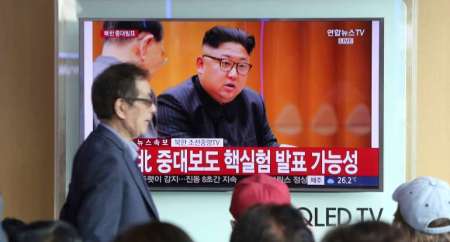
People watch a TV news program showing North Korean leader Kim Jong Un at the Seoul Railway Station in Seoul, Sunday, Sept. 3, 2017. North Korea said it set off a hydrogen bomb Sunday in its sixth nuclear test, which judging by the earthquake it set off appeared to be its most powerful explosion yet. The signs read “North Korea, important announcement.” (AP Photo/Ahn Young-joon

What ought to be clear by now is that North Korea’s Kim regime is not going to be stopped by any niceties at the diplomatic bargaining table — even if Kim agrees at some stage to parley. For North Korea, deals in the past have amounted to nothing more than pitstops, a chance to refresh and refuel. There is no reason to expect anything better of Kim Jong Un, who clearly has a liking for the nuclear accelerator. Nor is it wise to expect that China or Russia will stop this pioneering tyrant who in the 21st century is doing such a standout job of humiliating and threatening the mighty United States.

For Kim Jong Un, what a joyride.

For President Trump, for Mattis, for South Korea, for Japan, for the entire free world, what a horrifying conundrum to inherit.

And the longer it goes on, quite likely the worse, for all of us, the crash.

****************************

Following North Korea’s sixth nuclear test, advertised by Pyongyang as an ICBM-ready hydrogen bomb, it was good to hear Defense Secretary James Mattis talking tough. But that won’t stop North Korea from building nuclear missiles. It won’t stop North Korea’s threats against the U.S. and our allies. I’d wager it won’t even interfere with Kim Jong Un’s enjoyment of his apparently ample meals.

Mattis stressed Kim’s peril in his remarks on Sunday, when he said: “Any threat to the United States or its territories, including Guam or our allies will be met with a massive military response.” Mattis added the backhanded threat that “we are not looking to the total annihilation of a country, namely, North Korea, but as I said, we have many options to do so.”

But does Kim have any reason to think the U.S. would exercise those options?

North Korea has long been a geyser of threats, including its threat last month to use the U.S. territory of Guam for missile practice, its launch last month of a ballistic missile over Japan, and its threat accompanying Sunday’s nuclear test that it could use thermonuclear weapons for a “super-powerful EMP attack.”

The U.S., Japan and South Korea have responded with shows of force, but like a multitude of displays done before, the de facto message is one of great muscle but no will to fight. None of that force has been used to strike North Korea. Kim holds Seoul hostage, and America, while groping for a solution to North Korea’s rapidly compounding threats, has no appetite to risk a replay of the carnage of the 1950-1953 Korean War, potentially amplified by nuclear weapons in the hands of Pyongyang.

With the caveat that I have no inside information, it’s intriguing to imagine what’s going on right now in Kim Jong Un’s head. He’s a young tyrant, now in his mid-thirties, who inherited power upon the death of his father, Kim Jong Il, in December 2011. Some young men inherit a family fortune. Kim inherited supremacy over a totalitarian ruling party, fully accessorized with a nation state, a gulag, a nuclear weapons program and one of the world’s largest standing armies — with artillery already dug in to threaten the fat prize of capitalist Seoul, with its population of 10 million South Koreans just the other side of the Demilitarized Zone.

Since inheriting the keys to this grotesque family estate, Kim has presided over four of North Korea’s six nuclear tests to date (one in 2013, two in 2016 and the latest this Sunday). Under his rule, North Korea has amassed a nuclear arsenal estimated by various experts to be in the double digits, perhaps now including thermonuclear weapons. On Kim Jong Un’s watch, North Korea has advertised its pursuit of the ability to launch nuclear missiles from submarines, and acquired the ability to miniaturize nuclear warheads and mount them on missiles. In July, North Korea succesfully tested two ICBMs. And, as mentioned, in August North Korea threatened the U.S. territory of Guam and launched a missile over Japan. And of course there was the test on Sunday of what North Korea celebrated as a hydrogen bomb.

From international obscurity half a dozen years ago, Kim has vaulted to erstwhile godhood on his totalitarian home turf, and become a celebrity tyrant who makes headlines around the globe. With tactics worthy of Stalin, or Caligula, he has consolidated power — recall the execution in 2013 of his uncle, Jang Song Thaek, and the assassination earlier this year, with VX nerve agent, of his half-brother, Kim Jong Nam. Under his rule, North Korea has become a global player in cyber warfare. In the tradition of his enterprising forebears, he continues to cultivate strategic alliances and illicit weapons networks that funnel North Korea’s military wares to the likes of Syria, Iran and their terrorist mascots.

All this has provoked repeated rounds of sound and fury from U.S. superpower, and inspired multiple rounds of emergency meetings at the United Nations. Serious high-level officials of the world’s great powers have spent plenty of time debating and discussing and pronouncing on North Korea — evidently all of them either unable or unwilling to stop Kim’s trajectory.

What ought to be clear by now is that North Korea’s Kim regime is not going to be stopped by any niceties at the diplomatic bargaining table — even if Kim agrees at some stage to parley. For North Korea, deals in the past have amounted to nothing more than pitstops, a chance to refresh and refuel. There is no reason to expect anything better of Kim Jong Un, who clearly has a liking for the nuclear accelerator. Nor is it wise to expect that China or Russia will stop this pioneering tyrant who in the 21st century is doing such a standout job of humiliating and threatening the mighty United States.

For Kim Jong Un, what a joyride.

For President Trump, for Mattis, for South Korea, for Japan, for the entire free world, what a horrifying conundrum to inherit.

And the longer it goes on, quite likely the worse, for all of us, the crash.

Iran building missile factories in Syria and Lebanon

September 4, 2017

By – on September 4, 2017

Source: Iran building missile factories in Syria and Lebanon – Geller Report

This is more of the poison fruit of Obama’s disastrous nuclear deal. He shipped billions of dollars to the Islamic Republic, in the dark of night. Now we see what that money is going for.

“Iran building missile factories in Syria and Lebanon – Netanyahu,” BBC, August 28, 2017 (thanks to Robert):

Israel’s prime minister has said Iran is building sites in Syria and Lebanon to produce precision-guided missiles.

Benjamin Netanyahu accused Iran of turning Syria into a “base of military entrenchment as part of its declared goal to eradicate Israel”.

Iran’s forces are supporting President Bashar al-Assad in Syria’s war and it backs Lebanon’s Hezbollah movement.

Mr Netanyahu’s comments came as he held talks with UN Secretary General António Guterres in Jerusalem.

Mr Guterres is on his first visit to the region since taking office in January.

Mr Netanyahu gave no details about the sites Iran was allegedly building to manufacture missiles, but he warned “this is something Israel cannot accept”.

Two weeks ago, the Israeli satellite imagery company ImageSat International published photographs it said appeared to confirm a report by a Syrian pro-opposition newspaper that a missile factory was under construction in north-western Syria under Iranian oversight.

ImageSat International said the facility in Wadi Jahannam, near the Mediterranean coastal town of Baniyas, bore a close resemblance to a missile factory near Tehran.

There was no comment from Iran, which calls for the Jewish state’s eradication….

Courageous WWII Spy Jeannie Rousseau Has Died at 98

September 4, 2017

Courageous WWII Spy Jeannie Rousseau Has Died at 98, SmithsonianmagBrigit Katz, August 30, 2017

(Inspirational story of the day. — DM)

Jeannie Rousseau photographed in 1939 or 1940 (Public Domain)

 Rousseau played down the magnitude of her decision to collaborate with the Allied forces, to put her life at risk.

“I just did it, that’s all,” she told Ignatius. “It wasn’t a choice. It was what you did.”

********************************

In 1943, British intelligence analysts received alarming information about German plans to build V-1 and V-2 rockets at a testing plant in Peenemünde, a region on the Baltic coast. Britain deployed 560 bombers to attack the facility, temporarily derailing the Nazi program and saving thousands of lives. The vital intelligence about Peenemünde had been transmitted by an unassuming, but fearless young French woman named Jeannie Rousseau, who died last week, at the age of 98, reports William Grimes of the New York Times.

Rousseau was born in Saint-Brieuc, in Brittany, in 1919. She had a talent for languages and learned to speak German fluently, according to Olivier Holmey of the Independent. In 1940, when German forces arrived in France, Rousseau’s father, a former official with the foreign ministry, volunteered his daughter to act as an interpreter for Nazi officers in Brittany.

But Rousseau did more than just translate. She began passing bits of information to a local chapter of the French Resistance and was arrested by the Gestapo on suspicion of espionage in 1941. She was quickly released—“German officers would not contemplate that their charming translator might be a spy,” Holmey writes—but the Gestapo ordered her to leave the French coast.

Rousseau landed in Paris, where she secured a job as an interpreter for French businessmen, helping them negotiate contracts with German occupiers. Soon, Rousseau took on a more significant role with the Resistance. While traveling on a train from Paris to Vichy, she had a chance meeting with Georges Lamarque, an acquaintance from her days at university. (Or perhaps the encounter was not so chance. As journalist Anne Sebba notes, Rousseau decided to go to Vichy “in a bid to find out what was going on there, instinctively recognizing that there might be an opportunity to use her knowledge but not yet knowing how.”) As it turned out, Lamarque was building the Druids, a small intelligence-gathering chapter of the Resistance, and he asked Rousseau if she would be willing to help the cause. She agreed, and began collecting information under the alias “Amniarix.”

During her interactions with Nazi officers in Paris, however, Rousseau went by the name Madeleine Chauffour. Using charm and cunning, she cajoled classified information out of the officials—including their plans to test rockets at Peenemünde.

“I teased them, taunted them, looked at them wide-eyed, insisted that they must be mad when they spoke of the astounding new weapon that flew over vast distances, much faster than any airplane,” Rousseau said during a 1998 interview with David Ignatius of the Washington Post. “I kept saying: What you are telling me cannot be true!’ I must have said that 100 times.”

Eager to prove her wrong, one of the Germans showed Rousseau drawings of the rockets. She couldn’t make much sense of them, but she had a “near-photographic memory,” according to Grimes of the Times. She transmitted the plans in great detail to Lamarque, who passed them on the British. That information ultimately persuaded Prime Minister Winston Churchill to bomb the test site, Ignatius noted.

In 1944, the British decided to evacuate Rousseau to London for a debriefing. But according to Rousseau’s Washington Post obituary, also written by Ignatius, she was betrayed to the Nazis on her way to the meeting point. Rousseau was captured, and sent to Ravensbrück, a women’s concentration camp. She was later transported to the subcamp Torgau, and then back to Ravensbrück and then to the subcamp Königsberg, a new punishment camp that was a “particularly abominable” place, according to journalist Sarah Helm. In order to escape it, she and two others ultimately snuck their way onto a truck full of prisoners with typhus to get back to Ravensbrück.

Throughout, Rousseau appears to have been helped somewhat by the Nazis’ inability to properly identify her. When she arrived at Ravensbrück, she gave German officials her real name, Jeannie Rousseau. They did not connect her to the “Madeleine Chauffour” described as a spy in documents that were sent separately to the camp.

Still, Rousseau was on the brink of death when she was liberated by the Red Cross in 1945. While being treated for tuberculosis at a sanatorium in Sweden, she met Henri de Clarens, who had survived Buchenwald and Auschwitz. They later married and had two children.

In the years following the war, Rousseau worked as a freelance interpreter for the United Nations. She was made a member of France’s Legion of Honor in 1955, and was named grand officer of the Legion in 2009. She has been awarded the Resistance Medal, the Croix de Guerre, and the C.I.A.’s Seal Medal.

But Rousseau rarely spoke publicly about her wartime experiences. Her interview with the Washington Post in 1998 reportedly marked the first time that she had opened up to a journalist. At the time of the interview, Rousseau played down the magnitude of her decision to collaborate with the Allied forces, to put her life at risk.

“I just did it, that’s all,” she told Ignatius. “It wasn’t a choice. It was what you did.”


Iran a Far Greater Threat Than North Korea, Warns Scholar

September 4, 2017

Iran a Far Greater Threat Than North Korea, Warns Scholar, PJ MediaKarl Herchenroeder, September 2, 2017

(This article may have been written before North Korea’s successful H Bomb test. We know what North Korea is doing because the Kim regime brags about it. We don’t know what Iran is doing because of the limitations placed on inspections of its military and other nuke facilities. It is quite likely that Iran has, or soon will have, whatever nuclear capabilities North Korea has. Nevertheless, North Korea presently is a more immediate and probably more dangers problem than Iran. — DM)

President Hassan Rouhani attends an interview with the state-run TV at the presidency office in Tehran on Aug. 29, 2017. (Iranian Presidency Office via AP)

WASHINGTON – If the U.S. stays on its present path, Iran will emerge in the coming years as a far more ominous nuclear threat than North Korea, a Heritage Foundation scholar said Wednesday.

“If you like what North Korea is doing today, you’re going to love what Iran is going to be doing a few years down the road,” said James Phillips, a senior research fellow.

The Obama administration, a handful of international partners, Russia and Iran agreed to the Joint Comprehensive Plan of Action in 2015, which dictated that Iran significantly curb nuclear operations in return for the lifting of international economic sanctions. The agreement dealt an estimated $100 billion in sanctions relief and unfrozen assets to Iran.

But international consensus is that Tehran has not upheld its end of the bargain, ramping up its ballistic missile program and expanding subversive forces throughout Iraq, Syria and Yemen. Iran’s list of proxies includes Hezbollah, Hamas and Houthis. The last administration acknowledged that such bad behavior was not meant to be covered by the P5+1 nuclear deal.

In Syria, Iran has cooperated closely with Russia, deploying some 5,000 revolutionary guards. According to Phillips, since the agreement, Tehran has boosted its defense budget by about $300 million for a ballistic missile program and the Quds Force, elite special forces of Iran’s Revolutionary Guard Corps charged with protecting and advancing the Islamic Republic. Phillips said the 2015 deal handed Iran an “economic bonanza.”

“The nuclear deal has not moderated Iran. In fact, it has strengthened and emboldened hardliners within Iran, and Washington must impose clear and increasing costs on Iran, on the regime, in order to dissuade it from continuing on its present path,” he said.

Iran differs from North Korea, he continued, in that Tehran leads a much stronger economy, has more allies around the world, and it has a far more aggressive track record of violent regional intervention.

Jim Hanson, president of the Security Studies Group who served in the U.S. Army Special Forces, said that America stood by for the past eight years watching President Obama empower Tehran. He was “stunned” that the Obama administration treated Iran as a potential peace partner, given that there is no historical basis for such an approach. Iran, he said, has been killing Americans since its revolution in the late 1970s. In the Iraq War, Iran was one of the major producers and distributors of weapons used by al-Qaeda and Shia militias, he said, which killed somewhere between 500 and 1,000 American troops.

“Yet somehow (Obama) decided that they were ones that we should back,” Hanson said. “2016 – (Iran was) the State Department’s leading sponsor of terrorism worldwide. Now, that might not get you much in the Trump administration. In the Obama administration, it got you pallets full of cash flown in the middle of the night.”

Mark Dubowitz, CEO of Foundation for Defense of Democracies, said that Iran’s regime took advantage of the “policy paralysis” of the past eight years.

“We were so afraid of the Iranian shadow,” he said. “We were so afraid that the Iranians would reach a nuclear deal, and then we were so afraid the Iranians would walk away from that nuclear deal that we were unwilling actually to counter Iranian aggression.”

In 10 years, he continued, Iran will have an industrial-sized nuclear weapons program.

“All they have to do is wait until the key restrictions on the program sunset, and they will emerge with a legal, internationally recognized, NPT-compliant, industrial-sized nuclear program,” he said.

He noted that Iran’s economy in 2013 was growing at a negative 6.5 percent GDP rate and was on the verge of collapse. The economy is now growing between 4 percent and 5 percent. Dubowitz recommended that the Trump administration not allow nuclear provisions in the agreement to sunset, comparing the situation to President Reagan’s showdown with the Soviet Union. Six years after Reagan issued National Security Decision Directive 75 in 1983, the Soviet Union collapsed.

“We have a huge project ahead of us, but what Reagan did to the communists, Donald Trump has to do to the mullahs,” he said.

Obama’s chief negotiator Wendy Sherman, who served as undersecretary of State for political affairs from 2011 to 2015, defended the Iran deal in May. Trump in August signed a veto-proof sanctions bill targeting Russia, Iran and North Korea, but complained that Congress had hamstrung his business-dealmaking skills with the “seriously flawed” legislation.

Mattis Holds EMERGENCY Press Conference on North Korea H-Bomb Test 9/3/17

September 3, 2017

Mattis Holds EMERGENCY Press Conference on North Korea H-Bomb Test 9/3/17 via YouTube


North Korea’s latest test: More diplomacy will only make matters worse, says Amb. Bolton

September 3, 2017

North Korea’s latest test: More diplomacy will only make matters worse, says Amb. Bolton, Fox Business, September 3, 2017

(Please see also, Powers may end up with Iranian model for NKorea. — DM)

Bolton said the U.S. has “fooled around” with North Korea for 25 years, and if that continues, the current situation will only worsen.

“It would be a lesson to every nuclear state in the world that if you just have patience enough you can wear the United States down. The notion that we can accept North Korea or Iran with any kind of nuclear capability just means that we will forever be at their mercy,” he said.

*****************************

Following North Korea’s announcement that it successfully tested a thermonuclear device on Sunday, former U.S. Ambassador to the United Nations John Bolton said more diplomacy will only make matters worse regarding the Hermit Kingdom’s nuclear threat to surrounding countries and America.

“I think the only diplomatic option left is to end the regime in North Korea by effectively having the South take it over,” Bolton told “Sunday Morning Futures.” “Anybody who thinks that more diplomacy with North Korea or sanctions, whether against North Korea or an effort to apply sanctions against China, is just giving North Korea more time to increase its nuclear arsenal, increase its ballistic missile capability, increase the accuracy of its guidance systems and put us, South Korea and Japan in more jeopardy.”

The artificial earthquake caused by the test was “five to six times stronger” than tremors created by previous tests; South Korean officials put the magnitude at 5.7 and the U.S. Geological Survey said it was a magnitude 6.3 Opens a New Window., according to The Associated Press.

In addition to the threat of the country launching a thermonuclear weapon, Bolton explained that the willingness of Kim Jong Un to sell anything for money is also quite worrisome.

“They could sell these weapons, ballistic missiles and the nuclear devices themselves to Iran in a heartbeat. North Korea can sell these devices to terrorist groups around the world; they could be used as electromagnetic pulse weapons (EMPs), not necessarily hitting targets, but destroying our electric grid’s capabilities,” the former ambassador said, adding that they could also be used for nuclear blackmail.

President Trump reacted to the news of the alleged test on Twitter saying, “North Korea is a rogue nation which has become a great threat and embarrassment to China, which is trying to help but with little success.”

..North Korea is a rogue nation which has become a great threat and embarrassment to China, which is trying to help but with little success.

He also criticized South Korea for not taking a tougher stand against the communist country.

South Korea is finding, as I have told them, that their talk of appeasement with North Korea will not work, they only understand one thing!


Bolton said the U.S. has “fooled around” with North Korea for 25 years, and if that continues, the current situation will only worsen.

“It would be a lesson to every nuclear state in the world that if you just have patience enough you can wear the United States down. The notion that we can accept North Korea or Iran with any kind of nuclear capability just means that we will forever be at their mercy,” he said.