Archive for September 2017

EXCLUSIVE: Gen. McMaster Sparked a Row With the Israeli Delegation at a White House Meeting on Hezbollah

September 13, 2017

EXCLUSIVE: Gen. McMaster Sparked a Row With the Israeli Delegation at a White House Meeting on Hezbollah, PJ MediaDavid Steinberg, September 12, 2017

H.R. McMaster (Rex Features via AP Images)

Friction between General McMaster and the Israeli delegation did not end with Israel’s demand that Ali leave the room.

Sources reported that McMaster went on to explicitly dismiss the Israelis’ specific concerns about Hezbollah.

In particular, the Israelis expressed concern that the “safe zone” currently being established within Syria — an idea that had been vociferously supported by Hezbollah’s sponsor, Iran — would immediately become a safe zone for Hezbollah to operate.

McMaster was said to “blow off” this major Israeli concern, and to be “yelling at the Israelis” during the meeting

None of the several sources were aware if Trump had been made aware of the incident.

As has been widely reported, Trump’s Chief of Staff General Kelly has instituted tight restrictions on information and contacts reaching the president. Additionally, Kelly has been said to be working closely with General McMaster on issues related to the flow of information within the administration.

*************************************

During the week of August 27, an Israeli delegation met with members of the National Security Council (NSC) at the White House to discuss the current threat to Israel by the terror group Hezbollah.

Israel believes this threat is currently dire. This meeting preceded a two-week long Israeli Defense Forces (IDF) exercise to rehearse for possible war with Hezbollah. The Jerusalem Post described this exercise, which commenced on September 4 and is ongoing, as the IDF’s largest in 20 years.

Hezbollah has been a U.S.-designated Foreign Terrorist Organization since 1997. However, National Security Adviser H.R. McMaster reportedly brought NSC Senior Director on Counter-Terrorism Mustafa Javed Ali to the White House meeting with Israel. Ali, a McMaster appointee, is described by a senior administration source as being “opposed to Hezbollah’s designation as a terrorist organization.”

What then transpired at the meeting has been confirmed to PJ Media by several administration sources, by members of non-governmental organizations involved in national security, and by a source within the Israeli government.

The Israeli delegation demanded that Mustafa Javed Ali leave the room.

This demand was made despite the clear likelihood that Ali would later be privy to the meeting’s materials and discussion. As such, sources speculated that Israel intended the demand to serve as a message to President Trump that McMaster’s behavior has constituted a subversion of Trump’s stated Middle East policy.

Mustafa Javed Ali, second from right, attending West Point’s 2015 Senior Conference. The conference was described as having focused on “unconventional approaches to counterterrorism.”

None of the several sources were aware if Trump had been made aware of the incident.

As has been widely reported, Trump’s Chief of Staff General Kelly has instituted tight restrictions on information and contacts reaching the president. Additionally, Kelly has been said to be working closely with General McMaster on issues related to the flow of information within the administration.

Friction between General McMaster and the Israeli delegation did not end with Israel’s demand that Ali leave the room.

Sources reported that McMaster went on to explicitly dismiss the Israelis’ specific concerns about Hezbollah.

In particular, the Israelis expressed concern that the “safe zone” currently being established within Syria — an idea that had been vociferously supported by Hezbollah’s sponsor, Iran — would immediately become a safe zone for Hezbollah to operate.

McMaster was said to “blow off” this major Israeli concern, and to be “yelling at the Israelis” during the meeting.

———————————-

For months, General McMaster has been under fire regarding his personnel decisions from Trump voters and the large majority of Americans who support Israel. McMaster has fired or otherwise removed all NSC appointees who strongly supported President Trump’s Middle East campaign platform.

Trump had repeatedly promised that his administration would reject the Bush/Obama policy of denying the doctrinal Islamic roots of terror, most notably expressed by Trump’s willingness to declare jihadist attacks to be “radical Islamic terrorism.” Indeed, Trump honored this pledge early in his term via the many appointees to the NSC brought on by former National Security Adviser Michael Flynn and others.

Under McMaster, however, all of these voices have been removed from the NSC in what has been described as a “purge.”

In their stead, McMaster has astonishingly welcomed figures such as Kris Baumanand Robert Malley to his NSC. Bauman’s and Malley’s careers have been so objectively subversive to the Trump agenda on Israel that McMaster might as well have appointed Barack Obama and Jimmy Carter.

Mustafa Javed Ali in attendance at former President Obama’s 2010 White House Iftar Dinner. Ali worked within the FBI at the time. Per a source: “No Muslim reformers or liberals were welcome at those events.” (List of expected attendees available at link.)

Little information has previously been public about McMaster appointee Mustafa Javed Ali. Regarding Israel’s demand that he leave the meeting, a source claimed:

Israel possibly knows more about Javed Ali than [the Trump administration] does.

Earlier this year, Ali was rumored to have caused the cancellation of a scheduled talk to the NSC by Ayaan Hirsi Ali on account of her “Islamophobia.” Mrs. Ali, who escaped to the Netherlands from Kenya after fleeing a forced marriage, violence, and being a victim of female genital mutilation, is now an activist exposing Islamic doctrine. She has lived under 24/7 protection since 2004, when a Muslim murdered Dutch film director Theo van Gogh for making a film with Mrs. Ali that criticized Islam. A five-page note threatening the same fate for Ali was left pinned to van Gogh’s chest with a knife.

Sources within the Trump administration have confirmed to PJMedia that this rumor about Mustafa Javed Ali was correct: Mrs. Ali had been invited to speak to the NSC. She was later disinvited due to Javed Ali’s interference.

On August 11, Mrs. Ali published a Wall Street Journal op-ed criticizing Trump for “losing focus” on his terrorism campaign pledges. Within the op-ed, she chose to mention only the “most charitable” criticism being floated about General McMaster:

Some administration critics have blamed the loss of focus on Lt. Gen. H.R. McMaster, who became White House national security adviser in February. The most charitable formulation of this criticism is that military men who slogged their way through wars in Iraq and Afghanistan have an aversion to the argument that we face an ideological opponent, as opposed to a series of military problems.

But I put the responsibility on Mr. Trump. With regard to radical Islam, he simply seems to have lost interest.

Yet senior administration sources are far less charitable about McMaster and his appointee Mustafa Javed Ali. As mentioned above, they described Ali as taking the breathtaking position that Hezbollah should not be a U.S.-designated foreign terrorist organization. They described Ali as holding the same view regarding the Muslim Brotherhood.

They claimed Ali’s work within the NSC essentially amounts to him attempting to prevent the Trump administration from using any of the means at its disposal to target Hezbollah and the Muslim Brotherhood as organizations. They claimed Ali advocates only targeting such groups’ identifiably “violent” members, and ignoring all other elements of their activities that may be subversive of U.S. interests.

These are recognizable as Obama-era policies — the “smart set” foreign policy strategies behind the Obama administration’s disastrous “Countering Violent Extremism” programs. This is the thinking that marched the Middle East to bloody catastrophe: a half-million dead in Syria.

Yet General McMaster appointed Ali as NSC Senior Director on Counter-Terrorism, and purged the NSC of voices supporting President Trump’s Mideast agenda. Then McMaster reportedly sat Ali in front of an Israeli delegation visiting the White House to share its concerns about Hezbollah.

——————–

I have previously reported here at PJMedia of an extensive public relations push — coordinated by administration supporters of General McMaster — to encourage conservative outlets and think-tanks to reject claims that McMaster is antagonistic to Trump’s foreign policy and to the State of Israel in general. That push was remarkably successful: an online search for critical McMaster stories from the right will reveal such articles virtually halted in mid-August.

The broader questions of President Trump’s continued silence are more difficult to read. None of the sources contacted for this article believe the president has fundamentally shifted his thinking.

Trump likely understands he would not have defeated Hillary Clinton without stating “radical Islamic terrorism.” Yet sources could offer only speculation as to how Trump intends to win his Middle East agenda while saddled with a National Security Council subversive to those goals.
Top Iranian Official Denounces UN Nuclear Watchdog Chief Yukiya Amano, Confirms Tehran Will Not Open Military Sites to International Inspection

September 13, 2017

Top Iranian Official Denounces UN Nuclear Watchdog Chief Yukiya Amano, Confirms Tehran Will Not Open Military Sites to International Inspection, AlgemeinerBen Cohen, September 12, 2017

(How diligently has the IAEA sought evidence to justify inspections of military and other non-declared Iranian sites? The Iranian position appears to be that even with substantial such evidence inspections would not be permitted.– DM)

Amano did not back down on his statement of September 1, delivered in an interview with the Associated Press, that under the provisions of the JCPOA, the IAEA “has access to all locations without making distinctions between military and civilian locations.” In private briefings with journalists, however, IAEA officials have said they are not seeking to inspect Iranian military sites, as they have no evidence to suspect Iran of carrying out banned activities; critics of the JCPOA have depicted such statements as a face-saving device, countering that the IAEA wants to avoid a losing confrontation with Iran, which has made clear that its military sites are off-limits.

**********************************

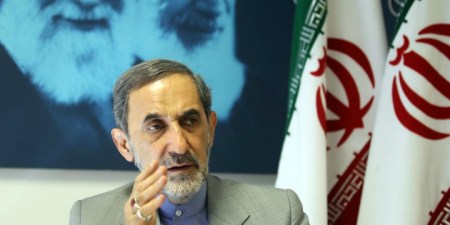
A senior adviser to Iran’s Supreme Leader has fiercely denounced Yukiya Amano – the head of the UN’s nuclear monitoring body, the International Atomic Energy Agency (IAEA) – for his assertion that IAEA inspectors are entitled to access all “relevant locations,” including military sites, inside Iran.

“The claim of such a right is fabricated by Mr. Amano,” Ali Akbar Velayati – a former Iranian foreign minister who now advises Supreme Leader Ayatollah Ali Khamenei on international affairs – told the regime’s official news agency, IRNAon Tuesday. “If he was independent, and his decisions were based fully on independence, he would have pressed inspecting the nuclear centers of the Zionist regime, because nuclear arms in the occupied lands set as the biggest danger to the entire Middle East region.”

Velayati’s attack on Amano is notable in that it comes two days after the IAEA chief confirmed that Iran, in the view of the agency, is abiding by the terms of the Joint Comprehensive Plan of Action (JCPOA)  – the official name of the nuclear deal between Tehran and six world powers, led by the United States, in July 2015.

“The nuclear-related commitments undertaken by Iran under the deal are being implemented,” Amano told the quarterly meeting of the IAEA’s 35-member Board of Governors in Vienna. Amano also told the meeting that Iran had agreed to a “high number” of short-notice inspections of its nuclear sites, without specifically addressing the concern voiced last month by Nikki Haley, the US Ambassador to the UN, that the IAEA does not have enough access in Iran.

At the same time, Amano did not back down on his statement of September 1, delivered in an interview with the Associated Press, that under the provisions of the JCPOA, the IAEA “has access to all locations without making distinctions between military and civilian locations.” In private briefings with journalists, however, IAEA officials have said they are not seeking to inspect Iranian military sites, as they have no evidence to suspect Iran of carrying out banned activities; critics of the JCPOA have depicted such statements as a face-saving device, countering that the IAEA wants to avoid a losing confrontation with Iran, which has made clear that its military sites are off-limits.

In his statement on Tuesday, Velayati bluntly confirmed this position. “Neither Mr. Amano, his officers nor any other foreigner is entitled to visit our military centers, because the centers are fully secret security zones for any foreigner and foreign affiliates,” IRNA quoted him as saying.

Velayati’s comments come amid persistent rumors that US President Donald Trump’s Administration is looking to ratchet up pressure on Tehran over its ballistic missile tests and its sponsorship of Shia Islamist organizations like Hezbollah in Lebanon. According to a Reuters news agency report on Tuesday, Trump was presented last Friday with a plan assembled by Defense Secretary James Mattis, Secretary of State Rex Tillerson, national security adviser H.R. McMaster, and other top officials. The plan “could allow more aggressive U.S. responses to Iran’s forces, its Shi‘ite Muslim proxies in Iraq and Syria, and its support for militant groups,” the report said.

Also in question is whether Trump will re-certify the JCPOA in October, as the president is legally required to do every 100 days. While Trump has made no secret of his distaste for the deal, the Iran strategy presented to him on Friday by his advisers reportedly does not advocate a withdrawal from the JCPOA, but rather increased economic sanctions and limited military moves to counter Iran’s growing influence.

Gorka to Jpost: Bannon camp still has sway with Trump administration

September 13, 2017

Source: Gorka to Jpost: Bannon camp still has sway with Trump administration – American Politics – Jerusalem Post

ByYonah Jeremy Bob, Shoshana Kranish
September 11, 2017 23:37
Ex-top staffer discusses Syria, Charlottesville and continued growth of Jihadism.
JPost Annual Conference 2017

Sebastian Gorka at the JPost Annual Conference 2017 . (photo credit:SIVAN FARAG)

Sebastian Gorka and the Steve Bannon camp still have sway with US President Donald Trump, former White House senior staffer Sebastian Gorka told the Jerusalem Post on Monday.
“The president remains loyal to those who served him well” and though “we left the building, we did not leave Trump,” explained Gorka on the sidelines of IDC Herzliya’s International Institute for Counter-terrorism conference.

Bannon was a Trump co-campaign manager and a chief White House strategist who was recently forced out after a prolonged battle with other Trump administration forces considered to be more moderate. Gorka, who worked for Bannon, resigned shortly after. He said he resigned from the Trump administration when he felt that Trump’s new Afghanistan and other policies contradicted the Make America Great Again and America First ideologies, but that he would “still support Trump from the outside.”

He said Trump called him the day after he resigned and “assured me that he will stay on with his original agenda.”

In that spirit, Gorka predicted that “the current state of affairs” in which competing ideologies have grown in power within the administration “is temporary and very soon the president will realize he is not being well-served by his senior staff.”

He said that once that occurs, Trump will ask “people associated with his ideology to come back,” which could include advisers like ex-campaign manager Cory Lowandowski, who Trump never stopped regularly advising with.

Acknowledging that White House Chief-of-Staff John Kelly had brought about “a drastic change in the way things are done inside the White House,” he implied that on ideology and even matters of Trumpian-style, Kelly would need to buy-in to Trump to have lasting influence.

Moving on to the constantly in flux Trump-Israel relationship, Gorka was pressed on how Trump could continue to claim the pro-Israel mantle after many Israelis thought he had thrown Israeli security interests under the bus in a Syria ceasefire deal.

Israel issued a rare public rebuke of the Trump deal with Russian President Vladimir Putin as the deal did not include provisions to keep Iran off the Syrian side of the Golan border, an issue of major concern since it could give Iran a new point to threaten the country.

Gorka said unequivocally “no one has thrown anyone under the bus. We stand shoulder to shoulder with Israel as our strongest ally in the region.”

Explaining further, he said, “The president’s priority was simply to stop the bloodshed. A political resolution, the future of Assad and the disposition of Iranian forces” were all issues the US would still attend to even if they were not part of the initial deal.

“The bottom-line is this is the most pro-Israeli administration, not just in modern times, but since 1776,” he said. Pressed further that a favorable tone toward Israel did not cure concrete Israeli security concerns, he said that as a private individual he would note that Trump was still running into interference on foreign affairs from the bureaucratic state.

He said that, “Trump is the quintessential disruptor, but that even a disruptor fighting 15-20 years of institutional momentum” faces “massive inertia” in trying to fix “20 years of disastrous foreign policy.”

Honing in on how disturbed the Jewish community was about Trump’s reaction to recent white supremacist violence and incitement in Charlottesville, Virginia, he “rejected new labels.”

He said that Trump “unequivocally condemned Nazis, antisemites and fascists,” and pointed out that he has orthodox Jewish grandchildren.

Next, he was asked how any of that absolved the president of making what many viewed as a false equivalence between violent white supremacist actions in Charlottesville and the non-violent activism of some left-wing activists there.

He said that this obscured Trump’s broader point that the media focuses endlessly on right-wing violence, but underplays left-wing violence – giving James Hodgkinson, who attacked Republican Congressmen, and a left-wing Oregon man who knifed multiple people as examples.

Later, Gorka spoke at the conference itself, saying he doesn’t believe the US is winning the war on terrorism.

His argument for why was twofold. On the one hand, he said, the Bush, Obama and Trump administrations have focused too heavily on the physical aspect of terrorism, instead of focusing on undermining the ideology of those they seek to defeat. Trump’s strategy, he said, is one of obliteration of ISIS, but that this also does not address the bigger issue.

On the other hand, he said that the US – like Israel and other Western countries – has not done enough to de-incentivize terrorists.

By focusing on killing low-level “lone wolf” terrorists, they aren’t attacking the root of the problem, according to Gorka’s model.

He said that the current administration must attack the “center of gravity” of terrorist organizations, whom he described as the people with hundreds of thousands of Twitter followers.

He did note that the US is bound by the First Amendment, and that effectively removing content from social media sites would be stifling freedoms of speech and expression. However, he suggested that threats of national security outweighed the “videos on YouTube that seek to kill you, and your children.”

He cautioned private citizens and politicians alike from prematurely celebrating the small successes in the war on terror. Against the idea that the war is “being won” because there has been no mass casualty attack on US soil since 9/11, he noted that the frequency of attacks has increased, which signals that the war is far from over. “Jihadism, as a global phenomena, is increasing.” He added that groups like ISIS don’t aim for mass casualties like they did in previous years.

Terrorist groups have adapted to changing times, encouraging a kind of “irregular warfare” that recruits individuals in the country they hope to attack, rather than bringing foreigners abroad.

This new warfare also aims to scare populations more than it aims to annihilate them, which helps to explain the frequency of attacks in public places that only kill three or four individuals, rather than dozens, hundreds, or thousands. Gorka, who has been accused of antisemitism and Islamophobia, said definitively that there is “no war on Islam” since there is “no monolithic Islam.”

He said that anyone who thinks there is only one Islam is an idiot. The war on terror is being fought, he says, against political and radical Islam. “We’ve only paid lip service” in terms of combating terrorism in the last 16 years, he asserted. He divulged to the audience his personal insights from his short time in the White House. “The best answers,” he opened, “are those found outside the government. I know this especially after my stint in the White House.”

While he defended the president several times throughout the 30-minute speech – “most people really misunderstand the president, but he’s a patriot, and a pragmatist” – he expressed some lighthearted anger at the White House.

Playing on an American expression, he joked that “When the going gets tough, that’s when you find out who your real friends are.”


What that airstrike in Hama means (and what it does not) | Arab News

September 13, 2017

Source: What that airstrike in Hama means (and what it does not) | Arab News

An Israeli airstrike last Thursday near Hama in western Syria was the biggest since the Syrian conflict began in 2011. The Assad regime says the target was a scientific research facility. Israel says it was a missile production plant used by Iran to develop chemical weapons for Hezbollah.

In the past, when Israeli jets have targeted military convoys linked to Hezbollah, which is fighting alongside the regime, the Syrian government has warned of grave consequences and threatened to retaliate at the appropriate time. But both the regime and Hezbollah have been careful not to get dragged into a confrontation with Israel.

The timing of the Israeli attack is telling. It followed clear Israeli objections to a deal between the US and Russia, agreed in Amman in Jordan in July, to implement a cease-fire in southwest Syria. Full details of the agreement have not been disclosed, but it is thought to limit the presence of Iranian backed militias in that area that borders Jordan and the Israeli-occupied Golan Heights. Amman requested, and apparently received, guarantees that non-Syrian government forces will respect a 30 to 40 km distance from its borders. The same should apply to Israel. But Israeli Prime Minister Binyamin Netanyahu has made his displeasure at the deal public on a number of occasions.

In August, he dispatched his Mossad chief to Washington to deliver Israeli concerns. It is not clear what Israel wants, but it is obvious that it is worried about a long-term Iranian presence in post-war Syria and Hezbollah’s access to advanced missile technology. Netanyahu himself flew to the Russian resort of Sochi on Aug. 23 to meet Russian President Vladimir Putin and present his case, but he returned empty handed.
As much as Netanyahu has tried to shake the Russian alliance with Tehran, and by extension the apparent support from Moscow for a Hezbollah presence in Syria, his efforts appear to have failed. The Israeli press disclosed that Moscow had put pressure on the UN Security Council to remove reference to Hezbollah and its military activities in southern Lebanon from the final draft resolution on the UNIFIL mandate last week.
Despite the official Israeli stance that it has no preference on the outcome of the Syrian conflict, it is naive to believe that it is not following military and strategic developments with keen interest. Its dubious ties to extreme rebel groups in southwestern Syria raise questions about its motives and objectives. Certainly, a weak and divided Syria that is engulfed in chaos for years would suit long-term Israeli interests.

The attack shows Israel’s concern over its enemies’ presence in Syria, but it will not weaken Iran and Hezbollah’s influence.

Osama Al-Sharif

For Tel Aviv, the Syrian regime remains technically at war with Israel, even though the Golan front has been quiet for over four decades. The two sides have fought indirectly through proxies a number of times, starting with the Israeli invasion of Lebanon in 1982 and most recently, in 2006, with Hezbollah.

A regime collapse in Syria would create a geopolitical upset for the region, including Israel, but its survival thus far has presented a more difficult set of challenges. The Russian military intervention in 2015 changed the dynamics of the conflict. The US recoil from the Syrian conflict, which was started by President Barack Obama and continues under his successor, has firmly established Moscow as the power that has the final say over the future of Syria.

Aside from this, Iran and its proxies were instrumental in paving the way for a regime comeback when the Syrian army was on the verge of defeat. It is not clear where Moscow stands on Iranian ambitions to create a land corridor between Tehran and Beirut, via Baghdad and Damascus; something that presents Israel with an existential challenge.

The recent Israeli airstrike was meant to send messages in various directions.

Despite absolute control of Syrian skies by Russia and its deployment of a sophisticated air defense system, Israeli jets were able to hit their target without hindrance. Some reports suggested that Israeli jets launched the strike from Lebanese airspace. The strike is meant to underline Israeli readiness to take pre-emptive action in Syria regardless of third party agreements that do not meet its security concerns.
But the strike does not change the new geopolitical reality in Syria. For now, Iran and Hezbollah, bitter enemies of Israel, are part of a new power structure that is taking shape there. This reality offers a number of scenarios for future confrontations. Certainly, recent Israeli military exercises designed to simulate a war with Hezbollah underline its apprehension over the group’s presence in Syria along with archenemy Iran.

• Osama Al-Sharif is a journalist and political commentator based in Amman.

Trump and Netanyahu to meet on sidelines of UN confab, US confirms

September 13, 2017

Source: Trump and Netanyahu to meet on sidelines of UN confab, US confirms | The Times of Israel

The two will both be in New York to address the world body; no indication yet if Trump will also meet with Abbas

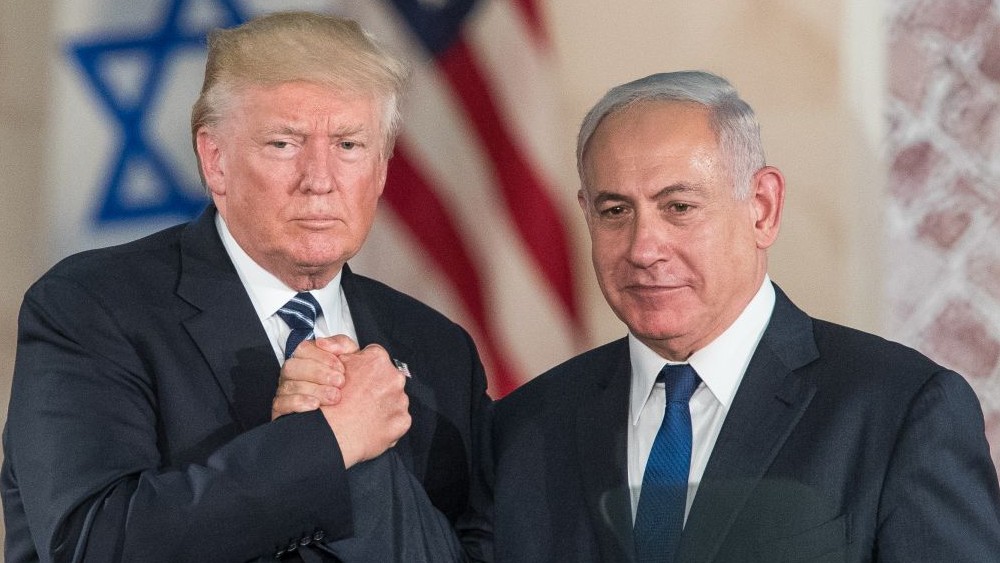
US President Donald Trump, left, and Prime Minister Benjamin Netanyahu shake hands after giving final remarks at the Israel Museum in Jerusalem before Trump's departure, May 23, 2017. (Yonatan Sindel/Flash90)

US President Donald Trump, left, and Prime Minister Benjamin Netanyahu shake hands after giving final remarks at the Israel Museum in Jerusalem before Trump’s departure, May 23, 2017. (Yonatan Sindel/Flash90)

WASHINGTON — US President Donald Trump and Prime Minister Benjamin Netanyahu will meet in New York next week on the sidelines of the UN General Assembly, a US official confirmed on Tuesday.

“The President is planning to sit down with the Prime Minister Benjamin Netanyahu and I know that the President’s looking forward to doing that,” State Department spokeswoman Heather Nauert told reporters during her daily press briefing.

On Sunday, Netanyahu said he would meet with Trump while they both were in Manhattan, but Washington had yet to verify a summit would take place.

The meeting will be the two leaders forth together since Trump assumed office. The two met once in February when the Israeli premier visited the White House, and twice in May when the American president traveled to the region, which included a two-day stop in Israel and the Palestinian territories.

Trump is slated to address UNGA on September 19. Reports have quoted officials saying the meeting with Netanyahu will likely take place on or around September 18.

Officials did not say where the meeting would take place, but last month the Israel Hayom daily reported it would be held at Trump’s National Bedminster Golf Club in New Jersey.

Officials have not yet disclosed what subjects are on the itinerary of discussion, but their summit will come as Trump is making headlines for his machinations to toughen up on Iran and potential plans to decertify the regime as violating the 2015 nuclear deal, despite International Atomic Energy Agency investigators finding it is abiding by its terms.

Trump told The Wall Street Journal in August he “does not expect that they will be in compliance.” That interview came shortly after Foreign Policy reported that he told his aides to develop a case for why the Iran has violated the agreement by October, when he must report to Congress on whether Tehran is honoring the landmark pact.

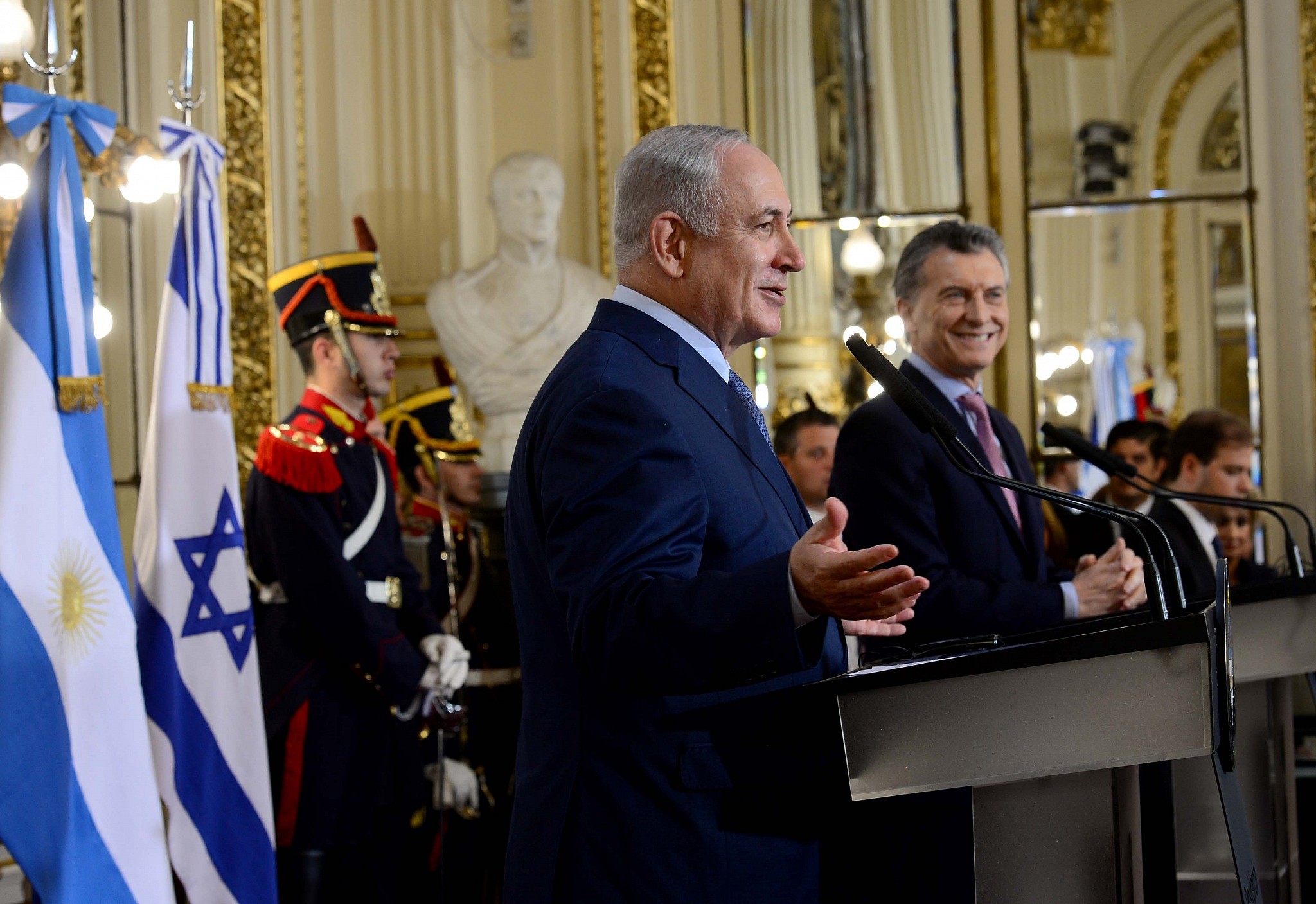
Prime Minister Benjamin Netanyahu meets with Argentinian President Mauricio Macri at the San Martin palace, in Buenos Aires, Argentina, during his official state visit. September 12, 2017. (Avi Ohayon / Government Press Office)

Netanyahu has long been a fierce critic of the deal. On Tuesday, he said his position remained simple — that it is a bad deal and should either be renegotiated or trashed.

“In the case of Iran, there have been some news stories about Israel’s purported position on the nuclear deal with Iran. So let me take this opportunity and clarify: Our position is straightforward. This is a bad deal. Either fix it — or cancel it. This is Israel’s position,” Netanyahu said from Argentina, where he is on a Latin American swing before making his way to New York for the UN General Assembly.

The meeting between the two leaders also comes at a sensitive time for Trump’s peace push. Last month, the former real estate mogul dispatched a US delegation to the Middle East to try and renew negotiations between the sides.

No tangible developments occurred, but Palestinians continue to criticize the US team for its refusal to back a two-state solution, a goal that has been central to American foreign policy for decades.

In August, Nauert responded to these criticisms by saying the Trump administration did not want to “bias” itself by supporting any particular outcome to the conflict.

Palestinian Authority President Mahmoud Abbas will also be in town for the UN confab. There is no indication yet that he is slated to meet individually with Trump or that the three will meet together.


Cancel Iran nuclear deal, asks Netanyahu in Argentina

September 13, 2017

Source: Cancel Iran nuclear deal, asks Netanyahu in Argentina | Zee News

Israeli Prime Minister Benjamin Netanyahu said Tuesday that the nuclear deal between world powers and Iran should be amended or cancelled.

AFP| Last Updated: Wednesday, September 13, 2017 – 06:41

Cancel Iran nuclear deal, asks Netanyahu in Argentina

Buenos Aires: Israeli Prime Minister Benjamin Netanyahu said Tuesday that the nuclear deal between world powers and Iran should be amended or cancelled.

Speaking in Buenos Aires alongside Argentine President Mauricio Macri, Netanyahu said he wanted to correct the impression in recent media reports that Israel`s position on the 2015 deal had softened.

“So let me take this opportunity and clarify. Our position is straightforward. This is a bad deal — either fix it or cancel it. This is Israel`s position.”

Netanyahu has repeatedly taken aim at Iran since arriving in Argentina on Monday as the first sitting Israeli prime minister to visit Latin America.

He accused Tehran of operating “a terror machine that encompasses the entire world, operating terror cells in many continents, including Latin America.”

“In the case of Iran, it`s not only merely terror, it`s also the quest for nuclear weapons that concerns us and should concern the entire international community.”

In a veiled reference to the US and world powers` preoccupation with North Korea, he said: “We understand the danger of a rogue nation having atomic bombs.”

Macri, who hosted Netanyahu at his Casa Rosada presidential palace, said the visit was “an important step” to improve commercial relations between their two countries.

As the Israeli government seeks partners and alliances, dozens of left-wing activists waving Palestinian flags protested Netanyahu`s presence in Buenos Aires late Tuesday over his “bellicose and repressive policies” against the Palestinians.Referring affectionately to Macri as “Mauricio, my friend,” the Israeli leader said his visit marked the dawn of a new era — “and not accidentally did we begin it here with you.”

Netanyahu, who is accompanied by a 30-member delegation of Israeli business leaders, said Israel was an “innovation nation” eager to share opportunities with Argentina in agriculture, water, IT, cyber security and health.

The two presidents signed a series of agreements on social insurance, streamlining customs arrangements and police cooperation.

Macri also presented Netanyahu with some 140,000 historical documents and photographs from before and after World War II in digital form.

The documents will enable a deeper understanding of the Holocaust and crimes against humanity, Israel said.

On Monday, Netanyahu participated in a ceremony to remember victims of bomb attacks at the Israeli embassy in 1992, and at a Jewish community center in 1994.

The embassy attack killed 29 and injured 220, while the community center blast left 85 dead and 300 injured.

But some relatives of victims of the 1994 bombing refused an invitation to the event on Monday.

“Netanyahu did not come to commemorate the attack, but to increase business,” said Diana Malamud, who heads a group called Active Memory.

“In these 23 years (since the bombing) Israel has been an observer, like any other country,” and did not honestly help “search for the truth” behind the attack, she said.

During his stay in Buenos Aires, the Israeli premier was also to meet Paraguayan President Horacio Cartes, who traveled expressly to the Argentine capital for the meeting.

Following the two-day visit, Netanyahu will visit Colombia and Mexico before heading to New York for the United Nations General Assembly.

AFP


» Naftali Bennett: Hezbollah and Iran Greatest Threat to Israeli Security

September 13, 2017

Source: » Naftali Bennett: Hezbollah and Iran Greatest Threat to Israeli Security– IMEMC News

13 Sep
5:25 AM

By Emma Von Larsen and Bettina Boye/PNN

Various Israeli officials joined the IDC institute of Counterterrorism annual conference to discuss the development of terrorism and ways to counter, where Israeli minister of education, Naftali Bennett  emphasized that “modern Zionism has created a safe haven for Jewish people, and Iran threatens this” and continued “I have no doubt that the nuclearization of Iran is the number one existential threat to the state of Israel”.

He claimed that an attack on Iran would not destroy the country, but an attack by Iran on Israel would, and that is a great threat for Israel. Despite the lack of an actual war between Israel and Iran and Israel’s recent bombing of an alleged weapon factory in Syria, which could be seen as provoking and as an invitation to a proxy war with Iran, Bennett underlines, that the tension between the two countries is not a “Cold War”.

Bennett also argued that Israel’s own policy of disengagement is one of the greatest threats towards itself, and mentions as an example the 2005 disengagement from the conflict in Gaza, and that the consequences of Israel’s disengagement was the takeover of the Strip by Hamas.

As another example of Israel’s policy of disengagement, Bennett mentions the situation with Hezbollah, and states that, when the Israeli military retreaded from the position in Lebanon they indirectly allowed Hezbollah to blossom and to grow strength.

“I would like to state this emphatically: Lebanon is Hezbollah and Hezbollah is Lebanon. A ballistic attack on Israel would be the equivalent of a declaration of war by sovereign state of Lebanon,” he said.

Homeland Security issues waivers to ramp up improved border fencing

September 12, 2017

Homeland Security issues waivers to ramp up improved border fencing, BreitbartUPI, September 12, 2017

(The district courts in the 9th Circus Circuit will be busy with this for a long time. — DM)

Sept. 12 (UPI) — The U.S. Department of Homeland Security announced Tuesday it has issued waivers of environmental and historical preservation laws to speed construction of fencing between California and Mexico.

The waivers protect border barriers near Calexico, Calif., from federal regulations such as Endangered Species Act and the National Historic Preservation Act, the department said in a news release.

The department described it as “an area of high illegal entry” that is a “critical sector for border security.” In fiscal year 2016, the United States Border Patrol “apprehended more than 19,400 illegal aliens and seized approximately 2,899 pounds of marijuana and approximately 126 pounds of cocaine in the El Centro Sector,” according to Homeland Security.

This project is approximately a three-mile segment that starts at the Calexico West port of entry and extends westward, replacing approximately two miles of the existing primary pedestrian fence with a new “bollard wall,” the department said.

The Border Patrol plans to build 18-to-25-foot fencing that replaces the existing 14-foot fencing built in the 1990s, The Hill reported. The waiver also allows improvement of Border Patrol service roads.

DHS Acting Secretary Elaine Duke published the waiver in the Federal Register.

According to the notice, “The Secretary of Homeland Security has determined, pursuant to law, that it is necessary to waive certain laws, regulations and other legal requirements in order to ensure the expeditious construction of barriers and roads in the vicinity of the international land border of the United States near the city of Calexico in the state of California.”

Existing budget appropriations cover some repairs and improvements to existing fencing, including the prototypes.

The White House requested $1.6 billion for 2018 to begin new construction for the wall between the United States and Mexico, which was a campaign promise by President Donald Trump.

“The Department is implementing President Trump’s Executive Order 13767, Border Security and Immigration Enforcement Improvements, and continues to take steps to immediately plan, design and construct a physical wall along the southern border, using appropriate materials and technology to most effectively achieve complete operational control of the southern border” according to the release.

Last week, DHS announced prototypes for a wall in the San Diego sector, west of El Centro.

U.S. Threatens to Cutoff China, Russia for Undermining Sanctions Against North Korea

September 12, 2017

U.S. Threatens to Cutoff China, Russia for Undermining Sanctions Against North Korea, Washington Free Beacon, September 12, 2017

(Please see also, UN Passes Mega-Ultra Toughest-Ever North Korea Sanctions, Again.– DM)

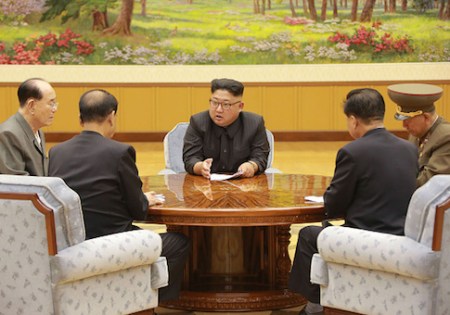
North Korean leader Kim Jong-Un attends a meeting with a committee of the Workers’ Party of Korea about the test of a hydrogen bomb / Getty Images

“Unfortunately, I cannot tell the committee today that we’ve seen sufficient evidence of China’s willingness to truly shut down North Korea’s revenue flows, to expunge North Korean illicit actors from its banking system, or to expel the various North Korean middlemen and brokers who are continuing to establish webs of front companies,” he said.

*****************************

The Trump administration on Tuesday threatened to cut off from the U.S. financial system Chinese and Russian companies helping North Korea smuggle coal overseas to circumvent international sanctions on Pyongyang’s nuclear activities.

Marshall Billingslea, the Treasury Department’s assistant secretary for terrorist financing, provided Congress with intelligence images mapping North Korea’s illicit shipping networks used to mask the origin of exported coal to China and Russia.

The images appear to expose China and Russia’s covert hand in undermining international pressure on the Kim Jong Un regime to give up its nuclear ambitions, despite the two nations voting publicly on several occasions at the United Nations Security Council to strengthen sanctions.

“North Korea has been living under United Nations sanctions for over a decade and it has nevertheless made significant strides toward its goal of building a nuclear tipped ICBM,” Billingslea testified before the House Foreign Affairs Committee, referring to the regime’s pursuit of an intercontinental ballistic missile capable of reaching the United States mainland.

“I urge anyone in the financial services industry who might be implicated in the establishment of shell or front companies for [North Korea], and anyone who is aware of such entities, to come forward with that information now, before they find themselves swept up in our net,” he said.

The Treasury Department estimates North Korean coal shipments bring in more than $1 billion in annual revenue for the regime, in part enabling Kim Jong Un to generate income used to fund ballistic missile and nuclear programs. Though the UN Security Council over the past month has passed two separate sanctions packages targeting North Korea’s coal industry, illicit coal-smuggling networks through China and Russia have watered down the impact, according to the Trump administration.

Citing the intelligence images provided to Congress on Tuesday, Billingslea said North Korean shipping vessels routinely shut off their transponders in violation of international maritime law to avoid detection as they move from North Korea into Chinese or Russian ports to offload sanctioned coal.

The Treasury Department is also tracking North Korea’s effort to penetrate the international financial system through shell companies based in China and Russia to help conceal the regime’s overseas footprint. Billingslea warned the Trump administration will punish any company in violation of UN sanctions by choking it off from the U.S. financial market.

Though he lauded China for supporting a recent round of UN sanctions, he said Beijing has not yet shown it is serious about cutting off North Korean funding.

“Unfortunately, I cannot tell the committee today that we’ve seen sufficient evidence of China’s willingness to truly shut down North Korea’s revenue flows, to expunge North Korean illicit actors from its banking system, or to expel the various North Korean middlemen and brokers who are continuing to establish webs of front companies,” he said.

Stupidity or malice? The US plans to return stolen Jewish artifacts to Iraq

September 12, 2017

Stupidity or malice? The US plans to return stolen Jewish artifacts to Iraq | Anne’s Opinions, 12th September 2017

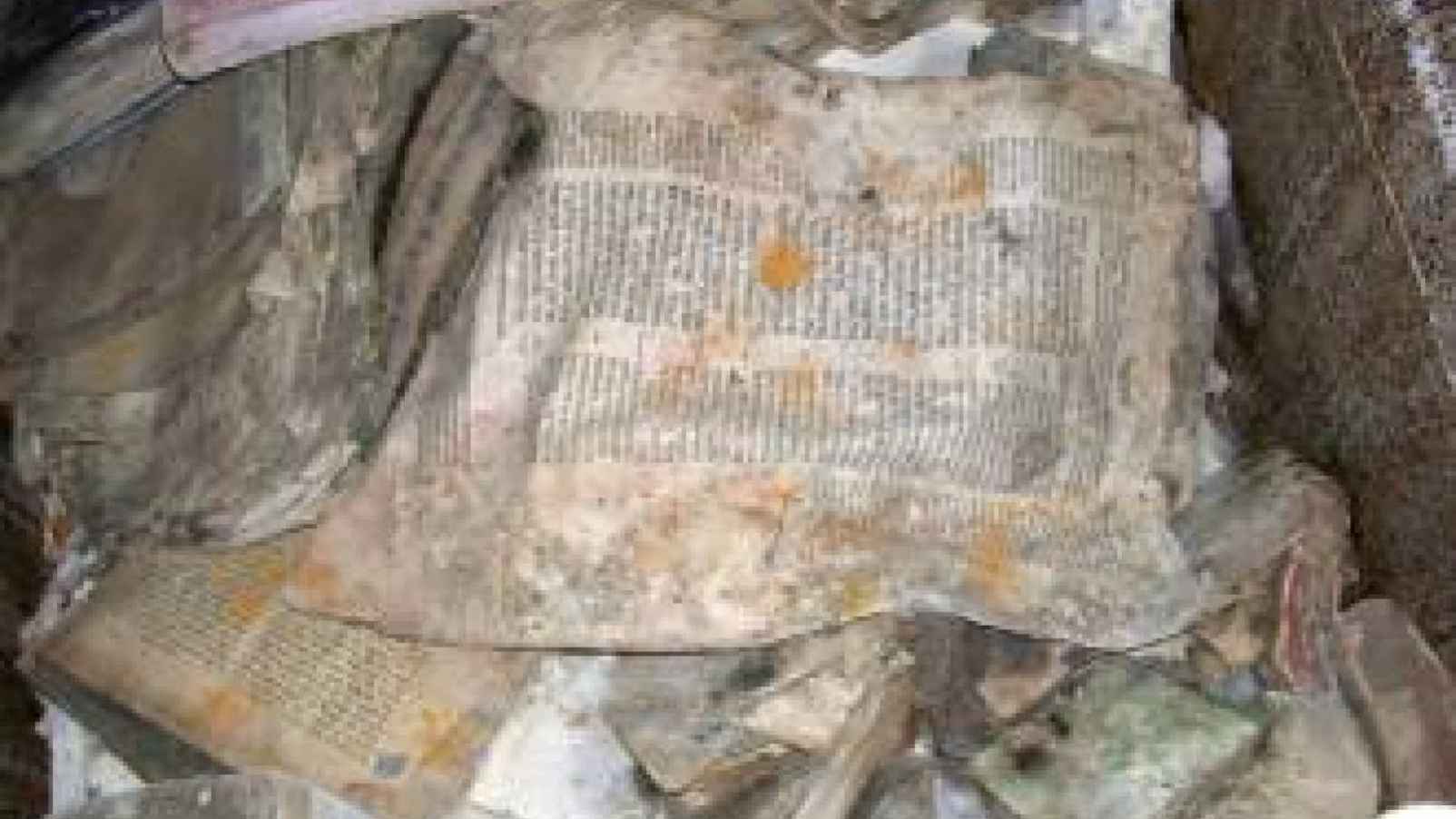
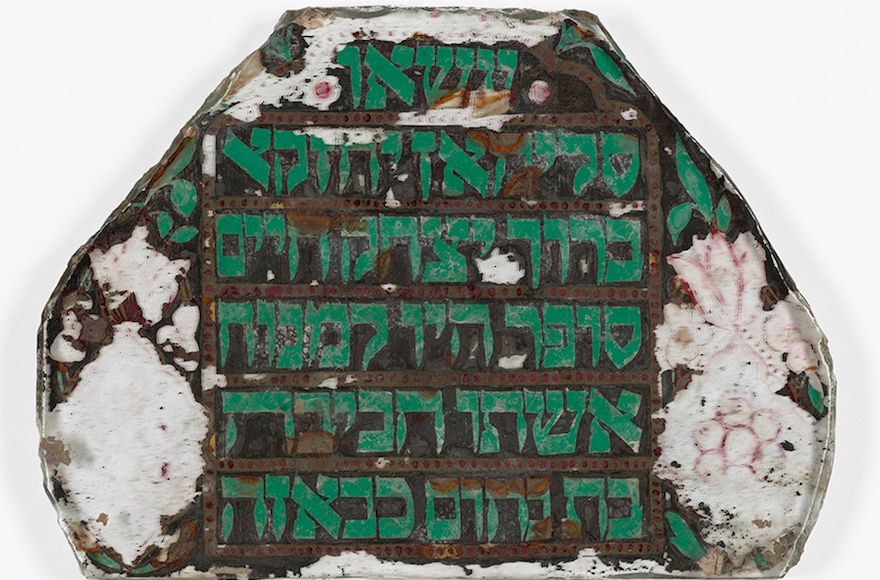
Looted Jewish artifacts from Iraq

When the news hit the headlines this week that the US plans to return Jewish artifacts to Iraq – artifacts, it should be noted, that were stolen from the Iraqi Jewish community by the Saddam Hussein regime in Iraq and rescued by US forces – I thought the story sounded familiar. A quick search on my blog revealed that this decision had already been discussed 4 years ago! To be honest, I thought that this absurd decision to return the artifacts to their unlawful owners had been shelved once Donald Trump became President. Sadly this is not the case.

The JTA reports:

NEW YORK (JTA) — The United States will return to Iraq next year a trove of Iraqi Jewish artifacts that lawmakers and Jewish groups have lobbied to keep in this country, a State Department official said.

A four-year extension to keep the Iraqi Jewish Archive in the U.S. is set to expire in September 2018, as is funding for maintaining and transporting the items. The materials will then be sent back to Iraq, spokesman Pablo Rodriguez said in a statement sent to JTA on Thursday.

Rodriguez said the State Department “is keenly aware of the interest in the status” of the archive.

“Maintaining the archive outside of Iraq is possible,” he said, “but would require a new agreement between the Government of Iraq and a temporary host institution or government.”

Detail of Tik (Torah case) and Glass Panel from Baghdad, 19th-20th centuries, part of the Iraqi Jewish Archive. (National Archives)

The archive was brought to America in 2003 after being salvaged by U.S. troops. It contains tens of thousands of items including books, religious texts, photographs and personal documents. Under an agreement with the government of Iraq, the archive was to be sent back there, but in 2014 the Iraqi ambassador to the U.S. said its stay had been extended. He did not say when the archive was to return.

Democratic and Republican lawmakers and Jewish groups have lobbied to renegotiate the deal, arguing that the documents should be kept in the U.S. or elsewhere where they are accessible to Iraqi Jews and their descendants. JTA reached out to lawmakers who have sponsored resolutions urging a renegotiation of the archive’s return but did not hear back in time for publication.

Iraq and proponents of returning the archive say it can serve as an educational tool for Iraqis about the history of Jews there and that it is part of the country’s patrimony.

Addressing the points that I highlighted above in bold, Caroline Glick scathingly attacks the “State Department’s strange obsession” while also answering the question in my headline:

The law of Occam’s Razor, refined to common parlance, is that the simplest explanation is usually the correct one.

If we apply Occam’s Razor to recently reported positions of the US State Department, then we can conclude that the people making decisions at Foggy Bottom have “issues” with Jews and with Israel.

The books and documents were looted from the Iraqi Jewish community by successive Iraqi regimes. They were restored by the National Archives in Washington, DC.

Before Treatment: Passover Haggadah, 1902. One of very few Hebrew manuscripts recovered from the Mukhabarat, this Haggadah was hand-lettered and decorated by an Iraqi youth.

The Iraqi Jewish community was one of the oldest exilic Jewish communities.

It began with the Babylonian exile following the destruction of the First Temple in Jerusalem 2,600 years ago. Until the early 20th century, it was one of the most accomplished Jewish communities in the world. Some of the most important yeshivas in Jewish history were in present-day Iraq. The Babylonian Talmud was written in Iraq. The Jewish community in Iraq predated the current people of Iraq by nearly a thousand years.

It was a huge community. In 1948, Jews were the largest minority in Baghdad.

Jews comprised a third of the population of Basra. The status of the community was imperiled during World War II, when the pro-Nazi junta of generals that seized control of the government in 1940 instigated the Farhud, a weeklong pogrom. 900 Jews were murdered.

Thousands of Jewish homes, schools and businesses were burned to the ground.

With Israel’s establishment, and later with the Baathist seizure of power in Iraq in the 1960s, the once great Jewish community was systematically destroyed.

Between 1948 and 1951, 130,000 Iraqi Jews, three quarters of the community, were forced to flee the country. Those who remained faced massive persecution, imprisonment, torture, execution and expulsion in the succeeding decades.

When US forces overthrew the Baathist regime of Saddam Hussein in 2003, only a dozen or so remained in the country.

Today, there are none left.

As for the current Iraqi government that the State Department wishes to support by implementing its 2014 agreement, it is an Iranian satrapy. Its leadership and military receive operational orders from Iran.

The Iraqi Jewish archive was not created by the Iraqi government. It is comprised of property looted from persecuted and fleeing Jews. In light of this, it ought to be clear to the State Department that the Iraqi government’s claim to ownership is no stronger than the German government’s claim to ownership of looted Jewish property seized by the Nazis would be.

On the other hand, members of the former Jewish community and their descendants have an incontrovertible claim to them. And they have made this claim, repeatedly.

To no avail. As far as the State Department is concerned, they have no claim to sacred books and documents illegally seized from them.

When asked how the US could guarantee that the archive would be properly cared for in Iraq, all State Department spokesman Pablo Rodriguez said was, “When the IJA [Iraqi Jewish archive] is returned, the State Department will urge the Iraqi government to take the proper steps necessary to preserve the archive, and make it available to members of the public to enjoy.”

It is hard not to be taken aback by the callousness of Rodriguez’s statement.

Again, the “members of the public” who wish to “enjoy” the archive are not living in Iraq. They are not living in Iraq because they were forced to run for their lives – after surrendering their communal archives to their persecutors. And still today, as Jews, they will be unable to visit the archives in Iraq without risking their lives because today, at a minimum, the Iraqi regime kowtows to forces that openly seek the annihilation of the Jewish People.

And the State Department knows this.

The question then arises, surely this new American administration under President Donald Trump would be more sympathetic to Jewish concerns, and would overturn this surreal decision made by the Obama administration?

Apparently it’s not so clear-cut. It appears that Trump’s Chief of Staff John Kelly has been blocking most conservative news sites from reaching Trump, thus limiting his awareness of what is happening outside of his immediate circle (h/t Dan Miller in Panama).

Daniel Greenfield reiterates his call to the President – which he made in 2013 to Barack Obama (and which I quoted in my blog post at the time) – and demands that Trump should block Obama’s move to return these stolen artifacts to Iraq: (emphases are added):

… The archive doesn’t belong to the Iraqi government, but to the Jewish population that was ethnically cleansed from Iraq.

The United States recovered the archive and should have turned it over to the Jewish community. Instead we had a bizarre Kafkaesque process in which the archive was restored to be turned over to the thieves who stole it.

Jewish political leaders have invested a lot of energy into looted art in Europe. And that’s a worthwhile cause. Yet this is a far more compelling issue. The archive contains the history of a Jewish community. It matters far more than a Klimt painting. Sadly, the priorities are those of a secular Ashkenazi leadership that is uninterested in the Iraqi Jewish archive because it’s Sephardi and religious.

“This is Jewish communal property. Iraq stole it and kept it hidden away in a basement. Now that we’ve managed to reclaim it, it would be like returning stolen goods back to the thief,” Urman told JTA on Friday.

It’s exactly like it. Meanwhile here’s the bizarre anti-Semitic justification on the Iraqi side for wanting the archive. Here’s Al Arabiya’s explanation

Experts add that Israel is keen on obtaining the manuscripts in order to prove their claim that the Jews had built the Tower of Babel as part of its attempt to distort the history of the Middle East for its own interests.

Wonderful.

Harold Rhode, who discovered the trove while working as a Defense Department policy analyst assigned to Iraq’s transitional government, said he is “horrified” to think the material would be returned when it had been “stolen by the government of Iraq from the Jewish community.”

“It would be comparable to the U.S. returning to the German government Jewish property that had been looted by the Nazis,” he told The Jewish Week.

It’s exactly like it.

I don’t expect Tillerson to care. Between McMaster at the NSC, Mattis on Defense and Tillerson, foreign policy is under the control of the usual Islam Firsters who are very concerned with Muslim feelings, particularly in the oil states, and very little else. And so the old Obama plan to turn over stolen Jewish religious items to a hostile Islamic regime is moving forward.

But President Trump can and should block the move. It’s the right thing to do. And Jewish activists should make that case.

If at the end the State Department’s decision cannot be overcome by President Trump’s executive veto (or whatever it is called in American politics), we can safely say that this decision is motivated more by malice than stupidity.

As before in 2013, there is a petition (possibly still the same one) which you should all sign, demanding that the artifacts do not return to Iraq.

Please sign and share the petition.