Archive for September 28, 2017

An epic moment at the UN as former Hamas member speaks up for Israel

September 28, 2017

An epic moment at the UN as former Hamas member speaks up for Israel | Anne’s Opinions, 28th September 2017

This has to be one of the most epic and stunning moments in the history of the UN. Once more the UN Human Rights Wrongs Council was holding a debate on “the human rights situation in Palestine”. All the usual anti-Israel suspects had their say, spouting lies, slander, blood libels and epithets at the one and only free, civilized and democratic country in the Middle East. How the likes of Pakistan, North Korea, Venezuela, Syria and other like dictatorships, who between them have killed millions and imprisoned even more – how they can sit there with straight faces while they accuse Israel of the very crimes of which they are guilty, is a subject for a psychologist to deal with.

And then it was UN Watch‘s turn. We have already seen Hillel Neuer speak at the UN many times, and his is superb. But Mosab Hassan Yousef (aka The Green Prince) was in a class of his own, not only for what he said, but for who he is.

Just watch the faces of the Palestinian delegation and enjoy a bit of schadenfreude from the UN for a change.

The funniest reaction was the face of this Palestinian delegate:

Shock horror at the UN as Palestinian speaks up for Israel


This speech was a master-stroke by UN Watch.

Kol hakavod on their persistence and devotion to the cause of Israel’s defence.

Albanian PM Exports Kosovo Approach to all of Europe: Give it or Else (more like AND ELSE)

September 28, 2017

By – on

Source: Albanian PM Exports Kosovo Approach to all of Europe: Give it or Else (more like AND ELSE) – Geller Report

Threats of  “nightmare” scenario if the Balkans doesn’t get EU membership, calls for an independent Islamic state in Kosovo, the ethnic cleansing of Sarajevo of non-Muslims, the rise of ISIS armies in Bosnian safe havens etc. are all a  predictable result of President Bill Clinton’s Bosnian misadventure, going to war for Muslims in the Balkans against the Christian Serbs.

Here is Julia Gorin’s in-depth analysis of recent threats made by the Albanian Prime Minister to all of Europe.

Albanian PM Exports Kosovo Approach to all of Europe: Give it or Else (In the Final Analysis: AND Else)

By Julia Gorin, September 25, 2017:

THE EU will face a “nightmare” scenario if it does not allow Albania and other Balkan states to join the bloc, the Albanian Prime Minister has claimed. (By Vincent Wood, UK Express, Apr. 18, 2017)

Albania is a formal membership candidate for the EU, but the process has been slowed by the crumbling bloc and member states who do not want to allow new countries into the 28 member union.

Now Prime Minister Edi Rama, a self-avowed friend of Tony Blair, has claimed the Balkans could “go crazy” if their role in Europe is not appreciated.

He warned the bloc rolling back its membership offer could wreak havoc on the continent, saying “the alternative would be a nightmare for the people and countries of Europe.”

Mr Rama said: “There is a lack of understanding, or a lack of vision in not realising that this region needs Europe, but Europe needs this region too, for a secure and safe Europe.

[What’s that saying? “You need us to not wreak havoc”?]

“How can the union be secure and safe if the Balkans will go crazy?

“How can the European Union allow at its own heart a grey zone where other actors can have a larger influence than the EU itself?

“This is nonsense in terms of security, in terms of safety.”

It comes as the county considers creating a union with Kosovo, which has a majority Albanian ethnic population, despite it being explicitly disallowed by the Kosovan constitution.

Speaking to Politico, the Albanian leader claimed the move could be a “possible alternative” to EU membership.

[A[As if they’re not going to go for the Kosovo-Albania merge one way or the other. In fact, the first threat to Brussels after EU membership will be if it doesn’t let Albania have its union within a union. ]p>

Mr Rama added: “The only way to keep the Balkans in this peaceful and cooperative mode is to keep the path to the EU open, to keep the perspective clear, to keep emotions about the EU positive.

[�[’You don’t want Albanians for an enemy. Just look what happened to Serbia.’ Indeed, they’re only “peaceful and cooperative” so long as you’re giving them what they demand.]p>

“No one would like to turn in on themselves and look for smaller unions, everyone would like to unite in the big union.

“But if there’s no hope, no perspective, no space, then, of course, little unions may happen.”

It comes after European Commission President Jean-Claude Juncker warned over instability in the Western Balkans.

Mr Juncker said to the US Vice President Mike Pence last month: “If we leave them alone – Bosnia-Herzegovina, Republika Srpska, Macedonia, Albania, all those countries — we will have war again.”

Unlike the last time we didn’t leave them alone?

Just to refresh our memories on what underlies all this Western talk of “stability vs. instability,” here is a flashback to a BBC item from Jan. 2011:

[T]h[T]nited States and leading EU countries reacted differently to the [Dic[Dick]ty report [whi[which uncovered a murder-for-organs operation by the KLA that involved current Kosovo leaders] after repeating in unison from the beginning that Kosovo should be given independence because this was a precondition for stability.

But [Lon[London School of Economics’ James]-Lindsay said that none were willing to publicly admit that the greatest danger posed to stability were in fact threats made by Kosovo’s Albanians that they would “return to violence” unless given independence.

The British expert also noted that Hashim Thaci was “long believed to be of key importance” in preventing such violence. [i.e[i.e., he turns the violence on or off with a snap of the fingers; yet here he is talking about “fighting crime and organized corruption.”

Now, however, Europeans are beginning to go with the stance that Priština must first fulfill those standards “that were insisted on before independence” [a little late for that!]id Ker-Lindsay, adding that “American interests in Kosovo are different from those of Europe”, and that this difference meant the EU “truly wanted Kosovo to grow into a democratic state that respects human rights”, whereas Washington “still insisted on stability”.

So what that’s saying is, for Europe Kosovo is a reality in its midst, whereas for us it’s a sweepable-under-the-rug abstraction to be used politically as needed, since it’s not our neighborhood that’ll be disrupted by a dysfunctional criminal state. And yet it’s this dysfunctional state that the dysfunctional Albania seeks to unite with — even as Albanians have expressed just how united they feel with Kosovo by fleeing it in droves.

And the band marches on, to make sure there’s no stopping the Kosovo fait accompli: Though technically it’s not even a country yet, the fast-tracked calamity called Kosovo is being insinuated into all kinds of memberships normally reserved for real countries. Real countries such as Serbia, for example, which doesn’t issue threats and which — unlike Kosovo, apparently — isn’t ready for EU membership, according to craven politician Eliot Engel:

“Lobbyists drafting resolution to make Pristina UN observer” (B92, Sputnik, Sept. 8, 2017)

According to Sputnik, lobbyists in America are working on the draft, helped by the Clinton Foundation, and their plan is for Kosovo to gain the status of “an observer state,” modeled after Palestine.

The United States allegedly intends, as Sputnik claims, to in this way circumvent the UN Security Council [just li[just like we did with Kosovo “independence”!]members have veto power — and if Pristina, with the help of the United States, succeeds in achieving its goals before the end of the negotiations in Brussels, talks between Belgrade and Pristina “would exit their status-neutral format.”

At the same time, “Clinton’s America” is in a hurry to realize this idea as soon as possible also because of Turkey, i.e.,”the growing support of Istanbul to the project of ‘Greater Albania’ — because official America is not in favor of redrawing borders in the Balkans.”

[What was [What was that PM Rama was saying about keeping outside influences out?]sovo President Hashim Thaci recently said the United States should officially join the negotiations in Brussels. Also, a letter from US Congressman and Albanian lobbyist Eliot Engel has surfaced, sent to the head of EU diplomacy, Federica Mogherini, that stated Serbia was “not ready for the EU.”

“The whole initiative that is coming from Washington, Brussels and Berlin looks like a desire to prevent the creation of ‘Greater Albania’, because, regardless of previous interpretations, the creation of any large state in the Balkans does not suit America, or other great powers. The strengthening of Kosovo’s independence and the presence of Pristina internationally ensure that such a scenario will not happen [really?] [really?]nk it is the interest of the United States to be involved in the dialogue between Belgrade and Pristina,” [political[political science professor Stefan]id.

Asked if, and to what extent, negotiations between Belgrade and Pristina would change if Pristina succeeded, with the help of America, in “grabbing the UN (chair) in any form,” Surlic said:

“First of all, this initiative should be preceded by a serious diplomatic struggle to secure the votes of two-thirds of the members of the UN, and that would…represent very strong pressure on Serbia. The mere fact that more than two-thirds of the world’s countries would recognize Kosovo as a separate state would mean defeat for Serbia and additional pressure to make concessions to Pristina,” he believes. […]

<[…]kquote>Always the same solution: Pressure Serbia. Get additional concessions from Serbia.Defeat Serbia. It’s like watching a protracted and exponential version of the Oslo “peace process.”

New UNRWA Schoolbooks Teach Hate: Israel, Jews Don’t Belong in Region

September 28, 2017

Source: New UNRWA Schoolbooks Teach Hate: Israel, Jews Don’t Belong in Region | The Jewish Press | Hana Levi Julian | 9 Tishri 5778 – September 28, 2017 | JewishPress.com

Photo Credit: ISM Palestine , UNRWA school

Six million Jews living in victorious Palestine will be expelled from the land with the Arab inhabitants present to witness the “extermination of its defeated and scattered remnants,” according to a Palestinian Authority textbook published in 2016, and used in United Nations schools under the auspices of the international body’s Relief and Works Agency (UNRWA).

According to a new study released Wednesday by the Center for Near East Policy Research, the Middle East Forum and the Simon Wiesenthal Center, the latest texts being used in the hundreds of schools under the auspices of the United Nations Relief and Works Agency in Judea, Samaria and Gaza reinforce the deadly anti-Israel and anti-Semitic incitement fed daily to the children of the Palestinian Authority by their government media.

Advertisement

The research was carried out by Dr. Aaron Groiss, an expert in Arab textbooks, in collaboration with the leaders of each of the above-listed groups.

Some 160 textbooks for use in grades one through 12, on various school subjects, were scrutinized through the lens of how Jews / Israelis are depicted. Half of the books were published in the past two years; the curriculum was provided to UNRWA schools by the Palestinian Authority.

What the study revealed was horrifying. The research concluded the Palestinian Authority is using its curriculum – as it does with its media – to reinforce its message of hate via the schools. The United Nations agency now appears to be collaborating.

The contents of the textbooks underlines and reinforces the delegitimization and demonization of Israel and its people, as well as other Jews. Likewise, the children in the Palestinian Authority are being indoctrinated towards violent struggle, rather than towards peace.

“The Palestinian child stood facing the enemy’s bullets like a brave soldier,” one book teaches.

A 2017 text describes firebombing an Israeli public bus as a “barbecue party.”

Another schoolbook praises Dalal Mughrabi, the bloodthirsty Arab terrorist who led the most deadly attack in Israeli history, known as the Coastal Road Massacre; 37 people were killed, including a dozen children, and more than 70 others were wounded.

The State of Israel does not appear on any map and instead has been replaced entirely by “Palestine,” including all pre-1967 areas. Any description of the state is referenced by the phrase, “Zionist occupation,” the researchers wrote.

“Even the former expression ‘the Arab-Israeli conflict’ is now spelled ‘the Arab-Zionist conflict,’” they added. “This change signals an intensification of the non-recognition attitude regarding Israel on the part of the Palestinian educators. While demonization of Jews is less evident in the PA schoolbooks, compared to books of some other Arab governments, Jews are still demonized as opponents of Islam’s revered prophets, namely, Moses, Jesus and Muhammad.

“The first group of Jewish settlers came to Palestine from Russia in 1882 and the second group was in 1905,” one of the books reads. “The arrival of the Jewish throngs to Palestine continued until 1948 and their goal was taking over the Palestinian lands and then replacing the original inhabitants after their expulsion or extermination.”

The researchers conclude that “UNRWA, in fact, not only does propagate a non-peaceful line contrary to UN resolutions on the Middle East, and not only does allow the presentation of Israel and its Jewish citizens as illegitimate with heavy layers of demonization. UNRWA also betrays its moral obligation toward the Palestinian children and youths’ human rights and well-being, by letting the PA prepare them for a future war with Israel.

“It is now high time that UNRWA change its policy of non-intervention in the contents of local curricula taught in its schools,” the researchers added.

CAIR Chief Among American Islamists Eulogizing Brotherhood Leader

September 28, 2017

CAIR Chief Among American Islamists Eulogizing Brotherhood Leader, Investigative Project on Terrorism, John Rossomando, September 28, 2017

It’s not uncommon for members of an immigrant community to mourn a prominent figure from their homelands. But Akef led a religious movement which seeks global dominance and which cultivated an Islamist ideology that inspires Sunni terrorist groups throughout the world.

His U.S.-based mourners can continue trying to deny their Brotherhood affinity, but actions speak louder than words. If the leader you pray God places “in the higher paradise with the prophets, the pious, and the martyrs” led a global Islamist movement, sanctioned terrorism and served in a secretive, violent Brotherhood branch, you’ve tipped your hand.

**********************************

A number of U.S.-based Muslim group leaders who vehemently reject evidence connecting them to the Egyptian Muslim Brotherhood in public made a point of publicly mourning the group’s former spiritual guide, who died in prison Friday.

Mohamed Akef was praised as the “Sheikh of the Mujahidin” and received prayers that Allah place him “in the higher paradise with the prophets, the pious, and the martyrs.”

“What kind of tyrannical regime would imprison a sick 90 years old man?” Council on American-Islamic Relations (CAIR) co-founder and Executive Director Nihad Awad wrote Saturday after Brotherhood Supreme Guide Mohamed Akef’s death. “Who resisted the colonizer, and raised generations on righteousness and the love of their country? #Mahdi_Akef, consider not Allah to be oblivious.” His Twitter post was in Arabic, so many of Awad’s U.S. followers may not have appreciated its significance.

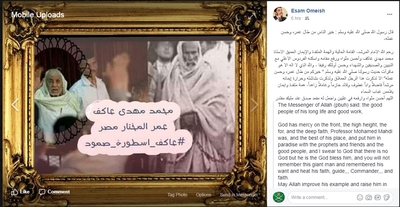
Esam Omeish, a past Muslim American Society president who serves on the board of Northern Virginia’s Dar Al-Hijrah mosque, along with a fellow board member, are among the religious leaders and political activists who publicly eulogized the Brotherhood’s leader.

In addition to running an organization which ultimately seeks a global Islamic government, Akef left a long history of extreme rhetoric that his mourners didn’t mention.

Akef led the Muslim Brotherhood from 2004-2010. During his tenure, all members had to swear a religious oath of allegiance to him known as bayah. As supreme guide, his word was absolute for members. He signed a 2004 fatwa written by Brotherhood spiritual leader Yusuf al-Qaradawi which said Muslims had “an obligation … to kill American citizens in Iraq, since they are in Iraq in order to assist the soldiers and the occupation forces; it is forbidden however to desecrate their corpses.” Bombings against American soldiers in Iraq and against Israelis in the Palestinian territories were “religious obligation[s],” Akef said months before signing that fatwa during an interview with Egypt’s Al-Arabi newspaper that was translated by the Middle East Media Research Institute (MEMRI).

He rejected calling Osama bin Laden a terrorist, saying the al-Qaida leader was “without a shadow of a doubt – a jihad fighter. I do not doubt the fact that he opposes occupation, nor that he does this in order to get closer to Allah, may He be praised and extolled,” Akef said in a 2008 interview with the website Elaph.com.

Akef was just 12 years old when he joined the Muslim Brotherhood in 1940. He worked closely with founder Hasan Al-Banna and spent more than 20 years in Egyptian prisons. Akef joined the Muslim Brotherhood’s “secret apparatus” that was involved in bombings and assassinations in the late 1940s.

Akef helped inspire the foundation of the Muslim American Society (MAS) during his trips to the U.S. in the early 1990s, a 2004 Chicago Tribune article said.

Brotherhood members founded MAS and continued to be inspired by Brotherhood ideology, Shaker Elsayed, imam of the Falls Church, Va. based Dar al-Hijrah Islamic Center, told the Tribune.

Elsayed generated controversy last spring after he endorsed partial female genital mutilation during a sermon. He remains on the job.

Omeish, one of Dar Al-Hijrah board members responsible for Elsayed’s continued employment, prayed that Akef be placed “in the higher paradise with the prophets, the pious, and the martyrs, whose company is exalted. The best of people is he who lives longer and perfected his deeds. I remember this giant man, I remembered his smile and the warmth of his faith, as a pious guide, a compassionate father, a decisive leader, and an ascetic laborer.”

Omeish acknowledged his past Brotherhood membership during a 2011 talk at American University, calling it a “wonderful experience.” He also lavished praise on the Muslim Brotherhood last December in another Facebook post.

Similarly, this was not Awad’s first time toeing the Muslim Brotherhood party line. “We congratulate the Egyptian people and their new president on this great achievement in Egypt’s struggle for freedom,” Awad said after the Brotherhood’s 2012 election victory in Egypt.

Other CAIR leaders defended the Muslim Brotherhood on social media against claims it engaged in authoritarian tactics before it fell from power in July 2013. Awad also defended Turkey following last year’s failed coup despite Islamist President Tayyip Recep Erdogan’s transformation of his country into a police state where dissent is illegal.

Awad’s past membership in the Muslim Brotherhood is documented in internal records seized by the FBI. A telephone list places Awad on the Brotherhood’s Palestine Committee, which was tasked with providing political and financial support for Hamas in the United States.

Another pro-Brotherhood individual who serves with Omeish on the Dar Al-Hijrah board eulogized Akef. Akram Elzend, a co-founder of the Muslim Brotherhood-linked Egyptian Americans for Democracy and Human Rights (EADHR), posted his own tribute to Akef on Facebook: “The Sheikh of the Mujahidin has died #Farewell_Akif,” Elzend wrote.

Elzend also alluded to supporting the Muslim Brotherhood in a March 2015 Facebook post emblazoned with the Brotherhood’s crossed sword-logo that linked to an article written by the group’s spokesman vowing to “liberate Egypt from the grip of this bloody coup.” EADHR co-founder Hany Saqr eulogized Akef as someone who could not be described with words.

“May Allah repose the martyr Mr. Mohamed Mahdi Akef and elevate him in the higher paradise and make his blood be upon them who did him injustice,” Saqr wrote on Facebook. Those internal Palestine Committee records which tie Awad to the Brotherhood network also identify Saqr as a onetime “Masul” or leader of the American Brotherhood’s Administrative Office for East America.

Osama Abu Irshaid, a board member of the United States Council of Muslim Organizations (USCMO) together with Awad, joined in the chorus of Akef mourners.

“May Allah repose Akef and all the martyrs of injustice in Egypt; may Allah curse their killers, those who enslave Egypt and their supporters, may Allah reward the liked of Habib according to their malicious acts,” Abu Irshaid wrote.

Abu Irshaid has his own past connection with a Palestine Committee entity. He served as editor of Al-Zaitounah, a pro-Hamas Arabic periodical published by the now-defunct Islamic Association for Palestine (IAP). IAP was the Palestine Committee’s propaganda arm.

Support for Akef showed particular intensity among leaders associated with Egyptian Americans for Freedom and Justice (EAFJ), who have shown strong pro-Brotherhood sympathies for years.

President Hani Elkadi eulogized Akef as a hero who “died holding his head high; he asked for no mercy, he did not entreat his jailers, or his executioners. The hero and the martyr died giving an example in patience, defiance, manhood, and steadfastness in truth.”

Elkadi made several other Facebook posts mourning Akef. EAFJ spokesman Mahmoud ElSharkawy hailed Akef as the “sheikh of the revolutionaries” who was martyred while in prison.

“May Allah rest the soul of the captive and the martyr, and we ask Allah to grant us the best of end on the path of truth and martyr without any alteration,” ElSharkawy wrote.

Elkadi and ElSharkawy’s support for Brotherhood-linked Egyptian terrorists is made clear by their numerous social media posts.

Formal memorial services for Akef were arranged by EAFJ-linked people in New York and in New Jersey. A banner at the New Jersey event called Akef the “Sheikh of the Mujahideen” in Arabic and described him as a martyr in both English and Arabic.

EAFJ co-founder Sheikh Mohamed Elbar of Brooklyn’s Islamic Center of Bay Ridge eulogized Akef as a martyr and a “mujahid” or holy warrior. Elbar belongs to the International Union of Muslim Scholars headed by Qaradawi, the Muslim Brotherhood ideologue and EAFJ co-founder.

“We ask Almighty Allah to elevate Mahdi Akef to the ranks of the martyrs … Oh Allah, he died as a Mujahid for your cause, so grant him the status of the Mujahideen,” Elbar said.

Speaker Hemmi Khairallah likewise described Akef as a martyr and warned that Muslims in America were under attack from “Zionists” and “Crusaders.”

Elbar’s mosque held a separate memorial service for Akef.

It’s not uncommon for members of an immigrant community to mourn a prominent figure from their homelands. But Akef led a religious movement which seeks global dominance and which cultivated an Islamist ideology that inspires Sunni terrorist groups throughout the world.

His U.S.-based mourners can continue trying to deny their Brotherhood affinity, but actions speak louder than words. If the leader you pray God places “in the higher paradise with the prophets, the pious, and the martyrs” led a global Islamist movement, sanctioned terrorism and served in a secretive, violent Brotherhood branch, you’ve tipped your hand.

Steve Scalise full address to Congress

September 28, 2017

Steve Scalise full address to Congress, Washington Free Beacon via YouTube, September 28, 2017

(Shot and almost killed, he’s back! — DM)

The case for a ‘clean withdrawal’ from the Iran Nuclear Deal

September 28, 2017

The case for a ‘clean withdrawal’ from the Iran Nuclear Deal, Center for Security Policy, Fred Fleitz, September 28, 2017

(Please see also, Omni Ceren: Decertification Approaches and How to Get Out of the Iran Nuclear Deal by Amb. Bolton. Iran has already received lots of money from Obama’s America and may well have made significant progress on making nukes and the missiles to deliver them. Would Iran forego further nuke-related technological advances to renegotiate the JCPOA with America and her allies? That seems highly unlikely if we withdraw, and even more unlikely if we remain, as McMaster and Tillerson apparently desire. — DM

Now, with the president reportedly determined to “decertify,” Tillerson, McMaster and others who oppose a U.S. withdrawal have shifted gears.  They have intensified their criticism of the Iran deal as deeply flawed and are proposing the president not certify but remain a party to the deal to fix it later.  In addition, they are calling for the JCPOA be sent to Congress for it to impose more sanctions.

Ambassador John Bolton has a far better and more honest option: a clean withdrawal implementing a comprehensive strategy with America’s allies – including Israel – that addresses the full range of threats posed by Iran.

***********************

There’s a pitched rhetorical battle underway right now in Washington as an October 15 deadline approaches for President Trump to certify to Congress that the 2015 nuclear deal with Iran (the JCPOA) is in the national interests of the United States and that Iran is in compliance. Although the president said last week he has made his decision, backers and opponents of the agreement are working overtime to convince him to adopt their recommendations.

President Trump has been highly critical of the JCPOA, calling it “the worst deal ever” during the presidential campaign and “an embarrassment to the United States” during his speech to the UN General Assembly on Sept. 19.

However, the president reluctantly certified the nuclear deal to Congress twice this year due to heavy pressure from his top national security advisers, especially Secretary of State Rex Tillerson and National Security Adviser H.R. McMaster.  After a heated discussion with his advisers, Mr Trump made the last certification in July but indicated he did not plan to do so again.

A few months ago, Tillerson, McMaster and other advisers were telling President Trump he had no choice but to certify the JCPOA because Iran was in compliance and any violations were “not material.”  Many disagreed, including Senators Tom Cotton, R-Ark., Ted Cruz, R-Texas, David Perdue, R-Ga., and Marco Rubio, R-Fla., who spelled out major instances of Iranian noncompliance and cheating in a July 11, 2017 letter to Secretary of State Rex Tillerson.

But the main argument Trump advisers made to certify the Iran deal was that if America withdrew it would alienate European leaders.

Now, with the president reportedly determined to “decertify,” Tillerson, McMaster and others who oppose a U.S. withdrawal have shifted gears.  They have intensified their criticism of the Iran deal as deeply flawed and are proposing the president not certify but remain a party to the deal to fix it later.  In addition, they are calling for the JCPOA be sent to Congress for it to impose more sanctions.

This supposed middle-ground option would allow President Trump to give a tough-sounding speech lashing out at the JCPOA and demanding major changes.  But Iran has made it clear that it will never agree to alter the agreement and Congressional Democrats are certain to filibuster any sanctions legislation that would kill the deal.  As a result, the “decertify but remain in the deal” option is actually a clever ploy to ensure the U.S. never withdraws from the nuclear deal.

Ambassador John Bolton has a far better and more honest option: a clean withdrawal implementing a comprehensive strategy with America’s allies – including Israel – that addresses the full range of threats posed by Iran.

Bolton was tasked to write a plan to do this by former Trump Chief Strategist Steve Bannon in response to the president’s request last July for a policy option to withdraw from the Iran deal.  Worried that the Bolton plan could sway Mr. Trump, senior Trump officials have blocked Bolton from meeting with the president.  Bolton therefore published his “Iran Deal Exit Strategy” in National Review on August 28.

Bolton’s plan has not received a lot of media coverage because senior Trump officials – especially McMaster – have been aggressively working with the press to promote the “decertify but remain in the deal” option.  However, the Bolton plan received a huge boost last week when 45 national security experts sent a letter to President Trump urging him to withdraw from the JCPOA using Bolton’s strategy.

The letter’s signatories included many leading experts in arms control and nuclear nonproliferation such as former Director of Sandia National Laboratory Paul Robinson, former Under Secretary of State for Arms Control Robert Joseph; former Under Secretary of Defense for Policy Douglas Feith; former Under Secretary of Defense for Intelligence Gen. William Boykin and dozens of other former State and Defense Department officials.

The proposal being advanced by McMaster, Tillerson and others — that President Trump keep the United States in the JCPOA but not certify to Congress that it is in our national security interests — is absurd, especially after the president called the agreement an embarrassment to the United States.  This option will ensure that this dangerous agreement continues as is and will undermine Mr. Trump’s credibility with the American people and the world.

As the 45 experts said in their letter to President Trump, “It is time to move beyond President Obama’s appeasement of Iran and to begin work on a comprehensive new approach that fully addresses the menace that the Iranian regime increasingly poses to American and international security.”  President Trump should do this by implementing a clean withdrawal from the fraudulent Iran nuclear deal using the plan drafted by Ambassador Bolton.

The Future the US Military is Constructing: a Giant, Armed Nervous System

September 28, 2017

Source: The Future the US Military is Constructing: a Giant, Armed Nervous System – Defense One

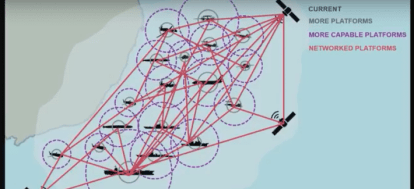
Chief of Naval Operations, Adm. John Richardson, gives a keynote address during the Naval Future Force Science and Technology (S&T) Expo, July 21, 2017. This is a slide from his presentation.

Service chiefs are converging on a single strategy for military dominance: connect everything to everything.

Leaders of the Air Force, Navy, Army and Marines are converging on a vision of the future military: connecting every asset on the global battlefield.

That means everything from F-35 jets overhead to the destroyers on the sea to the armor of the tanks crawling over the land to the multiplying devices in every troops’ pockets. Every weapon, vehicle, and device connected, sharing data, constantly aware of the presence and state of every other node in a truly global network. The effect: an unimaginably large cephapoloidal nervous system armed with the world’s most sophisticated weaponry.

In recent months, the Joint Chiefs of Staff put together the newest version of their National Military Strategy. Unlike previous ones, it is classified. But executing a strategy requiring buy-in and collaboration across the services. In recent months, at least two of the service chiefs talked openly about the strikingly similar direction that they are taking their forces. Standing before a sea of dark- blue uniforms at a September Air Force Association event in Maryland, Air Force Chief of Staff Gen. David Goldfein said he had “refined” his plans for the Air Force after discussions with the Joint Chiefs “as part of the creation of the classified military strategy.”

The future for the Air Force? The service needed to be more like a certain electric-car manufacturer.

“Every Tesla car is connected to every other Tesla car,” said Goldfein, referring to a presentation by Elon Musk about the ways his firm’s vehicles learn from their collective experience. “If a Tesla is headed down the road and hits a pothole, every Tesla that’s behind it that’s self-driving, it will avoid the pothole, immediately. If you’re driving the car, it automatically adjusts your shocks in case you hit it, too.”

What would the world look like… If we looked at the world through a lens of a network as opposed to individual platforms?
AIR FORCE CHIEF OF STAFF GEN. DAVID GOLDFEIN

Goldfein waxed enthusiastically about how Tesla was able to remotely increase the battery capacity of cars in the U.S.Southeast to facilitate evacuationbefore the recent hurricanes.

“What would the world look like if we connected what we have in that way? If we looked at the world through a lens of a network as opposed to individual platforms, electronic jamming shared immediately, avoided automatically? Every three minutes, a mobility aircraft takes off somewhere on the planet. Platforms are nodes in a network,” the Air Force chief said.

The idea borrows from the  “network centric warfare” concept that seized the military imagination more than a decade ago. But what leaders are today describing is larger by orders of magnitude. It’s less a strategy for integrating multiple networks into operations more efficiently than a plan to stitch everything, networks within networks, into a single web. The purpose: better coordinated, faster, and more lethal operations in air, land, sea, space, and cyberspace.

So the Air Force is making broad investments in data sharing. Maj. Gen. Kimberly A. Crider, the service’s first data officer, issetting up a series of experimental tests in the Nevada desert at Nellis Air Force Base near Las Vegas, seeking to better understand “what happens when we actually connect into this resilient and agile network” said Goldfein. The Air Force’s current experimentation with next-generation light tactical attack aircraft are as much about hardware as networks, he said. “Not only what can I buy and what can they do, but more importantly, can they connect? Can they actually share? And can we tie it to a new network that’s based on sharable information that gets me beyond the challenges I have right now in terms of security?”

The Air Force is also fielding new connected devices. The handheld “Android Tactical Assault kit” or ATAK, designed with special operations forces, provides a common operational picture of everything going on — basically, doing what a huge command-and-control station used to do a few years ago. “What we determined was that there were so many devices on the battlefield that had information that we weren’t collecting. Rather than build a system to pull that in, we actually went to a commercial entity and they created an algorithm. It’s user-defined and it pulls in whatever data you need and puts it on Google Maps,” said Goldfein.

The Air Force used the device during this year’s hurricane relief efforts, sending rescue teams to people reaching out for help on social media, Goldfein said.

Our scope would be in helping the Air Force to think about operations they would be conducting that would incorporate joint sensors and platforms, like destroyers.
JAMES CHOW, AIR FORCE SCIENCE BOARD

The Air Force Science Board is also launching a study into how to control a constellation of objects, some in the air, some in the sea, some on land, some piloted by humans and others more autonomous. James Chow, the board’s new head, said the study would also consider how to connect to other services.

Importantly, although the study would come out of the Air Force, it wouldn’t stop at just Air Force equipment but would extend to other weapons and vehicles in the battlespace, like Navy destroyers, said Chow.

“Our scope would be in helping the Air Force to think about operations they would be conducting that would incorporate joint sensors and platforms, like destroyers, I think that has to be part of it. And that is within the charter of the study,” Chow  said, adding that the study has “the highest priority level for Air Force leadership.”

The Multi-Domain Army and Marine Corps

The U.S. Army, too, is investing big dollars into figuring out how to connect everything on the battlefield. An Army Research Lab program called the Internet of Battle of Things will be led by researchers at the University of Illinois, with help from the Universities of Massachusetts, multiple California State branches, Carnegie Mellon, and SRI International.

The Army is currently revising its Operating Concept for itself the Marine Corps for 2025-2040. It basically forms the framework for writing future Army doctrine, which in turn shapes training, weapons acquisition, and operations. The final draft won’t be available until the Association of the United States Army conference in October, but sources close to the drafting process said it will focus on networked, multi-domain battle.

The Marines are already conducting experiments along these lines. In April, the Corps’ Warfighting Lab staged a beach assault, linking together robots, ships, satellites, amphibious assault vehicles to share targeting info and other situational intelligence.

The Marines are also looking at tanks that are digitally connected through their armor, according to Lt. Gen. Robert Walsh, who leads Marine Corps Combat Development Command and serves as Deputy Commandant for Combat Development and Integration. Speaking at a Navy event in July, Walsh recounted how he had recently emerged from a meeting with makers of new “reactive armor” for tanks.

When you start linking these platforms together, [the rate of progress is] not exponential…it’s factorial.
ADM. JOHN RICHARDSON, CHIEF OF NAVAL OPERATIONS

Walsh said that the armor — he declined to name the vendor— could heal itself while sending information about the direction of the attack to other units and back to headquarters. “It’s not, ‘we defeat a missile with a capability,’” Walsh said. “It’s ‘we quickly figure out where that came from.’ What I found was, after talking to Marines out there, that could bring out a much more offensive capability where we were originally talking about bringing a defensive capability to bear.”

Read that to mean faster clobbering of the enemy immediately after they shoot at you, rather than cowering from them.

The Navy: “Network Everything to Everything”

Navy leaders, too, are eager to connect every object on the sea, land, air, space and cyberspace. This is no exaggeration. As Adm. John Richardson, Chief of Naval Operations, put it during the Navy’s Future Force Expo in Washington, D.C., in July, “I want to network everything to everything.”

This is necessary to preserve the U.S. Navy’s advantage, even if Richardson gets the larger 355-ship fleet he seeks — hardly a given in today’s industrial and budgetary landscape. Adversaries are building more and better ships and weapons, and even the U.S. superiority in orbital and terrestrial sensing is diminishing. The cost of launching a constellation of spy sats is dropping asthe satellites become smaller and launches become cheaper.

“It’s going to be more and more difficult to find ranges and places where we can do exercises and practice without being observed,” the admiral said. “Think about the number of surveillance cameras that followed you on your way to this conference this morning. This idea of sensing is becoming ubiquitous and it’s shifting the competitive space in this [observe, orient, decide and act] loop so that no longer are we superior in that first mode, in the ability to observe. That’s becoming a very level playing field. Competition is shifting to ‘what do I do with that information.’ How do I manage…that avalanche of data?…The momentum of the game is not in our favor…We have to recapture that momentum.”

Nettworking everything is the way to win that competition. “When you start linking these platforms together, [the rate of progress is] not exponential…it’s factorial,” he said, meaning orders ofmagnitude greater than a rate of progress that is even orders of magnitude greater than a linear progression.

The Navy has already made some important progress. Last year, an experimental datalink allowed the pilot of a Marine Corps F-35B strike aircraft to send targeting data to an Aegis destroyer, which shot down the target drone with an SM-6 missile.
Interconnections

This push is too new, and still too developmental, to have attracted much concern from the public or Capitol Hill. But that will change. When Richardson’s remarks talk hit Twitter, arms-control watcher Jeffrey Lewis professed a touch of concern.

Certainly, “network everything to everything” sounds a bit like the setup for the Terminator franchise, wherein a fictional defense contractor, Cyberdyne Systems, convinces the Defense Department to link the U.S. arsenal to a single artificially intelligent entity. Skynet, of course, determines that humans are a threat to its existence and uses its ubiquitous command and control powers to launch a war on humankind.

Military leaders hate comparisons between their own tech projects and anything from the Terminator franchise. The reference usually comes up in discussions about individual drones with missiles or “killer robots.” Defense Department watchers are always keen to remind people that official policy is to keep humans at the top of the command-and-control loop, overseeing —or at least retaining veto power — over the decision to take life.

But artificial intelligence will play an important supporting role in helping commanders and operators makes sense of what’s happening on with all of these inter-linked devices and weapons, even as it steers and operates burgeoning fleets of near-autonomous drones, unmanned tanks, robot boats, and the like.

The effort to understand exactly how well all of these moving parts will co-ordinate has only barely begun. But it is the direction that the United States military is moving with both determination and speed.

Disappointed by good news from Puerto Rico

September 28, 2017

Disappointed by good news from Puerto Rico, Washington TimesDavid Keene, September 27, 2017

National Guardsmen arrive at Barrio Obrero in Santurce to distribute water and food among those affected by the passage of Hurricane Maria, in San Juan, Puerto Rico, Sunday, Sept. 24, 2017. Puerto Rico’s nonvoting representative in the U.S. Congress said

Based on what’s really been happening, Mr. Trump’s critics will not find their silver bullet in the wreckage of Puerto Rico — and would be better off trying to help rather than politicize this human tragedy.

****************************

ANALYSIS/OPINION:

They’re hoping for “deja vu all over again,” as Yogi Berra might have said. Liberals looking for a silver bullet to take down a president they can’t stand are hoping they’ve found it in the administration’s response to Hurricane Maria. After all, they found one in President George W. Bush’s perceived bungling of the Hurricane Katrina relief effort in 2005 and used it to almost terminally undermine his popularity.

Exploiting the Trump administration response to Maria may prove more difficult than they hope, however, as the Federal Emergency Management Agency (FEMA) and the administration are doing not just a better job, but a much, much better job today than the Bush administration did then. Liberal pundits, not deterred by mere facts, are almost unanimously suggesting that consistent with their ongoing belief that President Trump is an insensitive racist who simply doesn’t care about Puerto Rico. They see his criticism of NFL players who “diss” the National Anthem and the flag as proof of all this because if he really cared about Puerto Rico, he wouldn’t be tweeting about the NFL.

Mr. Trump’s critics are similarly outraged that he dared mention the island’s fiscal and budget crisis as a complicating factor that has to be dealt with to facilitate the rebuilding Puerto Rico’s infrastructure. Anyone familiar with Puerto Rico’s plight knows that this is dead-on accurate. Indeed, experts have been warning for years that the island’s electrical infrastructure is so old, weak and badly maintained that any storm could wipe it out. Restoring power is going to be very difficult and it is essential that the Trump administration recognize the difficulties our fellow citizens in Puerto Rico face. It’s why FEMA and the military immediately dispatched experts to the island to help determine just how and how soon power can be restored, relying on a system that doesn’t work very well in the best of times.

There are folks who will believe almost anything negative about the current administration, but to relive their past success, liberals are simply lying. The administration’s response to the humanitarian crisis that struck Puerto Rico has been quick and massive. Within days, FEMA and the Defense Department had more than 10,000 logistics experts on the island, supplies and food were being flown in, and mainland experts were working to re-establish communications with areas cut off by the storm.

After earlier accurately observing the total breakdown of the island’s communication’s infrastructure, one media report criticized the Trump response for taking several days to contact some local officials outside San Juan. Rescuers were trying to reach them and the officials were trying to contact the capital city, but both found communication impossible.

It is going to be quite a while before services are restored in Puerto Rico and emergency aid will continue to be needed, but those on the ground believe, in contrast to anti-Trump activists outside Puerto Rico and in the media, that the Trump administration and FEMA are doing a pretty good job.

Earlier this week, Puerto Rico’s governor was asked by a National Public Radio reporter how he would assess the administration’s response to Maria. The reporter may have been hoping for a different response, but Gov. Ricardo Rossello, who lines up nationally with Democrats, was having none of it. He said, “We are very grateful for the administration. They have responded quickly. The president has been very attentive to the situation, personally calling me several times. FEMA and the FEMA director have been here in Puerto Rico twice. As a matter of fact, they were here with us today, making sure that all the resources in FEMA were working in conjunction with the central government. We have been working together. We have been getting results.”

San Juan’s mayor has also praised the administration for its quick response and for the advance planning that had to have been behind the ability to respond as quickly as it did, and the island’s non-voting delegate in Congress agrees. Resident Commissioner Jennifer Gonzalez told a Politico reporter on Monday, “This is the first time we got this type of federal coordination.”

Based on what’s really been happening, Mr. Trump’s critics will not find their silver bullet in the wreckage of Puerto Rico — and would be better off trying to help rather than politicize this human tragedy.

Saudi women ‘thank God’ for end to driving ban

September 28, 2017

Saudi women ‘thank God’ for end to driving ban, Israel Hayom, September 28, 2017

(Old Chinese proverb: “A journey of a thousand miles begins with a single step.” — DM)

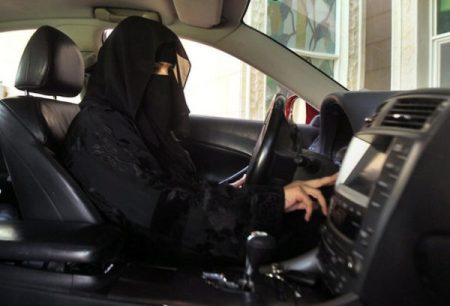
A woman drives a car in Saudi Arabia. Archives: Reuters

Women will be allowed to obtain licenses without the permission of a male relative.

A muted response from Saudi Arabia’s clergy, which has long backed the ban, suggested power shared between the Al Saud dynasty and the Wahhabi religious establishment could be shifting decisively in favor of the royals.

Many younger Saudis regard Prince Mohammed’s ascent as evidence their generation is taking a central place in running a country whose patriarchal traditions have for decades made power the province of the old and blocked women’s progress.

********************************

Saudi Arabian women rejoiced at their new freedom to drive on Wednesday, with some taking to the roads even though licenses will not be issued for nine months.

Hundreds of others chatted with hiring managers at a Riyadh job fair, factoring in the new element in their career plans: their ability to drive themselves to work.

“Saudi Arabia will never be the same again. The rain begins with a single drop,” Manal al-Sharif, who was arrested in 2011 after a driving protest, said in an online statement.

King Salman announced the historic change on Tuesday, ending a conservative tradition which limited women’s mobility and was seen by rights activists as an emblem of their suppression.

Saudi Arabia was the only remaining country in the world to bar women from driving.

At the jobs fair, Sultana, 30, said she had received four job offers since graduating from law school two years ago but turned them down because of transport issues.

“My parents don’t allow me to use Uber or Careem, so one of my brothers or the driver would need to take me,” she said, referring to dial-a-ride companies.

“I’m so excited to learn how to drive. This will be a big difference for me. I will be independent. I won’t need a driver. I can do everything myself.”

She plans to start taking driving lessons when her family travels abroad for vacation.

Other women weren’t waiting. Internet videos showed a handful of women driving cars overnight, even though the ban has not been officially lifted.

The move represents a big crack in the laws and social mores governing women in the conservative Muslim kingdom. The guardianship system requires women to have a male relative’s approval for most decisions on education, employment, marriage, travel plans and even medical treatment.

The new initiative recalls previous modernizing milestones that unnerved conservatives at first but were eventually accepted, such as the 1960s start of state education for girls and the introduction of television.

The decree is expected to boost the fortunes of 32-year-old Crown Prince Mohammed bin Salman, who has ascended to the heights of power in the kingdom with an ambitious domestic reform program and assertive foreign policy.

He said letting women drive is a “huge step forward” and that “society is ready.”

“This is the right time to do the right thing,” he told reporters. Women will be allowed to obtain licenses without the permission of a male relative.

A muted response from Saudi Arabia’s clergy, which has long backed the ban, suggested power shared between the Al Saud dynasty and the Wahhabi religious establishment could be shifting decisively in favor of the royals.

Many younger Saudis regard Prince Mohammed’s ascent as evidence their generation is taking a central place in running a country whose patriarchal traditions have for decades made power the province of the old and blocked women’s progress.

Sharif, the activist, described the driving ban’s removal as “just the start to end long-standing unjust laws [that] have always considered Saudi women minors who are not trusted to drive their own destiny.”

A driving instructor at a government-run center said women called all day to inquire about registering a license, but he had received no instructions yet from the government.

Um Faisal, a mother of six, said her daughters would get licenses as soon as possible.

“Years ago, there wasn’t work outside the house. But today women need to get out and go places. This generation needs to drive,” she said, clad in a long black abaya.

The Saudi ambassador to Washington said on Tuesday women would not need their guardians’ permission to get a license, nor to have a guardian in the car when driving.

In a country where gender segregation has been strictly enforced for decades in keeping with the austere Wahhabi form of Sunni Islam, the decree means women will have regular contact with unrelated men, such as fellow drivers and traffic police.

Other rules have loosened recently, with the government sponsoring concerts deemed un-Islamic by clerics, allowing women into a large sports stadium for the first time and permitting them to dance beside men in a central Riyadh street over the weekend.

Amnesty International welcomed the decree as “long overdue” but said there was still a range of discriminatory laws and practices that needed to be overturned.

That risks inflaming tensions with influential Wahhabi clerics with whom the ruling Al Saud has enjoyed a close strategic alliance since the kingdom’s founding.

The state-backed Council of Religious Scholars expressed support for the king’s decree. Grand Mufti Sheikh Abdulaziz Al Sheikh, who has repeatedly opposed women working and driving and said letting them into politics may mean “opening the door to evil,” has yet to comment.

On that note, meanwhile, a Saudi woman was named to a senior government post for the first time, authorities said on Wednesday.

Eman Al-Ghamidi was given the post “as part of plan to boost the number of females in leadership positions in line with Vision 2030,” the Center for International Communication at the Ministry of Culture and Information said in a statement.

The Saudi government has said Vision 2030, a vast plan of economic and social reforms, will raise women’s share of the labor market to 30% from 22% currently.

Still, some men expressed outrage at the about-face by prominent clerics, who in the past have sometimes justified the driving ban by saying women’s brains are too small or that driving endangered their ovaries.

“Whoever says this is permitted is a sinner. Women driving means great evils and this makes them especially sinful,” one Twitter user wrote.

Kawthar al-Arbash, a member of the Shura Council, a government advisory body, acknowledged that resistance, saying: “That’s how things go. Everything new is accompanied by fears.”

Lori Boghardt, a Gulf specialist at the Washington Institute for Near East Policy, said the change is yet another sign that the crown prince is intent on adopting social reforms that will transform the kingdom.

“Today it’s especially clear that this includes moves that’ve long been thought of by Saudis as politically risky,” she said.

Aziza Youssef, a professor at King Saud University and one of Saudi Arabia’s most vocal women’s rights activists, said, “I am really excited. This is a good step forward for women’s rights.”

Speaking to The Associated Press from Riyadh, she said women were “happy” but also that the change was “the first step in a lot of rights we are waiting for.”

GOTTA LOVE how China deals with its Muslim problem under the guise of protecting the country against Islamic terrorism

September 28, 2017

Chinese authorities in the northwestern predominantly Muslim region of Xinjiang have ordered all Muslim families to hand in religious items including prayer mats and all copies of the quran.

by

Source: GOTTA LOVE how China deals with its Muslim problem under the guise of protecting the country against Islamic terrorism

RFA , Officials across Xinjiang have been warning neighborhoods and mosques that ethnic minority Uyghur, Kazakh and Kyrgyz Muslims must hand in the religious items or face harsh punishment if they are found later, sources in the region said.

“Officials at village, township and county level are confiscating all Qurans and the special mats used for namaaz[prayer],” a Kazakh source in Altay prefecture, near the border with Kazakhstan told RFA on Wednesday. “Pretty much every household has a Quran, and prayer mats,” he said.

Dilxat Raxit, spokesman for the exile World Uyghur Congress group, said reports have emerged from Kashgar, Hotan and other regions of similar practices starting last week.

“We received a notification saying that every single ethnic Uyghur must hand in any Islam-related items from their own home, including Qurans, prayers and anything else bearing the symbols of religion,” Raxit said.

“They have to be handed in voluntarily. If they aren’t handed in, and they are found, then there will be harsh punishments,” he said.

China force Uighur Muslims in Xinjiang to turn in passports.

In China, Muslim men under the age of 65 are not allowed to have beards, Muslim women are not allowed to wear face-covering headbags or burqas.

Muslims in China are now forbidden from giving their babies religious names such as “Jihad,” “Islam,” “Mecca,” etc.

https://youtu.be/p9tT2u2ahfE

China bans Islamic religious activity of any kind in schools.

China bans Muslim civil servants and students from fasting during Ramadan.

https://youtu.be/mTCMAGWBPjc