Archive for September 27, 2017

Terror Victim Families: Israel Has Completely Lost Its Deterrence

September 27, 2017

Source: Terror Victim Families: Israel Has Completely Lost Its Deterrence | The Jewish Press | David Israel | 6 Tishri 5778 – September 26, 2017 | JewishPress.com

Dvorah Gonen and her son Danny z’l

Dozens of bereaved families this week announced the formation of a new organization through which they will seek to increase deterrence against would-be terrorists and fight against the “lavish conditions” received by terrorists in Israeli prisons.

The organization, “Choosing Life,” is comprised of over 40 bereaved families, the majority of whom lost their loved ones in the recent wave of terror that began in the fall of 2015.

Among those who have joined the organization include Rina Ariel, mother of 13-year-old Hallel Yaffe Ariel who was murdered in her Kiryat Arba bedroom in June 2016; Merav and Herzl Hajaj, parents of 22-year-old Shir Hajaj who was murdered in a truck-ramming attack in Jerusalem in January 2017; Noah Litman and Sarah Litman-Beigle, the wife and sister of 40-year-old Rabbi Yaakov and 18-year-old Netanel Litman who were murdered four days before Sarah’s wedding in November 2015; and Doron Mizrachi, father of 18-year old Ziv Mizrahi who was killed in a November 2015 stabbing attack on Route 443 and brother of 22-year-old Alon Mizrahi who was murdered in a suicide bombing at Jerusalem’s Cafe Hillel in September 2003.

Rina Ariel and her daughter Hallel z’l / courtesy of the family

The decision to establish an official, non-profit organization stemmed from a series of intensive activities conducted by the families over the past two years in which they’ve advocated for stricter conditions for terrorists in Israeli prisons and for harsher punishments against those complicit in the attacks, including family members of the terrorists.

The families have also been active in protesting the foreign government-funded legal defense provided by Israeli NGOs to terrorists and their families.

Dvorah Gonen, leader of the organization and mother of 25-year-old Danny Gonen who was murdered while hiking near the village of Dolev in June 2015, said: “Unfortunately, the voices of the bereaved families are not heard strongly enough. Since Danny was murdered two years and four month ago, there is no light in my life. I am dedicating my life to ensure that this does not happen to any more Israeli citizens.”

“The citizens of Israel don’t know the wide-range of benefits that terrorists and their families receive,” added Gonen. “It pays to be a terrorist today. It is absurd, we completely lost our deterrence.”

Hadas Mizrahi, wife of 47-year-old Chief Superintendent Baruch Mizrahi who was murdered in a drive-by-shooting in 2014 by a convicted terrorist freed in the 2011 Gilad Shalit prisoner swap, said: “The time has come to impose the death penalty on terrorists. It is inconceivable that convicted terrorists could be freed and could then go and murder our loved ones. We must wield an iron fist against terrorism.”

Matan Peleg, Chairman of the Zionist organization Im Tirtzu that has been accompanying the families and assisting them with establishing the organization, noted: “We have arrived at an absurd situation wherein terrorists know that it is more worthwhile for them to murder an Israeli than to steal his car.”

“Terrorists enjoy extravagant conditions in prisons and their families receive the finest legal defense courtesy of foreign governments and the New Israel Fund. This is an unacceptable phenomenon that ‘Choosing Life’ is seeking to end,” concluded Peleg.

PA accepted as INTERPOL member

September 27, 2017

The majority of INTERPOL voted in favor of accepting the Palestinian Authority as a member state Wednesday. Over the past few weeks, Israel and the US had been working together in order to thwart the vote. The Palestinians will now be able to issue international arrest warrants for IDF officers and obtain sensitive information about the fight against terrorism.

Becca Noy

Source: PA accepted as INTERPOL member | JerusalemOnline

The madness has reach a new level, terrorists as member of Interpol !!

PA President Mahmoud Abbas Photo Credit: Reuters/Channel 2 News

Despite the heavy diplomatic pressure from Israel’s National Security Council, Foreign Affairs Ministry and Strategic Affairs Ministry, the Palestinian Authority’s request to join the International Police Organization (INTERPOL) was approved today (Wednesday). 75% of the member states voted in favor of the bid while only 24 opposed it.

In accordance with its new status, the PA will be able to issue international arrest warrants for IDF officers and obtain sensitive information about the fight against terrorism.

Two days ago, JOL reported that INTERPOL’s board of directors decided that the PA’s request would be put to a vote. The discussion was temporarily delayed due to the claims of several countries, including Israel, regarding the PA not meeting the required criteria for becoming a member of the organization.

Many steps were recently taken, especially by Israeli Prime Minister Benjamin Netanyahu, in order to convince the INTERPOL member states to vote against the PA bid. However, Israel knew that it would be nearly impossible to prevent the Palestinians from joining the organization.

About two weeks ago, the UN’s World Tourism Organization announced that the vote on the PA’s request to become an official member has been postponed. The chairman of the UN agency announced at a conference in China that the vote will take place at the next UNWTO plenary session in 2019. The announcement came after the organization was pressured by Israel and the US regarding the matter.

Kurdish statehood

September 27, 2017

Source: Kurdish statehood – Opinion – Jerusalem Post

By JPost Editorial
September 26, 2017 23:46
The Kurdistan Regional Government gained relative independence in 1991, in the wake of the First Gulf War.
A man casts his vote during Kurds independence referendum in Erbil, Iraq September 25, 2017, beside

Conceiving an independent Kurdish state in northern Iraq is no easy matter. The obstacles seem insurmountable. But anyone who values democratic values and the right of a people to self-determination and who empathizes with the Kurds’ tragic history cannot help but be moved by Monday’s referendum and hope it will lead one day to international recognition of an independent and viable Kurdish state.

As a religious minority whose political independence is at best grudgingly recognized by the nations of the Middle East, Jews are natural allies of the Kurds. Cooperation – particularly military cooperation – dates back at least to 1966 when Israel, with Iranian help, aided Kurds in a battle against Iraq.

Kurdish society in northern Iraq is remarkably tolerant, though the Kurds’ de facto leader, Masoud Barzani, is no democrat.

Israeli flags could be seen on the streets of Erbil on Monday.

Earlier this month, Prime Minister Benjamin Netanyahu reiterated his support for “the legitimate efforts of the Kurdish people to achieve a state of their own.”

Netanyahu happens to be the only head of state who has come out in favor of an independent Kurdistan in northern Iraq.

Netanyahu has since honored Kurds’ request to tone down support. Ministers have reportedly been asked not to speak out on the referendum. Kurds are concerned that their many detractors will use Israel’s support for Kurdish independence against them. Nouri al-Maliki, Iraq’s vice president, said on Sunday during a meeting with US Ambassador to Iraq Douglas Sliman that his country “will not allow the creation of a second Israel in northern Iraq.”

But Israel’s natural and publicized affinity with the Kurdish cause in north Iraq should be the least of the Kurds’ worries. The Kurds have no international support for the referendum. The US, the UN and the EU have all opposed the timing of the referendum. Their central claim is that it shifts attention away from a unified battle against ISIS and sparks separatism and infighting.

Turkey and Iran, which share borders with northern Iraqi Kurdistan, are openly opposed. A fifth of Turkey’s population is Kurdish; a tenth of Iran’s population is. Neither country is interested in igniting Kurdish aspirations at home.

The Kurdistan Regional Government gained relative independence in 1991, in the wake of the First Gulf War. In 2005 it held a nonbinding referendum in which 98% voted in favor of independence. But the Kurds are hardly united. The more conservative Kurdish Democratic Party, which has relatively good ties with Turkey, is at odds with the Patriotic Union of Kurdistan. The two fought a civil war between 1994 and 1998 and control different parts of northern Iraq. Barzani, who heads the KDP, is not a unifying figure in Kurdistan. And his democratic mandate ran out four years ago. It was grudgingly extended twice but will run out again at the end of the year.

Also, it is not at all clear that northern Iraqi Kurdistan is capable of becoming a viable state. It has no access to the sea and is trapped between Iraq, Turkey and Iran, all of which oppose independence. Turkish President Recep Tayyip Erdogan hinted during a speech this week that he was considering cutting the Kurds’ only oil line, which runs through his country, and which supplies Kurds with source revenue.

Also, many Kurds living in Turkey are seeking equality and recognition as an ethnic minority and see the creation of an independent Kurdish state as endangering that quest.

Further complicating matters is the fate of Kirkuk, under Kurdish control, but with a large population of Sunnis and Turkmen and which is not considered a part of the Kurdish autonomous area by the Iraqi government.

A unilateral decision by the Kurds to take control of Kirkuk, home to rich oil reserves, could lead to conflict.

Still, the creation of an independent Kurdish state, ideally through dialogue and cooperation with local and international powers, would right a long-standing wrong. The Kurds, one of the largest stateless peoples in the world, have a shared language, culture and history. They have suffered the duplicities of American foreign policies; the barbarism of Saddam Hussein’s regime; and the atrocities of Turkish persecution. They have fought bravely against ISIS and have maintained a stable and tolerant political entity. We hope that Monday’s referendum will set in motion a process that, eventually, will lead to statehood.


Iraq warns Kurds as they claim victory in independence vote

September 27, 2017

Source: Iraq warns Kurds as they claim victory in independence vote | The Times of Israel

Iraqi PM orders Kurdish region to hand over control of its airports to federal authorities or face a flight ban

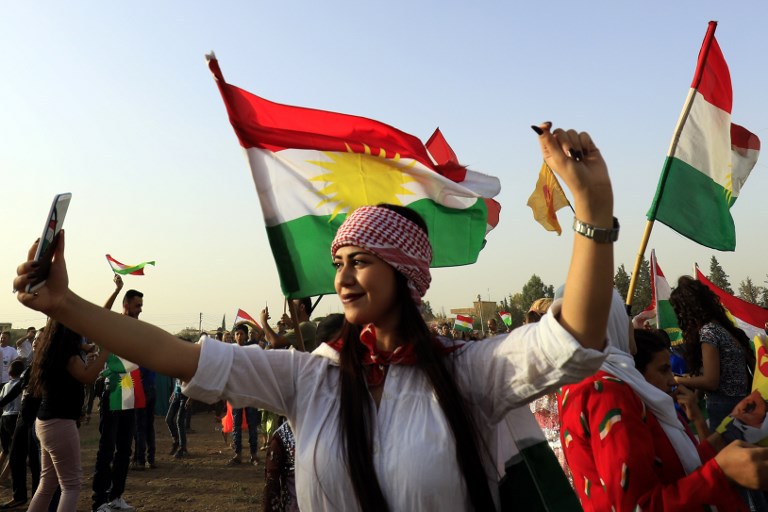
A Syrian Kurd takes a selfie, in the northeastern Syrian city of Qamishli on September 26, 2017, during a gathering in support of the independence referendum in Iraq's autonomous northern Kurdish region. ( AFP/ Delil souleiman)

A Syrian Kurd takes a selfie, in the northeastern Syrian city of Qamishli on September 26, 2017, during a gathering in support of the independence referendum in Iraq’s autonomous northern Kurdish region. ( AFP/ Delil souleiman)

IRBIL, Iraq (AP) — Iraq’s prime minister on Tuesday ordered the Kurdish region to hand over control of its airports to federal authorities or face a flight ban, as the Kurds claimed victory for the “yes” vote in an independence referendum rejected by Baghdad and Iraq’s neighbors.

The Iraqi Kurdish leadership billed Monday’s vote as an exercise in self-determination, but the Iraqi government is strongly opposed to any redrawing of its borders, and Turkey and Iran fear the move will embolden their own Kurdish populations.

Prime Minister Haider al-Abadi issued his ultimatum a day after the landmark vote, which he said was a “historic and strategic mistake by the Kurdish leadership.”

“I will not give up on the unity of Iraq, that is my national and constitutional duty,” he said, adding that any ban would still allow for humanitarian and other “urgent” flights.

Masoud Barzani, the Kurdish regional president who spearheaded the referendum, called for “dialogue” with Baghdad. “Negotiations are the right path to solve the problems, not threats or the language of force,” he said in a televised address.

Regional authorities in Iraq’s autonomous Kurdish north put the turnout at over 70 percent, but many voters reported irregularities, including cases of individuals voting multiple times and without proper registration. Official results are expected Wednesday.

For decades, Kurdish politics have hinged on dreams of an independent Kurdish state. When colonial powers drew the map of the Middle East after World War I, the Kurds, who now number around 30 million, were divided among Turkey, Iran, Syria and Iraq.

After polls closed in Iraq’s Kurdish region Monday night, the skies above Irbil filled with fireworks and families flocked to the center of town to celebrate. Across the border thousands of Iranian Kurds held rallies in support.

The non-binding vote is unlikely to lead to formal independence, to which virtually the entire international community is opposed, but could spark unrest at a time when Iraqi and Kurdish forces — both U.S. allies — are still battling the Islamic State group.

Iraqi troops are carrying out joint military exercises with Turkey along the border. Fearing the vote could be used to redraw Iraq’s borders, taking a sizeable part of the country’s oil wealth with it, al-Abadi has called the referendum an act of “sedition” that “escalated the ethnic and sectarian tension” across the country.

In Iran, thousands of Kurds poured into the streets in the cities of Baneh, Saghez and Sanandaj on Monday night. Footage shared online by Iranian Kurds showed demonstrators waving lit mobile phones in the air and chanting their support into the night. Some footage also showed Iranian police officers assembling nearby or watching the demonstrators.

Iranian state television on Tuesday acknowledged the rallies, a rarity in the Islamic Republic. Iran’s paramilitary Revolutionary Guard and its regular army have been running military exercises near the border with Iraq’s Kurdish region in a sign of Tehran’s displeasure at the Kurdish referendum.

Turkish President Recep Tayyip Erdogan reiterated on Tuesday that his country is considering all options, ranging from military intervention to economic sanctions against Iraq’s Kurdish region.
Erdogan said, however, that he hopes the Iraqi Kurdish leadership will abandon aims of creating a separate state and not force Turkey into enforcing sanctions.

“I hope the northern Iraqi administration gathers itself together and abandons this adventure with a dark ending,” Erdogan said, adding that the landlocked Iraqi Kurdish region would not be able to survive without Turkey’s support in helping export its oil.

“The moment we shut the valve it’s finished for them,” Erdogan said, referring to a pipeline through Turkey. The Turkish leader said no country other than Israel supports the Iraqi Kurdish referendum on independence, which he described as “invalid” and “fraudulent.” He said attempts by Kurds to form an independent state are doomed to fail.

The United States and United Nations both opposed the referendum, describing it as a unilateral and potentially destabilizing move that could detract from the war Iraqi and Kurdish forces are waging against the Islamic State group.

State Department spokeswoman Heather Nauert said the US wouldn’t alter its “historic relationship” with Iraq’s Kurds, but the referendum would increase hardships for them. She said IS and other extremists are hoping to “exploit instability and discord.”

Statements from UN Secretary-General Antonio Guterres expressed regret that the vote was held and said issues between Iraq’s federal government and Kurdish region should be resolved through dialogue.

Kurdish electoral commission spokesman Sherwan Zerar put the turnout at about 3.3 million of the eligible 4.5 million residents.