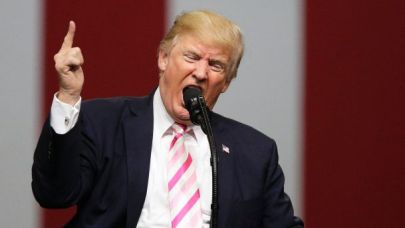
Archive for September 24, 2017

Angela Merkel Loses Support, But Wins Election

September 24, 2017

Angela Merkel Loses Support, But Wins Election, PJ MediaMichael Van Der Galien, September 24, 2017

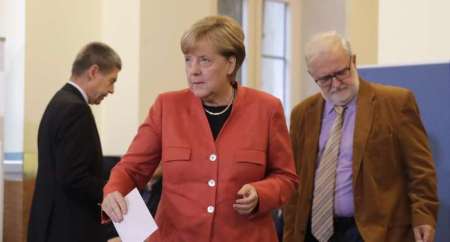
German Chancellor Angela Merkel casts her vote in Berlin, Germany, Sunday, Sept. 24, 2017. Merkel is widely expected to win a fourth term in office as Germans go to the polls to elect a new parliament. (AP Photo/Markus Schreiber)

Today’s results are a clear sign that German voters are just about fed up with Merkel’s (and Schulz’s) immigration policy. It’s because of Merkel that millions of Syrians, North Africans, Middle Easterners — and on and on — have flooded into Europe in the last few years.

*****************************

Although Angela Merkel’s Christian Democratic Union lost 9 percent compared to the last elections, her party has yet again become the largest party in Germany’s parliament today. Merkel’s CDU won 32.5 percent of the vote. That’s significantly less than four years ago, but because Germany’s electorate is more divided than ever before, it’s enough to make her chancellor once more.

However, that’s only if she’s able to form a coalition with the liberal Free Democrats and the Greens, who finished the day with 10.5 and 9.4 percent of the vote, respectively.

For Merkel, the results will leave a bitter taste in her mouth — not only because she has lost support and now needs other parties to form a coalition government, but also because she now has a competitor to her right. For the first time in decades, a right-wing populist party has won enough votes to get into the Bundestag. Alternative für Deutschland, which is routinely depicted as “racist” in the American media, won 13.5 percent of the vote, making AfD Germany’s third largest party.

The second-largest party is the SPD. However, if Merkel is somewhat disappointed, today truly was a day from hell for the SPD and its leader Martin Schulz. The SPD ended the day with a mere 20.2 percent of the vote. That’s the worst result for the social democrats since the end of the Second World War. As a result, Schulz has already announced that he is not willing to form a coalition with Merkel.

Today’s results are a clear sign that German voters are just about fed up with Merkel’s (and Schulz’s) immigration policy. It’s because of Merkel that millions of Syrians, North Africans, Middle Easterners — and on and on — have flooded into Europe in the last few years. She encouraged that wave of mass migration by telling everybody that “we can deal with it” (“Wir Schaffen das“). Well, perhaps she can schaff it, but German voters beg to differ. They see what has happened to their country, to their cities, and to their neighborhoods, and want no more of it. That’s why the CDU and the SPD have lost, while the AfD has not only passed the voting threshold of 5 percent but has done so with great ease.

This despite the fact that AfD has routinely been portrayed as neo-Nazi racist scum, not only in the media but also by Germany’s other parties. To break through regardless shows just how much potential this party — or any other right-wing populist party — has.

Hugh Fitzgerald: Pope Francis, Confusing and Confused

September 24, 2017

Hugh Fitzgerald: Pope Francis, Confusing and Confused, Jihad Watch, September 24, 2017

(Please see also, The Pope of Islam and my parenthetical comment.– DM)
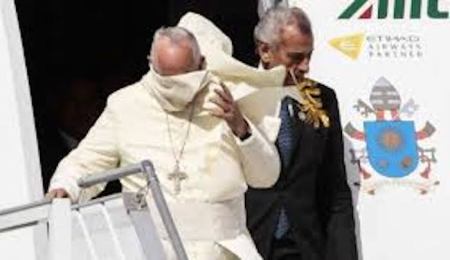
Pope Francis is a strange man. He has seemed, at times, to grasp the nature of the threat to Europe of what he once had no hesitation in describing as an “Arab invasion.” Here is what he said in 2014 in an interview with La Vie:

“The only continent that can bring about a certain unity to the world is Europe,” the Pope adds. “China has perhaps a more ancient, deeper, culture. But only Europe has a vocation towards universality and service.” … “If Europe wants to rejuvenate, it is necessary for it to find anew its cultural roots. Of all Western countries, the European roots are the strongest and deepest. By the way of colonization, these roots even reached the New World. But, by forgetting its history, Europe weakens itself. It is then that it risks becoming an empty place.”

La Vie: “Europe, an empty place? The expression is strong. … Because in the history of civilizations, emptiness always calls fullness to itself. Incidentally, the Pope becomes clinical [in his diagnosis]:

“We can speak today of an Arab invasion. It is a social fact.” … “How many invasions Europe has known throughout its history! It has always known how to overcome itself, moving forward to find itself as if made greater by the exchange between cultures.”

Clearly the Pope is torn between recognition of the parlous state Europe is now in (“we can speak today of an Arab invasion”), and faith in its amazing powers of recuperation, as he sees it in his pollyannish fashion, for this “Europe..has always known how to overcome itself, moving forward to find itself as if made greater by the exchange between cultures.”

So which is it? Is it a Europe that will “find anew its [own] cultural roots” to withstand “an Arab invasion,” or is it, rather, a Europe that ought not to fear that “Arab invasion” since it can only be “made greater by the exchange between cultures”? The Pope seems to be suggesting that both are true.

But what if this time Europe will not be “made greater” by some fructifying “exchange between cultures”? The tens of millions of Muslims who have been allowed to settle in Europe, behind what their own faith teaches them to regard as enemy lines, are not there for some kind of cultural exchange but, rather, to take what they can get, in welfare benefits and through crime, from the Unbelievers, and through inexorable demographic conquest, by degrees to subjugate the Unbelievers, until Islam everywhere dominates, and Muslims rule, everywhere.

The Muslims now in Europe are far more numerous than any previous “invasion” of immigrants, with 44 million of them now present (if we include those in European Russia), with millions more attempting, however they can, to get to Europe. These are economic migrants. They come intent on finding the most generous of welfare states; hence the desire of these migrants to make it to Sweden and Germany instead of remaining in Italy or Spain. But everywhere in Europe, albeit to different degrees, these Muslims can batten on free or highly subsidized housing, free education, free (and advanced) medical care, family allowances, subsidized or free food, and unemployment benefits (though almost no Muslims have paid into the unemployment system).

With all that on offer, Muslim migrants are in no apparent hurry to learn the skills, or the local language, that might make them employable. Why have a job when the Infidel state provides you with so much? Is it any wonder that in Sweden, one of the most generous of welfare states, of the 163,000 “asylum seekers” who arrived in  2015, by mid-2016 only 494 had jobs? Pope Francis appears to believe that when two or more groups jostle one another, this automatically leads to a welcome “exchange between cultures.” But where, in what part of the world, have those who have endured a Muslim invasion, slow or quick, having experienced this “exchange” emerged the better for it? What happened to the Christians all over the Middle East and North Africa, after the Arabs arrived to islamize and then arabize lands? The Christians were greatly reduced in numbers — some killed by their Muslim conquerors, while many others, over time, converted to Islam in order to spare themselves the payment of the Jizyah and the other onerous conditions imposed on them as dhimmis.

Where in Europe can one say that the indigenous non-Muslims are better off, socially, economically, politically, or even culturally, because of Muslim migrants? Isn’t it truer to say that the large-scale presence of Muslims in Europe has created a situation that is far more unpleasant, expensive, and physically dangerous for those indigenes, and for other, non-Muslim immigrants, than would be case without that large-scale presence?

The Pope may be thinking of other, more fructifying encounters among peoples in the distant past. He may be thinking of the Roman and the Celt in Western Europe, of the Angles and the Saxons and the Normans in England, of Basques, Catalans, and Castilians in Spain, or of the many different peoples who made America America, perhaps the most successful example of the mixing of peoples in history. He may be thinking of his own country, Argentina, with the engrafting of later arrivals — Italians, Germans, Jews — onto the Spanish tree.

When the Muslims conquered non-Muslim lands, they did not mix as equals with those they conquered and subjugated. The ancestors of the several hundred million Muslims now in Pakistan, Bangladesh, and India, for example, were once Hindus and Buddhists, who in the past converted to Islam in order to avoid living as dhimmis. In Kashmir, the Muslims have driven 200,000 Hindu Pandits out of the area into India proper. There has been no splendid cultural synthesis between Hindu and Muslim, or Buddhist and Muslim, anywhere on the subcontinent.

In many islamized and arabized countries, the non-Muslim — usually Christian — population was greatly diminished. There was no apparent benefit, no “exchange between cultures.” Even where non-Muslims have remained a significant part of the population, as the Copts are in Egypt, even though payment of the Jizyah is no longer demanded, they live lives of great physical insecurity and are subject to attack from Muslims. Possibly the grimmest result of the Iraq War was that when the Americans removed Saddam Hussein, who for his own reasons had protected the Christians, the Christian population plummeted from 1,400,000 in 2003 to 250,000 today. Apparently the Christians — both Assyrians and Chaldeans — who had lived with the Muslims for centuries, realized that without a protector, even one as ruthless and cruel as Saddam Hussein, their own lives were at permanent risk.

The Pope derives his apparently unshakeable belief that only good can arise when cultures collide from an insufficient understanding of Islam. He appears to complacently believe that all faiths resemble one another, and that all Believers desire the same things. None of this is true. For Muslims, humans are uncompromisingly divided between Muslims (“the best of peoples”) and Unbelievers (“the most vile of creatures”), and the world itself is similarly divided between Dar al-Islam, the lands where Muslims rule, and Dar al-Harb, the lands where Unbelievers still rule.

The Pope has in the past defended Islam so stoutly that he was once thanked by Ahmed al-Tayeb, the Grand Imam of Cairo’s Al-Azhar, for his “defense of Islam against the accusation of violence and terrorism.” It’s not praise for which he should be proud.

Pope Francis has even seemed to defend, albeit obliquely, the killing of the Charlie Hebdo cartoonists, by saying that “it is true that you must not react violently, but even if we are good friends, if [an aide] says a curse word against my mother, he can expect a punch, it’s normal. You can’t make a toy out of the religions of others. These people provoke and then (something can happen). In freedom of expression there are limits.” Let’s look that over: Pope Francis is comparing his landing a “punch” on someone who maligns his mother to the cold-blooded premeditated murder of a dozen people because they dared to draw Muhammad. And since he’s Pope, no one in his entourage will dare attempt to morally set him straight.

Last February, Pope Francis insisted that  all religions are equally innocent of the charge of terrorism: “Christian terrorism does not exist, Jewish terrorism does not exist, and Muslim terrorism does not exist. They do not exist. There are fundamentalist and violent individuals in all peoples and religions—and with intolerant generalizations they become stronger because they feed on hate and xenophobia.” Does the Pope not know of the verses in the Qur’an that explicitly command Believers to “strike terror” in the hearts of Unbelievers? Apparently not. He could start with 8:12: “I will cast terror into the hearts of those who disbelieve. Therefore strike off their heads and strike off every fingertip of them.” Or 8:60: “Against them make ready your strength to the utmost of your power, including steeds of war, to strike terror into (the hearts of) the enemies, of Allah and your enemies, and others besides, whom ye may not know, but whom Allah doth know. Whatever ye shall spend in the cause of Allah, shall be repaid unto you, and ye shall not be treated unjustly.”

Has Pope Francis not seen on television the killers of Drummer Lee Rigby holding up the Qur’an? Has he never heard the many terrorists, from ISIS, from Al-Qaeda, from Boko Haram,  who recite verses from the Qur’an that justify their acts? Is he deliberately keeping himself in the dark about this? Muslim terrorism is not a product of lone madmen, but of those Muslims who have become especially devout, and take to heart the Qur’anic commands to wage Jihad, and to strike terror in the hearts of the enemies of Allah. They feed on the Islamic texts themselves; they have no need to “feed on hate and xenophobia” from Unbelievers.

What “hate and xenophobia” had Osama Bin Laden or Ayman al-Zawahiri experienced? Or the two killers of Drummer Rigby? Or the Muslim who mowed down pedestrians on the Promenade des Anglais in Nice, or the Muslim who plowed through crowds on Las Ramblas in Barcelona? Had Major Nidal Malik Hassan, who had his complete medical education paid for by the U.S. army, and was earning a salary of $90,000 a year, been treated at all badly by anyone with whom he worked, or was he merely fulfilling Qur’anic commandments when he slaughtered twelve fellow servicemen? What grievances did Mohamed Atta and his 18 co-terrorists have against Americans, other than that they felt murderous hate for all Infidels, precisely for being Infidels? What grievances, what experience of “hate and xenophobia,” explain the behavior of the couple who killed their fellow co-workers at a Christmas party in San Bernardino? What “hate and xenophobia” did Aafia Siddiqui, who received scholarships to Brandeis as an undergraduate,  and to MIT for graduate study, have to endure, she who led a charmed academic life as a cosseted student, until she threw in her lot with Al-Qaeda?

The Pope claims that he finds unacceptable the  very phrase “Islamic violence,” because, of course, there are non-Muslims who commit violence:

“I don’t like to talk about Islamic violence, because every day, when I read the newspaper, I see violence.” He said, according to Crux, that “when he reads the newspaper, he reads about an Italian who kills his fiancé or his mother in law.” The pontiff added: “They are baptized Catholics. They are violent Catholics.” He said that if he spoke about “Islamic violence,” then he would have to speak about “Catholic violence” as well.

The obvious response to this is simple: Italian Catholics, or Swedish Protestants, who kill their wives, or fiancés, or mothers-in-law, are not following the teachings of their religions. But Muslims find, in more than a hundred verses of the Qur’an, calls to commit violence against Infidels. The Pope’s inability to make that simple distinction is deeply disturbing.

Pope Francis can hardly be unaware that all over the Muslim lands, Christians, whether they are converts or born into the faith, have been persecuted, attacked, killed by Muslims through the centuries, and in our own time. Such killings have taken place in Iraq, in Syria, in Egypt, in Pakistan, in Libya, in Somalia, in Yemen, in Iran, in Sudan, in Eritrea, in Afghanistan, in Indonesia. Even Angela Merkel, so tireless in her efforts to increase the Muslim population of Germany, has admitted schizophrenically that “Christianity is the most persecuted religion in the world.” She knows perfectly well who is doing the persecuting. The Pope appears not to recognize this, leaving his flock to fend for itself. He has certainly never wanted to believe that the Muslim persecution of Christians arises naturally from the texts and teachings of Islam. He avoids all mention of what is in the Qur’an. Instead, the Pope exculpates Islam at every term. He insists there’s no specifically “Muslim terrorism,” but only the terrorism of disturbed individuals, Muslim, Christian, and Jewish. He finds it perfectly understandable why Muslims would take violent offense at someone dissing their Prophet. But while Muslim violence would in such a case be perfectly understandable, he has made it clear, back in 2013, that he believes  that “authentic Islam and the proper reading of the Koran are opposed to every form of violence.”

It’s impressive that Pope Francis is such an expert on Islam and the “proper reading” of the Qur’an, and knows so much more about the matter than Yusuf al-Qaradawi, and the Grand Imam of Al-Azhar, Ahmed el-Tayeb, and the Ayatollah Khomeini, and dozens of senior Muslim clerics, all of whom seem to think that the proper reading of the Qur’an requires violence against the Infidels. “I spit on those who say that Islam is a religion of peace,” said Khomeini. What does Pope Francis think of his remark? Anything? Nothing? That the learned Shi’a cleric who has been studying Islam all of his life — he’s an Ayatollah, for god’s sake — is badly misinformed about the peaceful essence of his faith?

Pope Francis’s recent lecture to the peoples and governments of Europe is cause for real alarm. In the midst of Muslim terror attacks from Spain to Finland, and the return to Europe of thousands of ISIS supporters, and the inability of European governments to halt the flow of Muslim migrants, the Pope chose that moment to tell Europeans that they must care less about national security and more about admitting all those who want entry. It’s an extraordinary demand. The first duty of any government is to protect its citizens. The danger of Islamic terrorism is real, and increasing:  we have had more than 31,700 such attacks since 9/11 alone.

The Pope has never addressed this menace forthrightly. Instead of assuming he’s an expert on Islam,  he might practice the humility he preaches and take tuition on Islam from a real Muslim, Yahya Cholil Staquf, general secretary of the Nahdlatul Ulama in Indonesia, a group with about 50 million members, making it the country’s biggest Muslim organization. And Yahya Staquf berates Western leaders who “should stop pretending that extremism and terrorism have nothing to do with Islam. There is a clear relationship between fundamentalism, terrorism, and the basic assumptions of Islamic orthodoxy. So long as we lack consensus regarding this matter, we cannot gain victory over fundamentalist violence within Islam.”

The Pope’s latest message makes no mention of the continuing existence, and increase, of Islamic terrorism. Instead, the Pope urges countries in Europe to make still greater efforts than those they have for so long been making on behalf of Muslims. The Pope demands that governments not merely allow in as many millions of “refugees” as manage to arrive — apparently there is to be no limit — but that they “welcome, protect, promote and integrate migrants.”

Let’s stop right there. Why should Europe “welcome” those who, as Muslims, are taught to despise (Qur’an 98:6) them, commanded by their holy book to “strike terror” in the hearts of Unbelievers (8:12, 8:60), to “smite at their necks” and “cut off their fingertips,” and in more than a hundred Qur’anic verses, commanded as well to wage Jihad against them (e.g., 2:191-193, 9:5, 9:29, 47.4)? It is the Europeans who for several decades now have allowed in many millions of Muslims, so that there are now 44 million Muslims in Europe (including European Russia). They have welcomed them, protected them, promoted and tried to integrate migrants. What has been the result?

Pope Francis may not have been paying proper attention, but the result of this influx has not been some welcome convivencia, to use the word favored by Muslim apologists, when they offer as a model for the present day a sanitized version of Islamic Spain where, they want us to believe, Muslims, Christians, and Jews got along splendidly. Instead, Muslim terrorists have struck everywhere in Europe: in London and Manchester, in Nice and Toulouse, in Madrid and Barcelona, in Brussels and Amsterdam, in Berlin and Munich and Wurzburg, in Copenhagen and Stockholm and Turku, in Moscow and St. Petersburg and Beslan. And outside of Europe, there are all those attacks by Muslim terrorists in Asia (Mumbai, Kashmir, New Delhi, Jakarta, Beijing, Urumqi).

None of this appears to have made an impression on Pope Francis. He insists on repeating religious bromides, as that “Jesus’ message of love is rooted in welcoming the ‘rejected strangers of every age.’” He fails to recognize that the Muslim “strangers” were not rejected, but initially were welcomed, and it is only in a very belated response to what they have done, and are doing, in Europe that this welcome has evanesced, and both the attitudes and behavior of Muslims and greater familiarity with the Qur’an, has led Europeans to regard the Muslims in their midst not with baseless prejudice but with well-justified suspicion and fear. Or does the Pope believe that nothing any “strangers” do ought to dis-entitle them to the welcome, protection, promotion, and integration that he thinks they automatically deserve and that, equally without foundation, he thinks they will requite? How much contempt or hatred from Muslim migrants should non-Muslims be expected to endure?

What “protection” for Muslim migrants does he have in mind? This sounds as if he thinks the Muslim immigrants will  will require “protection.” But where are the news items about attacks on such immigrants? All the attacking has been done by, and not to, Muslim immigrants, and the victims have been the Unbelievers, including Catholics whom Pope Francis is supposed to protect. As for “integration,” can the Pope be unaware of all the efforts made, all the expenses incurred, by European governments, to provide free housing, medical care, education, family allowances, to the immigrants, as well as tutors in the local language, and even interpreters for their children in school, and classes in the customs and laws of the country, in order to “integrate” Muslim migrants?

It’s difficult to see what more could be done to attempt to integrate Muslim migrants. What the Pope fails to recognize is that Muslim migrants do not want to “integrate” into the society of despised Infidels; they want, instead, to be faithful to the ideology of Islam, as for example in its misogynistic treatment of women, and not to adopt the customs and laws of the Unbelievers. The Pope might ask himself why it is that Muslims are the only immigrants who have enormous trouble in integrating into Western societies. The efforts to integrate Chinese, Hindus, or black African Christians have been much more successful. Shouldn’t the Pope ask himself why all these other “strangers” have managed to integrate, while Muslims have not? The Pope wants you to believe, as he does, that if there is a problem with “integration,” it is never the fault of the migrants and their ideology, but of the rich white West that has failed to make the efforts necessary for immigrants to truly succeed. Isn’t the real barrier to integration by Muslims their own insistence on the superiority of Muslims, as the “best of peoples,” and their belief that non-Muslims are the “most vile of creatures,” and that they need to show love to fellow Muslims and hatred to Unbelievers, following the doctrine of al wala wal bara with which, one has the uneasy feeling, the Pope is unfamiliar, and even more disturbing is the thought that were it brought to his attention, he would simply refuse to believe it?

The Pope has spoken of the need for “a simplified process of granting humanitarian and temporary visas,” and rejected arbitrary and collective expulsions as “unsuitable.” He said the principle of ensuring each person’s dignity “obliges us to always prioritize personal safety over national security.”

The Pope is saying here that we must always put first the “personal safety” of migrants/refugees/asylum seekers, even if in so doing we are compromising our own national security. Why? The “simplified process” the Pope calls for means that migrants would be allowed in before they have been properly vetted, on “humanitarian” grounds. A “temporary visa” ends up being permanent, as those granted them so often refuse to leave, and when an individual who has overstayed his visa is finally caught, it takes forever to obtain, and then to enforce, a judgment of expulsion against him. Collective expulsions are not only not “unsuitable,” as Pope Francis seems to think, but the only way to deal effectively with tens or hundreds of thousands of people. No country in Europe can devote the kind of attention to individual cases that the Pope seems to think is desirable; half the government would be tied down studying those “individual cases.” No government has the manpower or the money to entertain such a policy. And keep in mind, as the Pope never does, that immigration is not a right, but a privilege. Surely, any European state that refuses to admit as immigrants people whose consuming ideology teaches them to hate, and wage war against, those they regard as Unbelievers (which is what those Europeans are), is fully justified. Pope Francis, secure in his Vatican apartments, does not grasp the need, in deciding whom to admit and whom to keep out, for administrative efficiency, and following the dictates of common sense, to judge groups rather than individuals. Is it wrong to treat a group of Muslims claiming to be “refugees” from Somalia and a group of Christians fleeing Iraq differently, privileging the latter and being deeply suspicious of the former?

The Pope thinks Europeans owe migrants a great deal. But which migrants? And for what? For the Pope, all immigrants are equal, and their presence an unalloyed benefit. It’s total nonsense. This is what the late Oriana Fallaci deplored in some Catholic clerics: il buonismo, or goody-goodiness, particularly in regard to Islam. She would be horrified to see what Pope Francis is now suggesting. Border guards, he claims, must be trained to protect not borders from illegal migrants, but those illegal migrants themselves, presumably to lend them succor and a helping hand as  they come across. They should, Pope Francis says, be guaranteed access to “basic services beyond health care.” Again, one must plaintively ask: why? Because they are there? Because they are breaking the law? Why do they even deserve “health care”? He lists as “basic services” such things as “access to consulates, the justice system, the ability to open a bank account” — that last presumably with money provided by generous Infidel taxpayers. Migrants should be given the ability “to survive financially.”

So if, say, an Iraqi family, with six children, and not one speaking a word of Italian, manages to make it to the Italian island of Lampedusa, instead of sending them back to Libya, where they would share the same religion and language as its inhabitants, they should all be admitted, according to the Pope, to Italy, where they have nothing in common, religiously, linguistically, culturally, with the Catholic Italians, and instead, bring in their mental luggage, undeclared, an inculcated enmity toward Italians as Infidels (see the Qur’an, see the Hadith). They should immediately be provided with basic needs, says the Pope. This of course includes housing, big enough for a family of eight, medical care, and education — all free. No matter that the father speaks no Italian, and has no skills (according to reports, Muslim men in Europe are in no hurry to acquire the training  that might make them employable, for why not help oneself to the Jizyah, and stay on the dole for as long as those foolish Infidels will allow?), no matter that unemployment benefits will have to be paid to support the family, no matter that in addition the government will supply  a family allowance that is determined by the size of the family (and Muslims have much larger families than non-Muslims, and not only in the Middle East). No matter that, because the father married his first cousin — a very common practice in Muslim lands (in Pakistan, consanguineous marriages are 50-60% of the total) — one of the six children may have congenital defects that are colossally expensive to treat, over a lifetime, and for which the Italian taxpayers will be paying. No matter that, when the children go to school, they will have to be provided both with interpreters and with special Italian-language classes. All of this — the housing, the education, the medical care, the family allowances, the unemployment benefits that may become permanent, the interpreters, the language classes, the extra security guards in schools, hospitals, and in other places where Muslims have behaved badly, and of course the huge anti-terrorism apparatus, consisting of police, military men, prosecutors, judges, lawyers, prison guards — adds up to huge sums.

The Pope is indifferent to economic reality. He talks as if the Italian state, and its taxpayers, have endless resources. He may be confusing Italy with Saudi Arabia, or the U.A.E., or Kuwait, or Qatar, Muslim Arab countries which could far more easily “welcome” and “integrate” fellow Muslim and Arab immigrants, and that possess the hundreds of billions of dollars to pay for them, unlike Italy or the other economically struggling nations of Europe, struggling precisely because of the tens of billions of dollars these Muslim migrants cost their host countries, in welfare benefits, and in crimes of both property and sexual assault.

Leaving aside crime, and just taking the difference between the taxes paid and the welfare benefits received, in the U.K. alone the cost of these Muslims migrants, for one year, is about 24 billion dollars, and that annual amount will only increase as their numbers increase, both through a high birth rate and immigration. If we attempt to add up the amount spent on these mostly Muslim migrants (immigrants from Eastern Europe, in fact, pay more into the system than they receive in benefits, so including them in our calculations actually helps to hide the real cost of Muslim immigrants), the cost to all the European countries comes to more than $200 billion dollars a year — a colossal sum. Does the Pope care about such things, and what that expense does to the ability of European governments to take care of their own poor? Why doesn’t the Pope publicly address the deep-pocketed rulers of Saudi Arabia, Kuwait, Qatar, the United Arab Emirates, and ask why they are not taking in these migrants who share their language and religion, people who could be far more easily integrated in Arab lands than in Europe, rather than insisting that the burden be borne by the long-suffering European Infidels?

At any time, such naivete and heedlessness as Pope Francis exhibits would be difficult to take. At this moment in world history, when the leader of the Catholic Church appears determined not to understand the meaning, and menace, of Islam, while Christians are everywhere under assault by Muslims, and Muslims are knocking at Europe’s gates and demanding to be let in without delay, to enjoy every benefit offered by those generous welfare states, even as the Muslim recipients continue to despise the Infidel providers of such benefits, his complacent buonismo is intolerable.

Pope Francis is 81. He still has plenty of time to do even more damage. In early September, he sent his secretary for relations with states, Paul Richard Gallagher, to Tehran to meet with the Islamic Republic of Iran’s Foreign Minister, Mohamed Javid Zarif, where they  discussed the “plight” of the Rohingya in Myanmar, and together no doubt deplored how the Buddhists were treating the innocent, because Muslim, Rohingya. Not a scintilla of sympathy from the Vatican for the Buddhists in Myanmar, not a word about how over the centuries Muslims have treated Buddhists wherever they conquered, nor about how Muslim invaders had brought about the virtual disappearance of Buddhism from India. Nor, of course, did the Pope raise the one issue that he ought to have always on his mind and on his lips: the horrific persecution of, and attacks on, Christians by Muslims, in the Middle East, in Africa, in South Asia, and now — thanks to this  migration he has done nothing to halt or slow down — in Europe too.

The Pope tells us that there is no such thing as “Muslim terrorism.” He knows that “authentic Islam and the proper reading of the Koran are opposed to every form of violence.” He knows that, despite the 31,700 violent attacks by Muslims since 9/11/200, many of them designed to “strike terror in the hearts of the Infidels,” Islam has nothing to do with terrorism. Despite this impressive record of fatuity, perhaps common sense will break through, somehow, and the amiable but misguided Pope Francis will begin to be mindful of the most important of today’s P’s and Q’s, the P of Islamic Practice, and the Q of the Qur’an. It could happen. But don’t hold your breath.
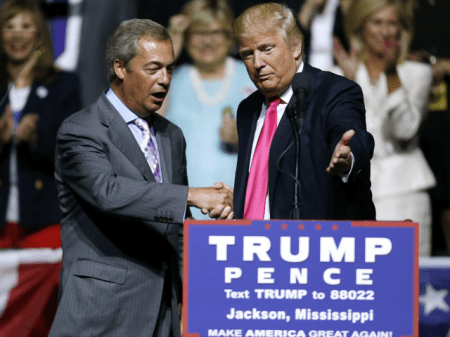
Brexit Leader Nigel Farage Endorses Judge Roy Moore, Will Speak Alongside Bannon at Rally

September 24, 2017

Brexit Leader Nigel Farage Endorses Judge Roy Moore, Will Speak Alongside Bannon at Rally, BreitbartOliver JJ Lane, September 24, 2017

Jonathan Bachman/Getty

Mr. Farage told Breitbart London he was keen to help the President achieve his goals, and that his appearance at the rally was about helping to cement the victories over the political establishment that the President and his base won in 2016.

Breitbart reported Friday the remarks of the President on his thoughts surrounding the Alabama race when he appeared to show regret in backing the establishment candidate. “We have to be loyal in life,” Trump said. “There is something called loyalty, and I might have made a mistake and I’ll be honest, I might have made a mistake.”

*********************

Nigel Farage — the man behind Britain’s anti-establishment Brexit vote and an early supporter of President Donald Trump during his campaign for election will stand behind Alabama  Republican primary candidate Judge Roy Moore.

The veteran campaigner will speak in support of the candidate Monday evening at a rally in Fairhope, Alabama, reports The Guardian.

The news comes a day after Breitbart reported executive chairman of Breitbart News and President Donald Trump’s former chief strategist Steve Bannon would be addressing the same rally alongside Phil Robertson, businessman and star of popular television programme Duck Dynasty.

The appearance of Mr Farage, Breitbart London understands, is not to oppose President Trump but to assist him in battling against Senate Majority leader Mitch McConnell’s candidate in the GOP primary.

Mr. Farage told Breitbart London he was keen to help the President achieve his goals, and that his appearance at the rally was about helping to cement the victories over the political establishment that the President and his base won in 2016.

Breitbart reported Friday the remarks of the President on his thoughts surrounding the Alabama race when he appeared to show regret in backing the establishment candidate. “We have to be loyal in life,” Trump said. “There is something called loyalty, and I might have made a mistake and I’ll be honest, I might have made a mistake.”

Arab League Opposition to Kurds Only Fuels Iran

September 24, 2017

Arab League Opposition to Kurds Only Fuels Iran, Clarion ProjectZach Huff, September 24, 2017

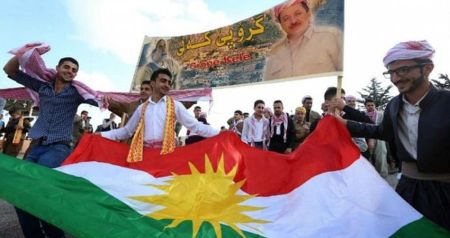
A rally for Kurdish independence in Erbil ahead of the Sept.25, 2017 referendum (Photo: Chris McGrath/Getty Images)

Sunni Arab leaders have largely been silent on the September 25 Iraqi Kurdish independence referendum, but Arab League Secretary General Ahmed Abdul Gheit visited the Iraqi Kurdish capital last week to dissuade the Kurds from holding the vote.

In a recent letter to Kurdistan Region President Massoud Barzani, Ahmed described his fears of “disintegration and fragmentation,” noting in his plea that the Arab League is “strongly keen on ensuring the territorial integrity of the Arab states.”

What seems lost on Ahmed is the strategic pragmatism in allowing the Kurds to further solidify their proven bastion against Iran and successive waves of regional instability.

The Kurdistan region is an effective vanguard against Iran, the chief instigator of regional division. At the same time, it has been the Kurds who have beaten back ISIS from their other borders.

The region has also weathered simultaneously a collapse in oil prices, a total cut of support from Baghdad, the arrival of two million refugees and the onslaught of ISIS. Standing in stark contrast to their surroundings, the Kurds are the model for stability.

Tellingly, who else vehemently opposes Kurdish self-determination in Iraq and Syria? Iran and her shadow proxies.

The regional balance continues to tilt in favor of Iran’s aspirations to create a Shiite crescent from Iran to Syria to counter the Sunni world, the West and Israel, all under a nuclear umbrella and aided by Russia. Kurdish independence would stymie that.

Competing regional designs, whether pan-Arab irredentism or America’s “freedom agenda,” now lay in tatters with Iran picking up the pieces.

With Iraq, Syria, Yemen, Qatar and Lebanon now overrun with Iranian influence, and with Iran’s expansionist sights now set on unprecedented relations with Turkey, it may not be long before the remaining Gulf States meet the full brunt of Iran and her proxies. In just the last year, Iran established a new pathway to the Mediterranean and strongholds on the Red Sea.

The Arab League in 2016 likewise condemned the Syrian Kurdish federalization, again citing fears of “disunity.” What “unity” does Secretary General Ahmed hope to preserve?

In addition to untold civilian casualties, is “Syria” still the Syrian Arab Republic if it requires massive, ongoing intervention by Russian, Iranian and Hezbollah militants to “restore” this “unity”? After all, the Arab League suspended Syria in 2011 on the basis of what the league saw as government suppression of protestors.

If an Arab city such as Aleppo can be leveled, then one cannot imagine what awaits intransigent Kurdish population centers. Indeed, Syrian officials recently warned of the “price” that the Syrian Kurdish democratic administration will pay for refusing to return to the fold.

Yet, it has only been Kurdistan region President Barzani and the Syrian Kurdish forces that have declared they will not allow the Iranian-backed Popular Mobilization Units to operate in their respective areas — which the Iranian-influenced central governments of Baghdad and Damascus fully welcome, and which Ahmed is intent on defending.

Barzani has received warm welcomes in regional capitals, including Riyadh and Amman. While his desire for independence has been met with measured silence from Sunni Arab leaders, this silence is far from the vocal condemnation by the Arab League chief.

In May, Ahmed made a wise observation when he said, “Iran is enjoying what the Arab world is going through. There are those in Iran who are watching and waiting for us to destroy ourselves.”

Ahmed should consider whether he seeks a self-fulfilling prophecy by playing into Iran’s aspirations. It’s time for the Arab League to reexamine the source of this position on the “unity” of the failed states of Iraq and Syria, and whether this opinion truly reflects the strategic pragmatism and moral clarity that the region.

Negotiation, not dialogue (or negation) [Venezuela]

September 24, 2017

Negotiation, not dialogue (or negation), Venezuela News and ViewsDaniel Duquenal, September 23, 2017

The fact of the matter is that the regime is on the defensive. The sanctions are starting to work. The latest sign that credit is withheld on gasoline import is that there are growing lines at gas stations. If it is true that the forced election of the constituent assembly had a perverse way to boost provisionally the regime it is also true that one month and a half has passed since the assembly was [seated] and there is no evidence that it is doing something positive to solve the problems of the country.  The regime is in denial but the truth is that the world that counts is united against the regime.  Russia and China, when all is said, may have a limited role since what will bring down the regime is its economic failure. Russia cannot save Maduro with bombers like in Syria…

Meanwhile the week ended with Canada imposing sanctions on 40 high ranking dictatorship personnel.  The symbolism does not escape us, the 40 thieves of Ali Baba finally starting to suffer consequences.

******************************

This past week has been eventful. It started with a new attempt at dialogue that nobody but the regime wants, to the strong words against Venezuela dictatorship from TrumpMacronSantosMichetti, and more, taking place at the UN general assembly.

That dinner table was certainly better supplied than those of Caracas

There were all sorts of activities during the festivities, like Trump hosting a dinner for the heads of a few Latin American states highly critical of Venezuela’s dictatorship.  Venezuela was mentioned in several speeches at the tribune, invariably condemnatory, except from the usual suspects like Evo’s speech, very poorly attended for that matter.  We even have the money quote from Trump, who may be wrong and obnoxious a lot of the time, but when he is right, he is right, hands down:

“The problem in Venezuela is not that socialism has been poorly implemented,
but that socialism has been faithfully implemented”

These expected actions against Maduro’s regime are what explains why a few days ago the regime asked for “dialogue” with the opposition, to be held in Santo Domingo.

Certainly, as it has become usual, the regime starts dialogue as a dilatory instrument to bring down Venezuelan opposition when the going gets too intense. But this time around it is different and the regime is not going to get once again a free pass: months of protests, political prisoners and political murders cannot be dismissed by the world democracies. What in last century would have been considered as collateral effect cannot be ignored anymore in the XXI century.

As usual a volley of declarations and counter declarations has been launched since the “dialogue” started. No point going over the confusing details.  The summary is as follow:

– all seems to indicate that it is the regime that this time around truly asked for a new dialogue and went out of their [way] to effect it, as the opposition this time around was not in the mood (at least not as long as the regime fulfills at least one of its previous commitments).

– if the regime succeeded in bringing back allies like the Dominican Republic to host the talks, and Zapatero ready for a new failure, it did not go as planned. First, the opposition announced that it would talk only to Santo Domingo president. Second, that a new set of countries would be guarantors of any new talk, not anymore the more complaint countries or devious double agents like Zapatero. e.g., now at least France will be attending for Europe.

– before the talks the head of the National Assembly, Julio Borges, came from a very successful tour in Europe’s main capitals (Paris, Berlin, Madrid and London, only Rome missing, for now).  He received full support from those who matter: Macron, Merkel, Rajoy and May. On the other hand Venezuela sent its foreign minister to do a counter tour and he was only receive by foreign ministers at best, and scolded each time.

– even though everywhere Arreaza was told that the constituent assembly would not recognized, the regime keeps trying to force its recognition by sending the president of that illegal assembly as its chief negotiation in Santo Domingo. To little effect so far we must say.

– eventually, in front of a losing strategy, as more and more inside the opposition state that there should be no talk until AFTER the state elections, the regime has started sabotaging the process with all sorts of manipulations and lies. The thing here is that the radicals inside the regime do not want any negotiation and the opposition, and the world, only wants a negotiation. Not a dialogue, a negotiation. There is a difference.

The fact of the matter is that the regime is on the defensive. The sanctions are starting to work. The latest sign that credit is withheld on gasoline import is that there are growing lines at gas stations. If it is true that the forced election of the constituent assembly had a perverse way to boost provisionally the regime it is also true that one month and a half has passed since the assembly was sat and there is no evidence that it is doing something positive to solve the problems of the country.  The regime is in denial but the truth is that the world that counts is united against the regime.  Russia and China, when all is said, may have a limited role since what will bring down the regime is its economic failure. Russia cannot save Maduro with bombers like in Syria…

But at least the regime has one satisfaction: the “dialogue” has divided deeply the opposition, before the crucial elections of next months. Those elections will be fraudulent and more, but going in disperse order with too many promoting abstention will not help. For some reason the lies of the regime about dozens of “secret” meetings, those that the opposition is willing to recognize the constituent assembly (without describing what the opposition will get in exchange) have found a wide public of, well, hysterical oppos. Then again the resurrection of Rosales or Zambrano as envoys to Santo Domingo has not been a PR coup for the MUD…..

So we have all sorts of people that preach that we should not go to vote because this would give some legitimacy to the regime. True, but in part at best for the regime. International opinion at the government levels will not be swayed by an election where harsh handed tactics of the regime will be closely monitored by their embassies.

But that saddest part of it all is that the abstention party virulence, from Maria Corina Machado to twitter warriors of the nebulous “resistencia”, is not offering any other strategy. They do not want to vote yet they are not telling us what to do, and even less, are not willing to place themselves in the front lines of whatever it is that they have in mind. Well, Maria Corina would go on the front line, but she is unable to say where the fucking front line is.

I do not know where all of this will lead us. We cannot even be certain whether the regional elections will be held. We can be sure that the regime is following a close pulse of the electoral mood, and in particular the abstention movement who thank the deities seems to peter some already.  The point is that the regime must balance the risk of losing badly the regional elections but proving to the world that a democratic transition is coming, or stick to a goal of at least 40% governors, no trickery spared, no political violence too gross.  In short, a lose lose of sorts for the regime, with a radical and radicalizing constituent assembly which nobody seems really in control of.

Meanwhile the week ended with Canada imposing sanctions on 40 high ranking dictatorship personnel.  The symbolism does not escape us, the 40 thieves of Ali Baba finally starting to suffer consequences.

And Europe sanctions are expected any time soon…………

Iraqi Kurds vote for independence. Barzani: Our borders lie where our tanks stop

September 24, 2017

Iraqi Kurds vote for independence. Barzani: Our borders lie where our tanks stop, DEBKAfile, September 24, 2017

(Please see also, The Kurdish Referendum Imbroglio. — DM)

The 5.2 million eligible voters of the semiautonomous Kurdish Republic of Iraq avow their desire on Monday, Sept. 25 to establish the first independent Kurdish state in history. An estimated 15-20 percent of the Iraqi population, the Kurds of Iraq won their autonomy in 1991. This was the halfway mark to their final goal which, too, was denied their brothers in Syria, Turkey or Iran.

“Yes” voters are expected to pack polling booths in Dahuk, Irbil and Sulaimaniya the three official provinces of KRG, plus “areas outside its administration,” such as Kirkuk, Makhmour, Khanaqin and Sinjar, where the Kurdish Peshmerga established control after expelling the Islamic State invaders.

Most world powers, including the UN Security Council, warned KRG President Masoud Barzani to back off the referendum because of its potentially destabilizing impact on the region and as a distraction from the main war on ISIS.

Iraq, Turkey and Iran threatened “counter-measures,” fearing the impact on their own Kurdish minorities.  Doubling down on their threats, their armies staged military exercises around the borders of the Kurdish Republic on various pretexts.

Barzani’s reply: “Our borders lie where our tanks stop.”  Furthermore, Kurdish leaders explained the referendum was not Kexit on the model of Brexit. It had no built-in declaration of secession from Iraq. “On the road to independence, the referendum is only one step,” said Hoshyar Zebari, former Iraqi foreign minister.

Neither Turkey, Iran or Iraq, while making threatening motions, are unlikely to take on the fierce Kurdish Peshmerga in a full-fledged war, especially when it has the backing of the US, Russia, Germany and up to a point, Israel.

With this card in hand, Iraq’s Kurdish leaders are in no hurry. They find that their people’s commitment to the independence, even though it is unconsummated, arms them with an ace in the hole for the lengthy negotiations ahead with the Baghdad government on separation – and possibly on rights for their fellow communities as well, with Ankara, Tehran and Syria.

These negotiations are likely to wind back and forth and erupt into violent outbreaks, with the potential for inflaming the national ambitions of the Kurdish communities outside Iraq. Turkey has the largest Kurdish minority – 15 million; Iran around 6 million; and Syria 2 million – together with Iraq a total of 35 million, who dwell in regions fragmented among the four neighboring countries. The Kurdish national struggle carries the potential of being caught up in a bloody conflict with Sunni Arab or Shiite Iranian opponents, with unpredictable consequences.

The most immediate prospect now is an Iraqi-Kurdish confrontation, triggered not just by the Kurds’ national referendum, but by the battle for control of Iraq’s northern oilfields, centering on Kirkuk.

The Kurds cherish Kirkuk as their Jerusalem, whereas for Baghdad, it represents one-quarter of the oil produced in the northern region.

Russia is the only world power which has not publicly condemned the Kurds for their referendum  – for the very good reason that the Russian energy giant, Rosneft, last week announced a pledge estimated at $4 billion for the development of Kurdish oil and gas fields for domestic consumption and eventual export.

Barzani not only has his tanks on the ready, but also a timely big-power insurance guarantee  Moscow is hardly likely to let the Iraqi army attack Kirkuk, after successfully planting there Russia’s first strategic foothold in Iraq, since the Americans toppled Saddam Hussein in 2003.

And so the Kurds can continue to safely pump around 600,000 barrels of oil a day under their tricolor red, white and green flag, set with a blazing sun.

The Kurdish Referendum Imbroglio

September 24, 2017

The Kurdish Referendum Imbroglio, Gatestone Institute,> Amir Taheri, September 24, 2017

What is the first thing you should do when you have dug yourself into a hole? The obvious answer is: stop digging. This is the advice that those involved in the imbroglio over the so-called independence referendum in Iraqi Kurdistan, due to be held on September 25. But still in the suspense of writing this column, would do well to heed.

The idea of holding a referendum on so contentious an issue at this time is bizarre, to say the least. There was no popular demand for it. Nor could those who proposed it show which one of Iraq’s problems such a move might solve at this moment. In other words, the move was unnecessary, in the sense that Talleyrand meant when he said that, in politics, doing what is not necessary is worse than making a mistake.

If by independence one means the paraphernalia of statehood, the three provinces that form Iraqi Kurdistan lack nothing: They have their president, prime minister, cabinet, parliament, army, police, and, even, virtual embassies in key foreign capitals. They are also well-furnished with symbols of statehood, including a flag and national anthem.

Having said all that, one could hardly deny the Kurds a desire for independence.

In a sense, some Kurds have dreamt of an independent state since over 2000 years ago, when the Greek historian Xenophon ran into them in the mountains of Western Asia. (See his account in his masterpiece Anabasis).

Right now, however, all indications are that any attempt at a unilateral declaration of independence by the Kurds could trigger a tsunami of conflicts that the region, already mired in crisis, might not be able to handle. In other words, the hole dug by Erbil may become an ever-deepening black hole, sucking a bigger chunk of the Middle East into the unknown; hence the need to stop digging.

Yet, almost everyone is doing the opposite.

Massoud Barzani, the president of the autonomous Kurdistan Regional Government, has lashed out against Turkey and Iran while threatening military action to seize disputed areas in Iraq. Barzani’s tough talk may please his base but could strengthen chauvinist elements in Baghdad, Ankara and Tehran who have always regarded Kurds as the enemy.

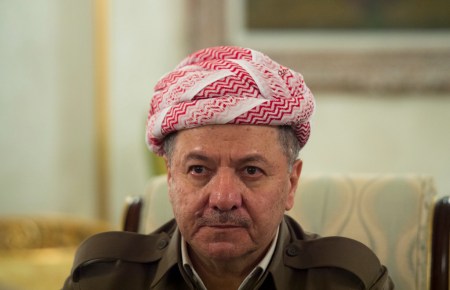
Massoud Barzani, president of the autonomous Kurdistan Regional Government. (Image source: U.S. Department of Defense)

For his part, Iraqi Prime Minister Haidar al-Abadi has come close to threatening the use of force to stop a process that remains unclear.

Threats have also come from Tehran, where National Security Adviser Ali Shamkhani says the Islamic Republic would cancel all security accords concerning the Kurdish region and might intervene there militarily to deal with anti-Iran groups.

For its part, Ankara has branded the referendum a “red line”, using a discredited term made fashionable by former US President Barack Obama in 2014 over Syria.

Just days before the referendum, the Turkish army staged a highly publicized military demonstration on the border with the autonomous Iraqi Kurdistan, presumably as a warning to Erbil.

As for Russia, the sotto voce support given to the referendum is more motivated by hopes of juicy oil contracts than sober geostrategic considerations. Such a stance might win President Vladimir Putin more support from the oligarchs, but risks dragging Russia into a risky process over which it won’t have any control.

Washington’s mealy-mouthed comments on the issue are equally problematic.

Iraqi Kurds have been the United States’ best allies in dismantling the Saddamite system in post-liberation Iraq and in the current fight against ISIS. The US would gain nothing by casting itself as an opponent of Kurdish self-determination.

Tackling the problem from a legal angle, Iraq’s Supreme Court has declared the proposed referendum in violation of the Iraqi constitution. For its part, Iraq’s national parliament has invited the Erbil leadership to postpone the referendum, echoing a message from the United States and the European Union.

It is not clear where all this talk of canceling the referendum at the 11th hour may lead. However, I think cancellation at this time could do more harm than good.

First, it could discredit the Erbil leadership at a time it needs to prop up its authority, indeed its legitimacy. Whether one likes the Erbil leadership or not, sapping its authority is neither in the interest of Iraqi Kurds nor, indeed, of Iraq as a whole. Encouraging splits in the Kurdish ranks and promoting a political vacuum in the autonomous region is the last thing Iraq needs.

Secondly, a last-minute cancellation could strengthen elements who still believe that force and threat of force are the most efficient means of dealing with political problems. Almost 14 years after the demise of Saddam Hussein, Iraq isn’t yet free of past demons who dream of a monochrome Iraq dominated by a clique.

Thirdly, a last-minute cancellation could be seen as a legitimization of the right of Ankara and Tehran to intervene in Iraqi domestic affairs through a mixture of military pressure and thinly disguised blackmail.

So, what is the best way to stop deepening the hole?

A possible answer may be built around the position taken by Iraqi President Fouad Maasoum, himself an ethnic Kurd but, apparently at least, genuinely committed to building a pluralist system in Iraq. Maasoum has not offered an elaborate scheme. But his suggestion that the imbroglio be tackled through talks between Baghdad and Erbil could be used as the basis for a compromise.

In such a compromise, the referendum would go ahead unhindered while it is made clear that its outcome would in no way be legally binding on anyone. In other words, the referendum, whatever its result, would be accepted as a political fact that could and should be taken into consideration in designing the road-map Iraq would need once it has wiped out ISIS.

Iraqi Kurds cannot impose their wishes by force, especially when they are far from united over national strategy. On the other hand, Iraq cannot revert to methods of dealing with its “Kurdish problem” that led to so many tragedies for the Kurds and derailed Iraqi national life for decades.

The September 25th referendum was unnecessary. The best one could do at the 11th hour is to help morph it into a mistake. Politics cannot deal with the unnecessary, but it can deal with mistakes.

Amir Taheri, formerly editor of Iran’s premier newspaper, Kayhan, before the Iranian revolution of 1979, is a prominent author based on Europe. He is the Chairman of Gatestone Europe.

This article first appeared in Asharq Al Awsat and is reprinted here with the kind permission of the author.

It Was the Deep State that Colluded with the Russians, not Trump

September 24, 2017

It Was the Deep State that Colluded with the Russians, not Trump, American ThinkerClarice Feldman, September 24, 2017

(Lots of questions that require answers. — DM)

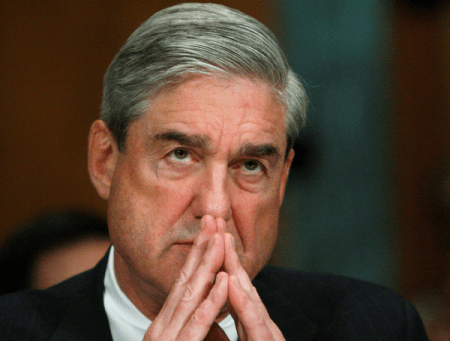
With each leak of his conduct – designed, I suppose, by his team to terrify honest men into lying to redeem the special counsel’s misbegotten efforts — Mueller looks more and more like a petrified enlistee in  the secretive repressive state force — the Stasi — as the wall is coming down and their conduct made public.

************************************

As more and more leaks about the ongoing “Russian collusion” witch hunt by Robert Mueller appear in print, it seems to me that if Russia had been trying to erode our faith in our institutions, the Deep State is accomplishing what Russia failed to do.

The Obama claque’s efforts were initially intended to help Clinton when they thought she would win and no one would know about their crimes. Then they continued the unlawful spying to cover up their role in the worst case of misuse of federal power in our history, to effect the removal or emasculation of the President, and now they are desperate to cover up their illegal actions when all that failed.

A. Where we are today on “Russian collusion”?

Instapundit tweeted the answer succinctly: “The election was hacked!” turns out to mean, “Russia bought some ads on Facebook.”

Facebook is turning over ads presumably purchased by Russians during the campaign. Good — let’s see them. As the article notes:

The announcement that Facebook would share the ads with the Senate and House intelligence committees came after the social network spent two weeks on the defensive. The company faced calls for greater transparency about 470 Russia-linked accounts  — in which fictional people posed as American activists — which were taken down after they had promoted inflammatory messages on divisive issues. Facebook had previously angered congressional staff by showing only a sample of the ads, some of which attacked Hillary Clinton or praised Donald J. Trump.

As Tom Maguire reminds us, it would be unwise to assume this was a one-sided campaign: “Let’s see all the ads and find out whether Russia was winding up both sides. Back in the day it was believed Russia backed anti-fracking groups in Europe. Why not also in the US?”

Best of the Web’s James Freeman thinks that, in any case, the notion that these ads swung the election is ridiculous on its face:

So the spending on fake Russian political ads identified by Facebook amounted to around 1/7,000th of what Mrs. Clinton spent on advertising. And of course these fake ad buys were not material in the context of Facebook’s total advertising revenues, which amounted to nearly $27 billion last year.

Is a $150,000 ad buy even big enough to require sign-off from Mr. Putin? If as some believe, Russian meddling was simply intended to discredit the likely winner, some poor Russian agent may now be headed to Siberia for engineering the election of a U.S. President who seems determined to drive down the price of oil.

Let’s hope Congress gets to the bottom of this. If $150,000 amounts to the entire iceberg, and it still managed to sink the S.S. Clinton, marketing majors will be studying these ads for years to come.

B. Using the Full Force of FISA to spy on a political opponent

Obama has a long history of spying on his opponents and releasing information damaging to them. It’s a lifelong pattern. He got two opponents’ sealed divorce records unsealed in order to use unsubstantiated claims in pleadings by estranged spouses against them. As President, he continued this practice. By way of example, the Obama Administration did that with IRS, collecting information about the activities and donors of conservative and pro-Israel citizen groups while it refused to grant them the tax-exempt status to which they were entitled. The EPA collected private information from farmers and ranchers and released it to environmental groups to help them in their battles against those farmers and ranchers. There’s no reason to suppose that this pattern didn’t carry over to the 2016 election, and plenty of evidence that it did. As Sharyl Attkisson points out, they did it with reporters and Congressmen.

Nobody wants our intel agencies to be used like the Stasi in East Germany; the secret police spying on its own citizens for political purposes. The prospect of our own NSA, CIA and FBI becoming politically weaponized has been shrouded by untruths, accusations and justifications.

You’ll recall DNI Clapper falsely assured Congress in 2013 that the NSA was not collecting “any type of data at all on millions or hundreds of millions of Americans.”

Intel agencies secretly monitored conversations of members of Congress while the Obama administration negotiated the Iran nuclear deal.

In 2014, the CIA got caught spying on Senate Intelligence Committee staffers, though CIA Director John Brennan had explicitly denied that.

There were also wiretaps on then-Congressman Dennis Kucinich (D-Ohio) in 2011 under Obama. The same happened under President George W. Bush to former Congresswoman Jane Harman (D-Calif.).

Journalists have been targeted, too. [snip]

The government subsequently got caught monitoring journalists at Fox News, The Associated Press, and, as I allege in a federal lawsuit, my computers while I worked as an investigative correspondent at CBS News.

As Attkisson reminds us, other Trump associates General Michael Flynn and Carter Page were also under government surveillance. As bad as that was, it was ”discovered [that] multiple Trump “transition officials” were “incidentally” captured during government surveillance of a foreign official. We know this because former Obama adviser Susan Rice reportedly admitted “unmasking,” or asking to know the identities of, the officials. Spying on U.S. citizens is considered so sensitive their names are supposed to be hidden or “masked,” even inside the government, to protect their privacy.”

She also specifically unmasked Steve Bannon, who met in the transition period with a UAE official so it’s altogether possible they were spying on him generallyas well.

If so, that would mean that four Trump associates had been spied on, multiplying the number of conversations with the President these people were listening in on.

Even more “unmasking”– revealing the names of those innocents scooped up in this broad surveillance — about 300 people had their privacy violated when the dyspeptic-looking UN Ambassador Samantha Power was revealed to have made almost one unmasking request a day, rapidly adding to the list as the inauguration approached.

Samantha Power, the former U.S. ambassador to the United Nations, was ‘unmasking’ at such a rapid pace in the final months of the Obama administration that she averaged more than one request for every working day in 2016 — and even sought information in the days leading up to President Trump’s inauguration, multiple sources close to the matter told Fox News.

Two sources, who were not authorized to speak on the record, said the requests to identify Americans whose names surfaced in foreign intelligence reporting, known as unmasking, exceeded 260 last year. One source indicated this occurred in the final days of the Obama White House.

C. The FISA Court surely was misled in order to get information to surveil and to continue surveilling Trump and his associates.

FISA (the Foreign Intelligence Surveillance Act) permits blunderbuss intelligence gathering. It’s not designed to gather information on crimes in general, but only to act as a tool of counterintelligence or counterterrorism. And it certainly would be suspicious if efforts were made to misuse it to conduct domestic political spying. There’s only one legitimate reason to conduct surveillance on a U.S. citizen under FISA — to find out more about the activities of a foreign power or terrorist organization. Since in the process of scooping up so much information, other matters might be revealed, “minimization” procedures are used to mask the identities of those caught up in the sweep who are not involved in such activities.

CNN reported — with some obvious omissions and errors of law — that former FBI director James Comey secured secret FISA orders to wiretap Paul Manafort, who briefly served as Trump’s campaign manager, and that having received nothing from that order, then secured another FISA warrant in 2016 (after Manafort joined the Trump campaign) and continued that surveillance into 2017, after the election.

Further, CNN reported that two attempts were made in the summer of 2016 to obtain a FISA order, both of which were rejected, and an order was issued only after the third try. FISA rarely rejects such requests, so I think it fair to assume the court was suspicious of these requests, which smelled like political, not national security matters. I think it almost a certainty that the final request received the personal imprimatur of Comey (as Director of the FBI) and Attorney General Loretta Lynch.

And what, you may ask, was different about the third and ultimately successful third attempt? I suggest it was the phony Steele dossier, which credible reports indicate was partially financed by Comey’s own FBI.

The House Intelligence Committee’s investigation took a sharp and notable turn on Tuesday, as news broke that it had subpoenaed the FBI and the Justice Department for information relating to the infamous Trump “Dossier.” That Dossier, whose allegations appear to have been fabricated, was commissioned by the opposition-research firm Fusion GPS and then developed by a former British spook named Christopher Steele. [Ed: Sources for the most scurrilous allegations in it were from unnamed sources in Russia, most likely Russian government intelligence agents or liars working on a pay for dirt basis.]

The Washington Post in February reported that Mr. Steele “was familiar” to the FBI, since he’d worked for the bureau before. The newspaper said Mr. Steele had reached out to a “friend” at the FBI about his Trump work as far back as July 2016. The Post even reported that Mr. Steele “reached an agreement with the FBI a few weeks before the election for the bureau to pay him to continue his work.”

Who was Mr. Steele’s friend at the FBI? Did the bureau influence the direction of the Trump dossier? Did it give Mr. Steele material support from the start? The timing matters because it could answer the vital question of why the FBI wanted the dossier. Here’s one thought: warrants.

The Foreign Intelligence Surveillance Court, which oversees spying activities, is usually generous in approving warrants, on the presumption law-enforcement agencies are acting in good faith. When a warrant is rejected, though, law enforcement isn’t pleased.

Perhaps the FBI wanted to conduct surveillance on someone connected to a presidential campaign (Carter Page?) but couldn’t hit what was — and ought to be — a supremely high bar for getting such a potentially explosive warrant. A dossier of nefarious allegations might well prove handy in finally convincing the FISA court to sign off. The FBI might have had a real motive to support Mr. Steele’s effort. It might have even justified the unjustifiable: working with a partisan oppo-research firm and a former spook to engineer a Kremlin-planted dossier that has roiled Mr. Trump’s entire presidency.

True Pundit claims that FBI connivance with GPS Fusion to create the dossier was not all it did to secure the final 2016 FISA warrant — it also set up a meeting in Trump Tower and used information gleaned from Britain’s GCHQ in NSA headquarters to unlawfully gather information on U.S. citizens.

From the beginning it was a set up to find dirt on Trump campaign insiders and if possible to topple Donald Trump’s presidential aspirations.

Before and after the 2016 election. And while this operation had many moving parts and alternating players, the mission to unseat Trump never changed. And it remains ongoing.

And none of it was very legal.

[snip]

Six U.S. agencies [the FBI, NSA, CIA, Office of the Director of National Intelligence, Treasury financial crimes division under DHS, Justice Department]created a stealth task force, spearhead by CIA’s Brennan, to run domestic surveillance on Trump associates and possibly Trump himself.

To feign ignorance and to seemingly operate within U.S. laws, the agencies freelanced the wiretapping of Trump associates to the British spy agency GCHQ.

The decision to insert GCHQ as a back door to eavesdrop was sparked by the denial of two FISA Court warrant applications filed by the FBI to seek wiretaps of Trump associates.

GCHQ did not work from London or the UK. In fact the spy agency worked from NSA’s headquarters in Fort Meade, MD with direct NSA supervision and guidance to conduct sweeping surveillance on Trump associates.

[snip]

The Justice Department and FBI set up the meeting at Trump Tower between Trump Jr., Manafort and Kushner with controversial Russian officials to make Trump’s associates appear compromised.

Following the Trump Tower sit down, GCHQ began digitally wiretapping Manafort, Trump Jr., and Kushner.

After the concocted meeting by the Deep State, the British spy agency could officially justify wiretapping Trump associates as an intelligence front for NSA because the Russian lawyer at the meeting, Natalia Veselnitskaya, was considered an international security risk and prior to the June sit down was not even allowed entry into the United States or the UK, federal sources said.

By using GCHQ, the NSA and its intelligence partners had carved out a loophole to wiretap Trump without a warrant. While it is illegal for U.S. agencies to monitor phones and emails of U.S. citizens inside the United States absent a warrant, it is not illegal for British intelligence to do so. Even if the GCHQ was tapping Trump on U.S. soil at Fort Meade.

The wiretaps, secured through illicit scheming, have been used by U.S. Special Counsel Robert Mueller’s probe of alleged Russian collusion in the 2016 election, even though the evidence is considered “poisoned fruit.”

Veselnitskaya, the Russian lawyer who spearheaded the Trump Tower meeting with the Trump campaign trio, was previously barred from entering the United Sates due to her alleged connections to the Russian FSB (the modern replacement of the cold-war-era KGB).

Yet mere days before the June meeting, Veselnitskaya was granted a rare visa to enter the United States from Preet Bharara, the then U.S. Attorney for the southern district of New York. Bharara could not be reached for comment and did not respond the a Twitter inquiry on the Russian’s visa by True Pundit.

(More on the unusual visa granted to Veselnitskaya here. More on GCHQ operating from NSA headquarters here.)

In July, Bharara’s former associate US Attorney Andrew Goldstein was added to Mueller’s army of largely Clinton backers and contributors to the special counsel’s enormous team.

In sum, the contention by True Pundit is that the government first spied on Trump and then concocted a national security ruse and desperately sought a FISA warrant to cover up the political spying which occurred before the FISA warrant was ever issued.

The editors of the Wall Street Journal also suspect that the dossier was used to obtain the FISA warrant, and, if so, that requires a congressional investigation:

The FISA court sets a high bar for warrants on U.S. citizens, and presumably even higher for wiretapping a presidential campaign. Did Mr. Comey’s FBI marshal the Steele dossier to persuade the court?

All of this is reason for House and Senate investigators to keep exploring how Mr. Comey’s FBI was investigating both presidential campaigns. Russian meddling is a threat to democracy but so was the FBI if it relied on Russian disinformation to eavesdrop on a presidential campaign. The Justice Department and FBI have stonewalled Congressional requests for documents and interviews, citing the “integrity” of Special Counsel Robert Mueller’s investigation.

But Mr. Mueller is not investigating the FBI, and in any event his ties to the bureau and Mr. Comey make him too conflicted for such a job. Congress is charged with providing oversight of law enforcement and the FISA courts, and it has an obligation to investigate their role in 2016. The intelligence committees have subpoena authority and the ability to hold those who don’t cooperate in contempt.

I agree with Daniel Greenfield. Based on what I’ve read and observed, while the initial surveillance was to stop Trump and help Clinton, Obama used FISA to provide a “national security” cover for politically spying on Trump right up to the inauguration. As he notes, the first 2016 application was made the month after Trump obtained the nomination and the second in October, the month before the election.

As the unmasking picked up pace after the election, the reasonable assumption is that its purpose was to undo the results of the election or hamstring the incoming President.

Now Obama and his allies are or should be terrified that the scope of the illegal surveillance is revealing their criminal acts.

This is why I believe Mueller is growing increasingly desperate to find one crime by one person he can force by threat of jail to provide any shred of anything that might be used to justify their illegal espionage. Greenfield’s conclusion is apt: “The left is sitting on the biggest crime committed by a sitting president. The only way to cover it up is to destroy his Republican successor. A turning point in history is here. If Obama goes down, the left will go down with him. If his coup succeeds, then America ends.”

Why do I say that Mueller seems increasingly desperate? How else does one explain a middle-of-the-night pick-lock armed entry (and the search of his bedclothes-garbed wife) into the home of a man who by all accounts had been fully cooperating and turning over all requested documents? How else to explain requesting a court grant such a necessary special warrant on the ground that otherwise documents evincing a purported eleven-year-old crime would suddenly be destroyed? How else to explain the effort by Mueller to find out client information from the Skadden Arps and Akin Gump law firms, materials probably covered by attorney-client privilege? With each leak of his conduct – designed, I suppose, by his team to terrify honest men into lying to redeem the special counsel’s misbegotten efforts — Mueller looks more and more like a petrified enlistee in  the secretive repressive state force — the Stasi — as the wall is coming down and their conduct made public.

Trump says Iran ‘working’ with North Korea after Tehran tests missile that can reach Israel

September 24, 2017

Source: Trump says Iran ‘working’ with North Korea after Tehran tests missile that can reach Israel – Africa, Asia and Australia – Haaretz.com

Trump’s tweet comes after North Korea said that firing its rockets at the U.S. mainland was ‘inevitable’

U.S. President Donald Trump speaks at a campaign rally in support of Sen. Luther Strange in Huntsville, Alabama, September 22, 2017.
U.S. President Donald Trump speaks at a campaign rally in support of Sen. Luther Strange in Huntsville, Alabama, September 22, 2017. Brynn Anderson/AP

U.S. President Donald Trump accused Iran of collaborating with North Korea on Saturday after Tehran succesfully tested a new ballistic missile that could reach Israel.

“Iran just test-fired a Ballistic Missile capable of reaching Israel.They are also working with North Korea.Not much of an agreement we have!” Trump tweeted.

Trump’s tweet follows a week of heightened rhetoric from Washington and Pyongyang, with Trump and Kim Jong Un trading insults. Trump called the North Korean leader a “madman” on Friday, a day after Kim dubbed him a “mentally deranged U.S. dotard.”

On Saturday, North Korea’s foreign minister said that firing its rockets at the U.S. mainland was “inevitable” after Trump called Pyongyang’s leader “rocket man.”

North Korean Foreign Minister Ri Yong Ho’s remarks before the United Nations General Assembly came hours after U.S. Air Force B-1B Lancer bombers escorted by fighter jets flew in international airspace over waters east of North Korea, in a show of force the Pentagon said demonstrated the range of military options available to Trump.

“Through such a prolonged and arduous struggle, now we are finally only a few steps away from the final gate of completion of the state nuclear force,” Ri told the annual gathering of world leaders.

“It is only a forlorn hope to consider any chance that the DPRK (Democratic People’s Republic of Korea) would be shaken an inch or change its stance due to the harsher sanctions by the hostile forces,” he said.

Trump announced new U.S. sanctions on Thursday that he said allow targeting of companies and institutions that finance and facilitate trade with North Korea. Earlier this month the UN Security Council unanimously adopted its ninth round of sanctions on Pyongyang to counter its nuclear and ballistic missiles programs.

Ri, who said Pyongyang’s ultimate goal was to establish a “balance of power with the U.S.”, retorted that Trump himself was on a “suicide mission” after the U.S. president said Kim was on such a mission.

The U.S. bombers’ flight was the farthest north of the demilitarized zone separating North and South Korea that any U.S. fighter jet or bomber has flown in the 21st century, the Pentagon said.

“This mission is a demonstration of U.S. resolve and a clear message that the President has many military options to defeat any threat,” said Pentagon spokeswoman Dana White, calling North Korea’s weapons program “a grave threat.”

“We are prepared to use the full range of military capabilities to defend the U.S. homeland and our allies.”

Ri warned Pyongyang was ready to defend itself if the U.S. showed any sign of conducting a “decapitating operation on our headquarters or military attack against our country”.

North Korea has launched dozens of missiles this year, several flying over Japan, as it accelerates its program aimed at enabling it to target the United States with a nuclear-tipped missile.

Pyongyang conducted its sixth and largest nuclear test on Sept. 3 and has launched dozens of missiles this year as it accelerates a program aimed at enabling it to target the United States with a nuclear-tipped missile. The North has threatened to test a hydrogen bomb over the Pacific.

The Pentagon said the B-1B Lancer bombers came from Guam and the U.S. Air Force F-15C Eagle fighter escorts came from Okinawa, Japan. It said the operation showed the seriousness with which it took North Korea’s “reckless behavior.”

The patrols came after officials and experts said a small earthquake near North Korea’s nuclear test site on Saturday was probably not man-made, easing fears Pyongyang had exploded another nuclear bomb just weeks after its last one.

China’s Earthquake Administration said the quake was not a nuclear explosion and had the characteristics of a natural tremor.

The CTBTO, or Comprehensive Test-Ban Treaty Organization, which monitors nuclear tests, and officials of the South Korean meteorological agency also said they believed it was a natural quake.

An official of South Korea’s Meteorological Agency said acoustic waves should be detected in the event of a man-made earthquake.

“In this case we saw none. So as of now, we are categorizing this as a natural earthquake.”

The earthquake, which South Korea’s Meteorological Agency put at magnitude 3.0, was detected 49 km from Kilju in North Hamgyong Province, where North Korea’s known Punggye-ri nuclear site is located, the official said.

All of North Korea’s six nuclear tests registered as earthquakes of magnitude 4.3 or above. The last test registered as a 6.3 magnitude quake.

Tensions have continued to rise around the Korean Peninsula since Pyongyang carried out its sixth nuclear test, prompting a new round of UN sanctions.

Trump told the UN on Tuesday the United States would “totally destroy” North Korea if it threatened the United States or its allies.

North Korea’s nuclear tests to date have all been underground, and experts say an atmospheric test, which would be the first since one by China in 1980, would be proof of the success of its weapons program.