
Archive for September 23, 2017
wisdom !
September 23, 2017Russia Warns US In Unprecedented “Secret” Face-To-Face Meeting Over Syria, But What’s The Endgame?
September 23, 2017by Tyler Durden
Sep 22, 2017 9:00 PM”>Sep 22, 2017 9:00 PM
The moment the first Russian jet landed in Syria at the invitation of the Assad government in 2015, Putin placed himself in the driver’s seat concerning the international proxy war in the Levant. From a strategic standpoint the armed opposition stood no chance of ever tipping the scales against Damascus from that moment onward. And though US relations with Russia became more belligerent and tense partly as a result of that intervention, it meant that Russia would set the terms of how the war would ultimately wind down.
Russia’s diplomatic and strategic victory in the Middle East was made clear this week as news broke of “secret” and unprecedented US-Russia face to face talks on Syria. The Russians reportedly issued a stern warning to the US military, saying that it will respond in force should the Syrian Army or Russian assets come under fire by US proxies.
The AP reports that senior military officials from both countries met in an undisclosed location “somewhere in the Middle East” in order to discuss spheres of operation in Syria and how to avoid the potential for a direct clash of forces. Tensions have escalated in the past two weeks as the Syrian Army in tandem with Russian special forces are now set to fully liberate Deir Ezzor city, while at the same time the US-backed SDF (the Arab-Kurdish coalition, “Syrian Democratic Forces”) – advised by American special forces – is advancing on the other side of the Euphrates. As we’ve explained before, the US is not fundamentally motivated in its “race for Deir Ezzor province” by defeat of ISIS terrorism, but in truth by control of the eastern province’s oil fields. Whatever oil fields the SDF can gain control of in the wake of Islamic State’s retreat will then used as powerful bargaining leverage in negotiating a post-ISIS Syria. The Kurdish and Arab coalition just this week captured Tabiyeh and al-Isba oil and gas fields northeast of Deir Ezzor city.
The race is underway for Syria’s most oil rich province. Syrian War Report (9/22/17) courtesy of SouthFront.
At various times the Syrian-Russian side has come under mortar fire from SDF positions, even as Russia and the US are theoretically said to coordinate through a special military hotline. The SDF for its part claims it too has come under attack from the Syrian Army. The most significant event occurred just over a year ago when the US coalition launched a massive air attack on Syrian government troops in Deir Ezzor near the city’s military airport at the very moment they were fighting ISIS. The US characterized it as a case of mistaken identity while Syria accused the US coalition of directly aiding ISIS by the attack. The end result was about 100 Syrian soldiers dead and over a hundred more wounded while ISIS terrorists were able to advance and entrench their positions.
Though US officials disclosed few elements of this week’s unusual meeting, the US side did confirm Russia’s threat of returning fire should Syrian soldiers come under attack. US coalition spokesman Colonel Ryan Dillon confirmed that, “They had a face-to-face discussion, laid down maps and graphics.” But the Russians publicly delivered further details outlining its message to the US military. Russian Major-General Igor Konashenkov said in a statement,“A representative of the U.S. military command in Al Udeid (the U.S. operations center in Qatar) was told in no uncertain terms that any attempts to open fire from areas where SDF fighters are located would be quickly shut down.” He added that, “Fire points in those areas will be immediately suppressed with all military means.” Russia has further openly accused the US of violating previously agreed to ‘de-escalation’ zones in Idlib (as part of Astana talks) using al-Qaeda proxies to engaged the Syrian Army in Idlib.
The US coalition hinted in its statements that future military-to-military talks could continue regarding coordination in Syria. Though Russian warnings sound alarmist, and though the situation is increasingly very dangerous for the prospect of escalation, the US side appears to be in a vulnerable enough position to listen. The fact that the meeting occurred in the first place and was publicly acknowledged by the Pentagon is hugely significant as a US ban on such direct military talks was put in place after the collapse in relations between the two nations following the outbreak of the Ukraine proxy war in 2014.
In reality some degree of US-Russian back channel communication and intelligence sharing probably existed long before the SDF made gains in Syria’s east – this according to Seymour Hersh’s 2016 investigation entitled, “Military to Military”. Though (ironically) the CIA’s push for regime change against Damascus was still operational and presumably in full gear at that time, the Pentagon’s actions in Syria were always perhaps more humble regarding pursuit of regime change.
But what are current Pentagon plans for its SDF proxy?
It’s no secret that the core component force of the SDF – the Kurdish YPG – has at times loosely cooperated with the Syrian government when the situation pragmatically served both sides. At the same time Damascus has over the past few years recognized the Kurds as a militarily effective buffer against both ISIS and other powerful jihadist groups like al-Nusra Front and Ahrar al-Sham. While many Russian and pro-Damascus analysts have accused the SDF of being a mere pawn of US imperialism meant to permanently Balkanize the region, this is only partially true – the truth is likely more nuanced.
No doubt, the US is laying plenty of concrete in the form of forward operating bases across Kurdish held areas of northern and eastern Syria (currently about a dozen or more). And no doubt the US is enabling the illegal seizure of oil fields formerly held by the Islamic State, but Kurdish and US interests are not necessarily one and the same. The Kurds know that the best they can hope for in a post-war Syria is a federated system which allows Kurdish areas a high degree of autonomy. They also know, as decades of experience has taught them, that they will eventually be dumped by the US should the political cost of support grow too high or become untenable. For now the Kurds are gobbling up as many oil fields as possible before they are inevitably forced to cut deals with Damascus.
Though the US endgame is the ultimate million dollar question in all of this, it appears at least for now that this endgame has something to do with the Pentagon forcing itself into a place of affecting the Syrian war’s outcome and final apportionment of power: the best case scenario being permanent US bases under a Syrian Kurdish federated zone with favored access to Syrian oil doled out by Kurdish partners. While this is the ‘realist’ scenario, there’s of course always the question that an independent Iraqi Kurdistan could one day be realized out of the merging of Kurdish northern Iraq and Syria. But this would be nothing less than a geopolitical miracle. For now, early voting has begun in the Kurdish diaspora ahead of the planned for September 25th referendum on Kurdish independence, with the very first votes reportedly being cast in China.
“I Think There Will Be War” – Iraqi Kurds Fear Conflict After Referendum
September 23, 2017class=”submitted_username”>by Tyler Durden
22, 2017 3:30 AM”>Sep 22, 2017 3:30 AM
Source: “I Think There Will Be War” – Iraqi Kurds Fear Conflict After Referendum | Zero Hedge
Authored by Tom Westcott via Middle East Eye,
Official fears violence after 25 September independence vote, as disputes grow in areas controlled by Kurd forces outside original KRG borders.

Fears of fresh conflict in northern Iraq are bubbling to the surface weeks before Iraqi Kurds hold a contentious vote on independence, with warnings of war over disputed, ethnically mixed border regions and reports of Shia forces pushing Kurd officials from a town to prevent voting.
The Kurdistan Regional Government, or KRG, has refused repeated requests from Baghdad, the US and regional powers to postpone its 25 September referendum, saying it would only do so if an alternative was presented by Iraq’s central government.
Tensions have risen in areas liberated by KRG forces outside the region’s original 2003 borders, including the city of Kirkuk. On Monday the KRG’s president, Massoud Barzani, said “any attempt to change the reality using force” in Kirkuk “should expect that every single Kurd will be ready to fight.”
Dr Jutyar Mahmoud, a member of the region’s independence referendum commission, told Middle East Eye that disputed territories such as Kirkuk were the focus of fears of a new conflagration after the referendum.
“We will face border problems in the near future and I definitely think there will be another war, and soon,” he said.
He described Iraq as “militarily weak,” after three years of battling the Islamic State (IS), during which time forces have suffered extensive losses, particularly in the recent nine-month fight to liberate Mosul.
A greater threat, he said, was posed by Iraq’s other army – the Iranian-backed paramilitary Hashd al-Shaabi, or Popular Mobilisation force.
“The Hashd are another threat and maybe Iran will push them to fight us,” Mahmoud said, adding that Iraq’s prime minister, Haider al-Abadi, “doesn’t control the Hashd, but Iran can.”

Jutyar Mahmoud considered the Hashd a greater threat than Iraq’s regular army (AFP)
Hostile acts
His comments preceded bouts of recent unrest in some of the contested border regions. On Saturday, local Arabs pulled the KRG flag from a council building in Mandali, in the province of Diyala, and staged an armed, albeit peaceful, protest in the town.
The next day, the town council sacked the Kurdish mayor and overruled a previous vote that agreed to the town’s participation in the referendum, according to the Kurdish news service Rudaw. Claims that the Hashd were involved were denied by a well-placed source, who said such actions were not in line with the force’s policies.
The source told MEE that if local fighters affiliated with the Hashd were involved, they were representing themselves, not the Hashd al-Shaabi.
Also on Saturday, Kurdish Turkmen were urged to boycott the referendum by eight Turkmen parties in Kirkuk, who repeated Baghdad’s line that the vote is unconstitutional.
In Sinjar, 2,000 Yazidis have joined the Hashd, according to the force’s spokesman Ahmed al-Asadi.
Yazidi refugees living in camps said the move was prompted by dissatisfaction with the Kurdish peshmerga forces for failing to protect them from IS in 2014, and what they said was ongoing neglect and marginalisation of Yazidis under the KRG.
Adding to extant tensions are limitations of voter eligibility. Although northern Iraq has long been ethnically mixed, Arabs relocated under former Iraqi leader Saddam Hussein’s Arabisation schemes are not eligible to vote in the referendum, said the KRG referendum commission’s Mahmoud.
Voting in the disputed territories would also be limited to areas controlled by the peshmerga, Mahmoud said, adding that Hashd forces had made it clear that they would not accept ballot boxes being placed in any areas under their control.
Kirkuk’s tinderbox
Both the peshmerga and Hashd forces are maintaining a strong military presence in several disputed territories, including Kirkuk province.
Several thousand Turkmen Hashd fighters reportedly control what Hashd spokesman Asadi said was the lion’s share of the province, but he insisted any talk of war was political bluster.
“The Hashd al-Shaabi were founded to ensure the stability and security of Iraq, not to ignite sectarian or regional wars,” he told Middle East Eye.
“Anyone who promotes these ideas about war between Iraq and Kurdistan are outsiders intent on destabilising the security and stability of Iraq.
“The affairs in Kurdistan are not going to lead to a war and such talk is nothing but a passing political tempest to satisfy some political matters for some Kurdish politicians.
“We view Kurdistan as an Iraqi land and we will defend it as we continue to defend all of Iraq.”
Asadi said “brotherly ties” between Hashd fighters and the Kurds had been proved by how they stood united in one trench to defend Iraq in the battle against IS.

Baghdad, the US and regional powers have urged the KRG to postpone its referendum (Reuters)
Brotherly ties
Dr Kemal Kerkuki, a peshmerga commander stationed near IS-occupied Hawija, echoed this sentiment, saying the chance of war with Iraq was “very, very narrow, if not impossible” – but was keen to reiterate the strength of the peshmerga.
“The peshmerga forces are always ready to defend our lands and I think the fight against IS has shown the whole world what our forces are capable of,” he said.
“However, we are determined to use the referendum and all democratic tools in our negotiations with Baghdad for an amicable divorce.”
Kerkuki insisted defeating IS remained a priority for both the KRG and Baghdad, and said there was ongoing cooperation between Iraqi and peshmerga forces.
Having swiftly defeated IS in Tal Afar, Iraqi forces are now preparing to begin their operations to retake Hawija, in one of the many disputed areas along the border regions between the KRG and Iraq.
Kerkuki admitted there were recurrent problems between rival Iraqi forces but remained adamant that the referendum would help resolve rather than exacerbate problems in the border regions.
“The referendum is a peaceful and democratic tool to solve the chronic problems between the Kurdistan region and Iraq,” he said.“The referendum is a tool to defuse war and intra-city conflicts in the newly liberated areas, particularly the so-called ‘disputed areas’.”
Iran too “shoots rockets all over the place” with no US action. Another NKorean nuclear test?
September 23, 2017
The nuclear twinning of North Korea and Iran is a long established fact. Shortly after Iran’s ballistic missile test Saturday, Sept. 23, North Korea is suspected of conducting another nuclear test. A magnitude-3.4 zero-depth quake was detected in North Korea, at roughly the same site as the shallow quake on Sept. 3 that was caused by nuclear test. China’s seismic service, says the quake is likely caused by an explosion.
Two dictators, supreme leader Ayatollah Ali Khamenei and Kim Jong-il, followed by his son, Kim Jong-un, have for years used their nuclear and missile collaboration to fertilize their programs while taunting the world.
As recently as Aug. 3, a delegation from Pyongyang, led by parliament speaker Kim Yong Nam, who ranks as number 2 in the North Korean hierarchy, spent 10 days in Tehran as guests of the government. DEBKAfile reported at the time that the visitors sat down with the heads of Iran’s army, security authorities and military industry, to explore ways of expanding their military cooperation in general and their nuclear and ballistic missile programs, in particular.
The interplay between Pyongyang and Tehran came to the fore in the last 48 hours. While the Kim regime indicated on Friday, Sept. 22, that it was considering a hydrogen bomb test in the Pacific Ocean, the Islamic regime went forward the next day to conduct a test of a 2,000km range ballistic missile, which is capable of carrying multiple warheads and dropping them at any point in the Middle East, including Israel
Airspace chief, Gen. Amir Ahajizadeh of the Revolutionary Guards Corps, which runs the program, is quoted as saying that the new Khoramshahr missile “can carry several warheads for various uses.”
Translated into military terms, this means that even if American or Israeli anti-air missiles posted in the region can intercept one or two of those warheads, the rest will hit their target.
The in-flight video implanted in the Khoramshahr’s nose cone was stressed by the Iranian general because it was Tehran’s answer to Israel’s Chief of Staff, Lt. General Gady Eisenkott. He stated in his New Year message on Wednesday that the IDF is focusing on preventing Hizballah from obtaining high-precision Iranian missiles.
However, a missile carrying a video in its nose cone can be steered precisely by ground stations to hit within a few meters of target. Therefore, even if Israel can prevent their delivery to Hizballah, those missiles can be guided to target from stations in Iran.
President Donald Trump said in Alabama Friday: “We can’t have mad men out there shooting rockets all over the place. He should have been handled long ago.”
He was referring to the North Korean dictator, but the rejoinder came the next day from Tehran: the test of the missile showcased in a military parade in Tehran Friday.
As of Saturday, the US president finds that the twin perils he faces from the two rogue regimes, dumped in his lap by his predecessors, have reached a point which can’t be addressed by trading playground insults. Threats of “total destruction” and assurances that they will be handled are beginning to sound like pretexts for Trump’s failure to confront the provocative threats posed by Kim Jong-in and Ayatollah Khamenei.
Trump has the option of trashing the nuclear deal with Iran – for better or for worse.
But Prime Minister Binyamin Netanyahu can no longer get away with strong speeches against Iran taking up an established position in Syria, or with threats that the imported pro-Iran Shiite militias fighting there “will never go home.”
Israel is too close to the line of fire to be able to passively follow the Trump administration’s lead on whether or not to react to a peril which has already reached its threshold. Jerusalem can’t continue to rely on Washington for solving its most immediate security threats without serious loss to its deterrence capacity and military credibility.T
Israeli jets reportedly strike weapons depot outside Damascus
September 23, 2017Source: Israeli jets reportedly strike weapons depot outside Damascus | The Times of Israel
No casualties as three separate airstrikes target area known to be a Hezbollah stronghold; Israel, Syria mum on alleged attack

Illustrative: Israeli F-35 fighter jets fly over Jerusalem during celebrations marking Israel’s 69th Independence Day on May 2, 2017. (AFP Photo/Thomas Coex)
Israel has for years has been widely believed to have carried out airstrikes on advanced weapons systems in Syria — including Russian-made anti-aircraft missiles and Iranian-made missiles — as well as Hezbollah positions, but it rarely confirms such operations on an individual basis.
Earlier this month, Israel allegedly struck a facility in northwestern Syria, where the regime was said to have stockpiled chemical weapons and missiles, killing two people.
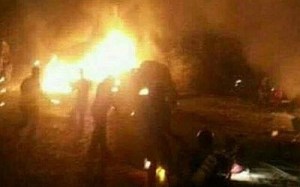
A Syrian facility reportedly attacked by Israeli aircraft early on Thursday, September 7, 2017 (screen capture: Twitter)
Jerusalem fears that the Iranian presence in southern Syria, near the Golan Heights, would serve as a springboard for terrorist groups to attack Israel in the future.
On Tuesday, the Israeli Air Force shot down an Iranian-built drone launched by Hezbollah with a Patriot missile after it attempted to cross into Israeli airspace.
The military also scrambled fighter jets to the area, but ultimately did not need to use them as the interceptor missile was able to destroy the target.
Judah Ari Gross and AFP contributed to this report.
Defying US warnings, Iran tests new missile capable of reaching Israel
September 23, 2017Source: Defying US warnings, Iran tests new missile capable of reaching Israel | The Times of Israel
Tehran says test launch of Khoramshahr — with 1,250-mile range and ability to carry multiple warheads — was successful
September 23, 2017, 9:57 am
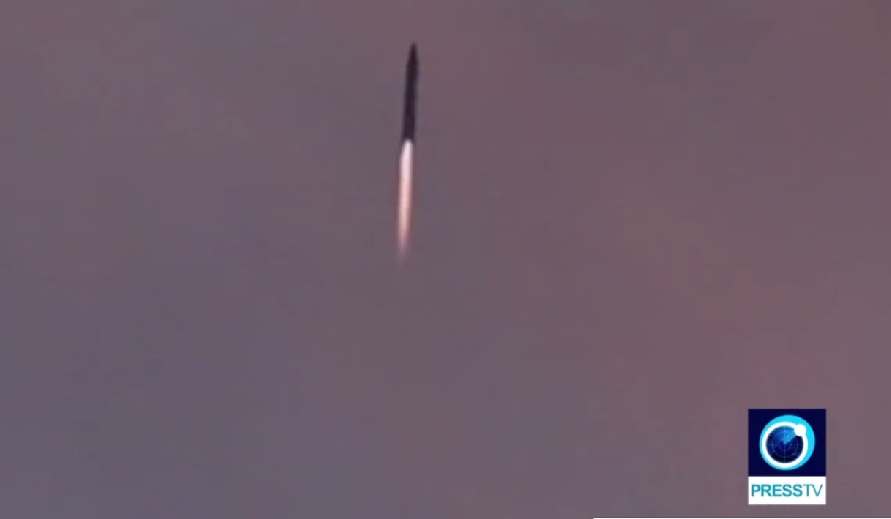
Iran announced on Saturday, September 22, 2017, that it has successfully tested a new missile, with a 1,250-mile range, which is capable of reaching Israel and US bases in the Gulf. (Screenshot/PressTV)
Iran said on Saturday that it had successfully tested a new medium-range missile, in defiance of warnings from Washington that it was ready to ditch a landmark nuclear deal over the issue.
State television carried footage of the launch of the Khoramshahr missile, which was first displayed at a high-profile military parade in Tehran on Friday. It also carried in-flight video from the nose cone.
The broadcaster gave no date for the test, although officials had said on Friday that it would be tested “soon.”
“The Khoramshahr missile has a range of 2,000 kilometers (1,250 miles) and can carry multiple warheads,” the official IRNA news agency quoted Revolutionary Guards aerospace chief General Amir Ali Hajizadeh as saying on Friday when the missile was unveiled.
Iran says all of its missiles are designed to carry conventional warheads only and has limited their range to a maximum of 2,000 kilometers, although commanders say they have the technology to go further.
That makes them only medium-range but still sufficient to reach Israel or US bases in the Gulf.
Previous Iranian missile launches have triggered US sanctions and accusations that they violate the spirit of the 2015 nuclear deal between Tehran and major powers.
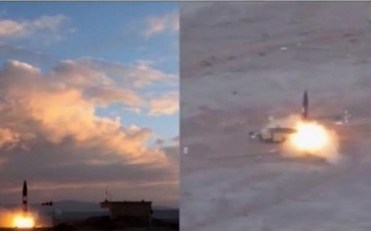
Iran said on Saturday, September 22, 2017, that it successfully tested a new missile, with a 1,250-mile range, which is capable of reaching Israel and US bases in the Gulf. The missile, Khoramshahr, was launched from an unknown location. (Screenshot/PressTV)
US President Donald Trump has threatened to ban the agreement over the issue, saying that Iran’s missile program could give it the technical know-how for a delivery system for a nuclear warhead when a sunset clause in the deal expires in 2025.
He is due to report to Congress on October 15 on whether or not he believes Iran is in compliance with the nuclear deal. If he decides that it is not, it could open the way for renewed US sanctions and perhaps the collapse of the agreement. Trump said on Wednesday he had made his decision, but was not yet ready to reveal it.
On Friday, Iranian President Hassan Rouhani vowed that Iran would boost its ballistic missile capabilities despite US criticism.
“Whether you like it or not, we are going to strengthen our military capabilities which are necessary for deterrence,” Rouhani said in a speech broadcast live on state television as Iran displayed a new missile at a military parade marking the anniversary of the outbreak of its devastating 1980-1988 war with Saddam Hussein’s Iraq.
US President Donald Trump addresses the United Nations General Assembly at UN headquarters in New York City, on September 19, 2017. (Drew Angerer/Getty Images/AFP)
“We will strengthen not only our missiles but also our air, land and sea forces… When it comes to defending our country, we will ask nobody for their permission.”
Criticism by the Trump administration of the 2015 nuclear deal has focused heavily on Tehran’s continuing missile program.
Tehran says that the missiles are entirely legitimate under the terms of the deal, as they are not designed to carry a nuclear warhead.
At the UN on Wednesday, Rouhani said Iran has never sought nuclear weapons, and that its military arsenal, including its missiles, “are solely defensive deterrence.”
But Washington says they breach the spirit of the agreement as they have the potential to carry a nuclear warhead, and the US has imposed new sanctions over Tehran’s continuing launches and tests.
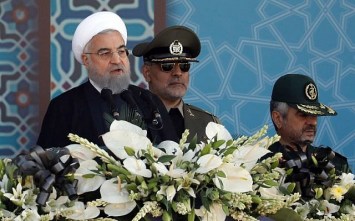
class=”wp-caption-text”>Iranian President Hassan Rouhani delivers a speech during the annual military parade marking the anniversary of the outbreak of Iran’s 1980-1988 war with Saddam Hussein’s Iraq, on September 22, 2017 in Tehran. (AFP/Stringer)
There has been some sympathy for the US position from France, whose President Emmanuel Macron said the deal could be expanded to ban missile tests and cut a sunset clause in the nuclear agreement that would see Iran resume some uranium enrichment from 2025.
Washington has also taken aim at what it says is Tehran’s failure to meet expectations that it would play a more stabilizing role in the Middle East.
“Regrettably, since the agreement was confirmed we have seen anything but a more peaceful, stable region and this is a real issue,” Secretary of State Rex Tillerson told reporters at the United Nations.
Washington has been particularly concerned about Iran’s heavy intervention in Syria on the side of the government of President Bashar al-Assad and its support for Shiite rebels in Yemen who control the capital in defiance of its Saudi-backed government.
But Rouhani ruled out any change of policy in the region.
“Whether you like it or not, we are going to defend the oppressed peoples of Yemen, Palestine and Syria,” he said Friday.
Moscow: US-backed SDF faces “destruction.” Pro-Iranian Iraqi force crosses into Syria
September 23, 2017Source: Moscow: US-backed SDF faces “destruction.” Pro-Iranian Iraqi force crosses into Syria – DEBKAfile
class=”below-entry-meta”> Deir el-Zour, Hizballah, IDF, Iran, Russia, SDF, Syria, US

Israel’s strategic situation took several steps back in the first week of the New Year, chiefly: The US pulled back from E. Syria under Russian threat, allowing Iran to move in.
In just one week, the dire perils, which many military and political experts warned against for years, are suddenly looming on Israel’s northern border.
- From Sept.15-17, Syrian and Hizballah forces crossed the Euphrates to the eastern bank on pontoon bridges provided by Russia.
- Last Saturday, Sept. 16, Russian jets bombed the US-backed Syrian Defense Forces (SDF) in the Deir ez-Zour region, as a warning against their obstructing the eastward impetus of those Syrian and Hizballah units.
- On Monday, Sept. 18, US Marines began blowing up buildings at the Zaqaf military base in eastern Syria and then retreating to the Jordanian border. The US set up Zaqaf early this year in the Syrian Desert as a barrier against this very Syrian/Hizballah crossing to impede their advance to the Syrian-Iraqi border.
- The following day, on the heels of the US withdrawal, Hizballah troops took charge of the Zaqaf base.
- On Wednesday, Sept. 19, the Iraqi Hashd Al-Sha’abi (Popular Mobilization Units – PMU) crossed into Syria and linked up with the Syrian-Hizballah force. The PMU is under the direct command of Gen. Qassam Soleimani, head of Iranian military operations in Syria and Iraq.
- Iran, through its Iraqi, Lebanese and other foreign Shiite pawns, is now in control of 230km of the Syrian border, from Abu Kamal (still held by ISIS) in the north, to Al Tanf in the Syrian-Iraqi-Jordanian border triangle in the south – where, too, US and coalition special forces have begun packing up ready to exit.
Iran in recent years imported some 20,000 Afghan and Pakistani Shiite fighters to reinforce the Syrian army and Hizballah in their battles for Bashar Assad. The new Iraq arrivals boost that figure by tens of thousands and more are coming in all the time. - On Thursday, Sept. 21, the growing disconnect between Moscow and Washington over Syria suddenly erupted into an open breach with a crude threat from the Kremlin: “Russia has officially informed the United States via a special communications channel that Russian forces will strike immediately US-backed forces if they attack or shell Syrian or Russian task forces operating near the Deir Ez-Zour city. Any attempts at shelling from the areas where the militants of the Syrian Democratic Forces are based will be immediately curbed. Russian forces will suppress firing points in these areas using all means of destruction.”
A threat of this degree of ruthlessness has not been encountered in the Middle East for decades, it may recall Moscow’s threat to Israel in 1956 to end its invasion of the Sinai without delay or else…
Where do these menacing steps leave Israel?
- The US has washed its hands of central and southeastern Syria.
- Russia is wholly, unreservedly and openly in lockstep with the Syrian army, Iran and Hizballah in all their objectives in the war-torn country, and moreover, willing to threaten any pro-American entity with total military punishment. Is this an indirect message to Israel too?
Iraqi Shiite forces are surging into Syria; they have given Tehran the gift of control of a 230km segment of the border.
And what does the IDF chief of staff, Lt. Gen. Gady Eisenkott have to say about all this? In an interview to Israeli media as recently as Wednesday, Sept. 19, when it was all happening, he said: “If Iran does entrench itself in Syria, that will be bad news for the entire region, including the moderate Sunni camp, and even more for the countries of Europe.”
He went on to explain: “That is why we have given the Iranian threat and halting its expanding influence very high priority as an issue to be dealt with.”
Gen. Eisenkott underlined the IDF’s focus as being to prevent [Israel’s foes] from obtaining weaponry, i.e. missiles – of high targeting precision.
The trouble is that, while the IDF focuses on this objective, commendable in itself, Russia and Iran are focusing and in full flight on a far wider-ranging goal, the precise and systematic deepening of Iran’s military presence in Syria. Iran and Hizballah have already established military commands at Arnaba just 6 km from Israel’s Golan border.
Yet the IDF chief is still talking about this as an untoward event that may – or may not – come some time in the future.




 anneinpt
 artaxes
 danmillerinpanama
 davidking1530
 Peter Hofman
 Joseph Wouk
 Peter
Peter Louisiana Steve
 WarSclerotic
Recent Comments