Archive for September 13, 2017

What that airstrike in Hama means (and what it does not) | Arab News

September 13, 2017

Source: What that airstrike in Hama means (and what it does not) | Arab News

An Israeli airstrike last Thursday near Hama in western Syria was the biggest since the Syrian conflict began in 2011. The Assad regime says the target was a scientific research facility. Israel says it was a missile production plant used by Iran to develop chemical weapons for Hezbollah.

In the past, when Israeli jets have targeted military convoys linked to Hezbollah, which is fighting alongside the regime, the Syrian government has warned of grave consequences and threatened to retaliate at the appropriate time. But both the regime and Hezbollah have been careful not to get dragged into a confrontation with Israel.

The timing of the Israeli attack is telling. It followed clear Israeli objections to a deal between the US and Russia, agreed in Amman in Jordan in July, to implement a cease-fire in southwest Syria. Full details of the agreement have not been disclosed, but it is thought to limit the presence of Iranian backed militias in that area that borders Jordan and the Israeli-occupied Golan Heights. Amman requested, and apparently received, guarantees that non-Syrian government forces will respect a 30 to 40 km distance from its borders. The same should apply to Israel. But Israeli Prime Minister Binyamin Netanyahu has made his displeasure at the deal public on a number of occasions.

In August, he dispatched his Mossad chief to Washington to deliver Israeli concerns. It is not clear what Israel wants, but it is obvious that it is worried about a long-term Iranian presence in post-war Syria and Hezbollah’s access to advanced missile technology. Netanyahu himself flew to the Russian resort of Sochi on Aug. 23 to meet Russian President Vladimir Putin and present his case, but he returned empty handed.
As much as Netanyahu has tried to shake the Russian alliance with Tehran, and by extension the apparent support from Moscow for a Hezbollah presence in Syria, his efforts appear to have failed. The Israeli press disclosed that Moscow had put pressure on the UN Security Council to remove reference to Hezbollah and its military activities in southern Lebanon from the final draft resolution on the UNIFIL mandate last week.
Despite the official Israeli stance that it has no preference on the outcome of the Syrian conflict, it is naive to believe that it is not following military and strategic developments with keen interest. Its dubious ties to extreme rebel groups in southwestern Syria raise questions about its motives and objectives. Certainly, a weak and divided Syria that is engulfed in chaos for years would suit long-term Israeli interests.

The attack shows Israel’s concern over its enemies’ presence in Syria, but it will not weaken Iran and Hezbollah’s influence.

Osama Al-Sharif

For Tel Aviv, the Syrian regime remains technically at war with Israel, even though the Golan front has been quiet for over four decades. The two sides have fought indirectly through proxies a number of times, starting with the Israeli invasion of Lebanon in 1982 and most recently, in 2006, with Hezbollah.

A regime collapse in Syria would create a geopolitical upset for the region, including Israel, but its survival thus far has presented a more difficult set of challenges. The Russian military intervention in 2015 changed the dynamics of the conflict. The US recoil from the Syrian conflict, which was started by President Barack Obama and continues under his successor, has firmly established Moscow as the power that has the final say over the future of Syria.

Aside from this, Iran and its proxies were instrumental in paving the way for a regime comeback when the Syrian army was on the verge of defeat. It is not clear where Moscow stands on Iranian ambitions to create a land corridor between Tehran and Beirut, via Baghdad and Damascus; something that presents Israel with an existential challenge.

The recent Israeli airstrike was meant to send messages in various directions.

Despite absolute control of Syrian skies by Russia and its deployment of a sophisticated air defense system, Israeli jets were able to hit their target without hindrance. Some reports suggested that Israeli jets launched the strike from Lebanese airspace. The strike is meant to underline Israeli readiness to take pre-emptive action in Syria regardless of third party agreements that do not meet its security concerns.
But the strike does not change the new geopolitical reality in Syria. For now, Iran and Hezbollah, bitter enemies of Israel, are part of a new power structure that is taking shape there. This reality offers a number of scenarios for future confrontations. Certainly, recent Israeli military exercises designed to simulate a war with Hezbollah underline its apprehension over the group’s presence in Syria along with archenemy Iran.

• Osama Al-Sharif is a journalist and political commentator based in Amman.
Trump and Netanyahu to meet on sidelines of UN confab, US confirms

September 13, 2017

Source: Trump and Netanyahu to meet on sidelines of UN confab, US confirms | The Times of Israel

The two will both be in New York to address the world body; no indication yet if Trump will also meet with Abbas

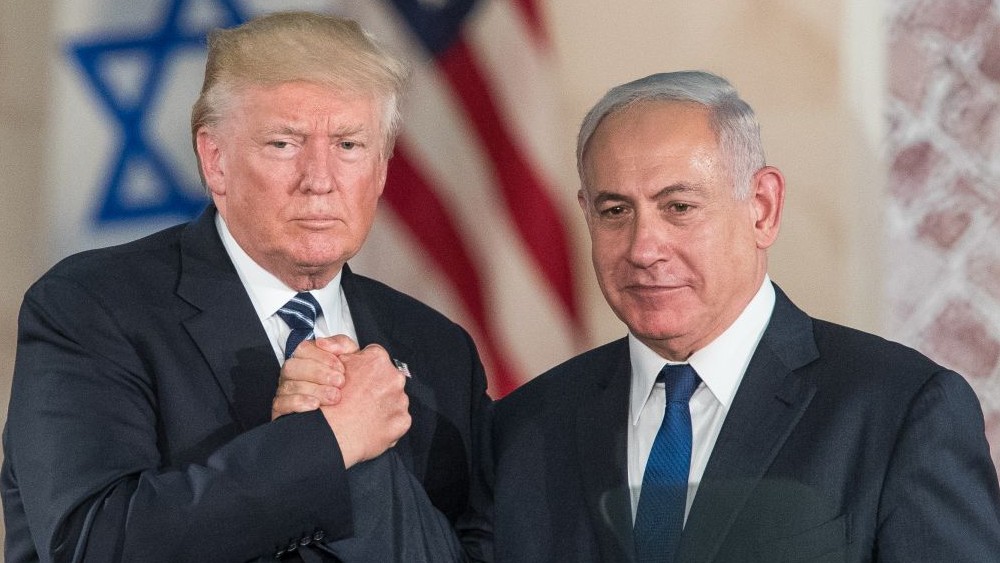
US President Donald Trump, left, and Prime Minister Benjamin Netanyahu shake hands after giving final remarks at the Israel Museum in Jerusalem before Trump's departure, May 23, 2017. (Yonatan Sindel/Flash90)

US President Donald Trump, left, and Prime Minister Benjamin Netanyahu shake hands after giving final remarks at the Israel Museum in Jerusalem before Trump’s departure, May 23, 2017. (Yonatan Sindel/Flash90)

WASHINGTON — US President Donald Trump and Prime Minister Benjamin Netanyahu will meet in New York next week on the sidelines of the UN General Assembly, a US official confirmed on Tuesday.

“The President is planning to sit down with the Prime Minister Benjamin Netanyahu and I know that the President’s looking forward to doing that,” State Department spokeswoman Heather Nauert told reporters during her daily press briefing.

On Sunday, Netanyahu said he would meet with Trump while they both were in Manhattan, but Washington had yet to verify a summit would take place.

The meeting will be the two leaders forth together since Trump assumed office. The two met once in February when the Israeli premier visited the White House, and twice in May when the American president traveled to the region, which included a two-day stop in Israel and the Palestinian territories.

Trump is slated to address UNGA on September 19. Reports have quoted officials saying the meeting with Netanyahu will likely take place on or around September 18.

Officials did not say where the meeting would take place, but last month the Israel Hayom daily reported it would be held at Trump’s National Bedminster Golf Club in New Jersey.

Officials have not yet disclosed what subjects are on the itinerary of discussion, but their summit will come as Trump is making headlines for his machinations to toughen up on Iran and potential plans to decertify the regime as violating the 2015 nuclear deal, despite International Atomic Energy Agency investigators finding it is abiding by its terms.

Trump told The Wall Street Journal in August he “does not expect that they will be in compliance.” That interview came shortly after Foreign Policy reported that he told his aides to develop a case for why the Iran has violated the agreement by October, when he must report to Congress on whether Tehran is honoring the landmark pact.

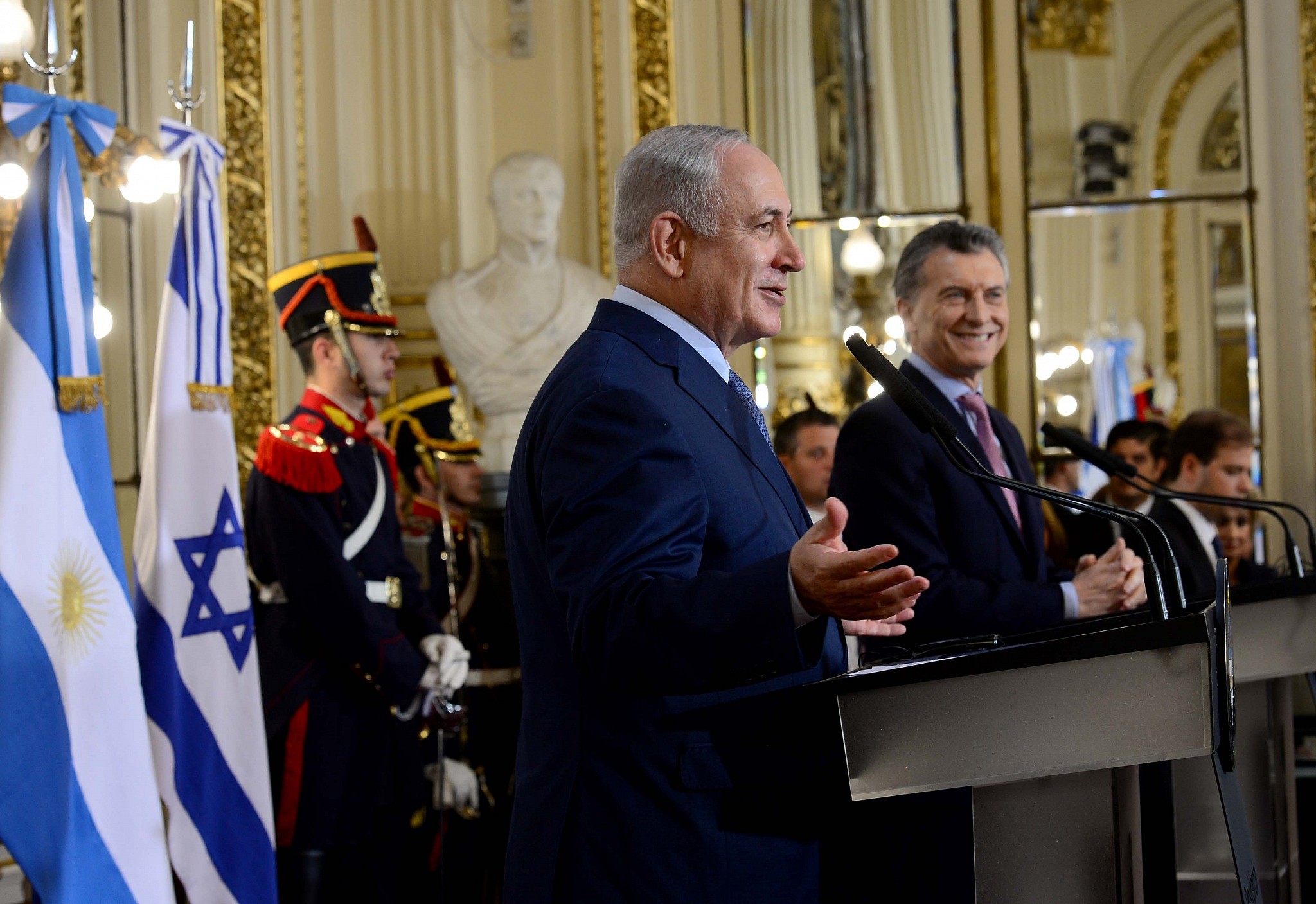
Prime Minister Benjamin Netanyahu meets with Argentinian President Mauricio Macri at the San Martin palace, in Buenos Aires, Argentina, during his official state visit. September 12, 2017. (Avi Ohayon / Government Press Office)

Netanyahu has long been a fierce critic of the deal. On Tuesday, he said his position remained simple — that it is a bad deal and should either be renegotiated or trashed.

“In the case of Iran, there have been some news stories about Israel’s purported position on the nuclear deal with Iran. So let me take this opportunity and clarify: Our position is straightforward. This is a bad deal. Either fix it — or cancel it. This is Israel’s position,” Netanyahu said from Argentina, where he is on a Latin American swing before making his way to New York for the UN General Assembly.

The meeting between the two leaders also comes at a sensitive time for Trump’s peace push. Last month, the former real estate mogul dispatched a US delegation to the Middle East to try and renew negotiations between the sides.

No tangible developments occurred, but Palestinians continue to criticize the US team for its refusal to back a two-state solution, a goal that has been central to American foreign policy for decades.

In August, Nauert responded to these criticisms by saying the Trump administration did not want to “bias” itself by supporting any particular outcome to the conflict.

Palestinian Authority President Mahmoud Abbas will also be in town for the UN confab. There is no indication yet that he is slated to meet individually with Trump or that the three will meet together.


Cancel Iran nuclear deal, asks Netanyahu in Argentina

September 13, 2017

Source: Cancel Iran nuclear deal, asks Netanyahu in Argentina | Zee News

Israeli Prime Minister Benjamin Netanyahu said Tuesday that the nuclear deal between world powers and Iran should be amended or cancelled.

AFP| Last Updated: Wednesday, September 13, 2017 – 06:41

Cancel Iran nuclear deal, asks Netanyahu in Argentina

Buenos Aires: Israeli Prime Minister Benjamin Netanyahu said Tuesday that the nuclear deal between world powers and Iran should be amended or cancelled.

Speaking in Buenos Aires alongside Argentine President Mauricio Macri, Netanyahu said he wanted to correct the impression in recent media reports that Israel`s position on the 2015 deal had softened.

“So let me take this opportunity and clarify. Our position is straightforward. This is a bad deal — either fix it or cancel it. This is Israel`s position.”

Netanyahu has repeatedly taken aim at Iran since arriving in Argentina on Monday as the first sitting Israeli prime minister to visit Latin America.

He accused Tehran of operating “a terror machine that encompasses the entire world, operating terror cells in many continents, including Latin America.”

“In the case of Iran, it`s not only merely terror, it`s also the quest for nuclear weapons that concerns us and should concern the entire international community.”

In a veiled reference to the US and world powers` preoccupation with North Korea, he said: “We understand the danger of a rogue nation having atomic bombs.”

Macri, who hosted Netanyahu at his Casa Rosada presidential palace, said the visit was “an important step” to improve commercial relations between their two countries.

As the Israeli government seeks partners and alliances, dozens of left-wing activists waving Palestinian flags protested Netanyahu`s presence in Buenos Aires late Tuesday over his “bellicose and repressive policies” against the Palestinians.Referring affectionately to Macri as “Mauricio, my friend,” the Israeli leader said his visit marked the dawn of a new era — “and not accidentally did we begin it here with you.”

Netanyahu, who is accompanied by a 30-member delegation of Israeli business leaders, said Israel was an “innovation nation” eager to share opportunities with Argentina in agriculture, water, IT, cyber security and health.

The two presidents signed a series of agreements on social insurance, streamlining customs arrangements and police cooperation.

Macri also presented Netanyahu with some 140,000 historical documents and photographs from before and after World War II in digital form.

The documents will enable a deeper understanding of the Holocaust and crimes against humanity, Israel said.

On Monday, Netanyahu participated in a ceremony to remember victims of bomb attacks at the Israeli embassy in 1992, and at a Jewish community center in 1994.

The embassy attack killed 29 and injured 220, while the community center blast left 85 dead and 300 injured.

But some relatives of victims of the 1994 bombing refused an invitation to the event on Monday.

“Netanyahu did not come to commemorate the attack, but to increase business,” said Diana Malamud, who heads a group called Active Memory.

“In these 23 years (since the bombing) Israel has been an observer, like any other country,” and did not honestly help “search for the truth” behind the attack, she said.

During his stay in Buenos Aires, the Israeli premier was also to meet Paraguayan President Horacio Cartes, who traveled expressly to the Argentine capital for the meeting.

Following the two-day visit, Netanyahu will visit Colombia and Mexico before heading to New York for the United Nations General Assembly.

AFP


» Naftali Bennett: Hezbollah and Iran Greatest Threat to Israeli Security

September 13, 2017

Source: » Naftali Bennett: Hezbollah and Iran Greatest Threat to Israeli Security– IMEMC News

13 Sep
5:25 AM

By Emma Von Larsen and Bettina Boye/PNN

Various Israeli officials joined the IDC institute of Counterterrorism annual conference to discuss the development of terrorism and ways to counter, where Israeli minister of education, Naftali Bennett  emphasized that “modern Zionism has created a safe haven for Jewish people, and Iran threatens this” and continued “I have no doubt that the nuclearization of Iran is the number one existential threat to the state of Israel”.

He claimed that an attack on Iran would not destroy the country, but an attack by Iran on Israel would, and that is a great threat for Israel. Despite the lack of an actual war between Israel and Iran and Israel’s recent bombing of an alleged weapon factory in Syria, which could be seen as provoking and as an invitation to a proxy war with Iran, Bennett underlines, that the tension between the two countries is not a “Cold War”.

Bennett also argued that Israel’s own policy of disengagement is one of the greatest threats towards itself, and mentions as an example the 2005 disengagement from the conflict in Gaza, and that the consequences of Israel’s disengagement was the takeover of the Strip by Hamas.

As another example of Israel’s policy of disengagement, Bennett mentions the situation with Hezbollah, and states that, when the Israeli military retreaded from the position in Lebanon they indirectly allowed Hezbollah to blossom and to grow strength.

“I would like to state this emphatically: Lebanon is Hezbollah and Hezbollah is Lebanon. A ballistic attack on Israel would be the equivalent of a declaration of war by sovereign state of Lebanon,” he said.