Archive for August 10, 2017

Bloomberg: Manafort Alerted Authorities About Russian Meeting

August 10, 2017

Bloomberg: Manafort Alerted Authorities About Russian Meeting, Jonathan Turley’s Blog, Jonathan Turley, August 10, 2017

Buried in a new article out of Bloomberg is an understated but potentially significant statement: “In fact, Manafort had alerted authorities to a controversial meeting on June 9, 2016, involving Trump’s son Donald Jr., other campaign representatives and a Russian lawyer promising damaging information on Hillary Clinton, according to people familiar with the matter.”  That would be a huge development in this controversy if true, particularly if the notice occurred before the Russian meeting occurred.

Much of the criticism directed at Donald Trump Jr. and Paul Manafort has been that only chumps would have gone to this meeting or, at a minimum, alerted authorities.  Now Bloomberg is saying that it has sources saying that Manafort did indeed alert authorities.  That would go a long way to defusing the conspiracy theories surrounding the meeting and shatter the narrative put forward by critics.

What is also concerning is that, if true, this fact is one of the only facts not leaked out of Congress.  It seems that closed sessions have been mere precludes to media leaks.  Yet, members have been saying as a mantra that the FBI or some other agency should have been notified.  Ironically, this is the most significant part of the Bloomberg story but is buried without further comment.  Why?

Trashed at Lima: Maduro goes from PR fail to PR fail [Venezuela]

August 10, 2017

Trashed at Lima: Maduro goes from PR fail to PR fail, Venezuela News and ViewsDaniel Duquenal, August 9, 2017

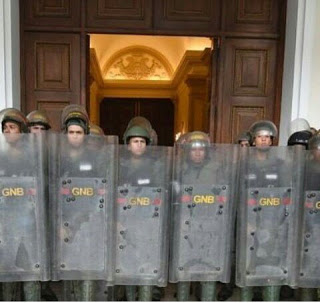
In the middle of the night the nazional guard and the constituent assembly chair took over the old senate chamber of Venezuelan Congress which had been transformed into a ceremonial room. The problem is that the hall is not big enough for the 550 constituents as it can hold barely 450.  But the point here is to piss off the National Assembly and slowly but surely edge them out of existence.

For good measure the National Assembly was barred to enter its chambers for its scheduled session, least the couple of dozens that did make it into congress house would attack the 500+ constitutionals.  Nice to see the nazional guard deployed in a legislative room. Nothing militaristic or repressive in the regime. No serreee…

The constituent is above all

That they are overcrowded sitting on party pliable and uncomfortable chairs did not stop the constituents to declare themselves as of today of being above any of the existing powers and institutions. For our own good, apparently. (1)

Note that the complete results are not yet out and these creeps are already ruling as if nothing, fraud declarations remaining investigated, of course.

To make sure that we know who is in charge truly (besides Cuba, of course) we even had the visit of the defense minister in full drag, as a guest of honor. That is right, a constituent assembly of the people starts by bowing to a general.

Today was thus quite a democratic display. And right on time as the Lima reunion was taking place, to make sure to confort them in their soon to come decisions.

In Lima the s… hit the fan

Many countries were invited to a meeting outside of any international organization to discuss what to do about Venezuela. That is, the countries that are decided to do something about it, without the bothers that sell out countries do to stop any measure against the dictatorship (2). They met today at Lima.  Of those who met, 12 decided to sign a declaration which is as strong as you will ever see any. And apparently Jamaica was about to add its name though they did not. Nobody understands why Uruguay did not go along since last week end they agreed to kick out Venezuela from Mercosur. At any rate, the 12 signatories have agreed to further meetings as sanctions are implemented and that anyone wanting to join the principled positions could so so.

The WSJ has a summary in English, though if you can read Spanish I urge you to read the short and drastic declaration.  The important points to be drawn from it are:

  • Venezuela is a dictatorship (written in diplomatese, but that is the exact translation)
  • They will not recognize the constituent assembly nor any decision that this one takes.
  • For any future legal/financial contact between those countries (the largest in the Americas, the rest counts for nothing anyway) these will only be accepted if the legal and legitimate National Assembly approves them. That is, there is no possible contracts to be made state to state, and business to business/state unless the NA approves them. Also, Venezuela cannot send new ambassadors unless voted by the NA. And other consequences.
  • Ban any weapon shipment to Venezuela, in particular of repressive nature.
  • These countries will actively seek that Venezuela will be removed from any international organization that pretends to be democratic.

In short, Venezuela is declared a pariah state.

Meanwhile in Caracas the dictatorship could only gather the ALBA (Cuba and Caracas client states) and emit a long and ridiculous declaration that even included the wall. Maybe feel good, but totally out of step with the moment, which shows you that even the sophisticated Cuban diplomacy is losing its footing.

It is to be noted that the US was not, on purpose, in Lima and so it cannot be accused of remote directing the whole thing. As a matter of fact, if you read the Lima declaration you will be stricken by its novelty and creativity. Venezuela is truly seen as a continental problem and all agree that it is best that the US sanctions are taken separately from other sanctions so that the Cuban propaganda cannot use tired old cliches.

We’ll see.  Meanwhile the image of Maduro has gone down quite a lot today. As a matter of fact he even asked the ALBA to speak on his behalf tot he Lima group….

————————-

1) On that note the high court keeps condemning opposition mayors without trials, removing them form office and jailing them for 15 months under the pretense that they did not keep order in their districts even though it is public knowledge that the dictatorship has taken away any means that they could have used to maintain public order. It is simply put a purge following a kangaroo court. Some are already in jail, some have chosen exile. About half of the opposition mayors elected last time have been thus removed. And going.

2) As of this post the words regime and dictatorship are interchangeable when referring to Venezuela. This is not a democracy anymore, there are no valid elections anymore, there is no rule of law anymore.  As for Maduro, he will not be referred anymore as president Maduro, unless irony is required. From now on Maduro is the dictator of Venezuela.

As for the leftist that keep supporting the dictatorship, like Corbyn, Melanchon, Iglesias, IU, and other, I will come with wonderful epithets to underline their falsehood, hypocrisy and absolute lack of true democratic instincts.  Readers suggestions welcome.

N. Koreans denounce Trump’s ‘fire & fury’ threat in massive rally (VIDEO)

August 10, 2017

Published time: 10 Aug, 2017 15:31

Source: N. Koreans denounce Trump’s ‘fire & fury’ threat in massive rally (VIDEO) — RT News

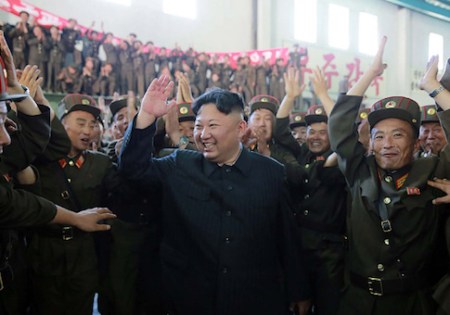
Tens of Thousands of North Koreans rallied on Kim Il Sung Square in Pyongyang, after the UN Security Council passed a new round of sanctions and US President Donald Trump threatened the country with “fire and fury” over its missile tests.

Footage from the Wednesday rally showed North Koreans lined up in an organized fashion behind military troops, clapping to remarks made by government leaders.

Some held propaganda placards as they marched through the square, chanting as they pumped their fists in the air.

Thousands of North Korean workers, dressed in white shirts, also angrily marched through the square while carrying the country’s flag.

Meanwhile, Pyongyang officially dismissed Trump’s promise that North Korean threats would be “met with fire, fury, and frankly power, the likes of which the world has never seen before.”

In addition to shrugging off Trump’s words, Pyongyang also called the US leader “bereft of reason,” stating that “only absolute force can work on him.”

READ MORE: Who said it: Donald Trump or Kim Jong-un? (QUIZ)

The rally also came after the United Nations’ Security Council approved new sanctions against North Korea, following the country’s latest missile tests.

The war of words between Pyongyang and Washington has escalated since Trump took office, with the US president repeatedly stating that the White House has run out of patience with the government led by Kim Jong-un.

Both sides have also taken action, with North Korea conducting numerous ballistic missile tests – one for the “American bastards” on the Fourth of July – and the US flying bombers over the Korean peninsula.

In their latest move, North Korea’s state media have outlined details of the country’s plan to strike Guam, which would include four missiles fired over Japan and landing within a few kilometers of the US territory. The plan is scheduled to be ready by mid-August.

Meanwhile, reports have emerged stating that the US has a plan to strike North Korean sites with B-1 bombers, with a senior intelligence official calling it the “best of a lot of bad options.” 

“Under Any Analysis, It’s Insanity”: What War With North Korea Could Look Like

August 10, 2017

The most important impact of a full-scale conflict on the Korean peninsula would be a massive loss of life. But there would also be significant economic consequences: we present some of the most notable risks should war break out between the US and North Korea.

Source: “Under Any Analysis, It’s Insanity”: What War With North Korea Could Look Like | Zero Hedge

Now that the possibility of a war between the US and North Korea seems just one harshly worded tweet away, and the window of opportunity for a diplomatic solution, as well as for the US stopping Kim Jong-Un from obtaining a nuclear-armed ICBM closing fast, analysts have started to analyze President Trump’s military options, what a war between the US and North Korea would look like, and what the global economic consequences would be. Needless to say, this is a challenging exercise due to the countless possible scenario, event permutations and outcomes, not least because China and Russia may also be sucked in, leading to a true world war.

Realistically, war has to be avoided,” said John Delury, an assistant professor of international studies at Yonsei University in South Korea. “When you run any analysis, it’s insanity.”

Insanity or not, as Capital Economics writes in a May 17 note, while the most important impact of a full-scale conflict on the Korean peninsula “would be a massive loss of life” but added that there would also be significant economic consequences. While we focus on the latter below, first here are some big picture observations courtesy of Bloomberg, including an analysis of whether all out war can be avoided:

  • Can’t the U.S. try a surgical strike?

It probably wouldn’t work well enough. North Korea’s missiles and nuclear facilities are dispersed and hidden throughout the country’s mountainous terrain. Failing to hit them all would leave some 10 million people in Seoul, 38 million people in the Tokyo vicinity and tens of thousands of U.S. military personnel in northeast Asia vulnerable to missile attacks — with either conventional or nuclear warheads. Even if the U.S. managed to wipe out everything, Seoul would still be vulnerable to attacks from North Korea’s artillery.

  • Why might Kim go nuclear?

“Even a limited strike” by the U.S. “would run the risk of being understood by the North Koreans to be the beginning of a much larger strike, and they might choose to use their nuclear weapons,” said Jeffrey Lewis, director of the East Asia nonproliferation program at the Middlebury Institute of International Studies. Somehow, the U.S. would need to signal to both North Korea and China — Pyongyang’s main ally and trading partner — that a surgical military strike is limited, and that they should avoid nuclear retaliation.

  • Is regime change an option?

New leadership wouldn’t necessarily lead to a new way of thinking among North Korea’s leadership. Kim’s prolonged exposure to Western values while at school in Switzerland led some to speculate that he might opt to open his country to the world — until he took power and proved them wrong. Moreover, if Kim somehow were targeted for removal, the ruling clique surrounding him would have to go as well — making for a very long kill list. China, fearing both a refugee crisis and U.S. troops on its border, would likely seek to prop up the existing regime.

  • Does that mean all-out war is the best U.S. option?

A full-scale invasion would be necessary to quickly take out North Korea’s artillery as well as its missile and nuclear programs. Yet any sign of an imminent strike — such as a buildup of U.S. firepower, mobilization of South Korean and Japanese militaries and the evacuation of American citizens in the region — could prompt North Korea to strike preemptively. China and Russia may also be sucked in. “Realistically, war has to be avoided,” said John Delury, an assistant professor of international studies at Yonsei University in South Korea. “When you run any cost-benefit analysis, it’s insanity.”

  • How might North Korea retaliate?

The most immediate reaction would likely be massive artillery fire on Seoul and its surroundings. North Korean artillery installations along the border can be activated faster than air or naval assets and larger ballistic missiles that can target South Korean, Japanese or American bases in the region with nuclear, chemical and biological weapons. Those countries have ballistic-missile-defense systems in place but can’t guarantee they will shoot down everything. Japan has begun offering advice to its citizens on what to do in the event a missile lands near them — essentially try to get under ground — and U.S. firms are marketing missile shelters. While it’s unclear if North Korea can successfully target U.S. cities like Denver and Chicago with a nuclear ICBM, it’s similarly unknown if U.S. defense systems can strike it down — adding to American anxieties.

  • What options remain on the table?

Many analysts say it’s time to start talks to prevent the situation from worsening. Stopping North Korea from obtaining a thermonuclear weapon, or more advanced solid-fuel missiles, is a goal worth pursuing, according to Lewis. However unpalatable it may seem, that means offering rewards to entice North Korea back to the negotiating table. Lewis suggested one reward could be to scale back U.S.-led military drills around North Korea. The question of what can be offered to the North Koreans “is a conversation that should be happening both with the public, with Congress and with the North Koreans, instead of having this imaginary conversation about war scenarios,” said Delury. “The realistic option is a diplomatic one that slows this thing down. And that’s going to require a lot of talks.

* * *

Assuming appeasement and containment are off the table, and a diplomatic solution fails, what would the impact on the regional and global economy be from a worst case scenario – one in which conventional war breaks out? Here are the salient thoughts from Capital Economics on this increasingly sensitive topic:

  • North Korea’s conventional forces, which include 700,000 men under arms and tens of thousands of artillery pieces, would be able to cause immense damage to the South Korean economy. If the North was able to set off a nuclear bomb in South Korea, the consequences would be even greater. Many of the main targets in South Korea are located close to the border with the North. The capital, Seoul, which accounts for roughly a fifth of the country’s population and economy, is located just 35 miles from the North Korean border, and would be a prime target.
  • The experience of past military conflicts shows how big an impact wars can have on the economy. The war in Syria has led to a 60% fall in the country’s GDP. The most devastating military conflict since World War Two, however, has been the Korean War (1950-53), which led to 1.2m South Korean deaths, and saw the value of its GDP fall by over 80%.
  • South Korea accounts for around 2% of global economic output. A 50% fall in South Korean GDP would directly knock 1% off global GDP. But there would also be indirect effects to consider. The main one is the disruption it would cause to global supply chains, which have been made more vulnerable by the introduction of just-in-time delivery systems. Months after the Thai floods had receded in 2011 electronics and automotive factories across the world were still reporting shortages.
  • The impact of a war in Korea would be much bigger. South Korea exports three times as many intermediate products as Thailand. In particular, South Korea is the biggest producer of liquid crystal displays in the world (40% of the global total) and the second biggest of semiconductors (17% market share). It is also a key automotive manufacturer and home to the world’s three biggest shipbuilders. If South Korean production was badly damaged by a war there would be shortages across the world. The disruption would last for some time – it takes around two years to build a semi-conductor factory from scratch.
  • The impact of the war on the US economy would likely be significant. At its peak in 1952, the US government was spending the equivalent of 4.2% of its GDP fighting the Korean War. The total cost of the second Gulf War (2003) and its aftermath has been estimated at US$1trn (5% of one year’s US GDP). A prolonged war in Korea would significantly push up US federal debt, which at 75% of GDP is already uncomfortably high.
  • Reconstruction after the war would be costly. Infrastructure, including electricity, water, buildings, roads and ports, would need to be rebuilt. Massive spare capacity in China’s steel, aluminium and cement industries mean reconstruction would unlikely be inflationary, and should instead provide a boost to global demand. The US, a key ally of South Korea, would likely shoulder a large share of the costs. The US spent around US$170bn on reconstruction after the most recent wars in Afghanistan and Iraq. South Korea’s economy is roughly 30 times larger than these two economies combined. If the US were to spend proportionally the same amount on reconstruction in Korea as it did in Iraq and Afghanistan, it would add another 30% of GDP to its national debt.

* * *

Finally, a look at the market impact, with the immediate attention falling on South Korea. It has been the market’s persistent refusal to even contemplate a worst-case scenario that perplexed Goldman, as we discussed this morning. In a note from the bank’s chief credit strategist, Charles Himmelberg said that “our sense is that investors have grown comfortable with the view that geopolitical tensions invariably result in diplomatic talks, in which case the right trade is to buy any dips. The result is a market psychology that is relatively resistant to the pricing of geopolitical risk.

As Capital Economic follows up in a daily note this morning, despite the trading of combative statements over the past two days between the US and North Korea, “movements so far have not been very large, and we suspect that this will remain the case so long as military conflict is avoided.”

Not surprisingly, South Korea’s stock market has been amongst the worst affected, with the country’s Kospi index falling by just over 1%. The won has also weakened by a similar amount against the dollar. But in context, these moves are small. South Korea’s stock market is still about 17% higher than it was at the start of the year, so investors are hardly panicking. And the won is merely back to its level of four weeks ago. (See Chart 1.)

The good news for market bulls is that even if tensions escalate further from here, CapEcon thinks that the implications for equities in South Korea and elsewhere “will remain limited”, assuming of course that war does not actually break out. As proof, the advisory boutique shows the example of the 1962 Cuban missile crisis, when the world came closest to outright conflict between two nuclear-armed powers, and its impact on the S&P.

Although the S&P 500 fell after US President Kennedy announced the discovery of missiles on Cuba, it had more or less recovered its losses before Soviet General Secretary Khrushchev announced six days later that the missiles would be removed from the island. (See Chart 2.) And even the initial fall was very small compared to the declines in US equities earlier that year, which were not connected to the crisis.

One notable difference from 1962 is that back then the world’s central banks were not “all in” in the effort to keep equity markets stable, so one can argue that it would take an even greater “shock” to the system to have an adverse and lasting impact on stocks, because many people are looking for stocks to invest in now a days. In fact, stocks may even forego the initial dip and proceed straight to the inevitable rally which central banks will do everything in their power to unleash, even if it means making the current bubble which now has virtually every asset manager worried, even greater.

And then there is the worst case scenario in which war does break, and where not even central banks can deflect the avalanche of selling. What asset should be owned in that scenario? According to CapEcon, the best answer (our earlier discussion about ethereum notwithstanding) may be gold:

The price of gold edged higher on Wednesday, to about $1,267 per ounce, following President Trump’s comments that the US was ready to hit North Korea with “fire and fury”. The Japanese yen, another safe-haven asset, also rose on the news. That said, the moves have been small. This is perhaps due to the fact that markets are pricing in a very low probability that the situation will actually escalate to a full-scale war. However, there remains huge uncertainty as to how the crisis will play out and this may benefit gold prices over the coming weeks. Indeed, increased geopolitical risk might even see the price rise beyond $1,350 per ounce, which hasn’t been breached since the Brexit referendum last year.

How a renewed Korean conflict is going to be felt around the globe

August 10, 2017

OPINION | The conflict is going to be felt in industries ranging from cellular electronics to oil production.

Source: How a renewed Korean conflict is going to be felt around the globe | TheHill

© KCNA/Getty Images

The United States and the Republic of South Korea have, until now, had identical interests in the Korean peninsula: defending against a North Korean attack on the South, and keeping the North’s regime at bay until it collapsed from internal contradictions.

The inevitable ability of North Korea to hit North America with a nuclear-armed intercontinental ballistic missile (ICBM) means the U.S. has to consider striking North Korea preventively, regardless of the casualties in South Korea because no U.S. President will trade San Francisco for Seoul.

Sen. Lindsey Graham (R-S.C.) recently said President Trump told him, “If there’s going to be a war to stop [Kim Jong Un], it will be over there. If thousands die, they’re going to die over there. They’re not going to die here.” And National security adviser H.R. McMaster has stated the U.S. is planning a “preventive war” against North Korea.

What will the president have to consider before he launches a preventative attack on North Korea?

Casualties in an attack of the North on the South are estimated at 100,000 in Seoul in the first 24 hours. The U.S. military estimates 200,000-300,000 South Korean and U.S. military casualties within 90 days, and even more civilian deaths, many of which may be caused not by North Korean weapons but the collapse of the electric power grid, and the water, transport and sewer systems in a city with one of the highest population densities in the world. Half of the South’s population of over 50 million lives in the Seoul Capital Area, which produces almost half of the country’s gross domestic product.

The effects would be felt worldwide and immediately as South Korea is a vital part of the global supply chain for high technology equipment, both as end products and parts used by other manufactures. Nor is it likely companies in other countries can quickly pick up the slack: it is estimated that the replacement cost of the display manufacturing capability of Samsung and rival LG will top $50 billion. In the words of one analyst, “If Korea is hit by a missile, all electronics production will stop.”

Shipping in the nearby Sea of Japan, East China Sea, and Yellow Sea will halt as there may no longer be a destination for the cargo, and spiking maritime insurance rates, if insurance can be had, will make most voyages unprofitable. Shipping to and from major Chinese ports such as Dalian, Qingdao, Shanghai, and Tianjin will halt and disrupt worldwide supply chains. Ships returning to China will have to anchor until the crisis abates, at a cost to the shipping lines (and customers). Most of Japan’s major ports are on the east coast of the main island, Honshu, and will be open for business, though with the threat of North Korean missiles early in the conflict.

South Korea imports 98 percent of its fossil fuels and relies exclusively on tankers for liquefied natural gas (LNG) and crude oil. China will also be affected as it is the world’s largest net importer of crude oil and has LNG regasification terminals at Dalian, Qingdao, Shanghai, and Tianjin. Crude and LNG tankers enroute will have to be rerouted, but the product can probably be sold on the spot market.

The airspace surrounding the Korea Peninsula and northeast China will be closed and will affect passenger and cargo traffic, including at Beijing, the world’s second busiest airport, and Shanghai, the ninth busiest. Eastward traffic to the region will slow and will hit the hub airport, Dubai, which is also a major tourist destination for Asia. Japan will lose eastbound air traffic, but westward traffic from the U.S. less so.

South Korea imports most of its food as it has little arable land. The U.S. is its largest supplier, providing mostly corn, meat, hides, soybeans, milling wheat, and cotton, so the U.S. farm sector will sag if the crisis happens when produce is on the way to market.

Of the local allies, Japan may be more disposed to action as it isn’t – literally – on the front line and it has already deployed the PATRIOT surface-to-air interceptor and the AEGIS ship-based anti-ballistic missile system, and it may install the AEGIS Ashore system or the Terminal High Altitude Area Defense (THAAD) system. South Korea will be more reticent as it will absorb the initial blows and the only air defense missiles on its territory, the THAAD system, were deployed by the U.S. in the spring of 2017.

President Trump will have to weigh Asia’s regional stability and homeland security when making the toughest call since President Truman OK’d the use of nuclear weapons in Japan in 1945.

James D. Durso (@James_Durso) is the managing director at consultancy firm Corsair LLC. He was a professional staff member at the 2005 Defense Base Closure and Realignment Commission and the Commission on Wartime Contracting in Iraq and Afghanistan, and served as a U.S. Navy officer for 20 years specializing in logistics and security assistance. His overseas military postings were in Kuwait and Saudi Arabia, and he served in Iraq as a civilian transport advisor with the Coalition Provisional Authority. He served afloat as supply officer of the submarine USS SKATE (SSN 578).


McMaster’s Misunderstanding of the Middle East

August 10, 2017

by A.Z. Mohamed
August 10, 2017 at 4:00 am

Source: McMaster’s Misunderstanding of the Middle East

  • If H.R. McMaster, President Trump’s national security adviser, were merely exhibiting a misunderstanding of how things work in the Middle East, it would be bad enough. Yet this is not the greatest problem with his attitude towards Israel and the Palestinians. More serious is his anti-Israel, pro-Palestinian bias, as an article in the Conservative Report, based on comments by senior West Wing and defense officials, reveals.
  • According to the piece, “McMaster has emerged as a man fiercely opposed to strengthening the U.S. alliance with the Jewish state” — one who “constantly refers to the [historically false] existence of a Palestinian state before 1947,” and “who describes Israel as an ‘illegitimate,’ ‘occupying power.'” More recently, as a source told the Conservative Report, after the terrorist attack on the Temple Mount in Jerusalem on July 14, 2017 — committed by three Arab Israelis against two Druze Israeli Border Police officers — McMaster called Israel’s placement of metal detectors at the site “just another excuse by the Israelis to repress the Arabs.”
  • As Middle East scholar Daniel Pipes explains, peace is achieved through victory over one’s enemies, not by appeasement or dangerous compromises.

In his address to the American Jewish Committee’s Global Forum in Washington on June 4, 2017, U.S. President Donald Trump’s national security adviser, H.R. McMaster, pointed to a “reassessment of regional relationships, most notably between Israel and a number of our Arab partners — all friends of America, but too often adversaries of each other.”

McMaster was referring to the counter-terrorism initiative that President Donald Trump launched two weeks earlier in Saudi Arabia. McMaster called the move “an opportunity.”

Judging by his previous statements — for example, during a speech in honor of Israel Independence Day at the Israeli Embassy in Washington in May — McMaster considers one aspect of this opportunity to be a resolution to the Palestinian-Israeli conflict. This is where his approach is misguided, if not totally counter-productive.

In the first place, the Arab states have never been America’s allies in the way that Israel has been. Israel and the U.S. not only share a Western value system, but the Jewish state is a technological, economic and military democratic power in an unstable Middle East ruled by dictatorships. Speaking about them in the same breath not only indicates a lack of understanding of the region, but necessarily hinders any attempt on the part of the U.S. administration to revive long-stalled negotiations between Israeli and Palestinian leaders, let alone achieve a peace deal. As Middle East scholar Daniel Pipes explains, peace is achieved through victory over one’s enemies, not by appeasement or dangerous compromises.

If McMaster were merely exhibiting a misunderstanding of how things work in the Middle East, it would be bad enough. Yet this is not the greatest problem with his attitude towards Israel and the Palestinians. More serious is his anti-Israel, pro-Palestinian bias, as an article in the Conservative Report, based on comments by senior West Wing and defense officials, reveals.

According to the piece, “McMaster has emerged as a man fiercely opposed to strengthening the U.S. alliance with the Jewish state” — one who “constantly refers to the [historically false] existence of a Palestinian state before 1947,” and “who describes Israel as an ‘illegitimate,’ ‘occupying power.'”

More recently, as a source told the Conservative Report, after the terrorist attack on the Temple Mount in Jerusalem on July 14, 2017 — committed by three Arab Israelis against two Druze Israeli Border Police officers — McMaster called Israel’s placement of metal detectors at the site “just another excuse by the Israelis to repress the Arabs.”

This is in keeping with McMaster’s ideology in general. During his first “all hands” staff meeting on February 23, 2017, he called terrorism “un-Islamic” and the term “radical Islamic terrorism” not helpful.

Prior to the meeting, retired U.S. Army Col. Peter Mansoor told Fox News that McMaster, with whom he served in Iraq during the 2007 surge of American troops, “absolutely does not view Islam as the enemy… and will present a degree of pushback against the theories being propounded in the White House that this is a clash of civilizations and needs to be treated as such.”

In response to mounting criticism against the national security adviser in conservative circles, Trump said in a statement emailed to the New York Times, “General McMaster and I are working very well together. He is a good man and very pro-Israel. I am grateful for the work he continues to do serving our country.”

This may be an attempt on Trump’s part to mitigate the damage done by the manpower upheaval in the White House, and allay fears of further turmoil. However, if McMaster continues to view Israel and its Arab neighbors as comparable U.S. allies, and to consider the Jewish state to blame for a lack of peace with the Palestinians, the president would do well to re-examine whether his national security adviser is serving either his interests or those of the United States.

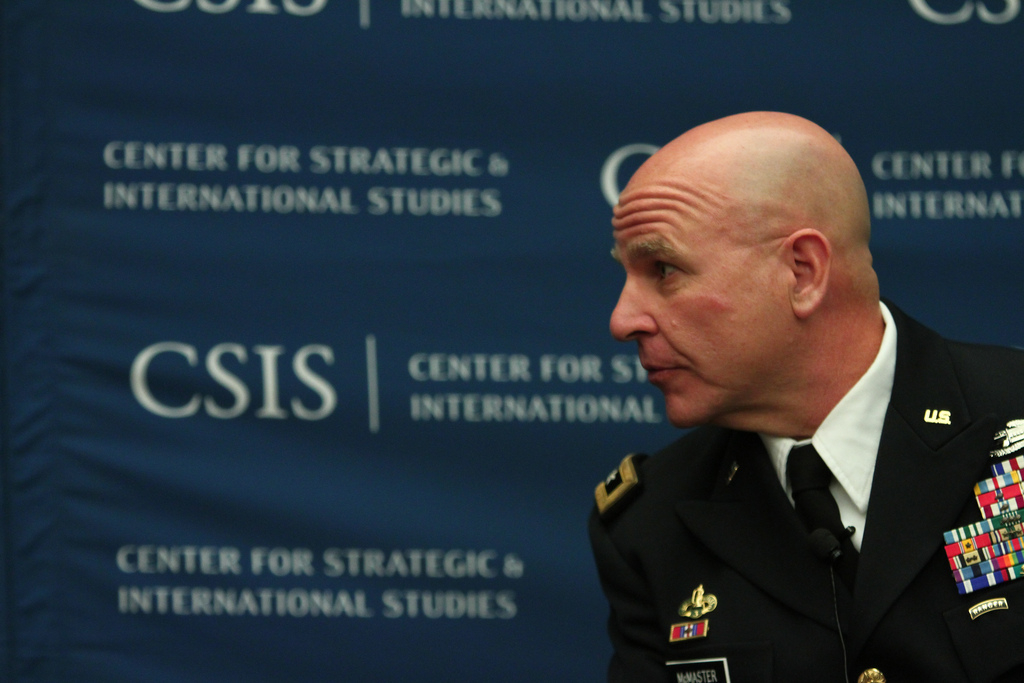
H.R. McMaster, pictured in 2013. (Image source: CSIS/Flickr)

A.Z. Mohamed is a Muslim born and raised in the Middle East.

Susan Rice Urges Donald Trump to ‘Tolerate Nuclear Weapons in North Korea’

August 10, 2017

Susan Rice Urges Donald Trump to ‘Tolerate Nuclear Weapons in North Korea’, BreitbartCharlie Spiering, August 10, 2017

Associated Press

Former President Barack Obama’s National Security adviser, Susan Rice, wants President Donald Trump to accept North Korea as a nuclear power.

“History shows that we can, if we must, tolerate nuclear weapons in North Korea — the same way we tolerated the far greater threat of thousands of Soviet nuclear weapons during the Cold War,” she wrote in a New York Times op-ed, criticizing the president’s “fire and fury” rhetoric in response to the escalating tensions between the two countries.

Rice urged Gen. John Kelly, White House chief of staff, to stop Trump, and she pointedly attacked Dr. Sebastian Gorka, the deputy assistant to the president.

“John Kelly, Mr. Trump’s chief of staff, must assert control over the White House, including his boss, and curb the Trump surrogates whipping up Cuban missile crisis fears,” she wrote.

Rice complained that Trump’s rhetoric was “unprecedented and especially dangerous” and that America would have to be cautious about its response to Pyongyang.

She defended Obama’s actions in response to North Korea, insisting that his administration put them “on edge” by conducting joint military exercises with South Korea and introducing more economic sanctions.

She urged Trump to continue the Obama doctrine on North Korea despite growing hostility from the country.

“Rational, steady American leadership can avoid a crisis and counter a growing North Korean threat,” Rice wrote. “It’s past time that the United States started exercising its power responsibly.”

McMaster – Reassign Him to Area Not Dealing with Israel or Iran

August 10, 2017

Zionist Organization of America | ZOA: NSC’s McMaster – Reassign Him to Area Not Dealing with Israel or Iran

August 9, 2017

Source: Zionist Organization of America | ZOA: NSC’s McMaster – Reassign Him to Area Not Dealing with Israel or Iran

Zionist Organization of America (ZOA) National President Morton A. Klein; ZOA Director of Special Projects, Elizabeth Berney, Esq.; and ZOA Director of Center for Mideast Policy, Daniel Mandel, Ph.D. released the following report:

The duties of the National Security Council (NSC) include “coordinat[ing] and direct[ing] the activities of the United States Government relating to combating transnational threats.”  50 U.S.C. § 3021(i).  It is thus alarming that National Security Advisor Lt. Gen. H.R. McMaster purged from the NSC those officials who were carrying out President Trump’s policies of combating Iranian and radical Islamist transnational threats, and purged from the NSC those officials who support the U.S.-Israel alliance – an alliance that is vital to America’s ability to combat radical Islamist terrorism.

Instead, General McMaster has appointed officials who are holdovers from the Obama administration, who favor the Iran nuclear deal and are hostile to Israel – officials who are diametrically opposed to President Trump’s policies.  Moreover, new revelations demonstrate that General McMaster’s ideology is antagonistic to the President’s policies on these vital issues.  The ZOA thus urges President Trump to remove General McMaster from his current position and reassign him to another position where he can do no further harm on these critical national security issues.  General McMaster should not maintain a position where he can continue to undermine President Trump’s policies on Iran, Israel and the fight against “radical Islamic terrorism” – a term that General McMaster believes should not even be used.

McMaster Fired Officials Carrying Out President Trump’s Pro-Israel, Anti-Iran Policies That McMaster Opposes

As highly respected journalist and Jerusalem Post senior editor Caroline Glick pointed out, all the Trump loyalists whom General McMaster purged from the NSC “are pro-Israel and oppose the Iran nuclear deal, positions that Trump holds.”  General McMaster has purged the following officials from the NSC, who were carrying out the president’s policies:

  • K.T. McFarland: McFarland is a staunch Iran deal opponent, opponent of the Islamist global jihad against western civilization, and a highly respected and experienced pro-Israel national security professional, who served on the NSC during the Nixon, Ford and Reagan administrations.  President Trump’s appointment of McFarland as deputy national security advisor was widely praised.  (See Trump Assembling Team of Fierce Iran Deal Opponents,” by Adam Kredo, Dec. 5, 2016.)  General McMaster promptly forced out McFarland, who was then nominated to be the U.S. Ambassador to Singapore. (WH Press Release, May 19, 2017.)
  • Ezra Cohen-Watnick: President Trump’s former NSC appointee, General Michael Flynn, appointed Cohen-Watnick as the NSC’s senior director for intelligence.  Cohen-Watnick was a staunch opponent of the Iran nuclear deal and Islamist terrorism, who “wanted to revamp counter-Iran efforts in the Middle East, and sought to reform the intelligence community to rein in the ‘deep state’ of unaccountable bureaucrats with rogue agendas.”  (“Trump Loyalist Ezra Cohen-Watnick Fired from NSC: McMaster’s Purge of Conservatives Continues,” by Jordan Schachtel, Conservative Review, Aug. 2, 2017.)  Cohen-Watnick also exposed the Obama administration’s eavesdropping on Trump officials.  Foreign policy expert Daniel Greenfield noted that General McMaster fired Cohen-Watnick because “there’s no room for anyone telling the truth about Islamic terrorism at McMaster’s NSC.”  (“McMaster’s NSC Coup Against Trump Purges Critics of Islam and Obama: The National Security Council is Becoming a National Security Threat,” by Daniel Greenfield, Frontpage Mag., Aug. 4, 2017; see also McMaster Pushes Cohen-Watnick, Iran Hard-Liner, Out at NSC,” by JTA, Jerusalem Post, Aug. 3, 2017.)
  • Rich Higgins: Higgins was the NSC’s director of strategic planning, until General McMaster fired him on July 21.  Higgins was an “Iran hawk” (“McMaster Pushes Cohen-Watnick, Iran Hard-Liner, Out at NSC,” cited above),and also had sought to declassify Presidential Study Directive 11 (PSD-11), the secret blueprint of Obama’s support for the Muslim Brotherhood.  Former House Intelligence Committee Chair Pete Hoekstra linked PSD-11 to the rise of ISIS and called for its declassification.  Higgins had stood by Trump during the Khizr Khan attacks. Higgins also wrote a memo warning of the strategic threats from the left’s alliance with the Muslim Brotherhood, Islamic terrorism, Sharia and the Hijrah colonization by Islamic migrants.  As expert Greenfield noted: “Like [Derek] Harvey and Ezra Watnick-Cohen, Higgins had warned of an enemy within.  And paid the price.” (“McMaster’s NSC Coup Against Trump Purges Critics of Islam and Obama,” cited above.)
  • Adam Lovinger: Caroline Glick reported:  “In May, Adam Lovinger, a pro-Trump national security strategist on loan from the Pentagon’s office of net assessment was summarily informed that his security clearance was revoked.  He was fired and escorted from the White House like a spy and put on file duty at the Pentagon.  Lovinger is a seasoned strategic analyst who McMaster hated because he supported India over Pakistan, among other things.

Journalist Daniel Greenfield noted that: “When Adam Lovinger urged that ‘more attention be given to the threat of Iran and Islamic extremism,’ his security clearance was revoked.”

  • Steve Bannon: Early in the McMaster era, General McMaster removed Steve Bannon from the NSC’s principals committee.  Bannon is a strong opponent of the Iran deal, and a staunch supporter of Israel.
  • Derek Harvey:  Former U.S. Army Colonel Harvey – one of the CENTCOM’s most trusted advisors on Iraq, who had also warned of Al Qaeda early on – was eminently qualified to serve as the NSC’s top Middle East advisor in the Trump administration.  Harvey vocally advocated for a tougher policy on Iran and Iran’s proxies.  Harvey also reportedly constructed a comprehensive plan on how to scrap the Iran nuclear deal – a Trump campaign promise that General McMaster apparently opposes.  Harvey also uncovered the holdovers from the Obama administration who were leaking to the press.  Instead of firing the Obama loyalists and leakers, General McMaster fired Harvey.  (See, e.g., “McMaster, On ‘Warpath,’ Purges Key Trump Allies From White House NSC,” by Adam Kredo, Washington Free Beacon, Aug. 3, 2017; and “McMaster’s NSC Coup Against Trump Purges Critics of Islam and Obama,” above; and “McMaster Fires Iran Hawk From NSC: Another Flynn Holdover Has Been Removed,” by Kate Brannen, Foreign Policy, July 27, 2017.)

More Firings to Come:  General McMaster reportedly has a list of additional senior Trump allies whom he intends to purge from the NSC, if he is not stopped.  (See, e.g., “McMaster, On ‘Warpath,’ Purges Key Trump Allies From White House NSC: McMaster Has List of Senior Officials He Plans to Fire,” by Adam Kredo, Washington Free Beacon, Aug. 3, 2017.)

McMaster Appointed Replacements to the NSC Who are Pro-Iran, Hostile to Israel Opposing Trump’s Policies

General McMaster’s appointees to the NSC are hostile to Israel, favor the Iran deal, and are weak on, or seek to appease, Islamists.  These include the following:

  • Kris Bauman:  The ZOA previously objected to General McMaster’s appointment of hostile critic of Israel Kris Bauman to be NSC advisor on Israel-Palestinian matters.  McMaster-appointee Bauman is a protégé of hostile-to-Israel, Iran-deal negotiator John Kerry.  Bauman’s plans for Israel include: Israel’s retreat to indefensible borders; creating a Palestinian-Arab (terrorist) state; sending in U.S. and Palestinian Arab troops to areas currently controlled by Israel; and “engaging” genocidal terrorist organization Hamas.  Bauman also falsely blames and accuses Israel of inciting Palestinian Arab violence and derailing peace.  (See ZOA Concerned: NSC’s McMaster Appoints Kris Bauman – Hostile Israel Critic,” May 17, 2017.)
  • Dina Habib-Powell: After General McMaster forced out the highly experienced K.T. McFarland from her role as deputy national security advisor (see above), General McMaster appointed Egyptian-born Dina Habib-Powell to the position – someone without any background in national security.  Habib-Powell has been called Huma Abedin’s “Republican doppelganger,” and she defended Abedin.  (Hillary’s Mystery Woman: Who Is Huma?,” by Spencer Morgan, The Observer, Apr. 2, 2007.)  Politico noted that Habib-Powell “has strong relationships with senior Democrats including outgoing Obama White House senior adviser Valerie Jarrett.”

Journalist Daniel Greenfield also explained that:  “Habib-Powell had attended the Iftar dinner with members of Muslim Brotherhood front groups.  You can see her photographed at the American Task Force of Palestine gala.  The ATFP was originally Israel-basher Rashid Khalidi’s American Committee on Jerusalem. She was there as a presenter at the Middle East Institute after a speech by [Israel-basher] Hanan Ashrawi.  Her achievements under Bush included cultural exchanges with Iran, as well as cash for the Palestinian Authority and for Lebanon after the Hezbollah war with Israel.  While President Trump fights to restrict Muslim immigration, at his side is the woman who had once bragged on CNN, ‘Over 90% of student visas are now issued in under a week, and that is in the Middle East.’  But that is typical of the McMaster revamp of the NSC. It’s populated by swamp creatures who oppose the positions that President Trump ran on. And who are doing everything possible to undermine them.”

  • Lisa Weissgold (attempted hire):  General McMaster also attempted to hire Lisa Weissgold (to replace Trump loyalist Ezra Cohen-Watnick), but was overruled by President Trump.  Weissgold authored the Obama administration’s infamous Benghazi “talking points” – which falsely blamed a video for triggering the Benghazi attacks, instead of blaming radical Islamist terrorist groups responsible for them.  (See McMaster Interviewed CIA Operative to Replace Trump NSC Official,” by Michael Warren, Weekly Standard, Mar. 16, 2017; and “McMaster Tried To Bring In CIA Official Who Lied About Benghazi ‘Protest’,” by Daniel Greenfield, Frontpage Mag., Mar. 19, 2017.)
  • Obama Holdovers: Caroline Glick reported that General McMaster “allows anti-Israel, pro-Muslim Brotherhood, pro-Iran Obama people like Robert Malley to walk around the NSC and tell people what to do and think.  [McMaster] has left Ben (reporters know nothing about foreign policy and I lied to sell them the Iran deal) Rhodes’ and Valerie Jarrett’s people in place.”

McMaster’s Ideology and Actions Undermine President Trump’s Agenda

Since “personnel is policy,” it speaks volumes that General McMaster purged Trump loyalists from the NSC who were dedicated to the President’s policies on Israel, Iran and combatting radical Islam – and that instead, General McMaster retained or appointed Obama holdovers and their ilk.  General McMaster’s additional actions that warrant his removal from his current position and his reassignment to another include the following:

  • McMaster Supports the Iran Deal; Refused to Publish Side Deals:  Caroline Glick reported thatMcMaster supports the [Iran] deal and refuses to publish the side deals Obama signed with the Iranians and then hid from the public.”  (See Caroline Glick post.)

The Washington Free Beacon reported that “McMaster . . . ha[s] aggressively urged maintaining [the Iran deal].  ‘That’s why they took [Derek] Harvey out,’ explained one source, . . . [Harvey] is said to have constructed a comprehensive plan on how to scrap the nuclear deal.  Another source described the Trump administration’s Iran policy as ‘completely gutted’ in the aftermath of [McMaster’s] firings.”  (McMaster, On ‘Warpath,’ Purges Key Trump Allies From White House NSC,” by Adam Kredo, Washington Free Beacon, Aug. 3, 2017.)

  • McMaster Wrongly Pushed to Recertify the Iran Nuclear Deal; Refused to Acknowledge Iran’s Violations:  General McMaster reportedly pushed for recertification of the Iran deal.  He evaded a reporter’s questions about Iran’s actual violations of the deal.  Instead, General McMaster misleadingly stated that Iran was violating the “spirit” of the agreement.  This ignored the facts and enabled the recertification of the Iran deal, and continued unwarranted sanctions relief to Iran.  (“McMaster Outlines Hillary Clinton–Like Approach to Certification of Iran Nuclear Deal,” by Fred Fleitz, National Review, July 17, 2017.)
  • McMaster Opposes Calling Out Radical Islamist Terrorism:  Iran scholar Dr. Michael Ledeen noted that “McMaster has instructed his staff to avoid using the phrase ‘radical Islamic terrorism,’ and tried to remove it from the president’s recent speech in Warsaw, Poland (Trump put it back in). According to a recent rumor, the NSC declined to schedule a talk on radical Islamic terrorism by Ayaan Hirsi Ali, one of the country’s most respected authorities, reportedly because one of McMaster’s appointees, Mustafa Javed Ali, accused her of ‘Islamophobia.’”  (“The McMaster Turmoil,” by Michael Ledeen, PJ Media, Aug. 6, 2017.)
  • McMaster’s Presumptuous Attempt at Anti-Israel, Pro-Palestinian Regime Policy-Making:  ZOA previously expressed concern when, at a May 12, 2017 White House press conference, General McMaster stepped to the podium and presumptuously attempted to supplant President Trump’s pro-Israel policy.  General McMaster proclaimed that President Trump would call for “Palestinian self-determination” during the President’s upcoming Israel visit, when this clearly conflicted with the President’s policy.  General McMaster also said nothing about the fact that President Trump would be demanding that Palestinian Authority (PA) leaders end their horrendous “pay to slay” payments incentivizing Palestinian Arab terrorists to murder Jews. (SeeZOA Urges Trump: Don’t Promote McMaster’s Call for ‘Palestinian Self-Determination’: Calling for ‘Palestinian Self-Determination’ Damages Peace; Prejudices Negotiations; Encourages Abbas That He Can Get His Demands Met While Continuing to Teach Hatred and Paying Terrorists to Murder Jews,” May 19, 2017.)
  • McMaster Refused to Acknowledge the Western Wall is in Israel:  At the same May 12, 2017 press conference, General McMaster refused to say whether the Western Wall is in Israel.  (“McMaster’s Western Wall Evasion: McMaster’s Ideological Differences With Trump Became Apparent From The Minute He Accepted The Offer To Replace Gen. Michael Flynn In The Role Of National Security Adviser,” by Ruthie Blum, May 21, 2017.)
  • McMaster Pressured Trump Not to Visit the Western Wall:  General McMaster is apparently bent on undermining President Trump’s policies of recognizing the Jewish people’s historic connection to Israel’s capital, Jerusalem, and of promoting the U.S.-Israel alliance.  It was recently shockingly revealed that General McMaster pressured President Trump not to visit Judaism’s holy site, the Western Wall, and that he insisted that neither Israeli Prime Minister Netanyahu nor any other Israeli official could accompany President Trump on his visit – an insult to our ally Israel.  (See Caroline Glick post.)  As Caroline Glick noted, General McMaster “pressured Trump to cancel his visit to the Wall and only visit the Yad Vashem Holocaust memorial — ala the Islamists who insist that the only reason Israel exists is European guilt over the Holocaust.”  (See Caroline Glick post.)
  • McMaster’s Overall Arabist Views and Hostility to Israel:  As Ms. Glick also reported: “McMaster . . . is deeply hostile to Israel and to Trump.  According to senior officials aware of his behavior, he constantly refers to Israel as the occupying power and insists falsely and constantly that a country named Palestine existed where Israel is located until 1948 when it was destroyed by the Jews.”  (Caroline Glick post; see also Official: McMaster Calls Israel ‘Illegitimate,’ ‘Occupying Power’: Embattled NSC Chief Holds Anti-Trump Positions On Israel,” by Jordan Schachtel, Conservative Review, Aug. 3, 2017.) Daniel Horowitz, Senior Editor, Conservative Review, stated on Frank Gaffney’s radio show (Aug 3):  “From his time at CENTCOMM, McMaster has developed the full Arabist world-view, that Israel’s an enemy; he’s as anti-Israel as anyone in the Obama administration; he’s pro-Iran-deal; he wants to get all of our troops involved in every Islamic civil war.  Literally, if you would check the boxes on Trump’s campaign promises, he’s on the opposite side of every one of them…
  • McMaster Served as a Consulting Senior Fellow at the International Institute for Strategic Studies, which is partially financed by outspoken anti-Zionist George Soros and by multinational corporate firms doing billions of dollars of business in Iran. Bahrain has provided one quarter ($32.5 million) of  their budget over the years. It is also partially financed by outspoken anti-Zionist George Soros and by multinational corporate firms doing billions of dollars of business in Iran. They include Airbus, Total SA, BP International Limited, Shell International LTD.
  • McMaster Shut Down Joint U.S.-Israel Counterterror, Anti-Hezbollah Effort: As the Conservative Review reported, General McMaster “expressed great reluctance to work with Israel on counterterror efforts, as he shut down a joint U.S.-Israel project to counter the terrorist group Hezbollah’s efforts to expand Iran’s worldwide influence.  The project was led by the now-former NSC Middle East director Derek Harvey [whom McMaster fired].”  (See Jordan Schachtel’s article in the Conservative Review, above.)  We cannot afford to have a NSC head who shuts down joint U.S.-Israel counter-terror efforts against Iran that are so vital to our security.
  • McMaster Opposed Israel Counterterror Efforts:  A senior defense official told the Conservative Review that General McMaster viewed Israel’s reasonable security measures (the installation of metal detectors after armed Palestinian Arab terrorists murdered two Israeli police officers on the Temple Mount) as “just another excuse by the Israelis to repress the Arabs.” (See Schachtel’s article, above.)
  • McMaster Gave Susan Rice Access to Classified Information:  General McMaster wrote an official letter that gave President Obama’s national security adviser Susan Rice unfettered, continuing access to classified information and that waived her “need-to-know” requirement. (“A Letter From H.R. McMaster Said Susan Rice Will Keep Her Top-Secret Security Clearance,” by Sara A. Carter, Circa, Aug. 3, 2017.)  Rice was deeply involved in many of the Obama administration’s policies that are inimical to President Trump’s positions, and in the unmasking of Trump campaign officials.  Although such letters are generally pro forma for former administration security officials, the letter appears to make little sense in Rice’s case.

ZOA National President Morton A. Klein said, “We are deeply concerned about General McMaster’s actions in his role as the Trump administration’s top national security adviser.

“We find it hard to understand how someone who clearly has animus toward Israel, who supports the disastrous Iran nuclear deal, who opposes calling out radical Islamist terrorists, who fires Trump loyalists and supporters of Israel and opponents of Iran, who hires those opposed to President Trump’s policies especially on Israel and Iran, who refused to acknowledge that the Western Wall is in Israel, who opposes Israeli counterterrorism measures, and who shuts down joint U.S. counterterrorism programs that are of enormous value to U.S. security, can faithfully serve President Trump as top national security advisor.  President Trump made it crystal clear, both before and since his election, that supporting Israel and the U.S.-Israel alliance, abrogating or at least vigorously enforcing the Iran deal while calling out and sanctioning Iran’s violations, confronting radical Islamist terrorism, and draining the Washington swamp, were key, distinguishing policies of his administration.

“General McMaster’s record during these past few months can only lead to the conclusion that McMaster is opposed to President Trump’s basic policy positions on Israel, Iran, and Islamist terror.  General McMaster is not the appropriate person to serve the Trump White House as top national security adviser. The ZOA strongly recommends that General McMaster be reassigned to a different role in this administration, unrelated to these critical issues.”

Read more: http://zoa.org/2017/08/10371905-zoa-nscs-mcmaster-reassign-him-to-area-not-dealing-with-israel-or-iran/#ixzz4pMjOCzW7

Israeli Air Force Pounds Hamas after Rocket Attack from Gaza

August 10, 2017

By: World Israel News

Aug 9, 2017

Source: Israeli Air Force Pounds Hamas after Rocket Attack from Gaza | United with Israel

The IAF pounded Hamas bases overnight Wednesday in response to an attack from Gaza earlier in the evening aimed as residents in the south.  

The Israeli Air Force (IAF) pounded Gaza overnight Wednesday in response to a rocket attack aimed at the southern city of Ashkelon just before 9 p.m., prompting ‘red alert’ emergency sirens to go off.

The rocket from Gaza landed in an open area in the Hof Ashkelon Regional Council, the IDF Spokesperson’s Unit confirmed. There were no injuries.

No group has yet claimed responsibility. However, Israel holds Hamas, which rules Gaza, responsible for any missiles of other attacks emanating from the Strip.

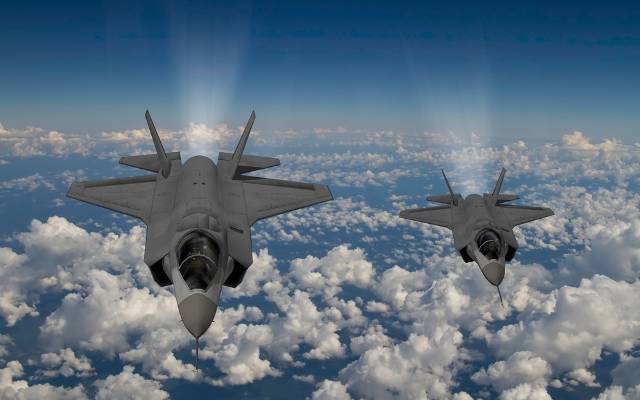
Reports indicate there were at least three injuries caused by the IAF strike, in which recently acquired F-35 stealth fighter jets were reportedly used, according to the Jerusalem Post.

 Since the summer 2014 war with Gaza, a number of missiles have been aimed at Israel from Gaza. In June, terrorists fired a rocket toward southern Israel, which exploded in an open space in the Eshkol region, causing no injuries or damage.


U.S. and Guam Shielded From North Korean Missiles by High-Tech Defenses

August 10, 2017

U.S. and Guam Shielded From North Korean Missiles by High-Tech Defenses, Washington Free Beacon, August 10, 2017

Kim Jong Un / Getty Images

Amid growing missile threats from North Korea, American missile defenses based in Alaska, California, and Guam, as well as on Navy ships, are capable of knocking out North Korean nuclear missiles, according to military leaders and experts.

Missile Defense Agency Director Air Force Lt. General Samuel Greaves said Wednesday he is confident current defenses would be effective against Pyongyang’s missiles.

“Yes, we believe that the currently deployed ballistic missile defense system can meet today’s threat, and we’ve demonstrated that capability through testing,” Greaves told a conference in Alabama.

Contrary to critics who say ground-based interceptors and naval anti-missile systems are unreliable, retired Air Force Lt. Gen. Trey Obering, a former MDA director, says the Ground-based Midcourse Defense (GMD) provides the best protection from a long-range North Korean strike.

Yet other shorter-range defenses such as the land-based Terminal High Altitude Area Defense, or THAAD, and the Navy’s ship-based Aegis SM-3 missiles can knock out medium and intermediate-range North Korean missiles, and if given enough satellite warning could attack North Korea’s ICBM warheads, he said.

“Any interceptor can intercept any missile, given the right parameters,” Obering said in an interview.

“I have high confidence that if we were attacked by North Korea we would be able to defend ourselves.”

President Trump has declared North Korea will not be allowed to develop a nuclear missile capable of striking the United States. On Tuesday he warned that continued North Korean threats against the United States would result in “fire and fury like the world has never seen.”

North Korea responded by announcing that an attack on the American Pacific island of Guam is being considered.

On Wednesday, the official KCNA news agency dismissed Trump’s warning as a “load of nonsense.”

“Sound dialogue is not possible with such a guy bereft of reason and only absolute force can work on him,” the state media organ said.

The heated rhetoric prompted Defense Secretary Jim Mattis to reiterate U.S. military capabilities, including missile defenses, in a statement Wednesday.

“The United States and our allies have the demonstrated capabilities and unquestionable commitment to defend ourselves from an attack,” Mattis said.

Noting the unified vote condemning North Korea at the United Nations on Saturday, Mattis said “Kim Jong Un should take heed” of those who agree North Korea poses a threat to global security and stability.

North Korea “must choose to stop isolating itself and stand down its pursuit of nuclear weapons,” he said, adding that Pyongyang “should cease any consideration of actions that would lead to the end of its regime and the destruction of its people.”

Mattis said Trump was notified of the growing missile threat and his first orders were to emphasize the readiness of both missile defenses and nuclear deterrent forces.

The defense secretary added that the “combined allied militaries now possess the most precise, rehearsed and robust defensive and offensive capabilities on earth,” and noted that the Kim Jong Un regime’s actions “will continue to be grossly overmatched by ours and would lose any arms race or conflict it initiates.”

Air Force Gen. John Hyten, commander of U.S. Strategic Command, said recently that he is concerned about growing missile threats from both North Korea and Iran and wants better sensors and interceptors for missile defenses.

“I’m concerned about any missile threat that is growing and can either range our allies or the United States,” he said in Omaha last month.

“But when I look at where we need to invest in future missile defenses, I see the most important thing that we have to invest in right now would be increased sensor capabilities because we need to be able to characterize the threat wherever it is on the globe in order to be able to effectively respond to it with defenses.”

Hyten also favors adding sensors in space “because you can’t have access to enough land points in the world to have a full sensor capability, so we need to go to space.”

Next is the need for improved interceptors.

“We have interceptors right now that are good enough to deal with the basic North Korean threat that is out there right now,” Hyten said. “But the threat is maturing fast and we have to improve our interceptor capability fast enough to stay with them.”

The Pentagon is developing an advanced kill vehicle that will be added current interceptors in Alaska and California. New technology is also available to deal with maneuvering warheads.

Hyten said he would favor building space sensors and better interceptors before setting up a third based on the East Coast for the Ground-based Midcourse Defense.

The Pentagon is currently conducting a major review of ballistic missile defense policy that will set the course of current and future defenses.

“There’s a ballistic missile defense review underway right now that will say where we have to go in terms of capacity, whether it’s more in the West, more in the East,” Hyten said.

“But I continue to advocate to make sure we don’t in the discussion on capacity miss the need for improved sensors and improved interceptors that will really enable decisions we have coming out of the review.”

The ground based missile defenses that would be used against a North Korean ICBM include 36 interceptors mainly based at Fort Greely, Alaska with a smaller number located at Vandenberg Air Force Base in southern California.

The interceptors are equipped with kinetic kill vehicles that travel at very high speeds and ram into enemy warheads in space.

Command centers are located in Colorado Springs and Fort Greely.

Obering said the command and control for missile defense is highly automated because of the need to respond very quickly to a missile launch by North Korea that would be spotted by special military satellites focused on North Korea.

Once detected the system predicts an “impact fan” of potential target areas and if the track indicates it is going to hit the continental United States, Alaska or Hawaii.

“If that fan touches any of the defended area that is programed into the Ground Based Midcourse system, the system automatically alerts,” Obering said.

The alert notifies commanders that a missile is inbound heading for a specific area. Then electronic sensors around the world, including radar, begin searching for the missile.

The sensor information is then fed into the fire control system that assesses which data is more reliable and selects an interceptor to attack the warhead.

“The system then determines what would be the most optimum shot, either from Vandenberg or Alaska,” Obering said. “The human has to enable it. It has to say, ‘Ok, you’re authorized to launch.’ But everything else is done automatically.”

For Guam, currently a THAAD battery is deployed to the island and Aegis missile defenses ships also are likely being deployed near the island in the event North Korea would attempt to strike the island.

North Korea has three ICBMs, the Taepodong-2, Hwasong-13, and Hwasong-14. Those would not be used for strikes on Guam. Other medium-range or intermediate range missiles such as the Musudan or Hwasong-12 could be used.

Those missiles can be countered by THAAD and Aegis ships.

Obering said current defenses are capable against North Korean missiles today but need to be upgraded. “We certainly need to add more interceptors, we need to add more sensors and we need to do much more in terms of fielding advanced capabilities to stay ahead of the North Korean threat and the Iranian threat as well,” he said.

The MDA budget should be increased to $10 billion to $12 billion annually, he said.

For example, in addition to using space satellites for warning, satellites should be used for tracking in order to provide more precision for missile defenses.

“When you do that, you get dramatically improved sensor coverage,” Obering said. Space based sensors would bolster the three most effective missile defenses: GMD, THAAD and Aegis.

Another step to increase the lethality of missile defenses would be to use what is called cooperative engagement capabilities—the ability to use multiple tracking and guidance sensors on various missile defense systems.

For example, the Navy’s SM-3 missile has a range greater than the Aegis radar and thus could be extended by using data from other longer-range radar.

“That’s what we mean by an integrated system—the ability to take any sensor and marry it with any interceptor,” Obering said.

Cooperative engagement has been tested several times and more are scheduled.

Obering said missile defenses are proving opponents wrong. Many arm control advocates for decades opposed all missile defenses by arguing the defenses undermined arms control agreements.

“Just imagine where we would have been in the late 1990s and early 2000s if we would have listened to the critics and listened to those who said we don’t need to field missile defenses,” he said.

Without missile defenses, there would be only two options for military commanders: preemptive attacks or retaliation after being attacked.

“And now we have another option and that’s very critical,” Obering said.