US President Donald Trump and Russia’s President Vladimir Putin shake hands during a meeting on the sidelines of the G20 Summit in Hamburg, Germany, on July 7, 2017. (AFP PHOTO / SAUL LOEB)
HAMBURG, Germany (AP) — The United States and Russia struck an agreement Friday on a cease-fire in southwest Syria, crowning President Donald Trump’s first meeting with Russian President Vladimir Putin. It is the first US-Russian effort under Trump’s presidency to stem Syria’s six-year civil war.
The cease-fire goes into effect Sunday at noon Damascus time, according to US officials and the Jordanian government, which is also involved in the deal.
Secretary of State Rex Tillerson, who accompanied Trump in his meeting with Putin, said the understanding is designed to reduce violence in an area of Syria near Jordan’s border that is critical to the US ally’s security.
It’s a “very complicated part of the Syrian battlefield,” Tillerson told reporters after the US and Russian leaders met for more than 2 hours on the sidelines of a global summit in Hamburg, Germany.
Of the agreement, he said, “I think this is our first indication of the US and Russia being able to work together in Syria.”
For years, the former Cold War foes have been backing opposing sides in Syria’s war. Moscow has staunchly backed Syrian President Bashar Assad, supporting Syrian forces militarily since 2015. Washington has backed rebels fighting Assad. Both the US and Russia oppose Islamic State militants and say they’re focused on rooting out the extremist group.
The potential pitfalls for the cease-fire are clear — not least the challenge of enforcing it.
A picture taken from the Israeli side of the border shows smoke rising near the Israeli-Syrian border in the Golan Heights during fights between the rebels and the Syrian army, June 25, 2017. (Basel Awidat/Flash90)
Russia Foreign Minister Sergey Lavrov said Russian military police would monitor the new truce. But Tillerson said that was still being worked out. A senior US State Department official said the two countries were close to a deal on that issue and hoped to finalize it in the coming days, raising the prospect it could take effect Sunday with no clear sense of who is policing it.
That the deal was announced before all the details were ironed out was a clear indication of how eager the U.S. and Russia were to cast their leaders’ first meeting as a success. Officials said the deal had been in the works for weeks or months, but came together in time for the meeting.
The deal marks a new level of involvement for the Trump administration in trying to resolve Syria’s civil war.
Trump ordered some 60 cruise missiles to be fired at a Syrian air base in April after accusing Assad’s forces of a deadly chemical weapons attack. But his top military and national security advisers pointedly said they had no intentions of intervening to oust Assad. And they stopped short of endorsing Russian-led or UN peace mediation efforts between Assad’s government and rebel groups.
Israel also is part of the agreement, one US official said, who like others wasn’t authorized to speak publicly on the matter and demanded anonymity. Like Jordan, Israel shares a border with the southern part of Syria and has been concerned about a spillover of violence as well as an amassing of Iranian-aligned forces in the south of the country.
Jordanian government spokesman Mohammed Momani confirmed the accord in a statement that made no reference to Israel’s participation. Syrian government forces and its allies will stay on one side of an agreed demarcation line, and rebel fighters will stick to the other side. The goal is also to enable aid to reach this area of Syria, Momani told state media. US officials said the US, Russia and Jordan had only agreed on that demarcation line last week, clearing the way for a cease-fire to be worked out.
The deal is separate from an agreement that Russia, Turkey and Iran struck earlier this year to try to establish “de-escalation zones” in Syria with reduced bloodshed. The US, wary of Iran’s involvement, stayed away from that effort. Follow-up talks this week in Kazakhstan were unable to produce agreement on finalizing a cease-fire in those zones.
Image made from video provided by the Russian Defense Ministry press service on August 18, 2016, shows a Russian combat fighter bomber Su-34 unload its bombs over a target in Syria. (Russian Defense Ministry Press Service photo via AP, File)
Previous cease-fires in Syria have collapsed or failed to reduce violence for long, and it was unclear whether this deal would be any better.
Tillerson said the difference this time is Russia’s interest in seeing Syria return to stability. It’s an argument top US officials such as former Secretary of State John Kerry cited regularly amid his failed efforts to end a conflict that has killed as many as a half-million people, contributed to Europe’s worst refugee crisis since World War II and allowed IS to emerge as a global terror threat.
Tillerson also repeated the US position that a “long-term role for the Assad family and the Assad regime” is untenable and voiced his belief that Russia might be willing to address the future leadership of Syria, in tones reminiscent of Kerry. Up to now, Assad has rejected any proposals that would see him leave power, contributing to an impasse that has prolonged Syria’s suffering.
Earlier in the week, Syria’s military said it was halting combat operations in the south of Syria for four days, in advance of the new round of Russian-sponsored talks in Kazakhstan. That move covered the southern provinces of Daraa, Quneitra and Sweida. Syria’s government briefly extended that unilateral cease-fire, which is now set to expire Saturday — a day before the U.S. and Russian deal was to take effect.
The US-Russian cease-fire has no set end date, one US official said, describing it as part of broader discussions with Moscow on lowering violence in Syria.
The agreement may also reflect Iran’s increasingly prominent role in Syria.
This March 7, 2017 frame grab from video provided by Arab 24 network shows US forces patrolling on the outskirts of the Syrian town of Manbij, in Aleppo province, Syria. (Arab 24 network, via AP, File)
Washington has been resistant to letting Iranian forces and their proxy militias gain strength in Syria’s south, a position shared by Israel and Jordan. Friday’s deal could help the Trump administration retain more of a say over who fills the power vacuum left behind as the Islamic State is routed from additional territory in Syria.
In recent weeks, US forces have shot down a Syrian aircraft that got too close to American forces, as well as Iranian-made drones. A renewed government offensive against Western-backed rebels and Islamic militants in the contested province of Daraa also is sparking tensions, and Iranian-backed Hezbollah fighters have shifted south to join the fight.
Israel has also struck Syrian military installations on several occasions in the past few weeks after shells landed in the Israeli side of the Golan Heights. Ahead of the deal, media reports in Israel have suggested unease at any arrangement that relies on Russia policing areas near its frontier.
Implications for Syria aside, the deal marks the biggest diplomatic achievement for the US and Russia since Trump took office. Trump’s administration has approached the notoriously strained relationship by trying to identify a few limited issues on which the countries could make progress, thereby building trust for a broader repair of ties.
(What a great place for the U.S. Army to look for recruits. Maybe they can find another Nidal Hasan. — DM)
The Islamic Society of North America (ISNA) wants to be viewed as a mainstream Muslim organization, but its recent convention suggests it remains anything but moderate.
ISNA’s annual convention drew thousands of people in Chicago last weekend, spreading paranoid messages such as claiming President Trump wants to put Muslims in concentration camps, and presenting speakers who cast convicted terrorists as victims.
Invoking Japanese internment camps from World War II, speaker Zahra Billoo warned that Muslims face a similar fate despite assurances from politicians today.
“And we know from our experience that unless we have laws in place… and we [know they have done this] with other communities, that they’re going to send us to concentration camps,” she said.
Billoo is the Council on American-Islamic Relations’ (CAIR) San Francisco director. In the past, she has urged Muslims to “build a wall of resistance” between themselves and law enforcement, equated Americans in the Israeli army with ISIS terrorists, and accused the FBI of fabricating terrorist threats for public consumption.
ISNA saw her as an ideal person to lead a political discussion. Joining her was a former CAIR official who used the opportunity to advocate for convicted terrorists, including one whose case has been championed by al-Qaida and ISIS.
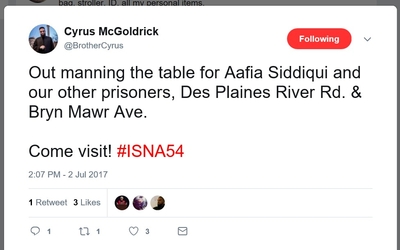
“…[Some] of them are our leaders,” Cyrus McGoldrick said. “Some of them are our youth, who were entrapped, some people were framed, I’m talking about Imam Jamil Al-Amin, I’m talking about Tarek Mehanna, I’m talking about Dr. Aafia Siddiqui. A number, hundreds, hundreds of leaders who, and Muslims who are in prison right now. And we forget them, we forget them. No one’s talking about that at this convention. We need to do more.”
Jamil Al-Amin, a Black Panther formerly known as H. Rap Brown, was convicted in 2002 for killing a Fulton County, Ga., sheriff’s deputy who tried to serve an arrest warrant.
Tarek Mehanna was convicted in 2011 for conspiring to provide material support for al-Qaida and lying to federal investigators. After traveling to Yemen seeking training in order to then fight U.S. soldiers in Iraq, Mehanna returned to the United States where he posted al-Qaida recruitment videos and other documents online.
Aafia Siddiqui, an MIT-trained neuroscientist, represents the most extreme case McGoldrick cast as “political prisoners” to his ISNA audience. Afghan security officers detained her in 2008, finding “handwritten notes that referred to a ‘mass casualty attack'” and a list of New York landmarks. During subsequent interrogation, Siddiqui, known as “Lady al-Qaida,” managed to grab a soldier’s M-4 rifle and open fire. She allegedly shouted, “I’m going to kill all you mother**kers!” and “Death to America.”
Ironically, U.S. Armed Forces recruiters set up a booth in the exhibit hall not far from where McGoldrick defended convicted terrorists.
Despite such rhetoric, ISNA remains politically influential. It played a key role in convincing former FBI Director Robert Mueller to purge FBI training materials dealing with Islam. Former ISNA President Mohamed Magid served on President Obama’s Homeland Security Advisory Council. During the Obama administration, ISNA representatives met with then President Obama and Vice President Joe Biden, and ISNA hosted then-DHS Secretary Jeh Johnson at its convention last year.
Another ISNA speaker, John Morrow, who teaches at Ivy Tech Community College in Indiana and directs the Covenants of the Prophet Foundation, launched into conspiratorial rhetoric accusing the U.S. of using the CIA to support jihadi groups with the intent of spreading anti-Muslim hatred.
“How do you ensure that the public continues to support the War on Terror, which is really a war on Islam and Muslims?” Morrow asked. “By means of terrorist attacks, by means of false flag operations, that way the eternal endless war of the globalist totalitarian fascists continues unabated to the pleasure of big brother, or as we know him in Islam, the one-eyed liar.
“The philosophy is clear. Keep the focus on fear.”
This is the same narrative that ISIS jihadist recruiters use to lure disaffected Muslims into becoming terrorists.
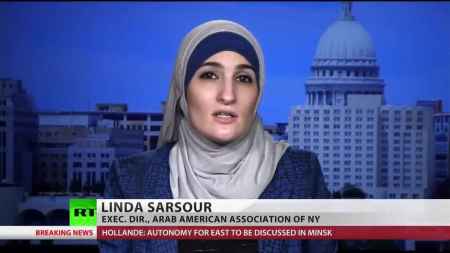
Prominent Muslim activist Linda Sarsour falsely asserted that white supremacists were a bigger terror threat in the United States than Muslims.
“I will not be on a national platform condemning terrorism as a Muslim. I will only condemn terrorism as a human being because that’s the only place that we should be condemning terrorism, because terrorism should never be framed as a conversation that should be just had with Muslims in a country where white supremacists have killed more people since 9/11 than Muslims have,” Sarsour said.
Even the liberal New America Foundation now admits that Muslim terrorists have killed more Americans since 9/11 than white supremacists.
Sarsour accused the Trump administration of being an “authoritarian racist regime” that needed to be resisted.
“I hope, that when we stand up to those who oppress our communities, that Allah accepts from us that as a form of jihad,” Sarsour said. “That we are struggling against tyrants and rulers, not only abroad in the Middle East or on the other side of the world, but here in these United States of America.
“You have fascists and white supremacists and Islamophobes reigning in the White House.”
The ISNA convention also featured hatred of Israel.
Several speakers promoted the Boycott, Divestment and Sanctions movement that aims to isolate Israel. Sarsour proudly proclaimed that the prominence she received due to her involvement in the Women’s March in January gave her a better platform to discuss the BDS movement.
“I have been able to have our country reckon with this conversation about what does it mean for a Muslim or a Palestinian American to be part of the resistance and to be working with allies who are now taking up the cause of BDS and supporting the Palestinian people,” Sarsour said. “So, what I am saying to you is don’t be afraid to be the center of controversy.”
Billoo repeatedly referred to the Jewish state as “apartheid Israel.”
McGoldrick attacked the Muslim Leadership Institute (MLI), which “invites North American Muslims to explore how Jews understand Judaism, Israel, and Jewish peoplehood.” MLI brings people to “occupied Palestine,” McGoldrick said, indicating he had no interest in recognizing its legitimacy. He condemned MLI for teaching Muslims about Zionism in a positive manner and for instructing them about Judaism in “so-called Israel.”
This kind of hateful rhetoric is a staple at ISNA conferences. In 2009, a speaker lamented Jewish “control of the world.”
In 1993, ISNA signed a declaration calling Israel’s creation a crime. “To recognize the legitimacy of that crime is a crime in itself and any agreement which involves such recognition is unjust and untenable. The League of Ulama in Palestine declared on Sept. 14 ’93 that no one has the authority to concede the rights of the Islamic Ummah in Palestine.”
It would seem that ISNA’s radical past still is very much part of its radical present. Politicians should think twice before working with ISNA as long it tolerates and gives a platform for narratives that enable terrorist recruiters.
Secretary of State Rex Tillerson spoke and took questions at an off-camera news briefing on Friday after participating in talks with Russia at the G20. Treasury Secretary Steven Mnuchin also spoke briefly before Tillerson.
There is little in the news today quite as delightful as watching the mainstream media do the CNN Two-Step. The CNN Two-Step is a simple dance. Step One: Put your foot in your mouth. Step Two: Shoot yourself in the foot. The results are bloody but hilarious.
The latest iteration comes from CNN’s own Jim Acosta. Acosta seems to have modeled himself on the Grandfather of Fake News, Dan Rather. Rather made his name by shouting biased and hostile questions at a president despised of the elite. Acosta has made a fool of himself doing the same thing. Acosta beclowned himself most recently (as of this writing; it’s hard to keep up) filing a sneering, unprofessional report on the president’s press conference in Poland. Acosta scornfully called it a “fake news conference“:
The other thing that was fake news coming from President Trump is he said, “Well, I keep hearing it is 17 intelligence agencies who said Russia interfered in the election. I think it is only three or four.” Where does that number come from? Where does this three or four number come from?
Turns out the number comes from corrections filed by the New York Times and the Associated Press, after weeks of complaints about the error from conservative websites.
But, of course, this is only the latest example. Over at MSNBC, they were doing the CNN Two-Step last week after Trump tweeted some nasty remarks about Morning Joe co-host Mika Brzezinski. This came after months of Mika and her fiance Joe Scarborough attacking Trump as a “thug,” a “goon,” “mentally ill,” and so forth. When Trump finally gave them the smack they deserved, their over-the-top whining and crying were absurd enough to make a statue laugh.
And we mustn’t forget how CNN extorted an apology out of a private citizen after Trump retweeted an anti-CNN .gif that the citizen may or may not have made. Alisyn Camerota reported this act of sinister thuggery by the network as if it were some kind of happy ending. And the entire CNN staff seemed surprised when Trump supporters responded in kind by releasing staffers’ personal info along with a blizzard of anti-CNN memes.
The media might use this opportunity to stop dancing the CNN Two-Step — to stop blowing their own heads off in other words — and take stock. They might ignore Donald Trump’s manners and ask themselves whether perhaps he has a point, whether perhaps their industry is desperately in need of reform.
After sixteen years of listening to CNN and the networks and WaPo and the New York Times attack the honest George W. Bush relentlessly, then coddle the corrupt Barack Obama; after listening to Middle-American values disdained and the Tea Party movement denigrated; after being told their opinions were only a backlash to the progressive genius of the elites; after being told they must not say what was right in front of their eyes whether it was Islamic terrorism or that boys aren’t girls or that cops make black neighborhoods safer… after sixteen years of snarling contempt from the fancy-pants mouthpieces of large media corporations, the American people elected Donald Trump, in part at least, to send the media a message.
The message is: Go to hell. It’s about time the press received it loud and clear.
Linda Sarsour, the left’s favorite Muslim organizer, with a history of promoting violence against Jews and ex-Muslims, gave a Jihadist speech at ISNA.
Literally.
“I hope that we when we stand up to those who oppress our communities that Allah accepts from us that as a form of jihad. That we are struggling against tyrants and rulers not only abroad in the Middle East or in the other side of the world, but here in these United States of America where you have fascists and white supremacists and Islamophobes reigning in the White House.”
The very predictable media defense is that Sarsour was speaking of political change, not terrorism. This is the same lie that turned the Arab Spring into a killing field.
Sarsour was speaking in the typical language of the Muslim Brotherhood. Its notion of political change embraces a spectrum that includes both violent and non-violent action. It’s primary allegiance is Islamic Supremacism.
That is the familiar doctrine that Sarsour laid out. Jihad for Allah against the enemies of Islam. The tactics are shaped by the context, but the goal of Jihad never changes.
President Trump kicked off his two-hour meeting with Russian President Vladimir Putin by addressing Russia’s election meddling and pressed the issue with him repeatedly, Secretary of State Rex Tillerson told reporters in Hamburg Friday.
Tillerson, who was the only other American official in the room besides Trump, said Putin denied authorizing cyberattacks against Democrats during the presidential race.
The secretary of state confirmed reports that Trump and Putin agreed to a ceasefire with Jordan in southwest Syria.
[I]t is critical that Eastern Europe continues to be a strong voice of dissent in the EU project. It might provide just the cultural confidence that European bureaucrats dramatically lack — at the peril of Europe itself.
**************************
“The greatest difference is that in Europe, politics and religion have been separated from one another, but in the case of Islam it is religion that determines politics” — Zoltan Balog, Hungary’s Minister for Human Resources.
It is no coincidence that President Donald Trump chose Poland, a country that fought both Nazism and Communism, to call on the West to show a little willingness in its existential fight against the new totalitarianism: radical Islam.
“Possessing weapons is one thing, and possessing the will to use them is another thing altogether”. — Professor William Kilpatrick, Boston College.
In a historic speech to an enthusiastic Polish crowd before the meeting of the G20 Summit leaders, US President Donald Trump described the West’s battle against “radical Islamic terrorism” as the way to protect “our civilization and our way of life”. Trump asked if the West had the will to survive:
“Do we have the confidence in our values to defend them at any cost? Do we have enough respect for our citizens to protect our borders? Do we have the desire and the courage to preserve our civilization in the face of those who would subvert and destroy it?”
Trump’s question might find an answer in Eastern Europe, where he chose to deliver his powerful speech.
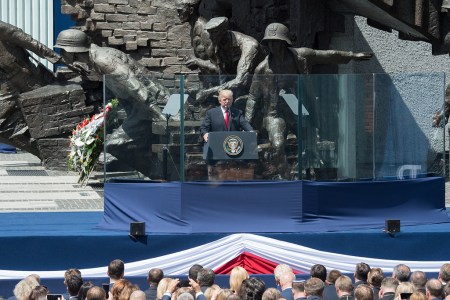
President Donald Trump gives a speech in Warsaw, Poland, in front of the monument commemorating the 1944 Warsaw Uprising against the Germans, on July 6, 2017. (Image source: The White House)
After an Islamist suicide-bomber murdered 22 concert-goers in Manchester, including two Poles, Poland’s prime minister, Beata Szydło, said that Poland would not be “blackmailed” into accepting thousands of refugees under the European Union’s quota system. She urged Polish lawmakers to safeguard the country and Europe from the scourges of Islamist terrorism and cultural suicide:
“Where are you headed, Europe? Rise from your knees and from your lethargy, or you will be crying over your children every day”.
A few days later, the European Union announced that it would begin proceedings to punish Poland, Hungary and the Czech Republic for their refusal to accept migrants as the European Commission had decided under a 2015 scheme it created.
After Szydło’s speech, Zoltan Balog, Hungary’s Minister for Human Resources, declared:
“Islam is a major culture and religion, which we must respect, but Europe has a different identity, and it is clear that these two cultures are incapable of coexisting without conflict… The greatest difference is that in Europe, politics and religion have been separated from one another, but in the case of Islam it is religion that determines politics”.
That is why Viktor Orban has been labelled as “Europe’s enemy within” — because he spelled out what the President of the European Commission, Jean-Claude Juncker, will never do: “Keeping Europe Christian“.
These speeches from Visegrad officials — the European group made up of the Czech Republic, Poland, Hungary and Slovakia — are just two examples of deep ideological divisions between Western European countries and those in Central- and Eastern Europe.
There has been a growing tendency of Visegrad leaders to depict Islam as a civilizational threat to Christian Europe. If, in Western Europe, Christianity has been dramatically cast aside by public opinion and severely restricted by EU official rules, in Eastern Europe new polls reveal that Christianity is as robust and patriotic as ever. That is why Trump called Poland “the faithful nation“. That is why US Catholic magazines are openly asking if there is a “Christian reawakening” in Eastern Europe. Slovakia approved a law to prevent Islam from becoming an official state religion.
These Central- and Eastern European countries know that Western Europe’s multiculturalism has been a recipe for terror attacks, for a start. As Ed West of The Spectator noted:
“Not all of Europe, of course. Central Europe, chiefly Poland, Hungary and the Czech Republic, remain largely safe from the terror threat, despite the former in particular being a Nato player in the Middle East. It is precisely because the reasons for this are so obvious that they cannot be mentioned. Poland is 0.1 percent Muslim, most of whom are from a long-settled Tartar community, Britain is 5 percent, France 9 percent and Brussels 25 percent, and those numbers are growing”.
What is presumably “obvious” here is that Poland and Hungary are not hit by Islamic terror attacks because they have very few Muslims, while Belgium and UK it is the reverse. Europe would probably have been safer if it had followed Eastern Europe’s example.
Eastern Europe not only shows a greater understanding of Western culture than Western Europe does; these Eastern countries have also been far more generous to NATO, the bulwark of their independence and security. Culture and security go hand-in-hand: if you take your own culture and civilization seriously, you will be ready to defend them.
A brief look at the NATO’s members’ military spending as a percentage of GDP shows that Poland meets the 2% target, unlike all the Western European countries. Only five of NATO’s 28 members — the U.S., Greece, Poland, Estonia and the U.K. — meet the 2% target. Where is France? And Belgium? And Germany? And The Netherlands?
“Unlike most of its NATO and European peers,” Agnia Grigas, a senior fellow at the Atlantic Council, explained, “Poland has for the past two decades consistently viewed defense as a priority issue, and as a result, has been slowly but steadily emerging as the bedrock of European security”. Poland — unlike Belgium, Italy and other European countries — is not a “free rider” but a trustworthy partner to its US ally. Poland showed loyal support to the United States both in Afghanistan and Iraq, where its troops fought the Taliban and helped to topple Saddam Hussein.
It is no coincidence that President Trump selected Poland, a country that fought both Nazism and Communism, to call on the West to show a little willingness in its existential fight against the new totalitarianism: radical Islam.
“The West will continue to have the military edge for a good time to come, but possessing weapons is one thing, and possessing the will to use them is another thing altogether”, wrote William Kilpatrick, a professor at Boston College. “The West is strong militarily, but weak ideologically. It lacks civilizational confidence”.
That is why it is critical that Eastern Europe continues to be a strong voice of dissent in the EU project. It might provide just the cultural confidence that European bureaucrats dramatically lack — at the peril of Europe itself.
Giulio Meotti, Cultural Editor for Il Foglio, is an Italian journalist and author.
BEIJING, July 7 (Xinhua) — A Foreign Ministry spokesman on Friday objected to India’s attempts to stir up disputes over the Doklam region.
The Indian sides claims that, according to a 2012 India-China agreement, the tri-junction point of China, India and Bhutan will be decided by consulting with the Bhutan side, which means China and India have recognized their divergence on the issue.
Chinese Foreign Ministry spokesman Geng Shuang said the so-called tri-junction point, just as its name implies, is a point, rather than a line or an area.
He said, on the tri-junction, the Convention Between Great Britain and China Relating to Sikkim and Tibet (1890) stipulates that the Sikkim section of the China-India boundary commences at Mount Gipmochi in the east.
However, the trespass by the Indian troops took place at the Sikkim section of the China-India boundary over 2,000 meters away from Mount Gipmochi and has nothing to do with the tri-junction, said Geng.
The Indian side, by disregarding of the boundary convention, assumes the whole Doklam region as part of the tri-junction. This is obviously an attempt to confuse the public, he added.
Some opinions hold that the 1890 convention has ceased to have any significance, because the situation changed after the Sino-Indian Border Conflict in 1962.
In response to a question on whether India has recognized the delimitation of the Sikkim section of the China-India boundary since 1962, Geng said successive Indian governments had repeatedly confirmed the 1890 convention in written form, with no disagreement on the boundary alignment at the Sikkim section.
Once the border treaty was signed, its legitimacy and effectiveness was not affected by changes of governments or state systems, said Geng.
Israel blasted as “shameful and anti-Semitic” the UNESCO designation of Old Hebron and the Cave of the Patriarchs as “Palestinian heritage sites in danger.” “Not a Jewish site?” Prime Minister Binyamin Netanyahu asked, after 12 countries voted in favor, three against and six abstained from the resolution in a secret ballot held Friday, July 7, in Krakow, Poland. “Who is buried there, Abraham, Isaac and Jacob, Sarah, Rebecca and Leah, our patriarchs and matriarchs,” Netanyahu said.
“Everywhere else in the Middle East mosques, churches and synagogues are being destroyed. Only in Israel is freedom of worship guaranteed.”
The Cave built over the site purchased, according to the Bible, by Abraham is Judaism’s second holiest site after Jerusalem and Islam’s fourth. Both faiths worship there at separate times. By Jewish tradition, Hebron is hallowed as the first seat of King David’s kingdom’s 3,000 years ago.
“We’ll continue to safeguard the Cave of the Patriarchs, freedom of religion and truth,” Netanyahy vowed.
President Reuven Rivlin tweeted: “UNESCO seems intent on sprouting anti-Jewish lies, while it remains silent as the region’s heritage is destroyed by brutal extremists.”
Opposition Yesh Atid leader, Yair Lapid, called UNESCO’s decision “a despicable falsification of history. Does UNESCO not believe that the Bible is heritage?”
The decision was hailed by Palestinian officials as a diplomatic victory against pressure from Israel and the US to derail the vote. Israel failed to have the motion on Hebron blocked, despite the personal intervention of the US ambassador to the UN, Nikki Haley.
This UN body consistently passes anti-Israel, pro-Palestinian resolutions. Tuesday, UNESCO carried a Jordanian-drafted resolution declaring Israel an ‘occupying power’ in Jerusalem’s Old City and denying the Jewish state’s right to sovereignty in its capital.
The visit this week of Indian Prime Minister Narendra Modi, the first ever official visit of an Indian Prime Minister to Israel, is too important to relegate to a small item in a regular Good News Friday post, so this week you shall receive a double portion (just like the Manna in the wilderness 😀 )
Indian PM Narendra Modi and Israeli PM Binyamin Netanyahu (Tomer Neuberg/Flash90)
Israel’s welcome of Modi was almost ecstatic. Not only the Prime Minister and the government, but the people of Israel too were delighted with the visit of this remarkable man. The warmth between the two nations was expressed right from the start, on Modi’s descending from his plane onto the tarmac. Watch just the first minutes of PM Modi’s (25 minute long) video to understand:
As Modi said:
The President of Israel welcomed me so warmly, he broke protocol. This is a mark of respect for the people of India: PM @narendramodipic.twitter.com/r6eFdlrYwz
Hello Israel! Today I begin a special & historic visit with the aim of further strengthening the relations between India and Israel. pic.twitter.com/q8mfeaciIu
But there is even more to the level of respect and affection than meets the eye. The Times of India explains that even PM Modi’s fashion choice was meant as a tribute to Israel.
He wore a white suit with a blue handkerchief to represent the colours of Israel. What a beautiful gesture! What a mensch!
With bilateral relations at all-time high, India’s Prime Minister Narendra Modi has embarked on a 3-day visit to Israel today. Prime Minister Modi becomes the first ever sitting Indian premier to visit the Jewish State.
Developmental issues such as agriculture technology and water management will be high on agenda during the historic visit that marks the 25 years of bilateral diplomatic ties. Both countries are expected to sign an agreement setting up a $40 million innovation fund to finance joint research in agriculture, water, energy and technology during the prime ministerial visit.
“In the last few years the world has seen the India Israel relationship come out from the perception of just Defense related activities to showcasing a fantastic connection in agricultural, educational, entrepreneurial & cultural cooperation. It’s these new areas which are making this bilateral a model for the rest of the world to follow.” Rishi Suri, senior international affairs editor at Indian newspaper Daily Milap, told Israellycool.
“Narendra Modi receives extraordinary welcome as he begins path-breaking visit to Israel,” noted Indian financial daily Economic Times. “The personal chemistry and the warmth between Modi and Prime Minister Benjamin Netanyahu was apparent in their remarks and their hugs.” The newspaper noted the significance of the visit that goes beyond the impressive personal rapport that both world leaders have managed to forge:
Behind the overt affection and friendship, lies deep political significance as India for the first time has delinked its relationship with Israel from its traditional support to Palestine. But, India now hopes to leverage its relationship with Israel to attract more investment, and gain from Israeli cutting-edge technology and defence.
“Investments to boost tourism, education and cultural ties and building bridges with the Indian diaspora in Israel can help boost ties between the two countries,” wrote the leading Indian business daily Mint. “Indeed, these are the low-hanging fruits in the bilateral relationship that can be plucked right away.”
Indian PM Narendra Modi and Israeli PM Binyamin Netanyahu on Modi’s arrival in India
“Red carpet welcome done, PM Narendra Modi gets down to business in Israel today,” reported the Indian news channel NDTV. “Israel PM Benjamin Netanyahu, who usually meets visiting heads of government for a meeting and over dinner or lunch meeting, will accompany PM Modi to most engagements.”
On a historic visit that started with firm handshakes, hugs and a smattering of Hindi and Hebrew, Prime Minister Narendra Modi will get down to business today with back-to-back meetings with Prime Minister Benjamin Netanyahu and other Israeli leaders that will focus on cooperation on defence, security, water and more. Apart from the multiple pacts that the two strategic partners are expected to seal at Wednesday’s meetings, the two leaders are also expected to deliver a strong message against terrorism in their joint statement. Both leaders had yesterday spoken in one voice to resolutely combat terrorism and radicalism.
India-Israel partnership in the field of start-up alone has a revenue potential of $25 billion, projected NASSCOM, the association of Indian IT companies. Indian daily Financial Expresspublished the excerpts of a report compiled by NASSCOM and consultancy firm Accenture:
Revenue worth USD 25 billion can be generated in India and Israel through cumulative cross- border investment into start-ups in these two countries, a joint report by Nasscom and Accenture today said. The report titled ‘Collaborative Innovation: The vehicle driving Indo-Israel prosperity’ noted India and Israel’s innovation ecosystems share unique innovation complementary traits in three areas — temperament, talent and technology.
In a stunning display, Indian Prime Minister Narendra Modi’s visit to Israel received favourable coverage from across the Indian media landscape. The Indian Prime Minister was in Israel on a 3-day visit, first ever by an Indian premier.
Prime Minister Modi’s visit lays “the foundation of a new chapter in relations with Israel,” commented the country’s leading business daily Economic Times. Both countries took “historic steps towards a new engagement,” wrote newspaper Hindustan Times. Like many Indian newspapers, The Hindu described the visit as “ground-breaking” and noted the “extraordinary welcome” Indian leader received in “the Jewish nation.”
“In reorienting India’s foreign policy, Narendra Modi is responding to history and realpolitik,” commented the often left-leaning Indian news website, FirstPost.
“It is time Muslims rethink their idea of Israel,” wrote the Indian-Muslim commentator Tufail Ahmad. “Muslims in India must keep in mind that their success lies in India’s prosperity. As India makes rapid progress, the fruits of economic development and growing educational opportunities will inevitably reach Muslims as well. However, India’s economic progress lies in its strong security partners: Israel and the US.”
There were prominent voices in support of Prime Minister’s visit, even within the main opposition Congress Party. The former Deputy Foreign Minister Shashi Tharoor praised Prime Minister Modi’s diplomacy on Israel. “[This] shows our relationship has reached a level of maturity which makes it possible for us to contemplate first ever PM visit [to Israel],” Tharoor said.
SwarajyaMag, India’s leading centre-right magazine with a young readership, praised Prime Minister Modi’s diplomatic initiative, urging the government to “disassociate itself completely from the Palestinian question” and seek greater strategic cooperation with Israel. Ahead of Modi’s visit, the publication was blunt in its assessment of India’s foreign policy, stating “[the Visit] does not upend India’s decades-long policy by betraying a tilt towards the Jewish state.” Criticising India’s track record at the UN and other international fora, SwarajyaMag wrote:
A truly historic moment would be if India were to disassociate itself completely from the Palestinian question – it is not as if it has contributed in any meaningful way all these years. The issue does not affect India and is best left to the concerned parties to resolve, much as India insists on Kashmir. If India’s voting at international fora were to shift to reflect this new position, such a move would give Israel much diplomatic room to manoeuvre.
Of course there was whining from the Palestinian camp, but that is hardly news. It would only be newsworthy if they had welcomed such a visit.
But amid all the compliments paid and deals struck, perhaps most striking about Modi’s historic visit were the things that weren’t mentioned. Iran — a close Indian ally — for example. The Islamic Republic’s ongoing destabilizing actions in the region and continuous calls for Israel’s destruction were not raised, or at least not publicly.
In meetings with world leaders, even those with good relations to Tehran, Netanyahu usually doesn’t shy away from talking about Iran. Last December in Astana, for instance, he asked Kazakh President Nursultan Nazarbayev to send a message to Tehran. “Ask … why Iran continues to threaten us with annihilation. Don’t you understand: we’re not a rabbit. We’re a tiger,” he said.
Hosting Modi, Netanyahu refrained from belligerent statements directed at Tehran, despite the fact that Iranian terrorists were responsible for a 2012 terror attack in New Delhi, during which an Israeli was wounded. India never made any arrests in this case.
More importantly, the Palestinian issue was entirely absent from Modi’s visit. The Indian leader’s intention to separate Delhi’s friendship to Israel from its support for the Palestinians was evident once it emerged that Modi would visit Israel but skip the Palestinian Authority. But it was even more remarkable that in several speeches Modi made in Israel, he never cited the issue.
In a two-page joint statement the governments of Israel and India released Wednesday, the two leaders dedicated but one of 22 paragraphs to their discussion of the Israeli-Palestinian peace process. “They underlined the need for the establishment of a just and durable peace in the region,” the declaration read. “They reaffirmed their support for an early negotiated solution between the sides based on mutual recognition and security arrangements.”
The premier of India — a state which in 1947 opposed the UN Partition Plan and, 65 years later, supported granting the “State of Palestine” nonmember state status at the UN General Assembly — did not endorse Palestinian statehood once during his time here. He did not mention the two-state solution or the principle of two states for two peoples.
Herb Keinon in the Jerusalem Post similarly notes that Narendra Modi spent over two days in the country – and never once mentioned the Palestinians, nor did he visit them.
But one of the most refreshing aspects for Netanyahu was certainly that Modi did not publicly lecture or hector about the Palestinian issue. Had he come here and not coupled his visit with a quick trip to Ramallah to see Palestine Authority President Mahmoud Abbas, that – in Netanyahu’s eyes – would have been enough.
But Modi did even more than that. He didn’t even mention the Palestinians in public. He didn’t slam Israel for the settlements. And in the joint statement carefully drawn up by both sides spelling out the underpinnings of the relationship, the Palestinians were not mentioned until the 20th clause of a 22-clause document.
And even there, India – which was the first non-Muslim country in 1987 to recognize “Palestine” – spoke only generically about a “just and durable peace in the region,” without explicitly calling for a two-state solution.
Netanyahu had to wish that all his guests – especially those from Europe – behaved like Modi.
Why? What happened? How come Modi, whose country for decades was at the forefront of championing the Palestinian cause, did not even give the issue public lip service while here.
There are many reasons, some having to do with how Asians do business, others with how Modi prepared the ground for the trip, and still others dealing with India’s emerging power and status in the world.
First a word about style. India, unlike many of the European countries, does not like “megaphone diplomacy.”
…
One of the reasons, the officials said, is that India detests when other countries lecture and hector it about its fraught relationship with Pakistan, an indication New Delhi has internalized – at least when it comes to Israel – Hillel’s famous dictum about not doing to others what is hateful to you.
Secondly, Modi could get away with making this a strictly bilateral trip because he carefully prepared the ground for it.
Elected in 2014, there was talk that he would come to Israel already in the summer of 2015. He didn’t. He waited. He first went to Saudi Arabia, Iran, Qatar and Iran, where he obviously explained the nature of India’s relationship with Israel, and that improved ties with Israel would not come at their expense.
He also invited PA President Mahmoud Abbas to New Delhi in May, publicly supported a Palestinian state, and pledged that India’s historical support for the Palestinians would not waver.
In other words, he got all his ducks in a row before making his historic trip to Israel, something important from an Indian perspective considering that more than seven million Indians live and work in the Persian Gulf.
…
One of the reasons often given in the past for the brakes the Indians put on the relationship with Israel, was that a high-profile relationship would infuriate India’s Muslims.
It doesn’t.
India’s Muslims did not take to the streets when it became clear Modi wanted to visit, they didn’t raise a hue and cry. One conclusion is that the resonance of the Palestinian issue on the Muslim- populations in non-Arab countries is not as great as is often imagined. Another conclusion is that with all the turmoil in the Middle East, with the hundreds and thousands who have died in the region since the Arab Spring, the Palestinian issue has simply dropped as a priority issue.
If only other countries could learn from India and follow their lead, how different would the world, particularly the Middle East, look today.
The three-day visit was brimful with grand gestures — including plenty of Modi’s trademark hugs — and mutual declarations of love and admiration. Modi’s jam-packed itinerary comprised political talks with the government and the leader of the opposition, and secret talks on improving counter-terrorism coordination. There was an emotional meeting with an 11-year-old Jewish boy who lost his parents in the 2008 terror attack in Mumbai. Modi addressed a Bollywood-infused concert/rally for Israelis with Indian roots. And after paying his respect to the six million Jews who perished in the Holocaust, he spontaneously visited the nearby grave of Zionist visionary Theodor Herzl.
A floricultural center named a flower after him, and he took a stroll with Prime Minister Benjamin Netanyahu at the beach. The photos of the two leaders, their bare feet in the water as they chatted about Israeli desalination techniques, will go down in history as one of the most iconic images to come out of Israel since Netanyahu and Barack Obama took off their suit jackets at Ben Gurion Airport in March 2013.
Watch the two leaders at the beach. 🙂
On the economic front, too, the visit will have an impressive lasting impact. Israel and India established a $40 million Industrial R&D and Innovation Fund, and individual companies from both nations signed deals worth millions. Jerusalem and Delhi signed seven bilateral agreements, covering technology, agriculture, water and even space research. “We already agreed that the sky is not the limit because we’re doing it in space, but I think that the talents that we have in India and Israel are amazing and the possibilities are amazing,” Netanyahu said Thursday at the launch of the Israel-India CEOs’ Forum.
…
Modi formally invited Netanyahu to visit India, something the Israeli leader had dreamed about for years.
On a more serious note, in a very moving and emotional moment , Modi met with Moshe Holzberg, the little boy who was saved by his Indian nanny during a terror attack in Mumbai in which his parents, Chabad emissaries Rabbi Gavriel and Rivka Holzberg Hy’d, were killed.
It was an emotional moment to meet young Moshe, his maternal & paternal grandparents and Ms Sandra Solomon, his nanny. pic.twitter.com/jI93JBSDp1
The 11-year-old son of Chabad emissaries who were murdered in a 2008 jihadist rampage in Mumbai told visiting Indian Prime Minister Narendra Modi that he loves India and wants to return to complete the mission of his slain parents, during an emotional meeting Wednesday.
Indian Prime Minister Narendra Modi (C-L) and Prime Minister Benjamin Netanyahu (C-R) meet with Moshe Holtzberg (C), and his nanny Sandra Solomon and with other relatives at the King David Hotel in Jerusalem on July 5, 2017. ( AFP PHOTO / POOL / ATEF SAFADI)
Modi met with Moshe Holtzberg, pulling the boy close for an embrace and telling him that he would always be welcome in India.
Moshe’s nanny, Sandra Samuel, escaped from the Nariman Chabad House carrying 2-year-old Moshe in November 2008 after the building came under siege. Four Jewish victims were killed, including Moshe’s parents, Rabbi Gavriel and Rivka Holtzberg. Samuel has remained in Israel and was at the meeting as well.
…
At their meeting at a hotel in Tel Aviv, Modi immediately embraced Moshe, pulling him close and cupping his head against his chest before inviting him to come back to India.
The boy, accompanied by his grandparents who are raising him, welcomed the Indian premier to Israel.
Wearing a lapel pin with Indian and Israeli flags, he read out a message in halting English, telling Modi, “I hope I will be able to visit Mumbai, and when I get older, live there. I will be the director of our Chabad House” in place of his murdered father. “With God’s help, this is my answer.”
“Dear Mr. Modi,” Holtzberg concluded, “I love you and your people in India.”
I challenge you to have a dry eye at seeing this courageous little boy, all grown up, speaking two or three languages, and having developed so well thanks to his brave nanny Sandra Solomon and his wonderful grandparents and family.
And one more item from Modi’s visit to conclude this enjoyable post:
On Wednesday, thousands of Indian Israelis gathered in the city to greet Indian Prime Minister Narendra Modi and Prime Minister Benjamin Netanyahu in a glitzy, wild welcome for the first premier from their home country to visit the Jewish state.
Brightly colored Indian saris mingled with jeans and t-shirts — and not a few kippot and religious headscarves — at Wednesday’s event, which began with several Bollywood dance acts and a concert.
Members of the Indian community in Israel celebrate during the official visit of the Indian Prime Minister Narendra Modi, at the Convention Center in Tel Aviv, on July 5, 2017. (Tomer Neuberg/Flash90)
Bollywood dancing at festivities celebrating Modi’s visit to Israel
…
“It gives me chills,” said Naomi Yakub, who immigrated to Israel from India in the early 1970s and is part of a community of some 100,000 Indian Jews living in the country. For the Jewish community in Israel, “a meeting like this we haven’t had in 45 years,” she said.
“We love India, because we were born there and our parents are there,” added her friend Tal Shulamith, now a resident of Be’er Yaakov in central Israel. “It’s very emotional.”
…
But the culmination of the community’s raw elation was reserved for the moment Modi and Netanyahu walked on stage to Academy Award-level applause and a solid two-minute standing ovation. The leaders — Modi dressed in blue-and-beige, Netanyahu in a blue tie — clasped hands triumphantly in the air.
“Modi! Modi! Modi!” chanted the observers, some of whom wore “I am a fan of Narendra Modi” t-shirts.
…
Hailing the strong bilateral ties between the two countries for 25 years, Netanyahu noted that “we always remember that there’s a human bridge between us — you. We admire you, we respect you, we love you.”
Taking the stage after Netanyahu, Modi gave a lengthy speech in Hindi to the crowd of mostly Indian immigrants.
“For the first time in 70 years an Indian PM has got an opportunity to visit Israel,” his office wrote on Twitter in English simultaneously. “This is a matter of joy.”
For Israel’s Indian community, it certainly was.
Not only for Israel’s Indian community. For all of us.
Safe journey home Mr. Modi. May our two countries continue on the path to deep and warm relations for our mutual benefit.










 anneinpt
 artaxes
 danmillerinpanama
 davidking1530
 Peter Hofman
 Joseph Wouk
 Peter
Peter Louisiana Steve
 WarSclerotic
Recent Comments