Archive for July 2017

Trouble among America’s Gulf Allies

July 11, 2017

by John R. Bolton
July 11, 2017 at 8:30 am

Source: Trouble among America’s Gulf Allies


  • The State Department should declare both the Muslim Brotherhood and Iran’s Islamic Revolutionary Guards Corps (IRGC) as Foreign Terrorist Organizations (FTOs), thus triggering the penalties and sanctions required by law when such a declaration is made.
  • Those “affiliates” of the Muslim Brotherhood that, in whole or part, meet the statutory FTO definition should be designated; those that do not can be spared, at least in the absence of new information.
  • Qatar can legitimately complain that it is being unfairly singled out. The proper response is not to let Qatar off the hook but to put every other country whose governments or citizens are financing terrorism on the hook.

In recent weeks, governments on the Arabian Peninsula have been having a diplomatic brawl. Saudi Arabia, the United Arab Emirates and Bahrain (together with Egypt and other Muslim countries) have put considerable economic and political pressure on Qatar, suspending diplomatic relations and embargoing trade with their fellow Gulf Cooperation Council (GCC) member. Kuwait and Oman, also GCC members, have been mediating the dispute or remaining publicly silent.

The Saudis and their supporters are demanding sweeping changes in Qatari policies, including suspending all financial support to the Muslim Brotherhood and other terrorist groups; joining the other GCC members in taking a much harder line against the nuclear and terrorist threat from Shia Iran and its proxies; and closing Al Jazeera, the irritating, radical-supporting television and media empire funded by Qatar’s royal family.

The United States’ response so far has been confused. President Trump has vocally supported the Saudi campaign, but the State Department has publicly taken a different view, urging that GCC members resolve their differences quietly.

As with so many Middle East disputes, the issues are complex, and there is considerable underlying history. Of course, if they were easy, Saudi Arabia and Qatar would not be nearly at daggers drawn seemingly overnight.

Washington has palpable interests at stake in this dispute and can make several critical moves to help restore unity among the Arabian governments, even though the issues may seem as exotic to the average American as the Saudi sword dance Trump joined during his recent Middle East trip.

Twin issues to confront

Confronting the twin issues of radical Islamic terrorism and the ayatollahs’ malign regime in Iraq are central not only to the Arab disputants but to the United States as well. In addition to providing our good offices to the GCC members, the Trump administration should take two critical steps to restore unity and stability among these key allies.

First, the State Department should declare both the Muslim Brotherhood and Iran’s Islamic Revolutionary Guards Corps (IRGC) as Foreign Terrorist Organizations (FTOs), thus triggering the penalties and sanctions required by law when such a declaration is made. Both groups meet the statutory definition because of their violence and continuing threats against Americans. The Obama administration’s failure to make the FTO designation has weakened our global anti-terrorist efforts.

The Muslim Brotherhood’s defenders argue that it is far from monolithic; that many of its “affiliates” are in fact entirely harmless; and that a blanket declaration would actually harm our anti-jihadi efforts. Even taking these objections as true for the sake of argument, they counsel a careful delineation among elements of the Brotherhood. Those that, in whole or part, meet the statutory FTO definition should be designated; those that do not can be spared, at least in the absence of new information. The Brotherhood’s alleged complexity is an argument for being precise in the FTO designations, not for avoiding any designations whatever.

Saudi Arabia, Egypt and other Arab governments already target the Brotherhood as a terrorist organization but Qatar does not. That may sound suspicious, but as of now, of course, the United States hasn’t found the resolve to do it either. Once Washington acts, however, it will be much harder for Qatar or anyone else to argue that the Brotherhood is just a collection of charitable souls performing humanitarian missions.

A direct terrorist threat

Similarly, Iran’s Revolutionary Guards Corps is a direct terrorist threat that has been killing Americans ever since the IRGC-directed attack on the Marine barracks in Beirut, Lebanon, in October 1983. The only real argument against naming the IRGC is that so doing would endanger Obama’s 2015 nuclear agreement, given Tehran’s expected response to an FTO determination.

Second, Trump should follow up his successful Riyadh summit by insisting on rapid and comprehensive implementation of the summit’s principal outcome, the Global Center for Combating Extremist Ideology (GCCEI). This center can provide governments across the Muslim world a face-saving mechanism to do what should have been done long ago, namely taking individual and collective steps to dry up terrorist financing.
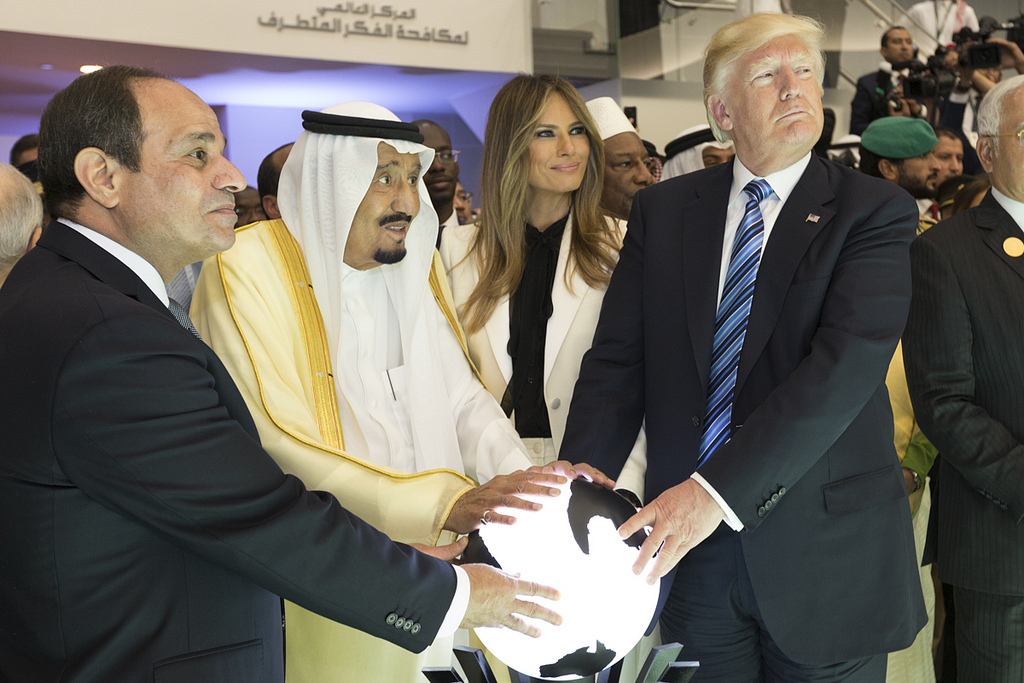
U.S. President Donald Trump and First Lady Melania Trump join King Salman bin Abdulaziz Al Saud of Saudi Arabia, and the President of Egypt, Abdel Fattah al-Sisi, in the inaugural opening of the Global Center for Combating Extremist Ideology, May 21, 2017. (Official White House Photo by Shealah Craighead)

One could write books on the intricate financing that supports international terrorism, and finger-pointing at those responsible could take years. But whether terrorists are financed by governments, directly or indirectly, or by individuals or groups, with or without government knowledge or encouragement, it must all stop. Qatar can legitimately complain that it is being unfairly singled out. The proper response is not to let Qatar off the hook but to put every other country whose governments or citizens are financing terrorism on the hook.

Although superficially the ongoing crisis among the oil-producing monarchies may seem a setback to American efforts in the war again terrorism and the struggle to eliminate the Iranian threat, in fact it provides a rare opportunity to make considerable progress on two of our top priorities. The Trump administration should not miss its chance.

John R. Bolton, former U.S. Ambassador to the United Nations, is Chairman of Gatestone Institute, a senior fellow at the American Enterprise Institute, and author of “Surrender Is Not an Option: Defending America at the United Nations and Abroad”.

This article first appeared in the Pittsburgh Tribune-Review and is reprinted here with the kind permission of the author.


“Confirmed Information” that ISIS leader is dead

July 11, 2017

Syrian Observatory: “Confirmed information” that al-Baghdadi has been eliminated

A Syrian human rights organization claims that it has “confirmed information” that the leader of ISIS, Abu Bakr al-Baghdadi, has been eliminated. This confirms the claim made by the Russian Foreign Ministry a month ago that al-Baghdadi was killed in an air strike, but the Pentagon still insists that they do not have enough information to confirm his death.

Jul 11, 2017, 5:17PM Chelsea Mosery Birnbaum

Source: “Confirmed Information” that ISIS leader is dead | JerusalemOnline

Abu Bakr al-Baghdadi in Mosul, 2014 Photo Credit: Channel 2 News

A member of the Syrian Observatory for Human Rights said on Tuesday that it has “confirmed information” that ISIS leader Abu Bakr al-Baghdadi has been killed. Rumors of his death have been making their rounds since his first and only public appearance in 2014 in which he announced the establishment of the terrorist organization. In June, the Russian Foreign Ministry reported that Baghdadi and other senior level members of ISIS had been killed in an air strike in Syria, but US intelligence said it could not substantiate the claims.

https://twitter.com/syriahr/status/884741013549527040?ref_src=twsrc%5Etfw&ref_url=http%3A%2F%2Fwww.jerusalemonline.com%2Fnews%2Fmiddle-east%2Fthe-arab-world%2Fconfirmed-information-that-isis-leader-is-dead-29643

In Washington, however, senior Pentagon officials told Reuters that it was impossible to say for sure that al-Baghdadi, who was on the Trump administration’s hit list along with other members of the organization, had indeed been eliminated. “We take any report of this nature with a large dose of salt,” said Sebastian Gorka, deputy assistant to US President Donald Trump. “We will verify it. We will look at the intelligence available…we will give a statement when we have the requisite facts.”

‘Don’t shift responsibility’: China says pressuring N. Korea isn’t solely up to Beijing

July 11, 2017

Source: ‘Don’t shift responsibility’: China says pressuring N. Korea isn’t solely up to Beijing — RT News

North Korean Leader Kim Jong Un © Reuters

China has responded to repeated calls for Beijing to put pressure on North Korea, stating that such responsibility does not rest solely on China. President Trump has repeatedly urged for Beijing to use its influence as Pyongyang’s sole economic lifeline.
Read more

US President Donald Trump and Chinese President Xi Jinping (R) meet on the sidelines of the G20 Summit in Hamburg, Germany, July 8, 2017 © Saul Loeb

“Recently, certain people, talking about the Korean Peninsula nuclear issue, have been exaggerating and giving prominence to the so-called ‘China responsibility theory’,” Foreign Ministry spokesman Geng Shuang told a daily news briefing on Tuesday, as quoted by Reuters.

“I think this either shows lack of a full, correct knowledge of the issue, or there are ulterior motives for it, trying to shift responsibility.

“Asking others to do work, but doing nothing themselves is not OK,” he added. “Being stabbed in the back is really not OK.”

“The ‘China responsibility theory’ on the peninsula nuclear issue can stop,” Geng said.

Although Geng did not mention any names during his Tuesday remarks, they come after repeated calls from the US for Beijing to put more pressure on North Korea over its nuclear and ballistic missile programs.

It also comes after Donald Trump met with Chinese President Xi Jinping at the G20 summit in Hamburg on Saturday, with the US president calling it an “excellent” meeting in which the two spoke about trade and North Korea.

US Treasury Secretary Steven Mnuchin said following the meeting that “substantive discussions” had taken place between the two leaders.

“In regards to China, we had very direct discussions about North Korea. We had very direct discussions about military and security cooperation,” Mnuchin said.

READ MORE: US & S. Korea fire tactical missiles, demonstrate ‘deep strike capability’ to Pyongyang (VIDEO)

“I think that President Trump made very clear to President Xi that he is focused on this issue, and wants to move forward and make progress. And I think President Xi gave a very interesting perspective from their standpoint,” he added.

The talks followed public discontent by Trump over China’s continued trade with Pyongyang, with the US leader tweeting last week that any cooperation between Washington and Beijing was unlikely when it came to the North Korea issue.

However, as Trump continues to express a desire to work alongside China when it comes to North Korea, Beijing has accused Washington and Seoul of worsening tensions in the region with joint military exercises.

The US and China are also in the midst of tense relations over Washington’s decision to deploy the Terminal High Altitude Area Defense (THAAD) system to South Korea, with Beijing saying it threatens China’s security and will do nothing to ease tensions.

READ MORE: Russia, China: N. Korea must freeze nuclear activities, US halt THAAD deployment

Although Washington has called for North Korea to end all missile testing and for the ‘de-nuclearization’ of the Korean Peninsula, Pyongyang has ignored those calls and has continued to launch missile tests – including one on the Fourth of July which it said was for the “American bastards.”

North Korea says its nuclear and ballistic missile programs are non-negotiable, “unless the US hostile policy and nuclear threat to the DPRK are definitely terminated,” according to the official state news outlet KCNA.

Trump’s challenge: N. Korea

July 11, 2017

Source: Israel Hayom | Trump’s challenge: N. Korea

Prof. Abraham Ben-Tzi

During the Cold War era, particularly during severe crises, the United States and the Soviet Union still managed to conduct the tense and charged conflicts between them in a fairly controlled and balanced manner. They did this by making an effort to establish new and reliable communication channels and patterns between them, even before the establishment of the Moscow-Washington hotline, also known as the “red telephone,” in 1963.

These efforts enabled Soviet Premier Nikita Khrushchev and U.S. President John F. Kennedy, in the midst of the Cuban missile crisis in October 1962, to draw the red lines that, if crossed, would bring the entire international community to the brink. This demarcation helped neutralize the possibility that a distorted perception or misunderstanding would set things off.

But unlike the clear lines drawn in a world with two superpowers, the current crisis with North Korea faces the world’s only superpower with a new, unchartered challenge. The challenge stems from the fact that the motivation behind North Korean leader Kim Jong-Un’s decision to test-fire intercontinental ballistic missiles, in flagrant disregard of clear American warnings, remains unclear. Is this nothing more than saber-rattling — Kim’s rational effort to terrorize the international arena by projecting an image of an irrational leader — or is it a reflection of delusions of grandeur and a dangerous predilection for unexpected moves?

It seems that the rules that enabled the international community to survive the Cold War era, anchored in the shared desire of the White House and the Kremlin to avoid mutual destruction, are now invalid, faced with the brazen challenge by the tyrant of North Korea. Moreover, the Trump administration’s working assumption — that the key to restraining North Korea is China — has not yet proved itself. This is not only because China is categorically opposed to a policy of brinkmanship or conducting economic warfare against North Korea, but also because it is unclear if it really has the ability to force Kim (despite his great dependence on trade with China) onto a less provocative path.

And so Kim continues to be defiant. The latest example could be heard in his threatening remarks last weekend: In response to a recent aerial show of power by the U.S. and its allies South Korea and Japan, which held war games not far from the North Korean border, the leader warned against “playing with fire,” which would increase the chances of a nuclear war. Indeed, in light of the difficulty in enlisting Chinese (and Russian) support for expanded sanctions against North Korea, the range of non-violent options available to U.S. President Donald Trump appears to be shrinking.

The problem is that even the most surgical strike against North Korea’s nuclear facilities is likely to have the opposite of the desired effect, exacerbating an already tense situation on the Korean peninsula even further. North Korea has significant conventional military power, and it could easily shed South Korean blood within range of its murderous artillery and missile barrages in immediate response to any military move by the U.S.

In summary, the current crisis proves the inherent difficulty in deterring rivals who behave like pyromaniacs at a gas station displaying an insatiable urge to light a fire, regardless of the consequences. In recent days, a new, complex challenge has cropped up right before the eyes of the American administration and the question is how willing Trump will be to incorporate aspects of former President Bill Clinton’s plan from 20 years ago into his own efforts to curb these nuclear aspirations.

But the Clinton policy, based on the carrot and stick method — humanitarian aid and sanctions — ultimately failed in the face of North Korea’s strategy of deception. At this time, it would be unwise to rule out a resumption of aggressive diplomacy that also incorporates incentives and rewards. After all, even a policy of economic strangulation may not topple the merciless North Korean tyrant, because his people, hungry and helpless, don’t factor into his considerations in any way.

The US is still the leader

July 11, 2017

Source: Israel Hayom | The US is still the leader

Zalman Shoval

The recently concluded G-20 summit in Hamburg once again poses the question of who will lead the Western world. At every point since the end of World War II, the answer to that question was obvious: the United States. But since the beginning of the Obama administration with its isolationist tendencies, and through the election of President Donald Trump and his declarations — which were interpreted as an attempt to shake off U.S. obligations to NATO and other international commitments — the answer now is not as clear-cut.

If not America, then who? Many people would answer: Germany under Chancellor Angela Merkel, who is seen as a balanced, level-headed leader who has successfully handled the euro crisis and other internal and foreign issues. But it’s not obvious that Merkel herself desires to be the official or even unofficial leader of the free world. One possible reason is that she knows that such a status would require a major build-up of Germany’s military capabilities, and she understands all that would entail in terms of economics and her worldview.

This weekend’s G-20 summit brought to light not only the conflict of interests between the West and China and Russia, but also the different approaches and friction within the Western camp itself, a situation that China and Russia are doing their utmost to exploit. The summation highlighted the very general agreements reached on global trade and the war on terrorism (although not on climate change), and Merkel issued a conciliatory statement of her own in which she said that America had not been isolated at the summit.

But her words carried no answer to the question of who will lead, or which principles and values will lead the Western world forward in the critical years ahead. After the fall of the Soviet Union, some believed that the “end of history” had arrived and the world would sail forward on clear moral waters in the spirit of philosopher Immanuel Kant. But the rise of the Islamist threat and waves of global terrorism, Iran’s and North Korea’s races to a nuclear bomb, Russia’s diplomatic gambits, and, in particular, China’s astonishing growing strength in all fields, including the military, are showing the West that this is not a Kantian world.

Whether it wants to or not, only the U.S. can lead the free world in the face of the current dangers, the ones that Trump himself mentioned in Warsaw last week when he spoke about “dire threats” to Western security and way of life.

In the end, it is not only a question of values, but of who will control the world. Various European leaders can kick around ideas of a “European answer” to current and future threats, resting on Britain’s and France’s nuclear capabilities, but they also know that nothing can replace American power as a main element of deterrence against any potential aggression.

Israel is also an integral part of the Western world. If Israel had its way, there would be no doubt that the U.S. should be at the helm. Not only because no other player can objectively match up to the U.S., and not only because of the alliance of practicalities and values between the two nations, but because the European alternative, even Merkel’s generally supportive and positive image, seems very disheartening given Europe’s well-known official positions on various matters having to do with Israel boycotts, Jerusalem, and the whole Palestinian issue. French President Emmanuel Macron’s negative announcement last week about Israeli settlements and a Palestinian state should be all the proof anyone needs.

ISIS: The beginning of the end

July 11, 2017

Source: Israel Hayom | ISIS: The beginning of the end

Oded Granot

Israel should welcome Islamic State’s defeat in Mosul, but it should also bear in mind that the Jewish state was never one of its primary targets. The main threat is still Iran.

Iraqi Prime Minister Haider al-Abadi rushed to Mosul on Sunday to congratulate his armed forces for their great victory over Islamic State. But considering the balance of power on the ground, that should have happened a long time ago.

For nine months, tens of thousands of Islamic State combatants in Mosul managed to survive a massive ground assault carried out by hundreds of thousands of Iraqi soldiers and special forces units, fighting alongside Kurdish regiments and Shiite militias, as well as devastating aerial bombardments launched by coalition aircraft. American military advisers supervised this offensive while Washington delivered a steady stream of weapons, equipment, intelligence and considerable funds to the Iraqi army.

Islamic State fighters put up a fight almost to the end with car bombs and suicide attacks. Women and children were strapped with suicide vests and sent out to greet the advancing Iraqi forces. Fighters’ corpses are still strewn in the alleyways of the Old City of Mosul.

The cost of defeating Islamic State in Mosul was unfathomable. Cautious estimates indicate a 40% casualty rate among the Iraqi army’s counterterrorism units, which spearheaded the campaign. Alongside Islamic State fighters, thousands of civilians also perished in the battle for Mosul, some of them in their homes in airstrikes and others while attempting to flee the besieged city.

But the war against Islamic State in Iraq is not over yet. There are still several active pockets of resistance in Mosul, as well as in other areas in the country’s west. The main concern now pertains to suicide bombers embedded in groups of fleeing civilians who will continue trying to inflict damage on Iraqi forces.

On the other hand, the fall of Mosul is undoubtedly a severe morale blow for the jihadi group. In the summer of 2014, in the Old City’s ancient al-Nuri mosque, Islamic State leader Abu Bakr al-Baghdadi declared a caliphate in territory seized by the group in Iraq and Syria. The mosque no longer exists, and apparently neither does Baghdadi.

In many respects, this is the beginning of the end for Islamic State in its current form. After Mosul, Raqqa, the group’s “capital” in Syria, will fall too. While the infrastructure will crumble, its extremist, murderous ideology will continue to fuel jihadists in Europe, the Middle East and elsewhere.

Israel, of course, should welcome the defeat of Islamic State in Mosul, but it should also bear in mind that the Jewish state was never one of its primary targets. The main threat to Israel is still posed by Iran and its proxies, Hezbollah and the Shiite militias beholden to Tehran. These groups continue to operate in Syria, Lebanon, and to some degree could potentially grow stronger in Iraq in the post-Islamic State era.

Forgive me .

July 10, 2017

Forgive me , but do we really wanna kill this of with nukes ?

Have the guts to watch till the end, do you realize how much amazing people we already have killed  because of our selfish interest , religions madness , ideological madness , drunkenness from power .

Lets try for once to step a bit higher on the ladder to real human kindness .

O what the FUCK , i do flip a light switch on a Saturday , and NOBODY tells me if i,am a god or bad Jew or even a Jew at all !


U.S. Ambassador to Turkey Slams American Fight Against Terror During July 4th Celebration

July 10, 2017

U.S. Ambassador to Turkey Slams American Fight Against Terror During July 4th Celebration, Washington Free Beacon  July 10, 2017

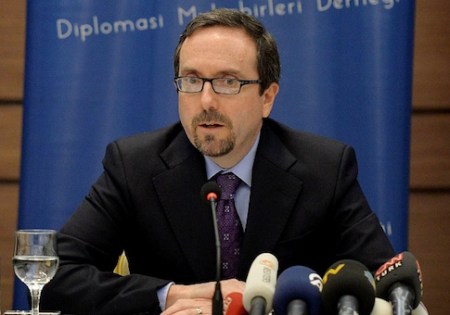
US Ambassador to Turkey John Bass delivers a statement to journalists in Ankara on April 7, 2016. / AFP / ADEM ALTAN (Photo credit should read ADEM ALTAN/AFP/Getty Images)

“If we have learned anything from last year and the violence of this year, it is that the only answer to terrorism and violence is justice and tolerance,” he said.

*****************************

U.S. Ambassador to Turkey John Bass criticized the American fight against terrorism during a July Fourth celebration hosted by the U.S. consulate in Ankara, claiming that an “overly broad” definition of terrorism has hampered U.S. efforts to combat extremists and eroded international confidence in America.

Bass, a career foreign service officer who was appointed by former President Barack Obama in 2014, urged Turkey to “avoid making the mistakes the U.S. made” in its fight against radical terrorists, telling those in attendance at an Independence Day reception “that rushing to justice or making an overly broad definition of terrorism can erode fundamental freedoms and undermine public confidence in government.”

Bass’s comments have come under scrutiny by Trump administration insiders and regional experts, who told the Washington Free Beacon that Turkey’s recent crackdown on scores of political dissidents in no way reflects America’s own battles in the region.

Insiders are viewing Bass’s criticism of U.S. policy on terrorism as a veiled rejection of President Donald Trump, who has come under fire from multiple U.S. officials who rose to prominence under Obama and are still serving in government.

For example, Dana Shell Smith, who served as the U.S. ambassador to Qatar until she resigned in June, came under scrutiny earlier this year when she signaled distain for representing the Trump administration while still serving as a U.S. official abroad.

“We support the Turkish government’s ongoing efforts to bring to justice those who were responsible for the terrible events of a year ago,” Bass said in comments recorded by the Turkish newspaper Hurriyet Daily News, referring to a recent coup attempt in Turkey that resulted in the imprisonment and detention of more than 100,000 political opponents.

“In our own experience dealing with terrorism in recent years, in the U.S., we have learned some painful lessons,” Bass said, drawing parallels between Turkey’s crackdown and U.S. efforts to fight terrorists. “Among those lessons, we have learned that rushing to justice or making an overly broad definition of terrorism can erode fundamental freedoms and undermine public confidence in government. We learned those lessons the hard way.”

“It is our hope that our friends in Turkey will avoid making some of the same mistakes that we have made,” Bass was quoted as saying.

Bass’s public criticism of the U.S. fight against terrorism has raised eyebrows among Trump administration insiders and foreign policy experts, who noted a recent trend in which senior State Department stalwarts, many of whom served under Obama, have been willing to criticize U.S. policy and the Trump administration both on record and anonymously in the press.

Michael Rubin, a former Pentagon adviser and Middle East expert, chided Bass for comparing the U.S. fight against terrorism to Turkey’s recent coup attempt, in which thousands were jailed for taking up arms against Turkish President Recep Tayyip Erdogan.

“Let me get this straight: a democratic debate about the Patriot Act is the moral equivalent of jailing tens of thousands of people, and firing a hundred thousand more?” Rubin asked. “At the very least, the ambassador’s remarks reflect a culture problem within the State Department where criticizing U.S. policy is a virtue rather than a liability. Such moral equivalence insults all those in prison without evidence or real charges and hemorrhages both credibility and leverage.”

Bass also maintained in his remarks that the only way to combat terrorism is to promote “justice and tolerance.”

“If we have learned anything from last year and the violence of this year, it is that the only answer to terrorism and violence is justice and tolerance,” he said.

Sources close to the Trump administration’s foreign policy team told the Free Beacon that Bass’s remarks reflect an attitude of opposition to Trump among senior U.S. foreign service officers who served under Obama.

“Like many other officials who rose to prominence during the Obama administration, Ambassador Bass still hasn’t adjusted to the last election and what it means,” said one veteran Middle East analyst who works with the White House on these regional issues.

“We haven’t been too tough on terrorism,” the source said. “President Trump was elected in part because he was clear that, if anything, we’ve been way too weak. In any case July Fourth is an occasion for emphasizing America as the world’s beacon of freedom, not apologizing for real and imagined faults.”

State Department spokesmen did not respond to a Free Beacon request for comment on Bass’s remarks by press time.

The Left Won’t Let Go of the ‘Russian Collusion’ Meme

July 10, 2017

The Left Won’t Let Go of the ‘Russian Collusion’ Meme, PJ MediaMichael Walsh, July 10, 2017

Natalia Veselnitskaya (Yury Martyanov /Kommersant Photo via AP)

Having established the smear of “collusion,” the Times must now link every story with the word “Russia” to it in the hopes that the rubes and suckers won’t stop believing that Trump somehow cheated his way into the White House.

*********************************************

Now the top story on the Drudge Report, the top Must-Read on Lucianne.com and listed on Real Clear Politics: my latest column for the New York Post regarding the ridiculous stories in the New York Times about “Russian collusion.”

The news was  delivered by the New York Times in the breathless tones that might announce a cure for cancer or the discovery of life on Mars: “President Trump’s eldest son, Donald Trump Jr., was promised damaging information about Hillary Clinton before agreeing to meet with a Kremlin-connected Russian lawyer during the 2016 campaign, according to three advisers to the White House briefed on the meeting and two others with knowledge of it.”

To which a rational response is … who wouldn’t? And also: So what? A third response is unprintable.

As I said on the Dennis Prager radio show an hour ago: think David Mamet.

Just as the “Russian collusion” fantasy — a resentful smear cooked up in the immediate aftermath of Clinton’s stunning defeat last fall — was finally fading from the fever swamps of the “resistance” and its media mouthpieces, along comes the Times with a pair of journalistic nothingburgers.

They first reported that Trump Jr., along with Paul Manafort (then the campaign manager) and Jared Kushner, the president’s son-in-law, met with Natalia Veselnitskaya, a Russian lawyer “linked to” the Kremlin, back in June, shortly after Trump had clinched the Republican nomination. The second claimed she’d promised dirt on Clinton and the Democrats in order to entice Trump Jr. and the others.

According to the younger Trump, the Clinton angle was just a ruse: “Her statements were vague, ambiguous and made no sense. No details or supporting information was provided or even offered,” he told the Times.

The real reason, it seems, was that Veselnitskaya wanted to lobby for the repeal of the Magnitsky Act, an Obama-era law that allows the US to deny visas to Russians thought guilty of human rights violations. In retaliation, the Russians promptly ended the adoption of Russian orphans by Americans.

Honestly, where does this end? Having had their two big scoops instantly blasted back into their faces, the Left has now moved on to claiming that Donald Jr. “lied” about the meeting with a Russian lawyer nobody ever heard of. This is the baleful legacy of the Mike Flynn affair, where it was not the “crime” of meeting with Russians (is that against the law?) but the “coverup” of a non-existent transgression.

But this is where we are now: once the instruments of the state roll into action, the slightest discrepancy or memory loss can now be twisted into a felony: just ask Martha Stewart or Scooter Libby.

And that’s what all the fuss is about? No campaign in its right mind would turn down an offer of information on their opponent. That is what opposition research is all about. You can bet Hillary wouldn’t have hung up on the person who claimed to have dirt on The Donald. After all, the Clinton campaign lobbied the comedian Tom Arnold two days before the election to release potentially embarrassing footage from Trump’s TV show, “The Apprentice.” Arnold declined.

But in the end, the lawyer had nothing, gave nothing, got nothing in return, in a meeting that lasted 20 minutes. This is a scandal? Having established the smear of “collusion,” the Times must now link every story with the word “Russia” to it in the hopes that the rubes and suckers won’t stop believing that Trump somehow cheated his way into the White House.

Understand that the two Times stories arrived a) in the aftermath of Trump’s triumphant speech in Warsaw last week, a speech that drove the anti-American and anti-Western left into paroxysms of anger and b) just as the “Russians!” meme was fading. But the Times and the other Leftist house organs are by now too fully invested in the “resistance,” and must now play their hand all the way to the end.

Hasn’t the Times learned its lesson from  its disastrous Feb. 14 story, also anonymously sourced, about the Trump campaign’s “repeated contacts with Russian intelligence”? In his congressional testimony last month,  former FBI Director James Comey said: “In the main, it was not true.”

But then, so are the other “collusion” stories the left is trying to peddle as proof of some sinister plot to subvert democracy. And all because they refuse to accept the results of the 2016 election. As the president might say: Sad!

This won’t end well for them.

Malabar Exercise: India, US and Japan deploy its biggest carriers in show of force against China’s growing naval power

July 10, 2017

Malabar Exercise: India, US and Japan deploy its biggest carriers in show of force against China’s growing naval power, South China Morning Post, July 10, 2017

(Please see also, Commentary: India must understand borderline is bottom line from Chinese official paper Xinhua. “India should rectify its mistakes and show sincerity to avoid an even more serious situation creating more significant consequences.” — DM)

Troops from the two nuclear-armed neighbours have for weeks been engaged in a stand-off on a disputed section of land high near what is known as the trijunction, where Tibet, India and Bhutan meet.

China has alleged that the Indian troops are on its soil, but both Bhutan and India say the area in question is Bhutanese territory.

*********************************

India began holding naval exercises with the United States and Japan off its south coast on Monday, seeking to forge closer military ties to counter growing Chinese influence in the region.

India has a longstanding territorial dispute with its northern neighbour, which is also expanding its naval presence in the region.

It is the fourth consecutive year Japan’s Maritime Self-Defence Force (MSDF) has taken part in the Malabar Exercise, conducted annually by the US and India in the Bay of Bengal since 1992.

In a statement, the US said the exercises had “grown in scope and complexity over the years to address the variety of shared threats to maritime security in the Indo-Asia Pacific”.

About 20 vessels including the world’s largest aircraft carrier, USS Nimitz, are participating in drills which will last until July 17.

Helicopter carrier Izumo, the biggest Japanese warship since the second world war, and India’s aircraft carrier Vikramaditya are also participating in the exercises.

China has stepped up its activities in the Indian Ocean in recent years, building ports in Sri Lanka, Bangladesh and Pakistan.

The area also features heavily in Beijing’s new One Belt One Road initiative to revive ancient trade routes from Asia, which has caused concerns in New Delhi.

Troops from the two nuclear-armed neighbours have for weeks been engaged in a stand-off on a disputed section of land high near what is known as the trijunction, where Tibet, India and Bhutan meet.

China has alleged that the Indian troops are on its soil, but both Bhutan and India say the area in question is Bhutanese territory.

The maritime exercises come weeks after US President Donald Trump declared that ties between Washington and New Delhi had “never been stronger” as he held his first talks with India’s Prime Minister Narendra Modi.

Beijing already claims large swathes of the resource-rich South China Sea and East China Sea, putting it in competition with Japan and other countries in the region.