Archive for July 2017

Canadian Islamist Groups Lose Charity Status Over Potential Militant Financing

July 19, 2017

Canadian Islamist Groups Lose Charity Status Over Potential Militant Financing, Investigative Project on Terrorism, July 19, 2017

(Please see also, U.S. Group Connected to Terrorists in Kashmir. — DM)

Canadian authorities have stripped two former affiliates of the Islamic Society of North America’s Canada chapter (ISNA-Canada) of their charitable status after discovering financial ties between the Islamic organizations and a Pakistani militant group.

ISNA Islamic Services of Canada and the Canadian Islamic Trust Foundation lost their charity status for “non-compliance” following a Canada Revenue Agency (CRA) audit, according to records acquired by Canada’s Global News.

The CRA discovered several issues during the audit, including evidence that ISNA Islamic Services facilitated donations that may have ended up in the hands of Hizbul Mujahideen (HM), a Kashmir-based militant group. According to the CRA report, the Toronto-based Jami Mosque raised and transferred funds to the ISNA Development Foundation “for remit” to the Relief Organization of Kashmiri Muslims (ROKM), a “charitable arm” associated with HM.

“Given the identified commonalities in directorship between ROKM and Jamaat-e-Islami and the Hizbul Mujahideen executive committee, concerns exist that the funds collected and disbursed as part of this relief fund may have been used to support the political efforts of Jamaat-e-Islami and/or its armed wing Hizbul Mujahideen,” the CRA said.

HM is designated as a terrorist organization by the European Union and India. In June, the State Department put HM’s leader, Syed Salahuddin, on its terrorist designations list, citing his threats to train suicide bombers in Kashmir and HM’s responsibility for several deadly terrorist attacks.

This development comes four years after Canadian authorities revoked ISNA Development Foundation’s charity status for similarly raising funds that may have reached militants in Kashmir. In July 2013, the Toronto Star reported that ISNA-Canada may have funneled $280,000 to ROKM.

The 2013 CRA audit found numerous issues within the ISNA Development Foundation, including missing documentation, misleading financial reports, and sending donations abroad to unapproved groups. The ISNA affiliated organization engaged in these activities despite a stated purpose of serving the poor and needy in Canada.

A 2010 CRA audit found that ISNA-Canada itself misused more than $600,000 in donor funds.

A “very small portion … is distributed to the poor and needy and the major portion is spent on the administration of the centre,” concluded the 2010 audit. “Spending for personal expenses out of the charity’s funds is unethical,” the auditor wrote, saying it is “tantamount to misappropriation of funds.”

Fmr. U.N. Amb. Power Emerges As Central Figure In Obama Unmasking Investigation

July 19, 2017

Fmr. U.N. Amb. Power Emerges As Central Figure In Obama Unmasking Investigation, Washington Free Beacon, July 19, 2017

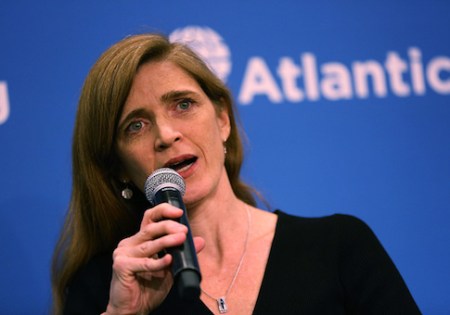
Samantha Power / Getty Images

Former United Nations Ambassador Samantha Power’s involvement in the unmasking by former Obama administration officials of sensitive national security information is raising red flags over what insiders view was an attempt by the former administration to undermine President Donald Trump and key figures on his team, according to current and former U.S. officials familiar with the situation.

Power appears to be central to efforts by top Obama administration officials to identify individuals named in classified intelligence community reports related to Trump and his presidential transition team, according to multiple sources.

The names of Trump allies in the raw intelligence reports were leaked to the press in what many in Congress and the current administration claim is an attempt by Obama allies and former officials to damage the White House.

The House Intelligence Committee, which is spearheading the investigation into these efforts, has issued subpoenas for Power and other top Obama administration figures, including former national security adviser Susan Rice, as part of congressional efforts to determine the source of these leaks.

Power’s role in this unmasking effort is believed to be particularly questionable given her position as a the U.N. ambassador, a post that does not typically require such sensitive unmasking activities, according to former U.S. officials and other sources familiar with the matter.

“Unmasking is not a regular occurrence—absolutely not a weekly habit. It is rare, even at the National Security Council, and ought to be rarer still for a U.N. ambassador,” according to one former senior U.S. official who spoke to the Washington Free Beacon.

“It might be defended when the communication in question relates directly to U.N. business, for example an important Security Council vote,” explained the former official, who would only discuss the matter on background. “Sometimes it might be done out of other motives than national security, such as sheer curiosity or to defend a bureaucratic position. Or just plain politics.”

The Intelligence Committee’s focus of Power and other key Obama officials is a prime example of the Obama administration’s efforts to spy on those close to Trump, according to sources familiar with the ongoing investigation.

“The subpoena for Power suggests just how pervasive the Obama administration’s spying on Americans actually was,” said one veteran GOP political operative who has been briefed on the matter by senior Congressional intelligence officials. “The U.N. ambassador has absolutely no business calling for the quantity and quality of the intelligence that Power seems to have been asking for.”

The source questioned why Power would need to uncover such classified intelligence information in her role at the U.N.

“That’s just not the sort of thing that she should have been concerned about, unless she was playing the role of political operative with the help of the intelligence community,” the source said. “It gives away what was actually going on: the Obama administration was operating in a pervasive culture of impunity and using the intelligence community against their political opponents.”

Rice was scheduled to speak to House Intelligence Committee this week, but the meeting was reportedly postponed. Some sources speculated this could be a delaying tactic by Rice aimed at pushing the testimony back until after Congress’s summer recess.

Leading members of Congress have begun pushing for the Intelligence Committee and other oversight bodies to investigate former Obama administration officials who they believe are responsible for the leaks.

Rep. Ron DeSantis (R., Fla.), a member of the House Oversight Committee and chair of its National Security Subcommittee, told the Free Beacon last week that these leaks appear to have come from former senior officials, potentially including Ben Rhodes, the Obama national security adviser responsible for creating what he described as an in-house “echo chamber” meant to mislead the public and Congress about the landmark Iran nuclear deal.

“I think Congress and some members on the Intelligence Committee can call Ben Rhodes to testify,” DeSantis said. “He may be able to invoke executive privilege from when Obama was president, but he definitely can’t do that in any interactions he’s had since then.”

DeSantis identified Rhodes and other senior Obama administration officials as being “involved with feeding journalists some of these [leaks]. I believe he’s in touch with people on the National Security Council. It would be absolutely legitimate as part of leak investigation to bring him in and put him under oath, and I would absolutely support doing that.”

Senior Trump administration officials also have decried the leaks, which have expanded to operational information and are now impeding U.S. national security operations.

The anonymous sources for these articles “are obviously the same Obama holdovers who constantly leak classified information” to various newspapers, one senior administration official told the Free Beacon earlier this month.

Russia vies with Israel over aid for Quneitra

July 19, 2017

Russia vies with Israel over aid for Quneitra, DEBKAfile, July 19, 2017

(Please see also, Operation Good Neighbor: Israel’s part in Syria.– DM)

On their arrival in Quneitra, the Russians found a population that was better fed and cared for than Syrian civilians on any other of the country’s warfronts. They are nonetheless challenging Israel for the locals’ hearts and minds.

******************************

As Russian troops began moving into the Quneitra ceasefire sector opposite Israel’s Golan border on Wednesday, July 19, they found they were in hot competition with Israel over … humanitarian aid for the sector’s rebel-held villages.

Since Israel is adamantly opposed to the Russian presence in the Quneitra demilitarized zone – although it was endorsed by the Trump administration, as DEBKAfile reported exclusively on Tuesday, July 18 – Moscow decided to take it slowly and meanwhile try and win over the Syrian rebel groups whom Israel has succored for years. The Kremlin figured that if these anti-Assad groups could be weaned away from Israel, they might be persuaded to cooperate with the Russian troops in setting up the Quneitra ceasefire zone, and the Russians would not need Israel’s compliance.

On Tuesday, therefore, a Russian military convoy drove into Jabah, a village northeast of Qunetra town and 4km from Israel’s Golan border. Officers described as belonging to the “Russian Defense Ministry’s reconciliation center” alit from the trucks and began handing out food packages to the villagers.

The civilians received necessities and were treated by Russian doctors, a Syrian officer announced. Russian and Syrian officers promised that more humanitarian aid would be delivered to “settlements across the Quneitra province” and Russian doctors would visit all the villages in the ceasefire zone.

Israel, who has been sending aid across these Syrian villages which were cut off by the civil war from basic necessities, has mostly kept its humanitarian program under wraps, except when witnesses reported what they saw to the media. On Wednesday, the IDF officers running the program asked sardonically: “Where were the Russians all these years when Israel alone helped the beleaguered villages across its border?”

After watching the Russian troops hand out packages to the people of Quneitra, the Israeli government and military chiefs decided to challenge the Russian belated propaganda move.

Up until now, Israel has supplied regular humanitarian aid to some 200,000 Syrian villagers living in 80 non-ISIS rebel-controlled villages 15km deep inside the Syrian Golan. Last year alone, Israel sent over half a million liters of heavy fuel, 360 tonnes of foodstuffs, 77 tonnes of clothing and shoes, tens of generators and water system, as well as providing them with medical treatment, including hospital care for sick and injured Syrians and a field hospital on the border.

Wednesday, Israel formalized its assistance program under the title “The Good Neighbor” and disclosed it had been administered since 2016 by a special unit of the Bashan Division which is in charge of the Golan sector.

The IDF released footage of trucks ferrying across the border supplies of medical equipment, medicines, foodstuffs and fuel, as well as pictures documenting IDF medics lifting Injured Syrians off the battlefield for treatment in Israeli hospitals.

According to IDF statistics, at least 3,000 Syrians crossed the border in the past four years for medical treatment. And Israel sent over as needed incubators, respirators and ambulances. In the same period, the IDF conducted 150 assistance operations on Syrian soil.

On their arrival in Quneitra, the Russians found a population that was better fed and cared for than Syrian civilians on any other of the country’s warfronts. They are nonetheless challenging Israel for the locals’ hearts and minds.

Red Lines in Syria

July 19, 2017

Red Lines in Syria, Front Page MagazineKenneth R. Timmerman, July 19, 2017

Suleymania, Iraq – With Saturday’s bombing of Afrin, a town controlled by America’s Kurdish allies in northern Syria, Turkey appears to have crossed a line.

Turkish artillery pounded the Ashrafiyeh neighborhood near the city center as well as surrounding villages. Reports from the region said the Turkish attack killed five civilians, including an entire family that was buried alive in their own home, and damaged dozens of homes.

“This is considered the first targeting of the city since the start of Turkish preparations” to expand military operations in Northwest Syria last month, according to the UK-based Syrian Observatory for Human Rights.

The Turkish attacks were not directed against ISIS or against any other Islamist group. The Turks targeted Afrin because it has become a key political hub for the Democratic Union Party of Syria, the YPD, which Turkey accuses of being part of the PKK.

I spoke with Asya Abdallah Osman, the co-president of the YPD, on the sidelines of a conference both of us were attending in Iraqi Kurdistan. She was visibly shaken when she called home and learned details about the civilian casualties in Afrin.

“We have been fighting [ISIS] because we as women do not want to be subjected to their inhumanity. But we need your help,” she said, meaning the United States. “We need no other. This is war and people are dying. It won’t be resolved by politics, only by hard power.”

She swept aside the Turkish allegations that the regional government of the YPD, and its associated militia, known as the People’s Protection Units (YPG), were controlled by the PKK, or that the PKK was using YPD territory to launch attacks into Turkey.

“We are an independent political party that belongs to Syria and to the Kurds. If the PKK has come to Syria, it’s because Turkey has forced them to come,” she said.

Turkey has long accused the Kurdish Workers Party, or PKK, or fighting a terrorist war against it, but also has been willing to negotiate with PKK leaders when it felt it could reach a deal to curtail the violence.

After Turkey violated a 2013 truce negotiated in Oslo that called for the PKK to remove its fighters from Turkey into northern Iraq, the PKK relocated remaining fighters into the Kurdish areas in Syria, known as Rojava.

Like most Kurds, Ms. Osman believes Turkey and its allies in the region do not want to see a successful democratic self-governing region in northern Syria, because it would encourage their own Kurds to seek greater autonomy.

“They accuse us of not being democratic, but we have allowed all political and ethnic groups to have representatives in the regional government. Our project is for all of Syria, not just Kurds,” she told me.

Ms. Osman traveled to Northern Iraq in a group of 65 Syrian Kurdish activists, representing nearly twenty political groups.

Normally, they would have entered Iraq via a pontoon bridge over the Tigris River at Semalka, in an area that has escaped the current fighting.

But the Kurdish Regional Government in Iraq closed the border recently, forcing the Syrian pro-democracy delegates to make a dangerous 16-hour trek by foot across the only other border crossing into Iraq near Mount Sinjar, which is controlled by Iranian-backed Shiite militias.

“There is no Kurdish Regional Government,” Ms. Osman said dismissively. “There is only the KDP,” the Kurdish Democratic Party, dominated by President Massoud Barzani and his family.

She and other Kurdish activists at the weekend conference believe that Turkey pressured the Barzanis to close the Semalka border crossing in order to further isolate them. “Semulka is our only gate to the outside world,” she said. “When it is shut, we are closed off.”

She attributed claims that the YPD and its militia were controlled by the PKK to Turkish propaganda. “Of course, we have dialogue with other Kurdish parties, including the PKK. So do most Kurdish groups in the region. But we run our party and our administration ourselves. We elect our own officials and they take orders from no one.”

Indeed, I only learned after the conference that a member of the PKK central committee had attended the weekend event, sponsored by the Kurdistan National Congress, where three hundred delegates from Iran, Iraq, Syria and Turkey strategized over a future Kurdish state or confederation.

There were few references to the PKK by the speakers, and the PKK central committeeman himself never spoke. The final declaration of the conference makes no mention of the PKK.

Both President Trump and Secretary of Defense Mattis have warned Turkey not to attack America’s Kurdish allies in Syria. Turkey has blithely ignored those admonishments until now.

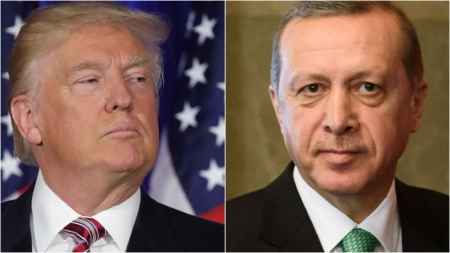
Less than a month after President Trump at the White House personally rejected Erdogan’s demand that the U.S. drop support for the Syrian Kurds, Turkey began moving troops to encircle Afrin, the political capital of the Syrian Kurdish region, and other Kurdish controlled areas.

After Turkey started to attack YPG positions in late June, Secretary of Defense James Mattis upped the ante by declaring that the United States might allow the Kurdish group to keep U.S. supplied weapons after the battle for Raqqa to smash ISIS was over.

Some of Erdogan’s erstwhile political allies believe he Erdogan is playing a dangerous game.

Even before the Turkish attacks on civilians over the weekend, former Turkish Foreign Minister Yasar Yakis, who helped found Erdogan’s ruling AKP party, counseled against attacking the Syrian Kurds.

“The best course would be to negotiate a deal with the Syrian Kurds, persuade them not to attempt to change the ethnic composition of the region, and establish – preferably in cooperation with the Syrian government – a multi-ethnic, multi-confessional democratic administration,” Yakis wrote in a column for Arab News.

That is precisely the project Ms. Osman and the YPD have been proposing.

Erdogan showed his arrogance in Washington when he calmly observed his bodyguards cross a Capitol Police barrier in May to viciously bludgeon opposition protestors with truncheons.

But by putting his forces in a position where they could potentially clash with U.S. military units assisting the YPG and the Syrian Democratic Forces, Erdogan has shown a reckless side as well.

Turkey has been warned twice. Will Afrin prove to be the third strike for Erdogan in Syria?
US should move bases 1,000km from Iran if it wants to pursue further sanctions

July 19, 2017

Source: US should move bases 1,000km from Iran if it wants to pursue further sanctions – army chief — RT News

The US has to move its bases 1,000km away from Iran’s borders if it plans to keep sanctions in place against Tehran, or risk paying a price, the commander of the Islamic Revolution Guards Corps, Major General Mohammad Ali Jafari, said.
Read more

 © Dennis Flaherty / Global Look Press

“In case the US wants to insist on pursuing sanctions against Iran’s defense sector and the IRGC [Revolutionary Guards], it needs to first dismantle its regional bases within a range of 1,000km around Iranian borders,” Tasnim news agency quoted the commander as saying.

“Washington should be aware that it will pay dearly for any miscalculations,” he went on to say.

Jafari said that Iranian missile capabilities are “rapidly growing,” creating an effective deterrent against any threats, the agency reports. He added that the Islamic Republic’s missile program is by no means “bargainable or negotiable.”

His comments come a day after the US Department of the Treasury imposed a new set of sanctions against 16 entities and individuals it accused of providing material support to the Iranian military and its missile program.

Earlier, the chief of staff of the Iranian armed forces, Major General Mohammad Hossein Baqeri, also warned the US authorities of the “big risks” they face by imposing sanctions against the IRGC.

“Drawing an analogy between the IRGC and terrorist groups and imposing the same sanctions (used against terrorists) on the IRGC would be a big risk to the US and its bases and forces stationed in the region,” he said on Monday.

He also said that the Iranian missile program “is defensive and never would be subject to bargaining and negotiation at any level.” The major general also called on the US to be more “cautious” and “think deeper” about its decisions relating to the anti-Iranian sanctions.

At the same time, he said that any fresh round of sanctions would be just an “opportunity” for Iran’s progress, Tasnim reports.

In the meantime, another Iranian high-ranking commander, the deputy chief of staff of the Iranian armed forces, Brigadier General Massoud Jazayeri, accused the US of double standards and outright deception by claiming that Tehran supports terrorists in Syria.

“The US behavior in Iraq and Syria is a perfect example of contradictions and blatant deception because it (the US) supports terrorists on the one hand and forms anti-terrorism coalitions on the other,” he said on Wednesday, as reported by Tasnim.

He went on to say that “any agreement with the deceitful government of the US is unacceptable.”

The Iranian Foreign Ministry also engaged in an indirect debate with Washington as the ministry’s spokesman, Bahram Qassemi, criticized US State Department spokeswoman Heather Nauert for remarks she made on Tuesday.

Qassemi particularly dismissed Nauert’s designation of Iran as “one of the most dangerous threats” to the US as well as regional stability, calling her words “empty and baseless.”

“The Islamic Republic of Iran is, of course, more concerned about the security and stability of the region than a country like the US, which is trying to interfere and destabilize the region from thousands of kilometers away and affect regional equations in accordance with its strategic interests and objectives,” he said.

On Tuesday, Nauert said during a briefing that the US believes that “some of the actions that the Iranian government has been involved with undermine that stated goal of regional and international peace and security.”

“Iran remains … one of the most dangerous threats to the United States – not only our interests here, around the world, but also to regional stability,” she added.

The US continues to impose new sanctions on Iran despite its compliance with its part of the landmark 2015 nuclear deal, as acknowledged by Washington itself. On Monday, just a day before the fresh round of sanctions was imposed against the Islamic Republic, the Trump administration certified that Tehran is in compliance with the terms of the nuclear deal.

Is it time for the DOJ to reopen the probe into Clinton?

July 19, 2017

Is it time for the DOJ to reopen the probe into Clinton? Judicial Watch via YouTube, July 19, 2017

(But that would be misogynistic and besides, it’s just old news.  Let’s just keep trying to impeach President Trump. That gets lots of headlines.– DM)


Operation Good Neighbor: :Israel’s part in Syria.

July 19, 2017


Israeli lawmaker: Waqf’s control of the Temple Mount is over

July 19, 2017

Parliament member says Israeli police force, not the Jordanian Waqf, has full control of the Temple Mount.

July 18, 2017

Source: Israeli lawmaker: Waqf’s control of the Temple Mount is over | World Israel News

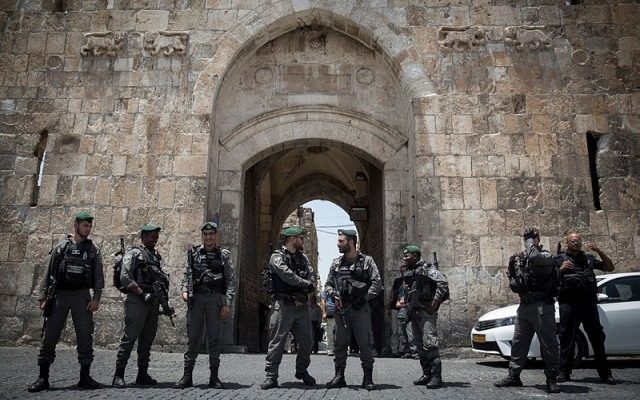
Israeli police outside the Temple Mount. (Hadas Parush/Flash90)

Parliament member says Israeli police force, not the Jordanian Waqf, has full control of the Temple Mount.

The Jordanian Waqf’s de facto control over the Temple Mount came “to an end last Friday,” Member of Knesset (MK) Avi Dichter, Chairman of the Knesset’s Foreign Affairs and Defense Committee, stated Tuesday. Dichter was specifically referring to Israel’s implementation of new security measures at the holy site, including the installment of metal detectors.

The Waqf, Jordan’s Islamic Trust which manages religious affairs at the site, has been boycotting the Temple Mount, refusing to adhere to new security procedures introduced by the Israeli police following Friday’s the attack, in which three terrorists shot and murdered two Israeli policemen. They called on other Muslim worshipers to follow suit, but hundreds nevertheless prayed at the holy site.

Speaking to Israel Radio, Dichter called for a change to the current situation, in which Jews have no rights on the Tempe Mount.

“Regarding the Temple Mount, I can say that it’s a question of our policy at the site, which is unclear to the Palestinians, but is very clear to us,” he said, pointing to the fact that the Palestinians have changed their propaganda strategy. In the past, they have run the campaign “al-Aqsa is in danger,” but “now they have changed the campaign to ‘the Temple Mount equals al-Aqsa.’ They are trying to create a situation in which it is problematic for Jews to go up to the Temple Mount. Al-Aqsa Mosque is considered the third-holiest place in Islam, so just as non-Muslims are not allowed to enter Mecca or Medina, they want to create the same situation on the Temple Mount, But the Mount will remain under the control of the Israel Police,” Dichter said.

He said the police were capable and well experienced in carrying out such security tasks, and rejected the notion of a foreign force securing the site.

“In no situation will an international force be inside the sovereign area of the State of Israel. The state knows how to take care of sensitive people,” Dichter said.

He charged the Waqf with trying to assert its authority and promote its agenda of control on the Temple Mount. “There will be no international force here, not UNIFIL and not any other force, apart from the State of Israel,” Dichter said.

On Monday, Arabs clashed with police just outside the Temple Mount and several of the rioters were reportedly wounded in the process.

By: World Israel News Staff


The other North Korean threat

July 19, 2017

The other North Korean threat, Washington ExaminerSean Durns, July 19, 2017

The Hermit Kingdom has been steadily expanding its special forces in recent years. The current estimate of 180,000 to 200,000 was noted in a 2010 South Korean defense white paper. That same report pointed out that just four years prior, the North likely had 120,000 SOF operators

************************************

North Korea’s successful launch of an intercontinental ballistic missile (ICBM) on July 4, 2017, has rightfully occasioned concern and condemnation by the United States and others. Ruled for more than seven decades by the dynastic dictatorship of the Kim family, the so-called Democratic People’s Republic of Korea (DPRK) has, in recent years, made huge advances in nuclear weapons, missilery and cyber-warfare, with which it menaces the West and its allies.

Yet with tensions increasing on the Korean peninsula, policymakers should consider another threat emanating from Pyongyang: the regime’s well-trained and fanatical special operations forces (SOF).

As foreign affairs analyst Kyle Mizokami has noted, North Korea might have “the largest special-forces organization in the world,” with some estimates numbering 200,000 men and women, encompassing 25 brigades and five battalions.

A Pentagon report issued to Congress in 2016 called the DPRK’s special operations forces “among the most highly-trained, well equipped, best fed and highly motivated” in the North’s military. They give Pyongyang “significant capabilities for small-scale attacks that could rapidly escalate into a larger confrontation.”

Should war erupt on the peninsula, the U.S. Department of Defense states that it’s likely that North Korean leader Kim Jong Un’s military strategy will rely heavily on asymmetric warfare to offset the comparative technological advantages of the U.S., the Republic of Korea and others. Indeed, much of the regime’s aircraft and the equipment of conventional forces in the Korean People’s Army — including the North Korean People’s Navy — are deeply outdated.

To compensate, Pyongyang has invested in air defense, cyber capabilities and its SOF component. The last is dispersed across the country and includes commandos capable of reconnaissance and airborne and seaborne insertions.

If war occurs, these forces “would likely launch dozens of separate attacks throughout South Korea,” according to Mizokami. It’s probable that they would utilize suspected underground tunnels to attack vulnerable targets in the South.

Once engaged, Kim’s SOF have the ability to deploy chemical, radiological and biological weapons. DPRK operators are also reportedly highly trained in the use of improvised explosive devices (IEDs), which plagued American forces in Iraq and Afghanistan in recent years.

In the event of conflict, the North’s rough and unforgiving terrain would act as a force multiplier; it would be ideal for ambushes, direct action raids and guerilla warfare tactics. It’s likely that these units, including sniper teams, would be dressed in civilian garb or South Korean or U.S. military uniforms. Some, disguised as civilians, might use passenger flights to enter the South and wreak havoc.

North Korean officials exhorted that the recent ICBM launch was a “gift” for “American bastards.” The dictatorship has been equally clear about how it would employ its special forces.

On December 11, 2016, Kim’s government built a full-scale mock-up of the official residence of the South Korean president called the Blue House. North Korean SOF, as part of a drill that was broadcast on state-controlled media, fast-roped from helicopters and assaulted the residence, eventually setting it ablaze.

Some analysts speculated that the televised propaganda was meant to celebrate the impeachment of then-South Korean President Park Geun-hye the day before. This would be in keeping with the regime’s character and its hateful ideology. But it would be a mistake not to take the North’s fantasies seriously.

Pyongyang, in fact, has a history of using commandos against those it deems enemies of its Stalinist regime.

In 1968, 31 DPRK operators conducted a raid on the South Korean capital of Seoul. The men, belonging to a group known as Unit 124, infiltrated the country with plans to storm the Blue House and assassinate then-South Korean President Park Chung-hee. The team managed to make it within yards of the residence before being discovered. The ensuing gunfight and subsequent manhunt resulted in 59 deaths, including four American soldiers. All but two of the North Koreans were killed — at least one via suicide with a hand grenade.

More recently, in 1996, a DPRK submarine loaded with a Special Forces reconnaissance team ran aground off the South Korean coast. Four South Korean civilians and eight soldiers, along with nearly all of the North Korean forces, were killed. Two years ago, tensions between North and South were raised when two land mines—likely planted by Kim’s SOF—went off in the demilitarized zone separating the two countries, wounding two ROK troops.

The Hermit Kingdom has been steadily expanding its special forces in recent years. The current estimate of 180,000 to 200,000 was noted in a 2010 South Korean defense white paper. That same report pointed out that just four years prior, the North likely had 120,000 SOF operators.

As the U.S. and its allies consider how to confront the North Korean menace, the Kim regime’s ability to employ fanatical and highly trained special forces in numbers comparable to the entire U.S. Marine Corps must be taken into careful consideration. The stakes are too high to do otherwise.


Ynetnews News – Netanyahu in hot mic tirade: EU treatment of Israel is ‘crazy’

July 19, 2017

In comments accidentally overheard by journalists, the prime minister urges leaders of Hungary and the Czech Republic to convince their European colleagues not to condition ties with Israel on peace talks with Palestinians.

Itamar Eichner|Published:  19.07.17 , 15:23

Source: Ynetnews News – Netanyahu in hot mic tirade: EU treatment of Israel is ‘crazy’

Prime Minister Benjamin Netanyahu went on an unprecedented tirade against the European Union on Wednesday, calling the organization’s treatment of Israel “crazy.”

“There is no logic here. Europe is undermining its own security by undermining Israel,” Netanyahu said in a private meeting in Budapest with the leaders of Hungary and the Czech Republic discussing Iran, Syria, the Islamic State, and EU-Israel relations.

Netanyahu’s hot mic comments were accidentally broadcast to journalists covering the prime minister’s trip through their earpieces. The feed was cut off as soon as it was discovered.

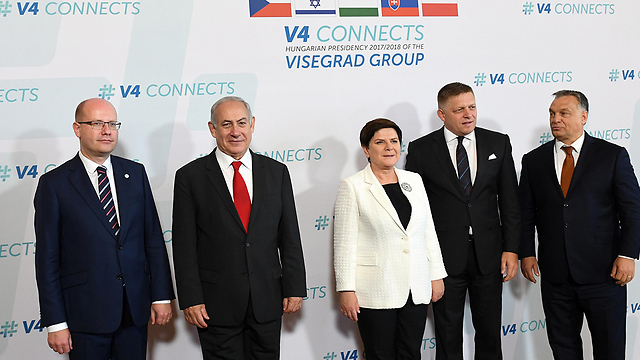
Netanyahu with the leaders of Hungary, Poland, the Czech Republic and Slovenia (Photo: Haim Tzah, GPO)

Netanyahu with the leaders of Hungary, Poland, the Czech Republic and Slovenia (Photo: Haim Tzah, GPO)

Before that, however, journalists heard the prime minister criticize the European Union for conditioning technological cooperation with Israel on creating the political conditions for peace talks with the Palestinians.

“Europe is endangering its own development by endangering its ties with Israel over this crazy attempt to create conditions” for peace between Israel and the Palestinians, he said. “Israel is right there and Europe is disconnecting itself from this massive center of innovation.”

He went on to comment that, “If this were only about my interests, I wouldn’t have brought it up. Don’t undermine the only country in the region that is looking after Europe’s interests. Stop attacking Israel, support Israel.”

Hungarian premier Viktor Orbán responded to Netanyahu in a conciliatory tone, telling him the European Union sets similar conditions to its member states as well. “We definitely understand what we’re talking about,” he said.

Netanyahu with the leaders of Hungary, Poland, the Czech Republic and Slovenia (Photo: Haim Tzah, GPO)

Netanyahu with the leaders of Hungary, Poland, the Czech Republic and Slovenia (Photo: Haim Tzah, GPO)

Netanyahu replied that “Europe must decide if it wants to live and prosper or wither and disappear. I see you’re shocked because I’m not being politically correct…. We’re part of the European culture. Europe ends in Israel. East of Israel, there’s no more Europe… I suggest you first help us and Europe by expediting agreements with us and sending a message to your colleagues in Europe on how to help Europe.”

The prime minister told the other leaders of Israel’s good ties with world powers like China and India. “There’s a strange situation here, I must say. The European Union is the only one in the world that sets conditions to its ties with Israel, which spreads technology in every region of the world,” he said. “I’ve just been to China. President Xi told me, ‘You’re an innovation giant.’ We have special ties with China and they don’t care about politics. (India’s Prime Minister) Modi told me, ‘I need to solve the water problem, what should I do? I need to produce milk, what cow produces the most milk? The Israeli cow.'”

 He also discussed Israel’s ties with the US. “We had a big problem with US policy. It’s different now. There’s a stronger stance against Iran. There’s a renewed American presence in our region and more bombings, and that’s positive… I told (Russian President) Putin, when we see (Iran) transferring weapons to Hezbollah, we’ll hit them. We’ve done it dozens of times.”

Netanyahu met with leaders of Poland, Hungary, the Czech Republic and Slovakia at a regional summit Wednesday