Archive for July 31, 2017

Stop before a nuclear holocaust

July 31, 2017

Source: Israel Hayom | Stop before a nuclear holocaust

Dr. Gabi Avital

About two decades ago, a senior Israeli security official said that Iraq couldn’t even build a screwdriver. Needless to say, this sort of arrogance is far from the truth. It took the West many years to go from treating the technological capabilities of the East — specifically China, India and Pakistan — with contempt, to recognizing the ever expanding capabilities of these countries. In the meantime, North Korea set a goal for itself: To become a nuclear power. They put all their resources into this project.

After taking confident steps, sometimes out in the open and even in extravagant displays, North Korea currently has the ability to launch intercontinental ballistic missiles capable of carrying nuclear warheads, no less. Older readers will immediately associate ICBMs with the Cold War between the former Soviet Union and the U.S., especially during the late 1950s, but the globe has not changed much. The distance between North Korea and the U.S. remains the same, some 6,400 miles away, and the day is not far off before more countries are engaged in cold war.

Why does North Korea need a nuclear weapon that sucks up the majority of the country’s economic and social resources? The answer is that while the people of North Korea have no need of such a weapon, the country’s young leader, Kim Jong Un, does. How is he supposed to secure his reign? By bringing North Korea to the forefront of the world stage thanks to its ability to launch long-range missiles, specifically those carrying nuclear warheads.

The moment Kim decides to threaten one U.S. city with nuclear weapons, just one, the rules of the game between the two countries will completely change. The practical threat will no longer be unilateral. There will no longer be an obvious American offensive advantage, but rather a mutual balance of fear: mutually assured destruction. This is a cold war in the old sense of the word, from 60 years ago. From past experience at least, such a move by North Korea promises to create a balance where the U.S. will refrain from attacking North Korea, even though America would surely emerge victorious. The price would simply be too great to bear.

So how does this new reality affect our region? First, even though we do not have a direct conflict with North Korea, the range of the new missiles covers Israel as well. Second, while Iran’s effort to launch missiles carrying satellites may have failed, the joy in Iran is palpable. The joy over the ICMBs could be seen on screens in North Korea, and certainly on the faces of Iran’s leaders. This spurs Iran on to forge ahead with its nuclear program, as success comes after failure. This is the nature of engineering, backed by funding, faith and especially collaboration.

Even though the nuclear map will expand once North Korea gains long-range missile capability, but North Korea will only have established its capability in a few years, once it completes building enough missiles, launchers and nuclear warheads. But the balance will be different. Once Kim, or another leader, joins the nuclear deterrence axis, which would mean the complete destruction of North Korea in the event of a nuclear attack, there will be no testing of the nuclear waters. The stature and power that come with possession of nuclear capability will be enough, without anyone having to launch a missile. The recent test, the only one as of yet, was done in the hopes that an escalation can stop before a nuclear holocaust is unleashed.
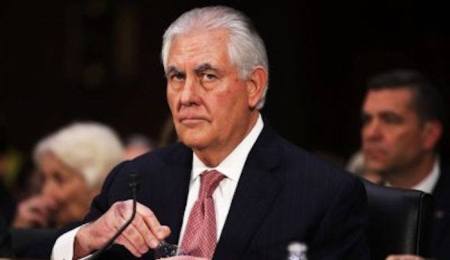

Break out the champagne: State Department officials quitting over “complete and utter disdain for our expertise”

July 31, 2017

Break out the champagne: State Department officials quitting over “complete and utter disdain for our expertise” Jihad Watch

(It’s a good start, but there are many more who need to quit or be fired. — DM)

The swamp needs draining indeed. This news from the State Department, and the New York Times’ grief over it, are good signs that the U.S. is on its way back on dry land.

************************************

We can only hope that with the departure of these failed State Department officials, their failed policies will be swept out along with them. Chief among these is the almost universally held idea that poverty causes terrorism. The United States has wasted uncounted (literally, because a great deal of it was in untraceable bags full of cash) billions of dollars in Afghanistan, Iraq, Pakistan, Egypt, and other countries in the wrongheaded assumption that Muslims turn to jihad because they lack economic opportunities and education. American officials built schools and hospitals, thinking that they were winning over the hearts and minds of the locals.

Fifteen years, thousands of lives and hundreds of billions of dollars later, no significant number of hearts and minds have been won. This is partly because the premise is wrong. The New York Times reported in March that “not long after the attacks of Sept. 11, 2001…Alan B. Krueger, the Princeton economist, tested the widespread assumption that poverty was a key factor in the making of a terrorist. Mr. Krueger’s analysis of economic figures, polls, and data on suicide bombers and hate groups found no link between economic distress and terrorism.”

CNS News noted in September 2013 that “according to a Rand Corporation report on counterterrorism, prepared for the Office of the Secretary of Defense in 2009, ‘Terrorists are not particularly impoverished, uneducated, or afflicted by mental disease. Demographically, their most important characteristic is normalcy (within their environment). Terrorist leaders actually tend to come from relatively privileged backgrounds.’ One of the authors of the RAND report, Darcy Noricks, also found that according to a number of academic studies, ‘Terrorists turn out to be more rather than less educated than the general population.’”

Yet the analysis that poverty causes terrorism has been applied and reapplied and reapplied again. The swamp is in dire need of draining, and in other ways as well. From 2011 on, it was official Obama administration policy to deny any connection between Islam and terrorism. This came as a result of an October 19, 2011 letter from Farhana Khera of Muslim Advocates to John Brennan, who was then the Assistant to the President on National Security for Homeland Security and Counter Terrorism, and later served in the Obama administration as head of the CIA. The letter was signed not just by Khera, but by the leaders of virtually all the significant Islamic groups in the United States: 57 Muslim, Arab, and South Asian organizations, many with ties to Hamas and the Muslim Brotherhood, including the Council on American-Islamic Relations (CAIR), the Islamic Society of North America (ISNA), the Muslim American Society (MAS), the Islamic Circle of North America (ICNA), Islamic Relief USA; and the Muslim Public Affairs Council (MPAC).

The letter denounced what it characterized as U.S. government agencies’ “use of biased, false and highly offensive training materials about Muslims and Islam.” Despite the factual accuracy of the material about which they were complaining, the Muslim groups demanded that the task force “purge all federal government training materials of biased materials”; “implement a mandatory re-training program for FBI agents, U.S. Army officers, and all federal, state and local law enforcement who have been subjected to biased training”; and moreto ensure that all that law enforcement officials would learn about Islam and jihad would be what the signatories wanted them to learn.

Numerous books and presentations that gave a perfectly accurate view of Islam and jihad were removed from coounterterror training. Today, even with Trump as President, this entrenched policy of the U.S. government remains, and ensures that all too many jihadists simply cannot be identified as risks, since the officials are bound as a matter of policy to ignore what in saner times would be taken as warning signs. Trump and Tillerson must reverse this. Trump has spoken often about the threat from “radical Islamic terrorism”; he must follow through and remove the prohibitions on allowing agents to study and understand the motivating ideology behind the jihad threat.

The swamp needs draining indeed. This news from the State Department, and the New York Times’ grief over it, are good signs that the U.S. is on its way back on dry land.

“The Desperation of Our Diplomats,” by Roger Cohen, New York Times, July 28, 2017:

WASHINGTON — On the first Friday in May, Foreign Affairs Day, the staff gathers in the flag-bedecked C Street lobby of the State Department beside the memorial plaques for the 248 members of foreign affairs agencies who have lost their lives in the line of duty. A moment of silence is observed. As president of the American Foreign Service Association, Barbara Stephenson helps organize the annual event. This year, she was set to enter a delegates’ lounge to brief Secretary of State Rex Tillerson on its choreography before appearing alongside him. Instead, she told me, she was shoved out of the room.

Stephenson, a former ambassador to Panama, is not used to being manhandled at the State Department she has served with distinction for more than three decades. She had been inclined to give Tillerson the benefit of the doubt. Transitions between administrations are seldom smooth, and Tillerson is a Washington neophyte, unversed in diplomacy, an oilman trying to build a relationship with an erratic boss, President Trump.

Still, that shove captured the rudeness and remoteness that have undermined trust at Foggy Bottom. Stephenson began to understand the many distressed people coming to her “asking if their service is still valued.” The lack of communication between the secretary and the rest of the building has been deeply disturbing.

An exodus is underway. Those who have departed include Nancy McEldowney, the director of the Foreign Service Institute until she retired last month, who described to me “a toxic, troubled environment and organization”; Dana Shell Smith, the former ambassador to Qatar, who said what was most striking was the “complete and utter disdain for our expertise”; and Jake Walles, a former ambassador to Tunisia with some 35 years of experience. “There’s just a slow unraveling of the institution,” he told me….

