Archive for July 29, 2017

Egypt goes about the task of reforming the religious rhetoric

July 29, 2017

Egypt goes about the task of reforming the religious rhetoric, Al ArabiyaMashari Althaydi, July 29, 2017

Egyptian President Abdel Fattah el-Sisi finally announced the establishment of the Egyptian supreme or national council for combating terrorism and extremism. 

This is an enlightening path and a blessed move. There is unquestionable determination to work and exterminate extremism that produces awful violence that targets markets, streets, schools, mosques, churches and airports. Terrorists are monsters who operate like zombies that rose from their dark graves.

The council is chaired by the president himself. Among the members are the parliament speaker, Al-Azhar Sheikh, the Coptic pope and state officials such as the education, awqaf, interior and intelligence ministers. The aim of the council is to set plans, execute them and supervise them.

All this is good and it’s rather a duty and a requirement. This is the work of the state and the society. We wish Egypt luck and success and we hope Muslims and the entire world succeed in winning over Islamized terrorism and the culture behind it.

Task before Al-Azhar

Previously, Sisi had informed Al-Azhar officials that religious reform is a must and said he will quarrel with them before God if they don’t achieve the task.

The determination and honesty of the responsible Muslim man, Sisi, are beyond doubt. However, the task of religious reform is not a military one which he can simply approve and it gets done. We wish it were so, as that would have been much easier.

The issue is also not just about Egypt, Saudi Arabia, Iraq, Pakistan, Indonesia or Senegal. It is about defeating the culture of terrorism and extremism – and I emphasize extremism here. It is a global task that concerns all people considering the news about terrorism coming daily from across the world.

There are many Arabic, Islamic and even European initiatives and centers that work to confront Islamized terrorist cultures, whether Sunni or Shiite, on the ideological and media levels. It’s worth noting that Sunni ones are more than Shiites. The diversity of such work is of course good and beneficial.

My only note is that we focus on media and quantitative activity at the expense of qualitative and intellectual activity when the problem’s core is educational and not relevant to media activity.

I’ll be more frank and ask: Is there a serious and specialized discussion before politicians and media figures talk about concepts such as Sharia, governance, Caliphate, secularism, international law and its moral obligations, women’s rights etc.?

This is where we must begin, as late author Khalid Mohammed Khalid put it.

Trump’s ‘America First’ vs. McCain’s ‘America Last’

July 29, 2017

Trump’s ‘America First’ vs. McCain’s ‘America Last’, PJ MediaDavid P. Goldman, July 28, 2017

Europeans suspect that the U.S. wants to sabotage Russian natural gas deliveries to Europe and replace them with LNG exports from the United States. Neither the Trump administration nor its opponents in Congress entertain such a Machiavellian agenda. On the contrary, the Trump administration initially supported sanctions against Russia as a bargaining chip, to be played to extract concessions from Moscow over the Ukraine, Iran and other matters of contention. The House and Senate bills in their present form effectively tie the president’s hands, turning what was a bargaining chip into a declaration of trade war. This would not be the first war to begin when what was intended as a feint was interpreted after the fact as a threat.

America won the Cold War by driving a wedge between Russia and China, and by persuading a frightened Western Europe to point medium-range missiles at the Russian heartland. Russia sought to compensate for its economic inefficiency by turning Europe into an economic colony, and the most dangerous operations of the Cold War were undertaken to prevent this. Now, for narrow political reasons, Trump’s enemies propose to undo the whole structure of relationships that won the Cold War and drive Europe into the arms of the Russians and Chinese. I do not believe for a moment that McCain and Schumer have a clue about this—they are like the “sleepwalkers” in Christopher Clark’s brilliant history of the outbreak of the First World War—but if I were a Russian operative, I would try to invent someone like John McCain, if McCain did not already exist.

***************************

Not the supposed protectionist Donald Trump, but the “free trade” wing of the Republican Party has taken the United States into a trade war that it can only lose. New sanctions against Russia passed by the House and Senate last week force Europe into a de facto alliance with Russia against the United States, and by extension with China as well. It is the dumbest and most self-destructive act of economic self-harm since the United States de-linked the dollar from gold on August 15, 1971, and it will have devastating consequences. The charade in the House and Senate may embarrass Trump, but it also poses a threat to European energy supplies as well as an extraterritorial intrusion into European governance. Berlin, Paris and Rome will conspire with Moscow to circumvent the sanctions while attacking the United States at the World Trade Organization and other international fora.

Sen. John McCain (R-AZ), Sen. Charles Schumer (D-NY), and their counterparts in the House of Representatives allowed their dudgeon against a sometimes provocative president to overwhelm their sense of self-preservation. The sanctions will hurt Russia, but not nearly as much as they will hurt the United States over the long term. The White House envisioned sanctions as a bargaining chip, to be used to persuade Moscow to behave in the Ukraine and to limit the ambitions of its Iranian ally of convenience. In their present form, however, the president will have no authority to remove sanctions imposed by Congress. That turns a feint into a threat. Wars have been started over less.

The Democrats along with the McCain Republicans, it will be remembered, accused Trump of undermining the Atlantic Alliance, of isolating the United States, and of handing a diplomatic victory to Russia. Not Trump, but his detractors have given Moscow a degree of leverage over Western Europe to which it has not aspired since the height of the Cold War in 1983, when Soviet premier Yuri Andropov considered a pre-emptive Russian attack in response to Western plans to deploy medium-range missiles in Germany.

Supposedly it was Trump who ignored the exigencies of international relations in favor of domestic political theater. Yet it is the Establishment wing of the Republican Party and its Democratic allies who combined to embarrass the president, without a moment’s consideration of the consequences of their actions. Among Washington’s elite, Trump Derangement Syndrome has nothing to do with ideology. It is about jobs and patronage. This is not hypocrisy. It is chutzpah.

Trump humiliated the Democrats and the Establishment rump of the Republican Party last November. The losers now face the prospect of permanent exile from political life. Writing in the Times Literary Supplement July 25, historian Edward Luttwak predicted a Trump dynasty lasting sixteen years, in which Ivanka Trump Kushner would succeed her father. “No wonder that leading Democrats and non-Trumpers continue to act hysterically even eight months after the election. President Trump’s plan threatens to exclude them all from office until long past their retirement age,” Luttwak wrote. The hopes of high office of the defeated Establishment can be realized only by stifling the Trump administration in its cradle.

That is the motivation behind the Black Legend of Russian collusion that continues to occupy the waking hours of the American media while putting most Americans to sleep. As Sen. McCain said after the Senate vote July 27, the sanctions “respond to Russia’s attack on American democracy….We will not tolerate attacks on our democracy. That’s what this bill is all about. We must take our own side in this fight, not as Republicans, not as Democrats, but as Americans.”

The notion that Russian machinations explain Trump’s electoral victory is fanciful, although Russia’s intelligence services no doubt sought targets of opportunity in the American electoral scramble. McCain’s outrage over the violation of America’s political virginity, though, rings rather hollow. Some of his friends, for example National Endowment for Democracy President Carl Gershman, publicly advocate regime change in Moscow, a topic that has been a matter of on-and-off public debate in Washington for years. A 2016 Defense Intelligence Agency document reported that Russia believes that the United States favors regime change. The U.S. supported the 2014 Maidan coup in Ukraine, which threatened Russia’s access to its Crimean warm-water port. America’s capacity to influence political events in and around Russia is vastly greater than Russia’s.

After the fall of Communism, the dominant strain of American thinking held that the march of liberal democracy was unstoppable, and that it would transform the Muslim world as well as Moscow. I played a bit part in this project; in 1992, then Ambassador to Moscow Robert Strauss arranged for me to advise President Boris Yeltsin’s finance minister, Yegor Gaidar. Strauss did so at the behest of private equity investor Theodore Forstmann, who had funded a proposed study of the Russian economy. As it turned out I had little advice to give to the Yeltsin government, which was acting as a family office for various Russian oligarchs who divided up the Russian economy. The free-for-all of theft left the economy in ruins. One needed a large shopping bag full of currency to do ordinary shopping. A few hundred meters from the Kremlin, old people sold used clothing to buy food, and World War II veterans wore their medals to beg in the streets. No-one who had first-hand experience with Russia’s brief experience with democracy was surprised at Vladimir Putin’s subsequent popularity. The oligarchs continued to steal, but in a measured and organized fashion that allows ordinary life to proceed without catastrophic disruption. Putin rules Russia by means I sometimes find abhorrent, but his is a land where people don’t talk of Ivan the Reasonable.

An ideological residue of the utopian attitudes of the 1990s colors the Republican Establishment’s attitude towards Trump, but it does not really inform them. This is not about the U.S. elections, or Putin’s nastiness, or freedom and democracy. It’s about privilege and the pecking order in the Washington swamp. McCain and Schumer want to destroy Trump because a successful Trump administration would destroy them, and destroy the reputation of an entire generation of diplomats, intelligence officers, academics and military officers who achieved rank by promoting the export of democracy, nation building, counterinsurgency, and so forth.

The trouble is that the Schumer-McCain combination has taken aim at Russia but inflicted collateral damage on the Europeans. The sanctions legislation in its present form allows the United States to impose heavy fines on European companies involved in energy infrastructure with Russia, and threatens several major projects now in progress, including the Nord Stream II natural gas pipeline, the Baltic Liquefied Natural Gas Project, and the Russia-Turkey Blue Stream pipeline, among others. EC Commission chief Klaus Juncker warned July 27, “The U.S. bill could have unintended unilateral effects that impact the EU’s energy security interests. If our concerns are not taken into account sufficiently, we stand ready to act appropriately within a matter of days. ‘America First’ cannot mean that Europe’s interests come last.”

The Trump administration has annoyed America’s trading partners previously by complaining about the exchange rate of the euro and about Germany’s trade surplus with the U.S. But those were cosmetic issues compared to sanctions which the Europeans see as a threat to essential economic interests. The French and German foreign ministries denounced the sanctions as a “violation of international law” and national governments as well as the European Commission are preparing as yet unspecified countermeasures.

Europeans suspect that the U.S. wants to sabotage Russian natural gas deliveries to Europe and replace them with LNG exports from the United States. Neither the Trump administration nor its opponents in Congress entertain such a Machiavellian agenda. On the contrary, the Trump administration initially supported sanctions against Russia as a bargaining chip, to be played to extract concessions from Moscow over the Ukraine, Iran and other matters of contention. The House and Senate bills in their present form effectively tie the president’s hands, turning what was a bargaining chip into a declaration of trade war. This would not be the first war to begin when what was intended as a feint was interpreted after the fact as a threat.

Not Trump, but his domestic opponents have set in motion an unprecedented disturbance in Atlantic relations, and effectively put Berlin, Paris and Rome in the same camp with Moscow in opposing American policy. European governments are already consulting with Moscow about mechanisms to get around the sanctions. Russia has responded by expelling a large number of diplomats from the embassy in Moscow, but that is merely a symbolic gesture. There are more disagreeable measures that Moscow might take, such as providing advanced weapons to Iran, giving close air support to Iranian-controlled militias in Syria, and increasing military cooperation with China. Russia and China, as I have reported elsewhere, already back Iran’s international brigades of Shi’ites as a counter-toxin to Sunni jihadists shaken loose by America’s blunders in Iraq.

America won the Cold War by driving a wedge between Russia and China, and by persuading a frightened Western Europe to point medium-range missiles at the Russian heartland. Russia sought to compensate for its economic inefficiency by turning Europe into an economic colony, and the most dangerous operations of the Cold War were undertaken to prevent this. Now, for narrow political reasons, Trump’s enemies propose to undo the whole structure of relationships that won the Cold War and drive Europe into the arms of the Russians and Chinese. I do not believe for a moment that McCain and Schumer have a clue about this—they are like the “sleepwalkers” in Christopher Clark’s brilliant history of the outbreak of the First World War—but if I were a Russian operative, I would try to invent someone like John McCain, if McCain did not already exist.

Trump under NKorean and Iranian missile siege

July 29, 2017

Trump under NKorean and Iranian missile siege, DEBKAfile, July 29, 2017
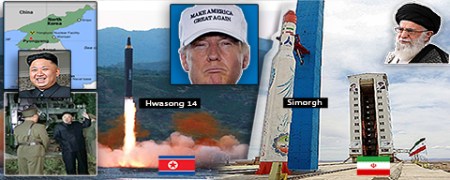
But the fact is that Iran was not trying this time to put a satellite in orbit. Its objective, for which a big step was taken forward, was to perfect the technology for building missiles able to carry small nuclear warheads, as well as carriers for boosting military and spy satellites into space.

President Barack Obama, hell bent on a deal, gave in to Tehran’s demand to leave its missile program out of the accord. Iran was left free to pursue its ballistic missile program unchecked by international law up until now.

Therefore, when on Thursday, the US Senate slapped sanctions on Iran as punishment for its missile tests, the Foreign Ministry in Tehran was formally within its rights Saturday in affirming “Iran’s inalienable right” to develop missiles “in compliance with its international obligations.”

******************************

In the same 48-hour time frame, North Korea and Iran both managed to rattle the West by successfully testing advanced missiles. Thursday, July 27, Tehran launched a “Simorgh” rocket, which is capable of carrying a 250-kg satellite into space. The next day, Pyongyang test-fired its second intercontinental ballistic missile, an improved version of the Hwasong 14, first tested three weeks earlier.

President Donald Trump was discovering that sanctions are no deterrent.

The depth of the dismay in the West may explain why none of the experts dared mention the even more troubling fact which has been known for some time: Iran and North Korea are longstanding partners in their long-range missile programs. Each maintains experts at the other’s development facilities.

On July 28, the Hwasong 14 flew 47 minutes over a distance of 3,724km before dropping into the Sea of Japan. Kim Jong-un boasted: “The test confirmed that all the US mainland is within striking range,” confirming the new estimate that North Korea’s latest ICBMs can now reach major American cities like Chicago and Los Angeles.

That was his delighted response to the latest round of US sanctions.

Iran was less forthcoming about its latest test, without however neglecting to underline its success. DEBKAfile’s military and intelligence sources confirm that Iran’s success was no less impressive than North Korea’s – and just as dangerous. The Simorgh, aka Safir-3, is the fruit of years of Iranian development and many failed tests on the way to achieving a satellite-carrying rocket as the basis for nuclear-armed ballistic missiles.

US military sources tried to present the Iranian test as another flop, only admitting at length that “the only thing we know for sure is that no satellite was put into orbit.” Like the Americans with regard to Iran, Russian military sources tried play down the North Korean success by tossing it off as an ordinary, medium-range ballistic missile.

But the fact is that Iran was not trying this time to put a satellite in orbit. Its objective, for which a big step was taken forward, was to perfect the technology for building missiles able to carry small nuclear warheads, as well as carriers for boosting military and spy satellites into space.

Tehran was extremely cagey with details about its success. The Safir-2, built around components of the North Korean BM-25 ballistic missile, which too derived from the Soviet R-27 fired from submarines, was able to attain an estimated range of 3,000-4,000km. The Simorgh or Safir-3 tested this week was an advanced version of its predecessor. The two-stage version, powered by solid fuel, is believed to have an improved range of 7,500km.

Two years ago, when Iran placed an imaging rocket into orbit during February 2015, Israeli rocket experts established that these rockets were also capable of striking any point that Iran may chose. Tehran was therefore well ahead of Pyongyang in its ability to stage a missile attack on the United States mainland – except that this discovery was eclipsed at the time by the Iranian nuclear negotiations nearing conclusion with six world powers, led by the United States.

President Barack Obama, hell bent on a deal, gave in to Tehran’s demand to leave its missile program out of the accord. Iran was left free to pursue its ballistic missile program unchecked by international law up until now.

Therefore, when on Thursday, the US Senate slapped sanctions on Iran as punishment for its missile tests, the Foreign Ministry in Tehran was formally within its rights Saturday in affirming “Iran’s inalienable right” to develop missiles “in compliance with its international obligations.”

In another event tied to Iran’s missiles, Saudi Arabia Thursday, July 26, announced the interception of “a ballistic missile launched by Yemen’s Iran-backed Houthi insurgents against the holy city of Mecca.” The defense ministry in Riyadh said the missile had been shot down some 69km away from Mecca, causing no damage or casualties.

The Saudis have for some months accused Iran of supplying the Yemeni insurgents with Fatteh-110 missiles for targeting Saudi cities, including the capital, Riyadh. They had expected President Donald Trump to hit back at Iran. However, other than reprimanding Tehran for hostile action against the “US partner Saudi Arabia,” no tangible US action was forthcoming – only fresh sanctions, which don’t cut much ice in Tehran or Pyongyang.

Donald Trump’s six-month presidency is clearly under siege. On top of the bucketfuls of trouble landing on his head at home, he is being pushed against a wall by America’s enemies in two world regions – the Far East and the Middle East.
What Iran Replacing China as North Korea’s Global Best Friend Means to Us

July 29, 2017

What Iran Replacing China as North Korea’s Global Best Friend Means to Us, BreitbartJames Zumwalt, July 28, 2017

(Collaboration on Nukes and missiles between Iran and North Korea is clear and well documented. But why would Kim let Iran take the “glory” of nuking America? He can escape death by going to Iran for “consultation” shortly before one of his nukes hits America.– DM)

Office of the Iranian Supreme Leader via AP / AP Photo/Wong Maye-E

What we must recognize, however, is that a North Korea capable of striking the US with nuclear weapons will result in nuclear conflict. Interestingly, this will not happen as a result of an attack initiated by Pyongyang. Kim is smart enough to understand the concept of Mutual Assured Destruction (MAD) by which any nuclear attack he launched against the US would lead to his own annihilation—obviously an outcome no narcissistic despot desires.

It will lead to a nuclear conflict in which Kim intends not to be a party, but a spectator.

*************************************

The only thing more difficult than attempting to stop one rogue nation from acquiring nuclear weapons is attempting to stop two rogue nations collaborating to do so.

As we explore our options in shutting down North Korea’s nuclear weapons and missile programs, we must recognize we are also dealing with Iran’s programs, which have piggybacked upon Pyongyang’s. Ever since Iran’s war with Iraq (1980-1988), during which North Korea began providing Tehran with SCUD missiles, both countries nurtured a relationship that would allow them eventually to gain membership into the nuclear arms club.

In recent years, the evolution of this relationship has allowed Iran to step into the shoes of North Korea’s former and longtime best friend, China. It is also why China has been unresponsive to U.S. calls to reel Pyongyang in.

North Korea’s leadership behaves as if it has determined that it no longer needs China as its “big brother,” as Iran is committed to seeing Kim acquire a nuclear arsenal and delivery system for it. Tehran’s mullahs have not hesitated to use Pyongyang over the past several years as a test case for American resolve. As such resolve has been non-existent, Iran came to recognize it could move forward simultaneously and in coordination with Pyongyang.

Having developed this close working relationship, Iranian observers began showing up at North Korean military tests. It was also this relationship that led to North Korean technicians working secretly to build a nuclear facility in Syria. Its development was closely monitored by Israel which, after the U.S. refused to take action to stop construction, destroyed it in an air attack in September 2007.

Undoubtedly, this nuclear facility was yet another effort by Iran – this time using its Syrian proxy, President Bashir Assad – to test our resolve. While Tehran found ours lacking, Israel’s was not. One can only imagine, had Israel not destroyed it then, ISIS seeking to capture it later.

As we weigh what option to take with North Korea, we must recognize, first of all, decades of diplomacy and sanctions have never worked. Kim will only use any future diplomatic efforts to extract concessions, as has been done in the past, lulling us to believe the crisis is over when it is not. Kim will relentlessly continue his missile and nuclear program. His motivation for doing so is twofold: to achieve a nuclear deterrent and to add to his prestige as a world leader. He has vowed never to give up his nuclear program and, as such, would lose face in the eyes of his people if he does now.

What we must recognize, however, is that a North Korea capable of striking the US with nuclear weapons will result in nuclear conflict. Interestingly, this will not happen as a result of an attack initiated by Pyongyang. Kim is smart enough to understand the concept of Mutual Assured Destruction (MAD) by which any nuclear attack he launched against the US would lead to his own annihilation—obviously an outcome no narcissistic despot desires.

It will lead to a nuclear conflict in which Kim intends not to be a party, but a spectator.

The North Korean strongman has received millions of dollars from the Iranians to continue his programs to develop nuclear weapons and a delivery system. Undoubtedly, much of this funding has come from the billions of dollars Obama sent the mullahs while negotiating the nuclear deal. Such weapons will then be acquired by Tehran as well. And, as firm believers in the eschatological Mahdi prophecy, the mullahs view MAD not as a threat to their existence but as a means of attaining their afterlife in Paradise.

For Kim, it is all about money and prestige. But if we fail to take military action to deny him his nuclear goal, we do need to forewarn him that any nuclear attack by Iran against the US or an ally will be deemed an attack by North Korea as well.

Unfortunately, at least nine U.S. presidents have believed reason ultimately would trump North Korea’s behavior. It has not. In fact, dozens of acts of aggression by its leadership against the U.S. and our allies have been documented in a 2007 report to Congress—from attacking and capturing a US Navy ship to shooting down a US military plane to assassinating South Koreans to kidnapping Japanese to sinking an ROK frigate—all failing to generate a military response. It has only emboldened additional bad behavior, leading today to a situation in which the Pyongyang/Tehran nexus has stacked the deck against us as our viable options can only be described as “lousy.” It now leaves us more threatened than ever before by a nuclear attack.

Sadly, threatening Kim’s personal survival in the event such an attack by Iran occurs may be the only card we have left to play.


