Archive for July 20, 2017

The Worst Ideological Enemy of the US is Now Europe

July 20, 2017

The Worst Ideological Enemy of the US is Now Europe, Gatestone Institute, Drieu Godefridi, July 20, 2017

The vast majority of these European courts — whether the European Court of Human Rights (ECHR) or the Court of Justice of the European Union (CJEU) — in their attempt to be moral and just, have dismissed the sovereign laws of Italy as irrelevant, and trampled the rights of the Italian state and ordinary Italians to approve who enters their country.

In Europe, Amnesty International and the like are, it seems, a new source of law.

Those who gave the Statue of Liberty to America in 1886 “to commemorate the perseverance of freedom and democracy in the United States” are willingly trampling their own people’s liberties today through courts of appointed, unelected, unaccountable ideologues. The danger is that, with the help of many doubtless well-intentioned, international NGOs, the EU will not stop at its shores.

Europe is the worst enemy of the US? You cannot be serious. Islamism, Russia, illegal immigrants… whatever, but surely not Europe! Are we not still together in NATO? Do we not conduct huge amounts of trade every day? Do we not share the same cultural roots, the same civilization, the same vision of the future? Did France not give the US her famous Statue of Liberty – “Liberty Enlightening the World?

Not anymore. In a sense, Europe looks like a continent where American Democrats have been in power for 30 years, not only in the European states, but also at the level of the European Union.

In the US, the political spectrum still spans a vast range of views between Democrats and Republicans, globalists and nationalists, pro-lifers and pro-choicers, pro-government control and pro-individuals’ control, and pro-whatever. Even today with a president and a Supreme Court clearly on the political “Right” these divisions, and the all-important separation of powers, allow for and encourage vigorous debate. By contrast, in Europe, at the “official” level, such a spectrum of views no longer exists.

In Western Europe, politically speaking, in the press and in universities, either you are on the “Left,” or you are a pariah. If you are a pariah, you are most likely to be prosecuted for “Islamophobia”, “racism”, discrimination or some other “trumped up” charge.

There are several reasons for this imbalance. One is the difference in political maturity between Europeans and Americans. Whereas “ordinary” American voters (not just the “elites”) understand that their Supreme Court is key to ensuring that fundamental constitutional freedoms are maintained for all, the Europeans have done the opposite. In the US, the constitutional right to “Life, Liberty and the pursuit of Happiness” is derived from the people — “from the consent of the governed.”

Consequently, when Justice Antonin Scalia of the US Supreme Court died, the US press wrote about him for weeks. “Ordinary citizens” in the US are deeply aware of judicial roles and their effect on judgements and legal precedents.

By contrast, in Europe, we now have two Supreme Courts: the European Court of Human Rights (ECHR) in Strasbourg, and the Court of Justice of the European Union (CJEU) in Luxembourg, in addition to national courts. There is, however, not one citizen in a million who can name a single judge of either the ECHR or the CJEU. The reason is that the nomination of those judges is mostly opaque, purely governmental and, in the instance of the ECHR, with no public debate. With the CJEU, appointments are also essentially governmental, with the sanction of the European Parliament, which is ideologically dominated by the Left.

In Europe, there are now two Supreme Courts: the European Court of Human Rights (ECHR) in Strasbourg, and the Court of Justice of the European Union (CJEU) in Luxembourg (pictured above), in addition to national courts. (Image source: Transparency International/Flickr)

The US has always welcomed immigrants, most of whom came to her shores via Ellis Island and went through a legal process for entry, led by the light of the torch of Lady Liberty. In recent years, especially since the advent of increased terrorism, the subject of illegal immigrants, migrant workers and the vetting of immigrants has become hotly debated.

By contrast, in Europe, the topic of “illegal” migrants is effectively forbidden. The continent has recently been invaded by millions of migrants — many apparently arriving under the false pretense of being refugees, even according to the United Nations.

One of the reasons is the open-door policy of German Chancellor Angela Merkel, who allowed over a million mostly Muslim migrants to enter Germany, not only without extreme vetting, but with no vetting at all.

There is, however, another, more structural cause for the current situation. In 2012, the ECHR enacted the so-called “HIRSI” ruling, named after the court case of Hirsi Jamaa and Others v. Italy, which states that the European states have the legal obligation to rescue migrants wherever they find them in the Mediterranean Sea — even just 200 meters away from the Libyan coast — and ferry them to the European shores, so that these people can claim the status of refugee.

When the Italian Navy intercepted illegal migrants in the Mediterranean Sea and sent them back to their point of origin, Libya, not only did the ECHR condemn Italy for this “obvious” breach of human rights; the Italians had to pay 15,000 euros ($17,000 USD) to each of these illegal migrants in the name of “moral damage”. This kind of money is equivalent to more than 10 years of income in Somalia and Eritrea (the countries of origin of Mr. Hirsi Jamaa and his companions). In 2016, Somalia’s GDP per capita was an estimated $400 USD; Eritrea’s $1,300.

Everyone, of course, heard about the HIRSI ruling. In Africa, especially, many understood that if they could reach the Mediterranean, Europe’s navies would now be obliged to ferry them directly to Europe. Before the HIRSI ruling, when people tried to reach the shores of Europe, hundreds every year tragically died at sea. After HIRSI, the objective is now simply to be intercepted. Consequently, hundreds of thousands attempt this journey — often with the help of non-governmental organizations (NGOs) such as Médecins Sans Frontières, whose activists wait for boats to appear at sea, just off the Libyan coast. We therefore presently have 5,000 unintercepted people dying at sea every year.

While Italy is “drowning” in refugees, Austria has deployed armored vehicles close to its border with Italy, to stop more migrants from coming north.

The vast majority of these European courts — whether the ECHR or the CJEU — in their attempt to be moral and just, have dismissed the sovereign laws of Italy as irrelevant, and trampled the rights of the Italian state and ordinary Italians to approve who enters their country.

Americans would do well to read the HIRSI decision; it is rather short and a perfect summary of current European jurisprudence. They will find that the ECHR does not hesitate to accept NGOs as an authoritative part of the process; the ECHR even quotes their statements as if fact or law. In Europe, Amnesty International and the like are, it appears, a new source of law.

The European people, of course, still share the common values of Western civilization. The “Visegrad Group” of countries in Central Europe, for instance — the Czech RepublicHungaryPoland and Slovakia — do not accept the German diktat to relocate Muslim refugees. Parts of Western Europe, such as the northern Flemish-speaking part of Belgium, are also pretty tired of the whole European mess, and Merkel will not embody the leadership of Germany forever.

Americans, therefore, would do well to understand that for the time being the “Cultural Left” is so deeply entrenched in Western Europe and the EU, that their worst ideological enemy is not the Middle East or Russia: it is Europe.

Those who gave the Statue of Liberty to America in 1886 “to commemorate the perseverance of freedom and democracy in the United States” are willingly trampling their own people’s liberties today through courts of appointed, unelected, unaccountable ideologues. The danger is, with the help of many, doubtless well-intentioned, international NGOs, the EU will not stop at its shores.

Drieu Godefridi, a classical-liberal Belgian author, is the founder of the l’Institut Hayek in Brussels. He has a PhD in Philosophy from the Sorbonne in Paris and also heads investments in European companies.
Trump ends program to arm anti-Assad jihadis in Syria

July 20, 2017

Trump ends program to arm anti-Assad jihadis in Syria, Jihad Watch

(Please see also, Trump to end lavish CIA support for ‘moderate’ anti-Assad forces in Syria. — DM)

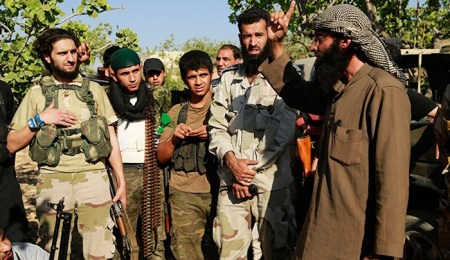
The Washington Post casts this story as evidence that President Trump is a pawn of the Russians, which is more of the Left’s ridiculous campaign to portray the 2016 election as having been stolen by Vladimir Putin. But this is the right decision. These “rebels” are mostly jihadis; arming and aiding them is arming and aiding enemies of the United States.

“Trump ends covert CIA program to arm anti-Assad rebels in Syria, a move sought by Moscow,” by Greg Jaffe and Adam Entous, Washington Post, July 19, 2017:

President Trump has decided to end the CIA’s covert program to arm and train moderate Syrian rebels battling the government of Bashar al-Assad, a move long sought by Russia, according to U.S. officials.

The program was a central plank of a policy begun by the Obama administration in 2013 to put pressure on Assad to step aside, but even its backers have questioned its efficacy since Russia deployed forces in Syria two years later.

Officials said the phasing out of the secret program reflects Trump’s interest in finding ways to work with Russia, which saw the anti-Assad program as an assault on its interests. The shuttering of the program is also an acknowledgment of Washington’s limited leverage and desire to remove Assad from power.

Just three months ago, after the United States accused Assad of using chemical weapons, Trump launched retaliatory airstrikes against a Syrian air base. At the time, U.N. Ambassador Nikki Haley, said that “in no way do we see peace in that area with Assad at the head of the Syrian government.”

Officials said Trump made the decision to scrap the CIA program nearly a month ago, after an Oval Office meeting with CIA Director Mike Pompeo and national security adviser H.R. McMaster ahead of a July 7 meeting in Germany with Russian President Vladimir Putin.

Spokesmen for the National Security Council and the CIA declined to comment….

‘It takes 2 to tango’: Germany threatens Turkey with major policy overhaul

July 20, 2017

Published time: 20 Jul, 2017 13:57

Source: ‘It takes 2 to tango’: Germany threatens Turkey with major policy overhaul — RT News

FILE PHOTO German Chancellor Angela Merkel and Turkish President Recep Tayyip Erdogan © Tobias Schwarz / Reuters

Berlin said it is losing its temper with Ankara, urging Turkey to release Germans detained on terrorism charges and “return to European values,” or face shrinking investment, restrictions on tourism and curbs to EU financial aid.

Speaking in Berlin on Thursday, Foreign Minister Sigmar Gabriel promised a major overhaul of Germany’s policy toward Turkey, threatening to further strain the already-tense ties between the two NATO members.

Read more

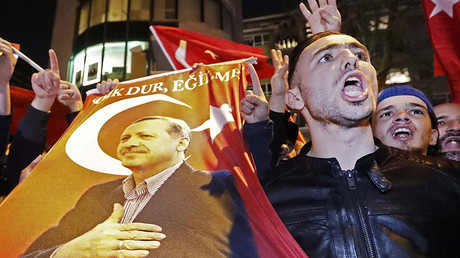
Demonstrators gather outsidethe Turkish consulate, Rotterdam, Netherlands March 11, 2017. © Yves Herman

“We cannot continue on as before,” Gabriel said, according to a Foreign Office press release. “We have to be clearer than before, so the authorities in Ankara understand that their policies are not without consequences.” 

“It takes two to tango!” he said. “I cannot see that the Turkish government is ready at the moment to go this way with us. It’s pitiful!”

The latest flare-up was triggered by the arrest of Peter Steudtner, a German human rights activist who was charged by Turkish authorities with supporting a terrorist organization. Demanding his immediate release, Gabriel said Steudtner had been invited to speak at a local human rights workshop and had no contacts among the Turkish opposition or civil society.

Mentioning other Germans, including Die Welt reporter Deniz Yucel, who were charged with alleged links to terrorist groups, the foreign minister announced stricter travel warnings for tourists planning to visit Turkey.

The cases of Steudtner and Yucel were a clear enough example “that German citizens are no longer safe from arbitrary arrests in Turkey,” Gabriel said. “We have no other choice – as we are responsible for the safety of our country’s citizens – but to adapt our travel and safety advice to Turkey and let Germans know what can happen to them when they travel [there].”

Earlier in the day, the German Foreign Office website updated its travel section. The revised travel advice stopped just short of a formal warning, but stated that “people traveling on private or business purposes to Turkey are advised to exercise elevated caution” and to register with the German embassy or consulate even in cases of a short stay.

Read more

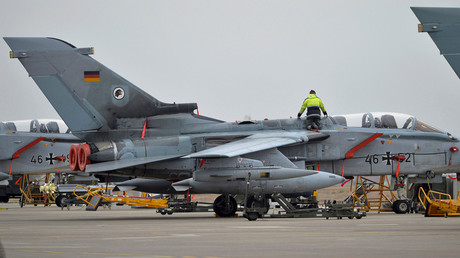
FILE PHOTO A technician works on a German Tornado jet at the air base in Incirlik, Turkey © Tobias Schwarz

“On and on, we showed patience and restrained ourselves,” Gabriel went on, adding that “the next stage of escalation has been reached.” Accusing Turkey of “departing the basis of European values,” the top diplomat also vowed economic retaliation.

“I therefore cannot see how we, as the government, can still guarantee corporate investments in Turkey when we are seeing arbitrary, politically-motivated confiscations [of property] there and arbitrary deportations for political reasons,” he underlined.
Berlin will also contact its European partners to discuss possible curbs on EU financial aid to Turkey “in the coming days and weeks,” Gabriel announced.

Germany was Turkey’s top export destination in 2016, according to Reuters, citing IMF data, and was also the second biggest source of Turkish imports, at $21.5 billion. The Association of German Chambers of Commerce (DIHK) has already commented on Gabriel’s speech, saying current developments in Turkey are likely to affect doing business in the country.

“In this environment it is hard to think about German companies making new investments in Turkey,” Volker Treier, DIHK foreign trade chief, told Reuters. Germany bought $14 billion worth of Turkish exports in 2016, according to IMF direction of trade statistics.

In order to prevent retaliatory measures, Ankara has to engage in a “decent dialogue” and provide consular access and “speedy, fair trials” for Steudtner, Yucel and other Germans facing political charges. “We expect [Turkey] to return to European values, respect freedom of expression, freedom of press and freedom of art,” Gabriel reiterated.

Turkey accuses Germany of ‘great political irresponsibility’

Turkey has responded that it is impossible for the government to bow to German demands. “It is not possible for us to accept statements aiming to blur the economic environment based on political motivation, we hope they turn back from this,” Ibrahim Kalin, Turkish President Recep Tayyip Erdogan’s spokesman, told reporters.

He also said it was “great political irresponsibility” to warn German citizens against traveling to Turkey. In turn, Mehmet Simsek, Turkey’s deputy prime minister, said in a tweet that the country welcomes German investors. The minister also dismissed media reports alleging some major German companies, including Daimler AG and BASF, were investigated by Turkey over “supporting terrorism.”

Over the past year, German-Turkish ties have deteriorated rapidly. After the foiled 2016 military coup, Ankara accused Berlin of harboring followers of Fethullah Gulen, a self-exiled Muslim cleric said to have orchestrated the uprising. Turkish pro-coup officers being granted asylum in Germany have also added more strains to the two countries’ relations.

Turkey repeatedly blocked access for German MPs to NATO’s air base at Incirlik, once home to some 300 Bundeswehr soldiers and several reconnaissance jets. In June, Berlin authorized troop withdrawal, relocating its contingent to Jordan.

Germany, for its part, sparked anger in Turkey’s government by barring top officials from speaking at political rallies on German soil.

Trump to end lavish CIA support for ‘moderate’ anti-Assad forces in Syria

July 20, 2017

The White House and CIA have reportedly decided to end a covert operation to arm the so-called moderate Syrian rebels. The US has allegedly pumped some $1 billion into train-and-equip efforts with questionable outcomes.

Source: Trump to end lavish CIA support for ‘moderate’ anti-Assad forces in Syria – reports — RT News

Alaa Al-Faqir / Reuters

On Wednesday, US officials told the Washington Post (WP) and Reuters that Trump has decided to put an end to the covert CIA plan which began arming and training the so-called moderate Syrian rebels in 2013.

Authorized by President Barack Obama, the secret Timber Sycamore weapons supply and training initiative has served as the backbone of Washington’s strategy to topple the Syrian President Bashar Assad.

Two US officials, who spoke on condition of anonymity with Reuters, said the covert CIA scheme has produced little results.

The Washington Post meanwhile claimed, based on their sources, that Trump’s reported intention to stop arming the rebels is the American president’s way of finding common ground with Russia on Syria.

Moscow has always warned against arming the so-called moderate rebel groups in Syria, pointing out that weapons supplied to them often fall into the hands of jihadist groups such as Jabhat al Nusra and Islamic State.

“Of course it’s been a tremendous waste of money … to train rebels who immediately turned weapons over and joined Al-Nusra [Front] or Al-Qaeda,” Rick Sterling, an investigative journalist and member of the Syria Solidarity Movement, told RT.

“The money in the training that the CIA has provided has primarily helped Al-Qaeda,” Sterling said. He described Trump’s decision was a positive step, but added it is likely “to come under attack now, and the decision may be undermined or sabotaged.”

Trump’s decision to end the CIA program was reportedly taken in consultation with CIA Director Mike Pompeo and national security adviser H.R. McMaster ahead of his meeting with President Vladimir Putin in Hamburg earlier this month. During that meeting, on the sidelines of the G20 summit, Trump and Putin reached a ceasefire agreement for southwest Syria.

The scrapping of the CIA’s Timber Sycamore program was not a precondition for the ceasefire negotiations, the US officials insisted.

Without sharing the details of the program’s demise, the unnamed US officials claimed that Timber Sycamore would be phased out over a period of months. The WP report also said the decision to end the operation is being supported by the Jordanians, where some of the CIA training has been taken place.

Varied US arms and training strategies to bolster rebel groups in Syria under the Obama administration have been notoriously underwhelming. In 2015, General Lloyd Austin, CENTCOM commander at the time, told Congress that only four or five of US-trained fighters have gone to Syria of the 5,000 the Pentagon envisaged.

Earlier that year, the then Defense Secretary Ash Carter told the Senate Armed Services Committee Carter that less than 1 percent of the pool of 7,000 Syrian volunteers for the US-funded train-and-equip program had made it through the vetting process.

“As of July 3, [2015] we are currently training about 60 fighters,” Carter said. “I can look out at your faces and you have the same reaction I do, which is that that’s an awfully small number.”

The Reuters report notes that the US will continue to support select Syrian rebel groups with airstrikes and guidance as part of a separate effort.

The White House declined to comment on the reports at their daily briefing. The CIA has also refused to comment when reached out to by Reuters.

In February, Reuters reported that the US had frozen the CIA-run program after rebels in northwest Syria came under major attack by Islamists. The alleged suspension of the program, which included salaries, training, ammunition, had nothing to do with Trump replacing Barack Obama as president, two US officials familiar with the CIA program told Reuters at the time.

The CIA declined to comment on the reported freeze, while officials in Qatar, Turkey and Saudi Arabia – the other three countries funneling support to Syrian anti-government rebels – also refused to discuss the matter.

Chinese Army Mobilizes Military Assets to Tibet Following Live Fire Drills

July 20, 2017

Chinese Army Mobilizes Military Assets to Tibet Following Live Fire DrillsSputnik News via Global Security org, July 20, 2017

The Chinese People’s Liberation Army (PLA) mobilized thousands of ground vehicles and other military equipment as the standoff between Chinese and Indian troops near the disputed area of Sikkim continues, according to a report from the PLA Daily.

PLA Daily is widely considered the main outlet the Chinese army uses for external communications, LiveMint notes.

The report did not specify the exact date the military assets were relocated to Tibet but said it occurred at the end of June. The unspecified military “hardware” was transported via rail and conventional roads.

It’s not entirely clear where in Tibet the chess pieces have been placed. The report also failed to indicate whether the military equipment would be used in tandem with a Chinese battalion that recently completed drills in Tibet, China’s second-largest province.

Last weekend, the PLA conducted live fire exercises in the province. Video footage of the drills was broadcast over CCTV. Analysts said the move would show the people of China the government is ready to protect them in the event that the standoff becomes more heated and violent.

Reinforcing the western front with personnel and hardware makes it much easier for commanders to defend Chinese borders, Wang Dehua of the Shanghai Institutes for International Studies told LiveMint on Wednesday. Offensive and defensive maneuvers are “all about logistics,” Wang said, and “now there is much better logistics support to the Tibet region.”

The dispute in Sikkim originated in mid-June when Indian troops stopped Chinese workers from building a road that Beijing said was on its territory. Bhutan claimed that the particular area where construction took place was actually its territory, and India sided with Bhutan.

The area where the road was being built is of significant strategic importance to New Delhi. A finished road could provide Chinese troops with an avenue to sever India’s access to its northeastern states.

A recent article in the Indian Defense Review argued that further espionage between India and China might actually be key to resolving the crisis. “The two countries are ignorant of each other’s strategies,” Nicolas Groffman wrote. As a result, suspicion is “taking the place of intelligence just when understanding is critical.”

Vasily Kashin told Sputnik China, however, that such activities ought to have strict limits if stabilizing effects are to be achieved. Intelligence operations would cross a critical threshold if “active intervention in the internal affairs or acts of sabotage” were used, Kashin emphasized.

While Nobody’s Looking, China And India Are Carrying Out A Real-Life ‘Game Of Thrones’

July 20, 2017

While Nobody’s Looking, China And India Are Carrying Out A Real-Life ‘Game Of Thrones’, The Federalist, July 20, 2017

(The article, dated July 20th, states, “Starting this week, India is holding naval exercises with the United States and Japan, a move viewed by observers as a show of force against China’s rising naval power.” However, the link provided, dated July 10th, states that “The Malabar exercises involving Japan’s Maritime Self-Defense Force and the US and Indian navies are taking place in the Bay of Bengal and will last until July 17.” Please see also, Malabar Exercise: India, US and Japan deploy its biggest carriers in show of force against China’s growing naval power at Warsclerotic. — DM)

The Asian version of the conflict between House Lannister and House Stark is playing out over a patch of remote land high in the Himalayas, bordered by China, India, and Bhutan. The Chinese dragon and the Indian tiger, the two most populous nations with nuclear weapons, are engaging in their worst border dispute in 40 years, which has turned this spit of land into the most dangerous place in Asia.

You haven’t heard anything about it until now because the U.S. media is so focused on who talked to whom during the 2016 presidential campaign that they can’t spare any resources to report on truly consequential events taking place around the world.

China and India share a very long border of more than 2,000 miles. The two countries have engaged in various border disputes since the nineteenth century. They even fought a war in 1962 over border issues. China claimed it won the war but India only admitted that the war resulted in a stalemate and left many border issues unresolved.

The most recent border dispute started in June, when Indian soldiers stopped a Chinese army construction crew from building a road in a pocket of land in the Dokalam region. Since this land lies between Bhutan, China, and the Indian state of Sikkim, all three countries claim ownership of it. China calls this region Donglang and treats it as part of Chinese-controlled Tibet. Thus, China firmly believes that it has every right to build the road within its sovereign territory. China let India know that “trespass into Chinese territory is a blatant infringement on China’s sovereignty, which should be immediately and unconditionally rectified.” However, Bhutan and India disagree.

This Land Is My Land

Bhutan is a tiny country wedged between two nuclear-armed superpowers. It doesn’t have an official diplomatic relationship with China. The government of Bhutan issued a demarche to China over the road construction, asking China to stop. Since Bhutan has a close relationship with India and relies on India for security protection, it also asked India for help. China has tried unsuccessfully to break the Bhutan-India alliance by engaging Bhutan directly. Bhutan, however, follows India’s lead on this matter.

From India’s perspective, it intervenes on behalf of both India and Bhutan because both have historical claims to the disputed land. Since Beijing and New Delhi agreed back in 2012 to solve their particular border dispute in this tri-junction area through consultations with all countries involved, New Delhi regards China’s recent road construction as a unilateral violation of the 2012 understanding.

Furthermore, India’s military is concerned that the road China intends to build will give China easier access to a strategically important area in India, which is known as the “chicken’s neck,” “a 20km (12-mile) wide corridor that links the seven north-eastern states to the Indian mainland.” If China’s road project succeeds, India military believes it would diminish their own “terrain and tactical advantage” over the Chinese army in this area.

India is also suspicious of the road project’s timing. The construction began right around the same time that India’s Prime Minister Modi was giving U.S. President Trump bear hugs and President Trump proclaimed that the U.S.-India relationship was “never better.” Did China try to warn India not to get too close to the United States by starting a road construction in the disputed area at this particular time? Many in India seem to think so.

Soldiers Face Off ‘Eyeball to Eyeball’

The border standoff continues with no obvious solution in sight. Both China and India increased their troop levels at the border. Online video shows soldiers from both countries facing off “eyeball to eyeball.” So far no one has fired the first shot yet, but the war of words has been heating up, not just at the border, but through both countries’ government officials and media.

China’s ambassador to India said “the first priority is that the Indian troops unconditionally pull back to the Indian side of the boundary. That is the precondition for any meaningful dialogue between China and India.” Chinese media used the 1962 Sino-India border war as an example to forewarn India that if the two sides get into a military conflict again, India will have the most to lose. Chinese media also warned Tibetan exiles in India not to take advantage of the situation because “sovereignty over Tibet is nonnegotiable.”

Indian Defense and Finance Minister Arun Jaitley fired back at China’s rhetoric by reminding China that the India of 2017 is not the India of 1962. He further pointed out that China’s intended construction site was on “Bhutan’s land, close to the Indian border, and Bhutan and India have an arrangement to provide security…To say we will come there and grab the land of some other country is what China is doing and it is absolutely wrong.”

Any Misstep Can Be Fatal

This dispute is a reflection of a deeper problem: the underlying, deep-rooted mistrust and hostility between China and India. Each feels insecure of the other nation’s growing economic and military power. These two countries, with a combined population of more than 2 billion people, both have nuclear weapons and strong nationalistic leaders, and are elbowing each other for the iron throne—ultimate dominance in the region. No one is willing to back down at this point.

Besides border disputes, both nations have breathed plenty of fires to irritate the other side. China’s pipeline project with Myanmar not only allows China to have easier access to cheap oil, but also enables Chinese ships to be present in India’s eastern backyard. India snubbed China’s “One Belt and One Road”(OBOR) economic summit in May by not sending a high-level delegation. India media even called the OBOR initiative “a new kind of colonization.” Starting this week, India is holding naval exercises with the United States and Japan, a move viewed by observers as a show of force against China’s rising naval power.

If there’s a lesson to be learned from the 1962 war, it’s this: any miscalculation or any missteps by either nation could lead to a war with devastating consequences not just for the region, but for the rest of the world. Therefore, it’s absolutely essential that the two nations find a peaceful resolution to their border dispute as soon as possible.

The United States probably will need support from both China and India to deal with the rising threat from North Korea. Therefore, it’s in the United States’ best interest to serve as a mediator to help both nations reach a diplomatic solution, before the “Game of Thrones” Asian edition moves from a fantasy to a bloody reality.

Helen Raleigh owns Red Meadow Advisors, LLC, and is an immigration policy fellow at the Centennial Institute in Colorado. She is the author of several books, including “Confucius Never Said” and “The Broken Welcome Mat.