Archive for June 2017

What Is the Right U.S. Policy on Iran?

June 21, 2017

What Is the Right U.S. Policy on Iran? Clarion ProjectShahriar Kia, June 21, 2017

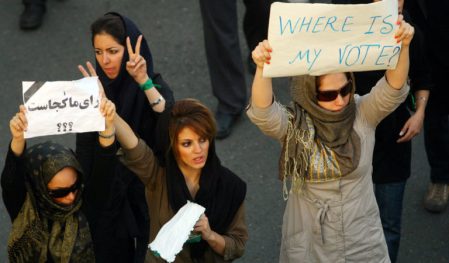
Iranian women protest election irregularities in 2009 (Photo: Getty Images)

Tillerson added. “As you know, we have designated the Quds [Force]. Our policy towards Iran is to push back on this hegemony, contain their ability to develop obviously nuclear weapons, and to work toward support of those elements inside of Iran that would lead to a peaceful transition of that government. Those elements are there, certainly as we know.”

******************************

United States Secretary of State Rex Tillerson responded to a variety of very serious questions raised by House of Representatives members in a recent hearing focusing on U.S. policy vis-à-vis Iran. Representative Ted Poe (R) from Texas touched on what many believe is the ultimate issue when he said:

“I’d like to know what the policy is of the U.S. toward Iran. Do we support the current regime? Do we support a philosophy of regime change, peaceful regime change? There are Iranians in exile all over the world. Some are here. And then there’s Iranians in Iran who don’t support the totalitarian state. So is the U.S. position to leave things as they are or set up a peaceful, long-term regime change?”

America’s top diplomat, taking into consideration how the Trump administration’s all-out Iran policy remains an issue of evaluation, answered:

“… our Iranian policy is under development.

“We continually review the merits both from the standpoint of diplomatic but also international consequences of designating the Iranian Revolutionary Guard in its entirety as a terrorist organization.” 

Tillerson added. “As you know, we have designated the Quds [Force]. Our policy towards Iran is to push back on this hegemony, contain their ability to develop obviously nuclear weapons, and to work toward support of those elements inside of Iran that would lead to a peaceful transition of that government. Those elements are there, certainly as we know.”

Iran is terrified of such a stance and responded immediately. In a tweet, Iranian Foreign Minister Mohammad Javad Zarif claimed that 75 percent of Iran’s population voted in the recent election farce back in May.

Iran’s wrath was not limited to this very issue. Following the twin ISIS attacks targeting Iran’s parliament and the tomb of Ayatollah Khomeini, leader of the Islamic revolution in Iran, senior regime officials sought to portray their apparatus as a victim of terrorism.

Failing to do so, Iranian regime officials accused the US, Saudi Arabia and the main opposition group, the People’s Mojahedin Organization of Iran (PMOI/MEK), of this terrorist plot. A few days ago, Supreme Leader Ayatollah Ali Khamenei lashed out at the US and accused Washington of bringing ISIS to life.

“Who created ISIS? Was it anyone but the U.S.? … The U.S. claim that they have established a coalition against ISIS is a lie; of course, the U.S. is against an ‘unrestrained ISIS,’ however, if anyone truly seeks to eradicate ISIS, they will have to fight against it,” he said.

Now the question is, what is Iran so concerned about and what is the right policy vis-à-vis Iran?

With Obama leaving the White House, Iran forever lost a major international backer. For eight years, the “golden era” as Iran dubbed the Obama years, any and all activities by the Iranian people and their organized opposition for change in Iran was countered by the domestic crackdowns and international hurdles, specifically by the U.S.

Obama’s neglect of Tehran’s crimes in Syria and Iraq led to the disasters we are witnessing today. Internationally, a major overhaul of U.S. policy in the region and establishing a significant Arab-American alliance in the face of Iran’s meddling has become a major concern for the mullahs.

In addition, increasing popular dissent and widespread activities by the PMOI/MEK in the past few months have also raised major concerns for the regime.

Khamenei personally intervened last week, first acknowledging the 1988 massacre, defending the Revolutionary Guards (IRGC), and those involved in the murder of over 30,000 political prisoners. Most of the victims, all executed in mass groups, were PMOI/MEK members and supporters.

Khamenei’s second concern and that of his entire apparatus is focused on the upcoming Iranian opposition’s annual convention in Paris scheduled for July 1 this year. The National Council of Resistance of Iran (NCRI), the main entity representing the Iranian opposition, hosts more than 100,000 Iranians from across the globe each year alongside hundreds of prominent dignitaries delivering their support and speeches seeking true change in Iran.

Last year alone, a very prominent delegation of American dignitaries from both sides of the political aisle included former New York Mayor Rudy Giuliani, former House Speaker Newt Gingrich, former U.S. ambassador to the UN John Bolton from the Republicans, former Democratic National Committee chairman Gov. Howard Dean, former U.S. ambassador to the UN Gov. Bill Richardson took part.

This year’s Iranian opposition rally is already brewing major concerns for Tehran as the regime understands the end of the era of appeasement has led to sweeping changes in Western policy regarding the Middle East, and most importantly Iran.

This is exactly why Tehran is going the limits to prevent the shifting of policy towards the Iranian people. Tehran’s lobbies in the U.S. and Europe are placing a comprehensive effort to demonize the images of the PMOI/MEK and the NCRI to prevent any such changes, especially in Washington.

If Iran resorts to ridiculous remarks of accusing the U.S. and Iranian opposition of staging the recent double attacks in Tehran, the correct policy is none other than supporting the Iranian people and their resistance to realize regime change in Tehran.

Iran gets North Korean expertise in building up, testing and hiding its ballistic missiles

June 21, 2017

Iran gets North Korean expertise in building up, testing and hiding its ballistic missiles, Washington Times

(The North Korea – Iran nuclear/missile axis has been active for years. Why not? Iran has lots of money courtesy of Obama’s Iran Scam and North Korea has technology that Iran wants. Iran is also likely pleased that the threat of North Korean nuke-laden missiles may be diverting attention from the dangers posed by Iran. — DM)

Iranian dissidents have documented work at 42 missile centers operated by the Islamic Revolutionary Guard Corps, the regime’s dominant security force. A dozen of those sites had never been disclosed before. (Associated Press/File)

Iran has increased production and testing of ballistic missiles since the 2015 nuclear deal with the U.S. while playing permanent host to scientists from North Korea, which has the know-how to build and launch atomic weapons, a leading Iranian opposition group said Tuesday.

The National Council of Resistance of Iran issued a white paper that the dissidents say identifies and documents work at 42 missile centers operated by the Islamic Revolutionary Guard Corps, the regime’s dominant security force.

A dozen sites had never been disclosed before, said the council, which operates a spy network that has exposed Iran’s hidden nuclear program.

Tehran views expertise from North Korea as being so critical that it has established residences in Tehran for Pyongyang’s scientists and technicians, according to the white paper. North Koreans have shown Iran how to dig tunnels and build “missile cities” deep inside mountains to prevent destruction by airstrikes, among other projects.

“On the basis of specific intelligence, the IRGC’s missile sites have been created based on North Korean models and blueprints,” the white paper said. “North Korean experts have helped the Iranian regime to build them. Underground facilities and tunnels to produce, store, and maintain missiles have also been modeled after North Korean sites and were created with the collaboration of the North Korean experts.”

Iranians also are traveling to North Korea, which uses occasional missile test-firings to rattle its neighbors South Korea and Japan, two strong U.S. allies.

“In the context of these trainings and relations, delegations of the IRGC’s aerospace constantly travel to North Korea and exchange knowledge, information and achievements with North Korean specialists,” the report said. “North Korea’s experts constantly travel to Iran while the IRGC’s missile experts visit North Korea.”

President Trump has been harshly critical of the 2015 deal struck by the Obama administration and five international allies to lift economic sanctions and other financial penalties in exchange for curbs on Iran’s nuclear weapons programs, but has said he will stick with the accord for now while closely monitoring Tehran’s adherence to the deal.

Iran’s leaders say they have yet to see all the benefits promised with the lifting of sanctions.

But even supporters of the Obama deal say there has been little sign that Iran’s Islamic Republic has moderated its behavior on other fronts, including the series of ballistic missile tests in recent months that some argue violate U.N. sanctions. U.S. officials also say Iran continues to back terror groups and foment instability in regional hot spots such as Syria and Yemen.

At a press conference Tuesday, Alireza Jafarzadeh, the council’s deputy director in Washington, displayed satellite photos that he said clearly show trademark North Korean mountain entrances to “cities” that hold hundreds of missiles.

He said the regime reorganized the IRGC Aerospace Force to focus almost exclusively on missile production and testing rather than aircraft.

“It’s not by accident,” Mr. Jafarzadeh said. “It’s part of their overall strategy.”

He said a huge missile arsenal allows the ruling Shiite mullahs to intimidate Sunni Muslim neighbors such as rival Saudi Arabia. In addition, missiles provide a delivery system for the nuclear weapons that the regime plans to build once the 2015 nuclear deal, known as the Joint Comprehensive Plan of Action, expires in less than 10 years.

“We’re racing against the clock,” he said.

The National Council of Resistance of Iran held a press conference in Washington in April to present evidence that Tehran’s harsh Islamic regime is cheating on the nuclear deal by continuing secret work on atomic bomb components. The Trump administration recently certified that the Islamic republic is living up to its obligations in the deal, which restricts Tehran’s production of only nuclear material, not missiles.

The council’s report pays close attention to the Semnan missile center, a complex of storage facilities and launching pads for medium-range ballistic missiles in north-central Iran. It is here, the white paper says, that Iran melds missile work with nuclear research conducted by the Organization of Defensive Innovation and Research, known by the Persian acronym SPND.

The council first disclosed SPND’s existence in 2011. In 2014, the Obama administration imposed sanctions on SPND for conducting illicit work not allowed at by the pending nuclear deal.

“The Semnan center for missile projects has been much more active after the JCPOA,” a council official said. “The speed and scope of activities and research in Semnan has increased significantly in this period and the exchanges and traffic between SPND.”

Iran has flouted U.N. resolutions repeatedly by test-firing ballistic missiles. In February, the nonprofit Foundation for Defense of Democracies put the number at 14 since the nuclear deal was signed in July 2015. Since then, Iran has conducted at least two more tests.

On Sunday, Iran for the first time since 2001 fired an operational missile outside its boundaries, targeting an Islamic State-controlled town in eastern Syria. Tehran said the ground-to-ground missile strike was retaliation for the Islamic State’s June 7 terrorist attack on the Iranian parliament. In 2001, the regime fired missiles on resistance targets in Iraq.

Iran owns one of the world’s largest inventories of ballistic missiles. GlobalSecurity.org lists more than a dozen different short- and medium-range Iranian missiles, some of which closely resemble North Korea’s Nodong arsenal.

Tehran this year announced the launch of the Emad, which has a range of 1,000 miles. It said the test marked a first for an Iranian precision-guided ballistic missile.

More than ever, the resistance council said, Iran’s religious leaders see missiles as instrumental to their survival strategy.

“The Iranian regime has remained in power in Iran by relying on two pillars: internal repression and external export of Islamic fundamentalism and terrorism,” the council said. “Its illicit nuclear weapons program and its continued expansion of ballistic missiles serve its policy of export of Islamic fundamentalism and terrorism.”

Donald Trump Meets Ukrainian President Petro Poroshenko After Sanctioning Russian-Backed Separatists

June 21, 2017

Donald Trump Meets Ukrainian President Petro Poroshenko After Sanctioning Russian-Backed Separatists, BreitbartCharlie Spiering, June 20, 2017

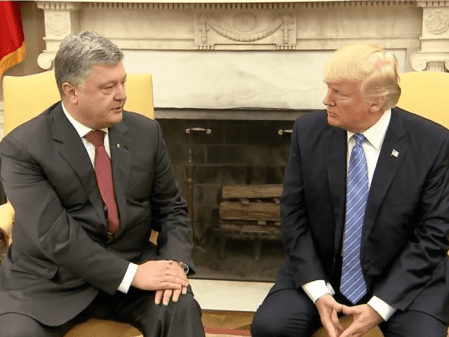
screenshot

President Donald Trump met with Ukrainian President Petro Poroshenko on Tuesday as his administration imposed sanctions on Russian-backed separatists in the country.

Trump said the two had “very, very good discussions,” calling Ukraine “a place that we’ve all been very much involved in.”

Behind the scenes, the White House revealed that Trump and Poroshenko discussed support for a peaceful resolution to the conflict in eastern Ukraine.

Treasury Secretary Steven Mnuchin announced sanctions on two Russian officials and several separatists in Eastern Ukraine to support the Ukrainian amidst ongoing Russian-backed conflicts in the region.

“This administration is committed to a diplomatic process that guarantees Ukrainian sovereignty, and there should be no sanctions relief until Russia meets its obligations under the Minsk agreements,” Mnuchin said Tuesday.

Poroshenko said it was a “great pleasure” to meet with Trump to discuss issues important to Ukraine and called the president a “supporter and strategic partner” of the country.

“We’re really fighting for freedom and democracy,” he said.

US Fighter Jet Shoots Down Armed Drone in Syria

June 21, 2017

by Kristina Wong 20 Jun 2017

Source: US Fighter Jet Shoots Down Armed Drone in Syria

AP Photo/Aaron Allmon

A U.S. F-15E Strike Eagle fighter jet shot down an armed “pro-Syrian regime” drone advancing on coalition forces in Southern Syria at approximately 12:30 a.m. on Tuesday.

The drone was identified as a Shaheed-129 that displayed “hostile intent and advanced” on coalition forces at the At Tanf combat outpost used to train partner Syrian forces in the fight against the Islamic State (ISIS).

The U.S.-led military coalition said in a statement that the shoot down occurred where another pro-regime drone dropped munitions on June 8 before it was also shot down.

“The F-15E intercepted the armed UAV after it was observed advancing on the Coalition position. When the armed UAV continued to advance on the Coalition position without diverting its course it was shot down,” the statement said.

The shoot down comes two days after the U.S. announced it shot down a Syrian regime fighter jet on Sunday after it dropped bombs near U.S.-backed Syrian Kurdish forces advancing on ISIS’s stronghold of Raqqa. That incident angered Russia, which intervened in the Syrian civil war on Syria’s behalf in 2015 and has a hotline with the U.S. to deconflict airspace and make sure their air forces don’t collide mid-air.

Russia announced on Monday it was suspending the hotline, but the U.S. said it was still functioning as of Monday morning.

The coalition implied the hotline was still working as of Tuesday morning.

“There is a de-confliction mechanism in place with Russian forces to reduce uncertainty in this highly contested space and mitigate the chances of strategic miscalculation. Given recent events, the Coalition will not allow pro-regime aircraft to threaten or approach in close proximity to Coalition and partnered forces,” the statement said.

Chairman of the Joint Chiefs of Staff Marine Gen. Joseph Dunford urged calm on Monday, calling talk of “World War III” unproductive.

“The worst thing that any of us could do right now is, would be to address this thing with hyperbole,” he said during an appearance at the National Press Club in Washington, DC.

“An incident occurred, we have to work through the incident, we have a channel to be able to do that,” he said.

The two latest shoot downs, in addition to the one on June 8, has raised questions over whether the U.S. is getting drawn into a war with Russia or Syria, rather than just with ISIS.

But the coalition said the move was defensive.

“The Coalition presence in Syria addresses the imminent threat ISIS in Syria poses globally. The Coalition does not seek to fight Syrian regime, Russian, or pro-regime forces partnered with them, but will not hesitate to defend Coalition or partner forces from any threat,” it said.

“The Coalition has made it clear to all parties [publicly] and through the de-confliction line with Russian forces that the demonstrated hostile intent and actions of pro-regime forces toward Coalition and partner forces in Syria conducting legitimate counter-ISIS operations will not be tolerated,” the statement read.

“The Coalition calls on all parties to focus their efforts on the defeat of ISIS, which is our common enemy and the greatest threat to regional and worldwide peace and security.”

The Leftist News Media, Unmasked

June 21, 2017

The Leftist News Media, Unmasked, Front Page MagazineDiscover The Networks, June 21, 2017

(Please see also, After Last Night. — DM)

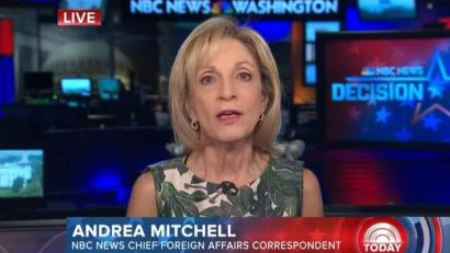
Andrea Mitchell, poster woman of the propaganda mill.

If there’s anything that the most recent presidential campaign and its aftermath have made crystal clear, it’s that the major news media in America are teeming with leftists who overtly and covertly promote leftist worldviews and agendas. Andrea Mitchell, who has been the chief foreign-affairs correspondent at NBC News since 1994, is emblematic of the media’s pitiful devolution into nothing more than a propaganda mill.

Like a dutiful leftist, for instance, Mitchell has long viewed white Republicans and conservatives as being particularly inclined toward racism. During a June 2008 appearance on MSNBC, she referred to a heavily pro-Republican area of southwestern Virginia where then-presidential candidate Barack Obama was campaigning, as “real redneck, sort of, bordering on Appalachia country.”

In a December 2015 discussion about Republican presidential candidate Donald Trump’s call for a temporary halt on Muslim immigration to the United States, Mitchell said: “I will tell you that the [Obama] White House views the Trump Muslim ban as pure racism … My first campaign, 1968 as a young reporter, was [that of segregationist] George Wallace. I have seen this before.”

Mitchell objected strongly in June 2016 when Donald Trump said he was being treated unfairly by U.S. District Judge Gonzalo Curiel, an Indiana-born American citizen whose parents originally hailed from Mexico. Trump described Curiel, who was presiding over a lawsuit against Trump University, as “a member of a club or society [La Raza Lawyers of San Diego] very strongly pro-Mexican,” and said that it was “just common sense” that Curiel’s connections to Mexico, and his disagreement with Trump’s past calls for stricter border controls, were responsible for his anti-Trump rulings. According to Mitchell, Trump’s remarks were “blatantly racist.”

In November 2016, Mitchell covered the annual conference of the National Policy Institute, a Washington-based think tank that promotes white nationalism. Though the gathering consisted of scarcely 200 attendees, Mitchell tried to emphasize its significance as a barometer of anti-black racism among Donald Trump’s political backers: “Supporters of Donald Trump’s election and the alt-right gathered in Washington this weekend at the Reagan Building … to celebrate with white supremacist speech and echoes of signature language from Nazi Germany.” Later in that segment, Mitchell related an anecdote she had heard about a four-year-old black girl in Harlem who, by Mitchell’s telling, “said she wants to be white” because of her fear “that black people are going to be shot under [President] Trump.” Trump’s election victory, said the news woman, was having a profound “effect on children in minority, in communities of color.”

Over the course of her broadcasting career, Mitchell has made plain her affinity for leftist Democrats. For example, in an April 2016 interview in which Senator Harry Reid said that “Hillary Clinton’s qualifications” for being president were more impressive than those of anyone “since the Founding Fathers,” Mitchell responded by saying that only “John Quincy Adams, maybe,” had compiled a résumé equal to that of Clinton. Just before the election that November, Mitchell characterized a Clinton campaign rally that featured appearances by such notables as Lebron James and James Taylor as “extraordinary” and “magical.”

In a similar spirit, Mitchell lauded outgoing President Barack Obama‘s “extraordinary” July 2016 speech at the Democratic National Convention as “the most optimistic speech, the most generous speech, politically,” that anyone could have expected to hear. She marveled at “the genuine affection” that Obama expressed for Hillary Clinton “when he said there’s never been anyone, not man or woman, not me, not Bill [Clinton], as qualified to be president of the United States.” Extolling also “the creativity” of Obama’s “own brilliant speech writing,” Mitchell said: “His gift is unique. I don’t think we’ve ever had a President save Lincoln, who is as great a speechwriter as this man.”

When Donald Trump was elected president in 2016, Mitchell feared that he would recklessly undo many of the supposedly vital achievements of President Obama. For example, when the Trump administration announced in April 2017 that it would be reviewing the Iran nuclear deal in light of Tehran’s ongoing support for Islamic terrorism, Mitchell lamented that “the new administration appears to be ready to rip up” the “landmark” agreement which had been structured to “stop Iran from getting a bomb.” Further, she suggested that if the United States were to “break out of that deal,” it would “send a signal to North Korea and other rogue nations that the U.S. can’t be trusted to keep its end of the bargain.”

In contrast to her dripping contempt for Donald Trump, Mitchell more than once has issued words of praise and admiration for Cuba’s longtime Communist dictator, the late Fidel Castro. In a December 15, 1999 report from Cuba, for instance, she described Castro as an “old-fashioned, courtly – even paternal” man and said: “He’s not just the country’s head of state, he’s the CEO.” After Castro’s death in November 2016, Mitchell reported that many Cubans were “overcome with grief,” as exemplified by one young person who allegedly said: “It’s painful for our country. This is the president we all loved.” “Leaders around the world” were “praising Castro,” Mitchell added, noting that “Cuban TV paid tributes all day and all night to the founder of the revolution, still a towering figure in the nation’s imagination.” Emphasizing Castro’s keen intelligence, Mitchell described him as “a voracious reader [who was] very, very aware of everything that was going on, very, very smart and very wedded to his revolutionary ideology.” In a separate report, Mitchell noted that Castro was “a declared socialist” who had “dramatically improved healthcare and literacy” in Cuba, and who, over time, had grown to “sho[w] a new tolerance for religion, welcoming Pope John Paul II in 1998.” She also suggested that Castro’s mass arrests of dissidents were sometimes carried out in response to American policies, such as after “the Bush administration tightened sanctions, cutting off most travel to the island.”

This, then, is Andrea Mitchell. One leftist fish in a vast sea of leftist fishes.

After Last Night

June 21, 2017

After Last Night, Power LineScott Johnson, June 21, 2017

Republican Karen Handel handily handled Democratic manchild Jon Ossoff in the special election to fill Georgia’s Sixth District congressional seat last night. The race was expected to be a cliffhanger. We were told that we wouldn’t know the outcome until the early morning hours today. By 10:00 p.m., however, it was clear that Handel would prevail. With 100 percent of the votes tabulated, Handel won by about four points or 10,000 votes (out of a total of about 260,000).

The Hollywood/San Francisco crowd invested big time in Ossoff. For the California left, it was the night that the lights went out in Georgia. Roger Simon rightly declares Hollywood a YUUUGE loser last night.

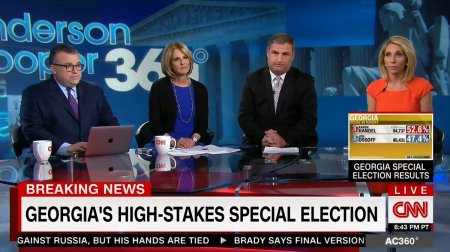
The lynch mob media (as Senator Cotton calls it) also heavily invested in the race — as one could see from the looks of the crew commenting last night on CNN. You didn’t even have to turn up the volume to figure out what was happening. How great is this?

Election Night Anchor Face™ is fast becoming one of my favorite things.

Until Ossoff lost, of course, this may have been the most important congressional race ever. It was to be an omen. It would be a portent. Now we’re back in the USSR. Mary Katharine Ham put it this way on Twitter last night:

Update: Formerly vitally important election with national implications that can’t be overstated now scheduled to be irrelevant by 10 am.

Washington Examiner politics editor Jim Antle let loose with a steady stream of punning tweets with musical themes last night. When Handel was declared the winner he observed that it would take a while before we knew which factor was Handel’s messiah.

Ossoff raised $23.5 million to Handel’s $4.5 million. Outside Republican campaign funds partially redressed the balance. The New York Times breaks down the numbers here.

PJ Media’s Tyler O’Neil considers the cash in an excellent post here. “Ossoff’s huge war chest might have hurt him. In the last two months, the Democrat reported receiving nine times more donations from California than from Georgia. In the nine counties of the San Francisco Bay Area alone, Ossoff reported receiving 3,063 donations, nearly four times the Georgia total of 808 gifts.”

From a distance, it seemed to me that Handel probably fit the district a bit better than Ossoff. For one thing, she actually lived there. Ossoff lived outside the district with his girlfriend. At one time he lived in the district. He could remember his old address there.

The Washington Free Beacon’s Brent Scher covered the race in the spirit of Andrew Breitbart. He documented his two-hour trek from Ossoff’s house to the Sixth District. He was rewarded for his efforts with his exclusion from an Ossoff campaign event on the night before the election.

In the end the California contributions may have boomeranged. Handel pounded on the Pelosi factor that an Ossoff victory would enhance. O’Neil notes: “Most of the Handel ads attacking Ossoff tied the Democrat to House Minority Leader Nancy Pelosi. It appears that that message worked.”

Naming Bin Salman Saudi heir impacts US, Israel

June 21, 2017

Naming Bin Salman Saudi heir impacts US, Israel, DEBKAfile, June 21, 2017

US President Trump is taking the lead role along with Prince Mohammed bin Salman of Saudi Arabia, Sheikh Mohammad bin Zayed Al Nahyan of the United Arab Emirates, another crown prince, Egypt’s President Abdul-Fatteh El-Sisi, and Israel’s Prime Minister Binyamin Netanyahu.

******************************

The Saudi king’s decision to elevate his son Prince Mohammed bin Salman, 31, to crown prince and heir to the throne, in place of his cousin Mohammed bin Nayef – as part of a broad reshuffle, is not merely the internal affair of the royal hierarchy, but a game-changing international event.

DEBKAfile’s analysts see it as the outcome of a global and regional process initiated by Donald Trump soon after he settled in the White House in January. With his appointment as de facto ruler of the oil kingdom, the Saudi king’s son is ready to step into his allotted place in a new US-Arab-Israeli alliance that will seek to dominate Middle East affairs. Israel will be accepted in a regional lineup for the first time alongside the strongest Sunni Arab nations who all share similar objectives, especially the aim to stop Iran.

Trump’s trip to Riyadh and Jerusalem in early May laid the cornerstone for the new US-Sunni Arab bloc versus Iran’s Shiite grouping and also cemented Israel’s co-option.

This bloc is in its infancy and has yet to display staying power and prove the wisdom of its policies. But its contours have taken shape. US President Trump is taking the lead role along with Prince Mohammed bin Salman of Saudi Arabia, Sheikh Mohammad bin Zayed Al Nahyan of the United Arab Emirates, another crown prince, Egypt’s President Abdul-Fatteh El-Sisi, and Israel’s Prime Minister Binyamin Netanyahu.

Three of those leaders already maintain strong direct – albeit discreet – ties with Israel’s prime minister, its security establishment, military and various intelligence agencies.

In a lecture on Tuesday, June 20, Israel’s chief of staff, Lt. Gen. Gady Eisenkott, spoke of the covert relations between the IDF and certain Arab nations, which he did not name. There is clearly a lot going on under the surface in various political, economic, financial, intelligence and military fields.

Recent events in the region already point to President Trump acting on important matters, such as the confrontation with Iran, the war on terror, the Syrian conflict and US intervention in the Yemen conflict, on the advice of the two Arab crown princes rather than Defense Secretary James Mattis and Secretary of State Rex Tillerson.

This was strikingly demonstrated when Trump overrode Tillerson’s recommendation to apply diplomacy for resolving the dispute that led to four Arab nations boycotting Qatar, with the Saudis in the lead, whereas the president then demanded strong action to stop Qatar’s funding of terrorists. He therefore opted for the aggressive Saudi and UAE stance against Qatar’s ruler, Sheikh Tamim bin Hamad Al Thani.

These developments bear strongly on US-Russian relations. The two crown princes maintain active ties with President Vladimir Putin. They could, of course, act as go-betweens for smoothing relations between the White House and the Kremlin. But, on the other hand, their influence could be counter-productive and goad Trump into engaging the Russians in a limited confrontation in Syria. It is hard to see Washington and Moscow coming to terms in Syria at this point when the former is closely allied to Saudi Arabia and the UAE and Moscow maintains its loyalty to Tehran.

The evolving bonds between the US, Saudi Arabia, the UAE, Egypt and Israel are the source of President Trump’s optimism about the prospects of pulling off an Israeli-Palestinian peace accord, a vision which eluded all his predecessors in the White House, while knocking over the decades-old barriers between the moderate Arab nations and the Jewish State.

The first steps towards this goal are in the making. They will include exposing parts of their hidden interaction to the light of day, as well as such important symbolic actions, as opening Arab skies to the passage of Israeli commercial flights, or direct telephone links.

None of this is expected to transpire overnight but rather over years, especially since there is opposition to the process still to overcome in the Arab world, including Saudi Arabia, and also in the United States. Critics lay into Mohammed bin Salman, who has made his mark as a visionary social and economic reformer at home, as too young, brash and impatient to rule the kingdom. His decision to entangle Saudi Arabia in the Yemen war, which many believe it cannot win, is held up as evidence of his reckless nature.

But the process switched on by Trump in Riyadh took a large stride forward on June 21, with the formalization by King Salman of his young son’s role as the top mover and shaker in the Saudi kingdom. King Salman obtained the support of 31 out of 34 members of Saudi Arabia’s Allegiance Council for confirming Prince Muhammad Bin Salman as crown prince as well as deputy prime minister and minister of defense.

Israel furious as UN set host ’50 years of Israeli occupation’ event

June 21, 2017

Minister Gilad Erdan appeals to UN Secretary-General Guterres to stop hostile conference scheduled to take place at the UN headquarters this month; writing to Guterres and telling him the groups participating are entirely dedicated to defaming and ‘delegitimizing Israel’ Erdan also reaches out to US Senator Marco Rubio, urging him to ‘continue to speak out against use of UN funds to promote the BDS campaign.’

Itamar Eichner|Published:  21.06.17 , 14:37

Source: Ynetnews News – Israel furious as UN set host ’50 years of Israeli occupation’ event

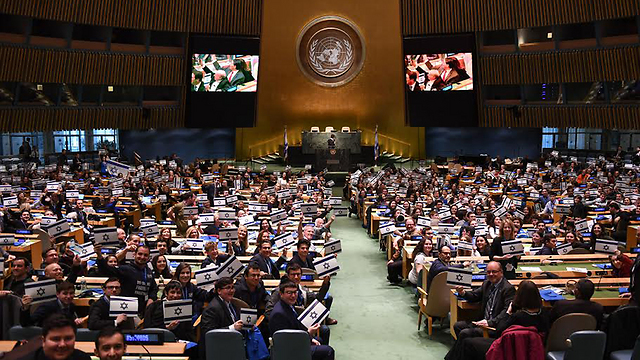
Anti-BDS conference at the UN (Photo: Shahar Azran)

Israel is gearing up to push back against a conference being hosted next week by the UN in the organization’s New York headquarters to mark what it describes as the “anniversary of the Israeli occupation.”

According to a report by the Ministry for Strategic Affairs, headed by Minister Gilad Erdan, several BDS and anti-Israel organizations will be taking part in the conference, which in the past has undertaken efforts to implement a series of hostile measures against Israeli officials.

These include, inter alia, issuing arrest warrants and prosecuting IDF officers and other officials for war crimes, openly calling for the boycotting of Israeli goods, promoting draft dodging in Israel and calling for Israelis to be tried in the International Criminal Court in The Hague for war crimes.

 The conference—titled “UN Forum to mark the 50th anniversary of the Israeli occupation”—is being organized by the UN Committee on Palestinian Rights, and will be held at the UN headquarters in New York from June 29-30.

Minister Erdan appealed to UN Secretary-General Antonio Guterres to prevent the conference from being held and to avoid UN funding for BDS events and UN entities whose sole purpose is to blacklist Israel.

“As Israel’s Minister of Strategic Affairs, responsible for leading Israel’s response to the international delegitimization and boycott (BDS) campaign against Israel, I write to you to protest in the strongest possible terms the use of UN funds and facilities to support an event aimed directly at promoting the delegitimization and boycott of Israel,” Erdan wrote to Guterres.

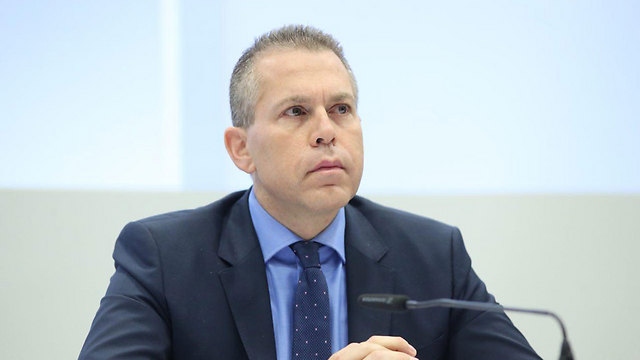
Gilad Erdan (Photo: Motti Kimchi) (Photo: Motti Kimchi)

Gilad Erdan (Photo: Motti Kimchi)

“Many of the organizations that will be given a platform by the UN at this event, including the American Friends Service Committee, Jewish Voice for Peace, Al-Haq, Al Mezan, Zochrot and others, are leaders of the anti-Israel BDS and legal warfare campaign,” he continued. “These organizations dedicate the majority of their energies to promoting economic, academic and cultural boycotts of Israel, attacking Israel in international legal and diplomatic forums, and delegitimizing Israel’s basic right to exist.

“Several have connections to designated terror groups while others publically glorify convicted terrorists.”

BDS protest

BDS protest

Erdan also sought to rally behind his cause the staunchly pro-Israel Republican senator Marco Rubio, whom he met earlier this month, discussing his fight against the efforts to delegitimize Israel and voicing his concern.

“I urge you to continue speaking out against the UN’s use of member states’ funds to promote the BDS campaign,” Erdan wrote after thanking Rubio for his “important initiatives for countering BDS,” as well as his “recent engagements with the UN Secretary-General” in his efforts to correct the “long-standing anti-Israel bias at the UN.”

In April, all 100 US senators signed a letter sent to Guterres urging him to act against discrimination against Israel in the United Nations.

(Translated & edited by Lior Mor)

King of Saudi Arabia overthrows heir to the throne

June 21, 2017

Saudi King Salman has ousted the heir to his throne, Prince Mohammed bin Nayef, and appointed his son Muhammad bin Salman as crown prince in his stead. The appointment was approved by the allegiance council with a majority of 31 votes out of 34.

Jun 21, 2017, 1:00PM Chelsea Mosery Birnbaum

Source: King of Saudi Arabia overthrows heir to the throne | JerusalemOnline

Saudi king ousts heir to the thrown Photo Credit: Reuters/ Channel 2 News

Saudi Arabia’s King Salman, 81, has named his son, Prince Mohammed bin Salman, first in line to the throne. The appointment was approved by Saudi Arabia’s allegiance council with a majority of 31 votes out of 34 members just after midnight on Wednesday.

Crown Prince Mohammed bin Salman will be replacing Prince Mohammed bin Nayef, the king’s nephew, who was in place to inherit the thrown and who has now been stripped of his influential position as interior minister.

Minister Tells Bloomberg Israeli-Saudi Back-Channel Relations to Become Official

June 21, 2017

Source: Minister Tells Bloomberg Israeli-Saudi Back-Channel Relations to Become OfficialThe Jewish Press | David Israel | 27 Sivan 5777 – June 21, 2017 | JewishPress.com

MK Ayoob Kara whispers in the ear of Prime Minister Benjamin Netanyahu at the Knesset, October 31, 2016.

On Tuesday night, Bloomberg reported the following:

“There’s a very good chance that we will soon have relations with what we call the Saudi coalition,” said Communications Minister Ayoob Kara, the Israeli cabinet’s only Arab member. “The Palestinian issue is No. 3 on the agenda today,” he said, behind security concerns about Iran and terrorism that Israel and Saudi Arabia have in common.

 There are very good reasons why this quote is questionable, not the least of which is that the Saudis and their Gulf neighbors don’t have to expose themselves to the scorn and wrath of a billion Arabs by recognizing the “Zionist entity” when they can get all the help and cooperation they need from said entity on the sly. And the “Palestinian issue” will never be demoted, at least officially, to third place, because it has to do with accepting the rule of an infidel over Haram land which used to be ruled by Muslims. It’s just not done.

Incidentally, there are two glaring errors in the Bloomberg paragraph above (had to get this off our chest): Ayoob Kara is not a cabinet minister, and he is not Arab. He is Druze (big difference in Israeli politics).

As to the actual message, namely that under the Iranian threat the Gulf States are willing to set aside their concerns about the Israeli-Palestinian issue, it could be more wishful thinking than thinking.

The Bloomberg story, Kushner Paves Way for Accelerated U.S. Push on Mideast Peace, suggests that the fact that President Trump this week sends two of his closest advisors, Jason Greenblatt and Jared Kushner, to the region, means that the White House is applying serious pressure on Prime Minister Netanyahu and Chairman Abbas into reviving their peace negotiations.

As Finance Minister Moshe Kahlon puts it in the Bloomberg story, Israel is feeling “mounting American pressure to advance a deal.” And Kahlon is a cabinet minister.

The same story says, “Saudi Arabia and its Gulf neighbors have indicated a willingness to upgrade unofficial ties with Israel, but veteran diplomats say that will depend on Israel’s willingness to withdraw from West Bank territory and commit to a Palestinian statehood, as spelled out in the 2002 Arab Peace Initiative.”

That’s generous. The actual plan, a.k.a. the “Saudi Initiative” (because it was originally floated by King Abdullah, who was still the crown prince of Saudi Arabia at the time), demands three fundamental concessions of Israel:

“Complete withdrawal from the occupied Arab territories, including the Syrian Golan Heights, to the 4 June 1967 line and the territories still occupied in southern Lebanon.

“Attain a just solution to the problem of Palestinian refugees to be agreed upon in accordance with the UN General Assembly Resolution No 194.

“Accept the establishment of an independent and sovereign Palestinian state on the Palestinian territories occupied since 4 June 1967 in the West Bank and Gaza Strip with East Jerusalem as its capital.”

In return for these three suicidal moves, the Arab states offered two pieces of paper:

“Consider the Arab–Israeli conflict over, sign a peace agreement with Israel, and achieve peace for all states in the region.

“Establish normal relations with Israel within the framework of this comprehensive peace.”

It’s interesting, by the way, that no one has inquired why the Arab states won’t reverse the process: first recognize Israel and consider the conflict finished, and then launch detailed negotiations over withdrawal, refugees, etc.

Dan Shapiro, Obama’s Ambassador to Israel, is one of the few voices that are cheering on the Kushner-Greenblatt visit this week. He is quoted by Bloomberg as suggesting that Kushner’s presence, after Trump has made the peace negotiations a centerpiece of his first foreign trip as president, “raises the stakes for everybody.”

Shapiro, who stayed in Israel after January 20 to join the Tel Aviv-based think tank Institute for National Security Studies, held a conference call with reporters on Monday, where he said, “It’s very difficult for any party in the region to say no” to Trump, unless “the [criminal] investigations drag on for a long period of time and there begin to be questions raised about the future of his administration, that will contribute to a lessening of his leverage.”

Which is probably why everybody, at this point, is reluctant to take serious steps toward reviving the negotiations: who knows whether Trump will survive his first year in office, never mind do it long enough for the ceremony in Stockholm where he would receive the Nobel Prize for Peace (a must these days for US presidents).

Also, as far as we’re concerned, Netanyahu should invite Minister Kara to join the cabinet – if only because he could translate those magnanimous Saudi offers from Arabic