Archive for June 22, 2017

US seeks to ‘milk’ terrorism sponsor Saudi Arabia – Iran’s Revolutionary Guard to RT

June 22, 2017

Source: US seeks to ‘milk’ terrorism sponsor Saudi Arabia – Iran’s Revolutionary Guard to RT — RT News

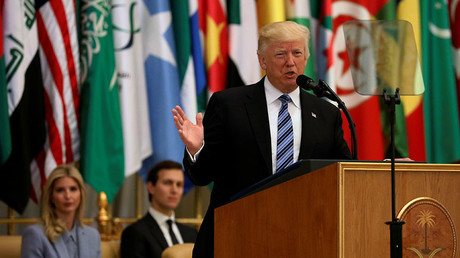
The inauguration of the Global Center for Combating Extremist Ideology in Riyadh on May 21, 2017 © Saudi Royal Palace / AFP

As the US influence in the Middle East wanes, it increasingly associates itself with dictatorships like Saudi Arabia, whose “dark face” and “role in supporting terrorism is known to everyone in the region,” a high ranking Iranian Revolutionary Guard official told RT.

The United States and President Trump in particular consider only one “dimension” of convergence with Saudi Arabia, ignoring the “ideological and intellectual” challenges and costs such ties entail, media adviser to the Islamic Revolutionary Guard Corps (IRGC), Commander-in-Chief Hamid Reza Moghadam Far told RT in an exclusive interview.

“That was one of Trump’s senseless moves. He was just seeking to milk this cow and thinking about only business,” Moghadam Far said.

Read more

© Parwiz Parwiz

“The first challenge is that Trump goes to such a country as his first trip after being elected… That is the behavior shown towards a dictatorial regime in which democracy is meaningless and no elections take place and the people have no presence on the scene. The next challenge is that they claim that they are combatting terrorism. It is no secret that Saudi Arabia has provided the most support for terrorism.”

The recent naming of Mohammed bin Salman as Saudi Arabia’s new crown prince might be another “outcome of Trump’s visit” amidst internal disputes among Saudi princes and with other Arab countries.

“This replacement is one of the internal political impacts of the [Trump’s] visit on Saudi Arabia. I mean the replacement of the crown prince. But Saudi Arabia is facing certain conditions today that I think the development would create further problems for the country,” Moghadam Far said, pointing out that this decision would hardly be beneficial for the Saudi people.

While the appointment might push Saudi Arabia into further radicalization, it would unlikely lead to an armed conflict with Iran, Moghadam Far believes, as the Saudi army is “not fit for military action.”

“There is no possibly of conflict. Today many Arab countries are complaining about Saudi Arabia’s inexperienced and radical moves. They consider Saudi Arabia as callow,” Moghadam Far told RT.

“A number of inexperienced people who are ruling Saudi Arabia lack the resolve and determination to initiate a war on Iran. They lack the courage and power. I do not think they will come up with such conclusion, even if all global powers support them.”

Saudi Arabia’s policies in the Middle East only bring instability to the region and its alliance with the US only diminishes the already dwindling American power and influence, Moghadam Far believes.

“[The US policies] definitely have a negative effect. What matters more, however, is that the US is not as influential a player as it used to be and it can no longer manipulate regional equations. Today, it does not enjoy such a sway at all and its influence in the region has waned,” Moghadam Far said.

“It now has to associate with countries like Saudi Arabia whose negative role in supporting terrorism, whose dictatorship, and whose dark face is known to everyone in the region.”

Read more

© Jonathan Ernst

Tehran’s recent Iranian missile attack on Islamic State (IS, formerly ISIS/ISIL) terrorists in Syria should have weakened the resolve of the Saudis and other powers to go to war with Iran. A key “message” of the attack was to clearly demonstrate Iranian military capabilities to those who doubted them, Moghadam Far said.

“In the past, when these missiles were test-fired in Iran, the US and certain western countries used to usually announce that Iran was lying that its launches had been successful and tried to create this impression that Iranians do not have such a capability and their missiles cannot strike their targets with precision,” he said.

The strike also demonstrated Iran’s resolve to fight terrorism, rubbishing usual US accusations that Tehran supports terrorist elements.

“As in the past, whenever Americans want to mount pressure on Iran, impose new sanctions and proceed with an issue in the region and beyond, [the US] accuse Iran of backing terrorism,” Moghadam Far said.

“But I think that today’s conditions are such that the world’s public opinion does not accept this. The world has come to realize that the US, despite leading a coalition against [IS] and terrorism in Syria and Iraq, Syria in particular, does not fight terrorism in practice and is in fact is supporting it… They cannot both take an opposite stance against terrorism and accuse Iran.”

The Ongoing Drama of Palestinian Lies

June 22, 2017

by Bassam Tawil
June 22, 2017 at 5:00 am

Source: The Ongoing Drama of Palestinian Lies


  • The current policy of the PA leadership is to avoid alienating the Trump administration by continuing to pretend that Abbas and his cronies are serious about achieving peace with Israel. This is why Abbas’s representatives are careful not to criticize Trump or his envoys.
  • When Israel does not comply with their list of demands, the Palestinians will accuse it of “destroying” the peace process. Worse still, the Palestinians will use this charge as an excuse to redouble their terror against Israelis. The Palestinian claim, as always, will be that they are being forced to resort to terrorism in light of the failure of yet another US-sponsored peace process.
  • No doubt, Abbas cannot find it within himself to clarify to the American envoys that he lacks a mandate from his people to make any step toward peace with Israel. Abbas knows, even if the American representatives do not, that any move in that direction would end his career, and very possibly his life. Abbas also does not wish to go down in Palestinian history as the treacherous leader who “sold out to the Jews.” Moreover, someone can come along later and say, quite correctly, that as Abbas has exceeded his legitimate term in office, any deal he makes is illegal and illegitimate.

US envoys Jason Greenblatt and Jared Kushner, who met this week in Jerusalem and Ramallah with Israeli and Palestinian Authority (PA) officials to discuss reviving the peace process, have discovered what previous US Middle East envoys learned in the past two decades — that the PA has not, cannot, and will not change.

During their meeting in Ramallah with PA President Mahmoud Abbas, the two US emissaries were told that the Palestinians will not accept anything less than an independent state along on the pre-1967 lines with East Jerusalem as its capital.

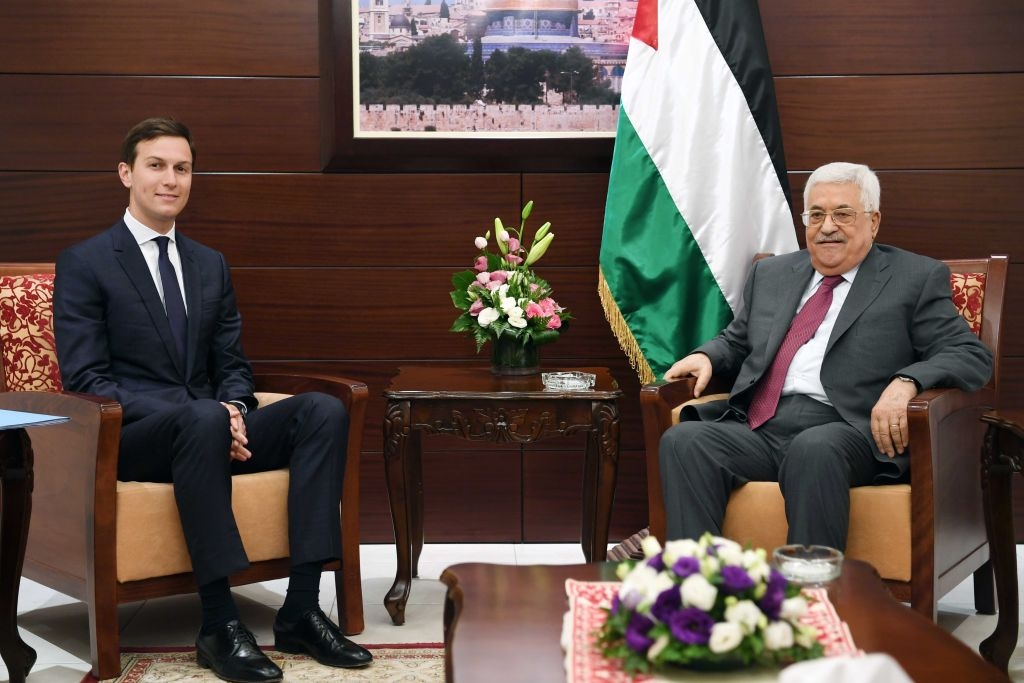
Jared Kushner (left), Senior Advisor to U.S. President Donald Trump, meets with Palestinian Authority President Mahmoud Abbas on June 21, 2017 in Ramallah. (Photo by Thaer Ghanaim/PPO via Getty Images)

Abbas also made it clear that he has no intention to make concessions on the “right of return” for Palestinian “refugees.” This means he wants a Palestinian state next to Israel while flooding Israel with millions of Palestinian “refugees” and turning it, too, into another Palestinian state.

At the meeting, Abbas also reiterated his demand that Israel release all Palestinian prisoners, including convicted murderers with Jewish blood on their hands, as part of any peace agreement. The release of terrorists in the past has only resulted in increased terrorism against Israel.

According to Abbas’s spokesperson, Nabil Abu Rudaineh, the PA president told Kushner and Greenblatt that a “just and comprehensive peace should be based on all United Nations resolutions (pertaining to the Israeli-Arab conflict) and the (2002) Arab Peace Initiative.” Translation: Israel must withdraw to the indefensible pre-1967 lines and allow armed Palestinian factions to sit on the hilltops overlooking Ben Gurion Airport and Tel Aviv.

Abbas’s position reflects accurately the policy of the PA leadership over the past two decades — a policy that has been regularly relayed to all previous US administrations, successive Israeli governments and the international community.

To his credit, Abbas has been nothing short of consistent. He has never, ever, displayed a willingness to offer any concessions to Israel. He misses no opportunity to reaffirm his demands to all world leaders and government officials, with whom he meets on a regular basis.

Nonetheless, some in the international community still believe that Abbas or any other Palestinian leader will be able to make concessions in return for peace with Israel.

Incredibly, Kushner and Greenblatt seem to believe that they can succeed where all others have failed.

The two inexperienced US envoys are laboring under the illusion that they will persuade Abbas and the PA leadership to drop demands such as the “right of return,” the release of imprisoned terrorists and a cessation of construction in settlements.

Why President Trump’s envoys are creating the dangerously misleading impression that peace is possible under the current PA leadership is nothing short of a mystery.

Creating such an impression is likely to boomerang with a vengeance; the higher the expectations, the greater the disappointment. Giving the Palestinians the feeling that the Trump administration holds a magic wand for solving the Israeli-Palestinian conflict will eventually increase Palestinian bitterness and hostility towards both the Americans and Israel. When the Palestinians wake up to the fact that the Trump administration will not strong-arm Israel to its knees, they will resume their rhetorical attacks against Washington, accusing it once again of being “biased” in favor of Israel.

This was precisely the fate of previous US administrations and presidents who disappointed the Palestinians by failing to impose dictates on Israel. The Palestinians are still dreaming of the day that the US or any other superpower would force Israel to comply with all their demands.

When Israel does not comply with their list of demands, the Palestinians will accuse it of “destroying” the peace process.

Worse still, the Palestinians will use this charge as an excuse to redouble their terror attacks against Israelis. The Palestinian claim, as always, will be that they are being forced to resort to terrorism in light of the failure of yet another US-sponsored peace process.

The Trump administration is making a colossal mistake in thinking that Abbas or any of his Palestinian Authority cronies can exhibit any flexibility whatsoever toward Israel, particularly concerning Jerusalem, settlements and the “right of return.”

No doubt, Abbas cannot find it within himself to clarify to the American envoys that he lacks a mandate from his people to make any step toward peace with Israel. Abbas knows, even if the American representatives do not, that any move in that direction would end his career, and very possibly his life.

Abbas also does not wish to go down in Palestinian history as the treacherous leader who “sold out to the Jews.”

Despite the best intentions of the US envoys and others in the international community, Abbas knows full well the fate of any Palestinian leader who even considers “collaboration” with the “Zionist entity.”

Abbas, whose term in office expired in 2009 and is seen as an illegitimate president by many Palestinians, is not even in a position to offer Israel any concessions for peace. First, someone can come along later and say, quite correctly, that as Abbas has exceeded his legitimate term in office, any deal he makes is illegal and illegitimate.

Abbas also cannot halt anti-Israel incitement; he cannot stop payments to convicted murderers and their families and he cannot accept Jewish sovereignty over the Western Wall in Jerusalem.

Even if some of his aides sometimes come out with statements suggesting that the PA leadership is prepared to consider some concessions on these issues, these remarks should not be taken seriously: they are only intended for Western audiences.

The PA’s declared position is that it has already made enough concessions by merely recognizing Israel’s right to exist and dropping Palestinian claims to “all of Palestine.” This position argues that it is Israel, and not the Palestinians, that needs to make concessions for peace.

“We have reached the red line with regards to making concessions [to Israel],” explained Ashraf al-Ajrami, a former PA cabinet minister. “We have already made a series of concessions on the core issues, while Israel has not presented us with anything.”

It might be recalled that this statement by the former PA official is a staggering lie, given the generous offers, gestures and concessions made by successive Israeli prime ministers and governments over the past two decades.

Again and again, all Israeli initiatives have been met with Palestinian rejectionism and stepped-up violence.

The offer made by Prime Minister Ehud Barak at Camp David in 2000 to withdraw from most of the territories Israel captured in 1967 was met with the Second Intifada.

The Israeli withdrawal from the Gaza Strip five years later was misinterpreted by Palestinians as a sign of weakness and retreat, and resulted in thousands of rockets and missiles being fired at Israel.

Another generous and unprecedented offer by Prime Minister Ehud Olmert fell on deaf ears.

The current policy of the Palestinian Authority leadership is to avoid alienating the Trump administration by continuing to pretend that Abbas and his cronies are serious about achieving peace with Israel. This is why Abbas’s representatives are careful not to criticize Trump or his envoys.

Abbas wants to deceive the Trump administration into believing that he has the courage, will and mandate to make peace with Israel, the same way he lied to previous Israeli prime ministers. This is the same Abbas who, for the past 10 years, has not been able to even go back to his private residence in the Gaza Strip, which remains under Hamas control.

But in private, some senior Palestinian officials have been criticizing the Trump administration for simply daring to make demands of the PA leadership, such as halting anti-Israel incitement and the payment of salaries to imprisoned terrorists and their families. In other words, what the Palestinian officials are saying is that either Trump accepts our demands or he can go to hell.

“The Americans have actually endorsed the Israeli position,” complained Hanna Amireh, a senior PLO official.

“The Palestinian leadership rejects the demand to stop financial aid to the prisoners and their families… Instead of setting preconditions for the Palestinians, the Americans must demand an end to Israeli settlement construction and incitement.”

In the twisted world of the Palestinian Authority leadership, Israeli demands for an end to the Palestinian glorification of murderers is itself an act of “incitement.”

How dare Israel demand that the PA leadership halt funds to imprisoned terrorists and their families? How dare Israel expose incitement and glorification of murderers and terrorists?

The PA leadership simply cannot fathom the problem with naming streets, public squares and youth and women’s centers after murderers of Jews.

It is only a matter of time before the PA leadership begins openly to accuse the Trump administration of being biased in favor of Israel. In the world of Abbas and his cronies, any US administration that does not swallow their lies and fabrications is a “hostile” party that is controlled by Jews and Zionists.

This is precisely what the Palestinians said about Trump and his team during the US presidential election campaign.

The PA leadership has indeed softened its tone against Trump and his advisors since they won the election. Yet this modified tone has one goal: for the PA to avoid accusations of being anti-peace.

In fact, the PA leadership has changed its tone, not its tune. We are witnessing a tactical and temporary move on the part of the Palestinians. This play-acting will end soon enough. The question remains, will the West notice that the curtain has gone down on the show?

Bassam Tawil is a Muslim based in the Middle East.

China Proposes Halt to U.S. Military Exercises in South Korea at Talks

June 22, 2017

China proposed a halt to U.S. military exercises with South Korea during high-level talks at the State Department on Wednesday.

BY:
June 22, 2017 5:00 am

Source: China Proposes Halt to U.S. Military Exercises in South Korea at Talks

US Secretary of Defense Jim Mattis is followed by US Secretary of State Rex Tillerson to conduct a two question press conference after meeting with Chinese State Councilor Yang Jiechi, and Chief of the People’s Liberation Army Joint Staff Department General Fang Fenghui / Getty Images

China proposed halting U.S. military exercises with South Korea as part of a nuclear deal with North Korea during high-level talks at the State Department on Wednesday, according to U.S. officials.

The Chinese raised what Beijing calls “dual suspension” of U.S.-South Korean war games and North Korean nuclear and long-range missile tests at the first meeting of the administration’s Diplomatic and Security Dialogue, said two officials.

The American side rejected the idea of canceling U.S. military exercises as a tactic tried in the past that was unsuccessful in convincing the North Koreans to give up their nuclear arms programs.

The talks came a day after President Trump cast a shadow over U.S.-China ties by suggesting China had failed to rein in North Korea, a fraternal communist state that maintains close military relations with Beijing.

“While I greatly appreciate the efforts of President Xi & China to help with North Korea, it has not worked out,” Trump tweeted. “At least I know China tried!”

In Beijing, Chinese Foreign Ministry spokesman Geng Shuang defended China’s efforts to resolve the North Korean nuclear and missile challenge. Geng asserted the problem in dealing with North Korea’s nuclear and missile threats does not “lie with the Chinese side,” he said.

“China has put up the dual track approach and the initiative of ‘suspension for suspension,’ as well as the proposal to strengthen the effort for both non-proliferation and promoting peace talks,” Geng said during a press briefing Wednesday.

Tensions between the United States and North Korea were heightened following the death on Monday of American college student Otto Warmbier, who was imprisoned in North Korea during a visit, and later released in a coma suffering brain damage.

Secretary of State Rex Tillerson and Defense Secretary Jim Mattis, who led the U.S. side to the talks, were not asked about the Chinese dual suspension proposal during a press briefing after the talks.

Both officials provided a general outline of the talks that were led on the Chinese side by State Counselor Yang Jiechi and Gen. Fang Fenghui, chief of general staff of the People’s Liberation Army (PLA).

In addition to North Korea, the two sides discussed China’s militarization of disputed islands in the South China Sea, international terrorism, and U.S. concerns about Chinese human rights abuses.

“The most acute threat in the region today is posed by the DPRK,” Tillerson said, using the acronym for North Korea.

“We both call for complete, verifiable, and irreversible denuclearization of the Korean Peninsula, and we call on the DPRK to halt its illegal nuclear weapons program and its ballistic missile test as stipulated in the U.N. Security Council resolutions.”

Tillerson said the Chinese agreed that U.S. and Chinese companies “should not do business” with North Korean companies linked to missile and nuclear programs.

“We reiterated to China that they have a diplomatic responsibility to exert much greater economic and diplomatic pressure on the regime if they want to prevent further escalation in the region,” Tillerson told reporters.

Mattis said the talks were a chance to hold “philosophical-level discussions” aimed at producing “a constructive and a results-oriented relationship with China.”

Mattis said he is committed to improving U.S.-China defense ties aimed at reducing the risk of conflict, and keeping open communications channels.

“At the same time, we do manage our differences where we have them, and while competition between our nations is bound to occur, conflict is not inevitable,” he said.

Mattis indicated the death of the American student had hardened U.S. policy toward North Korea.

Asked if Trump is extremely angry at North Korea and that China has failed to help, Mattis said president was reflecting “the American people’s view of North Korea right now.”

“We see a young man go over there healthy and with a minor act of mischief, come home dead basically, die shortly, immediately after he gets here,” Mattis said.

“There’s no way that we can look at a situation like this with any kind of understanding,” he added. “This goes beyond any kind of understanding of law and order, of humanity, of responsibility towards any human being.”

On South China Sea, Mattis said the dialogue as helped identify areas of common interest with China while dealing with what he called “disconnects, where our understanding of the problem is very different from theirs.”

Two of the key players who helped organize the talks, Pentagon policymaker David Helvey and Acting Assistant Secretary of State for East Asia Susan Thornton are both holdovers from the Obama administration. Both did not return emails seeking comment.

Halting U.S. military exercises with South Korea as part of a North Korea deal likely would be opposed by the U.S. military commander there, Army Gen. Vincent Brooks.

The U.S. military maintains around 23,000 troops in South Korea and holds two large-scale annual exercises, Foal Eagle and Ulchi Focus. U.S. Forces Korea spokesmen have said the exercises are needed for both nations’ forces to be ready for a conflict with North Korea on short notice.

North Korea routinely denounces the exercises as preparations for war.

“What it takes to go from the condition we’re in at this moment to hostilities again is literally the matter of a decision on North Korea’s side to say ‘fire,'” Brooks told CBS’ “60 Minutes.”

The Chinese dual suspension proposal was first raised in March by Foreign Minister Wang Yi, and again by People’s Liberation Army officers at the Shangri La security talks in Singapore earlier this month that were attended by Mattis.

Critics of the proposal say it is part of an effort by China to make it appear Beijing is a neutral third party in the North Korea dispute. Despite reported differences, China remains one of North Korea’s most significant military, economic, and political partners.

Former State Department official John Tkacik, a China affairs specialist, said the dual suspension proposal is a Chinese ruse.

“Double suspension is a clever Chinese negotiating proposal to stop U.S.-South Korean military cooperation that China believes undermines their own strategic leverage over South Korea, while not giving up anything in return,” Tkacik said.

“North Korea would abide by it only until it has another nuclear device or missile delivery system to test, and then it will test, deal or no deal. Then what?”

Tkacik, the former State Department official, said it remains to be seen if Trump will be able to use his negotiating prowess to reach a deal with China on North Korea.

Tkacik said Trump should counter China’s dual suspension ploy by threatening to re-introduce American nuclear weapons to South Korea.

“The U.S. removed nuclear weapons from the Korean Peninsula in 1991 to convince North Korea not to move forward with its nuclear weapons programs,” he said. “If President Reagan were alive today, he would send those weapons back to the region, and offer to negotiate a ‘mutual, permanent, verifiable, and irreversible denuclearization’ from a position of strength.”

Retired Navy Capt. Jim Fanell, a former Pacific Fleet intelligence chief, said the Chinese suspension proposal should be rejected.

American officials should “remind their Chinese counterparts there is no moral equivalence between U.S.-Republic of Korea military exercises, and North Korea’s provocative and dangerous nuclear weapon development and robust ballistic missile testing,” Fanell said.

“Any compromise on this strategic position will simply support Beijing’s strategic goal of driving the United States military off the Korean Peninsula,” he added. “Not only will this endanger our allies in South Korea and Japan, but will also not solve the threat of North Korea being able to launch a nuclear tipped ballistic missile at the United States.”

Trump signaled to Chinese leader Xi Jinping during the summit meeting in Florida in April that unless China does more to rein in North Korea, the United States would be prepared to take unilateral action.

During the Mar-a-Lago summit, Trump ordered the firing of 39 Tomahawk cruise missiles from a destroyer in the Mediterranean Sea against a Syrian airfield—a subtle message to the Chinese leader.

Thornton, the acting assistant secretary of state, told reporters recently that “China is still a leading, kind of facilitator for North Koreans’ economic activity.”

“And so we think that it’s very important that China do more to implement U.N. Security Council resolutions,” she said.

An editorial in the Party-affiliated Global Times newspaper called Trump’s criticism of China a “trap.”

“The U.S. always blames China for not doing enough when Washington is at a loss over the North Korean nuclear issue,” the newspaper said.

“The conflicting parties on the Korean Peninsula are North Korea and the U.S.-South Korea alliance. China’s forces have long withdrawn from the peninsula. It is absurd to expect China to solve the longstanding contradiction between the two sides.”

“The argument that China must be responsible for Pyongyang’s nuclear and missile activity is a trap for the Sino-US relationship,” the editorial said. “We hope Trump and his team are wise enough to avoid this trap.”


Israel has ‘unimaginable’ power to strike Hezbollah, Air Force chief tells security conference

June 22, 2017

Source: Israel has ‘unimaginable’ power to strike Hezbollah, Air Force chief tells security conference — RT News

© Pichi Chuang / Reuters

Israel has significantly increased its air superiority in the last decade following Israeli–Lebanese conflict of 2006, its Air Force chief has stated, warning Hezbollah and its allies of dire consequences should another war break out in the future.

“What the air force was able to do quantitatively in the Lebanon war over the course of 34 days we can do today in 48-60 hours,” Israel Air Force Commander Major-General Amir Eshel boasted at the 17th annual Herzliya security conference.

“This is potential power unimaginable in its scope, much different to what we have seen in the past and far greater than people estimate,” the air force chief said on the second day of the security conference, as quoted by the Times of Israel.

Eshel claims that Israel can now strike Hezbollah “with four to five times” the bombing power it deployed during the last conflict over a decade ago.

Tel Aviv last fought a war with Hezbollah, which Tel Aviv views as a terrorist organization that is closely aligned with Iran, in 2006. That conflict included rocket strikes inside Israel and an Israeli air and ground offensive in Lebanon. Israeli leaders have stated that since then, the Lebanon-based Hezbollah has built up and improved the range of its rockets which can now strike deeper inside the Jewish state.

Read more

Flames rising in the distance which are believed to be coming from Damascus International Airport following an explosion early in the morning of April 27, 2017. ©
Sameer Al-Doumy / AFP

“We are investing a lot in ensuring that in any future state of conflict we have full air superiority a lot faster than in the past, taking into account the capabilities of our foes in Lebanon,” Eshel noted, as quoted by the Jewish Press.

While the exact number of casualties from the 2006 conflict is still unknown, it is estimated that Lebanon suffered at least 1,200 deaths, mostly civilians, from the Israeli military campaign. Should the next war break out, Israel hopes to reduce “collateral damage.”

“We are doing whatever possible to reduce any collateral damage to civilians in any war, and we aspire towards zero civilian casualties,” Israel’s Air Force Chief said. “But I cannot delude myself, in every war there will always be people who are harmed inadvertently.

Eshel warned Lebanese civilians to flee their homes “as soon as the conflict erupts” to avoid being killed or wounded alongside Hezbollah militants who might be living or hiding among them.

Also taking the stage at the security conference, former Israeli deputy defense minister Ehpraim Sneh, suggested that the IDF should first strike Hezbollah’s supporter Iran, should the next war erupt.

“Iran does not give a damn if Lebanon’s infrastructure is destroyed,” Sneh said as reported by the Jerusalem Post. “If Hezbollah fires at Israel… [Tel Aviv] should strike Iran’s infrastructure.”

Speaking at the same conference Tuesday, the Israeli Chief of General Staff, noted that Hezbollah remains Israel’s main threat as it continues to receive $800 million worth of military aid from Iran annually.

“We know Hezbollah’s deployment very well, it is deployed in 240 towns, and almost every house contains 3-4 Hezbollah fighters,” said Lt. Gen. Gadi Eisenkot, Israeli Defense News quoted.

Eisenkot noted that the organization operates “thousands of underground sites” and “tens of thousands of rockets,” which are a direct threat to Israel.

The Chief of General Staff accused Iran of aiding Hezbollah and destabilizing the entire region.

“There is an Iranian desire to create a Shiite storm from Iran to Iraq, Syria and Lebanon,” Eisenkot said.

“Today there are terrorist organizations with state capabilities. This is happening because of the disintegration of countries and the fall of weapons to organizations, and because of countries like Iran that supply terrorist organizations,” the chief of staff said, adding that Israel would do what is necessary to stop the passage of these weapons into Lebanon.

Israel has repeatedly been accused – but rarely admitted – of carrying out a number of strikes in Syria since 2011 targeting Hezbollah arms convoys.

In mid-March, Israel confirmed that its jets conducted airstrikes near Palmyra, allegedly destroying “advanced arms” destined for Hezbollah. In response, Syria’s air defense forces fired anti-aircraft missiles at the planes as they were returning from their mission.

Liberman: Abbas Is Dragging Us into War with Gaza

June 22, 2017

Source: Liberman: Abbas Is Dragging Us into War with GazaThe Jewish Press | David Israel | 28 Sivan 5777 – June 22, 2017 | JewishPress.com

Defense Minister Avigdor Librman addressing the 17th Herzliyah Conference at the Institute for Policy and Strategy at the IDC Herzliya.Photo Credit: Hagai Frid Courtesy IDC Herzliya

Defense Minister Avigdor Librman on Thursday addressed the electricity crisis in Gaza, saying, “The electricity crisis is an internal Palestinian crisis which we need not forcibly enter – Mahmoud Abbas did not do this step as a one-time measure, his intent to continue in the future to cut the monies for fuel and medicines make sense. In my opinion this is a duel strategy – to attack Hamas and also to drag Hamas into a conflict with Israel, otherwise it is not clear to me why he didn’t coordinate this with us or with the Egyptians. I conclude that he said he would try to subdue Hamas, but in fact he is trying to drag us into a conflict with the Gaza Strip.”

Liberman addressed the 17th Herzliyah Conference at the Institute for Policy and Strategy at the IDC Herzliya. According to him, “From the moment I took on the position of Defense Minister, I am following a clear strategy, but I can’t speak about a strategy for Gaza , even in the Cabinet, because after one minute I’ll see all of this in the media.”

 Regarding the situation in Syria, Liberman said: “Unfortunately what is happening today in Syria is that Hezbollah is exploiting the situation to smuggle advance weapons systems from Syria to Hezbollah in Lebanon and to fortify its presence in southern Lebanon on the Israeli border. I warned the Syrian regime that it was encouraging Hezbollah and the Iranians to use Syrian soil as a base and that it will be held accountable for these developments. We are a country with responsible leadership. At the moment there are intense negotiations between the US and Russia on the buffer zone, I hope that they will reach an arrangement. This however wouldn’t prevent us from freedom of activity to defend Israeli interests.”

About the Palestinian issue he said that “there shouldn’t be illusions, even when we get to the end of the conflict, the problems won’t be solved, but to the contrary. We won’t agree to even a single refugee returning to the 1967 borders. The priorities need to be changed. Before a political arrangement with the Palestinians, the single matter that is possible is a regional arrangement, not one under the table, but on the table. I’ve seen interesting research which this type of arrangement will increase Israel’s annual revenue but 45 billion dollars. The reason that we haven’t got into a regional arrangement until now is because since 1967 we haven’t won a clear-cut victory. In this regard, “We left the Gaza Strip and we said that if terrorism would emanate from there we would obliterate them; there were more than few promises including mine, which weren’t backed up.”

On the issue of Israeli Arabs he said, “I meet more than a few Arab citizens of Israel and they are very loyal and logical. They’ve internalized that for them there’s no place better than the State of Israel. Today I see immigration from Arab countries and the one place that they don’t want to leave is the State of Israel. There is no place on earth which they receive such freedom of religion and expression, despite our and their self-criticism which is justified. There is no better place for them despite all of that. I propose that we are not captives to facts: when the Joint List Party refuses to sign a ‘surplus vote sharing agreement’ with Meretz because it’s a Zionist party, that speaks for itself. When Ayman Odeh doesn’t go to the funeral of Shimon Peres, but goes to a memorial for Yasser Arafat in Ramallah, that speaks for itself. When the entire Joint List Party condemns the Arab League for relisting Hezbollah as a terrorist organization that speaks for itself.”

Is Saudi Arabia’s Youthful New ‘King In Waiting’ Good For Israel?

June 22, 2017

Is Saudi Arabia’s Youthful New ‘King In Waiting’ Good For Israel? ForwardAri Feldman, June 21, 2017

(Please see also, Naming Bin Salman Saudi heir impacts US, Israel. — DM)

Crown Prince Mohammed bin Salman, who was recently given the title by his father, the current king of Saudi Arabia, is being lauded in some corners as an ‘ally of Israel.’

Though only 31 years old, bin Salman was put next in line for the throne at a time when the kingdom is consolidating its power in the region.

In May, Bin Salman reportedly called Israel “the sole lighthouse of democracy and freedom in one of the more troubled areas of the world,” and called on Arabs to embrace Israel.

Bin Salman has reportedly met with Israeli officials to begin economic negotiations. Preliminary agreements are said to include allowing Israeli business to operate in Saudi Arabia and permitting El Al planes to fly in Saudi airspace.

The crown prince also reportedly hopes to work with Israel and the U.S. on limiting Russia’s influence in the region, stopping ISIS, and clamping down on Iran.