Archive for June 21, 2017

The Consequences of an Independent Kurdistan

June 21, 2017

By – on June 21, 2017

Source: The Consequences of an Independent Kurdistan – Geller Report

Part I here: An Independent Kurdistan?

Iraqi Kurdistan is closer to independence than ever before. Its next step is to hold, despite the opposition of Baghdad, a referendum on independence in the Kurdish areas. The Peshmerga are now battle-hardened and well-supplied with American weaponry. The American military has taken notice. When asked by a member of the Senate Armed Services Committee on May 23 about the Kurdish Regional Government’s (KRG) intention to move forward with a referendum on independence after ISIS falls in Iraq, Marine Lt. Gen. Vincent Stewart, the chief of the Pentagon’s intelligence arm, responded: “Kurdish independence is on a trajectory where it is probably not if, but when.”

A Kurdish state in what is now northern Iraq will have tremendous consequences.

First, it will increase the restiveness, the sense of new possibilities, among the Kurds in Syria, Iran, and Turkey, with some now agitating for incorporation of their lands into an enlarged Kurdish state. What seemed impossible just a few years ago will now be a reality. And if the Kurds in any of those three countries rise in rebellion, it will be hard to suppress them. An independent Kurdish state can offer both experienced soldiers, and American-supplied weaponry, that was not available to the Kurds before. For the Kurds it makes the most sense to begin their revolt in Syria, for six years of civil war have greatly weakened the Syrian military, while the Kurds in Rojava have been recognized by the American military as the most effective fighting force against the Islamic State in Syria.

Second, the example of a Kurdish state will not be lost on the Berbers who, like the Kurds, are spread over several countries and, like the Kurds, have suffered from Arab supremacism. Those Berbers who have increasingly been thinking of independence, in re-asserting their Amazighité  or Berberness, and previously assumed it could only be a pipe dream, now have the example of an independent Kurdistan to embolden them. That means they will no longer be satisfied with official recognition being given to their language. They want more: they want recognition and celebration of the Berber culture, not the disparagement  and begrudging recognition it has received from the Arabs. Many of the Berbers who now live in France — there are more Berbers than North African Arabs in France, and the Berbers are much more open to such groups of freethinkers as Riposte Laique (“The Laic Response”), which warns against the power and spread of Islam. Berbers are much more likely, both in France and in Algeria, to become apostates, or even to convert to Christianity.

The Berbers have sensed the connection between islamization and arabization, and in rejecting the latter, have started questioning the former. Should a Berber state be attempted, the Arabs will do what they can to suppress it. It won’t be easy for them. The Berbers are quite numerous; 45% of Moroccans speak Berber as their first language, and estimates of the total Berber population in Morocco, including those Berbers who speak Arabic, run as high as 70% of the total. In Algeria 25% of the population speaks Berber, but there are many Berbers who speak Arabic. The total Berber population is somewhere between 30% and 40% of the total. No one knows, for sure, and it is certainly not the kind of figure the Arab government, even if it collected such information, which is doubtful, would make public. It counts as Arabs all those who speak Arabic as their first language, even if by ethnicity, by culture, by sense of identity, they are Berber. The Berbers in North Africa will have the support of Berbers in France, for an independent Berber state. Some Berbers have discussed  a state where Western-style freedom of religion would be protected, including the right of apostasy by Muslims, both Berber and Arab.

The French government might recognize, if it has well-prepared leaders, that the Berbers, both in France and in North Africa, are less in thrall to Islam than the Arabs, and a religiously liberal Berber state could have a salutary effect on its Arab neighbors, as an example of real enlightenment and true Islamic moderation, much needed in the current climate.

The third consequence of an independent Kurdistan, after the example it will offer both other Kurds (to join that state) and Berbers (to emulate it), is the conceivable widening of the fissure between Arab and non-Arab Muslims all over the globe. 80% of the world’s Muslims are not Arabs. As they watch the Arab attempt to suppress the Kurds, and then to suppress the awakened Berbers, they will begin to see that there is merit in the claim, a claim that should be continually repeated by statesmen and scholars in the West, that “Islam is a vehicle for Arab supremacism.” It’s something that needs to be pointed out by us to them, that is to the very people who, as non-Arab Muslims,  have suffered the most from Arab supremacism, but once they have recognized the truth of the observation, it will be impossible for them to forget it. They know they are supposed to read, recite, and memorize the Qur’an in Arabic, face Mecca five times a day in Arabic-language prayer, copy the habits and ways  of seventh-century Arabs, that is of Muhammad and his Companions, if converts to adopt Arabic names, to make the hajj to Mecca, in Arabia, at least once in one’s life, and finally, they learn to treat their own lands’ pre-Islamic histories as things of little worth, from the time of ignorance, or Jahiliyya. Those are some of the ways that Islam reinforces the Arab sense of superiority.

The Kurdistan spectacle, of a non-Arab Muslim people throwing off the Arab yoke, with the Arabs trying to re-impose it, should help awaken other non-Arab Muslims as to how they have suffered from Arab Muslims (far more than they ever have from the hated Infidels) and is more likely to increase their resentment both of Arabs and of Islam itself as that “vehicle of Arab supremacism” — a phrase one should be prepared to use on every conceivable occasion, so that it enters into the collective consciousness of Muslims and Infidels alike. That’s what the Kurds can help bring about, by holding that referendum this September, and voting for independence, and at long last attaining, despite the Arabs’ best efforts to prevent it, that independent state that they were promised long ago. An unintended consequence, devoutly to be wished.

An Independent Kurdistan?

June 21, 2017

By – on June 20, 2017

Source: An Independent Kurdistan? – Geller Report

The Kurds in Northern Iraq are holding a referendum on independence on September 25. This could be a momentous event, and not just for Iraq. For the Kurds in Iraq, as their Senior Adviser Hoshyar Zebari has said, “there is no going back.” After all, they can rightly claim that they are the largest ethnicity in the world — some 40 million of them — without a state. And they suffered terribly under Arab rule, and especially during the regime of Saddam Hussein, whose Arab soldiers killed 182,000 Kurds in Operation Anfal. The Kurds have taken note that neither during this murderous campaign, nor after, did a single Arab ruler, diplomat, or intellectual, ever denounce the killing of the Kurds, with the sole exception of the Iraqi writer Kanan Makiya. Nor did any Arabs, inside or outside Iraq, object to Saddam’s moving tens of thousands of Arabs into the Kurdish areas, in order to “arabize” them. The Arabs in Baghdad, Shi’a and Sunni, disagree on most things, but not on their shared opposition to the independence of Kurdistan. They think of Iraq as an Arab state, with the Kurds — who of course were living in Kurdistan long  before the Arabs arrived, bearing Islam, some 1400 years ago — there not as of right but on Arab sufferance.

And now the news comes that Syria, whose government disagrees with that in Baghdad in almost everything, does however shares its opposition to the referendum on Kurdish independence. For the Arabs, in Syria as in Iraq, think of Iraq (as they also think of Syria), as belonging only to them, the Arabs, who brought the great gift of Islam, with  the Qur’an written in the Arabic language, and with the Seal of the Prophets, Muhammad, himself a seventh-century Arab. The Kurds have long realized that for the Arabs, Arab Muslims are superior to all the others. It was the acute scholar Anwar Shaikh who claimed that although Islam offers itself as a universal religion, it privileges the Arabs for whom, as he put it, Islam is the “Arab national religion.”

Why is that so? First, a Muslim must ideally read, recite, and memorize the Qur’an in Arabic. Five times a day he prostrates himself in prayer, his body turned toward Mecca, in Arabia. The Prophet Muhammad, who is for Muslims the Perfect Man (al-insan al-kamil) and the Model of Conduct (uswa hasana), was an Arab. He should, at least once in his life, go on pilgrimage to the Arab city of Meccal. The habits, deeds, sayings, and even approving silences, of the Prophet Muhammad, as set down in the hadith, constitute the Sunna, which is, aside from the Qur’an, the other great Islamic text and guide. Converts to Islam routinely take Arab names. Non-Arab Muslims are often eager to  assume Arab identities — as, for example, all those Pakistanis who call themselves Sayyids, endowing themselves with a false lineage as descendants of the tribe of Muhammad. Just as the Arab identity reinforces the hold of Islam, so Islam reinforces the Arab consciousness of their own superiority.

The Arab people now possess  22 states, more than any other people in the world, but that does not make them willing to grant non-Arab Muslims within their countries any significant degree of autonomy, much less independence. The Kurds are not the only non-Arab Muslims who have been treated roughly by the Arabs. In North Africa, there are between 25 and 30 million Berbers, mainly in Algeria and Morocco. They were the original inhabitants of North Africa, which they settled long before the Arab invaders arrived; the Berbers claim they have been in the region for 3000 years. St. Augustine, had a Berber mother, Monica. Tertullian, who has been called “the founder of Latin Christianity,” was a Berber from Carthage.

The Berbers have long been subject to discrimination by the dominant Arabs, and attempts have been made to “arabize” the Berbers, beginning with the effort to suppress Tamazight, the Berber language, and to efface Berber culture. The Arabs have attempted to forbid its use in schools and government, but the Berbers have fought back. In Morocco, the Berber unrest finally led the Moroccan king to recognize Tamazight as a national language in 2011. In Algeria the Arabs, who have been in power ever since independence in 1962 (they are known collectively as “Le Pouvoir”) tried to suppress the use of Tamazight, as well as other aspects of Berber culture, but this led to violent riots in the Kabyle region, especially in the unofficial Berber capital of Tizi Ouzou, in 2001 and 2002. The ethnic unrest continued intermittently, but finally, in 2016, the Berbers in Algeria managed to win recognition of Tamazight as an official language. This may have bought a temporary truce, but the Berbers now have tasted victory in both Morocco (where they claim to be 70% of the population, by including those Berbers who now use Arabic) and in Algeria (where they claim to be 30-40% of the population, again including Berbers who use Arabic), and this does not mean they will remain quiet. More likely, as the Berbers observe the Iraqi Kurds, and see them at long last obtaining an independent state, this will whet their appetites for an independent state of their own, perhaps one running from the Atlas Mountains of northern Morocco to the Kabylie region of Algeria. Should the Kurds fail, of course, the reverse is also true: it will dishearten the Berbers, who may then give up the dream of an independent Berber state.

The Syrian government has just announced that it looks with deep disfavor on the referendum announced by the Iraqi Kurds for next September: “We, as representatives of our nation’s will, and Arabs, do not support this type of initiative. It is true that election and referendum is a healthy situation for all the nations in the world, but it should be aimed to achieve a loyal purpose, not to reduce the capacity of Iraqi government,” Riyaz Taus, a member of the Syrian parliament’s foreign affairs committee, told Rudaw. Independence for the Kurds, according to Taus, is not a “loyal purpose.”

“Damascus’s policy towards this subject is stable regarding Arab countries; it always seeks unity for Arab countries. As a Syrian national matter, it is something already decided which is not separating any region from its motherland,” Taus added.

“This is an unchangeable and steady policy for Syria because not any areas will be separated from the main government, and seeks unity for Arab nations not dividing and weakening them which serves universal Zionism and imperialism.”

Of course: any attempt by non-Arab Muslims to achieve  independence must be opposed, because it would only — here comes the parroting of the absurd Muslim Arab party line –“serve universal Zionism and imperialism.” Actually, non-Arab Muslims must be suppressed in Arab-ruled lands for quite a different reason:  not being Arabs, they don’t deserve a state carved out of lands the Arabs now control. For the Arabs, it is their fellow  Arabs who always come first. And it is the Arabs who treat with contumely, and worse, the non-Arabs over whom they rule.

In Syria, the performance of the Kurdish troops, who have been the best fighters against the Islamic State, has emboldened them to declare a kind of local autonomy in Rojava, where almost all of the 2.2 million Syrian Kurds live. The war-weakened Syrian central government has been in no position to deny that autonomy (there are reports, too, that Assad’s most important ally, the Russian government, supports Kurdish autonomy, which if true would necessarily weaken Syrian opposition to it). If the Kurdish-led forces finally retake Raqqa from the Islamic State, that will give the Kurds another victory, and they will certainly feel that the Syrian government owes them something, which means more than a modicum of autonomy in Rojava. The Syrian government will be forced by circumstances (Kurdish strength, Syrian Arab weakness after six years of civil war) to recognize aa new reality.  How the Kurds in Rojava  would react to news of a fully independent Kurdish state in northern Iraq, is one more great worry for the government in Damascus,  but there is not much they can do to head off a similar movement among the Kurds in Syria.

Abdulqadir Azuz, presidency consultant to the Syrian Council of Ministers, told Rudaw (the official Kurdish news site) that “Analysts have speculated that despite the leadership of the Democratic Union Party (PYD) in Syria and some major political parties in the Kurdistan Region not being on the best of terms, regional powers would oppose Kurdish aspirations for independence, fearing a ripple effect.

“Azuz continued: “Of course, any step to change Iraq from a federal government to a special independent country for its components, particularly the Kurdistan Region, will not receive recognition from Syrian government unless there is an agreement mainly by Iraqi nation according to articles in the constitution…Thus, any step towards it will be considered as a unilateral step, the Syrian government will not agree to divide Iraq unless there is an agreement with Iraqi people.”

“Azuz says Kurds have a right to self-determination but it should be within the framework of Iraq’s constitution and not a political step.”

This says the opposite of what Azuz means, for  the Syrian Arabs do not support the Iraqi Kurds’ “right to self-determination.” If they must first obtain the agreement of the Sunni and Shi’a Arabs who constitute more than 85% of Iraq’s population, they will never A. And that agreement will forever be withheld, as Abdulqadir Azuz knows perfectly well. Furthermore, he insists that the referendum to be held only in Kurdistan is invalid on its face, for it’s a vote in only one region, and among one people. The entire “Iraqi people” have to vote on independence for the Kurds or any other group.

It’s clear that the Syrian Arab people do not want the Kurds in Iraq to achieve independence, because, not being Arabs, they don’t deserve it. And there is also the real fear of the effect on the Kurds in Rojava. Here you can enjoy the spectacle of hypocrisy on stilts, by this who insist so strongly on “independence” for the “Palestinian” Arab people, that is clamor for a 23rd Arab state, do not sense there is anything wrong in Arabs  denying to a real people, the Kurds, even just one state for their political expression.

The West ought to focus right now on helping the Kurds in Iraq achieve independence, in offering them economic and diplomatic support, even if the government in Baghdad protests. What can Baghdad do — invade Kurdistan? With the Americans possibly providing air cover as they once did over Kurdistan,, and the battle-hardened Kurdish militia, who have outperformed every other group on the ground fighting the Islamic State, ready to fight even more fiercely, with memories of the mass murdering Arabs of Saddam, for what would now be their own country, Kurdistan can’t be won back.

If Western countries were to recognize the need to weaken the Camp of Islam, they would  see both how just and how useful it would be to support  the Kurds. An independent Kurdistan in what was northern Iraq would encourage the Kurds in Syria, Iran, and Turkey to join this Iraqi state, which would cause political pandemonium in three important Muslim states, as they attempt to hold onto those parts of their own countries where Kurds are a majority. In Turkey, for decades now, a low-level Kurdish rebellion has taken a steady toll. If the Turkish Kurds were emboldened to try not just for autonomy but for independence that would allow for an enlargement of the newly-created free Kurdistan, that would raise the conflict to a whole new level. But Erdogan, who has de-kemalised Turkey, is no friend of the West, but a despot intent on re-islamising a once-secular Turkey. Yet we continue to treatTurkey as if were still the way it was a half-century ago, not as it is today.

Under Erdogan, Turkey is no longer a reliable ally, and one wonders why it is allowed to continue to be a member of NATO. We need not worry if Turkish Kurds keep the Turks tied down or, better still, manage to successfully join the newly-independent Kurdish state in what was once northern Iraq. Nor do we wish the despotic regimes in Syria and Iran well, even if, for the moment, we share the need to wipe out the Islamic State.  And  if forced to deal with a domestic Kurdish revolt for independence, all three states — Syria, Turkey and Iran —  would find that any attempt by them to suppress the Kurds would entail a considerable expenditure of men, money, materiel, and– not to be overlooked —  morale. For the world’s Infidels, that’s not a bad outcome.

Obama DHS Secretary: We Offered to Help The DNC Combat Russian Hacking, They Declined

June 21, 2017

Obama DHS Secretary: We Offered to Help The DNC Combat Russian Hacking, They Declined, TownhallKatie Pavlich, June 21, 2017

(Why didn’t the DNC want help from either the FBI or the Department of Homeland Security to deal with “Russian hacking?” The then current DHS secretary can’t explain why.

The words “Seth” and “Rich” come to mind. Of course, that’s just a silly conspiracy theory. Isn’t it? Please see also, Tom Fitton gives updates on Obama Spying Scandal, Unmasking Scandal, Rep. Adam Schiff, & Seth Rich. A video posted a few days later which provided substantial information about the death of Seth Rich is “no longer available.”– DM)

Testifying in front of the House Intelligence Committee Wednesday morning, former Homeland Security Secretary Jeh Johnson revealed assistance from his department was offered to the Democrat National Committee to combat Russian hacking during the 2016 presidential election, but was rejected.

“I pressed my staff to know whether DHS was sufficiently proactive, and on the scene helping the DNC identify the intruders and patch vulnerabilities. The answer, to the best of my recollection, was not reassuring. The FBI and the DNC had been in contact with each other months before about the intrusion, and the DNC did not feel it needed DHS’s assistance at that time,” Johnson said.

Just before Election Day last year, Wikileaks published thousands of emails belonging to DNC Chairwoman Debbie Wasserman-Schultz, DNC staffers, Hillary Clinton, John Podesta and other high profile Democrats. The emails showed collusion between CNN’s Donna Brazil and Hillary Clinton ahead of a presidential debate and revealed Wasserman-Schultz did her best to rig the primary system against socialist candidate Bernie Sanders.

The DNC also reportedly refused to turn over servers to the FBI, whose agents investigated the email hacking. Intelligence agencies point to Russia as the original hacks of the documents.

“The FBI repeatedly stressed to DNC officials the necessity of obtaining direct access to servers and data, only to be rebuffed until well after the initial compromise had been mitigated. These actions caused significant delays and inhibited the FBI from addressing the intrusion earlier,” CNN reported last year.

During his testimony Johnson reiterated that although the Russian government did meddle in the 2016 presidential election with a number of online propaganda campaigns, the Kremlin didn’t change votes.

For months Democrats have claimed the Russians are the biggest threat to our Democracy since the founding of the country, yet didn’t seem concerned about the threat in the aftermath of hacks. It was only when President Trump won the White House that it became a major concern.

Judicial Watch: Options Exist to Obtain Susan Rice ‘Unmasking’ Requests

June 21, 2017

Judicial Watch: Options Exist to Obtain Susan Rice ‘Unmasking’ Requests, Newsmax, Brian Freeman, June 21, 2017

(Please see also, Susan Rice skates again. — DM)

Records concerning the unmasking of Trump campaign officials by former President Barack Obama’s national security adviser Susan Rice that have been sealed for five years at the Barack Obama Presidential Library can be obtained if Congress or special counsel Robert Mueller requests them, Judicial Watch President Tom Fitton told Fox News’ “Fox & Friends” Wednesday.

The president could also obtain the material if it is deemed important to carry out his tasks, Fitton said.

“There are options to get these records and they need to be taken because there could be elements of the records in other agencies, but these are key White House records about what the White House was up to,” Fitton said. “And that seems to me as important as anything else.”

Fitton argued those record need to be obtained, so it can be determined if intelligence abuses by Susan Rice and others in the Obama White House actually occurred.

He added that it’s also important to figure out when the records were sent off to the presidential library.

“Did it happen during the Trump administration? Were they told about it? Was this a bureaucratic shell game?” Fitton said.

After reports emerged in April that Rice had requested to unveil the hidden names of Trump transition officials who were caught up in surveillance of foreign targets, Judicial Watch requested materials related to the issue.

But the group announced earlier this week that it received a letter from the National Security Council that the material had been sent to the Obama Library.

This means that they are sealed from the public for at least five years.

What Is the Right U.S. Policy on Iran?

June 21, 2017

What Is the Right U.S. Policy on Iran? Clarion ProjectShahriar Kia, June 21, 2017

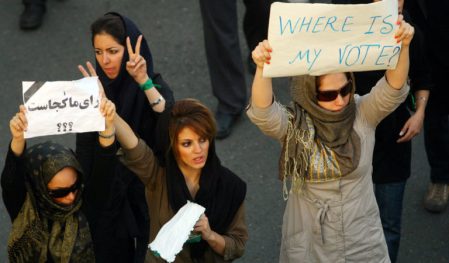
Iranian women protest election irregularities in 2009 (Photo: Getty Images)

Tillerson added. “As you know, we have designated the Quds [Force]. Our policy towards Iran is to push back on this hegemony, contain their ability to develop obviously nuclear weapons, and to work toward support of those elements inside of Iran that would lead to a peaceful transition of that government. Those elements are there, certainly as we know.”

******************************

United States Secretary of State Rex Tillerson responded to a variety of very serious questions raised by House of Representatives members in a recent hearing focusing on U.S. policy vis-à-vis Iran. Representative Ted Poe (R) from Texas touched on what many believe is the ultimate issue when he said:

“I’d like to know what the policy is of the U.S. toward Iran. Do we support the current regime? Do we support a philosophy of regime change, peaceful regime change? There are Iranians in exile all over the world. Some are here. And then there’s Iranians in Iran who don’t support the totalitarian state. So is the U.S. position to leave things as they are or set up a peaceful, long-term regime change?”

America’s top diplomat, taking into consideration how the Trump administration’s all-out Iran policy remains an issue of evaluation, answered:

“… our Iranian policy is under development.

“We continually review the merits both from the standpoint of diplomatic but also international consequences of designating the Iranian Revolutionary Guard in its entirety as a terrorist organization.” 

Tillerson added. “As you know, we have designated the Quds [Force]. Our policy towards Iran is to push back on this hegemony, contain their ability to develop obviously nuclear weapons, and to work toward support of those elements inside of Iran that would lead to a peaceful transition of that government. Those elements are there, certainly as we know.”

Iran is terrified of such a stance and responded immediately. In a tweet, Iranian Foreign Minister Mohammad Javad Zarif claimed that 75 percent of Iran’s population voted in the recent election farce back in May.

Iran’s wrath was not limited to this very issue. Following the twin ISIS attacks targeting Iran’s parliament and the tomb of Ayatollah Khomeini, leader of the Islamic revolution in Iran, senior regime officials sought to portray their apparatus as a victim of terrorism.

Failing to do so, Iranian regime officials accused the US, Saudi Arabia and the main opposition group, the People’s Mojahedin Organization of Iran (PMOI/MEK), of this terrorist plot. A few days ago, Supreme Leader Ayatollah Ali Khamenei lashed out at the US and accused Washington of bringing ISIS to life.

“Who created ISIS? Was it anyone but the U.S.? … The U.S. claim that they have established a coalition against ISIS is a lie; of course, the U.S. is against an ‘unrestrained ISIS,’ however, if anyone truly seeks to eradicate ISIS, they will have to fight against it,” he said.

Now the question is, what is Iran so concerned about and what is the right policy vis-à-vis Iran?

With Obama leaving the White House, Iran forever lost a major international backer. For eight years, the “golden era” as Iran dubbed the Obama years, any and all activities by the Iranian people and their organized opposition for change in Iran was countered by the domestic crackdowns and international hurdles, specifically by the U.S.

Obama’s neglect of Tehran’s crimes in Syria and Iraq led to the disasters we are witnessing today. Internationally, a major overhaul of U.S. policy in the region and establishing a significant Arab-American alliance in the face of Iran’s meddling has become a major concern for the mullahs.

In addition, increasing popular dissent and widespread activities by the PMOI/MEK in the past few months have also raised major concerns for the regime.

Khamenei personally intervened last week, first acknowledging the 1988 massacre, defending the Revolutionary Guards (IRGC), and those involved in the murder of over 30,000 political prisoners. Most of the victims, all executed in mass groups, were PMOI/MEK members and supporters.

Khamenei’s second concern and that of his entire apparatus is focused on the upcoming Iranian opposition’s annual convention in Paris scheduled for July 1 this year. The National Council of Resistance of Iran (NCRI), the main entity representing the Iranian opposition, hosts more than 100,000 Iranians from across the globe each year alongside hundreds of prominent dignitaries delivering their support and speeches seeking true change in Iran.

Last year alone, a very prominent delegation of American dignitaries from both sides of the political aisle included former New York Mayor Rudy Giuliani, former House Speaker Newt Gingrich, former U.S. ambassador to the UN John Bolton from the Republicans, former Democratic National Committee chairman Gov. Howard Dean, former U.S. ambassador to the UN Gov. Bill Richardson took part.

This year’s Iranian opposition rally is already brewing major concerns for Tehran as the regime understands the end of the era of appeasement has led to sweeping changes in Western policy regarding the Middle East, and most importantly Iran.

This is exactly why Tehran is going the limits to prevent the shifting of policy towards the Iranian people. Tehran’s lobbies in the U.S. and Europe are placing a comprehensive effort to demonize the images of the PMOI/MEK and the NCRI to prevent any such changes, especially in Washington.

If Iran resorts to ridiculous remarks of accusing the U.S. and Iranian opposition of staging the recent double attacks in Tehran, the correct policy is none other than supporting the Iranian people and their resistance to realize regime change in Tehran.

Iran gets North Korean expertise in building up, testing and hiding its ballistic missiles

June 21, 2017

Iran gets North Korean expertise in building up, testing and hiding its ballistic missiles, Washington Times

(The North Korea – Iran nuclear/missile axis has been active for years. Why not? Iran has lots of money courtesy of Obama’s Iran Scam and North Korea has technology that Iran wants. Iran is also likely pleased that the threat of North Korean nuke-laden missiles may be diverting attention from the dangers posed by Iran. — DM)

Iranian dissidents have documented work at 42 missile centers operated by the Islamic Revolutionary Guard Corps, the regime’s dominant security force. A dozen of those sites had never been disclosed before. (Associated Press/File)

Iran has increased production and testing of ballistic missiles since the 2015 nuclear deal with the U.S. while playing permanent host to scientists from North Korea, which has the know-how to build and launch atomic weapons, a leading Iranian opposition group said Tuesday.

The National Council of Resistance of Iran issued a white paper that the dissidents say identifies and documents work at 42 missile centers operated by the Islamic Revolutionary Guard Corps, the regime’s dominant security force.

A dozen sites had never been disclosed before, said the council, which operates a spy network that has exposed Iran’s hidden nuclear program.

Tehran views expertise from North Korea as being so critical that it has established residences in Tehran for Pyongyang’s scientists and technicians, according to the white paper. North Koreans have shown Iran how to dig tunnels and build “missile cities” deep inside mountains to prevent destruction by airstrikes, among other projects.

“On the basis of specific intelligence, the IRGC’s missile sites have been created based on North Korean models and blueprints,” the white paper said. “North Korean experts have helped the Iranian regime to build them. Underground facilities and tunnels to produce, store, and maintain missiles have also been modeled after North Korean sites and were created with the collaboration of the North Korean experts.”

Iranians also are traveling to North Korea, which uses occasional missile test-firings to rattle its neighbors South Korea and Japan, two strong U.S. allies.

“In the context of these trainings and relations, delegations of the IRGC’s aerospace constantly travel to North Korea and exchange knowledge, information and achievements with North Korean specialists,” the report said. “North Korea’s experts constantly travel to Iran while the IRGC’s missile experts visit North Korea.”

President Trump has been harshly critical of the 2015 deal struck by the Obama administration and five international allies to lift economic sanctions and other financial penalties in exchange for curbs on Iran’s nuclear weapons programs, but has said he will stick with the accord for now while closely monitoring Tehran’s adherence to the deal.

Iran’s leaders say they have yet to see all the benefits promised with the lifting of sanctions.

But even supporters of the Obama deal say there has been little sign that Iran’s Islamic Republic has moderated its behavior on other fronts, including the series of ballistic missile tests in recent months that some argue violate U.N. sanctions. U.S. officials also say Iran continues to back terror groups and foment instability in regional hot spots such as Syria and Yemen.

At a press conference Tuesday, Alireza Jafarzadeh, the council’s deputy director in Washington, displayed satellite photos that he said clearly show trademark North Korean mountain entrances to “cities” that hold hundreds of missiles.

He said the regime reorganized the IRGC Aerospace Force to focus almost exclusively on missile production and testing rather than aircraft.

“It’s not by accident,” Mr. Jafarzadeh said. “It’s part of their overall strategy.”

He said a huge missile arsenal allows the ruling Shiite mullahs to intimidate Sunni Muslim neighbors such as rival Saudi Arabia. In addition, missiles provide a delivery system for the nuclear weapons that the regime plans to build once the 2015 nuclear deal, known as the Joint Comprehensive Plan of Action, expires in less than 10 years.

“We’re racing against the clock,” he said.

The National Council of Resistance of Iran held a press conference in Washington in April to present evidence that Tehran’s harsh Islamic regime is cheating on the nuclear deal by continuing secret work on atomic bomb components. The Trump administration recently certified that the Islamic republic is living up to its obligations in the deal, which restricts Tehran’s production of only nuclear material, not missiles.

The council’s report pays close attention to the Semnan missile center, a complex of storage facilities and launching pads for medium-range ballistic missiles in north-central Iran. It is here, the white paper says, that Iran melds missile work with nuclear research conducted by the Organization of Defensive Innovation and Research, known by the Persian acronym SPND.

The council first disclosed SPND’s existence in 2011. In 2014, the Obama administration imposed sanctions on SPND for conducting illicit work not allowed at by the pending nuclear deal.

“The Semnan center for missile projects has been much more active after the JCPOA,” a council official said. “The speed and scope of activities and research in Semnan has increased significantly in this period and the exchanges and traffic between SPND.”

Iran has flouted U.N. resolutions repeatedly by test-firing ballistic missiles. In February, the nonprofit Foundation for Defense of Democracies put the number at 14 since the nuclear deal was signed in July 2015. Since then, Iran has conducted at least two more tests.

On Sunday, Iran for the first time since 2001 fired an operational missile outside its boundaries, targeting an Islamic State-controlled town in eastern Syria. Tehran said the ground-to-ground missile strike was retaliation for the Islamic State’s June 7 terrorist attack on the Iranian parliament. In 2001, the regime fired missiles on resistance targets in Iraq.

Iran owns one of the world’s largest inventories of ballistic missiles. GlobalSecurity.org lists more than a dozen different short- and medium-range Iranian missiles, some of which closely resemble North Korea’s Nodong arsenal.

Tehran this year announced the launch of the Emad, which has a range of 1,000 miles. It said the test marked a first for an Iranian precision-guided ballistic missile.

More than ever, the resistance council said, Iran’s religious leaders see missiles as instrumental to their survival strategy.

“The Iranian regime has remained in power in Iran by relying on two pillars: internal repression and external export of Islamic fundamentalism and terrorism,” the council said. “Its illicit nuclear weapons program and its continued expansion of ballistic missiles serve its policy of export of Islamic fundamentalism and terrorism.”

Donald Trump Meets Ukrainian President Petro Poroshenko After Sanctioning Russian-Backed Separatists

June 21, 2017

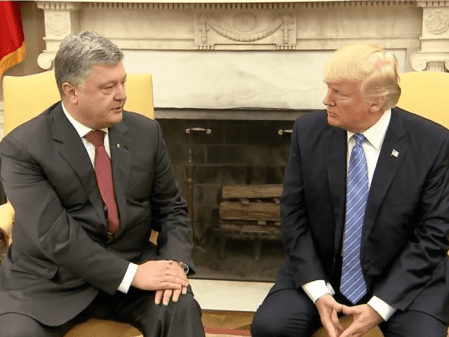
Donald Trump Meets Ukrainian President Petro Poroshenko After Sanctioning Russian-Backed Separatists, BreitbartCharlie Spiering, June 20, 2017

screenshot

President Donald Trump met with Ukrainian President Petro Poroshenko on Tuesday as his administration imposed sanctions on Russian-backed separatists in the country.

Trump said the two had “very, very good discussions,” calling Ukraine “a place that we’ve all been very much involved in.”

Behind the scenes, the White House revealed that Trump and Poroshenko discussed support for a peaceful resolution to the conflict in eastern Ukraine.

Treasury Secretary Steven Mnuchin announced sanctions on two Russian officials and several separatists in Eastern Ukraine to support the Ukrainian amidst ongoing Russian-backed conflicts in the region.

“This administration is committed to a diplomatic process that guarantees Ukrainian sovereignty, and there should be no sanctions relief until Russia meets its obligations under the Minsk agreements,” Mnuchin said Tuesday.

Poroshenko said it was a “great pleasure” to meet with Trump to discuss issues important to Ukraine and called the president a “supporter and strategic partner” of the country.

“We’re really fighting for freedom and democracy,” he said.

US Fighter Jet Shoots Down Armed Drone in Syria

June 21, 2017

by Kristina Wong 20 Jun 2017

Source: US Fighter Jet Shoots Down Armed Drone in Syria

AP Photo/Aaron Allmon

A U.S. F-15E Strike Eagle fighter jet shot down an armed “pro-Syrian regime” drone advancing on coalition forces in Southern Syria at approximately 12:30 a.m. on Tuesday.

The drone was identified as a Shaheed-129 that displayed “hostile intent and advanced” on coalition forces at the At Tanf combat outpost used to train partner Syrian forces in the fight against the Islamic State (ISIS).

The U.S.-led military coalition said in a statement that the shoot down occurred where another pro-regime drone dropped munitions on June 8 before it was also shot down.

“The F-15E intercepted the armed UAV after it was observed advancing on the Coalition position. When the armed UAV continued to advance on the Coalition position without diverting its course it was shot down,” the statement said.

The shoot down comes two days after the U.S. announced it shot down a Syrian regime fighter jet on Sunday after it dropped bombs near U.S.-backed Syrian Kurdish forces advancing on ISIS’s stronghold of Raqqa. That incident angered Russia, which intervened in the Syrian civil war on Syria’s behalf in 2015 and has a hotline with the U.S. to deconflict airspace and make sure their air forces don’t collide mid-air.

Russia announced on Monday it was suspending the hotline, but the U.S. said it was still functioning as of Monday morning.

The coalition implied the hotline was still working as of Tuesday morning.

“There is a de-confliction mechanism in place with Russian forces to reduce uncertainty in this highly contested space and mitigate the chances of strategic miscalculation. Given recent events, the Coalition will not allow pro-regime aircraft to threaten or approach in close proximity to Coalition and partnered forces,” the statement said.

Chairman of the Joint Chiefs of Staff Marine Gen. Joseph Dunford urged calm on Monday, calling talk of “World War III” unproductive.

“The worst thing that any of us could do right now is, would be to address this thing with hyperbole,” he said during an appearance at the National Press Club in Washington, DC.

“An incident occurred, we have to work through the incident, we have a channel to be able to do that,” he said.

The two latest shoot downs, in addition to the one on June 8, has raised questions over whether the U.S. is getting drawn into a war with Russia or Syria, rather than just with ISIS.

But the coalition said the move was defensive.

“The Coalition presence in Syria addresses the imminent threat ISIS in Syria poses globally. The Coalition does not seek to fight Syrian regime, Russian, or pro-regime forces partnered with them, but will not hesitate to defend Coalition or partner forces from any threat,” it said.

“The Coalition has made it clear to all parties [publicly] and through the de-confliction line with Russian forces that the demonstrated hostile intent and actions of pro-regime forces toward Coalition and partner forces in Syria conducting legitimate counter-ISIS operations will not be tolerated,” the statement read.

“The Coalition calls on all parties to focus their efforts on the defeat of ISIS, which is our common enemy and the greatest threat to regional and worldwide peace and security.”

The Leftist News Media, Unmasked

June 21, 2017

The Leftist News Media, Unmasked, Front Page MagazineDiscover The Networks, June 21, 2017

(Please see also, After Last Night. — DM)

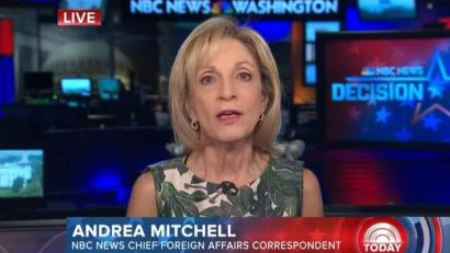
Andrea Mitchell, poster woman of the propaganda mill.

If there’s anything that the most recent presidential campaign and its aftermath have made crystal clear, it’s that the major news media in America are teeming with leftists who overtly and covertly promote leftist worldviews and agendas. Andrea Mitchell, who has been the chief foreign-affairs correspondent at NBC News since 1994, is emblematic of the media’s pitiful devolution into nothing more than a propaganda mill.

Like a dutiful leftist, for instance, Mitchell has long viewed white Republicans and conservatives as being particularly inclined toward racism. During a June 2008 appearance on MSNBC, she referred to a heavily pro-Republican area of southwestern Virginia where then-presidential candidate Barack Obama was campaigning, as “real redneck, sort of, bordering on Appalachia country.”

In a December 2015 discussion about Republican presidential candidate Donald Trump’s call for a temporary halt on Muslim immigration to the United States, Mitchell said: “I will tell you that the [Obama] White House views the Trump Muslim ban as pure racism … My first campaign, 1968 as a young reporter, was [that of segregationist] George Wallace. I have seen this before.”

Mitchell objected strongly in June 2016 when Donald Trump said he was being treated unfairly by U.S. District Judge Gonzalo Curiel, an Indiana-born American citizen whose parents originally hailed from Mexico. Trump described Curiel, who was presiding over a lawsuit against Trump University, as “a member of a club or society [La Raza Lawyers of San Diego] very strongly pro-Mexican,” and said that it was “just common sense” that Curiel’s connections to Mexico, and his disagreement with Trump’s past calls for stricter border controls, were responsible for his anti-Trump rulings. According to Mitchell, Trump’s remarks were “blatantly racist.”

In November 2016, Mitchell covered the annual conference of the National Policy Institute, a Washington-based think tank that promotes white nationalism. Though the gathering consisted of scarcely 200 attendees, Mitchell tried to emphasize its significance as a barometer of anti-black racism among Donald Trump’s political backers: “Supporters of Donald Trump’s election and the alt-right gathered in Washington this weekend at the Reagan Building … to celebrate with white supremacist speech and echoes of signature language from Nazi Germany.” Later in that segment, Mitchell related an anecdote she had heard about a four-year-old black girl in Harlem who, by Mitchell’s telling, “said she wants to be white” because of her fear “that black people are going to be shot under [President] Trump.” Trump’s election victory, said the news woman, was having a profound “effect on children in minority, in communities of color.”

Over the course of her broadcasting career, Mitchell has made plain her affinity for leftist Democrats. For example, in an April 2016 interview in which Senator Harry Reid said that “Hillary Clinton’s qualifications” for being president were more impressive than those of anyone “since the Founding Fathers,” Mitchell responded by saying that only “John Quincy Adams, maybe,” had compiled a résumé equal to that of Clinton. Just before the election that November, Mitchell characterized a Clinton campaign rally that featured appearances by such notables as Lebron James and James Taylor as “extraordinary” and “magical.”

In a similar spirit, Mitchell lauded outgoing President Barack Obama‘s “extraordinary” July 2016 speech at the Democratic National Convention as “the most optimistic speech, the most generous speech, politically,” that anyone could have expected to hear. She marveled at “the genuine affection” that Obama expressed for Hillary Clinton “when he said there’s never been anyone, not man or woman, not me, not Bill [Clinton], as qualified to be president of the United States.” Extolling also “the creativity” of Obama’s “own brilliant speech writing,” Mitchell said: “His gift is unique. I don’t think we’ve ever had a President save Lincoln, who is as great a speechwriter as this man.”

When Donald Trump was elected president in 2016, Mitchell feared that he would recklessly undo many of the supposedly vital achievements of President Obama. For example, when the Trump administration announced in April 2017 that it would be reviewing the Iran nuclear deal in light of Tehran’s ongoing support for Islamic terrorism, Mitchell lamented that “the new administration appears to be ready to rip up” the “landmark” agreement which had been structured to “stop Iran from getting a bomb.” Further, she suggested that if the United States were to “break out of that deal,” it would “send a signal to North Korea and other rogue nations that the U.S. can’t be trusted to keep its end of the bargain.”

In contrast to her dripping contempt for Donald Trump, Mitchell more than once has issued words of praise and admiration for Cuba’s longtime Communist dictator, the late Fidel Castro. In a December 15, 1999 report from Cuba, for instance, she described Castro as an “old-fashioned, courtly – even paternal” man and said: “He’s not just the country’s head of state, he’s the CEO.” After Castro’s death in November 2016, Mitchell reported that many Cubans were “overcome with grief,” as exemplified by one young person who allegedly said: “It’s painful for our country. This is the president we all loved.” “Leaders around the world” were “praising Castro,” Mitchell added, noting that “Cuban TV paid tributes all day and all night to the founder of the revolution, still a towering figure in the nation’s imagination.” Emphasizing Castro’s keen intelligence, Mitchell described him as “a voracious reader [who was] very, very aware of everything that was going on, very, very smart and very wedded to his revolutionary ideology.” In a separate report, Mitchell noted that Castro was “a declared socialist” who had “dramatically improved healthcare and literacy” in Cuba, and who, over time, had grown to “sho[w] a new tolerance for religion, welcoming Pope John Paul II in 1998.” She also suggested that Castro’s mass arrests of dissidents were sometimes carried out in response to American policies, such as after “the Bush administration tightened sanctions, cutting off most travel to the island.”

This, then, is Andrea Mitchell. One leftist fish in a vast sea of leftist fishes.

After Last Night

June 21, 2017

After Last Night, Power LineScott Johnson, June 21, 2017

Republican Karen Handel handily handled Democratic manchild Jon Ossoff in the special election to fill Georgia’s Sixth District congressional seat last night. The race was expected to be a cliffhanger. We were told that we wouldn’t know the outcome until the early morning hours today. By 10:00 p.m., however, it was clear that Handel would prevail. With 100 percent of the votes tabulated, Handel won by about four points or 10,000 votes (out of a total of about 260,000).

The Hollywood/San Francisco crowd invested big time in Ossoff. For the California left, it was the night that the lights went out in Georgia. Roger Simon rightly declares Hollywood a YUUUGE loser last night.

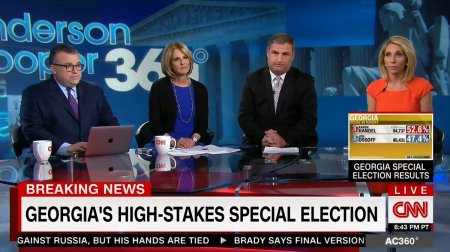
The lynch mob media (as Senator Cotton calls it) also heavily invested in the race — as one could see from the looks of the crew commenting last night on CNN. You didn’t even have to turn up the volume to figure out what was happening. How great is this?

Election Night Anchor Face™ is fast becoming one of my favorite things.

Until Ossoff lost, of course, this may have been the most important congressional race ever. It was to be an omen. It would be a portent. Now we’re back in the USSR. Mary Katharine Ham put it this way on Twitter last night:

Update: Formerly vitally important election with national implications that can’t be overstated now scheduled to be irrelevant by 10 am.

Washington Examiner politics editor Jim Antle let loose with a steady stream of punning tweets with musical themes last night. When Handel was declared the winner he observed that it would take a while before we knew which factor was Handel’s messiah.

Ossoff raised $23.5 million to Handel’s $4.5 million. Outside Republican campaign funds partially redressed the balance. The New York Times breaks down the numbers here.

PJ Media’s Tyler O’Neil considers the cash in an excellent post here. “Ossoff’s huge war chest might have hurt him. In the last two months, the Democrat reported receiving nine times more donations from California than from Georgia. In the nine counties of the San Francisco Bay Area alone, Ossoff reported receiving 3,063 donations, nearly four times the Georgia total of 808 gifts.”

From a distance, it seemed to me that Handel probably fit the district a bit better than Ossoff. For one thing, she actually lived there. Ossoff lived outside the district with his girlfriend. At one time he lived in the district. He could remember his old address there.

The Washington Free Beacon’s Brent Scher covered the race in the spirit of Andrew Breitbart. He documented his two-hour trek from Ossoff’s house to the Sixth District. He was rewarded for his efforts with his exclusion from an Ossoff campaign event on the night before the election.

In the end the California contributions may have boomeranged. Handel pounded on the Pelosi factor that an Ossoff victory would enhance. O’Neil notes: “Most of the Handel ads attacking Ossoff tied the Democrat to House Minority Leader Nancy Pelosi. It appears that that message worked.”