Archive for June 15, 2017

Putin: Russians do not see America as enemy

June 15, 2017

Source: Putin: Russians do not see America as enemy — RT News

White House, US. © Getty Images

President Putin has said Russia does not consider the US to be an enemy as the two countries were allies in two world wars. Putin was speaking at his annual Q&A, where a self-described pro-Russian American asked how he could convince his fellow Americans that Moscow was not an enemy.

LIVE UPDATES: Russian president holds annual Q&A

Putin reiterated his assentation that the anti-Russian sentiment in the US come from internal political strife in America.

The Russophobia currently evolving in the United States – we can see it and we believe that this is the outcome of a spiraling domestic struggle for power.”

The president said Russia has “many friends” in the US, although “media hysteria” has taken its toll on bilateral relations. Overall, Moscow believes US-Russia relations will return to normal.

‘No proof Russia meddled in US election’

Putin commented on the congressional testimony made by former FBI Director James Comey, who accused Russia of interfering in the US election.

“The first thing that attracted my attention was that the ex-FBI director said that he believes that there was Russian meddling in the electoral process [in the US], but at the same time provided no proof of that,” he said.

The president noted that, according to Comey, there was no interference by Russia in the vote count during last year’s election, saying: “Well, thank God, at least that, it’s good enough.”

The president said Russia’s influence on American’s minds was no greater than that of America, which sponsors NGOs worldwide with a goal to influence countries they work in.

Take a globe, spin it and point your finger at any spot, there’s surely American interests and interference there,” he told the audience. “I know it from my conversations with almost every national leader. They just don’t want to spoil relations with the Americans.”

‘We are ready to grant Comey asylum’

Putin also remarked that Comey’s leaks to the media about his conversations with Trump put him in a vulnerable position.

[Comey] suddenly said he recorded a conversation with Trump, and then handed the tape over to the media, which is strange.”

What’s the difference between him and Mr [Edward] Snowden then? He’s a human rights activist then, not an intelligence chief,” Putin said.

“At any rate, if this entails some kind of prosecutions against him [Comey], we are ready to grant him asylum in Russia. He should be aware of that,” Putin added.

Putin said Moscow is determined to re-engage with Washington on several pressing international issues, including nuclear non-proliferation, arms control, combatting poverty and climate change. He stressed political bickering between the world powers will not help in this regard.

He mentioned the 2015 landmark Iran nuclear deal as “a positive example of our cooperation” with Washington.

“This means we can negotiate and work together. The Syrian issue, the Middle East issue – it’s obvious to everyone that nothing will be achieved without our constructive dialogue,” Putin said.

Qatar’s Comeuppance

June 15, 2017

Qatar’s Comeuppance, Gatestone InstituteRuthie Blum, June 15, 2017

Ironically, pressure from this new anti-Iran Muslim bloc in the Middle East has done more to call the world’s attention to Qatar’s key role in the spread of Islamist terrorism than years of cajoling on the part of previous administrations in Washington to get Doha to live up to its signed commitments.

***********************************

Putting Doha on the Well-Deserved Defensive

Qatar’s extensive ties to terrorism and abetting of financiers to bolster it are well-documented.

Saudi Arabia, the UAE, Egypt and Bahrain issued a statement designating 59 individuals and 12 organizations as having terror ties to Qatar. According to the statement, Doha “announces fighting terrorism on one hand and finances and supports and hosts different terrorist organizations on the other hand,” and harbors “terrorist and sectarian groups that aim to destabilize the region, including the Muslim Brotherhood, Daesh [ISIS] and Al Qaeda.”
Ironically, pressure from this new anti-Iran Muslim bloc in the Middle East has done more to call the world’s attention to Qatar’s key role in the spread of Islamist terrorism than years of cajoling on the part of previous administrations in Washington to get Doha to live up to its signed commitments.

A mere two weeks after U.S. President Donald Trump delivered his first major foreign policy speech in Riyadh to delegates from dozens Muslim/Arab countries, Bahrain announced on June 5 that it was halting all flights to Qatar for being a sponsor of radical Islamist terrorists. Immediately, Saudi Arabia joined the boycott, as did the United Arab Emirates (UAE), Egypt and Yemen, all of which also shut off access to Al Jazeera, the anti-American, anti-Semitic Qatari television network established in 1996 and operating since then to foment unrest across the Middle East and bolster the terrorist organization the Muslim Brotherhood and its offshoot, Hamas.

The emir of Qatar, Sheikh Tamim bin Hamad Al Thani, and other officials in Doha fiercely denied the charge that their government has been backing terrorism, blaming a “fake news” report on the website of the state-controlled Qatar News Agency for the eruption of the Gulf crisis.

The report, which the FBI and other U.S. security agencies believe was the result of a Russian hacking attack, quoted Al Thani calling Iran an “Islamic power,” referring to Hamas as “the legitimate representative of the Palestinian people” and saying Qatar’s relations with Israel were “good.”

Although the report did turn out to be a hoax, Qatar’s extensive ties to terrorism and abetting of financiers to bolster it are well-documented. A Foundation for Defense of Democracies (FDD) study, titled “Qatar and Terror Finance: Private Funders of al-Qaeda in Syria,” shows that while Doha has pretended for more than a decade to be partnering with the United States to defeat Al Qaeda, the monarchy, in fact, has taken no action whatsoever against the Qatari financiers of the terrorist organization’s Syrian branch, the Nusra Front, which continues to plot attacks against the West. One of the reasons that this group eluded U.S. strikes operating in Syria was that it, like America, has been fighting ISIS. Another was that it changed its name to Jabhat Fateh al-Sham (JFS or the Front for the Conquest of Syria), in an effort to distance itself from Al Qaeda. This effort was led by Qatar.

According to the FDD study, the second of a three-part document written by David Andrew Weinberg:

“…[I]ntelligence officials from Qatar and other Gulf states met several times with Nusra’s leader [in 2015] to suggest that his group could receive money, arms, and supplies after stepping away from al-Qaeda.”

While the first part of the study, released in 2014, revealed “Doha’s dismal record” during the reign of Emir Hamad Al Thani (the current monarch’s father), this one

“evaluates the publicly available evidence on Qatar’s record since then, focusing primarily on individuals sanctioned by the U.S. Treasury Department in 2014 and 2015. All of these sanctions were imposed after Qatar agreed in September 2014, as part of a U.S.-led initiative called the Jeddah Communiqué, to bring terror financiers to justice.”

Weinberg concluded that Qatar has done little or nothing to comply. On the contrary, he wrote, “The funders of certain terrorist groups still enjoy legal impunity there. Nusra/JFS appears to be foremost among them.”

It is just as unlikely that a single news item was responsible for the banding together of several Arab states to impose a blockade on Qatar as it is implausible that these states, particularly Saudi Arabia — which itself has backed and spread radical Islamist ideology — are holding Qatar accountable for its ties to global jihad. Equally simplistic is the view, expressed by Trump on Twitter, that the embargo indicated the seriousness with which the above states took his call to “drive out the terrorists and extremists” from their midst.

“During my recent trip to the Middle East I stated that there can no longer be funding of Radical Ideology. Leaders pointed to Qatar — look!” Trump tweeted on June 7.

“So good to see the Saudi Arabia visit with the King and 50 countries already paying off. They said they would take a hard line on funding extremism, and all reference was pointing to Qatar. Perhaps this will be the beginning of the end to the horror of terrorism!”

This prompted pundits on both sides of the political spectrum to question whether Trump was simply being reckless in his response, or actually announcing a shift in decades of U.S. policy regarding Qatar, home of the Al Udeid Air Base southwest of Doha. Al Udeid is not only America’s largest military base in the Middle East — with some 10,000 troops, but since 2003, it has served as forward headquarters for CENTCOM (the U.S. Central Command), and has been crucial in America’s operations in Afghanistan, Iraq and Syria.

The following day, Trump was accused of backtracking, when he phoned Al Thani and offered to “help the parties resolve their differences, including through a meeting at the White House if necessary.”

Jerusalem Post columnist Caroline Glick pointed out that this was not a case of Trump reversing his position, but rather of proposing the most reasonable course of action available:

“With the Pentagon dependent on the Qatari base, and with no clear path for unseating the emir through war or coup without risking a much larger and more dangerous conflict, the only clear option is a negotiated resolution.

“Under the circumstances, the best option for the US to openly work towards is to diminish Qatar’s regional profile and financial support for Iran and its terrorist allies and proxies.”

Nevertheless, mixed messages appeared to be emerging from the Trump administration. On June 9, Secretary of State Rex Tillerson said that the blockade was hindering U.S. operations against ISIS. On the same day, Pentagon spokesman Navy Capt. Jeff Davis asserted that the isolation of Qatar so far has had no negative impact on U.S. operations in and out of Al Udeid. “All of our supplies are getting in just fine,” he told reporters. “The Defense Logistics Agency is certainly always looking at contingency plans if they’re needed, but for right now they’re OK.”

On the day that these conflicting claims began to circulate, Saudi Arabia, the UAE, Egypt and Bahrain issued a statement designating 59 individuals and 12 organizations as having terror ties to Qatar. According to the statement, Doha “announces fighting terrorism on one hand and finances and supports and hosts different terrorist organizations on the other hand,” and harbors “terrorist and sectarian groups that aim to destabilize the region, including the Muslim Brotherhood, Daesh [ISIS] and Al Qaeda.”

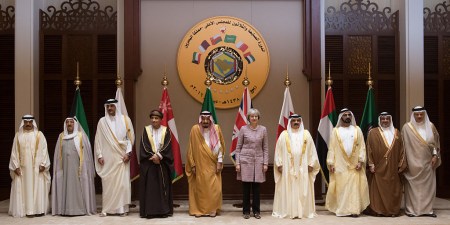
Bygone days of unity. The leaders of the Gulf states pose with British PM Theresa May at the Gulf Cooperation Council summit, on December 7, 2016 in Manama, Bahrain. (Photo by Carl Court/Getty Images)

On June 7 — the day of Trump’s phone call and two days before the release of the Saudi statement — Qatar hired of the law firm of John Ashcroft, former attorney general under President George W. Bush, to help counter terror accusations. This clearly was a calculated move, as Ashcroft had been instrumental in pushing through the post-9/11 “Uniting and Strengthening America by Providing Appropriate Tools Required to Intercept and Obstruct Terrorism Act of 2001,” more commonly known as the Patriot Act.

According to the “Scope of Engagement” of the Ashcroft retainer, its “broad purpose,” for a “flat fee” of $250,000, is to:

“provid[e] the Client with comprehensive strategic advice, legal counsel, support, and representation related to confirming, educating, assessing and reporting the Client’s efforts to combat global terrorism and its support of and compliance with international financial regulations, including compliance with United States Treasury rules and regulations.

“The firm understands the urgency of this matter and need to communicate accurate information to both a broad constituency and certain domestic agencies and leaders…will advance, advocate, represent, and protect the Client’s interests as necessary, including but not limited to the development of comprehensive legal and government affairs strategy, coordination as necessary and in the interest of the Client, assessment of the pending news and certain nations’ claims that adversely impact the Client’s reputation and pose serious risk and consequences.”

Hiring Ashcroft is not the only indication that Qatar is running scared. Another is its leaders’ simultaneous attempt to assuage fears among its populace – reported to have begun “panic-shopping” at supermarkets — and threaten fellow Gulf Cooperation Council countries that they will suffer severe financial consequences as a result of their boycott.

“If we’re going to lose a dollar, they will lose a dollar also,” warned Qatari Finance minister Ali Shareef Al Emadi. Emadi added, “Our reserves and investment funds are more than 250 percent of gross domestic product, so I don’t think there is any reason that people need to be concerned about what’s happening or any speculation on the Qatari riyal.”

In spite of Emadi’s posturing and Doha’s assertion that it is not in cahoots with Iran, Tehran announced that it has begun sending hundreds of tons of food products to Qatar. Oman, too, is transferring goods to Doha. Turkey went a step further, authorizing the dispatch of 3,000-5,000 troops to its military base in Qatar, to assist Al Thani’s regime, should it be jeopardized by the Saudi-led initiative and internal power struggles.

This unfolding of events is creating what Middle East expert Jonathan Speyer called a “clear drawing” of the “lines of confrontation between the two central power blocs in the region…”

As Speyer wrote on June 10:

“The shunting aside of little Qatar… is ultimately only a detail in the larger picture. What is more significant is the re-emergence of an overt alliance of Sunni Arab states under US leadership, following the development of military capabilities in relevant areas, and with the stated intention of challenging the Iranian regional advance and Sunni political Islam.”

Ironically, pressure from this new anti-Iran Muslim bloc in the Middle East has done more to call the world’s attention to Qatar’s key role in the spread of Islamist terrorism than years of cajoling on the part of previous administrations in Washington to get Doha to live up to its signed commitments.

Ruthie Blum is a journalist and author of “To Hell in a Handbasket: Carter, Obama and the ‘Arab Spring.'”

Can a Divided America Survive?

June 15, 2017

Can a Divided America Survive?, TownhallVictor Davis Hanson, June 15, 2017

(Good question. Can she? — DM)

History is not very kind to multicultural chaos — as opposed to a multiracial society united by a single national culture. The fates of Rwanda, Iraq and the former Yugoslavia should remind us of our present disastrous trajectory.

Either the United States will return to a shared single language and allegiance to a common and singular culture, or it will eventually descend into clannish violence.

Things are bad now. But our own history suggests that if we are not careful, they can get even worse.

***************************

The United States is currently the world’s oldest democracy.

But America is no more immune from collapse than were some of history’s most stable and impressive consensual governments. Fifth-century Athens, Republican Rome, Renaissance Florence and Venice, and many of the elected governments of early 20th-century Western European states eventually destroyed themselves, went bankrupt or were overrun by invaders.

The United States is dividing as rarely before. Half the country, mostly liberal America, is concentrated in 146 of the nation’s more than 3,000 counties — in an area that collectively represents less than 10 percent of the U.S. land mass. The other half, the conservative Red states of the interior of America, is geographically, culturally, economically, politically and socially at odds with Blue-state America, which resides mostly on the two coasts.

The two Americas watch different news. They read very different books, listen to different music and watch different television shows. Increasingly, they now live lives according to two widely different traditions.

Barack Obama was elected president after compiling the most left-wing voting record in the U.S. Senate. His antidote, Donald Trump, was elected largely on the premise that traditional Republicans were hardly conservative.

Red America and Blue America are spiraling into divisions approaching those of 1860, or of the nihilistic hippie/straight divide of 1968.

Currently, some 27 percent of all Californians were not born in the United States. More than 40 million foreign-born immigrants currently reside in the U.S. — the highest number in the nation’s history.

Yet widely unchecked immigration comes at a time when the country has lost confidence in its prior successful adherence to melting-pot assimilation and integration. The ultimate result is a fragmenting of society into tribal cliques that vie for power, careers and influence on the basis of ethnic solidarity rather than shared Americanness.

History is not very kind to multicultural chaos — as opposed to a multiracial society united by a single national culture. The fates of Rwanda, Iraq and the former Yugoslavia should remind us of our present disastrous trajectory.

Either the United States will return to a shared single language and allegiance to a common and singular culture, or it will eventually descend into clannish violence.

Does the unique American idea of federalism still work, with state rights and laws subordinate to federal law? We fought a Civil War that cost more than 600,000 lives in part to uphold the idea that individual states could not override the federal government.

Yet sanctuary cities declare that they can freely nullify federal immigration law. The California Senate passed a bill earlier this month that would prohibit the state from contracting with any firms that work on the federal government’s wall at the border with Mexico.

States such as California vow that they will ignore Washington and work directly with foreign nations to promote their own policies on global warming. Read carefully what some prominent Californians are saying about the federal government: It is not much different from what influential Confederate South Carolinians boasted about in 1860 on the eve of secession.

The national debt has almost doubled over the last eight years and at nearly $20 trillion is unsustainable.

Entitlement spending rose even as new taxes increased. The have-nots claim the haves make far too much money; the haves retort that they pay most of the income taxes while nearly half the country pays nothing.

Most Americans agree that the present levels of borrowing and spending cannot continue. But many believe that the tough medicine to cure the disease of chronic annual deficits and mounting debt is unacceptable.

America’s infrastructure and military are vastly underfunded, even though some voters want more subsidies for themselves and apparently others to pay for them.

America’s once-preeminent colleges and universities are fatally compromised. Universities charge far too much, resist reform, expect exemption from accountability, and assume their students must take on huge amounts of debt. Yet campuses can’t guarantee that their graduates are competently educated or that they will find jobs.

Illiberal attempts to end free speech, to sanction racial and gender segregation, and to attack rather than argue with opponents are disguised by euphemisms such as “safe spaces,” “trigger warnings” and various -isms and -ologies.

Behind the guise of campus activism and non-negotiable demands is the reality that too many students simply are unprepared to do their assigned work and seek exemption through protests in lieu of hard studying.

America barely survived the Civil War of 1861-65, the Great Depression of 1929-39, and the rioting and protests of the 1960s. But today’s growing divides are additionally supercharged by instant internet and social media communications, 24/7 cable news, partisan media and the denigration of America’s past traditions.

All Americans need to take a deep breath, step back and rein in their anger — and find more ways to connect rather than divide themselves.

They should assume their opponents are not all sinners, and that their supporters are not all saints.

Things are bad now. But our own history suggests that if we are not careful, they can get even worse.

Oliver Stone’s Response to Being Laughed at for Defending Putin: Blame the Jews

June 15, 2017

by Alan M. Dershowitz
June 14, 2017 at 3:00 pm

Source: Oliver Stone’s Response to Being Laughed at for Defending Putin: Blame the Jews

  • The essence of anti-Semitism is the bigoted claim that if there is a problem, then Jews must be its cause. This is the exact canard peddled by Stone — and is extremely dangerous if unrebutted. I challenge my old friend (and co-producer of Reversal of Fortune – the film based on my book) to debate me on the following proposition: Did Israel do more to influence the 2016 election than Russia?

When film director Oliver Stone could not come up with a plausible response to Stephen Colbert’s tough questions about why he gave a pass to Vladimir Putin for trying to influence the American presidential election, Stone resorted to an age-old bigotry: blame the Jews – or, in its current incarnation, shift the blame to the nation state of the Jewish people, Israel. Colbert was interviewing Stone about his new documentary, “The Putin Interviews” a film comprised of conversations he had with the Russian president over the past two years. The exchange regarding Israel did not make it to air but was relayed to the New York Post’s Page Six by a source who was in the audience.

When pressed by Colbert about his apparent fondness of the Russian dictator, Stone replied: “Israel had far more involvement in the U.S. election than Russia.” He then said again, “Why don’t you ask me about that?” Colbert responded: “I’ll ask you about that when you make a documentary about Israel!”

If Stone’s absurd response were not reflective of a growing anti-Semitism by the intolerant hard left (of which Stone is a charter member) it would be laughable. Indeed, Stone resorted to the “socialism of fools” (which is what German Social Democrat, August Bebel, coined anti-Semitism) precisely to save face because he was being mockingly laughed off stage by Colbert’s audience for giving Colbert ridiculous answers. Some of Stone’s bizarre pronouncements included:

“I’m amazed at his [Putin’s] calmness, his courtesy…he never really said anything bad about anybody. He’s been through a lot. He’s been insulted and abused.” Stone also expressed his “respect” for Putin’s leadership. But no answer was more ridiculous than his bigoted claim that Israel did more to try to influence the election than Russia.

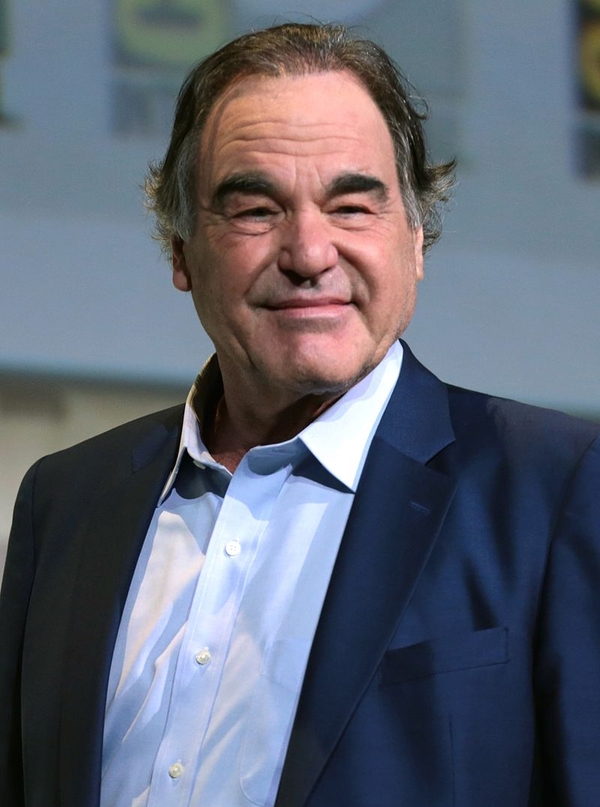
Oliver Stone (Image source: Gage Skidmore/Wikimedia Commons)


We know for certain that Russia (and that means Putin) desperately wanted Hillary Clinton to lose. We know that their surrogates timed leaks to cause maximum damage to her campaign. All of our intelligence agencies, in a rare show of unanimity, concluded that Russia went to great lengths to try to defeat Clinton.

What did Israel do? Stone hasn’t said. He just let the blood libel hang out there for other bigots, so they could say, “See, we knew the Jews were behind this; they always are.” There was an old Polish expression that said: if there is a bad outcome, the Jews must be behind it. Indeed, throughout history the last recourse of desperate bigots has been ‘blame the Jews.’ The modern version – pervasive among the hard left– is blame their nation-state, Israel.

The reason Stone did not provide any proof of his anti-Semitic accusation is because there is none. It simply is not true. Israel did not try to influence this election. The Israeli government took no position and its leaders were probably divided, as were its citizens, concerning the desired outcome. Prime Minister Netanyahu, for his part, remained neutral, emphatically stating before the election that he was “happy to work with whoever gets elected.”

Moreover, American Jews voted overwhelmingly in favor of Clinton. To be sure, some, such as Sheldon Adelson, contributed to Trump, but others, including many strong supporters of Israel, contributed heavily to Clinton. I would not be surprised if even in the face of Adelson’s huge contributions, more money from Jewish sources was contributed to Hillary Clinton’s campaign, but no one keeps track of such matters.

It is important to note that this is not an isolated incident. Stone’s bigotry towards Jews and their nation state is well documented. He has said that, “Hitler did far more damage to the Russians than [to] the Jewish people.”

And then argued that this fact is largely unknown because of “the Jewish domination of the media…there’s a major lobby in the United States. They are hard workers. They stay on top of every comment, the most powerful lobby in Washington.” He continued to say: “Israel has f***** up United States foreign policy for years.”

Moreover, Stone has also stated that, “Hitler is an easy scapegoat throughout history” and expressed affection for Cuban dictator, Fidel Castro, whom he called “a great leader.”

Clearly, there was no legitimate reason for Stone to bring up Israel in the context of a dialogue regarding Russia’s interference in the U.S. presidential election. By ducking questions about Putin and Russia, and then bizarrely accusing Israel of wrongdoing, Stone engaged in an old trope: blaming Jews – or the nation state of the Jewish people –for far reaching domestic political issues in foreign countries. By morphing the discussion about Putin’s untoward history of suppressing the press, killing political opponents, and engaging in cyber attacks against the U.S., into a polemic against Israel, Stone displayed his own bias.

The essence of anti-Semitism is the bigoted claim that if there is a problem, then Jews must be its cause. This is the exact canard peddled by Stone — and is extremely dangerous if unrebutted. I challenge my old friend (and co producer of Reversal of Fortune – the film based on my book) to debate me on the following proposition: did Israel do more to influence the 2016 election than Russia? If he agrees, he will once again be laughed off the stage.

Alan M. Dershowitz is the Felix Frankfurter Professor of Law, Emeritus, at Harvard Law School and author of “Taking the Stand: My Life in the Law” and “Electile Dysfunction: A Guide for the Unaroused Voter.”