Archive for June 5, 2017

CNN Caught Stage-Managing Scene in London Aftermath

June 5, 2017

Published on Jun 4, 2017

CNN stages Muslim protest in London. Look at them stage-managing the scene after another horrible event, a clear violation of journalistic ethics. Media analyst Mark Dice has the story. Copyright © 2017 – Subscribe now for more videos every day! http://bit.ly/1QHJwaK

Defeating Extremist Islam – A Western Imperative

June 5, 2017

Defeating Extremist Islam – A Western Imperative, Gatestone InstituteSaied Shoaaib, June 5, 2017

The infiltration of this ideology is reminiscent of the spread of communism and should be defeated similarly — not with weapons, but by exposing its true nature and providing an alternative. The West first must abandon, however, the notion that radical Islam is an internal Muslim issue, any more than communism was a “Russian issue” that “the Russians” needed to solve.

In addition, the views of liberal Muslim scholars, who reject the whole premise of extremist, political Islam, should be supported and widely circulated.

Finally, imams in Western countries must be held to the same standard as members of other professions. They should be required to receive occupational licenses, based on criteria determined by the state, in conjunction with modern Muslims seeking a peaceful life and the ability to integrate into their societies without fear of repercussions at the hands of fundamentalists.

Many imams in the West — citizens of the United States, Canada and other countries — use their pulpits to promote practices that go against democratic values and ultimately lead to terrorism.

Some call on their flock to kill Jews, Christians and “infidel” Muslims who do not adhere either to the strictest interpretation of Islam. Others justify the marriage of grown men to nine-year-old girls. There are those, too, who defend the spousal “right” of husbands to rape their wives.

Contrary to some claims, the type of clerics who preach murder and sexual abuse in North American and European mosques do not suffer from poor socioeconomic conditions and are not mentally unbalanced. Rather, they are loyal followers of an interpretation of Islam that envisions the establishment of a worldwide caliphate governed by sharia law. They deeply believe that the only way to enter Allah’s paradise is to live by the letter of the Quran and the Hadith (the words and deeds of the Prophet Muhammed).

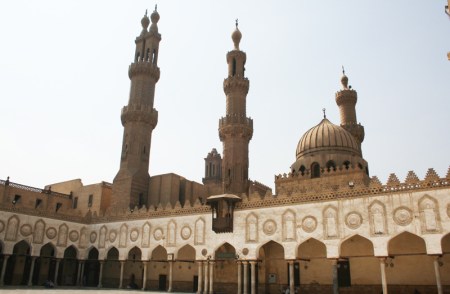
It is from such imams, most of whom are graduates of renowned Islamic institutions in the Middle East and Asia, that Muslims in the West have been receiving guidance. Key among these institutions is Al-Azhar, a Cairo-based Sunni center for higher learning, attended by students from all over the world. Its curriculum includes extremist content, such as tenets that killing “apostates” is a Divine obligation; that it is a Muslim’s duty to humiliate female prisoners through sexual abuse; that adulterers should be stoned to death, and that Christians and Jews are the “enemy of God.”

Many imams in the West are graduates of Cairo’s Al-Azhar, a Sunni center for higher learning. Its curriculum includes extremist content, such as tenets that killing “apostates” is a Divine obligation; that it is a Muslim’s duty to humiliate female prisoners through sexual abuse; that adulterers should be stoned to death, and that Christians and Jews are the “enemy of God.” (Image source: Diego Delso/Wikimedia Commons)

Whenever confronted by critics in the West calling them to task for spreading such violent teachings, many imams respond by cloaking their real objectives, saying that the texts should be read in the context of the time that they were written, and by highlighting peaceful and tolerant Quranic verses. Other clerics — those who do not know how to tailor their rhetoric to Western ears — openly admit their religious ideology’s true intentions.

The infiltration of this ideology is reminiscent of the spread of communism and should be defeated similarly — not with weapons, but by exposing its true nature and providing an alternative. The West first must abandon, however, the notion that radical Islam is an internal Muslim issue, any more than communism was a “Russian issue” that “the Russians” needed to solve.

Islam and Muslims are part and parcel of Western societies, and Islamist terrorism is a global problem.

In addition, the views of liberal Muslim scholars, who reject the whole premise of extremist, political Islam, should be supported and widely circulated. Among these are prominent intellectuals — such as the late Nasr Hamid Abu Zayd from Egypt; Mohammed Arkoun, an Algerian who died in France in 2010; the late Egyptian Supreme Court justice Muhammad Sa’id al-‘Ashmawi; Egyptian talk-show host Islam Bahiri; and the late Sudanese theologian Mahmoud Muhammad Taha — all of whom have provided evidence, based on knowledge of the Quran and Hadith, that the “caliphate” is merely a project to colonize more land, as all the old empires did, and that the hostility toward Jews connected to the Muhammed’s battle with the Banu Qurayza in the 7th century should have ended long ago.

Muslim innovators abound in the West, as well, and should be the ones establishing mosques, educational institutions and media outlets, to provide followers with an alternative to political Islamism. Finally, imams in Western countries must be held to the same standard as members of other professions. They should be required to receive occupational licenses, based on criteria determined by the state, in conjunction with modern Muslims seeking a peaceful life and the ability to integrate into their societies without fear of repercussions at the hands of fundamentalists.

Saied Shoaaib is a Muslim writer and researcher, specializing in Islamic movements. He can be reached at: saiedshoaaib@gmail.com

Between the Thames and the Nile

June 5, 2017

Between the Thames and the Nile, Israel Hayom, Dr. Shaul Shay, June 5, 2017

(On the rare occasions when President Obama led from the front (Egypt and Libya, for example) he led in the wrong direction. — DM)

Europe is currently paying the price for its strategic failure to understand the reality and culture of the Middle East, as it faces waves of terrorism and an influx of immigrants.

The war against terrorism must be decisive, and at times, this entails infringing on individual liberties and imposing restrictions on the media, when it caters to terror organizations. When Western nations and human rights groups exert pressure on Arab regimes that are already engaged in an existential battle against Islamic terrorist organizations, they only diminish these regimes’ ability to win and survive, and, furthermore, indirectly endanger the West.

***********************************

In the past two weeks, the United Kingdom has suffered two major terror attacks, which have killed a total of 29 people and wounded over a hundred. The first attack, on May 22, was carried out by a young terrorist of Libyan descent who detonated himself up outside the crowded Manchester Arena, while the second attack, on June 3, was a coordinated attack by three terrorists that began with a vehicle-ramming on London Bridge and continued with a stabbing spree at nearby busy Borough Market. The Islamic State group claimed responsibility for both attacks.

A few days after the Manchester attack, 29 people were killed and 27 were wounded in a shooting attack on two buses carrying Coptic Christians to the remote monastery of Saint Samuel in the al-Idwah district outside Minya in Egypt. Islamic State took responsibility for that attack too. A few hours later, the Egyptian Air Force launched airstrikes against Islamic State training camps near Derna in east Libya, from where Egypt said the terrorists had come.

Despite the geographical distance between these terrorist attacks, they have much in common. They are a reflection of the growing global Islamic terror problem, which poses challenges to the Muslim as well as the Western world.

In 2011, when the “Arab Spring” revolutions began to spread across the Arab world, the West chose to support those who acted to topple dictatorial regimes, out of an unfounded belief that they would be replaced by Western-style democracies. The result was the disintegration of nation-states created by the West a hundred years earlier, giving rise to a chaotic reality in which radical Islamic movements and terrorist organizations thrive.

Britain was one of the countries that supported the efforts to overthrow Libyan leader Moammar Gadhafi in 2011. Since then, Libya has been torn by civil war and has become a stronghold for Islamic State and al-Qaida terrorists. Furthermore, Libya has become a potential terrorist threat to its neighbors, first and foremost Egypt and Tunisia, by turning into a training base for jihadists from across the globe. Libya is also the gateway to hundreds of thousands of refugees and immigrants on their way from Africa and Asia to Europe.

Europe is currently paying the price for its strategic failure to understand the reality and culture of the Middle East, as it faces waves of terrorism and an influx of immigrants.

The war against terrorism must be decisive, and at times, this entails infringing on individual liberties and imposing restrictions on the media, when it caters to terror organizations. When Western nations and human rights groups exert pressure on Arab regimes that are already engaged in an existential battle against Islamic terrorist organizations, they only diminish these regimes’ ability to win and survive, and, furthermore, indirectly endanger the West.

The West needs to implement a three-tiered strategy involving a determined struggle against radical Islamic groups in the West; economic and security assistance to moderate Sunni regimes such as Egypt and Jordan in order to maintain their stability and assist them in fighting radical Islam at home and abroad; and a combined military, diplomatic and economic effort to rehabilitate failed countries such as Libya and Yemen, to prevent them from developing into a breeding ground for terrorist groups.

Iran Developing Advanced Nuclear Capabilities, Reducing Time to Weapon

June 5, 2017

Iran Developing Advanced Nuclear Capabilities, Reducing Time to Weapon, Washington Free Beacon, June 5, 2017

Iranian President Hassan Rouhani holds a press conference in Tehran on May 22, 2017. AFP PHOTO / ATTA KENARE (Photo credit should read ATTA KENARE/AFP/Getty Images)

Ali Akbar Salehi, the head of Iran’s Atomic Energy Organization, bragged in April that Tehran is prepared to mass-produce advanced centrifuges on “short notice.” Work of this nature would greatly increase the amount of nuclear fissile material produced by Iran, prompting concerns the country could assemble a functional nuclear weapon without being detected.

The issue is complicated by the lack of access international nuclear inspectors have to Iran’s contested military sites, according to the report.

**********************************

Iran is believed to be developing advanced nuclear-related capabilities that could significantly reduce the time it needs to build a deliverable nuclear weapon, according to statements by Iranian officials that have fueled speculation among White House officials and nuclear experts that the landmark accord has heightened rather than reduced the Islamic Regime’s nuclear threat.

The head of Iran’s nuclear program recently announced the Islamic Republic could mass produce advanced nuclear centrifuges capable of more quickly enriching uranium, the key component in a nuclear weapon. Work of this nature appears to violate key clauses of the nuclear agreement that prohibits Iran from engaging in such activity for the next decade or so.

The mass production of this equipment “would greatly expand Iran’s ability to sneak-out or breakout to nuclear weapons capability,” according to nuclear verification experts who disclosed in a recent report that restrictions imposed by the Iran deal are failing to stop the Islamic Republic’s nuclear pursuits.

The latest report has reignited calls for the Trump administration to increase its enforcement of the nuclear deal and pressure international nuclear inspectors to demand greater access to Iran’s nuclear sites.

It remains unclear if nuclear inspectors affiliated with the International Atomic Energy Agency, or IAEA, have investigated Iran’s pursuit of advanced centrifuges, according to the report, which explains that greater access to Iran’s sites is needed to verify its compliance with the deal.

The report comes amid renewed concerns about Iran’s adherence to the nuclear agreement and its increased efforts to construct ballistic missiles, which violate international accords barring such behavior.

“Iran could have already stockpiled many advanced centrifuge components, associated raw materials, and the equipment necessary to operate a large number of advanced centrifuges,” according to a report by the Institute for Science and International Security. “The United States and the International Atomic Energy Agency (IAEA) need to determine the status of Iran’s centrifuge manufacturing capabilities, including the number of key centrifuge parts Iran has made and the amount of centrifuge equipment it has procured.”

Ali Akbar Salehi, the head of Iran’s Atomic Energy Organization, bragged in April that Tehran is prepared to mass-produce advanced centrifuges on “short notice.” Work of this nature would greatly increase the amount of nuclear fissile material produced by Iran, prompting concerns the country could assemble a functional nuclear weapon without being detected.

The issue is complicated by the lack of access international nuclear inspectors have to Iran’s contested military sites, according to the report.

Salehi’s declaration highlights the “profound weaknesses in the JCPOA which include lack of inspector access, highly incomplete knowledge of Iran’s centrifuge manufacturing capabilities and output, and too few centrifuge components being accounted for and monitored,” according to the report.

Iran already has manufactured more centrifuge parts than needed for the amount of nuclear work permitted under the agreement.

The terms of the agreement permit Iran to operate one advanced IR-8 centrifuge. However, Iran is known to have assembled more than half a dozen such centrifuges.

Iran also is working to construct IR-6 centrifuges, which also point to an increased focus on the production of enriched nuclear materials.

“These numbers are excessive and inconsistent with the JCPOA,” according to the report. “Moreover, in light of Salehi’s comments, the excessive production of [centrifuge] rotors may be part of a plan to lay the basis for mass production.”

Iran’s work on “any such plan is not included in Iran’s enrichment plan under the JCPOA,” according to the report.

Inspectors affiliated with the IAEA should immediately investigate the total number of centrifuge parts in Iran’s possession and determine exactly how many of these parts are currently being manufactured, the report states. The IAEA also should attempt to keep tabs on any clandestine nuclear work Iran may be engaging in.

Iran may be misleading the world about its centrifuge production and it still has not declared all materials related to this work, as is obligated under the nuclear deal.

“A key question is whether Iran is secretly making centrifuge rotor tubes and bellows at unknown locations, in violation of the JCPOA, and if it takes place, what the probability is that it goes without detection,” the report concludes.

Additionally, “the United States and the International Atomic Energy Agency (IAEA) need to determine the status of Iran’s centrifuge manufacturing capabilities, including the number of key centrifuge parts Iran has made and the amount of centrifuge equipment it has procured,” the report states.

“They need to ensure that Iran’s centrifuge manufacturing is consistent with the intent of the nuclear deal as well as the deal’s specific limitations on advanced centrifuges,” according to the report. “Moreover, the Iranian statement illuminates significant weaknesses in the Iran deal that need to be fixed.”

When asked to address the issue, a State Department official told the Washington Free Beacon that Iran’s centrifuge work remains very “limited” under the nuclear agreement.

“Under the JCPOA, consistent with Iran’s enrichment and enrichment and [research and development] plan, Iran can only engage in production of centrifuges, including centrifuge rotors and associated components, to meet the enrichment and R&D requirements of the JCPOA,” the official said. “In other words, Iran’s production of centrifuges and associated components are limited to be consistent with the small scale of R&D that is permissible under the JCPOA.”

If Iran is in violation of the deal, the United States will take concrete action to address this once the Trump administration finishes its interagency review of the Iran deal.

“The Trump administration has made clear that at least until this review is completed, we will adhere to the JCPOA and will ensure that Iran is held strictly accountable to its requirements,” the official said.
Key Arab League states cut ties with Qatar over ‘supporting terrorism’

June 5, 2017

Source: Key Arab League states cut ties with Qatar over ‘supporting terrorism’ — RT News

Bahrain, Saudi Arabia, Egypt, the United Arab Emirates, and Yemen have severed diplomatic ties with Qatar, accusing the country of backing terrorist groups. Qatar has called the move a “campaign of incitement” which is “based on lies.”

READ MORE: ‘Terrorism, meddling in affairs’: Bahrain, Saudi Arabia & Egypt cut diplomatic ties with Qatar

An aerial view of Doha, Qatar © Jacquelyn Martin / Reuters

  • 12:18 GMT

    Egypt has ordered the Qatari ambassador to leave the country within 48 hours, and has recalled its charge d’affaires in Doha, according to the foreign ministry.

    “The Qatari ambassador was summoned today and given formal notification of the expiry of his accreditation as an ambassador to Egypt, and was given 48 hours to leave the country,” a statement from the foreign ministry said, as cited by Reuters.

  • 12:00 GMT

    Turkish Foreign Minister Mevlut Cavusoglu called on the sides to resolve the dispute in a “peaceful way.” Ankara “will provide every kind of support for the situation to be normalized,” he added, as quoted by AP.

  • 11:43 GMT

    Tehran has urged the Gulf nations to settle the current dispute through dialogue and diplomacy. “No country in the region will benefit from the heightened tension,” Reuters cited Iran’s Foreign Ministry spokesperson Bahram Qasemi as saying on state TV. “They should adopt peaceful methods, transparent dialogue and diplomacy,” he added.

  • 11:42 GMT

    Several Egyptian banks have suspended dealings with Qatari financial organizations following the announcement of cutting diplomatic ties between the states, Reuters reports, citing four bankers from Cairo.

  • 11:20 GMT

    Qatar has asked its citizens in the United Arab Emirates to leave that country within 14 days, complying with the UAE’s decision, the Qatari embassy announced, according to Reuters.

    “Qatari citizens must leave the UAE within 14 days, in accordance with the statement issued by the concerned Emirati parties,” the embassy tweeted.

    It stated that those who cannot travel directly to Doha should go through Kuwait or Oman.

  • 10:37 GMT

    Moscow won’t meddle in Middle-Eastern affairs, said Russia’s Foreign Minister Sergey Lavrov during a joint press conference with his Belarusian counterpart in Moscow.

    He noted that it is “these countries’ business, bilateral relations.” The minister stressed that Russia is interested in “maintaining friendly relationships with everyone, especially with the region, whose primary goal right now is to focus their efforts on combating our common threat of international terrorism.”

  • 09:43 GMT

    Saudi Arabian Airlines, also known as Saudia, has announced it is suspending flights to Qatar, following similar moves from Emirates, Etihad, and flydubai.

  • 09:12 GMT

    The Maldives has also cut ties with Qatar, according to Al Arabiya.

  • 09:00 GMT

    Libya’s eastern-based government has also cut diplomatic relations with Qatar, Foreign Minister Mohammed Dairi said, as cited by Reuters.

‘Terrorism, meddling in affairs’: Arab countries cut diplomatic ties with Qatar

June 5, 2017

Source: ‘Terrorism, meddling in affairs’: Arab countries cut diplomatic ties with Qatar — RT News


Bahrain, Saudi Arabia, Egypt, the United Arab Emirates, and Yemen have severed diplomatic ties with Qatar, accusing the country of backing terrorist groups. Qatar has called the move a “campaign of incitement” which is “based on lies.”

LIVE UPDATES: Gulf states cut ties with Qatar over ‘supporting terrorism’ Live updates

Bahrain announced early Monday that it is severing diplomatic relations with neighboring Qatar and cutting air and sea connections with Doha, accusing it of meddling in its internal affairs. Bahrain’s state news agency said in a brief statement that Qatari citizens have 14 days to leave the country.

It accused Doha of supporting terrorism and meddling in Manama’s internal affairs.

Citing “protection of national security,” Riyadh then announced it was also severing ties with Doha and closing off all land, sea and air contacts, the Saudi state agency said in a statement, cited by Reuters.

The Saudi state news agency SPA alleged that Qatar “embraces multiple terrorist and sectarian groups aimed at disturbing stability in the region, including the Muslim Brotherhood, ISIS and Al-Qaeda, and promotes the message and schemes of these groups through their media constantly.”

The Saudi-led coalition has announced that Qatar’s participation in its joint military operation in Yemen has been canceled. The coalition’s statement accused Doha of supporting the Al-Qaeda and Islamic State terrorist groups.

Egypt was next to join the diplomatic war, with Cairo announcing it is cutting relations with Doha, according to Sputnik news agency.

Egypt has closed all its seaports and airspace to Qatari vessels and planes, the country’s Foreign Ministry said in a statement.

“The Government of the Arab Republic of Egypt has decided to sever diplomatic relations with Qatar because of the continued hostility of the Qatari authorities towards Egypt,” the Cairo statement read, also accusing Doha of supporting terrorist organizations, including the Muslim Brotherhood.

 The United Arab Emirates (UAE) has followed suit, citing “support, funding and embrace of terrorist, extremist and sectarian organizations” as the reason for cutting ties with Qatar.

The UAE’s state news agency said in a statement that Qatar is “undermining regional stability,” Reuters reports.

READ MORE: Qatar-Saudi spat threatens Riyadh’s influence. But what are the Saudis really worried about?

The Emirates has similarly given Qatar’s diplomats just 48 hours to leave its territory.

Yemen also followed suit, accusing Qatar of working alongside its enemies in the country’s ongoing civil war, Al Arabiya and Reuters reported, citing state news agency Saba.

The government said it cut ties with Qatar partly over its support of extremist groups in the war-torn country, which were “in contradiction with the goals announced by the countries supporting the legitimate government,” AP reports.

“Qatar’s practices of dealing with the (Houthi) coup militias and supporting extremist groups became clear,” the government said in a statement cited by Reuters.

It added that it supports the decision by the Saudi-led coalition in Yemen to remove Qatar from its ranks.

Alarmed viewers of the Qatari TV network Al Jazeera wondered why it was not covering the diplomatic crisis, instead tweeting pieces such as a video about hijab cosplay in Malaysia.

Al Jazeera finally broke the news at around 03:35 GMT, citing a “dispute over a Qatar news agency hack” as grounds for the crisis.

There was no immediate response to the accusations available from Doha, Al Jazeera said.

 The hacking and “fake news” scandal broke out on May 23, when Qatar News Agency’s website and social media accounts were apparently hacked, spreading what Doha calls false statements citing Qatari emir Sheikh Tamim bin Hamad Al Thani. Those included him allegedly slamming the recent tensions with Iran, calling Hamas and Hezbollah “resistance movements,” as well as doubting whether US President Donald Trump will stay in power for long.

READ MORE: Qatar: We were hacked into praising rivals Iran & Israel

The agency’s compromised Twitter account also cited the Qatari foreign minister as saying the kingdom was severing relations with some of its neighbors.

While Doha vehemently denied the validity of those claims, UAE-based broadcasters Al Arabiya and Sky News Arabia picked up the stories, giving them extensive coverage and infuriating Qatari officials.

But the hacking scandal rapidly escalated, with Egypt, Saudi Arabia and Bahrain banning all Qatari-funded news agencies, including Al Jazeera, for what MENA agency called “having content that supports terrorism and extremism, as well [as] publishing lies.”

READ MORE: Bahrain, Egypt block Al Jazeera & others for ‘supporting terrorism & lies’ amid Qatar news ‘hack’

In the latest cyberwar development before the all-out diplomatic crisis, the Bahraini foreign minister’s Twitter account was allegedly seized on Saturday by hackers, who tweeting hostile and insulting clips about Iran. It took more than six hours for Bahrain to regain control of the account, judging by the reports on the Foreign Ministry’s Twitter page.

Saudi Arabia, Egypt and the UAE top the 22-state Arab League in terms of gross domestic product (GDP), with Qatar currently ranking 4th.

Qatar also hosts the US military’s Central Command and some 10,000 US troops, with American forces using its Al-Udeid airbase. AP said there was no immediate response from the Pentagon on the situation.

US President Donald Trump met with the Qatari emir during his recent visit to Riyadh, the capital of Saudi Arabia, describing the royal delegation as “friends” and marking that “our relationship is extremely good.”


