Archive for May 24, 2017

Trump’s new deal

May 24, 2017

Trump’s new deal, Israel Hayom, Boaz Bismuth, May 24, 2017

(The “nattering nabobs of negativism” are still numerous. No matter what happens it will be bad, they say. — DM)

Trump, it turns out, is not going to make the improvement of U.S.-Israel ties contingent on warmer relations between Israel and the Arabs. In his way, he apparently understands the Middle East better than most of the pundits analyzing him. He knows that in this part of the world, people respect you if you are strong; if you weaken your allies you are looked at with scorn. The players in the region respect his decision to stand by Israel — because they know this means he will keep his promises to them as well.

I have long said that Trump was good for the Jews. I said it as soon as he entered the 2016 race. I have long maintained that Trump’s new deal is actually going to be more pressure — on the Palestinians.

*****************************

Over the past several years, conventional wisdom among pundits was that Israel had lost America. They tried to drive home this argument even forcefully after Barack Obama became president.

They told us that Israel was losing its No. 1 ally because it was not relinquishing land; because it insisted that the Arabs recognize it as a Jewish state, and because it was not in a hurry to see a Palestinian state be established. Prime Minister Benjamin Netanyahu’s personal relations with Obama were thrown into the mix as well, and the bottom line was that Israel and the U.S. are no longer friends. Israel, so their thinking went, could only pine for Christopher Columbus.

And then Donald Trump came along. As Secretary of State Rex Tillerson said the other day, “America is back.”

It is also back in Israel. But the truth of the matter is that it never really went anywhere. It was Obama and its administration that went off course, not Israel. The experts said Israel must do a mea culpa and expected Obama to change the world, and Israel.

Ahead of Trump’s visit, this chorus of experts decided they would sing the same song they sang during the 1990s, using the same lyrics: “Palestinian state”; “ending the occupation is a prerequisite for ending Israel’s state of despair.” We all know how well things turned out during the 1990s.

They were willing to swear that as soon as Trump came to Israel, he would apply pressure on Israel and present demands. They said Netanyahu was nervous from what may come. They warned a diplomatic tsunami was making its way to Israel’s shores.

Some even borrowed medical lingo, saying Trump the candidate put some cotton wool on our skin to prepare from the shot, and now he was going to administer it.

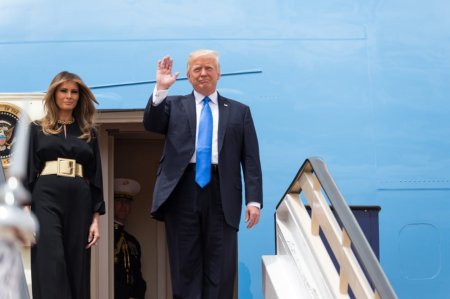
What ultimately unfolded? It turned out that the president who visited Israel this week is the most pro-Israel we have seen in several decades. This man likes us, period. He repeatedly mentions the strong ties between Jerusalem and the Jewish people.

He has promised to protect Israel and to eradicate terrorism, and on the way he said he was determined to make sure Iran would not obtain nuclear weapons and that he would not let anyone hurt Israel. During his visit here he has repeatedly called Netanyahu “my good friend,” as if to make the point that he was not Obama.

How is that possible, the experts wondered. Hasn’t he visited Saudi Arabia on his way? Hasn’t he delivered a speech in front of some 50 Arab and Muslim leaders while he was there? Hasn’t he visited the Palestinian Authority during his trip?

And what about Tillerson, the former head of an energy giant? He cannot possibly be pro-Israel because he is a known wheeler and dealer in the Arab world, they warned.

They also noted that Trump promised to move the U.S. Embassy to Jerusalem but has not done so in the first 120 days of his presidency. Undoubtably, that period is eternity. Not only that, they continued, Trump considered visiting the Western Wall with the prime minister but ultimately decided it would be a private visit. This, they insist, proves that he is actually Obama in Trump clothes.

But lo and behold, Trump’s visit actually ended well, and he had us asking for more. It feels good to have that genuine embrace of a U.S. administration once again. Yes, Israel was deeply loved in America even before Trump came to power, but in recent years this was manifested in Congress, in the public opinion polls in America, among American Christians and among taxi drivers. That’s it.

The Obama White House turned its back on Israel and helped, albeit indirectly, the boycott, divestment and sanctions movement flourish on U.S. campuses.

In the wake of the visit, I dared to think that maybe those experts don’t really know him. After all, the same Trump who was accused of being anti-Muslim got the royal treatment when he arrived in Saudi Arabia, meeting with some 50 Muslim leaders who know full well that he is in love with Zionism.

Trump, it turns out, is not going to make the improvement of U.S.-Israel ties contingent on warmer relations between Israel and the Arabs.. In his way, he apparently understands the Middle East better than most of the pundits analyzing him. He knows that in this part of the world, people respect you if you are strong; if you weaken your allies you are looked at with scorn. The players in the region respect his decision to stand by Israel — because they know this means he will keep his promises to them as well.

I have long said that Trump was good for the Jews. I said it as soon as he entered as the 2016 race. I have long maintained that Trump’s new deal is actually going to be more pressure — on the Palestinians.

Trump’s ‘Islam Speech’ Invited The Muslim World To A Renaissance

May 24, 2017

Trump’s ‘Islam Speech’ Invited The Muslim World To A Renaissance, The Federalist, May 24, 2017

Trump’s Riyadh Summit speech builds on common themes in Abrahamic faiths to advocate for human potential. One of those themes is the archaic but powerful idea of “good versus evil,” as we heard with the repeat phrase “drive them out” as you would drive out the devil that possess the hearts and minds of people, causing mischief in the land. It’s a language not only understood by people in that room, but also by the world watching. Speaking in simple binaries that break down the world into good and evil, President Trump created an opportunity that doesn’t shame Muslims plagued by terrorism. Instead it gives them something greater still to be a part of. That something is humanity.

The alternative is grim. The detriment and the high cost of doing nothing, as Trump points out, is not only the death of life under religious extremism, but also the death of dreams. Let’s give people something to work together for, whether those people are heads of states or those crushed under the weight of war. The speech also powerfully reframed refugees not as destitute victims, but as integral to building stable societies that give them not only autonomy but also dignity.

However flawed they still are, if Muslim nations are willing to come together in partnership with the United States for a common goal, then let’s work with them to secure all our interests

************************

President Trump embarked on an iconic first foreign tour this weekend to the Middle East that started with a stop in Saudi Arabia to deliver a much-anticipated speech on Islam. Americans sat at the edge of their seats in anticipation of what we all sensed was a defining moment in history.

The tour is described as resetting Middle East foreign policy, with President Trump as the first sitting president to embrace complex themes of faith tightly knotted in a rich and often violent regional history. Effectively, he’s channeled the most powerful seat in the world as a vehicle for the most burgeoning diplomatic struggle of the last century.

Yet what makes President Trump’s speech on Islam so iconic is that it wasn’t about Islam. It was about human potential. Presented at the Riyadh Summit, the speech paints a picture of the world that can still be created if nations unite in a common interest of security and advancement through mutual gain. That he spoke at the birthplace of Islam is symbolic because it points at the root of the problem: violent extremism linked to the most fundamentalist interpretations of Islam.

We Have a Common Threat Despite Internal Differences

As hinted in his speech, the last monotheistic faith is still awaiting its renaissance. While there are other issues including non-violent Islamic extremism (Islamism), government corruption, theocracies, autocracies, dictatorships, human rights violations, and failed women’s rights, and on and on, the greatest shadow darkening the future for a world of people is violent jihad that seeks to destroy all standing civilizations equally, including Islamic nation-states it sees as not being Islamic enough.

Back at home, Americans have questioned the authenticity of Muslim nations participating at the summit. American Muslims see the Saudi Arabia as hypocritical in its fight against extremism. Saudis are rightly accused of being both arsonists and firefighters in the fight against extremism.

What also rings true is the strong sense of survival and self-interest fueling the global coalition. Nations should be allies in a common fight, with the understanding that we will not agree on every front or tangential issue. We do not need to all agree; we just need to be aligned on the single greatest threat and work from there. That is how we move forward. Internally, each nation faces its own complications.

A common American reaction was petulant expectation that President Trump “tackle Saudi Arabia” short of going to war with the kingdom. Yet the man is not even allowed to effectively tackle homegrown Islamists in the United States without overwhelming opposition by media and interest groups using propaganda and disinformation.

Meanwhile, Saudi Arabia is dealing with a house divided between Saudis who want progress and those reluctant to move into the twenty-first century, although both sides agree there is an existential threat coming from outside forces even more fundamentalist than they. They can also agree that it is in their collective interest to ally with the United States, something on which all representatives at the Riyadh Summit concur. President Trump understands the most direct path to effecting change is to work in people’s self-interest, to cater to advancement through mutual gain — a strategy that also won him the election.

Let’s Get Beyond Survival

At this exact moment in history, this is about survival. But it is also about what comes after survival. What does the next phase of human evolution look like, and how do we rally the world of people around it?

Trump’s Riyadh Summit speech builds on common themes in Abrahamic faiths to advocate for human potential. One of those themes is the archaic but powerful idea of “good versus evil,” as we heard with the repeat phrase “drive them out” as you would drive out the devil that possess the hearts and minds of people, causing mischief in the land. It’s a language not only understood by people in that room, but also by the world watching. Speaking in simple binaries that break down the world into good and evil, President Trump created an opportunity that doesn’t shame Muslims plagued by terrorism. Instead it gives them something greater still to be a part of. That something is humanity.

The alternative is grim. The detriment and the high cost of doing nothing, as Trump points out, is not only the death of life under religious extremism, but also the death of dreams. Let’s give people something to work together for, whether those people are heads of states or those crushed under the weight of war. The speech also powerfully reframed refugees not as destitute victims, but as integral to building stable societies that give them not only autonomy but also dignity.

In this way, not only was President Trump’s speech iconic, it was visionary for emphasizing humanity and what can still be achieved if we come together. As a Muslim reformer, I focus on getting us to the next phase of human evolution, something that cannot happen without uniting world powers for a common goal. It is a powerful move necessary to destroy the Goliath that’s draining our resources and diverting our attention.

That “Goliath” is the version of Islam that demands we forfeit our humanity. To defeat it, we will need everyone on board, including the people we see as enemies today. If we have to sit at a table with Saudi Arabia to do it, so be it. If Americans expect the Middle East to shed the skin of their tribal identities, then we too have to break out of the tribal mindset that only sees people and populations as one-dimensional. However flawed they still are, if Muslim nations are willing to come together in partnership with the United States for a common goal, then let’s work with them to secure all our interests.
