Archive for May 17, 2017

Report: Top Trump Officials Behind Anti-Trump Leaks to Media

May 17, 2017

A new report is claiming that two top Trump officials, H.R. McMaster and Deena Powell, are behind many of the anti-Trump leaks coming out of the White House

By Paul | |

Source: Report: Top Trump Officials Behind Anti-Trump Leaks to Media

It’s no secret that the Trump White House has a serious problem with leaks. Since President Donald J. Trump took office, individuals looking to damage this administration have fed stories to the liberal media on a regular basis.

Earlier this year, President Trump told Fox News that he believed Obama officials that still work in all areas of government are behind many of the leaks that plague the White House, many of which have serious national security implications.

While President Trump may be correct that disgruntled Obama officials may be trying to destroy this White House, a new report suggests that some of the anti-Trump leaks are coming from within his very own team.

From GOT News:

Two separate National Security Council sources have confirmed that National Security Advisor H. R. McMaster and Deputy National Security Advisor Dina Powell have been leaking negative material about President Donald J. Trump to their allies in the anti-Trump media, GotNews can exclusively report.

“It’s very hard when your boss, the President, and your boss, the NSC advisor, see the world so differently,” says one staffer, who opposes regime change in Syria.

Staffers on the National Security Council describe a culture of intimidation, especially for those who didn’t come in under McMaster and support the Trump campaign’s commitment to put America First.

“It’s like the Bush years never ended,” notes one staffer who didn’t come in under McMaster. “I didn’t sign up for this shit and the American people didn’t vote for it.”

For those of you that forgot, McMaster was brought into the White House following the firing of Michael Flynn. McMaster and Dina Powell are not Trump loyalists, and had no affiliation to the president prior to his election.

Given this important fact, it is not inconceivable to think that career government employees, even though they work for the president, would be behind the anti-Trump leaks that continue to flow out of this White House.

President Trump is not a typical politician, and McMaster and Powell are part of the D.C. establishment that Trump has attacked for years. If the president feels that these two are responsible for leaking to the press, he should fire them immediately. The liberal media forced him to fire Michael Flynn, and if this report is true, it’s no surprise that the left praised the choice of McMaster to serve as National Security Adviser.

Would you be surprised if McMaster and Powell were the source of the leaks? Share your thoughts below! 

Trump Admin Sanctions Iran’s Ballistic Missile Program

May 17, 2017

BY:
May 17, 2017 1:40 pm

Source: Trump Admin Sanctions Iran’s Ballistic Missile Program

The Trump administration announced on Wednesday that it is sanctioning several entities in connection with Iran’s ballistic missile program, which the U.S. intelligence community estimates could be used to carry nuclear weapons over great distances, according to an announcement by the Treasury Department.

New sanctions will be leveled on two senior Iranian defense officials, including one who “facilitated the sale of explosives and provided other support to Syria and the director of the organization responsible for Iran’s solid-fueled ballistic missile program,” according to an announcement by the Trump administration.

New sanctions also have been leveled on a Chinese-based network believed to be supporting Iran’s ballistic missile program via “millions of dollars’ worth of missile-applicable items.”

Another Iran-based entity known to support Iran’s missile program also was hit with sanctions.

The Obama administration had avoided such sanctions to avoid upsetting the Iranians and potentially complicating the nuclear agreement.

The new action comes just days after Director of National Intelligence Dan Coats disclosed to Congress that Iran is continuing to boost its ballistic missile program, including inter-continental ballistic missiles that are capable of delivering a nuclear payload.

One senior Trump administration official working on the Iran portfolio told the Washington Free Beacon that the new sanctions are part of a larger effort to “hold Tehran accountable” for its nefarious activities that threaten regional peace.

“The inter-agency actions today demonstrate that the Trump administration is developing a comprehensive strategy to counter the threat from Iran,” the official said. “President Trump is determined to hold Tehran accountable for its dangerous and aggressive behavior that is destabilizing the Middle East, while making it clear to the Iranian people that he stands with them–not with the regime that has oppressed them for so long.”

U.S. lawmakers, as well as Trump administration insiders, have become increasingly concerned over Iran’s repeated ballistic missile tests since the landmark nuclear agreement was inked.

“This administration is committed to countering Iran’s destabilizing behavior, such as Iran’s development of ballistic missiles and support to the Assad regime,” Treasury Secretary Steven Mnuchin said in a statement. “It is alarming that individuals involved with Iran’s missile program are assisting the brutal Assad regime, and we are taking action to curtail this behavior.”

“These sanctions target Iranian officials as well as a China-based network that are providing support to Syria and supplying items to further Iran’s ballistic weapons program,” Mnuchin said.  “The United States will remain vigilant when it comes to Iran.”

The new sanctions specifically target Morteza Farasatpour, a top Iranian defense official, and Rahim Ahmadi, a senior Iranian official.

Both individuals are key enablers of Iran’s ballistic missile program, according to the Trump administration.

Farasatpour coordinated the sale and delivery of explosives and other materials to Syria on behalf of Iran’s Defense Industries Organization, according to the administration, which estimates the cost of this alliance to be in the tens of millions of dollars.

Ahmadi was sanctioned for his role in coordinating Iran’s ballistic missile flight tests, as well as research and development activities pertaining to the program.

The Trump administration also has targeted Chinese national OFAC designated Chinese national Ruan Runling and three associated Chinese companies for proliferation activities in support of a key designated Iranian defense entity,” according to the Treasury Department.

Ruan operates a network that has provided support to Iranian industries working on the ballistic missile program, including guidance systems.

New sanctions also have been placed on an Iranian-based company known as Matin Sanat Nik Andishan for its proliferation activities supporting Iran’s ballistic missile program.

Matin Sanat has aided an Iranian chemical company responsible for producing Iran’s liquid-fueled ballistic missile industry.

The latest sanctions coincide with the release to Congress of a semi-annual report detailing Iran’s human rights abuses.

The State Department informed lawmakers that it continues to closely monitor Iran’s systematic human rights abuses, including the imprisonment and torture of dissidents.

“As we continue to closely scrutinize Iran’s commitment to the JCPOA and develop a comprehensive Iran policy, we will continue to hold Iran accountable for its human rights abuses with new actions,” the report states. “We urge our partners around the world to join us in calling out individuals and entities who violate international sanctions targeting Iran’s human rights abuses.”

While the Trump administration continues to waive certain sanctions on Iran as required under the nuclear agreement, officials said the administration would not back down from imposing new sanctions, such as those announced Wednesday.

“The United States and its partners will continue to apply pressure on Iran to protect the human rights and fundamental freedoms for everyone in Iran,” the State Department said in its report. “This includes the U.S. citizens wrongfully detained or missing in Iran, and we call on Iran to immediately return them to their families.”

As the Trump administration continues to engage in a review of the nuclear agreement it will continue to counter “Iran’s destabilizing activity in the region, whether it be supporting the Assad regime, backing terrorist organizations like Hezbollah, or supporting violent militias that undermine governments in Iraq and Yemen,” according to the State Department.

Update 1:57 p.m.: This post has been updated with more information.

Update 2:20 p.m.: This post has been updated with further information.

Iraqi officers land in Syria, stir Israeli concern

May 17, 2017

Iraqi officers land in Syria, stir Israeli concern, DEBKAfile, May 17, 2017

Israel was deeply disquieted to discover that Iraq’s Prime Minister Haidar al-Abadi had secretly pivoted his support away from the US-Jordanian campaign for control over the borders of Iraq and Syria, and switched instead to alignment with Moscow and Tehran.

Israeli policy-makers are worried that President Donald Trump will be constrained by the daily barrage of personal attacks descending on from fully focusing on the forces building up dangerously against US military plans in Syria.

****************************

Israeli security chiefs were gravely concerned Wednesday, May 17, when they learned that a high-ranking Iraqi military delegation had arrived in Damascus, the first in decades during which the Iraqi and Syrian ruling regimes were at odds, for a discussion on the situation unfolding on the Syrian-Iraqi border – in particular the Al-Tanf crossing.

DEBKAfile’s military sources reported on May 15 and May 16 on the potential for a clash of arms over this strategic crossing, which is situated at the intersection of the Jordanian, Iraq, and Syrian borders and commands the No.1 Route linking Baghdad with Damascus and the Jordanian capital of Amman.

Wednesday saw a flurry of military activity in the area by US, British and Jordanian special forces, on the one hand, and Syrian, Hizballah and other pro-Iranian forces, on the other. A race appeared to be quietly developing over who would reach the border first and seize control of the Al-Tanf crossing.

On this very subject, the Iraqi military delegation held separate talks in Damascus with senior officers of the Russian command in Syria and senior Iranian officers posted at Syrian General Staff headquarters. Concurrently, the Russian military command announced that Russia, Iran and Iraq were holding consultations on how to secure the border regions between Syria and Iraq.

Our forces add that the three groups of officers got down to brass talks, in fact, on ways to fit Iraqi army units into the Syrian-Iranian effort for guaranteeing full control by Damascus and Tehran of the sensitive border regions.

Israel was deeply disquieted to discover that Iraq’s Prime Minister Haidar al-Abadi had secretly pivoted his support away from the US-Jordanian campaign for control over the borders of Iraq and Syria, and switched instead to alignment with Moscow and Tehran.

Israeli policy-makers are worried that President Donald Trump will be constrained by the daily barrage of personal attacks descending on from fully focusing on the forces building up dangerously against US military plans in Syria.

Trump Administration Taps Sheriff David Clarke for DHS Role

May 17, 2017

Trump Administration Taps Sheriff David Clarke for DHS Role, Washington Free Beacon, May 17, 2017

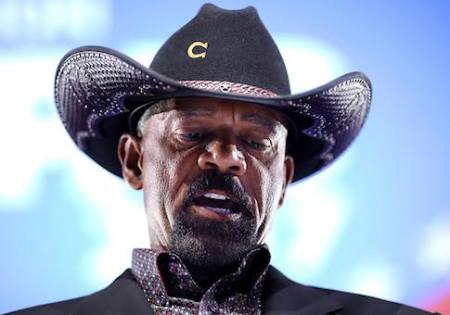
NATIONAL HARBOR, MD – FEBRUARY 23: Milwaukee County Sheriff David Clarke speaks as part of a pannel discussion titled “When did World War III Begin? Part A: Threats at Home” during the Conservative Political Action Conference at the Gaylord National Resort and Convention Center February 23, 2017 in National Harbor, Maryland. (Photo by Chip Somodevilla/Getty Images)

The Trump administration tapped Milwaukee County Sheriff David Clarke to serve as assistant secretary of the Department of Homeland Security for partnership and engagement.

Clarke, a tough-talking, conservative firebrand recognized by his penchant for cowboy hats, announced the appointment during an interview with a local Wisconsin radio station Wednesday afternoon.

“I’m both honored and humbled to be appointed to this position by [DHS Sec. John Kelly], working for the Trump administration in this position,” Clarke told WISN Milwaukee.

Clarke will begin in the position in June. The position does not require Senate confirmation.

Clarke, a Trump loyalist who served as a surrogate during the campaign, was one of three black speakers who endorsed President Donald Trump at the Republican National Convention. He is a vocal proponent of gun rights with close ties to the National Rifle Association.

His name has been floated as a possible replacement to former FBI Director James Comey, but the announcement Wednesday scraps those rumors.

Clarke’s brazenness and tendency to fire-off provocative, off-hand comments have contributed to his rise as one of Wisconsin’s most controversial political figures. The law-and-order sheriff has frequently told Black Lives Matters protesters to “stop trying to fix the police, fix the ghetto” and referred to Ferguson demonstrators as “vultures on a roadside carcass.”

Clarke is also facing scrutiny for the death of a mentally ill inmate who died of dehydration at the Milwaukee County Jail after being refused water for seven days. No criminal charges have been filed, but the case is under review by the Milwaukee County District Attorney’s Office.

The 38-year-old man was one of four people, including the newborn of an inmate, who died last year at the jail overseen by Clarke.

The sheriff will replace the current acting assistant secretary John Barsa.

Poland Says Taking Migrants ‘Much Worse’ Than EU Sanctions

May 17, 2017

Poland Says Taking Migrants ‘Much Worse’ Than EU Sanctions, BreitbartVirginia Hale, May 17, 2017

(The person named beneath the photo is the photographer. — DM)

CHRIS J RATCLIFFE/AFP/Getty Images

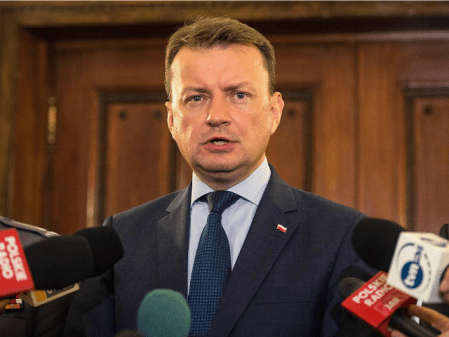
Taking migrants would do more damage to Poland than European Union (EU) sanctions, Interior Minister Mariusz Błaszczak has said, after fresh warnings from Brussels over the country’s refusal to welcome asylum seekers from the third world.

Reacting to the EU setting a June deadline by which Poland and Hungary must take migrants from Italy and Greece or face sanctions, the minister said “the security of Poland and the Poles is at risk” from the bloc’s relocation scheme.

Mr. Błaszczak said giving in to the EU’s demand that Poland welcome more than 6,000 asylum seekers would “certainly be much worse” for the nation than the threat of punishment from Brussels, citing the terror threat in Western Europe as a result of immigration.

“We mustn’t forget the terror attacks that have taken place in Western Europe, and how  — in the bigger EU countries  — these are unfortunately now a fact of life,” said the minister, pointing to demographic change as the cause.

“Remember that the now very numerous Muslim communities (in Western European countries) started out as relatively small numbers.”

The EU quota scheme moving migrants from Italy and Greece  — where asylum seekers from the third world arrive in droves via boat – to other nations in the bloc only exacerbates the continent’s problems with illegal migration according to Błaszczak.

“I tell my counterparts in Western Europe that the relocation strategy only intensifies [illegal migration] because traffickers get even more custom when [would-be migrants] hear people delivered to Europe are being given refuge in EU nations other than Italy and Greece.

“It also risks the lives of people who are trying to reach Europe [on boats],” he added.

On Tuesday, Brussels set a June deadline for Poland and Hungary to start admitting migrants under the EU’s quota scheme.

“I call on Poland and Hungary who have not relocated a single person… to start doing so right now,” EU Migration Commissioner Dimitris Avramopoulos told reporters.

“If no action is taken by them before the next (Commission) report in June, the Commission will not hesitate to make use of its powers under the treaties and to open infringement procedures,” he said.

Trump Policies Surprise Irans’ Extremists

May 17, 2017

Trump Policies Surprise Irans’ Extremists, Iran News Update, May 17, 2017

On the campaign trail, Donald Trump promised to be “unpredictable” and that’s certainly the case as over the past four months we’ve seen policies that have surprised other world leaders, the US public, and at times, even his own cabinet.

But could this be a good thing?

Abdulrahman al-Rashed,  the former General Manager of Al Arabiya News Channel, wrote an op-ed for Al Arabiya in which he asserted that the policies of the Trump administration have surprised and angered extremists (especially in Iran) because they cannot predict his next move and this leaves them two steps behind.

He wrote: “I believe nothing has angered extremists, be them regimes or organized radical groups, as much as the policies of US President Donald Trump has done.”

He argues that Trump’s stark contrast to the policies of former President Barack Obama are working in the US’s favour in relation to Iran, especially considering his recent mission in Iraq and Syria, and Yemen; three places that Iran is heavily involved in.

Some within the current administration have argued that Trump would be constrained by the nuclear deal, but he is finding ways around that.

al-Rashed wrote: “His Government had [expected] to respect the deal and insisted that Tehran should abide by its strict implementation. Trump did not want to be controlled by the deal.”

Others have argued that Trump would wildly discriminate against Muslim-majority countries, because of his call for all Muslims to be banned from entering the US and his subsequent travel bans, but he has reached out to the US’s middle-eastern allies and his first state visit will be to Saudi Arabia later this month.

A key topic of conversation during that meeting will be Iran’s expansionist qualities, especially regarding Iraq and Syria, Iran’s intimidation of foreign ships in the Persian Gulf and Iran’s illegal arms smuggling to Yemeni or Bahraini militias in violation of international law.

al-Rashed wrote: “President Trump is determined to deal with terrorism, not only as a security issue but as an integral political movement. He surprised everyone with his project and actions that began when he met Crown Prince Mohammed bin Salman in the White House; a program was drawn up to determine the allies he plans to cooperate with.”

It appears that Donald Trump, who wants to take down ISIS and foster peace in the Middle East, wants to work with US allies to achieve his goals.

al-Rashed wrote: “We are witnessing a collective project, Muslim governments and individuals are involved in it, and that is the difference. Trump’s policy lies in transferring responsibilities to the international community, especially to Muslim countries. This is the right step, instead of dropping the accusations through the media and be limited to security pursuits.”

Russia And The North Korean Nukes – An Update

May 17, 2017

Russia And The North Korean Nukes – An Update, MEMRI, May 17, 2017

Official Russia’s position on the recent crisis sparked by the North Korean missile tests and the American warnings to Pyongyang ranged from evenhandedness to an approach condemning American unilateralism and muscle-flexing. Below is a survey of comments on the crisis and on North Korea’s nuclear program:[1]
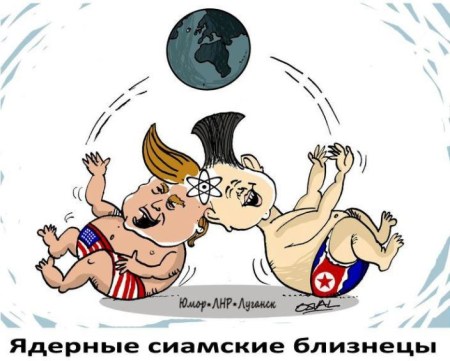
Caption: “Nuclear Siamese twins”

Source: twitter.com/sharzhipero, May 6, 2017; The logo on the bottom emphasizes that the cartoon was drawn in the Lugansk region of Eastern Ukraine that is controlled by pro-Russian separatists)

Russia Detects Launch Of Ballistic Missile From North Korea

On May 13, Russia’s Defense Ministry reported that Russian early warning systems had detected the North Korean missile launch at about 23:30 Moscow time. The Russian Defense Ministry’s statement read: “The missile early warning systems tracked the ballistic target during 23 minutes of its flight until it fell in the central part of the Sea of Japan (about 500 km away from the territory of Russia).” The statement also emphasized that the missile launch “posed no danger” for Russia, and that the Russian missile early warning systems and air defense alert were on routine combat duty.

The Russian news agency Tass reported routinely that North Korea had fired the ballistic missile from the north-west town of Kusong, where much of North Korea’s military industry is based. Tass also carried Japan’s assessment that the missile “flew about 800 km and fell in the sea outside Japan’s exclusive economic zone.”

(Tass.com, May 14, 2017)

Senator Ozerov: Missile Not Directed To Russia, But Russia’s Air-Defense Systems Remain On High Combat Alert

Senator Viktor Ozerov, who heads the Federation Council’s Defense Committee, said that Moscow understands that Russia is not the target of a North Korean attack, but he added: “Nevertheless, in order to keep ourselves safe of possible incidents, our Far Eastern air-defense systems in a high state of combat-readiness.”

(Ria.ru, May 14, 2017)

Putin: The West Should Stop Intimidating North Korea

Answering to media question about North Korea’s missile launch, Russian President Vladimir Putin also said that it was of “no immediate threat” to Russia. However, Putin added that Moscow “categorically opposes any expansion to the club of nuclear powers.” Putin said: “We have made our position clear to our partners, including the North Koreans. We consider this counterproductive, harmful and dangerous.”

On the other hand, Putin mentioned the need to resume dialogue with North Korea, and to “stop intimidating” it. Putin said: “Dialogue with North Korea must be resumed, attempts to intimidate the country must stop and a way to settle these matters peacefully must be found. Is this possible? I believe so, especially considering the positive experience of such dialogue with North Korea. As you may remember, there was a period when North Korea announced the termination of its nuclear program. Regrettably, the negotiating parties failed to muster the patience to translate this intention into reality. I believe we should resume these discussions.

“As for the latest missile launch, the Russian Defense Minister reported to me about it immediately, and the issue was later covered in the media. I have nothing more to say on this. This launch did not present a direct threat to Russia. However, such launches can provoke a conflict, which is not good at all.”

(Kremlin.ru, May 15, 2017)

Yuri Shvytkin, the deputy chair of the State Duma’s Defense Committee, also commented: “Our country is acting in the framework of the international law and… calls on North Korea to refrain from launching various missiles. Having said that, I personally think, that we have to force the U.S. to stop the muscle-flexing games against North Korea…The dispatch of a naval squadron as well as the U.S. president’s rather aggressive comments regarding North Korea, are triggering a defensive reaction… The U.S. should not unilaterally supplant the UN structure.”

(Ria.ru, May 14, 2017)

Russia’s Ambassador to China Andrei Denisov said: “Security in this part of Northeast Asia is complex, as both North Korea’s nuclear-missile program and the military presence of other countries, particularly the U.S., pose a threat to the area. Large-scale military exercises are becoming more and more intimidating, inducing North Korea and other countries to take measures to support their national security.”

(Tass.com, May 11, 2017)

Russian Diplomat: ‘The Reason For Tensions On The Peninsula Lies… Also In The Increased Military Activity Of The United States”

On May 8, at the First Session of the Preparatory Committee of the 2020 Review Conference of the Parties to the Treaty on the Non-Proliferation of Nuclear Weapons (Cluster II. Non-proliferation and IAEA safeguards), Ambassador Mikhail Ulyanov, head of the Russian delegation, said: “Russia rejects the [Democratic People’s Republic of Korea] DPRK’s self-proclaimed nuclear status. We openly declare to Pyongyang our conviction that the policy of nuclear missile capacity building will not contribute to the security of the country. On the contrary, it will have devastating consequences for the DPRK and for the region as a whole. We advocate Pyongyang’s strong commitment to the relevant UNSC decisions, cease of all nuclear and missile tests and return to the NPT regime. It is important though to prevent restrictions from narrowing the window of opportunities for the negotiations, as well as from escalating the humanitarian situation in the DPRK.

“Still we are convinced that the reason of tensions on the peninsula lies not only in Pyongyang’s nuclear and missile programs but also in the increased military activity of the United States and its allies in North-East Asia. It is evident that Pyongyang will not abandon its nuclear weapons as long as it feels that its security is directly threatened. And that is how it interprets regular maneuvers and exercises carried out by U.S.-centered military and political alliances in North-East Asia, alongside the escalation of the U.S. military presence, in particular, deployment of THAAD anti-ballistic missile systems in South Korea.

“The problems of the Korean Peninsula, including the nuclear issue, should be dealt with through an integrated solution to the whole spectrum of issues arising between the parties concerned so as to further create conducive environment for denuclearization. This requires de-escalation of overall military and political tensions, abandonment of further military infrastructure build-up, reduction of the ongoing maneuvers, and establishment of a trust-based climate among the States of the region.”

(Mid.ru, May 8, 2017)

Kremlin-Founded Think Tank’s Director: Russia-U.S. Relations Can Help Ease Asian-Pacific Tensions

Mikhail Fradkov, Director of the Kremlin-founded Russian Institute for Strategic Studies (RISS), said: “the Asian-Pacific direction today is one of the hottest in international relations. Unfortunately, it may appear that the region may literally become hot. What we see here is a snarl of potentially explosive issues, and we all need to join our forces to find peaceful solutions to them using only political means… It is extremely important to activate personal contacts between the Russian and the U.S. presidents during such critical moments in history like this one. Russian-American relations to a great extent identify the general level of security in the whole world.”

(Riss.ru, May 3, 2017)

RISS Analyst Konstantin Kokarev wrote: “The things that are currently happening in northeast Asia directly affect the national security interests of Russia. A targeted concentration of significant military forces of the US in the region and the statements by North Korean leader Kim Jong UN on his readiness for preventive strike with nuclear weapons can result in significant loss of life, permanently and seriously undermine the overall stability, interaction and cooperation in the region. This is a highly undesirable scenario.

“There is only one way out, which to seek solution of the problem exclusively through negotiations and compromise involving all the stakeholders. Russia has consistently advocated the early resumption of six-party talks, peace-building and mutually beneficial cooperation in the region, including in a trilateral format between Russia, the DPRK and the Republic of Korea.”

(Riss.ru, April 28, 2017)

Senator Kosachev: Passing The U.S. Bill On Enforcing N. Korea Sanctions On Foreign Territory Is A ‘Declaration Of War’

Russia has reacted to a bill adopted by the U.S. Congress, tightening sanctions against North Korea. If the law is passed, the U.S. president will have to provide Congress with a complete annual report, covering a period of five years, listing the ports and airports involved in the violation of sanctions against North Korea by any country. In particular, this refers to Vladivostok, Nakhodka and Vanino, as well as ports in China, Iran, Syria and other countries.

Commenting on the bill, head of the Federal Council’s Committee for International Relations, Senator Konstantin Kosachev said: “The realization of this [U.S.] bill includes a proposed force scenario in which the U.S. Navy would conduct compulsory inspections of all ships. Such a scenario is simply unthinkable because it means a declaration of war.” The bill has to be passed by the U.S. Senate and then signed by the U.S. president. Kosachev expressed his hope that Kosachev expressed the hope that the bill won’t pass.

The Deputy Chairman of the State Duma’s Committee for Defense and Security, Frants Klintsevich, also commented: “What immediately draws attention is the list of nations where U.S. congressmen want to have special control over sea ports. These are Russia, China, Iran and Syria. The United States is again trying to expand its jurisdiction all over the globe. It is as if they were telling Russia, China, Iran and Syria that these nations are suspects in crime, which is nonsense, according to international law.”

(Uawire.org, May 5, 2017; .Rt.com, May 5, 2017)

_______________________

[1] See MEMRI Special Dispatch No. 6891, Popular Pro-Kremlin Presenter Says Trump Is More Dangerous Than Kim Jong-Un, April 24, 2017.

Not Satire | Trump’s overseas trip must be canceled. The risks are too great.

May 17, 2017

Trump’s overseas trip must be canceled. The risks are too great, Washington Post

(More wisdom from WaPo. Let’s put Trump in a sound-proof cage so he can’t damage the entire world. Please see also, Is Trump Derangement Syndrome curable? — DM)

President Trump is scheduled to depart Friday on his first international trip as president, with scheduled visits in Saudi Arabia, Israel and the West Bank, and the Vatican, followed by attendance at meetings of NATO in Brussels and the G7 alliance in Sicily. Talking to reporters this morning, national security adviser H.R. McMaster brushed off questions about Trump’s sharing of classified information with Russian officials, focusing instead on the trip’s purpose to “highlight the need for unity among three of the world’s great religions” and further “an agenda of tolerance.”

But less than two hours after McMaster spoke, the New York Times reported this afternoon that Israel is the ally whose intelligence Trump inappropriately shared with Russian officials. Although Israel would not confirm the report, it would, if true, vindicate the fears of Israeli intelligence officials who warned, even before Trump took office, that intelligence shared with the United States could be leaked to Russia, and potentially passed on to Iran.

Here’s the upshot of all this: Trump’s trip must be canceled. Our national security, our relationships with allies, and the security of the world are at risk due to the president’s erratic behavior and inability to adhere to basic norms of both democracy and diplomacy.

Even for a capable president, Trump’s itinerary would represent an ambitious agenda. In Trump’s hands, though, it’s fraught with the perils of tweets, statements, misstatements, boasts or other inappropriate Trump outbursts that could trigger or intensify geopolitical and religious tensions. Beyond politics, the idea that Trump is capable of promoting even an iota of religious tolerance is almost too absurd to even address.

In short, the trip is a catastrophe waiting to happen.

First, and most crucially, revelations about Trump’s conduct over the past 24 hours have rightly spooked our allies. After yesterday’s blockbuster Post article exposing Trump’s cavalier sharing of classified information with Russian officials, the White House has not taken a single step to reassure them, such as publicly acknowledging Trump’s conduct and promising it won’t happen again.

Instead, the White House’s efforts at damage control have only made matters worse. The White House hasn’t meaningfully denied the story; it has only denied that Trump did anything wrong. Today, after Trump tweeted that he had an “absolute right” to share “facts pertaining to terrorism and airline flight safety” with Russian officials, McMaster seemed to acknowledge that the story was indeed true, but that what Trump did was “wholly appropriate.”

But  Trump’s loose lips may have endangered the life of an intelligence source and that person’s family, and it certainly is already damaging our relationships and crucial intelligence-sharing arrangements with allies, according to Stephen Tankel, a defense and national security expert writing at The Post’s Monkey Cage blog.

What’s more, the story is alienating allies. “If it proves to be true that the American president passed on internal intelligence matters, that would be highly worrying,” a senior German lawmaker told the Associated Press. A second European official warned that Trump’s actions may complicate intelligence-sharing with the United States. And by undermining allies’ trust in his ability to keep sensitive information secret, Trump is putting obstacles in the way of the counterterrorism fight. Because Trump is prone to off-the-cuff remarks, even a single misstep during his trip abroad (particularly as he is trying to engage in diplomacy) could further inflame these relationships.

Second, Trump’s justification by tweet this morning — that “I want Russia to greatly step up their fight against ISIS & terrorism” — reveals his utter lack of understanding of who precisely our allies are in the fight against ISIS. (Or, worse, it perhaps reveals a desire to realign those alliances.)

“The idea that Russia is going to be a responsible partner in the future of Syria is belied by years and years of facts on the ground,” Sen. Chris Murphy, the Connecticut Democrat, said at a panel at the Center for American Progress this morning. “We have been trying to get the Russians to be a meaningful partner inside Syria, and they end up doing more damage than good.” On his trip abroad, Trump could further alienate Middle Eastern allies simply by continuing to press his view that Russia could be an ally in the fight against ISIS.

Third, McMaster’s own admission to reporters today that “the president wasn’t even aware of where this information came from,” which was intended as a rationale, only demonstrates further why Trump cannot be trusted with any sensitive information, classified or not. And it further proves he’s winging it in nearly every setting, whether it’s Twitter, television interviews or meetings with foreign leaders.

Trump will be winging it during his trip to Israel, too — and in the polarized Israeli-Palestinian conflict, even seemingly small missteps relating to issues like the status of Jerusalem can set off violence. It’s not an exaggeration to say that lives are at stake. On this front, other warning signs of Trump’s lack of preparedness are in full view: Trump’s team has managed, over the past several days, to alarm Israeli officials with bizarre lapses in basic protocol and erratic statements on Trump’s own policy positions, including on the question of whether the U.S. Embassy should be moved from Tel Aviv to Jerusalem.  Given Team Trump’s lack of preparedness and expertise in the White House and State Department, it’s not unreasonable to expect that further gaffes of this nature are possible during his trip abroad.

That brings us to the final reason why this trip is quite possibly the most ill-conceived misadventure in the history of American diplomacy. Trump, McMaster told us this morning, will give a speech in Saudi Arabia about Islam and religious tolerance.

It is virtually unfathomable that Trump, whose first months in office have been dominated by his (disguised) effort to keep Muslims out of the United States, could give a speech anywhere in the Muslim world on Islam and have it be well-received. Trump, after all, once told the Christian Broadcasting Network that the Koran teaches “a very negative vibe.”

It’s hard to imagine Trump exercising sufficient self-control to emerge from an eight-day trip overseas without incident. He can barely go 24 hours without incident under normal circumstances. The best way to prevent more Trump damage is to keep him home.


Jordan monarch’s comments on Palestinians raise tensions in kingdom

May 17, 2017

Jordan monarch’s comments on Palestinians raise tensions in kingdom, Al Monitor

(Does the King of Jordan want to rid Jordan of Palestinians and hope they will go to Israel? That’s a great idea; Not.– DM)

Jordan’s King Abdullah arrives the opening ceremony of the first ordinary session of 18th Parliament in Amman, Jordan November 7, 2016. REUTERS/Muhammad Hamed – RTX2SB9H

While speaking with the local media, King Abdullah typically repeats national talking points on political reform. When addressing foreign audiences, he frequently adopts a different approach: bluntly assessing the country’s challenges and even violating sacred taboos. The Hashemite monarch’s recent interview with The Washington Post followed the same pattern.

In a surprising remark, Abdullah noted in the April 6 interview, “In 2016, for the first time, we captured and killed 40 [Islamic State] terrorists in two major incidents. Ninety-six percent of them were of Palestinian origin.” He added, “So if we don’t move the Israeli-Palestinian process forward, that is a major recruiting [opportunity] for disenfranchised and frustrated people.”

However, when the government media printed the king’s remarks, they inaccurately translated the king to avoid publicizing the potentially uncomfortable sections. The 96% statistic was removed from Petra News, and the regime-censored version did not refer to Palestinians as “terrorists” in contrast to Abdullah’s own words. Even Al-Ghad newspaper, which bills itself as Jordan’s most independent paper with the slogan “Right to Know,” deleted the embarrassing sections from the interview.

Jordanian political analyst Katrina Sammour explained that the explosive nature of the king labeling such a high percentage of IS terrorists as Palestinian forced newspapers to censor this part of the interview. She told Al-Monitor the 96% description would increase “resentment between Palestinians and Jordanians even more. Palestinians will feel that they are being attacked, and Jordanians will feel that Palestinians are a threat to society.” Due to political sensitivities, Amman does not publicize data about the percentage of Jordanians of Palestinian descent, but The New York Times estimates that the number is up to 60%.

A prominent Jordanian journalist, who insisted on anonymity due to the risks of directly critiquing Abdullah, told Al-Monitor that saying 96% of IS terrorists in Jordan were Palestinian was inappropriate since it “keeps reminding people where they came from and stigmatizes them, linking terrorism to their origin.”

Given the ongoing Israeli-Palestinian conflict where Jordanian media consistently portrays Israel as the aggressors and the Palestinians as victims, the king’s remarks were especially surprising. Kirk Sowell, an Amman-based political analyst and principal of Utica Risk Services, a Middle East-focused political risk firm, told Al-Monitor, “In Arabic, you would never say this. You can’t refer to Palestinians as terrorists. I am not surprised they [Petra News] edited it since it’s a very sensitive issue.”

Widad Salah, an official with the Royal Court media, declined multiple Al-Monitor requests to explain the king’s remarks.

In addition to the potentially offensive nature of Abdullah’s remarks, many disputed the accuracy of his statement to The Washington Post. “The statement was wrong. I don’t believe Palestine is a main drive for people to join terrorist groups in the Jordanian scene. The youth are feeling disenfranchised, there is government corruption and it is an authoritarian regime,” explained Sammour, who has written extensively on radicalism in the Hashemite kingdom.

With over 70% of Jordan’s national population under the age of 30, Sammour emphasized that the needs of the youth are not being adequately met. “The government has not allowed any alternative speech to be introduced or platform for young people to feel that they are expressing themselves, actually being heard and participating in the decision-making process,” she said. Approximately 2,000 Jordanian fighters have joined IS in Syria and Iraq, including the son of Jordanian member of parliament Mazen Dalaeen, who carried out a suicide attack in Anbar province.

Abdullah’s Washington Post comments are noteworthy given the Hashemite kingdom’s “Raise your head, you are Jordanian” campaign ongoing across Amman since 2015. The government’s message is encouraging national pride for all of its citizens, including those of Palestinian and East Bank descent.

“There is a fiction that there actually is no distinction” between Palestinians and East Bankers, said Sowell. The king’s comments highlighting the fact that the overwhelming majority of IS terrorists captured or killed in 2016 were of Palestinian origin “contradicts the superficial unity,” he added. With the vast majority of sensitive positions in the Jordanian security services awarded to East Bankers while Jordanians of Palestinian origin maintain significant influence over the private sector, “there are real problems of identity,” Sammour stressed.

While clarifying that the king’s motive of raising awareness in the West about establishing a Palestinian state is noble, Mohammed Hussainy, the director of the Amman-based Identity Center think tank, disagreed that Jordanians join IS due to Israel. He told Al-Monitor, “It is clear that IS is not mentioning the Palestinian cause in their media or as a goal.” IS has mainly focused on fighting Shiites, Kurds and Yazidis, Sowell pointed out. Noting that IS combats other Muslims, former Jordanian lawmaker Hind al-Fayez told Al-Monitor, “I’d rather that they [Jordanian youth] join Hamas instead of joining IS because Hamas is entitled to fight the Israelis for protecting their land.”

The Jordanian media’s approach of censoring such sensitive information is naive with the spread of the internet and Facebook and no longer guarantees — as it did decades ago — that the public is shielded from controversial subjects, Bassam al-Badareen, the Amman bureau chief for Al-Quds al-Arabi, told Al-Monitor.

Frustrated by the king’s insistence on linking national origin to radicalism, the Jordanian journalist said, “We are all Jordanians regardless of where we come from. It doesn’t mean if he is originally Palestinian, he is more prone to be a terrorist.”


Sweden: A Qatari Protectorate

May 17, 2017

Sweden: A Qatari Protectorate, Gatestone InstituteJudith Bergman, May 17, 2017

In the former democracy of Sweden, politicians are no longer answerable to the citizens, and can apparently cover up whatever topics they choose, no matter how detrimental to the people who elected them. The mainstream media willingly collude with the authorities by uniformly ignoring the issue.

**********************************

At the opening of the mega-mosque, Malmö City Councilor Frida Trollmyr gave a speech in which she continued to use the term “cultural center”, never using the word “mosque”, as if — Soviet-style — the use of certain words could alter reality.

The mega-mosque was never supposed to be a mosque, according to the Wakf’s own application for building permits, but merely a “cultural center” (the application talks about “an activity center for youth and families in Malmö with a focus on Rosengård”).

When the journalist asked Khaled Assi whether his organization was in fact building a mosque, he told her that “there already is a mosque in Malmö” and that the “cultural center” would just contain a “small prayer room”.

On April 28, the Ministry of Awqaf and Islamic Affairs of the State of Qatar opened the Umm Al-Mu’minin Khadijah Mosque in Malmö, Sweden. Qatar — the epicenter of Muslim Brotherhood and the base of its proselytizing megaphone, Al Jazeera — paid more than 3 million euros to build the mosque, which is almost 2,000 square meters and accommodates up to 2,000 people, making it the largest mosque in Scandinavia.

One astonishing fact about this new mega-mosque is that, according to Swedish mainstream media, the opening never happened. Not a single Swedish news outlet mentioned the opening. Swedish authorities were also completely silent on the topic. On her Facebook and Twitter accounts, Malmö’s Mayor, Katrin Stjernfeldt Jammeh, wrote about the opening of a new office for army recruits in Malmö and the Swedish coast guard moving its activities to Malmö harbor, but failed to mention the opening of the largest mosque in Scandinavia. The website of Malmö municipality was also silent on the topic.

For information on what goes on in Sweden, therefore, one has to turn to Qatar News Agency, which reported:

“Director of the Islamic Affairs Department at the Ministry of Awqaf and Islamic Affairs Khalid Shaheen Al Ghanim said that the mosque was built and furnished by the State of Qatar at a cost of over 3 million euros, under the supervision of the Ministry of Awqaf and in collaboration with the Wakf of Scandinavia in Malmo, Sweden

“He added that the Umm Al-Mu’minin Khadijah Mosque is the largest mosque in Scandinavia and is located on the first and second floors of the four-story building of the Wakf of Scandinavia in Sweden. The mosque is equipped with facilities for people with special needs to perform prayers and others for children and women.

“The opening ceremony was attended by representatives of Swedish local authorities, representatives of Islamic institutions in Sweden and Denmark, as well as a number of businessmen.”

The organization in Sweden behind the mega-mosque is the Swedish Wakf, better known as the Islamic Community of Malmö. In its statutes, the Swedish Wakf describes itself as a “religious and cultural community, registered as an ideal institution”, and “politically independent”.

The neighbors of the mega-mosque, which was never supposed to be a mosque, according to the Wakf’s own application for building permits, but merely a “cultural center” (the application talks about “an activity center for youth and families in Malmö with a focus on Rosengård”), protested when they learned of the plans in 2010. The Malmö municipality brushed them off. “It is like any congregational activity, and I find it hard to see that there should be anything to worry about”, said Dick Johansson, representing Malmö municipality, at the time.

As it turns out, there is a great deal to worry about.

Several of the Swedish Wakf’s members come from the Swedish Islamic Cultural Association, whose spokesman and front figure, Ammar Daoud, was described by Swedish newspaper Sydsvenskan in an article from 2006, as the “apprentice” of the Danish imam Abu Laban. Laban, who died in 2007, was known for his jihadist connections and for instigating riots in the Muslim world against Denmark after the 2005 publication of the Mohammed cartoons in Denmark’s Jyllands-Posten. He led his own Danish Wakf — Danish Islamic community — in Copenhagen.

Laban declared Sayid Qutb, the Muslim Brotherhood’s chief ideologue, to be his role model, and was a frequent guest preacher at one of the basement mosques of the Swedish Cultural Association in Rosengård (a crime-ridden, infamous no-go zone in Malmö).

Already in 2006, Abu Laban told the daily Sydsvenskan that he wanted to “help” his Swedish Muslim friends establish a new mosque. Abu Laban and Ammar Daoud were unhappy with the existing mosque in Malmö, Islamic Center Mosque, which Abu Laban derisively labelled “Islam-light”.

In 2010, Khaled Assi, head of the Swedish Wakf (a position he still holds today), told a Swedish journalist that he was “inspired” by Abu Laban and his Wakf in Denmark. When the journalist asked Khaled Assi whether his organization was in fact building a mosque, he told her that “there already is a mosque in Malmö” and that the “cultural center” would just contain a “small prayer room”. Asked about the financing of the project, Assi said that the Wakf was “unassociated with any organization” and that all financial contributors were “individuals from Malmö and Skåne”, although they would also approach “individuals” abroad.

At the opening of the mega-mosque of the Wakf on April 28, Malmö City Councilor Frida Trollmyr gave a speech in which she continued to use the term “cultural center”, never using the word “mosque”, as if — Soviet style — the use of certain words could alter reality:

“In many ways, this cultural center is unique but at the same time it is one of many meeting places that has contributed to the diversity that has made Malmö into the city it is today. We Malmöites know what this diversity entails and all its strength — it is that which has made Malmö into the city it is today.”

Trollmyr’s speech will go down in history as the moment Malmö municipality finally submitted completely to Islam.

When the Swedish independent news site, Samtiden, tried to reach Trollmyr for comment on how the new gender-separated mosque corresponds to Swedish values about gender equality, about Trollmyr’s views on the financing of mega-mosques by foreign dictatorships, and what this entails for Malmö with regards to radicalization, Trollmyr’s secretary informed Samtiden that the politician did not have time to answer the questions.

In the former democracy of Sweden, politicians are no longer answerable to the citizens, and can apparently cover up whatever topics they choose, no matter how detrimental to the people who elected them. The mainstream media willingly collude with the authorities by uniformly ignoring the issue.

One would have thought, however, that at least one mainstream Swedish journalist would be interested in uncovering the cover-up of the Swedish authorities. Here are some of the many unanswered questions:

How did a project that the Malmö municipality approved as a “cultural center” end up as the largest mosque in Scandinavia?

How did an organization, the Swedish Wakf, which is supposed to be “politically independent”, and which said it was collecting its financing from local Muslims, end up having its mosque bought and paid for by Qatar, the primary exporter — along with Saudi Arabia — of Wahhabism in the world?

When did Sweden become a province of the dictatorship of Qatar, where the presence of Qatari government officials at the opening of a Qatari-funded mosque in a major Swedish city does not elicit the slightest media attention, let alone criticism, as if this kind of occurrence were the most routine order of the day? Instead, the only Swedish reaction is an embarrassingly sycophantic speech by a representative of the Malmö municipality.

In short, when did the Swedish population vote to become a Qatari protectorate?

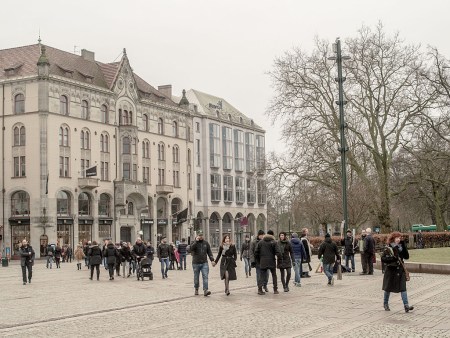
Malmö, Sweden. (Image source: David Ramos/Getty Images)