Archive for April 2017

U.S. Considers Re-Imposing All Sanctions on Iran, Dismantling Nuke Deal

April 19, 2017

U.S. Considers Re-Imposing All Sanctions on Iran, Dismantling Nuke Deal, Washington Free Beacon, , April 19, 2017

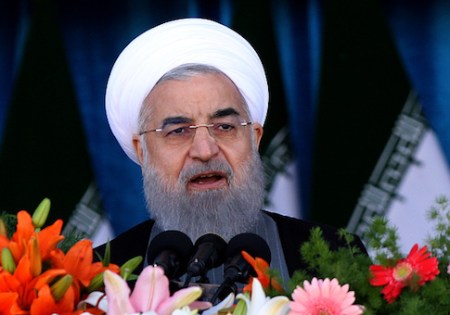
Iranian President Hassan Rouhani delivers a speech during a parade on the occasion of the country’s Army Day, on April 18, 2017, in Tehran. Photo credit: ATTA KENARE/AFP/Getty Images

Obama administration officials, while selling the nuclear deal to Congress, vowed that Iran would roll back its nefarious activities if it received relief from sanctions.

Tillerson informed Congress this has not happened. After receiving billions in cash assets and other economic relief, Iran invested heavily in its military and the Iranian Revolutionary Guard Corps, or IRGC, which continues to meddle in Syria, Iraq, Yemen, and a host of other countries.

************************

The Trump administration is considering re-imposing a massive set of economic sanctions on Iran that were lifted by the Obama administration as part of the landmark nuclear agreement that gave Tehran billions in economic support, according to U.S. officials who told the Washington Free Beacon that Iran’s military buildup and disregard for international law could prompt U.S. reprisal.

Secretary of State Rex Tillerson told Congress in a letter sent Tuesday that Iran is complying with requirements for its nuclear program imposed under the nuclear accord. However, Tillerson emphasized that Iran continues to be the world’s leading state sponsor of terror.

Tehran’s malign activities across the Middle East and elsewhere have prompted the Trump administration to place all aspects of the nuclear agreement under critical review, which is viewed by some as a first step to nixing some controversial aspects of the accord, including the massive sanctions relief package.

U.S. officials familiar with the review told the Free Beacon that Iran’s continued support for terrorism has become a sticking point for the Trump administration as it reviews the agreement and the previous administration’s policy toward Iran.

“I think the key is what comes next,” one senior White House official familiar with the interagency review told the Free Beacon. “The question of ongoing sanctions relief will be critical—Iran has already gotten significant economic benefits from the nuclear deal and we need to take a hard look at what Iran is doing with the resources that continue to flow in.”

The Trump administration has been paying close attention to Iran’s ongoing military buildup, including its continued work on ballistic missiles and other offensive weapons aimed at interfering with U.S. operations in the Persian Gulf region.

“Yesterday was the annual Army Day celebration—also known as Death to Israel day—and they paraded some pretty serious new hardware through the streets,” the White House official disclosed. “That has to be a significant concern.”

The White House’s national security apparatus will closely monitor Iran’s behavior as it makes a decision about re-imposing sanctions lifted by the Obama administration.

Tillerson’s emphasis on Iran’s terror operation is “a first step, but we have to remain focused on the threat Tehran poses to America and our allies,” the official said.

Obama administration officials, while selling the nuclear deal to Congress, vowed that Iran would roll back its nefarious activities if it received relief from sanctions.

Tillerson informed Congress this has not happened. After receiving billions in cash assets and other economic relief, Iran invested heavily in its military and the Iranian Revolutionary Guard Corps, or IRGC, which continues to meddle in Syria, Iraq, Yemen, and a host of other countries.

“Iran remains a leading state sponsor of terror through many platforms and methods,” Tillerson told Congress. “President Donald J. Trump has directed a National Security Council-led interagency review of the Joint Comprehensive Plan of Action (JCPOA) that will evaluate whether suspension of sanctions related to Iran pursuant to the JCPOA is vital to the national security interests of the United States.”

“When the interagency review is completed, the administration looks forward to working with Congress on this issue,” Tillerson wrote.

The dictator’s hour

April 19, 2017

The dictator’s hour, Venezuela News and Views, Daniel Duquenal, April 18, 2017

(My wife and I were in Venezuela off and on for several years in the late 1990s and early in the current century, before and after el Thugo Chavez came to power. Food and essentials were plentiful and inexpensive and the medical care we received was quite good. The people in urban and rural areas seemed reasonably happy and well-fed. The situation changed slowly but inexorably for the worse, then much became worse and then became unbearable.

Now Venezuela is at least as hellish as any country in the Middle East. The people of Venezuela are revolting but the “mainstream” media are paying scant attention. 

It would be very difficult for the Mad Mullas of The Islamic Republic of Iran to deal more harshly with protesters than have the Venezuelan dictators. Perhaps, with the Iranian elections coming next month, the Iranian people will achieve more than have the Venezuelans thus far; the slate of candidates, unfortunately, suggests that the situation in Iran will not change for the better unless the Iranian people have a successful revolution. At least the Middle-East media will be more attentive. — DM)

So we are in a dictatorship. And this one has made new progress these past days to prove to the world it is so.  We had Sunday a totally infamous presentation by the president Nicolas Maduro where live on TV he decided who is guilty of what and how.  This based on torture.  Yesterday he went further on that path convoking the militia to Caracas to stop the massive opposition protest planned for tomorrow and forcing the army to repeat once again their indefectible oath to the revolution and its heir, the dictator.  As a bonus he promised to arm the militia, which one needs to be recalled , is not constitutional. But details are not the regime’s forte.

The army today is controlling all the streets it can and all the entries to Caracas to make sure protesters do not come to fill in Caracas protests. Useless as the opposition is convoking protests in all major cities of Venezuela. You need not go to Caracas to state that Maduro is a piece of shit: you can do it in the comfort of your own city where repression awaits for you all the same than in Caracas. Decentralization at its best.

Funny dicator. He does not rule, he is just the front man but it seems that he has started to believe that all the narco generals, the corrupt generals and civilians, the Cubans cashing in whatever cash they can still grab, trust power into his hands.  Meanwhile we read things like this:

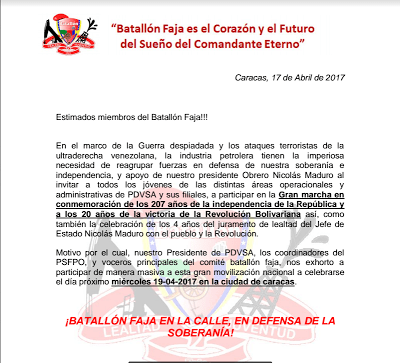
This memo of April 17 “exhorts” PDVSA employees from the Orinoco area (almost a day drive to Caracas) to attend the regime called counter march to block access to the opposition to downtown Caracas. It starts with the following words “Within the merciless War and the terrorist attacks of the venezuelan ultra right, the oil industry has the imperious need to regroup its forces in the defense of our sovereignty and independence, and support to our Worker president Nicolas Maduro to invite all….” you get it.  I respected the words with capital letters as I think they betray the subconscious of whomever wrote this memo.

Of course outside the country no body is buying it and even Cuba takes its distances from an eventual bloodbath for which they probably gave the order to the army. the local representation of the European Union had a communique (rather vague but better than nothing, and at least implying that the EU will have observers in the streets). OAS secretary on the other hand went all out with a communique of a strength unheard of in the OAS, which reflects the major hemispheric concern about what Maduro is trying to do. In English.

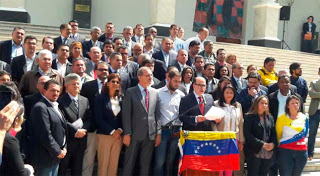
Of course, solemne declarations also exist in Venezuela, like the one from the National Assembly with a solid representation of its members, putting a face to the resistance to Maduro, and putting a face to its possible victims tomorrow.

The hour is dire indeed.

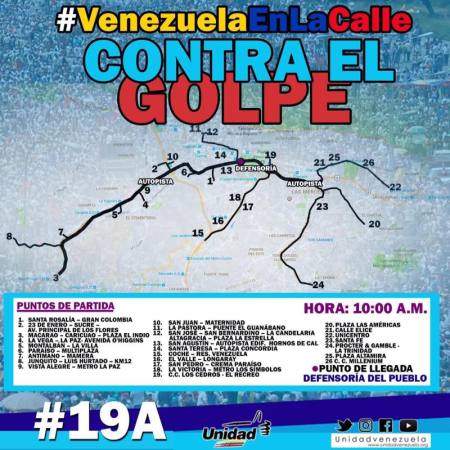
The opposition has convened a freedom march tomorrow starting from more than a dozen points in Caracas. As such it is impossible to block unless the regime acts early to block through whatever means the starting points in downtown Caracas, their hallowed excuse for repression.

The regime who dodged such a massive show of strength by the opposition last year through a fake dialogue has not found any excuse this time to slow down the mounting protest. The aslt two weeks fo marches and repression only seem to have united the opposition and render it more decided to end this conflict once and for all.

All sorts of threat have been uttered such as this Monday promises to arm the militia to maintain order against the opposition. That an election would be the best way to end the conflict is not an option for a regime who knows that 1) it will lose them and 2) it will have its leadership go to jail shortly afterwards for the crimes committed.  So we have pictures like this one commented by Le Monde from France. Of course, when you are an European and you see brown shirts like that with a peppering of military you jump. This is possibly the worst message to be read in any capital of Europe, probably even Budapest (Ankara is not in Europe and will never be apparently, but I digress).

Le Monde underlines this:

« Fini le temps des traîtres, des trahisons, fini le temps des hésitations, que chacun se définisse : on est avec la patrie ou on est contre elle ! », a lancé le président vénézuélien, lundi.
“The time of traitors is over, the times of hesitation is over, may each one self define: we are with the fatherland or we are against it.” thrown by the venezuelan president on Monday.

Sieg Heil would do nice at the end of that.

We also read the declarations of 11 LatAm countries warning the regime about abuse tomorrow. It is nice to see that Tal Cual reports on this lifting the logo of this blog, a logo since 2003 which has been lifted by several people from chavistas to Tal Cual. Lifted by Tal Cual is an honor and proves that at least someone there reads my blog. I do take the best pictures, check out my instagram 🙂

But again I digress.

The point here is that Maduro seems to go all out against tomorrow and he is clearly wanting a confrontation to solidify his dictatorship. Will the army oblige?

Meanwhile tomorrow in Caracas you may choose your meeting point for 10:00 AM. I will start from Plaza Las Americas #20 if anyone cares to meet me. And I will try to post stuff through Instagram if signal allows, which is rare when so many people are in the street using bandwidth. It will be nice if I could get a pic from EVERY starting point to post it here tomorrow evening.

Que este sea el punto de partida de la mayor presión que se haya hecho contra la dictadura. Desbordemos Vzla.


Kurdistan Independence Referendum and Why It Matters so Much in the Fight Against Radical Islam

April 19, 2017

Kurdistan Independence Referendum and Why It Matters so Much in the Fight Against Radical Islam, Clarion ProjectJennifer Breedon, April 19, 2017

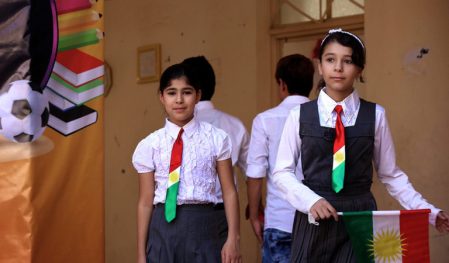
Iraqi Kurdish students attend the first day of the new school year in Arbil, the capital of the autonomous Kurdish region of northern Iraq, on September 10, 2014.  AFP PHOTO / SAFIN HAMED (Photo credit should read SAFIN HAMED/AFP/Getty Images)

Most Kurds are Muslim, but reject religious rule in favor of secular governance so that all religious people and ethnic minorities can have fair and equal representation. The Kurds have adopted secular lifestyles seen just by visiting the capitol city of Erbil where you’ll hear American music, see a booming economy, or have conversations about new business enterprises.  If you’re lucky, you may run into the Erbil Men’s Club. Kurds don’t identify as “Sunni” or “Shia” at the outset. While they will openly say what religion they practice, they refuse to allow their identity to be encompassed in the sectarian strife they’ve witnessed throughout the Middle East. They want no form of oppressive sharia law in their governance to promote the rights of women and minorities. In fact, Kurdish government mandates that 30% of Parliament members be women. I witnessed that firsthand and it looks a lot like the United States: churches, mosques, and synagogues side-by-side with equal numbers and mutual respect between all religious leaders.

****************************

The recent rejuvenated referendum on Kurdistan Independence will likely draw a few questions from people. Namely (1) What does “Statehood” mean and what is required to gain it? (2) Why does an independent Kurdistan really matter? And (3) Is it really helpful to have another independent government in the Middle East in an already volatile area?

What does “Statehood” mean and what is required to gain it?

Becoming a state provides autonomy and self-determination that allow a government to aid their people, provide security to their region, build infrastructure, among many other things. Even autonomous regions within a state are subject to the official national government decisions and therefore cannot enter into alliances with potential allies. In this situation, it matters for the United States because the modern Kurds and the Kurdish government in Northern Iraq are extremely pro-America and pro-democratic freedoms.  In an age where the Middle East is constantly laced with sectarian violence, the Kurds are a secular governing force that rejects extremism. However, since it is merely an “autonomous” region of Iraq, they are subject to alliances of the Iraqi government and cannot be a strength of secular democratic governance that is so desperately needed throughout the Middle East.

The Montevideo Convention of 1933 outlined the four main requirement of statehood. Those are: a permanent population, a defined territory, a government, the capacity to enter into foreign relations with other states. However, meeting the Montevideo requirements doesn’t automatically gain independent statehood today. That requires recognition by the international community (and recently done via the United Nations).

The Kurdish region was officially recognized as semiautonomous in the 2005 Iraqi constitution following the U.S. invasion of Iraq and fall of Saddam Hussein’s regime. Today, that region and the territories closest to it have become the only safe zone for refugees and IDPs fleeing from the wrath of ISIL in Iraq.

Why does an independent Kurdistan state really matter?

When I was meeting with Kurdish government officials in January this year, I asked this very question to Dr. Dindar Zebari, a top official in the Kurdish Democratic Party.

Dr Zebari: “…you cannot have a success story within a failure story [Iraq]. Sectarian violence in the Middle East-and especially Iraq-will continue. There is a problem and that’s religious engagement in government and it holds all of humanity back: the case of Shia vs. Sunni. Yazidi, Christian and other minority communities will be under religious extremist governments because the ethnic cleansing under these governments will never stop. Kurdistan has been successful as an accepting autonomous region and our government has never and will never turn away minorities. Our constitution is based on individual human rights and not religious identity.

JB: What makes Kurdistan as a state unique in this region?

Dr. Zebari: We are unique in that we already have self-determination and friendly relations with many other governments. The only forces that have EQUALLY protected all the religious minorities since ISIS began their violence, are the Peshmerga forces. We have already delivered more for the rights of minorities and protecting from ISIS than many other independent states in this region even though we aren’t yet a recognized nation-state.

According to the CIA World Factbookthere has been voluntary relocation of many Christian families to northern Iraq” since the rise of ISIS. An article in the Council for Foreign Relations noted in 2015 that, “even while asserting their autonomy, Iraqi Kurds are still considered by policymakers as the ‘glue’ that holds [Iraq] together amid sectarian tensions between Sunni and Shia Arabs.

Today, almost all the U.N. refugee areas for ISIS victims are in or near the Kurdish region because it has been secured by the Kurdish Peshmerga forces. However, since the Kurds are not an independent nation-state, they are not privy to U.N. practices in refugee camps, nor are they invited to talks on the humanitarian situation in the region. Additionally, when money is sent to the “refugees” and IDPs living in camps in the Kurdish region, none of that money goes to the Kurdish Regional Government because they are not a recognized state. The money is either given directly to the United Nations OR the “recognized” government of Iraq in Baghdad.  Considering that Iraqis have fled Baghdad for safety in Erbil and the Kurdish region, this seems to make very little sense in helping those that need it most and supporting the forces protecting the victims.

Jennifer Salcido, a humanitarian filmmaker in Iraqi Kurdistan, recently met with a small group of Assyrian Christians. When she asked them why they didn’t go to Baghdad for safety from ISIS, they responded, “Because they will murder us in Baghdad. We are much safer in Erbil [Kurdistan region capital].

Is it really helpful to have another independent government in an already volatile Middle East region?

The answer is 100% yes if that independent government is friendly to the United States, Israel, and secular governance including human rights and not Islamist sharia implementation. The Kurds have no sharia laws or desire to impose Islamist laws. They’ve been persecuted by Islamist governments for far too long and the modern Kurdish parties, such as the KDP, have adopted a secular democratic constitution.

Most Kurds are Muslim, but reject religious rule in favor of secular governance so that all religious people and ethnic minorities can have fair and equal representation. The Kurds have adopted secular lifestyles seen just by visiting the capitol city of Erbil where you’ll hear American music, see a booming economy, or have conversations about new business enterprises.  If you’re lucky, you may run into the Erbil Men’s Club. Kurds don’t identify as “Sunni” or “Shia” at the outset. While they will openly say what religion they practice, they refuse to allow their identity to be encompassed in the sectarian strife they’ve witnessed throughout the Middle East. They want no form of oppressive sharia law in their governance to promote the rights of women and minorities. In fact, Kurdish government mandates that 30% of Parliament members be women. I witnessed that firsthand and it looks a lot like the United States: churches, mosques, and synagogues side-by-side with equal numbers and mutual respect between all religious leaders.

The issues in the Middle East come down to proxy wars and one important differentiation: Does the country have a theocracy or a secular government that governs the people with basic freedoms of life and liberty to freely worship? The Kurdish government maintains the latter and thus makes their application for statehood a necessary element in upholding human rights and providing for a more stable and violence-free Middle East.

Why Is the US Still Funding Palestinian Terrorism?

April 19, 2017

Why Is the US Still Funding Palestinian Terrorism? Gatestone Institute, Shoshana Bryen, April 19, 2017

(Please see also, Towards the pending Abbas visit to Washington D.C. — DM)

Jamil Tamimi, 57, knew that if he committed an act of terror, he would be lionized by the Palestinian Authority (PA) and — perhaps more importantly — that, if he were killed or sent to prison, his family would be taken care of financially.

“The PLO Commission was new only in name. The PLO body would have the ‎same responsibilities and pay the exact same amounts of salaries to prisoners… PA Chairman Mahmoud Abbas retained overall supervision of ‎the PLO Commission.” — Palestinian Media Watch.

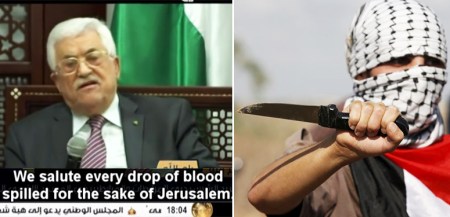
In 2016 Bashar Masalha, who murdered U.S. Army veteran Taylor Force and wounded several others, was hailed on official PA media outlets as a “martyr.” A few months later, Abbas said on PA TV, “We welcome every drop of blood spilled in Jerusalem…. With the help of Allah, every martyr will be in heaven, and every wounded will get his reward.”

The U.S. government should let the PLO and PA know that we are onto their game. Disincentivizing terrorism by closing the PLO office in Washington would be a good first step.

British exchange student Hannah Bladon was stabbed to death on a Jerusalem light rail train last Friday. Her murderer was identified as an East Jerusalem resident who had previously been convicted of molesting his daughter and had tried to commit suicide. Failing at that, he apparently opted for terrorism, on the assumption that the police would kill him. They didn’t. “This,” the Shin Bet said in a statement, “is another case, out of many, where a Palestinian who is suffering from personal, mental or moral issues chooses to carry out a terror attack in order to find a way out of their problems.”

“Suicide by cop” is not unheard of, but the real incentives need to be spelled out.

Jamil Tamimi, 57, knew that if he committed an act of terror, he would be lionized by the Palestinian Authority (PA) and — perhaps more importantly — that, if he were killed or sent to prison, his family would be taken care of financially.

To take the PA leader, Mahmoud Abbas, at his word, the PA itself does not pay salaries or pensions to terrorists in Israeli jails or to their families; the money — instead! — comes from the Palestine Liberation Organization (PLO). That sleight-of-hand would make this a perfect time for the United States, an ally of the UK and properly appalled by terrorism, to take a step it has been avoiding for more than 25 years: to close the PLO office in Washington — preferably before the planned visit by Abbas in May.

The PLO was once understood to be a terrorist organization and a terror umbrella. It hijacked airplanes and threw an elderly disabled man in a wheelchair overboard from a cruise ship. Black September, an arm of the PLO, murdered 11 Israeli Olympic athletes in Munich. The PLO has committed acts of horrific terror in Israel — including massacring bus drivers and their families on holiday. Twenty-five adults and 13 children were killed and 71 others wounded. The PLO has also committed acts of war against the United States by killing American diplomats in Sudan.

In the 1970s and 80s, the U.S. generally knew what it was looking at.

During the Reagan-to-Bush “41”-transition, however, the U.S. dropped its ban on officially talking to then-PLO Chairman Yasser Arafat. (Full disclosure: Colin Powell, then national security advisor, gave this author a “heads up”: “Everyone has something to say,” he said. “The U.S. government already knows what Arafat has to say,” I said, and it is unacceptable.” He was not interested.)

Talking was not the same as opening an office; that move was still prohibited by the Anti-Terrorism Act of 1987. However, in the post-Oslo Accords euphoria, Senate legislation permitted the PLO an official mission in Washington “to implement the accords,” and it allowed President Clinton to waive the law barring U.S. funds to international organizations that gave money to the PLO. The House passed similar legislation. Rep. Howard L. Berman (D-CA) said at the time:

“This legislation provides a limited, temporary and conditional waiver of restrictions in United States law that would seriously impede the ability of Israel and the PLO to proceed with negotiating and implementing their landmark peace agreement.”

It was “conditional” on the PLO meeting its Oslo Accords obligations, including refraining from terrorism and renouncing international moves that would impede bilateral agreement on final status issues. While the legislation was, as Berman said, “temporary,” it came with the usual waiver provision, ultimately allowing Presidents to do as they wished.

Presidents, therefore, beginning with President Clinton, did exactly that, even as the Palestinian Authority supplanted the PLO as the “peace partner” and ignored the Oslo Accords at will.

In 2003, the height of the so-called “second intifada,” the Palestinian terror war against Israel, Colin Powell, by then Secretary of State, waffled through a statement suggesting that the Palestinians kindly refrain from not killing so many Jews. “We need to see a more concerted effort against the capacity for terrorist activity on the Palestinian side… It’s not enough just to have a cease-fire.” He then noted “progress in reducing attacks against Israelis” — but without mentioning that the IDF and Shin Bet had reduced them; not the PA. Nevertheless, President Bush exercised the waiver.

A 2011, a Palestinian bid for recognition as a full member of the UN failed, but the waiver remained. Over U.S. objections, “Palestine” joined the International Criminal Court in 2015. President Barack Obama waived the sanctions every six months — right through two Hamas wars against Israel.

Largely through the work of Palestinian Media Watch (PMW), the question of payments to terrorists and their families has come to the fore. Worried about foreign aid payments from the U.S. and the EU, in 2014 the Palestinian Authority claimed it stopped paying salaries and that future money would come from a new PLO Commission of Prisoner Affairs. However, PMW reported from Palestinian sources:

The PLO Commission was new only in name. The PLO body would have the ‎same responsibilities and pay the exact same amounts of salaries to prisoners; the ‎former PA Minister of Prisoners’ Affairs, Issa Karake, became the Director of the new ‎PLO Commission and PA Chairman Mahmoud Abbas retained overall supervision of ‎the PLO Commission.

Tower Magazine reported that in 2015, a year after the PA “officially” transferred authority over Palestinian prisoners to the PLO, it also transferred an extra 444 million shekels (more than $116 million) to the PLO — nearly the same amount that the PA had allocated in the previous years to its now-defunct Ministry of Prisoners’ Affairs.

Citing PMW, Tower wrote that the transfer to the PLO was meant to evade pressure from Western governments that demanded an end to terrorist salaries — specifically the United States and the UK, which froze payments to the PA in 2016 over the problem.

In the end, perhaps, it does not matter whose bank account transfers the money to whose bank account:

In 2016 Bashar Masalha, who murdered U.S. Army veteran Taylor Force and wounded several others, was hailed on official PA media outlets as a “martyr.” A few months later, Abbas said on PA TV, “We welcome every drop of blood spilled in Jerusalem. This is pure blood, clean blood, blood on its way to Allah. With the help of Allah, every martyr will be in heaven, and every wounded will get his reward.”


Abbas has not said much about Jamil Tamimi, last Friday’s murderer, and it is time to stop encouraging, threatening or demanding that he do so. Rather, the U.S. government should let the PLO and PA know that we are onto their game. Disincentivizing terrorism by closing the PLO office in Washington would be a good first step.

Towards the pending Abbas visit to Washington D.C.

April 19, 2017

Towards the pending Abbas visit to Washington D.C., Israel National News, David Bedein, April 17, 2017

(Please see also, UNRWA Won’t Be Changing School Textbooks and Curriculum. — DM)

With President Donald Trump set to greet Mahmoud Abbas, head of the Palestinian Authority, at the White House on May 3rd, the time has come to examine how the US allowed the PLO to  trample upon ten US government PLO policy guidelines, and to examine what the current US administration can do to see to it that the PLO does not trample on Trump.

The US recognized the PLO during  the final month of the Reagan administration December 1988, on the condition that the PLO would recognize UN resolution 242, which required the PLO to  recognize the right of every nation to secure boundaries  – especially Israel . The PLO immediately ignored this requirements for US recognition.

It is not too late for the US to ask the PLO, under the aegis of the Palestinian Authority, to recognize UN resolution 242, which it has yet to do.

The US acted as  a witness and guarantor of the PLO/Israel Oslo Accords, signed on the White House lawn on September 13, 1993. Known as the DOP, “The Declaration of Principles”, it spelled out mutual recognition of Israel and the PLO, and the formal denunciation of violence and terror. The DOP was premised on its ratification by the Israeli Knesset and by the central committee of the PLO. The Israeli Knesset ratified the DOP on Sept, 26, 1993, by a vote of 61 to 50, with nine abstentions. The PLO central committee was set to meet in Tunis to ratify the DOP on October 6, 1993. However, the one Israeli correspondent dispatched to Tunis to witness the PLO ratification, Pinhas Inbari, on the staff of the left wing newspaper Al HaMishmar, reported from Tunis that the PLO chairman announced that he could not get a quorum of the PLO to attend, so the PLO Central Committee did not convene to ratify the DOP.

It is not too late for the US, as witness and guarantor of the Oslo Accord, to insist the PLO, through the aegis of the PA, ratify the DOP.  Otherwise, the agreement between Israel and the PLO does not hold water.

US law allowed the PLO, all of whose components were designated by the US law as FTOs, Foreign Terrorist Organizations, to open an embassy in D.C. and allowed the PLO to dispatch representatives to the USA, but only if PLO would cancel the PLO Covenant, the document which defined the purpose of the PLO:  To replace and destroy the State of Israel. The PNC, the PLO National Council, met in special session on April 24, 1996, with the stated purpose that this session would renounce and cancel the PLO Covenant. The PLO, at that session, filmed by the Institute for Peace Education Ltd, only announced the formation of a committee to consider changes in the PLO Covenant.

A video and protocol of the session was sent to the US embassy in Tel Aviv, and to the US Congress. Prof. Yehoshua Porat, expert on the PLO and a candidate of  the left wing Meretz party for the Knesset, reviewed the video and protocols of the PNC session, and affirmed that the PLO had not cancelled the PLO Covenant.  The US embassy in Tel Aviv, however, ignored what had actually transpired at the PNC, and instead reported to the White House and to the US Congress that the PLO had fulfilled the requirements of US law with the cancellation of the PLO Covenant, allowing the US to roll out a red carpet to welcome PLO chairman Yassir Arafat as a dignitary in Washington one week later. The PLO was allowed to open an official embassy , which has functioned ever since, conditional on the US President signing a waiver every six months which extends the non- terror status of the PLO.

It is not too late for the US to insist the head of the PLO and the Palestinian Authority call the PNC into a special session to cancel the PLO covenant, as required by US law, before Abbas enters the White House on May 3rd, 2017.  Otherwise, the entry of Abbas to the US represents a challenge to US law.

As an integral part of the US Aid package to the Palestinian Authority, the US funds PA schools which instituted a war education curriculum, despite US objections. That PA curriculum does not prepare Palestinian Arab children to live in state alongside Israel. That curriculum indoctrinates all Palestinian Arab children to conduct a Jihad to liberate Palestine, all of what they considere Palestine, with no attempt to train the next generation for peace with Israel.

It is not too late for the US to demand an overhaul of PA education to prepare the next generation for peace.

US law forbids any agency that receives funds from the US from placing members of a designate FTO  – a foreign terrorist organization — on the payroll of  a US government funded entity. Yet the US funded UNRWA schools, which openly employ members and even leaders of HAMAS, putting them on the payroll. UNRWA, which now receives $400 million of its 1.2 billion dollar budget from the US, has ignored US directives to remove Hamas from the UNRWA  payroll.  And when UNRWA has removed some Hamas leaders from the UNRWA payroll, they simple return as senior employees  of UNRWA.

It is not too late for the US, as the leading donor of UNRWA, to insist that UNRWA fire members and leaders of Hamas who receive salaries from UNWRA – especially Hamas teachers, who dominate the Gaza UNRWA teachers union. Elections are imminent.

It is not too late for the US to reverse its decision to force Hamas into the PA electoral process.

The US helped to create the  PSF, the Palestinian Security Force of the Palestinian Authority. However, the US embassy and US State department have ignored all inquiries challenging the PSF inclusion of Palestinian terror organizations which have never demonstrated any peaceful intentions, to say the least.

It is not too late for the US to ask the PSF to remove  Palestinian terror groups from its ranks.

The US enacted the  Koby Mandell act which requires the US to pursue and prosecute thoe who maim or kill US citizens abroad. Until the inauguration of President Trump, the US would not enforce the act concerning American citizens attacked  in Israel by terrorists. The new Trump administration has begun to file indictments of terrorists who murdered US citizens in Israel.

It is not too late, Trump has demonstrated, for the US government to enforce the Koby Mandell act.

The US established an office in the US State Department to monitor anti Semitism in 2008. However, that office has  refused to examine PA anti-Semitism. While there are rumors that Trump will not renew funding for the US office that tracks anti-Semitism, it is not too late for the US to examine the tentacles of official Palestinian Authority ant-Semitism which can be tracked world- wide.

The US created a special commission to form a Palestinian Authority constitution. However, the Papal Nuncio, Archbishop Pietro Sambi , the late Vatican official who examined the draft of the proposed PA constitution, and reported to the US, wrote  that the current PA constitution, which would form the basis of PA law in a Palestinian Arab state, does not allow for any  juridical status of  any religion other than Islam. Futhermore,  the Papal Nuncio  warned that the proposed US-funded PA constitution was  based on the strict Sharia law used in Saudi Arabia, and not on a more tolerant Sharia law that Archbishop Sambi had witnessed in  his earlier postings in Indonesia and Bangladesh.

It is not too late for the US government to reconsider the nature of jurisprudence that would exist in any kind of future Palestinian Arab entity.

Dr. Jasser discusses Turkey’s Pres. Erdogan & his Islamist policies 04.17.2017

April 19, 2017

Dr Jasser discusses Turkey’s Pres. Erdogan & his Islamist policies 04.17.2017, AIFD via NewsMax and YouTube, April 18, 2017


Who May Say what About Whom at Wellesley

April 18, 2017

Who May Say what About Whom at Wellesley, Front Page MagazineRichard L. Cravatts, April 18, 2017

(“All speech with which I disagree is hate speech, factually wrong or both, ipsi dixit.” — DM)

What is the solution to eliminating so-called hate speech at Wellesley? According to the editorial, it is a forced re-education, so that speech transgressors can be shown the light and taught, indeed coerced, to adopt acceptable views. If they cannot or refuse to learn the error of their thought, there will be potential censure and punishment; “if people are given the resources to learn and either continue to speak hate speech or refuse to adapt their beliefs, then hostility may be warranted [emphasis added]” and “it is critical to take the appropriate measures to hold them accountable for their actions.”

*********************************

Something alarming is happening on campuses, fueled by tendentious and morally self-righteous progressive students, and some faculty, who have displayed a shocking disregard for the university’s cardinal virtue of free expression, deciding themselves who may say what about whom on their respective campuses—and purging from campuses those ideas they have deemed too hateful, too unsafe, too incendiary to tolerate or to allow to be heard.

Until now, these champions of the aggrieved have been less than transparent in both their motives and intentions, disingenuously asserting that their efforts to suppress the speech of those with opposing conservative views is done to protect perceived victim groups. Ideas which are contrary to these social justice warriors’ acceptable worldview are dismissed as contemptible—not even worthy of being debated—or are neutralized and debased by designations which characterize it as ‘hate speech’ because it is, depending on the victim groups attacked, racist, sexist, xenophobic, Islamophobic, or homophobic. So sure of their righteousness and ideology are they that they do not even try to hide their preconceived notions and evident bias against ideas they have decided are beyond the pale or unworthy of being given voice.

Feelings, not ideas, are what count; emotionality now trumps rationality.

The defective rationale for the thuggish substitution of the suppression of other people’s speech for what is supposed to be two-sided academic dialogue was just revealed at Wellesley College, where both students and, unusually, faculty publicly articulated the shocking notion that only certain speech is to be permitted—namely, those ideas which promote and support progressive liberal views—and that opposing views, and the conservative speakers who utter them, are not even deemed worthy of being able to share their ideas on the Wellesley campus.

In an astoundingly facile editorial in the April 12th issue of the Wellesley News, the paper’s editors responded to recent debates over free speech on that campus, precipitated, somewhat ironically, by a series of lectures as part of Wellesley’s Censorship Awareness Week, during which one controversial speaker, Northwestern University professor Laura Kipnis, critiqued the notion that American campuses are awash with sexual assault. In her book Unwanted Advances: Sexual Paranoia Comes to Campus, in fact, Kripnis asserted the view that, “We seem to be breeding a generation of students, mostly female students, deploying Title IX to remedy sexual ambivalences or awkward sexual experiences, and to adjudicate relationship disputes post-breakup — and campus administrators are allowing it.”

That opinion was apparently intolerable to Wellesley’s students, and some faculty, who refused to acknowledge Kripnis’s notions, theories that contradict their preconceived worldview that men are predatory and women have to be protected from them, something she describes as “neo-sentimentality about female vulnerability.”

Alluding to the Kripnis visit, the editorial attempted to distinguish the difference between free speech and what they described as “hate speech,” mistakenly asserting that “Wellesley students are generally correct in their attempts to differentiate what is viable discourse from what is just hate speech,” and that “our Wellesley community will not stand for hate speech, and will call it out when possible.”

More ominously, the editors wrote, “Shutting down rhetoric that undermines the existence and rights of others is not a violation of free speech.” Why is that? Because, the editorial contended, that “rhetoric” is not protected or allowable speech at all; “it is hate speech.”

Further, in language that would come as a surprise to constitutional scholars, the editorial finally revealed what this approach was all about: it embraced Marcuse’s idea of “repressive tolerance,” where weak, marginalized, victim groups are given access to expression at the expense of opposing thought. “The spirit of free speech is to protect the suppressed,” the editorial fatuously asserted, “not to protect a free-for-all where anything is acceptable, no matter how hateful and damaging.” That, of course, is precisely what the First Amendment was not designed to do, as Oliver Wendell Holmes, Jr. famously observed when he said that speech protections are specifically for controversial, unpopular views, “not free thought for those who agree with us but freedom for the thought that we hate.”

What is the solution to eliminating so-called hate speech at Wellesley? According to the editorial, it is a forced re-education, so that speech transgressors can be shown the light and taught, indeed coerced, to adopt acceptable views. If they cannot or refuse to learn the error of their thought, there will be potential censure and punishment; “if people are given the resources to learn and either continue to speak hate speech or refuse to adapt their beliefs, then hostility may be warranted [emphasis added]” and “it is critical to take the appropriate measures to hold them accountable for their actions.”

It is one thing when intellectually-arrogant, morally-narcissistic students take it upon themselves to act as current-day Torquemadas and propose speech policies which are contradictory to what any university would normally seek to attain; namely, spirited intellectual debate from opposing views, with the hope that the truth will evidence itself, in Mill’s phrase, after “collision with error.” But this alarming editorial came on the heels of, and seems to have been inspired by, a March 20th email distributed to the Wellesley community by six self-righteous professors (members of the tellingly named Commission for Ethnicity, Race, and Equity (CERE)) in which they rail against “several guest speakers with controversial and objectionable beliefs [who] have presented their ideas at Wellesley.”

According to these progressive professors, “There is no doubt that the speakers in question impose on the liberty of students, staff, and faculty at Wellesley.” How does this imposition show itself? For one thing, they contended, “dozens of students tell us they are in distress as a result of a speaker’s words.” More absurdly, they continued, it is hurtful to students to expect them to confront opposing views with ideas of their own, and this necessity (which, one would think, is the reason a student even attends college) means that students will actually have to engage in dialogue and debate and waste time by countering what these professors have audaciously proclaimed are less than worthy ideas. Students “often feel the injury most acutely and invest time and energy in rebutting the [controversial] speakers’ arguments,” the professors wrote.

The notion that bringing speakers to campus with diverse views can actually lead to a more complete worldview and diversity of thought apparently is foreign to the professors, who are so concerned with protecting the sensibilities of perceived campus victim groups that they condemned those who invited controversial speakers in the first place, who “in their zeal for promoting debate . . . might, in fact, stifle productive debate by enabling the bullying of disempowered groups.”

Most egregious is the suggestion by this group of faculty that speakers be vetted prior to being invited to Wellesley, and that only those with progressive ideologies, acceptable views, be invited to speak. “This is not a matter of ideological bias,” the faculty contended, and then immediately revealed that ideological bias on their part is precisely what will influence who should speak and who should not. “Pseudoscience suggesting that men are more naturally equipped to excel in STEM fields than women, for example,” they declare without the benefit of being neuroscientists themselves, “has no place at Wellesley.”  “Similar arguments pertaining to race, ethnicity, sexuality, religion, and other identity markers are equally inappropriate,” meaning that any ideas challenging preconceived progressive notions of social justice and oppression will not be welcome at Wellesley.

And in case students are not comfortable with screening offensive speakers “whose ideas would be painful,” the six professors thoughtfully offer themselves as a thought tribunal, writing that, “We in CERE are happy to serve as a sounding board when hosts are considering inviting controversial speakers, to help sponsors think through the various implications of extending an invitation.”

This is, of course, a breathtaking display of pretentiousness and audacity, by both the professors and the Wellesley News editors, who have taken it upon themselves to decide which ideas can be heard and which can, and should, be suppressed—all in the name of protecting the sensibilities of victim groups on campus. That is a dangerous notion, and one that contradicts the primary goal of the university, which is the unfettered exchange of many views in the “marketplace of ideas.”

More importantly, it is not the role of universities to create “safe spaces” in which students are sheltered from any ideas that might challenge their pre-conceived notions; it is not the business of universities to insure that no one’s feelings are hurt. Yale University’s insightful 1974 Woodward Report on free speech affirmed this very point, suggesting that “. . . [a university] cannot make its primary and dominant value the fostering of friendship, solidarity, harmony, civility, or mutual respect . . . It will never let these values, important as they are, override its central purpose. We value freedom of expression precisely because it provides a forum for the new, the provocative, the disturbing, and the unorthodox.”

Unfortunately, many on the left believe that their progressive views are virtuous and moral, and those of conservatives are regressive, cruel, and unjust. The moral rectitude of these academics is not only ill-conceived, but startling and offensive. “Of all tyrannies, a tyranny sincerely exercised for the good of its victims may be the most oppressive,” observed literary critic C.S. Lewis, who bemoaned exactly this type of individual, “omnipotent moral busybodies . . .  who torment us for our own good will torment us without end for they do so with the approval of their own conscience.”
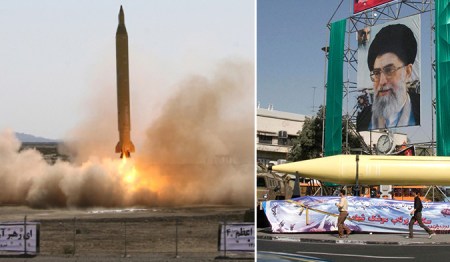
We’re turning a blind eye to Iran’s genocidal liars

April 18, 2017

We’re turning a blind eye to Iran’s genocidal liars, The Australian, Michael Oren, April 19, 2017

(Please see also, What North Korea Should Teach Us about Iran. DM)

In responding forcibly to North Korean and Syrian outrages, President Trump has taken a major step towards restoring America’s deterrence power. His determination to redress the flaws in the JCPOA and to stand up to Iran will greatly accelerate that process. The US, Israel and the world will all be safer.

**************************

The US has signed agreements with three rogue regimes strictly limiting their unconventional military capacities. Two of those regimes — Syria and North Korea — brazenly violated the agreements, provoking game-changing responses from Donald Trump. But the third agreement — with Iran — is so inherently flawed that Tehran doesn’t even have to break it. Honouring it will be enough to endanger millions of lives.

The framework agreements with North Korea and Syria, concluded respectively in 1994 and 2013, were similar in many ways. Both recognised that the regimes already possessed weapons of mass destruction or at least the means to produce them. Both ­assumed that the regimes would surrender their arsenals under an international treaty and open their facilities to inspectors. And both believed these repressive states, if properly engaged, could be brought into the community of nations.

All those assumptions were wrong. After withdrawing from the nuclear non-proliferation treaty, Pyongyang tested five atomic weapons and developed ­intercontinental missiles capable of carrying them. Syrian dictator Bashar al-Assad, less than a year after signing the framework, reverted to gassing his own people. Bolstered by the inaction of the US and backed by other powers, North Korea and Syria broke their commitments with impunity.

Or so it seemed. By ordering a Tomahawk missile attack on a Syrian air base, and a US Navy strike force to patrol near North Korea’s coast, the Trump administration has upheld the frame­­works and placed their violators on notice. This reassertion of power is welcomed by all of ­America’s allies, Israel among them. But for us the most dangerous agreement of all is the one that may never need military enforcement. For us, the existential threat looms in a decade, when the agreement with Iran expires.

Like the frameworks with North Korea and Syria, the Joint Comprehensive Plan of Action of 2015 assumed that Iran would fulfil its obligations and open its facilities to inspectors. The JCPOA assumed that Iran would moderate its behaviour and join the international community. Yet unlike its North Korean and Syrian allies, Iran was the largest state sponsor of terror and openly vowed to destroy another state: Israel. Unlike them, Iran systematically lied about its unconventional weapons program for 30 years. And unlike Damascus and Pyongyang, which are permanently barred from acquiring weapons of mass destruction, Tehran can look forward to building them swiftly and legitimately in the late 2020s, once the JCPOA expires.

This, for Israel and our neighbouring Sunni states, is the appalling flaw of the JCPOA. The regime most committed to our destruction has been granted a free pass to develop military nuclear capabilities. Iran could follow the Syrian and North Korean examples and cheat. Or, while enjoying hundreds of billions of dollars in sanctions relief, it can adhere to the agreement and deactivate parts of its nuclear facilities rather than dismantle them. It can develop new technologies for producing atomic bombs while testing intercontinental ballistic missiles. It can continue massacring Syrians, Iraqis and Yemenis, and bankrolling Hamas and Hezbollah. The JCPOA enables Iran to do all that merely by complying.

A nuclear-armed Iran would be as dangerous as “50 North Koreas”, Israeli Prime Minister Benjamin Netanyahu told the UN in 2013, and Iran is certainly many times more dangerous than Syria. Yet Iran alone has been granted immunity for butchering civilians and threatening genocide. Iran alone has been guaranteed a ­future nuclear capability. And the Iranian regime — which brutally crushed a popular uprising in 2009 — has amassed a million-man force to suppress any future opposition. Rather than moderating, the present regime promises to be more radical yet in another 10 years.

How can the US and its allies pre-empt catastrophe? Many steps are possible, but they begin with penalising Iran for the conventions it already violates, such as UN restrictions on missile development. The remaining American sanctions on Iran must stay staunchly in place and congress must pass further punitive legislation. Above all, a strong link must be established between the JCPOA and Iran’s support for terror, its pledges to annihilate ­Israel and overthrow pro-American Arab governments, and its complicity in massacres. As long as the ayatollahs oppress their own population and export their ­tyranny abroad, no restrictions on their nuclear program can ever be allowed to expire.

In responding forcibly to North Korean and Syrian outrages, President Trump has taken a major step towards restoring America’s deterrence power. His determination to redress the flaws in the JCPOA and to stand up to Iran will greatly accelerate that process. The US, Israel and the world will all be safer.

Michael Oren is Israel’s deputy minister for diplomacy, a member of the Knesset and a former ambassador to Washington.

American Flag Collapses Behind DNC Chairman During Interview

April 18, 2017

American Flag Collapses Behind DNC Chairman During Interview, Washington Free Beacon, April 18, 2017


Perez did not react to the flag falling despite a large bang on the stage behind him.

******************************

A large American flag fell to the stage floor during an interview with Democratic National Committee chairman Tom Perez on Monday night.

Perez was talking to MSNBC’s Joy Reid when the flag in the auditorium in Portland, Maine fell to the floor. Leading up to its fall, the flag’s poles could be seen shaking back and forth.

Perez did not react to the flag falling despite a large bang on the stage behind him.

What North Korea Should Teach Us about Iran

April 18, 2017

What North Korea Should Teach Us about Iran, Gatestone InstituteAlan M. Dershowitz, April 18, 2017

(The proposed legislation should explicitly authorise military action whenever Iran develops nukes; not merely after the Iran Scam permits their development. — DM

If we are not to make the same mistake with Iran that we made with North Korea, we must do something now – before Iran secures a weapon – to deter the mullahs from becoming a nuclear power, over which we would have little or no leverage.

Congress should now enact legislation declaring that Iran’s reaffirmation that it will never “develop or acquire nuclear weapons” is an integral part of the agreement and represents the policy of the United States. It is too late to change the words of the deal, but it is not too late for Congress to insist that Iran comply fully with all of its provisions, even those in the preamble.

Congress should authorize the President “to take military action against Iran’s nuclear weapon’s program if it were to cross the red lines….”

*****************************

We failed to prevent North Korea from developing nuclear weapons. As a result, our options to stop them from developing a delivery system capable of reaching our shores are severely limited.

The hard lesson from our failure to stop North Korea before they became a nuclear power is that we MUST stop Iran from ever developing or acquiring a nuclear arsenal. A nuclear Iran would be far more dangerous to American interests than a nuclear North Korea. Iran already has missiles capable of reaching numerous American allies. They are in the process of upgrading them and making them capable of delivering a nuclear payload to our shores. Its fundamentalist religious leaders would be willing to sacrifice millions of Iranians to destroy the “Big Satan” (United States) or the “Little Satan” (Israel). The late “moderate” leader Hashemi Rafsanjani once told an American journalist that if Iran attacked Israel with nuclear weapons, they “would kill as many as five million Jews,” and that if Israel retaliated, they would kill fifteen million Iranians, which would be “a small sacrifice from among the billion Muslims in the world.” He concluded that “it is not irrational to contemplate such an eventuality.” Recall that the Iranian mullahs were willing to sacrifice thousands of “child-soldiers” in their futile war with Iraq. There is nothing more dangerous than a “suicide regime” armed with nuclear weapons.

The deal signed by Iran in 2015 postpones Iran’s quest for a nuclear arsenal, but it doesn’t prevent it, despite Iran’s unequivocal statement in the preamble to the agreement that “Iran reaffirms that under no circumstances will Iran ever seek, develop or acquire nuclear weapons.” (Emphasis added). Recall that North Korea provided similar assurances to the Clinton Administration back in 1994, only to break them several years later — with no real consequences. The Iranian mullahs apparently regard their reaffirmation as merely hortatory and not legally binding. The body of the agreement itself — the portion Iran believes is legally binding — does not preclude Iran from developing nuclear weapons after a certain time, variously estimated as between 10 to 15 years from the signing of the agreement. Nor does it prevent Iran from perfecting its delivery systems, including nuclear tipped inter-continental ballistic missiles capable of reaching the United States.


If we are not to make the same mistake with Iran that we made with North Korea, we must do something now – before Iran secures a weapon – to deter the mullahs from becoming a nuclear power, over which we would have little or no leverage.

Congress should now enact legislation declaring that Iran’s reaffirmation that it will never “develop or acquire nuclear weapons” is an integral part of the agreement and represents the policy of the United States. It is too late to change the words of the deal, but it is not too late for Congress to insist that Iran comply fully with all of its provisions, even those in the preamble.

In order to ensure that the entirety of the agreement is carried out, including that reaffirmation, Congress should adopt the proposal made by Thomas L. Friedman on 22 July 2015 and by myself on 5 September 2013. To quite Friedman:

“Congress should pass a resolution authorizing this and future presidents to use force to prevent Iran from ever becoming a nuclear weapons state … Iran must know now that the U.S. president is authorized to destroy – without warning or negotiation – any attempt by Tehran to build a bomb.”

I put it similarly: Congress should authorize the President “to take military action against Iran’s nuclear weapon’s program if it were to cross the red lines….”

The benefits of enacting such legislation are clear: the law would underline the centrality to the deal of Iran’s reaffirmation never to acquire nuclear weapons, and would provide both a deterrent against Iran violating its reaffirmation and an enforcement authorization in the event it does.

A law based on these two elements — adopting Iran’s reaffirmation as the official American policy and authorizing a preventive military strike if Iran tried to obtain nuclear weapons — may be an alternative we can live with. But without such an alternative, the deal as currently interpreted by Iran will not prevent Iran from obtaining nuclear weapons. In all probability, it would merely postpone that catastrophe for about a decade while legitimating its occurrence. This is not an outcome we can live with, as evidenced by the crisis we are now confronting with North Korea. So let us learn from our mistake and not repeat it with Iran.