Archive for April 19, 2017

[UPDATED] Syria moves all its fighter jets to Russian base

April 19, 2017

Syria moves all its fighter jets to Russian base, DEBKAfile, April 19, 2017

The Pentagon disclosure came ironically just hours after a senior Israeli military officer confidently informed military correspondents in Tel Aviv that the mechanism introduced for Russian-Israeli air force coordination in Syria had been successfully adopted by other nations operating in Syria, such as Turkey and the United States. He reported that the arrangement included reciprocal visits once every two months by heads of the operations divisions of the two armies.

These visits will probably go the same way now as the entire arrangement.

**********************************

Syria has moved all its fighter aircraft to the Russian Hmeimim air base in Latakia three weeks after 59 US Tomahawk cruise missiles knocked out one-fifth of its air force at the Shayrat base, in retaliation for a chemical attack on civilians in Idlib. This was reported Wednesday night, April 19, by the Pentagon. The Russian high command in Syria has its seat at that base.

DEBKAfile’s military sources report that the Syrian air force will operate henceforth under Russian protection and behind the advanced Russian S-300 and S-400 air defense shield without fear of US reprisals.

President Vladimir Putin’s response to the Trump administration’s call to distance Moscow from the Assad regime is therefore a flat rejection. He is instead fortifying Russian support for that regime.

The upsurge of Russian-US military tension places at risk the operational coordination accords prevailing between the air forces of Russia, the US and Israel in Syrian skies.

Syrian operational staff officers working in Hmeimim will now have access to the advanced Russian surveillance instruments tracking the movements of all foreign aircraft moving through Syrian air space. Syrian intelligence officers will also be close to Russian SIGINT facilities which the Russian spy agency GRU has installed there. In other words, by a single move, the Russians have substantially upgraded the Syrian air force’s operational and intelligence capabilities.

How does this affect the Syrian and Iranian air freight traffic ferrying military supplies from Iran? Where will they deliver their cargoes? Will they too be allowed to land at the Russian base in Latakia? If they are, the Israeli air force will be prevented from cutting down the flow of Iranian weapons for Hizballah. The new move more or less buries the Russian-Israeli agreements covering Syrian skies.

The Pentagon disclosure came ironically just hours after a senior Israeli military officer confidently informed military correspondents in Tel Aviv that the mechanism introduced for Russian-Israeli air force coordination in Syria had been successfully adopted by other nations operating in Syria, such as Turkey and the United States. He reported that the arrangement included reciprocal visits once every two months by heads of the operations divisions of the two armies.

These visits will probably go the same way now as the entire arrangement.

Jeff Sessions: MS-13 Could Be Designated a Terrorist Organization

April 19, 2017

Jeff Sessions: MS-13 Could Be Designated a Terrorist Organization, BreitbartIan Mason, April 19, 2017

AP Photo/Alex Brandon

Attorney General Jeff Sessions continued his campaign against the vicious MS-13 gang on Fox News’s Tucker Tuesday evening, telling host Tucker Carlson that the group may qualify as a terrorist organization.


“The government of El Salvador has designated MS-13 a terrorist organization. Would it be helpful for our government to do the same?” Carlson asked. “I think so, perhaps. It could qualify for that,” was Sessions’s response.

Designating MS-13 a “foreign terrorist organization” would make providing any material support for the group, here or abroad, a felony, and compel U.S. financial institutions to freeze any assets they reasonably believe belong to the group. The determination is made by the State Department and not AG Sessions’s Justice Department, but Sessions’s willingness to support such a designation speaks to how seriously he takes the threat from the gang.

“This is one of the most violent gangs in the history of our country,” Sessions said of MS-13. He cited the group’s use of machetes and willingness to kill and prostitute children, as they have done across the United States.

The Attorney General laid out a plan to attack MS-13, whose 10,000+ estimated members in the United States operate across 40 states, according to a DOJ fact-sheet on the group. Tough use of immigration laws will be central to Sessions’s strategy for breaking the brutal gang, many of whose members are illegal aliens from Central America. The group originally sprouted up among Salvadorans in Los Angeles in 1980s after thousands of them fled there from political atrocities in their war-torn homeland.

“So many of these people are illegally here,” Sessions said, lashing out at the lax immigration enforcement of prior administrations that, in his view, have contributed to the blossoming of MS-13. “With a good lawful border, many of them of would not be here. They sent some of the most violent people.”

Sessions mocked the perverse use of Obama administration policies on “unaccompanied minor” illegal aliens by MS-13 leaders to get their people exactly where they were needed in America. “They were directed how to enter. If they came and claimed themselves as, you know, a minor, the Obama administration let ’em come into the country, and took them to their destination city, and turned them over to some ‘relative,’” he told Tucker.

Sessions sent a hopeful message about efforts to combat MS-13, calling the destruction of the gang “hard, but not impossible.” “As we have cases and we work them hard, pursue convictions, and we deport people who are here unlawfully, we can devastate this gang,” he said.

The end of Turkish democracy

April 19, 2017

The end of Turkish democracy, Israel Hayom, Clifford D. May, April 19, 2017

(Please see also, Kurdistan Independence Referendum and Why It Matters so Much in the Fight Against Radical Islam. — DM)

I made my first visit to Turkey 13 years ago. With the 2001 attacks on the United States still a vivid memory, Turkey struck me as a hopeful place. The people were friendly. The food was good. Istanbul was vibrant and cosmopolitan. This was not a Muslim country but rather a Muslim-majority country, a distinction made repeatedly and with pride. Turks, I was told, understood the importance of separating mosque and state.

Those who campaigned for a “no” vote had limited access to media and in some instances were prevented from holding rallies. The pro-Kurdish Peoples’ Democratic Party complained of unstamped ballots affecting 3 million voters — more than the margin of Erdogan’s victory.

************************************

On the grounds of the Turkish Embassy facing Massachusetts Avenue in Washington is a statue of Mustafa Kamal Ataturk, father of the Republic of Turkey, the nation-state he built from the rubble of the defeated Ottoman Empire and Islamic caliphate.

He is wearing a three-piece suit that would look stylish today, although he is steely-eyed in a way peculiar to early 20th century revolutionaries. He appears to be gazing into the future — a future in which Turkey would be modern, prosperous, secular and democratic.

If truth in advertising applied to governments, that statue would now be removed.

In a referendum on Sunday, Turkish voters were asked to give President Recep Tayyip Erdogan sweeping new powers. To no one’s great surprise, it was announced that they did, albeit by a narrow margin of 51.2% approving to 48.8% opposing, according to the state-run news agency. People in rural areas mostly voted yes, people in the cities — including Istanbul where Erdogan was once mayor — mostly voted no. But a win is a win and Erdogan has won.

I made my first visit to Turkey 13 years ago. With the 2001 attacks on the United States still a vivid memory, Turkey struck me as a hopeful place. The people were friendly. The food was good. Istanbul was vibrant and cosmopolitan. This was not a Muslim country but rather a Muslim-majority country, a distinction made repeatedly and with pride. Turks, I was told, understood the importance of separating mosque and state.

A NATO member, Turkey appeared to be the one sturdy bridge between the Middle East and Europe. It maintained cordial relations with Israel, too. While no Jeffersonian democracy, Turks had been going to the polls on a fairly regular basis for decades. Surely democratic habits were being acquired and democratic institutions were being built. A persuasive argument could be made that this was the direction history was taking throughout the Middle East and perhaps the world.

Sunday’s referendum contradicts that thesis. For a decade, Erdogan has been slowly concentrating power in his own hands. After a failed coup last summer — it’s unclear who launched it or why — he went full throttle, firing or arresting more than 140,000 military officers, academics, judges and civil servants, shutting more than 150 media outlets, and jailing journalists who dared criticize him.

The new referendum will significantly diminish whatever checks and balances the legislature and judiciary have left. And the rules on term limits will be adjusted so that the 63-year-old Erdogan can remain in the new 1,150-room presidential palace until 2029 or longer. In democratic societies, presidents do not serve for so many years. In the Ottoman Empire, sultans occasionally did.

Can we be confident that the announced results of the referendum are accurate? Those who campaigned for a “no” vote had limited access to media and in some instances were prevented from holding rallies. The pro-Kurdish Peoples’ Democratic Party complained of unstamped ballots affecting 3 million voters — more than the margin of Erdogan’s victory.

In Cermik, a town in northeastern Turkey, two members of the opposition CHP party were reportedly killed and two ballot observers were wounded as they were trying to prevent “ballot stuffing.” On Monday, European election monitors said the vote “fell short” of international standards.

Erdogan quickly fired back.

“The crusader mentality in the West and its servants at home have attacked us,” he told a crowd at Ankara’s airport. That is not the kind of language you expect to hear from the leader of a secular country. It is the kind of language you expect to hear from an Islamist demagogue.

Erdogan claims he will use the additional powers he is being granted to solve Turkey’s not insignificant problems, including political and economic instability, the strain caused by the refugees pouring in from Syria, and unrest among Turkey’s Kurdish minority, estimated at up to 20% of the country’s 80 million people.

What I think we can more realistically expect is for Turkey to become less free, less democratic, and less secular. Already we’ve seen Erdogan closing churches and detaining Christian clergymen. He has implied that only Muslims, not Christians, should be helped to rebuild their ancient communities in and around Mosul in Iraq, where he has sent Turkish troops, uninvited by the Iraqi government.

He appears to expect Turks living in Europe not to assimilate or even integrate but to remain loyal to Turkey and, of course, to him. In the weeks leading up to the referendum, he dispatched envoys to campaign in the large Turkish communities of the Netherlands and Germany. When local officials turned them away he leveled accusations of Islamophobia and even Nazism.

“Those who treat me, my ministers, my deputies with disrespect will pay the price for their actions,” he threatened. That is not the way leaders of NATO nations generally address one another.

Many Turks regard the referendum as illegitimate. It’s possible that Erdogan will feel the need to make peace with them. On the other hand, he may feel the need to make them submit.

More than a quarter of a century ago, when he was Istanbul’s mayor, Erdogan quipped that democracy was “like a streetcar. When you reach your destination you get off.”

In other words, he sees liberal democracy not as the best way to organize a government but only as a means to an end. If that’s correct, April 2017 marks the failure of Turkey’s democratic experiment. An Islamist, neo-Ottoman and neo-imperialist experiment began instead. It should surprise no one if a statue of Erdogan replaces that of Kemal Ataturk on Massachusetts Avenue.

CNN: Trump’s North Korea Policy Might Just Be Working

April 19, 2017

CNN: Trump’s North Korea Policy Might Just Be Working, BreitbartJoel B. Pollak, April 19, 2017

AP Photo/Alex Brandon

Former British ambassador to North Korea John Everard writes at CNN.com on Wednesday that President Donald Trump’s assertive strategy towards the rogue nuclear power may have actually worked, despite domestic criticism.

Everard writes:

In my opinion, the most plausible explanation for this is that North Korea blinked. Although it is possible the extensive preparations around its nuclear test site were intended only to wind up the international community, it seems more likely that the North Koreans did indeed plan a nuclear test Saturday but desisted, probably because they assessed the risks of serious retaliation were too great.

The US carrier group it thought was near Korea and China’s threat on April 12 to support UN sanctions, including cutting off North Korea’s oil supply — which would have quickly brought its fragile economy to a halt — probably weighed heavily on Pyongyang as well.

Though domestic critics attacked Trump for stating that the USS Carl Vinson and an “armada” were sailing toward the Korean peninsula, when in fact the ships were far away, Everard says that Trump’s statement was a successful bluff.

The North Korean dictator thought the carrier group really was off the Korean coast, Everard writes. “Very few people outside the US administration knew the carrier group was in fact some 3,500 miles away from the Korean Peninsula.”

He concludes:

Perhaps the North Koreans calculated (rightly, it seems) that either a nuclear test or a test of an intercontinental ballistic missile — a long-range missile of the kind they would need to carry a nuclear warhead to the continental United States — was too dangerous. Instead, launching a medium-range missile would allow them to deny they were buckling under foreign pressure while not triggering a vigorous international reaction. The fact it failed doubtless also softened responses.

If this analysis is right, then the United States has, for now at least, succeeded in its long-term goal of halting the development of North Korea’s nuclear weapons and missiles.

One observer who predicted Trump’s success in the confrontation was Dilbert illustrator and author Scott Adams, who had been stating for weeks that Trump’s unpredictable military moves might scare China into reining in its client state.

CNN is rarely positive in its coverage of the 45th president, making Everard’s article particularly noteworthy.

Confirmed: John Brennan Colluded With Foreign Spies to Defeat Trump

April 19, 2017

Confirmed: John Brennan Colluded With Foreign Spies to Defeat Trump, American SpectatorGeorge Neumayr, April 19, 2017

A supporter of the American Communist Party at the height of the Cold War, Brennan brought into the CIA a raft of subversives and gave them plum positions from which to gather and leak political espionage on Trump. He bastardized standards so that these left-wing activists could burrow in and take career positions. Under the patina of that phony professionalism, they could then present their politicized judgments as “non-partisan.”

The Guardian story is written in a style designed to flatter its sources (they are cast as high-minded whistleblowers), but the upshot of it is devastating for them, nonetheless, and explains why all the criminal leaks against Trump first originated in the British press. According to the story, Brennan got his anti-Trump tips primarily from British spies but also Estonian spies and others.

***********************

An article in the Guardian last week provides more confirmation that John Brennan was the American progenitor of political espionage aimed at defeating Donald Trump. One side did collude with foreign powers to tip the election — Hillary’s.

Seeking to retain his position as CIA director under Hillary, Brennan teamed up with British spies and Estonian spies to cripple Trump’s candidacy. He used their phony intelligence as a pretext for a multi-agency investigation into Trump, which led the FBI to probe a computer server connected to Trump Tower and gave cover to Susan Rice, among other Hillary supporters, to spy on Trump and his people.

John Brennan’s CIA operated like a branch office of the Hillary campaign, leaking out mentions of this bogus investigation to the press in the hopes of inflicting maximum political damage on Trump. An official in the intelligence community tells TAS that Brennan’s retinue of political radicals didn’t even bother to hide their activism, decorating offices with “Hillary for president cups” and other campaign paraphernalia.

A supporter of the American Communist Party at the height of the Cold War, Brennan brought into the CIA a raft of subversives and gave them plum positions from which to gather and leak political espionage on Trump. He bastardized standards so that these left-wing activists could burrow in and take career positions. Under the patina of that phony professionalism, they could then present their politicized judgments as “non-partisan.”

The Guardian story is written in a style designed to flatter its sources (they are cast as high-minded whistleblowers), but the upshot of it is devastating for them, nonetheless, and explains why all the criminal leaks against Trump first originated in the British press. According to the story, Brennan got his anti-Trump tips primarily from British spies but also Estonian spies and others. The story confirms that the seed of the espionage into Trump was planted by Estonia. The BBC’s Paul Wood reported last year that the intelligence agency of an unnamed Baltic State had tipped Brennan off in April 2016 to a conversation purporting to show that the Kremlin was funneling cash into the Trump campaign.

Any other CIA director would have disregarded such a flaky tip, recognizing that Estonia was eager to see Trump lose (its officials had bought into Hillary’s propaganda that Trump was going to pull out of NATO and leave Baltic countries exposed to Putin). But Brennan opportunistically seized on it, as he later that summer seized on the half-baked intelligence of British spy agencies (also full of officials who wanted to see Trump lose).

The Guardian says that British spy head Robert Hannigan “passed material in summer 2016 to the CIA chief, John Brennan.” To ensure that these flaky tips leaked out, Brennan disseminated them on Capitol Hill. In August and September of 2016, he gave briefings to the “Gang of Eight” about them, which then turned up on the front page of the New York Times.

All of this took place at the very moment Brennan was auditioning for Hillary. He desperately wanted to keep his job and despised Trump for his alleged “Muslim ban,” a matter near and dear to Brennan’s heart. Not only was he an apologist for the Muslim Brotherhood, but Brennan’s Islamophilia dated to his days in college, when he spent a year in Cairo learning Arabic and taking courses in Middle Eastern studies. He later got a graduate degree with an emphasis in Middle Eastern studies. In 1996, his ties to the Islamic world tightened after he became the CIA’s station chief in Riyadh, Saudi Arabia. He once recalled that “during a 25-year career in government, I was privileged to serve in positions across the Middle East — as a political officer with the State Department and as a CIA station chief in Saudi Arabia. In Saudi Arabia, I saw how our Saudi partners fulfilled their duty as custodians of the two holy mosques of Mecca and Medina. I marveled at the majesty of the Hajj and the devotion of those who fulfilled their duty as Muslims by making that privilege — that pilgrimage.”

Out of this Islamophilia came a special dislike of Michael Flynn, who had planned to rip up the Obama-era “reset” with Muslim countries. Furious with Flynn for his apostasy from political correctness, Brennan and other Obama aides couldn’t resist the temptation to take him out after rifling through transcripts of his calls with the Russian ambassador. They caught him in a lie to Mike Pence and made sure the press knew about it.

Were the media not so completely in the tank for Obama and Hillary, all of this political mischief would make for a compelling 2016 version of All the President’s Men. Instead, the public gets a steady stream of Orwellian propaganda about the sudden propriety of political espionage. The headline writers at Pravda couldn’t improve on this week’s official lie, tweeted out by the Maggie Habermans: “Susan Rice Did Nothing Wrong, Say Both Dem and Republican House Aides.”

U.S. Considers Re-Imposing All Sanctions on Iran, Dismantling Nuke Deal

April 19, 2017

U.S. Considers Re-Imposing All Sanctions on Iran, Dismantling Nuke Deal, Washington Free Beacon, , April 19, 2017

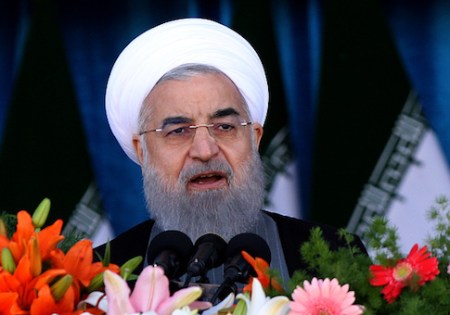
Iranian President Hassan Rouhani delivers a speech during a parade on the occasion of the country’s Army Day, on April 18, 2017, in Tehran. Photo credit: ATTA KENARE/AFP/Getty Images

Obama administration officials, while selling the nuclear deal to Congress, vowed that Iran would roll back its nefarious activities if it received relief from sanctions.

Tillerson informed Congress this has not happened. After receiving billions in cash assets and other economic relief, Iran invested heavily in its military and the Iranian Revolutionary Guard Corps, or IRGC, which continues to meddle in Syria, Iraq, Yemen, and a host of other countries.

************************

The Trump administration is considering re-imposing a massive set of economic sanctions on Iran that were lifted by the Obama administration as part of the landmark nuclear agreement that gave Tehran billions in economic support, according to U.S. officials who told the Washington Free Beacon that Iran’s military buildup and disregard for international law could prompt U.S. reprisal.

Secretary of State Rex Tillerson told Congress in a letter sent Tuesday that Iran is complying with requirements for its nuclear program imposed under the nuclear accord. However, Tillerson emphasized that Iran continues to be the world’s leading state sponsor of terror.

Tehran’s malign activities across the Middle East and elsewhere have prompted the Trump administration to place all aspects of the nuclear agreement under critical review, which is viewed by some as a first step to nixing some controversial aspects of the accord, including the massive sanctions relief package.

U.S. officials familiar with the review told the Free Beacon that Iran’s continued support for terrorism has become a sticking point for the Trump administration as it reviews the agreement and the previous administration’s policy toward Iran.

“I think the key is what comes next,” one senior White House official familiar with the interagency review told the Free Beacon. “The question of ongoing sanctions relief will be critical—Iran has already gotten significant economic benefits from the nuclear deal and we need to take a hard look at what Iran is doing with the resources that continue to flow in.”

The Trump administration has been paying close attention to Iran’s ongoing military buildup, including its continued work on ballistic missiles and other offensive weapons aimed at interfering with U.S. operations in the Persian Gulf region.

“Yesterday was the annual Army Day celebration—also known as Death to Israel day—and they paraded some pretty serious new hardware through the streets,” the White House official disclosed. “That has to be a significant concern.”

The White House’s national security apparatus will closely monitor Iran’s behavior as it makes a decision about re-imposing sanctions lifted by the Obama administration.

Tillerson’s emphasis on Iran’s terror operation is “a first step, but we have to remain focused on the threat Tehran poses to America and our allies,” the official said.

Obama administration officials, while selling the nuclear deal to Congress, vowed that Iran would roll back its nefarious activities if it received relief from sanctions.

Tillerson informed Congress this has not happened. After receiving billions in cash assets and other economic relief, Iran invested heavily in its military and the Iranian Revolutionary Guard Corps, or IRGC, which continues to meddle in Syria, Iraq, Yemen, and a host of other countries.

“Iran remains a leading state sponsor of terror through many platforms and methods,” Tillerson told Congress. “President Donald J. Trump has directed a National Security Council-led interagency review of the Joint Comprehensive Plan of Action (JCPOA) that will evaluate whether suspension of sanctions related to Iran pursuant to the JCPOA is vital to the national security interests of the United States.”

“When the interagency review is completed, the administration looks forward to working with Congress on this issue,” Tillerson wrote.

The dictator’s hour

April 19, 2017

The dictator’s hour, Venezuela News and Views, Daniel Duquenal, April 18, 2017

(My wife and I were in Venezuela off and on for several years in the late 1990s and early in the current century, before and after el Thugo Chavez came to power. Food and essentials were plentiful and inexpensive and the medical care we received was quite good. The people in urban and rural areas seemed reasonably happy and well-fed. The situation changed slowly but inexorably for the worse, then much became worse and then became unbearable.

Now Venezuela is at least as hellish as any country in the Middle East. The people of Venezuela are revolting but the “mainstream” media are paying scant attention. 

It would be very difficult for the Mad Mullas of The Islamic Republic of Iran to deal more harshly with protesters than have the Venezuelan dictators. Perhaps, with the Iranian elections coming next month, the Iranian people will achieve more than have the Venezuelans thus far; the slate of candidates, unfortunately, suggests that the situation in Iran will not change for the better unless the Iranian people have a successful revolution. At least the Middle-East media will be more attentive. — DM)

So we are in a dictatorship. And this one has made new progress these past days to prove to the world it is so.  We had Sunday a totally infamous presentation by the president Nicolas Maduro where live on TV he decided who is guilty of what and how.  This based on torture.  Yesterday he went further on that path convoking the militia to Caracas to stop the massive opposition protest planned for tomorrow and forcing the army to repeat once again their indefectible oath to the revolution and its heir, the dictator.  As a bonus he promised to arm the militia, which one needs to be recalled , is not constitutional. But details are not the regime’s forte.

The army today is controlling all the streets it can and all the entries to Caracas to make sure protesters do not come to fill in Caracas protests. Useless as the opposition is convoking protests in all major cities of Venezuela. You need not go to Caracas to state that Maduro is a piece of shit: you can do it in the comfort of your own city where repression awaits for you all the same than in Caracas. Decentralization at its best.

Funny dicator. He does not rule, he is just the front man but it seems that he has started to believe that all the narco generals, the corrupt generals and civilians, the Cubans cashing in whatever cash they can still grab, trust power into his hands.  Meanwhile we read things like this:

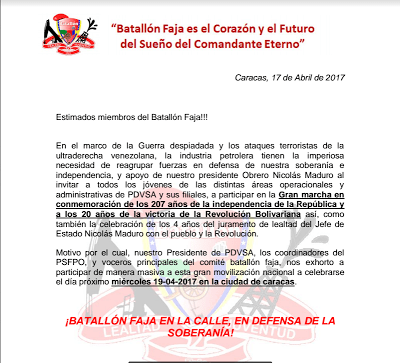
This memo of April 17 “exhorts” PDVSA employees from the Orinoco area (almost a day drive to Caracas) to attend the regime called counter march to block access to the opposition to downtown Caracas. It starts with the following words “Within the merciless War and the terrorist attacks of the venezuelan ultra right, the oil industry has the imperious need to regroup its forces in the defense of our sovereignty and independence, and support to our Worker president Nicolas Maduro to invite all….” you get it.  I respected the words with capital letters as I think they betray the subconscious of whomever wrote this memo.

Of course outside the country no body is buying it and even Cuba takes its distances from an eventual bloodbath for which they probably gave the order to the army. the local representation of the European Union had a communique (rather vague but better than nothing, and at least implying that the EU will have observers in the streets). OAS secretary on the other hand went all out with a communique of a strength unheard of in the OAS, which reflects the major hemispheric concern about what Maduro is trying to do. In English.

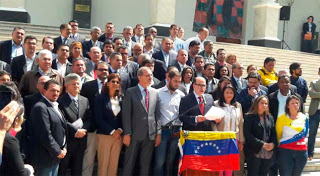
Of course, solemne declarations also exist in Venezuela, like the one from the National Assembly with a solid representation of its members, putting a face to the resistance to Maduro, and putting a face to its possible victims tomorrow.

The hour is dire indeed.

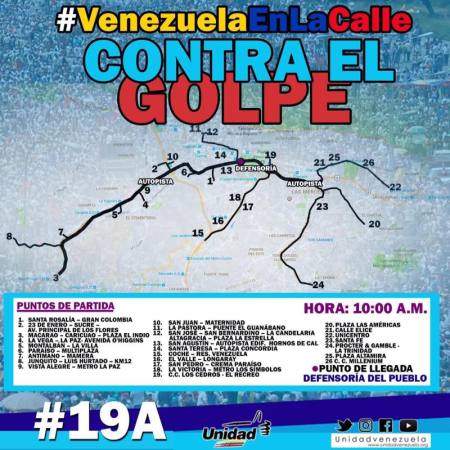
The opposition has convened a freedom march tomorrow starting from more than a dozen points in Caracas. As such it is impossible to block unless the regime acts early to block through whatever means the starting points in downtown Caracas, their hallowed excuse for repression.

The regime who dodged such a massive show of strength by the opposition last year through a fake dialogue has not found any excuse this time to slow down the mounting protest. The aslt two weeks fo marches and repression only seem to have united the opposition and render it more decided to end this conflict once and for all.

All sorts of threat have been uttered such as this Monday promises to arm the militia to maintain order against the opposition. That an election would be the best way to end the conflict is not an option for a regime who knows that 1) it will lose them and 2) it will have its leadership go to jail shortly afterwards for the crimes committed.  So we have pictures like this one commented by Le Monde from France. Of course, when you are an European and you see brown shirts like that with a peppering of military you jump. This is possibly the worst message to be read in any capital of Europe, probably even Budapest (Ankara is not in Europe and will never be apparently, but I digress).

Le Monde underlines this:

« Fini le temps des traîtres, des trahisons, fini le temps des hésitations, que chacun se définisse : on est avec la patrie ou on est contre elle ! », a lancé le président vénézuélien, lundi.
“The time of traitors is over, the times of hesitation is over, may each one self define: we are with the fatherland or we are against it.” thrown by the venezuelan president on Monday.

Sieg Heil would do nice at the end of that.

We also read the declarations of 11 LatAm countries warning the regime about abuse tomorrow. It is nice to see that Tal Cual reports on this lifting the logo of this blog, a logo since 2003 which has been lifted by several people from chavistas to Tal Cual. Lifted by Tal Cual is an honor and proves that at least someone there reads my blog. I do take the best pictures, check out my instagram 🙂

But again I digress.

The point here is that Maduro seems to go all out against tomorrow and he is clearly wanting a confrontation to solidify his dictatorship. Will the army oblige?

Meanwhile tomorrow in Caracas you may choose your meeting point for 10:00 AM. I will start from Plaza Las Americas #20 if anyone cares to meet me. And I will try to post stuff through Instagram if signal allows, which is rare when so many people are in the street using bandwidth. It will be nice if I could get a pic from EVERY starting point to post it here tomorrow evening.

Que este sea el punto de partida de la mayor presión que se haya hecho contra la dictadura. Desbordemos Vzla.


Kurdistan Independence Referendum and Why It Matters so Much in the Fight Against Radical Islam

April 19, 2017

Kurdistan Independence Referendum and Why It Matters so Much in the Fight Against Radical Islam, Clarion ProjectJennifer Breedon, April 19, 2017

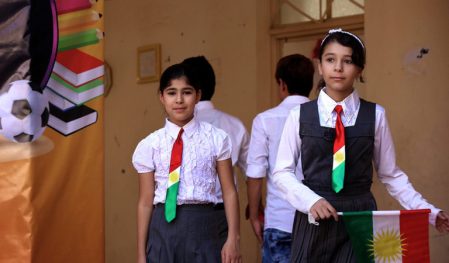
Iraqi Kurdish students attend the first day of the new school year in Arbil, the capital of the autonomous Kurdish region of northern Iraq, on September 10, 2014.  AFP PHOTO / SAFIN HAMED (Photo credit should read SAFIN HAMED/AFP/Getty Images)

Most Kurds are Muslim, but reject religious rule in favor of secular governance so that all religious people and ethnic minorities can have fair and equal representation. The Kurds have adopted secular lifestyles seen just by visiting the capitol city of Erbil where you’ll hear American music, see a booming economy, or have conversations about new business enterprises.  If you’re lucky, you may run into the Erbil Men’s Club. Kurds don’t identify as “Sunni” or “Shia” at the outset. While they will openly say what religion they practice, they refuse to allow their identity to be encompassed in the sectarian strife they’ve witnessed throughout the Middle East. They want no form of oppressive sharia law in their governance to promote the rights of women and minorities. In fact, Kurdish government mandates that 30% of Parliament members be women. I witnessed that firsthand and it looks a lot like the United States: churches, mosques, and synagogues side-by-side with equal numbers and mutual respect between all religious leaders.

****************************

The recent rejuvenated referendum on Kurdistan Independence will likely draw a few questions from people. Namely (1) What does “Statehood” mean and what is required to gain it? (2) Why does an independent Kurdistan really matter? And (3) Is it really helpful to have another independent government in the Middle East in an already volatile area?

What does “Statehood” mean and what is required to gain it?

Becoming a state provides autonomy and self-determination that allow a government to aid their people, provide security to their region, build infrastructure, among many other things. Even autonomous regions within a state are subject to the official national government decisions and therefore cannot enter into alliances with potential allies. In this situation, it matters for the United States because the modern Kurds and the Kurdish government in Northern Iraq are extremely pro-America and pro-democratic freedoms.  In an age where the Middle East is constantly laced with sectarian violence, the Kurds are a secular governing force that rejects extremism. However, since it is merely an “autonomous” region of Iraq, they are subject to alliances of the Iraqi government and cannot be a strength of secular democratic governance that is so desperately needed throughout the Middle East.

The Montevideo Convention of 1933 outlined the four main requirement of statehood. Those are: a permanent population, a defined territory, a government, the capacity to enter into foreign relations with other states. However, meeting the Montevideo requirements doesn’t automatically gain independent statehood today. That requires recognition by the international community (and recently done via the United Nations).

The Kurdish region was officially recognized as semiautonomous in the 2005 Iraqi constitution following the U.S. invasion of Iraq and fall of Saddam Hussein’s regime. Today, that region and the territories closest to it have become the only safe zone for refugees and IDPs fleeing from the wrath of ISIL in Iraq.

Why does an independent Kurdistan state really matter?

When I was meeting with Kurdish government officials in January this year, I asked this very question to Dr. Dindar Zebari, a top official in the Kurdish Democratic Party.

Dr Zebari: “…you cannot have a success story within a failure story [Iraq]. Sectarian violence in the Middle East-and especially Iraq-will continue. There is a problem and that’s religious engagement in government and it holds all of humanity back: the case of Shia vs. Sunni. Yazidi, Christian and other minority communities will be under religious extremist governments because the ethnic cleansing under these governments will never stop. Kurdistan has been successful as an accepting autonomous region and our government has never and will never turn away minorities. Our constitution is based on individual human rights and not religious identity.

JB: What makes Kurdistan as a state unique in this region?

Dr. Zebari: We are unique in that we already have self-determination and friendly relations with many other governments. The only forces that have EQUALLY protected all the religious minorities since ISIS began their violence, are the Peshmerga forces. We have already delivered more for the rights of minorities and protecting from ISIS than many other independent states in this region even though we aren’t yet a recognized nation-state.

According to the CIA World Factbookthere has been voluntary relocation of many Christian families to northern Iraq” since the rise of ISIS. An article in the Council for Foreign Relations noted in 2015 that, “even while asserting their autonomy, Iraqi Kurds are still considered by policymakers as the ‘glue’ that holds [Iraq] together amid sectarian tensions between Sunni and Shia Arabs.

Today, almost all the U.N. refugee areas for ISIS victims are in or near the Kurdish region because it has been secured by the Kurdish Peshmerga forces. However, since the Kurds are not an independent nation-state, they are not privy to U.N. practices in refugee camps, nor are they invited to talks on the humanitarian situation in the region. Additionally, when money is sent to the “refugees” and IDPs living in camps in the Kurdish region, none of that money goes to the Kurdish Regional Government because they are not a recognized state. The money is either given directly to the United Nations OR the “recognized” government of Iraq in Baghdad.  Considering that Iraqis have fled Baghdad for safety in Erbil and the Kurdish region, this seems to make very little sense in helping those that need it most and supporting the forces protecting the victims.

Jennifer Salcido, a humanitarian filmmaker in Iraqi Kurdistan, recently met with a small group of Assyrian Christians. When she asked them why they didn’t go to Baghdad for safety from ISIS, they responded, “Because they will murder us in Baghdad. We are much safer in Erbil [Kurdistan region capital].

Is it really helpful to have another independent government in an already volatile Middle East region?

The answer is 100% yes if that independent government is friendly to the United States, Israel, and secular governance including human rights and not Islamist sharia implementation. The Kurds have no sharia laws or desire to impose Islamist laws. They’ve been persecuted by Islamist governments for far too long and the modern Kurdish parties, such as the KDP, have adopted a secular democratic constitution.

Most Kurds are Muslim, but reject religious rule in favor of secular governance so that all religious people and ethnic minorities can have fair and equal representation. The Kurds have adopted secular lifestyles seen just by visiting the capitol city of Erbil where you’ll hear American music, see a booming economy, or have conversations about new business enterprises.  If you’re lucky, you may run into the Erbil Men’s Club. Kurds don’t identify as “Sunni” or “Shia” at the outset. While they will openly say what religion they practice, they refuse to allow their identity to be encompassed in the sectarian strife they’ve witnessed throughout the Middle East. They want no form of oppressive sharia law in their governance to promote the rights of women and minorities. In fact, Kurdish government mandates that 30% of Parliament members be women. I witnessed that firsthand and it looks a lot like the United States: churches, mosques, and synagogues side-by-side with equal numbers and mutual respect between all religious leaders.

The issues in the Middle East come down to proxy wars and one important differentiation: Does the country have a theocracy or a secular government that governs the people with basic freedoms of life and liberty to freely worship? The Kurdish government maintains the latter and thus makes their application for statehood a necessary element in upholding human rights and providing for a more stable and violence-free Middle East.

Why Is the US Still Funding Palestinian Terrorism?

April 19, 2017

Why Is the US Still Funding Palestinian Terrorism? Gatestone Institute, Shoshana Bryen, April 19, 2017

(Please see also, Towards the pending Abbas visit to Washington D.C. — DM)

Jamil Tamimi, 57, knew that if he committed an act of terror, he would be lionized by the Palestinian Authority (PA) and — perhaps more importantly — that, if he were killed or sent to prison, his family would be taken care of financially.

“The PLO Commission was new only in name. The PLO body would have the ‎same responsibilities and pay the exact same amounts of salaries to prisoners… PA Chairman Mahmoud Abbas retained overall supervision of ‎the PLO Commission.” — Palestinian Media Watch.

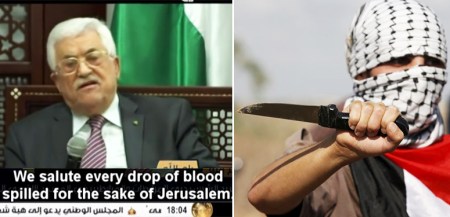
In 2016 Bashar Masalha, who murdered U.S. Army veteran Taylor Force and wounded several others, was hailed on official PA media outlets as a “martyr.” A few months later, Abbas said on PA TV, “We welcome every drop of blood spilled in Jerusalem…. With the help of Allah, every martyr will be in heaven, and every wounded will get his reward.”

The U.S. government should let the PLO and PA know that we are onto their game. Disincentivizing terrorism by closing the PLO office in Washington would be a good first step.

British exchange student Hannah Bladon was stabbed to death on a Jerusalem light rail train last Friday. Her murderer was identified as an East Jerusalem resident who had previously been convicted of molesting his daughter and had tried to commit suicide. Failing at that, he apparently opted for terrorism, on the assumption that the police would kill him. They didn’t. “This,” the Shin Bet said in a statement, “is another case, out of many, where a Palestinian who is suffering from personal, mental or moral issues chooses to carry out a terror attack in order to find a way out of their problems.”

“Suicide by cop” is not unheard of, but the real incentives need to be spelled out.

Jamil Tamimi, 57, knew that if he committed an act of terror, he would be lionized by the Palestinian Authority (PA) and — perhaps more importantly — that, if he were killed or sent to prison, his family would be taken care of financially.

To take the PA leader, Mahmoud Abbas, at his word, the PA itself does not pay salaries or pensions to terrorists in Israeli jails or to their families; the money — instead! — comes from the Palestine Liberation Organization (PLO). That sleight-of-hand would make this a perfect time for the United States, an ally of the UK and properly appalled by terrorism, to take a step it has been avoiding for more than 25 years: to close the PLO office in Washington — preferably before the planned visit by Abbas in May.

The PLO was once understood to be a terrorist organization and a terror umbrella. It hijacked airplanes and threw an elderly disabled man in a wheelchair overboard from a cruise ship. Black September, an arm of the PLO, murdered 11 Israeli Olympic athletes in Munich. The PLO has committed acts of horrific terror in Israel — including massacring bus drivers and their families on holiday. Twenty-five adults and 13 children were killed and 71 others wounded. The PLO has also committed acts of war against the United States by killing American diplomats in Sudan.

In the 1970s and 80s, the U.S. generally knew what it was looking at.

During the Reagan-to-Bush “41”-transition, however, the U.S. dropped its ban on officially talking to then-PLO Chairman Yasser Arafat. (Full disclosure: Colin Powell, then national security advisor, gave this author a “heads up”: “Everyone has something to say,” he said. “The U.S. government already knows what Arafat has to say,” I said, and it is unacceptable.” He was not interested.)

Talking was not the same as opening an office; that move was still prohibited by the Anti-Terrorism Act of 1987. However, in the post-Oslo Accords euphoria, Senate legislation permitted the PLO an official mission in Washington “to implement the accords,” and it allowed President Clinton to waive the law barring U.S. funds to international organizations that gave money to the PLO. The House passed similar legislation. Rep. Howard L. Berman (D-CA) said at the time:

“This legislation provides a limited, temporary and conditional waiver of restrictions in United States law that would seriously impede the ability of Israel and the PLO to proceed with negotiating and implementing their landmark peace agreement.”

It was “conditional” on the PLO meeting its Oslo Accords obligations, including refraining from terrorism and renouncing international moves that would impede bilateral agreement on final status issues. While the legislation was, as Berman said, “temporary,” it came with the usual waiver provision, ultimately allowing Presidents to do as they wished.

Presidents, therefore, beginning with President Clinton, did exactly that, even as the Palestinian Authority supplanted the PLO as the “peace partner” and ignored the Oslo Accords at will.

In 2003, the height of the so-called “second intifada,” the Palestinian terror war against Israel, Colin Powell, by then Secretary of State, waffled through a statement suggesting that the Palestinians kindly refrain from not killing so many Jews. “We need to see a more concerted effort against the capacity for terrorist activity on the Palestinian side… It’s not enough just to have a cease-fire.” He then noted “progress in reducing attacks against Israelis” — but without mentioning that the IDF and Shin Bet had reduced them; not the PA. Nevertheless, President Bush exercised the waiver.

A 2011, a Palestinian bid for recognition as a full member of the UN failed, but the waiver remained. Over U.S. objections, “Palestine” joined the International Criminal Court in 2015. President Barack Obama waived the sanctions every six months — right through two Hamas wars against Israel.

Largely through the work of Palestinian Media Watch (PMW), the question of payments to terrorists and their families has come to the fore. Worried about foreign aid payments from the U.S. and the EU, in 2014 the Palestinian Authority claimed it stopped paying salaries and that future money would come from a new PLO Commission of Prisoner Affairs. However, PMW reported from Palestinian sources:

The PLO Commission was new only in name. The PLO body would have the ‎same responsibilities and pay the exact same amounts of salaries to prisoners; the ‎former PA Minister of Prisoners’ Affairs, Issa Karake, became the Director of the new ‎PLO Commission and PA Chairman Mahmoud Abbas retained overall supervision of ‎the PLO Commission.

Tower Magazine reported that in 2015, a year after the PA “officially” transferred authority over Palestinian prisoners to the PLO, it also transferred an extra 444 million shekels (more than $116 million) to the PLO — nearly the same amount that the PA had allocated in the previous years to its now-defunct Ministry of Prisoners’ Affairs.

Citing PMW, Tower wrote that the transfer to the PLO was meant to evade pressure from Western governments that demanded an end to terrorist salaries — specifically the United States and the UK, which froze payments to the PA in 2016 over the problem.

In the end, perhaps, it does not matter whose bank account transfers the money to whose bank account:

In 2016 Bashar Masalha, who murdered U.S. Army veteran Taylor Force and wounded several others, was hailed on official PA media outlets as a “martyr.” A few months later, Abbas said on PA TV, “We welcome every drop of blood spilled in Jerusalem. This is pure blood, clean blood, blood on its way to Allah. With the help of Allah, every martyr will be in heaven, and every wounded will get his reward.”


Abbas has not said much about Jamil Tamimi, last Friday’s murderer, and it is time to stop encouraging, threatening or demanding that he do so. Rather, the U.S. government should let the PLO and PA know that we are onto their game. Disincentivizing terrorism by closing the PLO office in Washington would be a good first step.

Towards the pending Abbas visit to Washington D.C.

April 19, 2017

Towards the pending Abbas visit to Washington D.C., Israel National News, David Bedein, April 17, 2017

(Please see also, UNRWA Won’t Be Changing School Textbooks and Curriculum. — DM)

With President Donald Trump set to greet Mahmoud Abbas, head of the Palestinian Authority, at the White House on May 3rd, the time has come to examine how the US allowed the PLO to  trample upon ten US government PLO policy guidelines, and to examine what the current US administration can do to see to it that the PLO does not trample on Trump.

The US recognized the PLO during  the final month of the Reagan administration December 1988, on the condition that the PLO would recognize UN resolution 242, which required the PLO to  recognize the right of every nation to secure boundaries  – especially Israel . The PLO immediately ignored this requirements for US recognition.

It is not too late for the US to ask the PLO, under the aegis of the Palestinian Authority, to recognize UN resolution 242, which it has yet to do.

The US acted as  a witness and guarantor of the PLO/Israel Oslo Accords, signed on the White House lawn on September 13, 1993. Known as the DOP, “The Declaration of Principles”, it spelled out mutual recognition of Israel and the PLO, and the formal denunciation of violence and terror. The DOP was premised on its ratification by the Israeli Knesset and by the central committee of the PLO. The Israeli Knesset ratified the DOP on Sept, 26, 1993, by a vote of 61 to 50, with nine abstentions. The PLO central committee was set to meet in Tunis to ratify the DOP on October 6, 1993. However, the one Israeli correspondent dispatched to Tunis to witness the PLO ratification, Pinhas Inbari, on the staff of the left wing newspaper Al HaMishmar, reported from Tunis that the PLO chairman announced that he could not get a quorum of the PLO to attend, so the PLO Central Committee did not convene to ratify the DOP.

It is not too late for the US, as witness and guarantor of the Oslo Accord, to insist the PLO, through the aegis of the PA, ratify the DOP.  Otherwise, the agreement between Israel and the PLO does not hold water.

US law allowed the PLO, all of whose components were designated by the US law as FTOs, Foreign Terrorist Organizations, to open an embassy in D.C. and allowed the PLO to dispatch representatives to the USA, but only if PLO would cancel the PLO Covenant, the document which defined the purpose of the PLO:  To replace and destroy the State of Israel. The PNC, the PLO National Council, met in special session on April 24, 1996, with the stated purpose that this session would renounce and cancel the PLO Covenant. The PLO, at that session, filmed by the Institute for Peace Education Ltd, only announced the formation of a committee to consider changes in the PLO Covenant.

A video and protocol of the session was sent to the US embassy in Tel Aviv, and to the US Congress. Prof. Yehoshua Porat, expert on the PLO and a candidate of  the left wing Meretz party for the Knesset, reviewed the video and protocols of the PNC session, and affirmed that the PLO had not cancelled the PLO Covenant.  The US embassy in Tel Aviv, however, ignored what had actually transpired at the PNC, and instead reported to the White House and to the US Congress that the PLO had fulfilled the requirements of US law with the cancellation of the PLO Covenant, allowing the US to roll out a red carpet to welcome PLO chairman Yassir Arafat as a dignitary in Washington one week later. The PLO was allowed to open an official embassy , which has functioned ever since, conditional on the US President signing a waiver every six months which extends the non- terror status of the PLO.

It is not too late for the US to insist the head of the PLO and the Palestinian Authority call the PNC into a special session to cancel the PLO covenant, as required by US law, before Abbas enters the White House on May 3rd, 2017.  Otherwise, the entry of Abbas to the US represents a challenge to US law.

As an integral part of the US Aid package to the Palestinian Authority, the US funds PA schools which instituted a war education curriculum, despite US objections. That PA curriculum does not prepare Palestinian Arab children to live in state alongside Israel. That curriculum indoctrinates all Palestinian Arab children to conduct a Jihad to liberate Palestine, all of what they considere Palestine, with no attempt to train the next generation for peace with Israel.

It is not too late for the US to demand an overhaul of PA education to prepare the next generation for peace.

US law forbids any agency that receives funds from the US from placing members of a designate FTO  – a foreign terrorist organization — on the payroll of  a US government funded entity. Yet the US funded UNRWA schools, which openly employ members and even leaders of HAMAS, putting them on the payroll. UNRWA, which now receives $400 million of its 1.2 billion dollar budget from the US, has ignored US directives to remove Hamas from the UNRWA  payroll.  And when UNRWA has removed some Hamas leaders from the UNRWA payroll, they simple return as senior employees  of UNRWA.

It is not too late for the US, as the leading donor of UNRWA, to insist that UNRWA fire members and leaders of Hamas who receive salaries from UNWRA – especially Hamas teachers, who dominate the Gaza UNRWA teachers union. Elections are imminent.

It is not too late for the US to reverse its decision to force Hamas into the PA electoral process.

The US helped to create the  PSF, the Palestinian Security Force of the Palestinian Authority. However, the US embassy and US State department have ignored all inquiries challenging the PSF inclusion of Palestinian terror organizations which have never demonstrated any peaceful intentions, to say the least.

It is not too late for the US to ask the PSF to remove  Palestinian terror groups from its ranks.

The US enacted the  Koby Mandell act which requires the US to pursue and prosecute thoe who maim or kill US citizens abroad. Until the inauguration of President Trump, the US would not enforce the act concerning American citizens attacked  in Israel by terrorists. The new Trump administration has begun to file indictments of terrorists who murdered US citizens in Israel.

It is not too late, Trump has demonstrated, for the US government to enforce the Koby Mandell act.

The US established an office in the US State Department to monitor anti Semitism in 2008. However, that office has  refused to examine PA anti-Semitism. While there are rumors that Trump will not renew funding for the US office that tracks anti-Semitism, it is not too late for the US to examine the tentacles of official Palestinian Authority ant-Semitism which can be tracked world- wide.

The US created a special commission to form a Palestinian Authority constitution. However, the Papal Nuncio, Archbishop Pietro Sambi , the late Vatican official who examined the draft of the proposed PA constitution, and reported to the US, wrote  that the current PA constitution, which would form the basis of PA law in a Palestinian Arab state, does not allow for any  juridical status of  any religion other than Islam. Futhermore,  the Papal Nuncio  warned that the proposed US-funded PA constitution was  based on the strict Sharia law used in Saudi Arabia, and not on a more tolerant Sharia law that Archbishop Sambi had witnessed in  his earlier postings in Indonesia and Bangladesh.

It is not too late for the US government to reconsider the nature of jurisprudence that would exist in any kind of future Palestinian Arab entity.