Archive for March 19, 2017

Lieberman: If Syria targets our aircraft again, we’ll destroy its air defens…

March 19, 2017

Defense minister warns Assad regime after it unsuccessfully tried to shoot down IAF fighter jets on Friday night by firing an S-200 missile at it; ‘We have no interest in interfering in the Syrian civil war or clashing with the Russians, but we won’t hesitate to defend Israel’s security,’ Lieberman says.

Yoav Zitun|Published:  19.03.17 , 11:44

Source: Ynetnews News – Lieberman: If Syria targets our aircraft again, we’ll destroy its air defens…


Defense Minister Avigdor Lieberman threatened Sunday to destroy Syria’s air defense apparatus if it targets Israeli fighter jets again after the Assad regime tried to shoot down Israeli Air Force (IAF) planes over the weekend.

“We have no interest in interfering in the Syrian civil war, not for nor against (President Bashar) Assad, and we have no interest in clashing with the Russians,” Lieberman clarified during a visit to the IDF induction center.

“Our main problem is with the transfer of advanced weapons from Syria to Lebanon. That is why every time we identify an attempt to smuggle game-changing weapons, we will act to thwart it. There will be no compromise on this issue,” the defense minister stressed.
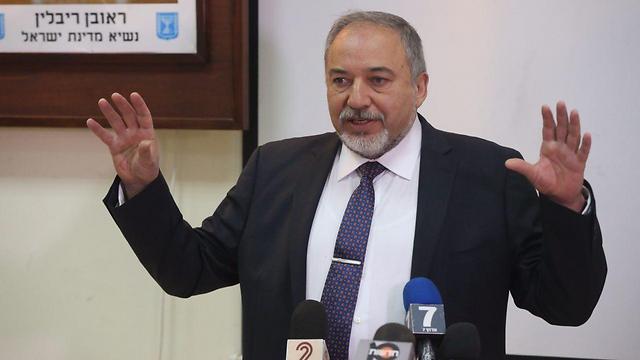
Lieberman at the IDF induction center (Photo: Motti Kimchi)

Lieberman at the IDF induction center (Photo: Motti Kimchi)

He added that “if the IDF does choose to act, there is a real reason for it.”

Israeli Arrow anti-aircraft missiles were used to intercept a Syrian S-200 missile fired at IAF jets that returned to Israeli territory after attacking targets in Syria on Friday night.

“Next time, if the Syrian aerial defense apparatus acts against our planes, we will destroy it,” Lieberman said. “We won’t hesitate. Israel’s security is above everything else; there will be no compromise.”
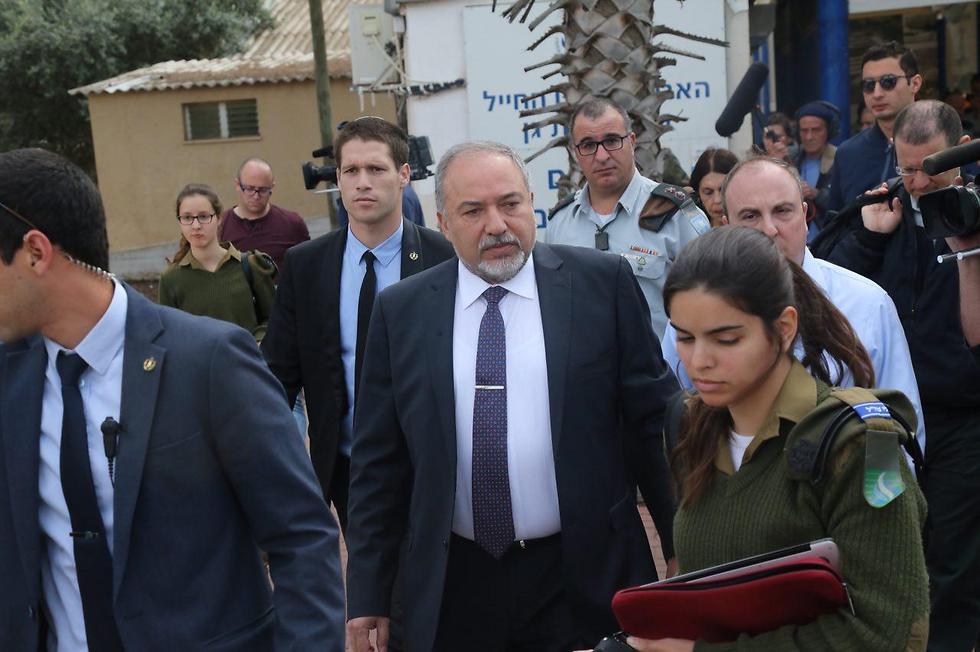
Lieberman at the IDF induction center (Photo: Motti Kimchi)

Lieberman at the IDF induction center (Photo: Motti Kimchi)

Similarly, he said, the IDF will respond to any rocket fire coming from the Gaza Strip “with force.”

“We’ll cut down Hamas’s capabilities, we’re not willing to tolerate any provocation,” Lieberman said. “We won’t take money from the Israeli taxpayer to invest in electricity and water for the strip, while they are investing their money in tunnels.”

New recruits at the IDF induction center (Photo: Motti Kimchi)

New recruits at the IDF induction center (Photo: Motti Kimchi)

The defense minister also addressed his ongoing feud with Education Minister Naftali Bennett over disparaging remarks made by Rabbi Yigal Levinstein about women in the IDF. Lieberman called on the rabbi to resign and threatened to halt Defense Ministry recognition of the rabbi’s pre-army preparatory yeshiva, which angered Bennett.

“The IDF presents a variety of options—from Caracal (a co-ed battalion) to the Haredi Nahal (for ultra-Orthodox soldiers). Everyone has a place,” Lieberman determined. “This sweeping attack against women is unreasonable. We’ve tried to avoid friction with Levinstein. We’ve forgiven him twice before (for similar comments) and dragged our feet on this. A third time is too much.”

Lieberman added that Rabbi Levinstein will face a disciplinary hearing, in accordance with a legal opinion in the Defense Ministry.

(Translated and edited by Yaara Shalom)
US is back

March 19, 2017

US is back, Israel Hayom, Prof. Eyal Zisser, March 19, 2017

(Please see, for example, A new foundation for Saudi-US relations. — DM

The Trump administration is not even 100 days old, but the Middle East is already feeling the change. The United States is once again taking an active role in the region, and more importantly, Washington is once again standing by the allies and friends it had abandoned. It is now abundantly clear that America can differentiate between the good guys and the bad guys in the region, and that it plans to act for the former and against the latter.

It is an open secret that the election of President Donald Trump, despite being portrayed as an enemy of Islam who gobbles up Muslims, was greeted with a sigh of relief in the region, and in some cases with overt jubilation. America’s allies were fed up with former President Barack Obama and his administration, which turned its back on them during tough times and did not hesitate to criticize them and even question their legitimacy.

The Obama administration was obviously biased in favor of pro-Islamic elements in the region, such as the Muslim Brotherhood in Egypt. It also courted Iran and tried to appease it, in the hope of dissuading it from pursuing its nuclear ambitions and maybe scaling back its destabilizing activities in the region. This all created an unbridgeable gulf between Washington and its old friends, who came to conclusion that even the minimal understanding Washington had of the region’s complexities was no longer there, and that perhaps the Obama administration had lost touch with reality.

Trump is not committed to the former administration’s value system, which was used to pass judgment and essentially sacrifice his allies and friends. For all of Obama’s high-minded values, he essentially let Syria falter and allowed its fate to be decided by the impulses of President Bashar Assad and his friends in Moscow and Teheran.

Many have assumed that Trump would prefer to wait before taking action in the Middle East, a region with which he is not familiar and which does not require immediate American intervention, especially since Obama left him almost no wiggle room. But, surprisingly, the American efforts in the region under his leadership have been the most intense in recent memory.

Last week, Trump hosted Crown Prince Mohammed bin Nayef, Saudi Arabia’s interior minister, whose associates were quick to declare that the meeting was a historic turning point in the countries’ bilateral relations, because the two leaders saw eye-to-eye on the Iranian threat and on the need to counter its efforts to destabilize the region. Similar voices have been heard in Cairo and in Ankara.

Trump is also sending additional forces to Syria to strengthen the American hold on its eastern part. This is designed to help deal a crushing blow to Islamic State and provide a counterweight to the Russian presence, and even more importantly, to the Iranian presence there. Trump has also tried to have the Israelis and the Palestinians resume direct talks without accepting the prerequisites set by Palestinian Authority President Mahmoud Abbas.

Trump’s actions regarding the Palestinian-Israeli conflict are part of a more comprehensive effort to advance regional cooperation in the region, an effort Egyptian President Abdel-Fattah el-Sissi has been pushing for months. Trump hopes this effort will usher in new arrangements between Israel and its Arab neighbor and the Palestinian Authority.

Trump may not have a deep understanding of the region, but he has the instincts of a businessman who wants to win. He may very well prove that one does not have to be impartial to reach a deal, as President Vladimir Putin has proved in Syria. Trump may be able to make Israel and the Palestinian reach certain understandings even while showing his support for Israel. Most importantly, the deal that Trump promotes will not be bound by the value system of Obama or the Europeans, nor will Trump say amen to every request made by the Palestinians. Trump will only make sure the deal advances both sides’ interests.

Only time will tell whether Trump can effect the change he desires in the region.

ANALYSIS: This time, the Russians are mad

March 19, 2017

Source: Israel Hayom | ANALYSIS: This time, the Russians are mad

Departing from their usual discreet style, the Russians publicly summon Israel’s ambassador for clarifications after Israel acknowledges striking an arms convoy in Syria • While the exact reason is unclear, the situation in Syria is clearly escalating.

Yoav Limor
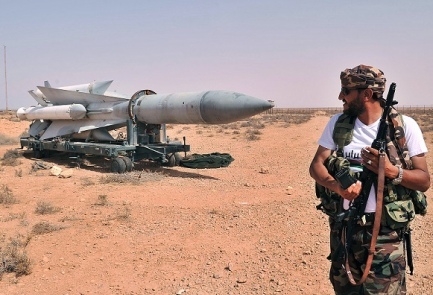
A Syrian SA-5 missile, the kind that was fired at Israeli jets over the weekend

Hizballah’s trust in Russia – strategic dilemma for Israel

March 19, 2017

Hizballah’s trust in Russia – strategic dilemma for Israel, DEBKAfile, March 18, 2017

Israel is not planning action against Russian forces in Syria, but if the Russian army, whether deliberately or unintentionally, grants Iran and Hizballaha military protection, as they counted on having at T4, Israel would not hesitate to disabuse them.

************************

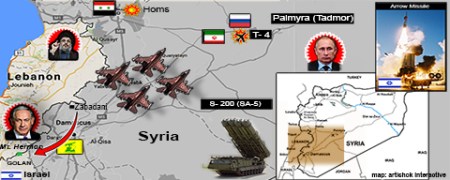
Israel finally took a hand in the swiftly moving events looming from Syria over its northern borders by launching multiple air raids against the key northern Syrian air base known as T4 near Palmyra early Friday night March 17.

Those events are spearheaded by the pro-Iranian Hizballlah’s drive to capture the Golan in line with its war of “resistance” on the Jewish state.  This fixation came into sharp focus the day after the air strike in a rare admission by Hizballah of the loss of a commander. He was named Badee Hamiyeh and was described as having been killed “in the southern Syrian region of Quneitra near the Israeli-held Golan Heights.”  This was the first anyone had heard of any recent battle on the Golan.

A week earlier, Prime Minister Binyamin Netanyahu and IDF Intelligence Director Maj. Gen. Hertzl Halevi showed President Vladimir Putin in the Kremlin maps depicting the various military movements ongoing in Syria, with the accent on an armored convoy of several hundred Hizballah troops driving out of their Syrian stronghold of Zabadani towards Mt. Hermon. The convoy was clearing a path by overrunning some 30 Syrian rebel villages on the Hermon slopes, which command the Syrian Golan town of Quneitra and the Israeli border.

This evidence demonstrated that Hizballah had developed a single military stratagem for threatening Israel-held Hermon, ruling central Golan and gearing up for battle to restore the entire Golan area to Syrian sovereignty under Hizballah control.

Netanyahu had hoped that Putin would agree to stop the Hizballah convoy and keep his promise not to let Iran and Hizballah deploy on the Israeli border. However, the Russian leader was unresponsive. Not only were Russian commanders in Syria not instructed to restrain Hizballah, they acted to persuade Syrian rebels on the Hermon and the Golan to surrender to he Lebanese Shiite invaders.

And indeed, as the Hizballah advance continued. Its leader Hassan Nasrallah contrived an equation to justify his assault on the Golan. “They brought ISIS to the Beqaa [Hizballah’s Lebanese stronghold] and so the ‘resistance’ [Hizballah] went to Syria. They wanted this group to reach Beirut, and so, today, we are in Golan.”

Seeing Hizballah on the move unchecked and gearing up for an expeced showdown with Israel, Netanyahu and the IDF decided to take matters in their own hands. They ordered several air force strikes Friday on the relatively remote strategic T4 air base near Palmyra in northeastern Syria and hit several birds with one stone.

DEBKAfile’s military sources describe T4 as the main terminal for Iranian planes to land day by day and unload  war materials for their own forces as well as the Syrian army and Hizballah.This air base also houses Russian attack helicopters and special operations troops, whose presence there was trusted by Tehran and Nasrallah to be an effective shield against Israeli attack.

The IAF air strike Friday proved them wrong.

These developments were the subtext of the video statement by Netanyahu that was broadcast Friday night by Israeli media: “I can assure you that our resolve is firm, as attested to by our actions,” he said. “This is something that everyone should take into account, everyone!.” When he said, “everyone,” he was not just addressing Tehran and Beirut, but Moscow as well.

Israel is not planning action against Russian forces in Syria, but if the Russian army, whether deliberately or unintentionally, grants Iran and Hizballaha military protection, as they counted on having at T4, Israel would not hesitate to disabuse them.

The Kremlin got the message and, a few hours after the Israeli air strikes, Israeli Ambassador Cary Koren was summoned to the Russian Foreign Ministry. There was no official protest, but Deputy Foreign Minister Mikhail Bogdanov firmly informed the ambassador that Moscow would not tolerate any further Israeli attacks on Syrian bases where Russian forces were present.

In the course of the raid, Israel’s advanced anti-missile Arrow system made its first operational appearance. IDF chiefs feared that the Syrian anti-air missiles fired against the Israeli jets might fall on a populated location inside Israel and so decided it was necessary to intercept any incoming projectiles.

Israel’s military experts got into an argument, which will no doubt go on for years, over whether Arrow’s first appearance in this situation was a good or a bad move. However, the deafening bang that the IDF wonder weapon inflicted on millions of Israeli ears, within a radius of more than a 150 kilometers from the Jordan Valley to the Mediterranean, offered an inkling of how much worse it will be in a full-scale conflict.