Source: Israel Hayom | The day after Mosul’s liberation
Islamic State’s impeding defeat in Iraq raises serious questions as to what will become of it in the future • With Iran eyeing a greater regional foothold, Islamic State’s fall will bolster Shiites in the Middle East • Israel still has cause for concern.
|
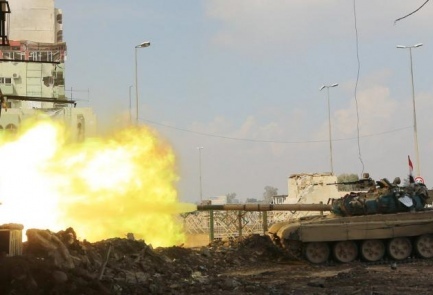
An Iraqi tank shelling an Islamic State post in Mosul
|
Two years ago, when the Islamic State group reached the height of its power, overrunning large areas of Syria and Iraq, it seemed nothing could stop the radical Islamist movement that splintered from al-Qaida.
Unlike al-Qaida, Islamic State took its radical doctrine further, with leader Abu Bakr al-Baghdadi declaring himself a caliph, meaning the leader of all Muslims worldwide, and one who demands his subjects’ fierce loyalty on pain of death. Islamic State’s control of such vast territory was the group’s greatest achievement, and in contrast to al-Qaida, Islamic State ruled the area as if it was the nucleus of a state actually predicated on the principles of Islam, with all the gruesome brutality that entails.
In retrospect, it was this combination that prompted countries in the region and the West to come together to rein in the threat. This effort has been successfully progressing, albeit slowly. The liberation of Mosul, the most important Iraqi city to fall to Islamic State, has taken longer than expected, but it has now entered its final stages; and the offensive to retake the city of Raqqa, Islamic State’s “capital” in Syria, is another advanced stage in the liquidation of the group’s strongholds on the ground.
Removing the Islamic State group from the territory it assumed to control raises the question of what will become of it in the future. There are three possible scenarios, which could all come to fruition simultaneously: The group may try to expand its global reach; it may increase its terrorist activity worldwide; and it may attempt to overrun areas in Syria again.
The first scenario, which is highly likely, will see Islamic State increase its efforts to spread its doctrine on a global scale, in an effort to preserve and nurture the notion of the Islamic caliphate among its followers. Ruling people’s minds and hearts will be the group’s alternative to territorial dominance, and this effort will take place wherever there are Muslims, including in Western countries and the weaker nations in Asia, Africa and the Arab world.
The second scenario will resemble what we know from al-Qaida, and would likely see Islamic State increase its efforts to terrorize the world wherever operational opportunities present themselves.
This effort will see the group make use of its tens of thousands of sympathizers, who will either become refugees or return to their homelands, where they will most likely partner with local Islamist and terrorist elements, from China to Africa. Another aspect of this effort will focus on areas where state control is failing. Such efforts can already be seen in Egypt’s Sinai Peninsula, and Libya. The organization will look for such opportunities and it will take full advantage of them without hesitation and with its trademark brutality.
The third scenario may see Islamic State lead a bloody battle to overrun new areas in Syria, for example in the northwestern area of Idlib. This will allow the organization to draw out the war waged against it, exhausting opposition forces that are waging fierce battles in Raqqa.
Either way, eradicating Islamic State in Iraq and Syria will be a lengthy process, and even after its major strongholds fall and it is declared as defeated, it will still have enough energy — and sympathizers — in both countries to spread occasional death and destruction.
Regional power plays
Islamic State is not about to disappear from the Fertile Crescent, mainly because the Shiite-Iranian threat is cause for major concern among the Sunni majority in the Middle East. Islamic State allows the Sunnis to dream of a better future when the present is, in fact, very bleak.
Iran stands to gain the most from the war on Islamic State. If the 2015 nuclear deal restored some of Iran’s international legitimacy, allowing it to collaborate with Russia on the civil war in Syria, the war on Islamic state is enabling Iran — this time with the global community’s support — to pursue forming a Shiite buffer in the heart of the Sunni world.
Iranian-affiliated Shiite militias are taking part in the battle of Mosul, once an almost exclusively Sunni city. These militias will stop at nothing, including the extermination or expulsion of civilians and bringing Shiites to the city to settle in their place, over the fact that Mosul in the gate to the strategic axis running to Raqqa, Aleppo, Damascus and Beirut, and establishing this axis in the Iranian dream — as it would give it direct access to the Mediterranean.
An Iranian-led Shiite success in creating such an axis would change Middle Eastern geopolitics, especially with respect to the Sunni-Shiite and Arab-Iranian struggles. An actual Iranian foothold in the Middle East is the Sunni world’s nightmare, and it stands to pose a real challenge for Israel.
An agreement seeking to end the Syrian civil war that would leave Iran and Hezbollah as permanent forces in Syria, alongside massive Russian support meant to prop up President Bashar Assad’s regime, will present a direct threat to Israel. Even more so if this Shiite presence is able to establish a ground link to Iran or a seaport in the Mediterranean.
Foiling this threat would require significant diplomatic effort, but there is no guarantee diplomacy will be enough. It is not for nothing that Prime Minister Benjamin Netanyahu’s recent trip to Russia focused on this threat, as it cannot materialize without Russian consent.
Another interesting question pertains to how Turkey might react to the new reality on its southern border.
Turkish President Recep Tayyip Erdogan is currently preoccupied with the constitutional referendum seeking to tighten his grip on power. His belligerent rhetoric may be aggravating tensions with some European nations, but they are not the long-term threat to Turkey. An active Shiite axis in northern Iraq and Syria is a far greater threat.
Ankara has thus far succeeded in preventing the classic Turkish nightmare, namely the establishment of a Kurdish state with maritime access. Such a state will unite the Kurds in Iraq and Syria and will pose a threat to Turkey’s integrity, as the latter is home to a large Kurdish minority.
Once the April 16 referendum is over, Ankara could potentially find itself facing another, equally menacing nightmare: Shiite-Iranian presence in its south with aspiration of Middle East hegemony.
This axis joins Ankara’s enemies in Syria, and they have vested interest in maintaining good relations with the Kurds, which in turn could change Turkey’s status as the largest and strongest nation bordering Syria and Iraq.
It remains to be seen how this new situation would affect Erdogan’s conduct, especially if he wins the referendum and realizes his dream of leading the Sunni world. Anything can happen, including the possibility of a renewed relationship between Turkey and Islamic State in the face of a growing Shiite enemy.






 anneinpt
 artaxes
 danmillerinpanama
 davidking1530
 Peter Hofman
 Joseph Wouk
 Peter
Peter Louisiana Steve
 WarSclerotic
Recent Comments