Now That Trump Is in the White House, Can Israel Seize the Moment? Alegmeiner, Martin Sherman, January 27, 2017
(Please see also, Trump Will Keep Vow on Jerusalem Embassy Move, Giuliani Says. — DM)
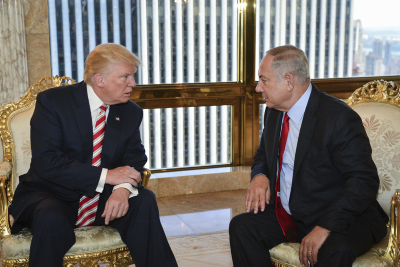
Prime Minister Benjamin Netanyahu meets with Republican Presidential candidate, Donald Trump, in New York, on September 25, 2016. Photo by Kobi Gideon/GPO
To date, there seems to be only one central pre-election commitment that the new administration appears uncharacteristically hesitant in embracing: the promise to transfer the US embassy in Israel to Jerusalem.
Of course, not all this regrettable reluctance can be blamed on the Trump administration. After all, the Israeli government itself has not been overly enthusiastic in promoting the embassy relocation.
************************
“There is a tide in the affairs of men,
Which taken at the flood, leads on to fortune.
Omitted, all the voyage of their life is bound in shallows and in miseries.
On such a full sea are we now afloat.
And we must take the current when it serves, or lose our ventures.”
— William Shakespeare, Julius Caesar, Act IV, Scene 3.
“If I am not for myself, who is for me? …And if not now, when?”
— Hillel the Elder, Ethics of the Fathers, Ch. 1:14.
In the first few days of his presidency, Donald Trump has acted with remarkable resolve to promote a number of his more strident campaign pledges, and to dismantle much of the edifice his predecessor had hoped to leave as his “legacy.”
Robust resolve
Thus, Trump moved to withdraw the US from the Trans-Pacific Partnership Agreement, which the New York Times dubbed “Obama’s signature trade achievement.”
Similarly, he instigated measures to begin rolling back “Obamacare,” the centerpiece of Obama’s domestic policy; approved the construction of two large oil pipelines (Keystone pipeline between the US and Canada, and Dakota Access Pipeline), which Obama had vetoed; cut funding of charities providing abortion services abroad, reinstating a 1984 bill that Obama had rescinded; and ordered a freeze on hiring federal government workers (apart from the military) in an “effort to reduce government debts and decrease the size of the federal workforce.”
Then, later this week, Trump “signed directives to begin building a wall along [the] US border with Mexico and crack down on US cities that shield undocumented immigrants.” Likewise, he is reported to be drafting directives to be implemented “in the coming days [that] would…suspend the entry of any immigrants from Muslim-majority Middle Eastern and African countries Syria, Sudan, Somalia, Iraq, Iran, Libya and Yemen while permanent rules are studied.”
So, regardless of whether one commends or condemns these policy decisions, they certainly reflect a firm — indeed, a seemingly unswerving — commitment to his campaign pledges, no matter how controversial or contentious.
With one notable exception.
Rare reticence
To date, there seems to be only one central pre-election commitment that the new administration appears uncharacteristically hesitant in embracing: the promise to transfer the US embassy in Israel to Jerusalem.
Readers will recall that in October 1995, the US Congress passed a law (the Jerusalem Embassy Act) with broad bi-partisan support — including from Obama’s vice president, Joe Biden and Secretary of State John Kerry — that, in effect, recognized Jerusalem as the undivided capital of Israel, under Israeli sovereignty, and explicitly called for the relocation of the US embassy to the city by May 1999. The bill, however, included a proviso permitting the president to issue a waiver holding up the relocation of the embassy should he deem it in the US national interest. The waiver is renewable every six months and since the legislation of the bill, every president — both Democrat and Republican — has exercised the waiver option. Indeed, 36 such waivers have been issued in the past — including eight by Obama — the last of which was put through in December 2016 and is due to expire in June 2017.
Accordingly, all Trump really needs to do to fulfill his pledge to relocate the US embassy to Israel’s capital is, well…nothing. Indeed, he need take no proactive measures at all. He does not need to build a wall, lay a pipeline, pass new legislation or sign a contentious executive order. All he needs to do is let the current waiver lapse, and allow the existing 1995 legislation to take effect.
Yet, for some reason, it is precisely on this issue that the new administration is displaying rare reticence in moving briskly forward to deliver on its clear commitments.
Disturbing lack of enthusiasm…from Israel
Of course, not all this regrettable reluctance can be blamed on the Trump administration. After all, the Israeli government itself has not been overly enthusiastic in promoting the embassy relocation.
Reflecting Israel’s lack of fervor in applauding Trump’s pledge was Defense Minister Avigdor Lieberman’s offhand apathy in addressing the prospect at last month’s Saban Forum in Washington. When asked by the moderator, CNN’s Jake Tapper, what he thought of Trump’s declaration that he would move the US embassy in very short order to Jerusalem, Lieberman was distinctly dismissive, indicating that he was skeptical as to the prospect: “You know, [what] we see before in every election is the same promise to remove the embassy to Jerusalem. But I think that we will wait and we will see.”
Then, virtually providing the administration with the justification to renege on its commitment, or at least significantly postpone it, Lieberman stated: “We have many other issues…we have enough challenges all around Israel. I think that it will be a mistake…to take the embassy as the focal point…We have many items on our common agenda. I think that maybe the Embassy will be one of the points.”
With such lethargic endorsement from the Israeli government, there would be little room for surprise if America’s new commander-in-chief does not push his proffered relocation vigorously forward.
Plethora of invalid arguments
A plethora of bad reasons has been advanced for not moving the US embassy to Jerusalem. Typical of such baseless arguments was the one articulated in an Haaretz op-ed, in which the writer warned: “Relocating its embassy to Jerusalem would mean the US taking a partisan stance on a central and sensitive issue, a source of controversy between Israel and the Palestinians, and between Israel and the international community.”
But of course, quite the opposite is true. By not relocating the embassy even to the western portion of Jerusalem, the US is, in fact, taking a partisan stance against Israel. For, in effect, this endorses the Palestinian/Arab position disputing Israeli sovereignty over any part of the city, including the portion that was under Israeli control prior to the Six-Day War. After all, if the US does not dispute Israeli sovereignty of the city within the pre-1967 lines, surely there should be no reason to refrain from establishing the embassy there. Or am I missing something here?
After all, the western portion of Jerusalem is, undisputedly, the functioning capital of Israel. There sit the national parliament, the prime minister’s office, all the government ministries (apart from agriculture) and the Supreme Court. Any capitulation to the notion that the Palestinians have a legitimate claim to any part of it would immediately torpedo the chances of an agreement. Accordingly, abstaining from relocating the embassy to western Jerusalem implicitly sustains grounds for such a claim and, in effect, constitutes a partisan pro-Palestinian stance.
By contrast, relocating the embassy would send a strong, even-handed message that the US will not tolerate exorbitant and unreasonable Palestinian territorial demands.
Invalid arguments (continued)
But, perhaps the most common argument advanced for not relocating the embassy is because the Arabs and Muslims will get really mad. The threat of uncontrollable rage due to grievous insult (which would not provoke any other segment of humanity to similar conduct) has frequently been raised as reason to avoid offending Muslim sensibilities. It has already almost completely curtailed free speech in much of Western Europe and Scandinavia, where Muslim thugs are free to ravage the domestic population in the name of moral relativism and cultural diversity.
Clearly, giving into Arab/Muslim extortion because of threats of violence is a slippery slope. Once you capitulate on one issue, there is little reason not to capitulate on another.
Indeed, if the menace of Muslim mayhem can coerce nations to forgo free choice, what is to prevent further far-reaching demands, such as universal application of Shariah law, the discrimination against females and the persecution of gays?
The threat of violence is no reason to refrain from establishing the US embassy in Israel’s capital, but rather the reason to do so — and it will convey to the Arab/Muslim world that brandishing “uncontrollable rage” is an unacceptable and counter-productive mode of conducting international relations.
Respite not redemption
The election of Trump was a huge stroke of good fortune for Israel. Just how dire its position might have been had Hillary Clinton been elected to continue the Obama legacy was vividly conveyed by two recent incidents.
The first: a surreptitious transfer of almost a quarter billion dollars to the Palestinian Authority by the outgoing president in the final hours of his incumbency, in defiance of a congressional hold on the funds.
The second: a jarring disclosure made last week by former director-general of Israel’s ministry of foreign affairs, Ambassador Dore Gold, of an astonishing admission by Obama’s National Security Adviser Susan Rice, that “even if Israel and the Palestinians reach an agreement, it is possible that the United States would oppose it” – because it might not do justice to the Palestinians.
These disturbing revelations starkly expose the blatant pro-Palestinian proclivities of the outgoing Obama administration and of the expected Clinton administration as the designated surrogate-successor.
Israel can be excused for feeling a huge sense of relief at the outcome of the November elections. However, a word of caution is necessary. For all the potential advantages involved in the Trump victory, it is — for the moment — merely a respite and still far from redemption. To attain that, there is yet much work ahead.
Catalyst or constraint?
There can be little doubt that the Trump victory harbors the potential for great opportunity for Israel. Not only is the incoming administration free from innate malice and anti-Israel bias that characterized the manifestly Islamophilic propensities of the previous one, but many in Trump’s inner circle are unabashedly pro-Zionist, and together with the wider Republican Party, unshackled to the failed “two-state solution.”
At last, after almost a quarter century, Israel has a real chance of being able to free itself of the deadly, debilitating tentacles of this pernicious paradigm — and to choose a new path that will allow it to extricate itself from the perilous cul-de-sac into which it had been led and allowed itself to be led.
The question now is whether the Israeli political class can rise to the occasion, and grasp the opportunity that destiny has provided. Will the nation’s leaders display the intellectual daring and the ideological resolve for which the hour calls? Will they be able to cast off the prevailing constraints of political correctness and forge new and sustainable paradigms for the conduct of the nation’s affairs, taking advantage of the new benign winds in Washington? Or will they, as it seems, remain captive to old molds of thought — and thus prove to be a constraint, rather than a catalyst, impeding rather than inducing the chances that the Trump administration may well afford them if they were to strike out in a bold new direction?
“There is a tide in the affairs of men…”
More than ever before, Israel’s destiny is in its own hands. The outcome of the US elections has given it a real chance to shape its destiny. The crucial question now is whether it will seize the moment or let it slip away.
Almost six months before the Trump inauguration, shortly after the Republicans had removed their endorsement of a two-state model in its party platform, I published a column entitled “What if the GOP wins?”. I called on the Israeli “Right” to prepare for the possibility of a Republican victory and formulate a credible alternative to the discredited two-state prescription.
However, I cautioned that haste to discard this failed two-state formula should not lead to the proposal/promotion of alternatives that are no less inimical than the ideas they were designed to replace.
I urged that, to reap the potential benefits of the Trump phenomenon:
Israel must prepare. It must formulate a cogent, comprehensive paradigm to replace the two-state folly, which addresses both its geographic and demographic imperatives for survival — lest it promote a proposal that threatens to make it untenable geographically or demographically — or both.
It must be a proposal that ensures that Israel retains its vital geo-strategic assets in Judea-Samaria and at the same time drastically reduces the presence of the hostile Arab population resident there — preferably by non-coercive means such as economic inducements…which, of course, is what brought the bulk of the Arab population here in the first place.
This is now becoming an urgent imperative, lest we miss the flood tide and find ourselves “bound in shallows and in miseries” that a lapse will inevitably entail.





 anneinpt
 artaxes
 danmillerinpanama
 davidking1530
 Peter Hofman
 Joseph Wouk
 Peter
Peter Louisiana Steve
 WarSclerotic
Recent Comments