Archive for October 13, 2016

US Tomahawks destroy Iran’s radar bases in Yemen

October 13, 2016

US Tomahawks destroy Iran’s radar bases in Yemen, DEBKAfile, October 13, 2016

uss_mason_fires__9-10-16_an_sm-2-1

Tomahawk cruise missiles launched by US Navy destroyer USS Nitze early Thursday, Oct. 13, destroyed three Iranian-Yemeni coastal radar stations, after C-802 anti-ship missiles supplied by Iran to Yemeni Houthi rebels were fired at US naval vessels off the Yemeni coast. The stations were built and  operated  by Iran’s Revolutionary Guards (IRGC) for their Yemeni proxies to back up a threat to blockade the Red Sea.

From Oct. 9, the new missiles four times targeted the US flotilla shortly after it arrived to patrol the Red Sea and the Bab al-Mandeb Strait. Neither the US nor Iran has acknowledged their mounting confrontation over control of these strategic waters, which Tehran is waging through its Yemeni proxy.

DEBKAfile was first to disclose this confrontation in a special report Wednesday. (see below)

Iran’s Guards are repeating the mode of operation they employed a decade ago at another Middle East flashpoint. On July 14, 2006, Hizballah used an earlier version of the C-802 to attack and cripple the Israeli Hanit missile ship on the day this Iranian Lebanese proxy launched the Second Lebanese War against Israel. Rev Guards seized control of Lebanese shore radar station to guide their aim.

A highly advanced radar installation is required for the use of the C-802. Two radar stations set up outside Yemen’s two principal Red Sea ports, Mokha and Hudaydah earlier this month were operated by Rev. Guards missile and radar teams until they were destroyed Thursday, DEBKAfile’s military sources report. The third station was added for triangulation. The destruction of all three by a US Tomahawk has knocked out the Houthis’ ability to use C-802 missiles and Iran’s threat to blockade the Red Sea.

To drive this lesson home, the US Pentagon issued the following statement:

“Destroying these radar sites will degrade their ability to track and target ships in the future. These radars were active during previous attacks and attempted attacks on ships in the Red Sea, including last week’s attack on the USA-flagged vessel “Swift-2”, and during attempted attacks on USS Mason and other ships as recently as yesterday.

The official was referring to the United Arab Emirates US-flagged transport ship that was badly damaged last week in the Bab al-Mandeb strait by a Houthi missile..

DEBKAfile reported earlier:

Contrary to Tehran’s assurance to Washington in August that Iranian arms supplies to Yemeni Houthi rebels had been suspended, the rebels took delivery last week of the largest consignment of Iranian weapons to date.

According to DEBKAfile’s military sources, the shipment included highly sophisticated Scud D surface-to-surface missiles with a range of 800km; and C-802 anti-ship missiles (an upgraded version of the Chinese YJ-8 NATO-named CSS-N-8 and renamed by Iran Saccade).

They came with Iranian Revolutionary Guards officers and radar systems to fine-tune the targeting of these missiles by Iran’s Yemeni proxies.

The Scuds were given to the Houthi forces fighting in northern Yemen on the Saudi border, while the C-802s were delivered to the Houthis’ Ansar Allah faction, which is under direct Iranian Rev Guards command.

The missiles were posted at special launch bases constructed by Iran outside Yemen’s two principal Red Sea ports of Mokha and Hudaydah.

Since no more than 62km of Red Sea water divides the Saudi and African coasts, the Iranian missiles are well able to block shipping and tanker traffic plying to and from the Gulf of Suez and the Persian Gulf. Therefore, the threat of blockade hangs imminently over one-third of Saudi and Gulf Emirate oil exports.

The same threat hangs over Israeli civilian and naval shipping from its southern port of Eilat through the Gulf of Aden and out to the Indian Ocean.

One of the most troubling aspects of this pivotal new menace to an international waterway was that US, Saudi, Egyptian and Israeli intelligence agencies missed the huge consignment of Iranian missiles as it headed towards Yemen. Neither did they pick up on the construction by Iranian military engineers of three ballistic missile bases – one facing Saudi Arabia and two Red Sea traffic.

Tehran’s Yemeni proxies moreover landed large-scale military strength on Perim island in the mouth of the Bab al-Mandeb strait, the chokepoint for ingress and egress from the Red Sea.

Since the strait is just 20km wide, control of this island empowers this force to regulate shipping movements through this strategic strait.
Tehran wasted no time after all its assets were in place to begin using them:

1. On Oct. 1, Iran’s Houthi surrogates launched C-8-1 missiles against a United Arab Emirates transport HSV-2 Swift logistics catamaran as it was about to pass through the strait. The ship, on lease from the US Navy, was badly damaged. No information was released about casualties.
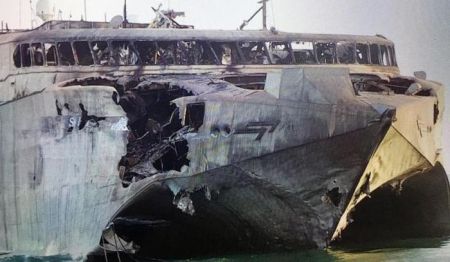
uae_hsv-2_1-1-16-1

DEBKAfile’s military and intelligence sources discerned that the aim of this attack was to choke off the movements of UAE warships from the southern Yemeni port of Aden, where large Emirate and Saudi forces are concentrated, to the Eritrean port of Assab, where the UAE has established a large naval base.

This attack did finally evoke a US response. The guided missile destroyers, USS Mason and USS Nitze, were dispatched to the Red Sea, along with the USS Ponceafloat forward staging base, to patrol the strait opposite the Yemeni coast

2. This did not deter Tehran or its Yemeni pawns: On Oct. 9, they fired an additional barrage of C-802 at the American flotilla, which according to a US spokesman, missed aim.

The Mason hit back with two Standard Missile-2s and a single Enhanced Sea Sparrow Missile.

There has been no official word about whether these weapons destroyed a Yemeni launching site. But the event itself was a landmark as the first direct Iranian-Houthi attack of its kind on an American naval vessel.

3. That same day, the Houthis fired Scud-D missiles at the Saudi town of Ta’if, 700 km from the Yemeni border and only 70km from the Muslim shrine city Mecca. This was meant as a direct assault on the Saudi royal house and its claim to legitimacy, by virtue of its role as Guardian of the Holy Places of Islam.

In America’s heated presidential campaign, the Democratic contender Hillary Clinton boasts repeatedly that as Secretary of State she helped “put the lid on Iran’s nuclear program without firing a single shot.”

That is factually true. America did not fire a single shot. Iran did the shooting and still does, constantly upgrading its arsenal with sophisticated ballistic missiles.

Iranian warships deployed off Yemen coast after US bombs Houthi targets

October 13, 2016

Iranian warships deployed off Yemen coast after US bombs Houthi targets

report Published time: 13 Oct, 2016 13:32

Source: Iranian warships deployed off Yemen coast after US bombs Houthi targets – report — RT News

FILE PHOTO Iranian navy warship © Stringer / Reuters

Iran has deployed a fleet of warships to the Gulf of Aden, according to the Tasnim news agency. The deployment follows US cruise missile strikes on Yemeni positions thought to be under Houthi rebel control.

The Iranian Navy has sent the warships to international waters for a mission that includes entering the area off the southern coast of Yemen, Tasnim reported on Thursday. The area is among the world’s busiest maritime trade routes.

“Iran’s Alvand and Bushehr warships have been dispatched to the Gulf of Aden to protect trade vessels from piracy,” Tasnim reported earlier, as quoted by Reuters.

Read more

FILE PHOTO © Eric Garst

Saudi Arabia, which has fought a long war with Yemen’s Houthi rebels, accuses Iran of supporting the group – a charge denied by Tehran.

The US military carried out “limited self-defense strikes” in Yemen on Thursday, in retaliation for recent attacks on an American naval destroyer, USS Mason, which has been operating north of the Bab Al-Mandab Strait.

According to the Pentagon’s initial assessments, three “radar sites” in the Houthi rebel-controlled area of Yemen were destroyed in the attack.

The attack on coastal targets was carried out by Tomahawk cruise missiles launched from the destroyer USS Nitze, NPR reported.

The Houthis have denied carrying out the attack, however. A military source reportedly told Saba news agency – a media outlet run by the group – that the assault did not come from areas under its control.

More from RT.com

Putin Ally Warns Americans To Vote For Trump Or Face Nuclear War

October 13, 2016

Putin Ally Warns Americans To Vote For Trump Or Face Nuclear War

by Tyler Durden

Oct 13, 2016 2:53 AM

Source: Putin Ally Warns Americans To Vote For Trump Or Face Nuclear War | Zero Hedge


The name of what is arguably Russia’s most flamboyant, ultra-nationalist politician, and according to some the local incarnation of Donald Trump,  Vladimir Zhirinovsky, a deputy in the state Duma and leader of the nationalist LDPR party, is familiar to frequent readers: he most recently made an appearance on these pages two months ago, when he warned Germany that it risks utter destruction if it continued on its present track of operating Bundeswehr forces in the Baltics. Zhirinovsky also shares another feature with Donald Trump: both are outspoken to a fault. Which is why we were not surprised to read that as Reuters reported earlier, Zhirinovsky urged Americans to vote for Donald Trump as president or “risk being dragged into a nuclear war.”

In an interview with Reuters, Vladimir Zhirinovsky, known in Russia and Europe for his fiery rhetoric, said that Trump was the only person able to de-escalate dangerous tensions between Moscow and Washington.

On the other hand, Hillary Clinton could spark World War Three, said the Russian who received a top state award from Putin after his pro-Kremlin Liberal Democratic Party of Russia (LDPR) came third in Russia’s parliamentary election last month.

“Relations between Russia and the United States can’t get any worse. The only way they can get worse is if a war starts,” said Zhirinovsky, speaking in his huge office on the 10th floor of Russia’s State Duma, or lower house of parliament. “Americans voting for a president on Nov. 8 must realize that they are voting for peace on Planet Earth if they vote for Trump. But if they vote for Hillary it’s war. It will be a short movie. There will be Hiroshimas and Nagasakis everywhere.”

Well, we said he was outspoken. And, Just like Trump, Zhirinovsky tends to polarize his fellow countrymen. According to Reuters while “many Russians regard the politician as a clownish figure who makes outspoken statements to grab attention” he is also “widely viewed as a faithful servant of Kremlin policy, sometimes used to float radical opinions to test public reaction.”

Zhirinovsky’s comments come at a time when relations between Russia and the US are at generational lows, as a result not only of the conflicts raging over Syria and Ukraine but also the recent White House accusation that Russia was responsible for cyber attacks against Democratic Party organizations. In turn, an amused Putin replied his country was not involved in an effort to influence the U.S. presidential election. Instead Putin accused the US of “starting this hysteria, saying that this (hacking) is in Russia’s interests. But this has nothing to do with Russia’s interests,” in a speech during a business forum in Moscow. He added that the accusations were a ploy to divert U.S. voters’ attention at a time when public opinion was being manipulated. “Everyone is talking about ‘who did it’ (the hacking),” said Putin. “But is it that important? The most important thing is what is inside this information.”

* * *

But back to “Russia’s Trump”: according to Reutersi, “Zhirinovsky likes to shock liberal public opinion and he has frequently heaped scorn on the West, which he and other Russian nationalists regard as decadent, hypocritical and corrupted by political correctness.

His combative style, reminiscent of Trump’s, ensures him plenty of television air time and millions of votes in Russian elections, often from the kind of blue-collar workers who are the bedrock of the U.S. Republican candidate’s support.


Zhirinovsky once proposed blocking off mostly Muslim southern Russia with a barbed wire fence, echoing Trump’s call for a wall along the U.S. border with Mexico.


Zhirinovsky, who said he met Trump in New York in 2002, revels in his similarities with the American businessman – they are the same age, favor coarse, sometimes misogynistic language and boast about putting their own country first. Zhirinovsky has even said he wants a DNA test to see if he is related to Trump.

Where the two differ, is that unlike Trump, an “anti-establishment candidate in the U.S. presidential race with no past political experience”, Zhirinovsky is a consummate political insider who has sat in the Duma for more than two decades; he is also more diplomatic when he needs to be, such as in this interview in which he continued to praise Trump: “(Trump) won’t care about Syria, Libya and Iraq and why an earth should America interfere in these countries? And Ukraine. Who needs Ukraine?,” said Zhirinovsky, who once counted himself a friend of Iraq’s Saddam Hussein and Libyan dictator Muammar Gaddafi and whose deaths he still laments.

“Trump will have a brilliant chance to make relations more peaceful … He’s the only one who can do this,” he said, adding that Trump could even win a Nobel peace prize.

And if he likes Trump, he must dislike Hillary. Sure enough Zhirinovsky described Clinton as “an evil mother-in law” and said her record as secretary of state under Obama in 2009-2013 showed she was unfit to lead her country.

“She craves power. Her view is that Hillary is the most important person on the planet, that America is an exceptional country, as Barack Obama said,” said Zhirinovsky. “That’s dangerous. She could start a nuclear war.”

 He did not stop here: “Most Americans should choose Trump because men have been leading for millions of year. You can’t take the risk of having one of the richest, most powerful countries led by a woman president,” he said.

Asked about lewd comments Trump made about women in 2005 that have harmed his campaign, Zhirinovsky defended the Republican: “Men all round the world sometimes say such things that are just for their comrades. We must only consider his business (and political) qualities.”

Zhirinovsky, who believes that although Putin and Trump have never met they could establish a close working relationship, had a very binary conclusion: “victory for Trump would be a gift to humanity. But if Hillary Clinton wins it will be the last U.S. president ever.”

Only time will tell if he is right.

Miami: Three Hizballah operatives busted for laundering $500,000 of cocaine money for Colombian cartel

October 13, 2016

Miami: Three Hizballah operatives busted for laundering $500,000 of cocaine money for Colombian cartel, Jihad Watch,

(Please see also, Venezuela, Iran, USA and Narco-Terrorism. — DM

Hizballah is a wholly owned and operated subsidiary of the Islamic Republic of Iran. Iran has repeatedly declared its intention to destroy the United States, as you can read about in detail in my book The Complete Infidel’s Guide to Iran (Regnery). Hizballah working with the drug cartel kills two birds with one stone: drugs weaken and destroy Americans, and sap American resources in largely futile anti-drug efforts, and the cash Hizballah earns in working with the drug cartel goes for more jihad against the U.S.

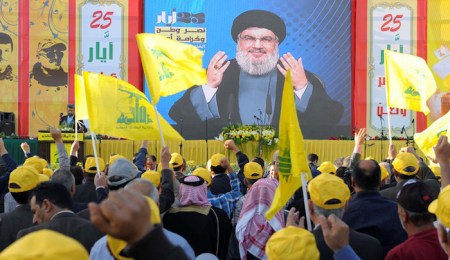
People watch Lebanon's Hezbollah leader Sayyed Hassan Nasrallah as he appears on a screen during a live broadcast to speak to his supporters at an event marking Resistance and Liberation Day, in Bekaa valley May 25, 2016. The event is to commemorate the 16th anniversary of Israel's withdrawal from southern Lebanon. REUTERS/Hassan Abdallah - RTSFWSN

People watch Lebanon’s Hezbollah leader Sayyed Hassan Nasrallah as he appears on a screen during a live broadcast to speak to his supporters at an event marking Resistance and Liberation Day, in Bekaa valley May 25, 2016. The event is to commemorate the 16th anniversary of Israel’s withdrawal from southern Lebanon. REUTERS/Hassan Abdallah – RTSFWSN

“State: Hezbollah-linked group laundered drug money through Miami banks,” by David Ovalle, Miami Herald, October 11, 2016:

Three men suspected of laundering cocaine money for the Colombian cartel have been busted after agents say they illegally moved $500,000 into Miami banks through a series of complicated financial transactions stretching from Australia to Europe.

That’s not uncommon in Miami, but the trio’s background is: They are suspected associates of the Middle Eastern terror group Hezbollah.

The main player is Mohammad Ahmad Ammar, 31, who was living in Medellín, Colombia. He was quietly booked into a Miami-Dade jail last week to face state felony money laundering charges in a case that underscores increased law-enforcement scrutiny on the role of Middle Eastern terror groups who use financial networks in Latin America to earn untold millions off drug profits.

Along with Ammar, two other Hezbollah associates are facing charges charges in the same case. One of them is in custody in Paris, while the other is on the lam, possibly in Lebanon or Nigeria.

The DEA investigated the case along with the the South Florida Money-Laundering Strike Force, a group of federal and state investigators that recently helped bust 22 people suspected in a large run connected to Mexican kingpin Joaquín “El Chapo” Guzmán.

“Drug dealers, potential terrorists and money launderers should all get the message that Miami-Dade County is not the place to do your dirty business,” Miami-Dade State Attorney Katherine Fernandez Rundle said in a statement.

The involvement of radical Islamic terrorist groups in Latin American is not new but has increased in recent years, according to federal law enforcement and security experts.

In November 2012, a congressional report on border security noted that Latin America has “become a money laundering and major fundraising center” for Hezbollah, the Shiite Muslim group classified as a terrorist organization by the U.S. government. The group, based in Lebanon, has been a key ally of Syrian dictator Bashar Assad in the bloody war that has decimated the country for the past five years.

“The notion of terrorist groups, especially Islamists using Latin America as place for money laundering, drug trafficking and other nefarious trades — it’s been known for some time now,” Jerry Haar, a Latin America expert at Florida International University, said in an interview.

In February, the U.S. Drug Enforcement Administration announced a “significant enforcement activity” against people connected with Hezbollah, The DEA’s efforts in “Operation Cassandra” came after the U.S. Department of Treasury announced sanctions against Hezbollah’s financiers, whom they the believe are capable of earning $400 million a year from drug trafficking and money laundering.

Exactly how much of money generated from laundering drug money is used directly to fund terror attacks is unknown. Many of those business associates such as Ammar “are more concerned with generating cash than religious or political doctrine” — though they readily send money back to their handlers in the Middle East, according to an arrest warrant.

Hezbollah-related arrests stemming from Latin American have popped up before in South Florida.

In 2008, a Lebanese man named Chekri Harb was arrested and convicted as part of a large-scale Colombian cocaine ring. U.S. authorities did not name Hezbollah in charging documents, but Colombian security officials described him as having links to the group.

Federal agents in 2010 arrested three South Florida businessmen accused of exporting video games and other electronic products to a shopping mall in Paraguay that allegedly served as a front to Hezbollah. They wound up being convicted of non-terrorism-related charges.

The lawless area at the borders of Paraguay, Brazil and Argentina has long been identified by the U.S. as a hotspot for money launderers who send their money back to the Middle East.

The latest Miami case was a spinoff from the DEA investigation into Colombian cocaine operations that netted dozens of trafficking and money-laundering arrests. In custody in Miami is Ammar, described in court documents as a Hezbollah associate whose job was to launder money for the Colombian cocaine operation known as La Oficina, or The Office, an off-shoot of the notorious Medellín cartel.

He was known to launder money through Holland, Spain, the United Kingdom, Australia and Africa, according to an arrest warrant. Ammar is charged with eight felonies, including money laundering and conspiracy to launder money; court records do not list a defense attorney.

According to court documents, his father is a well-connected Hezbollah associate living in Los Angeles, where the younger Ammar was arrested last month.

Also facing charges is Ghassan Diab, another purported Hezbollah associate based in Nigeria. According to court documents, Diab is related to a “high-ranking member of Hezbollah who has access to numerous international bank accounts.” He remains on the loose, possibly in Nigeria or Lebanon.

The third man facing charges is Hassan Mohsen Mansour, another Hezbollah associate with dual Lebanese and Canadian citizenship. He is in custody in Paris, and is facing a separate but similar federal money-laundering prosecution in South Florida.

The 42-page arrest warrant reads like a plot out of a international spy thriller, detailing a complicated web of encrypted communications between players in far-flung countries — some of them secretly working as informants — and murky financial transactions on six different continents.

A confidential source first tipped of Miami DEA agents to Ammar in early 2014, introducing him a second confidential informant who secretly recorded their meetings.

The second informant eventually asked Ammar to help him launder $250,000 worth of Australian dollars that was netted from cocaine sales. The task: Move the money to banks in Miami, where it could be moved later to Colombia or used by Colombian traffickers in South Florida.

Ammar was not aware, however, that the money was actually DEA cash and the Miami accounts were set up by the feds.

Using encrypted communications, Ammar enlisted the help of Mansour in Paris, who contacted a source in Australia (who by coincidence, happened to be an informant for the police there) to pick up the cash.

The money was deposited into an account in Dubai in the United Arab Emirates — where the anything-goes banking system remains out of reach of U.S. authorities. It was then then broken up and moved through a sham company called Al Haitham Exhibition and Conference Organizers, which purports to organize events but authorities believe is simply a front for money laundering.

From there, the money was cashed out and disappeared, according to an arrest warrant by DEA agent Kenneth Martin and state prosecutor Jared Nixon.

Back in Miami, the bank accounts set up by the DEA soon began receiving the money in chunks from obscure companies with names like “Tropical Trading” and “Khofo International.” To make them look like legitimate business, phony invoices were sent by Diab for nebulous goods or “payment for shipment.”

After the first deal went through successfully, Ammar soon admitted to the DEA informant that he was working with La Oficina, the chief cartel in Medellin, the warrant said.

In September 2014, another deal to launder $250,000 was struck. The Australian cash was sent to the events company in Dubai, with a note that it was for the purchase of a four-carat diamond ring head for Majorca, Spain. Through more bogus companies, some of the money was eventually transferred into the DEA’s Miami bank accounts; one transaction was disguised as payment for 50-kilogram bags of white rice.

Throughout the undercover operation, Ammar made admissions of interest to investigators, according to the warrant, including that he knew two brothers who worked for Avianca airlines who could smuggle in cocaine to Miami.

He also boasted that his family was well connected with Hezbollah, and inquired if the informant would be interested in helping smuggle 150 kilograms of cocaine from Costa Rica to the Netherlands.

Clinton Backed Egypt’s Muslim Brotherhood Regime

October 13, 2016

Clinton Backed Egypt’s Muslim Brotherhood Regime, Washington Free Beacon, Bill Gertz October 13, 2016

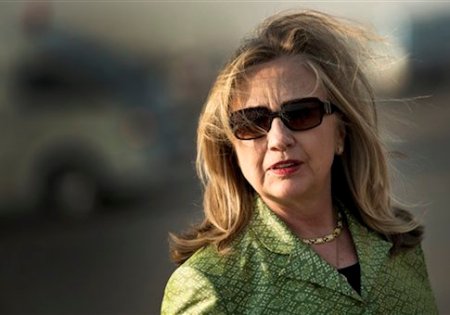
U.S. Secretary of State Hillary Rodham Clinton before her departure to Egypt's coastal city of Alexandria in Cairo, Egypt, July 15, 2012. Clinton on Sunday urged Egypt to commit to "a strong, durable democracy" that protects all citizens, hoping to appeal both to supporters of the popularly elected Islamist president and minorities fearful of being repressed under their new government. (AP Photo/Brendan Smialowski, Pool)

U.S. Secretary of State Hillary Rodham Clinton before her departure to Egypt’s coastal city of Alexandria in Cairo, Egypt, July 15, 2012. (AP Photo/Brendan Smialowski, Pool)

Secretary of State Hillary Clinton in 2012 called the election of Egypt’s Islamist Muslim Brotherhood leader a “milestone” for Egyptian democracy and offered covert police and security help, according to declassified State Department documents.

A nine-page document, once-labeled “Secret,” listed talking points for Clinton’s meeting with newly-elected Egyptian President Mohamed Morsi on July 14, 2012. The talking points said Morsi’s election was a key step toward popular democracy in the strategic North African state.

“We stand behind Egypt’s transition to democracy,” the heavily-redacted Clinton talking points state, adding that the only way to maintain a strong Egypt is “through a successful transition to democracy.”

The first key objective of the meeting was for Clinton to “offer our congratulations to Morsi and to the Egyptian people for this milestone in Egypt’s transition to democracy.”

Clinton then was meant to offer Morsi American technical expertise and assistance from both the U.S. government and private sector to support his economic and social programs.

Clinton’s talking points also included an offer of secret assistance to help Morsi “upgrade and reorient Egypt’s police force toward serving the needs of a democratic people.” The offer included sending a team of U.S. police and security experts to Egypt as part of a “framework of cooperation” that would be carried out “quite discretely.”

Also, the talking points reveal Clinton was ready to help launch an Egyptian-American Enterprise Fund, a private sector initiative of U.S. and Egyptian investors to help Egyptian businesses. The fund was to be launched with $60 million and would later involve Congress adding $300 million over five years.

The fund was created in September 2012.

Many pro-democracy Egyptians who had taken to the streets as part of the 2011 revolution that ousted long-time U.S. ally Egyptian President Hosni Mubarak viewed U.S. support for Morsi as a betrayal and part of a U.S. strategy of backing the Muslim Brotherhood in the region.

The meeting between Clinton and Morsi took place two months before terrorists in neighboring Libya attacked a U.S. diplomatic compound and CIA facility, killing four Americans, including U.S. Ambassador to Libya Christopher Stephens.

A second State Department document revealed that Deputy Secretary of State Thomas R. Nides wrote to Morsi on Sept. 24, 2012 seeking collaboration with the Egyptian leader on Syria and Iran.

“It was a honor to meet with you in Cairo,” Nides wrote in the letter. “We share the goal of growing our markets and increasing trade, as well as a desire for a stable, secure and peaceful region. As I said when we met, the United States also remains committed to helping Egypt address regional issues, including Syria and Iran.”

Both documents reveal that the State Department under Clinton had little understanding of the Islamist threat posed by the Muslim Brotherhood and its branches.

Andrew C. McCarthy, former assistant U.S. attorney in New York who prosecuted Islamist terrorism cases, said Clinton backed the Muslim Brotherhood over the Egyptian military, stating it was imperative that power be turned over to the winner of the election.

“The defining mission of the Muslim Brotherhood is the implementation of sharia,” McCarthy said. Sharia is Islamic law that critics say is antidemocratic and contrary to fundamental rights and freedoms

The documents were released under a Freedom of Information Act request seeking information on the Obama administration’s secret 2011 Presidential Study Directive-11, or PSD-11.

The directive, according to officials familiar with its contents, outlined how the administration would seek to support the Muslim Brotherhood around the world despite the Islamist supremacist organization providing the ideological underpinning for jihadist terrorism for both al Qaeda and its successor, the Islamic State.

U.S. backing for Morsi’s Muslim Brotherhood regime in Egypt was derailed by the Egyptian military a year after the meeting. Morsi, the first democratically elected head of state in Egyptian history, was ousted in a coup after he had sought to consolidate power by granting himself unlimited authority in what pro-democracy critics called an Islamist coup.

Egyptian military leaders arrested Morsi on July 3, 2013, after protesters took to the streets to oppose his rule. Abdel Fattah al-Sisi headed a military government and was later elected president.

The Muslim Brotherhood is an international organization founded in 1928 that adopted as its motto “Allah is our objective; the Prophet is our Leader; the Quran is our law; Jihad is our way; dying in the path of Allah is our highest hope.”

The leaders of the Brotherhood in September 2010 declared jihad, or holy war against the United States and Israel, six months before the Arab Spring uprisings in North Africa and the Middle East.

Clinton’s backing for Arab Spring states was guided by PSD-11 and produced ongoing disasters in the region, namely in Libya and Syria.

U.S. intervention in Libya ousted dictator Moammar Gadhafi but left the oil-rich state in turmoil. It is now viewed as a failed state and safe haven for several Islamist terror groups.

Syria’s civil war helped spawn the emergence of the Islamic State in 2014.

In a section on Israel, Clinton’s talking points expressed appreciation to Morsi for assertions that Egypt would continue to abide by international treaties and obligations.

“Maintaining peace with Israel is a fundamental shared interest and critical for Egypt’s ability to address its economic challenges and enjoy international support as it consolidates its democracy,” the talking points stated. “We may not have a common view, but we do have a common interest.”

The CIA also covertly backed the Muslim Brotherhood in Egypt, according to Egyptian news outlets. In December 2013, the news website Al Bashayer published audio recordings of a CIA delegation that met with Muslim Brotherhood Deputy Khayrat al Shatir and Brotherhood official Isam al Haddad at the U.S. Embassy in Cairo on Jan. 8, 2013.

The CIA asked the Muslim Brotherhood leaders to open a back channel to al Qaeda “to secure the safe exit of U.S. troops” from Afghanistan.

Additionally, another news outlet, Al-Marshad al Amni, reported that Maj. Gen. Abd-al-Hamid Khayrat, former deputy chief for Egyptian State Security Investigations said the CIA in January 2013 “asked for the help of the MB in Egypt to facilitate… the withdrawal from Afghanistan.” The Muslim Brotherhood agreed to become a “bridge” between the U.S. government and al Qaeda, Khayrat said.

The reports triggered widespread conspiracy theories in post-Morsi Egypt that the CIA was collaborating with Morsi and the Muslim Brotherhood to destabilize Egypt.

The Clinton talking points about the transition to democracy were reflected in a briefing given by a State Department official to reporters the day before the 2012 meeting. The covert police assistance was not mentioned.

A day after the meeting, Clinton stated in remarks at the U.S. Consulate in Alexandria, Egypt, that she told Morsi the success of his presidency and Egypt’s success “depends upon building consensus across the Egyptian political spectrum and speaking to the needs and concerns of all Egyptians—all faiths, all communities, men and women alike.”

Retired Army Lt. Col. Joseph Myers, a former DIA official and specialist on terrorism, said the documents show the endorsement and support of the Muslim Brotherhood government in Egypt was “a fools errand and shows a disastrous strategic naivety.”

“The whole policy initiative to support a Muslim Brotherhood government anywhere is another example of a total policy failure of Secretary Clinton,” Myers said.

“But it also raises deeper questions of who in our government is advising and influencing such reckless and dangerous policies that show no fundamental comprehension of the threat we face from radical Islamic jihad,” he added. “Or worse these advisers precisely understand what they are doing to U.S. policy and Secretary Clinton could not.”

Venezuela, Iran, USA and Narco-Terrorism

October 13, 2016

Venezuela, Iran, USA and Narco-Terrorism, Gatestone Institute, Susan Warner, October 13, 2016

There are an estimated six million Muslims living in Latin American cities, who provide a fertile terrorist recruiting environment.

“Iran has opened up more than 80 cultural centers in Latin America in order to export its toxic brand of political influence and serve its interest, focusing on partnering with nations well known for their anti-American rhetoric including Venezuela, Argentina, Bolivia, Ecuador, and Nicaragua.” — US Rep. Ileana Ros-Lehtinen, in testimony for the House Sub-Committee on the Middle East and North Africa.

Amidst the unspeakable economic distress facing residents of Venezuela today, security experts have identified yet another major cause for concern emanating from this once prosperous, oil-rich nation: Iran is moving in, partnering with Venezuela’s prosperous drug traders and creating a foothold there, as well as in other “friendly” Latin American countries. Iran is laundering money in Latin America and presumably secretly plotting to accomplish a strategic long-term goal to penetrate the Western hemisphere.

Iran’s terrorist activities, its partnership with Venezuelan drug traffickers and the general criminal atmosphere affects the citizens of Caracas so much that people reportedly are fearful of even going to the store to wait in the endless lines for food.

In Venezuela, security analysts say, the corruption starts at the very top with President Nicolas Maduro himself, who is looking frantically for money in every crevasse to keep the nation and his presidency afloat. Reports estimate that in Venezuela one police officer dies every day and the number of homicides per capita in Caracas is the highest in the world.

National crime statistics, however, seem to be just the start: deeper and more alarming than the Venezuelan homicide toll, there appears to be an imminent threat to the entire Western hemisphere from partnerships between Venezuelan drug traffickers and terrorist networks like Hamas and Hezbollah, two groups that act a proxies for Iran.

Together, terrorism and illegal drugs represent a significant export for Venezuela. Iran and Venezuela partner together to move terrorist cells and drugs to hubs in the United States and throughout North America.

This alliance has already come to the attention of the House Sub-Committee on the Middle East and North Africa; in 2015, Chairwoman Ileana Ros-Lehtinen headed a hearing entitled, “Iran and Hezbollah in the Western Hemisphere.”

“Drug trafficking funds terrorism,” said Ros-Lehtinen. “The need for a comprehensive strategy must address this fundamental cause of the problem.”

“Recent reports of the connections between Hezbollah and the FARC [Colombia]; the murder of the special prosecutor of Argentina, Alberto Nisman, and the alleged conspiracy between the Argentine Government, Venezuela and Iran to cover up Hezbollah’s activities and involvement in the AMIA [Jewish Community Center] bombing do nothing to quell doubts about Iran’s activities in Latin America.”

Through its Islamic Revolutionary Guard Corps (IRGC) and Hezbollah, Iran’s terrorist proxy in Lebanon, Iran is spreading its roots through legitimate enterprise “laundries” throughout Latin America.

Iran has set up banking entities, embassies, cultural centers and business enterprises, through which it is building an infrastructure to advance expansionist strategies.

Vanessa Neumann wrote in 2011:

“Besides its sponsored terrorist groups, Iran also has a growing direct influence in Latin America, spurred by three principal motivations: 1) a quest for uranium, 2) a quest for gasoline, 3) a quest for a base of operations that is close to the US territory, in order to position itself to resist diplomatic and possible military pressure, possibly by setting up a missile base within striking distance of the mainland US, as the Soviets did in the Cuban Missile Crisis”

“FARC in Columbia, Hezbollah in Lebanon and Al Qaeda all have training camps, recruiting bases and networks of mutual assistance in Venezuela as well as throughout the continent,” the Foreign Policy Research Institute reported.

Jaime Daremblum wrote in 2011:

“An official involved in the fight against terrorism said that the relation between Venezuela and Iran is becoming a strategic association. How to explain otherwise reported regular flights between Caracas and Tehran, for which no tickets are sold and no immigration or customs inspections are required?”

Rachel Ehrenfeld, in her 1990 book on terrorism funding (page xiii), defined the term “narco-terrorism” as “the use of drug trafficking to advance the objectives of certain governments and terrorist organizations.” Two decades after the book’s publication, the term narco-terrorism has almost become a household word, with Venezuela as a hub of activity in the Western hemisphere.

A U.S. State Department report stated:

“Venezuela remained a major drug-transit country in 2014. Venezuela is one of the preferred trafficking routes for illegal drugs from South America to the Caribbean region, Central America, the United States, Western Africa, and Europe, due to its porous western border with Colombia, weak judicial system, sporadic international counternarcotics cooperation, and permissive and corrupt environment.”

Hezbollah’s annual budget of more than 100 million dollars is provided by the Iranian government directly and through a complex system of finance cells scattered around the world, from Bangkok and Paraguay to Michigan and North Carolina.

Far from being the passive beneficiaries of drug-trafficking expats and sympathizers, Hezbollah has high-level officials directly involved in the South American cocaine trade and its most violent cartels, including the Mexican crime syndicate Los Zetas. Hezbollah’s increasing foothold in the cocaine trade is facilitated by an enormous Lebanese diaspora.

There are an estimated six million Muslims living in Latin American cities, who provide a fertile terrorist recruiting environment. Vanessa Neumann writes:

“The Free Trade Zones of Iquique, Chile; Maicao, Colombia; and Colón, Panama, can generate undetected financial and logistical support for terrorist groups. Colombia, Bolivia, and Peru offer cocaine as a lucrative source of income. In addition, Cuba and Venezuela have cooperative agreements with Syria, Libya, and Iran.”

Iran’s Islamic Revolutionary Guards Corps (IRGC) was established by Ayatollah Khomeini in 1979. Today it plays a leading role in Iran’s expansionist enterprises. The IRGC has become a wide-ranging political, social, and economic corporation — with holdings in industry, security, energy, construction, and communications. It is the most robust economic organization in the country. According to reports, many of its former members currently hold senior political and bureaucratic positions in the Iranian government.

According to a 2013 report in Military and Strategic Affairs:

“… the Revolutionary Guards are active on two major complementary levels. First, the organization leads the efforts to export the Iranian Islamic Revolution, seeking to expand the republic’s political, ideological, and religious influences in the Middle East, Central Asia, Africa, and Latin America. Secondly, the Revolutionary Guards continuously exert efforts to undermine the influence of the United States in the Middle East by harming the superpower’s regional interests and its allies. … the Revolutionary Guards make extensive global use of asymmetrical strategies in their struggle against the West and its allies, preferring tactics of subversion and terrorism.”

The Quds Force, an arm of IRGC, is in charge of exporting the Islamic Revolution and organizing terrorist and subversive activity against Iran’s enemies, according to a 2013 report from theAmerican Center for Democracy

The Quds Force uses proxies as a way to disguise Iran’s involvement in terrorist activity. The force’s most prominent ally is the Lebanese Hezbollah, which was established in 1982 with the help of the Revolutionary Guards.

Alongside their efforts to battle their own serious homegrown drug problems in Iran, the Revolutionary Guards are also reportedly working to harness the strategic and tactical potential of the international drug trade in order to advance Iran’s expansion.

Venezuela and Iran seem to have been friendly since the establishment of the Organization of Petroleum Exporting Countries (OPEC) in 1960. They have been reinforcing their bonds since May 2001, when then President Hugo Chavez paid a visit to Tehran. There he coordinated their anti-Western narrative, stressing opposition to all forms of “imperialism and oppression” in the Third World — a code for “lets agree to stay away from any relationship with Western capitalist powers: the United States, Israel and their allies”. This “anti-imperialist” mantra has been used by both Chavez and his successor, Nicolas Maduro, along with Iran as a unifying cry against the U.S. and its allies.

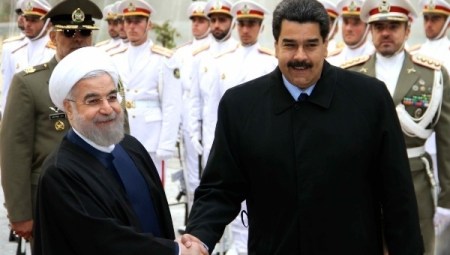
1944Venezuelan President Nicolas Maduro (right) meets with Iranian President Hassan Rouhani in Tehran, January 10, 2015. (Image Source: TeleSUR video screenshot)

According to the testimony of Ileana Ros-Lehtinen:

“Iran has opened up more than 80 cultural centers in Latin America in order to export its toxic brand of political influence and serve its interest, focusing on partnering with nations well known for their anti-American rhetoric including Venezuela, Argentina, Bolivia, Ecuador, and Nicaragua.”

Hamas and Hezbollah, both Iranian proxy terrorist groups, have also established offices in Caracas.

Representatives Ileana Ros-Lehtinen, Jeff Duncan and others say this is an appropriate time for the United States to pay more attention to activities happening in its own backyard.

The Need for a U.S. Response

In his statement to the House Committee on Foreign Affairs, Rep. Jeff Duncan asserted at the 2015 hearing, that the U.S. and its allies must do more to counter Iran’s goals to develop nuclear weapons, export terrorism and develop alliances with the narcotics trade.

Since the (unfortunate) approval of “Iran Nuclear Deal” in 2015, the United States has largely dissolved international sanctions against Iran, which leaves the IRGC free to make uninhibited alliances with networks of transnational organized crime organizations to finance its aspirations. Along with United States’ recent payment of $1.5 billion to Iran, there may be a grave risk to our own national security as Iran marches north from Venezuela into Central America and further into the United States through our southern border with Mexico.

In 2015, according to the US Department of State, U.S. President Barack Obama determined that Venezuela had failed to adhere to its obligations under international counternarcotics agreements. Even so, the US issued a waiver, allowing for continued assistance to be granted to Venezuela “in the interest of U.S. national security“.

The State Department admits that Venezuelan authorities do not effectively prosecute drug traffickers, in part due to their political corruption. Additionally, Venezuelan law enforcement officers lack the equipment, training, and resources required to significantly impede the operations of major drug trafficking organizations.

The U.S. Treasury Department has sanctioned multiple Venezuelan banks and Venezuelan regime operatives, including the former Minister of Interior and Justice. The U.S. State Department has cited Venezuela’s state-owned oil company, PDVSA, and CAVIM, the Venezuelan weapons company, for their role in helping Iran circumvent the sanctions that the U.S. has now lifted altogether.

At the same time, the U.S. administration continues to purchase 10% of its oil (roughly 300 million barrels per year) from Venezuela, the same entity that it sanctioned in 2011 for shipping gasoline to Iran.

This is all happening while terrorist groups are regularly connecting to drug cartels in the region, and forging a deepening narco-terror machine that in turn is funding terrorist activities.

While the US administration — apparently in denial about the clear threats posed by Iran’s expansionist and nuclear aspirations — dismisses Israel’s concerns as “hysteria,” Iran quietly continues its unfettered march westward.

More WikiLeaks Paydirt: Democrats Hate America

October 13, 2016

More WikiLeaks Paydirt: Democrats Hate America, Power Line, Steven Hayward, October 12, 2016

(Please see also, Catholic group calls for Clinton spokeswoman’s resignation after anti-Catholic comments in emails. — DM)

I wish I had time thoroughly to go through the trove of John Podesta emails released by Wikileaks, but just a few I’ve seen reveal the deep disdain by which liberals regard the American people, American traditions and institutions. Everyone recalls how Hillary had to backtrack quickly from her remark that half of Trump’s supporters are “deplorables” and “irredeemable” (though her apology only really regretted saying “half”). The Podesta emails show that this “slip” probably represents her true feelings.

One of the Podesta emails that has received a lot of attention reads: “I know she [Hillary] has begun to hate everyday Americans, but I think we should use it once the first time she says I’m running for president because you and everyday Americans need a champion.”

This reads pretty badly, but as has been pointed out, Podesta meant the campaign slogan“everyday Americans”—not that Hillary actually hates middle class Americans. To be clear the slogan ought to be set off in quotation marks—“everyday Americans”—and like mics onAccess Hollywood buses, you should always assume these days that your emails might be read by the public some day, so pay attention to punctuation and language.

Of course, the alternate explanation is that this was the kind of “slip” that reflects reality?

One that is less easily explained as sloppy wording or missing punctuation is a March 2015 email from Bill Ivey to Podesta that includes the following passage:

And as I’ve mentioned, we’ve all been quite content to demean government, drop civics and in general conspire to produce an unaware and compliant citizenry. The unawareness remains strong but compliance is obviously fading rapidly.

It’s hard to put a generous construction on this passage, which seems to admit that liberalism depends on the ignorance of citizens for them to be “compliant,” but darn these dumb Americans, they just don’t want to behave.

Even more outrageous is the email from Sandy Newman, identified as the president of “Voices for Progress,” that demands Roman Catholics give up their beliefs and just become liberal Democrats. John has already noted their disdain for “Thomism” in the following post, but this one is even worse:

There needs to be a Catholic Spring, in which Catholics themselves demand the end of a middle ages dictatorship and the beginning of a little democracy and respect for gender equality in the Catholic church. Is contraceptive coverage an issue around which that could happen. . . Even if the idea isn’t crazy, I don’t qualify to be involved and I have not thought at all about how one would “plant the seeds of the revolution,” or who would plant them. Just wondering . . .

There you have it folks, today’s Democratic Party and their respect for “diversity.” Here they admit a deliberate intent to interfere with a private religious institution because it doesn’t conform to the dictates of liberal identity politics.