Archive for October 5, 2016

Iran Rejects UN Chief’s Human Rights Report as Fundamentally Flawed

October 5, 2016

Iran Rejects UN Chief’s Human Rights Report as Fundamentally Flawed, Tasnim “News” Agency, October 5, 2016

(It all depends on the meaning of the phrase “human rights.” — DM)

humanrightsiniran

TEHRAN (Tasnim) – Iran’s Foreign Ministry spokesman slammed UN Secretary-General Ban Ki-moon’s recent report on human rights situation in Iran as baseless, saying there are fundamental flaws in the report, which has been drafted on the basis of unfair resolutions with political purposes.

“Such reports have fundamental flaws in essence and that is why they lack validity from Iran’s viewpoint,” Foreign Ministry Spokesman Bahram Qassemi said on Wednesday, after the UN chief gave a negative assessment of human rights in Iran in a 19-page report, released this week.

Ban has said he remains “deeply troubled” by what he called accounts “of executions, floggings, arbitrary arrests and detentions, unfair trials, denial of access to medical care and possible torture and ill-treatment” in Iran.

In response, Qassemi said the report lacks credibility since it has been prepared on the basis of “cruel, unfair and politically-motivated resolutions” with the purpose of exerting pressure on Iran.

What casts more doubt on the credibility of the report is that it has used unclear and unreliable sources, he added.

“The report makes an unfair, one-sided and incorrect judgement on Iran’s human rights situation and has missed the opportunity for an evenhanded and fair assessment based on facts,” the spokesman added.

Highlighting Iran’s efforts to promote human rights and protect civil rights under the Constitution, Qassemi said Ban’s report has ignored the Islamic Republic’s struggle against major challenges, such as the fight against narcotics trafficking and dealing with cruel sanctions.

The spokesman finally warned of erosion of trust in the United Nations as a result of continued politicization of issues, adoption of double standards on human rights and turning a blind eye to the killing of women and children in Yemen.

Such a poor performance dashes hopes about the UN’s role in promoting the human rights situation in the world, he deplored.

New Report Shows Iran’s Revolutionary Guards Profiting from Iran Deal

October 5, 2016

New Report Shows Iran’s Revolutionary Guards Profiting from Iran Deal, Counter Jihad, October 5, 2016

iranian-nuclear-weapon

A new report from the Foundation for the Defense of Democracies showcases the ways in which Iran’s Revolutionary Guards Corps (IRGC) has benefited from the so-called nuclear deal.  This deal, which Congress never voted to approve nor reject, and which the Iranian government fundamentally altered rather than accepting, has nevertheless led to a vast transfer of wealth to Iran.  Much of that wealth has fallen right in the hands of the IRGC, which oversees Iran’s terrorist and military nuclear programs.

Here at CounterJihad, we have covered the problems withIran’s nuclear deal somewhat extensively.  The Foundation for Defense of Democracies report’s conclusions will thus be of little surprise to our regular readers.  However, it does include additional detail on the degree to which Iran’s corporate and business ventures are secretly dominated by IRGC elites.  As the report says:

[IRGC abuses] did not stop France’s mobile phone giant, Orange, from beginning talks with Iran’s largest mobile phone operator, Mobile Telecommunication Company of Iran (MCI), over acquiring a stake in the Iranian company. The IRGC controls MCI through a 50-percent-plus-one stake in its parent company, the Telecommunication Company of Iran (TCI).  In short, whether its internal security, foreign adventures, or large corporate ventures, the IRGC plays an outsized role in Iran’s internal power structure. Established in 1979 to consolidate the Islamic revolution and fight its enemies, the IRGC has evolved over the years into a full-fledged conventional army, conducting and directing terrorist activity abroad. The Guard has also become a political power broker, an economic conglomerate, and an agency in charge of nuclear and ballistic-missile proliferation….  IRGC revenues from economic activities yield the necessary resources and political leverage to place its members in positions of power. Conversely, the Guard’s political power serves the economic enterprises it owns, and both its political and economic weight in turn advance its military projects.

The IRGC’s corporate activity offers revenue to the organization in the same way that its control of narcotics within Iran does.  However, whereas the narcotics are often passed on to Hezbollah to be turned into heroin, corporate profits can be rolled over into apparently legitimate enterprises that have useful military applications.  That allows Iran a backdoor to internationally-developed advanced weaponry and so-called “dual use” technologies.  These are technologies that have both a legitimate purpose, but also an application to Iran’s nuclear program.

Their space program is an excellent example of the way in which a legitimate purpose can mask development of nuclear weapons:  the same technologies involved in building space rockets that can deploy satellites in particular orbits can also be used to develop ballistic missiles that will deliver nuclear warheads to particular cities.  The New York Times reported in September that the biggest engine in North Korea’s nuclear missile program seems to have been developed in partnership with Iran.  Iran’s version is “nuclear-capable,” but the North Korean version makes no pretense about its intentions.

The potential links to Iran complicate the issue. Iran has ignored a United Nations Security Council resolution, passed in conjunction with last year’s agreement freezing its nuclear program, to refrain from tests of nuclear-capable missiles for eight years.  The Obama administration has not sought sanctions, knowing they would be vetoed by Russia and China, nor has it said much in public about the details of the cooperation on the new rocket engine.

Nor are they likely to do so, given how much of the administration’s prestige is tied up with the so-called nuclear deal.  It is worth noting, however, that the effect of the deal has been to embolden Iran — and North Korea, and Russia, and America’s enemies in general.

U.S. Army Chief Threatens War With Russia

October 5, 2016

U.S. Army Chief Threatens War With Russia “We will beat you harder than you have ever been beaten before”

Paul Joseph Watson – October 5, 2016

Source: U.S. Army Chief Threatens War With Russia » Alex Jones’ Infowars: There’s a war on for your mind!


Army Chief of Staff Gen. Mark Milley warned last night that the United States was ready to “destroy” its enemies in comments that were clearly directed at Russia.

“I want to be clear to those who wish to do us harm….the United States military – despite all of our challenges, despite our [operational] tempo, despite everything we have been doing – we will stop you and we will beat you harder than you have ever been beaten before. Make no mistake about that,” said Milley.

The General went on to warn that Russia and other countries had taken advantage of the U.S. being focused on the war on terror.

“Other countries – Russia, Iran, China, North Korea – went to school on us,” he said, adding, “They studied our doctrine, our tactics, our equipment, our organization, our training, our leadership. And, in turn, they revised their own doctrines, and they are rapidly modernizing their military today to avoid our strengths in hopes of defeating us at some point in the future.”

Milley cautioned that the next major conflict would “be highly lethal, unlike anything our Army has experienced at least since World War II,” and would involve fighting in “highly populated urban areas.”

“Make no mistake about it, we can now and we will … retain the capability to rapidly deploy,” he said, “and we will destroy any enemy anywhere, any time,” he concluded.

Gen. Milley made it clear who he was talking about when he went on to quote a senior Russian official who vowed, “Russia can now fight a conventional war in Europe and win.”

The comments come amidst rising tensions between the two superpowers.

40 million Russians from all sectors of government are currently taking part in a nationwide emergency drill that will wargame “evacuation” procedures during a national crisis.

According to Oleg Manuilov, the director of the Russian Civil Defence Department, the exercise will be a test run of how the population would respond to a “disaster occurrence” under an “emergency” situation.

Last week, Russian officials revealed that huge underground nuclear bunkers had been built to provide shelter for the city’s 12 million population.

A nationwide television station run by the country’s Ministry of Defence also warned citizens last week that nuclear conflict was on the horizon.

“Schizophrenics from America are sharpening nuclear weapons for Moscow,” reported Zvezda.

EU roadmap for ties with Iran accused of ignoring antisemitism, terrorism

October 5, 2016

The “EU strategy towards Iran after the nuclear agreement” is scheduled to be voted on Thursday by the Committee on Foreign Affairs in Brussels.

Source: EU roadmap for ties with Iran accused of ignoring antisemitism, terrorism – Middle East – Jerusalem Post

The European Parliament is set to vote on a roadmap for relations with Iran that critics charge sidesteps Tehran’s endorsement of antisemitism, terrorism, and calls to destroy Israel.

Compiled by Richard Howitt, a member of the European Union’s legislative arm for Britain’s Labour Party and a close ally of party leader Jeremy Corbyn, the draft report on “EU strategy towards Iran after the nuclear agreement” is scheduled to be voted on Thursday by the Committee on Foreign Affairs in Brussels.
The draft document, which sets principles for normalization of European Union relations with Iran following the agreement to lift sanctions from Tehran in exchange for the scaling back of its nuclear program, contains one single criticism of Iran, regarding its use of the death penalty. It does not mention Iran’s sponsorship of terrorism, support for Holocaust denial, and threats to destroy Israel.

“Iran’s revolutionary legacy and its constitution as an Islamic state must not be an impediment for finding common ground on matters related to democracy or human rights,” the document states. Omitting reference to Iran’s support for the Hezbollah military wing, which is on the EU list of terrorist groups, the document “welcomes Iran’s contribution to the fight against ISIS.”

The report in its current form “is a serious blow to the standing of the European Parliament as a defender of human rights, justice and freedom,” Daniel Schwammenthal, director of the American Jewish Committee’s EU Office, the AJC Transatlantic Institute, said in a statement.

Iran has been accused of fueling sectarian violence that has killed hundreds of thousands of people in Syria and Iraq.

Many EU sanctions on Iran have been lifted, along with other international sanctions, under the Joint Comprehensive Plan of Action — the formal name for the deal reached last year between six major world powers, led by the United States, and Iran, exchanging sanctions relief for a rollback of nuclear development in Iran.

Israel has opposed the deal, claiming it will pave Iran’s way to nuclear offensive capabilities rather than block it, as US President Barack Obama said the agreement would.

The document devotes considerable attention to the benefits of trade between Iran and Europe following the lifting of sanctions and notes that “European investments are key” for Iran’s stated objective of achieving a yearly growth rate of 8 percent.

Iran has faced criticism over its support for terrorist groups, persecution of minorities, state-sponsored torture, persecution of dissidents and journalists, and other human rights violations. In addition, it has been condemned for hosting last year the Second International Holocaust Cartoon Contest in Tehran. The event was decried as anti-Semitic by UNESCO, Germany and the United States, among others.

Noting this, the Transatlantic Institute wrote in its Oct. 3 statement that it is “deeply concerned over the European Parliament’s failure to mention let alone criticize in its draft Iran report Tehran’s anti-Semitic propaganda and repeated calls for the destruction of Israel; its support for international terrorism, and illegal ballistic missile tests.”

Pavlich: Jerusalem, Israel | TheHill

October 5, 2016

OPINION | The capital of Israel is Jerusalem, and Obama should have the courage to say so.

Source: Pavlich: Jerusalem, Israel | TheHill

Getty Images

Late last week, the White House sent out a press release featuring remarks made by President Obama at the memorial service for former Israeli President Shimon Peres. The location on the original release was marked Mount Herzl, Jerusalem, Israel.

“I could not be more honored to be in Jerusalem to say farewell to my friend Shimon Peres, who showed us that justice and hope are at the heart of the Zionist idea,” Obama said in his opening remarks. “A free life, in a homeland regained. A secure life, in a nation that can defend itself, by itself. A full life, in friendship with nations who can be counted on as allies, always. A bountiful life, driven by simple pleasures of family and by big dreams. This was Shimon Peres’s life. This is the State of Israel. This is the story of the Jewish people over the last century, and it was made possible by a founding generation that counts Shimon as one of its own.”

Soon after, another release was sent featuring the same remarks with a different header, simply reading: Mount Herzl, Jerusalem.Why the change from the White House? After all, Jerusalem is the capital of Israel, one of America’s strongest allies in the Middle East deserving of priority even during the most controversial of disputes.

“The administration’s policy toward Jerusalem follows that of previous US administrations — of both parties — since 1967,” the White House told The Jerusalem Post about the “correction.” “The status of Jerusalem is an issue that should be resolved in final-status negotiations between Israelis and Palestinians. We continue to work with the parties to resolve this issue and others in a way this is just and fair, and respects the rights and aspirations of both Israelis and Palestinians.”

The real answer is as obvious as it is unnecessary. Jerusalem will always be the capital of Israel, even if someday a peace agreement were to be reached. The change came as a way to appease the Palestinians and their leftist allies, who of course have attempted to erase all previously established Jewish history in Jerusalem for centuries. The change was also likely made as a way to prevent violence in response to the declaration from the United States that Jerusalem belongs to Israel, as if those carrying the ideology that has fueled terrorism against innocent Israelis for decades need an excuse.

In the category of U.S. interest, Israeli intelligence services regularly share valuable and essential information about the Middle East. As the region has all but collapsed under Obama’s leadership, Israel has been a reliable, steady, stable force in the region. The Palestinians, however, have partnered with enemy terrorist organizations and have repeatedly taken advantage of good will in order to take innocent life.

Despite being constantly under attack, Israeli doctors and nurses treat Palestinian terrorists in their hospitals, and the Jewish state regularly sends humanitarian aid and assistance to Gaza, even in the middle of wars. Over the years that aid hasn’t been used to promote peace and a better way of life, but instead to build tunnels for future attacks on the Israeli people. The small minority of Palestinians who truly believe in peace are bullied into silence for fear of being killed for admitting so.

In the private sector, Israel has more companies on the Nasdaq than any other country in the world, producing life-saving technology and medical devices. Palestinians and their leftist supporters boycott all of these products, services and information in the name of “human rights,” despite Israel being the only democracy in the Middle East surrounded by severe intolerance.

While Tel Aviv hosts the world’s largest gay pride parade each year, those even suspected of being gay are dragged through the streets in Gaza, and women are treated as slaves and property.

These are just a handful of examples that represent the relationship between the U.S. and Israel as a healthy partnership that promotes human dignity and freedom all around the world, rather than extreme ideological oppression. The U.S. relationship with the Palestinians is a limited, one-way street for a number of reasons, one prominently being a lack of common moral values.

The moral equivalency between the Palestinians and Israel constantly drawn by the White House is not only inaccurate, it elevates evil to the same level as true good. Denying that Jerusalem is the capital of Israel does nothing to promote peace — instead, it disrespects a longtime, helpful and humane ally in the Middle East.

The capital of Israel is Jerusalem, it always will be, and the White House should have the courage to stand by saying so.

Pavlich is editor for Townhall.com and a Fox News contributor.

Obama Warned To Defuse Tensions With Russia, “Unintended Consequences Likely To Be Catastrophic”

October 5, 2016

Obama Warned To Defuse Tensions With Russia, “Unintended Consequences Likely To Be Catastrophic”

Source: Obama Warned To Defuse Tensions With Russia, “Unintended Consequences Likely To Be Catastrophic” | Zero Hedge

A group of ex-U.S. intelligence officials is warning President Obama to defuse growing tensions with Russia over Syria by reining in the demonization of President Putin and asserting White House civilian control over the Pentagon.

ALERT MEMORANDUM FOR: The President


FROM: Veteran Intelligence Professionals for Sanity


SUBJECT: PREVENTING STILL WORSE IN SYRIA


We write to alert you, as we did President George W. Bush, six weeks before the attack on Iraq, that the consequences of limiting your circle of advisers to a small, relatively inexperienced coterie with a dubious record for wisdom can prove disastrous.* Our concern this time regards Syria.


We are hoping that your President’s Daily Brief tomorrow will give appropriate attention to Saturday’s warning by Russia’s Foreign Ministry spokesperson Maria Zakharova: “If the US launches a direct aggression against Damascus and the Syrian Army, it would cause a terrible, tectonic shift not only in the country, but in the entire region.”


Speaking on Russian TV, she warned of those whose “logic is ‘why do we need diplomacy’ … when there is power … and methods of resolving a problem by power. We already know this logic; there is nothing new about it. It usually ends with one thing – full-scale war.”


We are also hoping that this is not the first you have heard of this – no doubt officially approved – statement. If on Sundays you rely on the “mainstream” press, you may well have missed it. In the Washington Post, an abridged report of Zakharova’s remarks (nothing about “full-scale war”) was buried in the last paragraph of an 11-paragraph article titled “Hospital in Aleppo is hit again by bombs.” Sunday’s New York Times totally ignored the Foreign Ministry spokesperson’s statements.


In our view, it would be a huge mistake to allow your national security advisers to follow the example of the Post and Times in minimizing the importance of Zakharova’s remarks.


Events over the past several weeks have led Russian officials to distrust Secretary of State John Kerry. Indeed, Foreign Minister Sergey Lavrov, who parses his words carefully, has publicly expressed that distrust. Some Russian officials suspect that Kerry has been playing a double game; others believe that, however much he may strive for progress through diplomacy, he cannot deliver on his commitments because the Pentagon undercuts him every time. We believe that this lack of trust is a challenge that must be overcome and that, at this point, only you can accomplish this.


It should not be attributed to paranoia on the Russians’ part that they suspect the Sept. 17 U.S. and Australian air attacks on Syrian army troops that killed 62 and wounded 100 was no “mistake,” but rather a deliberate attempt to scuttle the partial cease-fire Kerry and Lavrov had agreed on – with your approval and that of President Putin – that took effect just five days earlier.


In public remarks bordering on the insubordinate, senior Pentagon officials showed unusually open skepticism regarding key aspects of the Kerry-Lavrov deal. We can assume that what Lavrov has told his boss in private is close to his uncharacteristically blunt words on Russian NTV on Sept. 26:


“My good friend John Kerry … is under fierce criticism from the US military machine. Despite the fact that, as always, [they] made assurances that the US Commander in Chief, President Barack Obama, supported him in his contacts with Russia (he confirmed that during his meeting with President Vladimir Putin), apparently the military does not really listen to the Commander in Chief.”


Lavrov’s words are not mere rhetoric. He also criticized JCS Chairman Joseph Dunford for telling Congress that he opposed sharing intelligence with Russia, “after the agreements concluded on direct orders of Russian President Vladimir Putin and US President Barack Obama stipulated that they would share intelligence. … It is difficult to work with such partners. …”


Policy differences between the White House and the Pentagon are rarely as openly expressed as they are now over policy on Syria. We suggest you get hold of a new book to be released this week titled The General vs. the President: MacArthur and Truman at the Brink of Nuclear War by master historian H. W. Brands. It includes testimony, earlier redacted, that sheds light on why President Truman dismissed WWII hero Gen. Douglas MacArthur from command of U.N. forces in Korea in April 1951. One early reviewer notes that “Brands’s narrative makes us wonder about challenges of military versus civilian leadership we still face today.” You may find this new book more relevant at this point in time than the Team of Rivals.


The door to further negotiations remains ajar. In recent days, officials of the Russian foreign and defense ministries, as well as President Putin’s spokesman, have carefully avoided shutting that door, and we find it a good sign that Secretary Kerry has been on the phone with Foreign Minister Lavrov. And the Russians have also emphasized Moscow’s continued willingness to honor previous agreements on Syria.


In the Kremlin’s view, Russia has far more skin in the game than the U.S. does. Thousands of Russian dissident terrorists have found their way to Syria, where they obtain weapons, funding, and practical experience in waging violent insurgency. There is understandable worry on Moscow’s part over the threat they will pose when they come back home. In addition, President Putin can be assumed to be under the same kind of pressure you face from the military to order it to try to clean out the mess in Syria “once and for all,” regardless how dim the prospects for a military solution are for either side in Syria.


We are aware that many in Congress and the “mainstream” media are now calling on you to up the ante and respond – overtly or covertly or both – with more violence in Syria. Shades of the “Washington Playbook,” about which you spoke derisively in interviews with the Atlantic’s Jeffrey Goldberg earlier this year. We take some encouragement in your acknowledgment to Goldberg that the “playbook” can be “a trap that can lead to bad decisions” – not to mention doing “stupid stuff.”


Goldberg wrote that you felt the Pentagon had “jammed” you on the troop surge for Afghanistan seven years ago and that the same thing almost happened three years ago on Syria, before President Putin persuaded Syria to surrender its chemical weapons for destruction. It seems that the kind of approach that worked then should be tried now, as well – particularly if you are starting to feel jammed once again.


Incidentally, it would be helpful toward that end if you had one of your staffers tell the “mainstream” media to tone down it puerile, nasty – and for the most part unjustified and certainly unhelpful – personal vilification of President Putin.


Renewing direct dialogue with President Putin might well offer the best chance to ensure an end, finally, to unwanted “jamming.” We believe John Kerry is correct in emphasizing how frightfully complicated the disarray in Syria is amid the various vying interests and factions. At the same time, he has already done much of the necessary spadework and has found Lavrov for the most part, a helpful partner.


Still, in view of lingering Russian – and not only Russian – skepticism regarding the strength of your support for your secretary of state, we believe that discussions at the highest level would be the best way to prevent hotheads on either side from risking the kind of armed confrontation that nobody should want.


Therefore, we strongly recommend that you invite President Putin to meet with you in a mutually convenient place, in order to try to sort things out and prevent still worse for the people of Syria.


In the wake of the carnage of World War II, Winston Churchill made an observation that is equally applicable to our 21st Century: “To jaw, jaw, jaw, is better than to war, war, war.”

For the Steering Group, Veteran Intelligence Professionals for Sanity

William Binney, former Technical Director, World Geopolitical & Military Analysis, NSA; co-founder, SIGINT Automation Research Center (ret.)

Fred Costello, Former Russian Linguist, USAF

Mike Gravel, former Adjutant, top secret control officer, Communications Intelligence Service; special agent of the Counter Intelligence Corps and former United States Senator

Matthew Hoh, former Capt., USMC, Iraq & Foreign Service Officer, Afghanistan (associate VIPS)

Larry C. Johnson, CIA & State Department (ret.)

John Kiriakou, former CIA counterterrorism officer and former senior investigator, Senate Foreign Relations Committee

Linda Lewis, WMD preparedness policy analyst, USDA (ret.) (associate VIPS)

Edward Loomis, NSA, Cryptologic Computer Scientist (ret.)

Ray McGovern, former US Army infantry/intelligence officer & CIA analyst (ret.)

Elizabeth Murray, Deputy National Intelligence Officer for Middle East, CIA (ret.)

Todd Pierce, MAJ, US Army Judge Advocate (ret.)

Coleen Rowley, Division Counsel & Special Agent, FBI (ret.)

Kirk Wiebe, former Senior Analyst, SIGINT Automation Research Center, NSA, (ret.)

Robert Wing, former Foreign Service Officer

Ann Wright, U.S. Army Reserve Colonel (ret) and former U.S. Diplomat

* In a Memorandum to President Bush criticizing Colin Powell’s address to the UN earlier on February 5, 2003, VIPS ended with these words: “After watching Secretary Powell today, we are convinced that you would be well served if you widened the discussion … beyond the circle of those advisers clearly bent on a war for which we see no compelling reason and from which we believe the unintended consequences are likely to be catastrophic.”


Europe’s “Good Terrorists”: Because They Might Destroy Israel?

October 5, 2016

Europe’s “Good Terrorists”: Because They Might Destroy Israel?

by Khaled Abu Toameh

October 5, 2016 at 5:00 am

Source: Europe’s “Good Terrorists”: Because They Might Destroy Israel?


  • Hamas spokesman Sami Abu Zuhri would like the Europeans to understand that they need not worry about terrorism by the Islamist movement because the attacks will be directed only against Israel.
  • The European Court of Justice (EJC) is sending the message to Hamas that Europeans see no problem with Hamas’s desire to destroy Israel and continue to launch terrorist attacks against Jews. This message also undermines those Palestinians who still believe in a peace with Israel.
  • The EJC recommendation to remove Hamas from the EU’s terrorism blacklist comes at a time when countries such as Egypt, Jordan, the United Arab Emirates and even Saudi Arabia, as well as the Palestinian Authority, are doing their utmost to weaken Hamas.
  • Appeasing terrorists is a dangerous game: it has already backfired on its foolhardy players and will continue to do so. This is exactly how Muslims conquered Iran, Turkey, North Africa and much of Europe, including Hungary, Greece, Poland, Romania, and the Balkans — countries that still recall a real “occupation,” an Islamist one, and abundantly want none of it.
  • The EU and the ECJ need to be stopped before they do any more harm to Palestinians, Christians and Jews — or to Europe.

Once again, the Europeans seem to be in Alice’s Wonderland when they consider Palestinian affairs in particular and the Middle East in general. The renewed attempt by the European Union to remove the Palestinian Islamist movement Hamas from its terrorism list is a case in point.

Recently, an advisor to the European Court of Justice (ECJ) recommended that Hamas be removed from the EU’s terrorism blacklist. In 2014, the EU’s second-highest court ruled that Hamas should be taken off the list on “technical” grounds. It argued that Hamas’s listing was not based on evidence, but on “factual imputations derived from the press and the internet.”

However, the European Council then appealed this judgement, arguing that Hamas should remain on the terrorism blacklist, citing a 2001 decision by the UK and the US that designated both Hamas and the Tamil Tigers as terrorist groups. But the recent opinion by the ECJ advisor dismisses this argument. “The council cannot rely on facts and evidence found in press articles and information from the internet,” Advocate General Eleanor Sharpton said. She explained that the council could not rely on terrorist listings by countries (the UK and US) outside the EU.

This latest highly dangerous European attempt to strike Hamas from the terrorism blacklist will, as the EU knows perfectly well, only serve further to embolden the Islamist movement to replace Israel with an Islamic empire.

Removing Hamas from the terrorism list would obviously be seen as a severe blow to Hamas’s rivals in the Western-backed and funded Palestinian Authority (PA), and to the efforts to revive any peace process between the Palestinians and Israel.

As this is not the EU’s first attempt to do this, it is hard not to conclude what many Palestinians have suspected all along: that the EU and its affiliates do not care if the Palestinians and others in the area are overrun by Hamas terrorists and are forced to live under the rule of despotic Islamist militants.

The recent opinion by the European court advisor lightheartedly ignores Hamas’s own statements concerning its true intentions and continued preparations for war against Israel. It is hard not to conclude that this is what the EU secretly wants — perhaps for Muslim voters, who brought to power France’s President François Hollande, perhaps in the hope of buying off terrorists so that they avoid further attacks in Europe, perhaps to continue good business deals with Arab and Muslim countries, and, of course, perhaps all of the above.

It came as no surprise, therefore, that Hamas was quick to “welcome” the opinion of the European Court advisor to whitewash and legitimize the Islamist terror movement. “Hamas considers the recommendation a first step towards removing the sin committed by the European Union towards the Palestinian people when it demonstrated bias in favor of Israel by placing Hamas on the terrorism list,” said Hamas spokesman Sami Abu Zuhri, who welcomed the opinion and called on the Europeans to abide by it. Hamas, he added, has always been keen on openness towards the West and on building strong humanitarian and political relations with it. Israel is the only enemy of Hamas, Abu Zuhri stressed.

In other words, Abu Zuhri would like the Europeans to understand that they need not worry about terrorism by the Islamist movement because the attacks will be directed only against Israel. Hamas wants “openness” and “strong” ties with the Europeans because it believes that this will advance its goal of implementing its charter, which calls for the elimination of Israel. This is how Hamas understands the renewed bid to have it removed from the EU’s terrorism blacklist. And it is improbable that the EU, which for decades has sought “good relations” between the two sides of the Mediterranean, does not understand it that way, too.

Even more improbable is that some Europeans believe that Hamas should not be on the terrorism only on the basis of press articles and information on the internet — as if what is being said about Hamas and its goals are rumors or unsubstantiated charges that need to be verified, and for which there is no basis.

What of Hamas’s own charter, which calls for Jihad (holy war) against Israel. “There is no solution to the Palestinian problem except by Jihad,” the charter states. It goes on to say that the

“liberation of that land (Palestine) is an individual duty binding on all Muslims everywhere. In order to face the usurpation of Palestine by the Jews, we have no escape from raising the banner of Jihad…We must spread the spirit of Jihad among the (Islamic) Umma, clash with the enemies and join the ranks of the Jihad fighters. The Islamic Resistance Movement believes that the land of Palestine has been an Islamic Wakf throughout the generations and until the Day of Resurrection, no one can renounce it or part of it, or abandon it or part of it.”

Okay, one might argue, so the Europeans will not take seriously the Hamas covenant. Yet what does the ECJ make of the incessant rhetoric of Hamas?

Here is what Fathi Hammad, a senior Hamas official in the Gaza Strip, had to say after the recommendation: “Resistance is the only way to liberate Palestine from the [Mediterranean] sea to the [Jordan] river.” Praising the recent wave of Palestinian knife and car-ramming attacks on Israelis, Hammad called on Palestinians to rise against any peace process with Israel. “The path of negotiations has dissipated the Palestinian cause,” he added.

In a statement marking the first anniversary of the anti-Israel attacks, which is being referred to by many Palestinians as the “Jerusalem Intifada,” Hamas said this week that the wave of terrorism will not stop “until the occupation is driven out of Jerusalem, the West Bank and all Palestine.” Reiterating its refusal to recognize the “Zionist Entity’s” right to exist, Hamas said that the Palestinians maintain the right to “resistance in all its forms.”

Let us translate that for a moment: When Hamas talks about “resistance in all its forms,” it is referring to killing Jews with suicide bombings, rockets, knives and vehicles. As far as Hamas is concerned, Palestinians are entitled to use all these methods to kill as many Jews as possible and drive them out, to “liberate all of Palestine.” Notably, this statement was issued after, not before, the recent recommendation by the European court advisor to remove Hamas from the terrorism list. This is far from simply another “press article” or “rumor” published on the internet; this is an official statement released by the Hamas leadership.
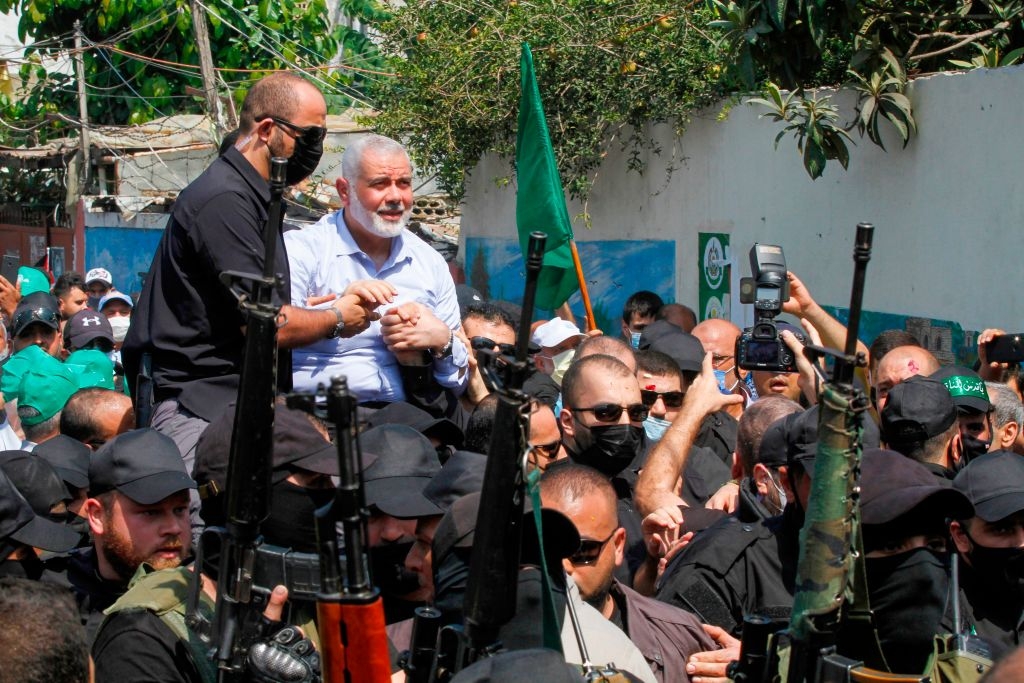
Thousands of armed Hamas troops showed off their military hardware at a Dec. 14, 2014 parade in Gaza, marking the organization’s 27th anniversary. (Image source: PressTV video screenshot)

To its credit, and despite the clearly genocidal ECJ recommendation, Hamas has been utterly transparent concerning its intentions. In fact, Hamas has never hidden its desire to destroy Israel and prevent any peace process between Palestinians and Israelis. This position and strategy has not changed since the establishment of the Islamist movement nearly thirty years ago. And if the officials of the EU and the ECJ do not know that, they should be replaced.

Further evidence of Hamas’s intentions and policies was provided by another leader of the movement, Mahmoud Zahar, who assured supporters in the Gaza Strip last week that Hamas will never recognize Israel’s right to exist. “We will not give up one inch of the land of Palestine to the Israeli entity,” Zahar declared. He then praised Palestinians for using “stones and knives” to attack Jews.

These are only some of the recent statements by Hamas leaders and spokesmen that leave no room for doubt as to the movement’s intentions to continue using terrorism as a means to destroy Israel. Perhaps EU officials might go to the numerous Hamas websites and read what is being said there by the movement’s leaders. The words speak for themselves.

Hamas’s threats do not stop at rhetoric. Hamas’s current actions also attest to its goals. Hamas and other terror groups openly continue to dig tunnels that will be used to attack Israel.

Only days after the ECJ recommendation was published, another Palestinian was killed while working in a tunnel. He was identified as 30-year-old Ahmed As’ad. Other men were wounded in the incident, in a tunnel that was supposed to serve Hamas and other terrorist groups to attack Israel.

Meanwhile, last week, in the context of these preparations, the terror group Al-Naser Salah Eddin Brigades unveiled a new rocket called Koka 70 (named after one of its leaders, Abu Yusef Koka).

The European recommendation to remove Hamas from the terrorism blacklist comes at a time when Hamas and other groups are not only talking about attacks, but also actively preparing to launch new rockets and infiltrate Israel via attack tunnels. These are not unverified press reports, but facts — facts that fly in the face of the European whitewashing and legitimizing of this terrorist group.

The ECJ is sending the message to Hamas that the Europeans see no problem with Hamas’s desire to destroy Israel and continue to launch terrorist attacks against Jews. This message also undermines those Palestinians who still believe in a peace with Israel. Moreover, the recommendation comes at a time when countries such as Egypt, Jordan, the United Arab Emirates and even Saudi Arabia, as well as the Palestinian Authority, are doing their utmost to weaken Hamas.

Those who embolden Hamas also strengthen ISIS, Islamic Jihad and the Muslim Brotherhood, not only in the Middle East, but also in Europe. Appeasing terrorists is a dangerous game: it has already backfired on its foolhardy players and will continue to do so, not less, but more. This is exactly how Muslims conquered Iran, Turkey, North Africa, the Crimea and much of Europe including Hungary, Greece, Poland, Romania, and the Balkans — countries that still recall a real “occupation,” an Islamist one, all too well, and abundantly want none of it.
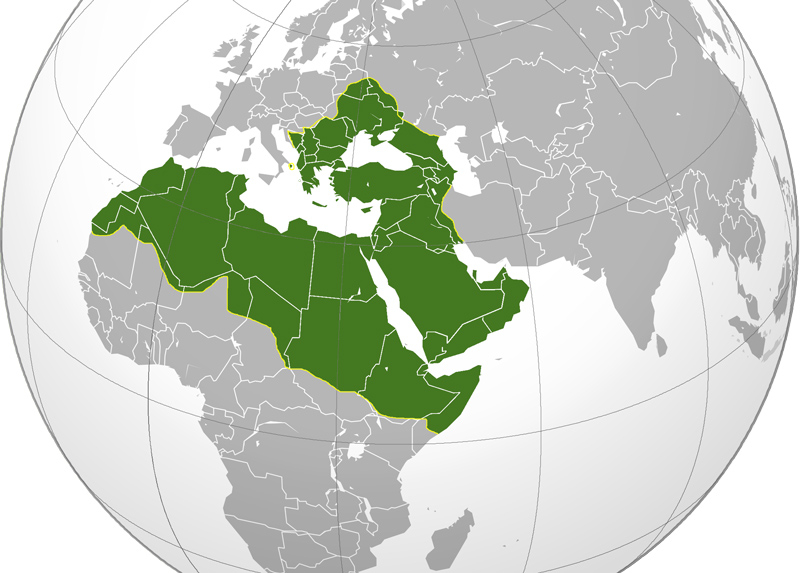
The Ottoman Empire at its largest size. (Image source: Wikimedia Commons/Mevlüt Kılıç)

The EU and the ECJ need to be stopped before they do any more harm to Palestinians, Christians and Jews — or to Europe.

Obama Administration Again Deliberates Air Strikes on Assad

October 5, 2016

Obama Administration Again Deliberates Air Strikes on Assad Regime President unlikely to accept military action in Syria

BY:
October 4, 2016 4:46 pm

Source: Obama Administration Again Deliberates Air Strikes on Assad

The Obama administration is again considering air strikes against the regime of Syrian President Bashar al Assad following the failure of a ceasefire deal brokered by the U.S. and Russia.

Top national security officials are meeting with senior administration officials Wednesday to address the ongoing crisis in the rebel-held city of Aleppo. President Obama is expected to reject proposed airstrikes, according to the Washington Post.

Officials from the State Department, CIA, and Joint Chiefs of Staff met last week at the White House to discuss limited military strikes in Syria against the regime to punish Assad for violating the latest ceasefire and continuing to commit war crimes against his people.

Administration officials also hope to pressure Assad into diplomatic talks aimed at ending the country’s civil war, now in its sixth year.

The administration is considering a number of options that include bombing Syrian air force runways, an official participating in the discussions told the Post. The official said the White House would work around its long-standing refusal to strike the Assad regime without a U.N. Security Council resolution by covertly conducting the strikes.

“There’s an increased mood in support of kinetic actions against the regime,” one senior administration official told the Post.

Still, Obama remains unlikely to approve military action against the regime.

The U.S. on Monday suspended bilateral engagement with Russia on negotiating a diplomatic resolution in Syria. Secretary of State John Kerry had worked to restore a week-long ceasefire with Moscow, but talks ultimately fell through given Russia’s continued assault on Aleppo along with Syrian forces.

Iraq demands that Turkey pull its ‘occupying’ troops out of military base near Mosul

October 5, 2016

Iraq demands that Turkey pull its ‘occupying’ troops out of military base near Mosul Published time:

5 Oct, 2016 07:52 Edited time: 5 Oct, 2016 10:07

Source: Iraq demands that Turkey pull its ‘occupying’ troops out of military base near Mosul — RT News

© Asmaa Waguih / Reuters

Outraged by Ankara’s decision to extend the stationing of its troops in northern Iraq, 30 kilometers from Mosul, Iraqi MPs have called on the government to review its relations with Turkey and lodge a complaint against the “occupation” with the UNSC.

On Tuesday, the majority of Iraqi legislators spoke out against the Turkish parliament’s decision to prolong the stationing of about 150 Turkish soldiers and some 25 tanks at the Bashiqa military camp in Iraq’s northern Nineveh Province, which is located at the forefront of the battle with Islamic State (IS, formerly ISIS/ISIL).

Read more

U.S soldiers walk on a bridge with in the town of Gwer northern Iraq © Azad Lashkari

In a written statement, the MPs decried the decision, appealing to the country’s prime minister, Haider al-Abadi, to summon the Turkish ambassador and file a complaint with the United Nations Security Council that would designate Turkey’s military contingent as an “occupying” force, according to Rudaw news agency.

On Saturday, the Turkish parliament green lighted the extension of the Turkish military’s engagement in both Iraq and Syria.

Since 2014, Turkish servicemen have provided training and support to Kurdish Peshmerga units and Sunni militia known as Hashd al-Watani forces at the camp, subject to agreement with the Iraqi government. However, on December 4 of last year, Turkey beefed up its military presence at the camp, allegedly to protect its advisers. The move infuriated Bagdad, which insisted that Turkey had not asked for permission from the Iraqi government to deploy additional troops, thus violating its sovereignty.

Turkish President Recep Tayyip Erdogan refused to acknowledge this at that time, claiming that Turkey was acting within the scope of the previous agreement.

“Turkish soldiers are in Basheeqa camp at the request of Haider al-Abadi in 2014. Now I am asking why he has been silent since 2014,” Erdogan said in December, disputing claims that Turkey was intervening in Iraq.

Read more

© Alaa Al-Marjani

Speaking in the wake of the vote, Abadi publicly called for Turkey’s troops to immediately leave its territory, saying that “the Turkish insistence on their presence inside Iraqi territories has no justification.”

The prime-minister told journalists on Tuesday that Iraq has managed to enlist the support of the ‘international community,’ as well as the US-led international coalition, in its bid to remove the Turkish military from its territory.

While Iraq doesn’t want to be dragged into a military conflict with Turkey, it finds the actions of its government “not acceptable by any standard,” he added.

Turkish Deputy Prime Minister Numan Kurtulmus stressed on Wednesday that Turkey’s military presence in the Bashiqa camp is intended solely to provide stability and train the local forces, and that Ankara does not aim to become an occupying force.

Turkey will not allow this to become a matter of debate,” he told reporters as cited by Reuters.

Both Turkey and Iraq summoned each other’s ambassadors on Wednesday to discuss the growing rift between the two states.

Turkey’s foreign ministry also condemned the vote, the Daily Sabah reported.

READ MORE:French fighter jets take off on mission against ISIS stronghold in Mosul, Iraq

Back in December, Iraq appealed to NATO to force Turkey to withdraw its forces, but the alliance found Ankara to be in compliance with the terms of the training agreement.

Iraq’s largest city, Mosul, fell into the hands of Islamic State in 2014, and Iraqi forces are currently preparing an offensive to retake the terrorist stronghold, aided by US-led anti-terrorism coalition.

If the operation is successful, Iraq wants to “ensure Turkish troops do not exploit the power vacuum after achieving victory against Islamic State in Mosul,” Abadi has stressed.

IDF hits targets in northern Gaza in response to rocket strike

October 5, 2016

IDF hits targets in northern Gaza in response to rocket strike After projectile lands on a Sderot street, Israeli tanks reportedly fire on Hamas sites in Beit Hanoun

By Judah Ari Gross October 5, 2016, 11:59 am

Source: IDF hits targets in northern Gaza in response to rocket strike | The Times of Israel

A rocket launched from the Gaza Strip strikes a road in the southern city of Sderot on October 5, 2016. (Israel Police)

Israeli tanks fired on Hamas targets in the northern Gaza Strip on Wednesday in response to a rocket that landed in southern Israel earlier in the day, the army said.

According to Palestinian reports, the IDF tanks struck sites in Beit Hanoun, on the northeastern corner of the coastal enclave. The army would not immediately confirm those reports to The Times of Israel.

There were no immediate reports of Palestinian injuries.

The rocket, which had been fired from the Gaza Strip, struck a street in the city of Sderot — a few miles from Beit Hanoun — just before 10:30 a.m. on Wednesday, police said, causing damage and sending three people to the hospital suffering from anxiety attacks.

The Islamic State-affiliated Ahfad al-Sahaba-Aknaf Bayt al-Maqdis terrorist group took responsibility for the rocket launch in statements released in both Arabic and Hebrew.

“Oh you cowardly Jews: You don’t have safety in our land. [Former defense minister Moshe] Ya’alon, the failure at giving security. [Defense Minister Avigdor] Liberman to fail will be a certainty,” the Salafist group said in its statement, in poorly translated Hebrew.

The attack against Israel was apparently a response to the Strip’s Hamas rulers arresting several members of the Salafist organization, according to the group’s statement.

Though the Salafist group took responsibility for the attack, Israel has said it holds Hamas responsible for any attacks emanating from Gaza and routinely responds to such launches with strikes inside the Palestinian territory.

“We can’t go after every little group in Gaza with a couple of dozen members that goes out one night and fires a rocket,” a senior officer in the IDF’s Southern Command told reporters last month.

Ahfad al-Sahaba-Aknaf Bayt al-Maqdis released a similar statement last month, after a failed attempt to launch a rocket at southern Israel on the first day of school. The group also claimed responsibility for a rocket attack that hit Sderot
in August, landing between two houses in the southern Israeli city.

In Wednesday morning’s rocket attack, three people in Sderot “suffered anxiety attacks” and were treated by medical teams, but no one was physically hurt by the attack, according to the Magen David Adom medical service.

The three — including a 15-year-old girl and 60-year-old man — were taken to Ashkelon’s Barzilai Medical Center for further care, MDA paramedics said.

The rocket alert siren was activated at approximately 10:20 a.m. and was heard in Sderot, Nir Am, Ivim and Gevim.

A few minutes later, Israel Police officers located the rocket in Sderot. The street where it landed was damaged in the attack, as were several nearby cars and homes.

Police sappers were called to the scene, and the area was closed off to pedestrians and traffic, police said.


Police sappers dig out piece of a rocket launched from the Gaza Strip that struck a road in the southern city of Sderot on October 5, 2016.

Last month, a mortar shell was launched from the Gaza Strip and landed in a field in southern Israel, causing neither injury nor damage, the army said. The projectile hit an empty field in the Eshkol region, next to the southern Strip, according to a statement from the Israel Defense Forces.