Archive for September 28, 2016

Comey: Clinton Aides Refused To Cooperate Without Immunity

September 28, 2016

Comey: Clinton Aides Refused To Cooperate Without Immunity, Jonathan Turley’s Blog, Jonathan Turley, September 28, 2016
grimhill

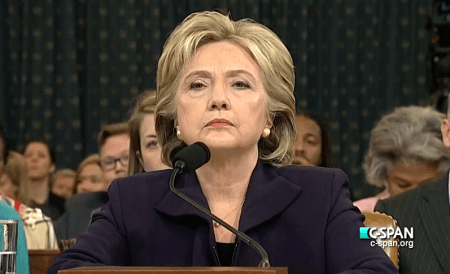
Hillary Clinton’s position on the email scandal has repeatedly changed from its first emergence in the presidential campaign from denial of bad judgment to the denial of the use of the private server for any classified information to the denial of any material “marked” as classified to the denial of seeing or understanding classified markings. However, one claim has remained unchanged. Clinton has maintained that she and her staff have “cooperated fully” with investigators. That claim was previously shown to be untrue when it was revealed that neither Clinton nor her staff would agree to speak with State Department investigators even though they said that such interviews were needed to determine the scope any damage to national security or security breaches. Now, however, the lack of cooperation has been put into sharper relief with the testimony of FBI Director James B. Comey this week. My column this week raised serious misgivings over the handling of the investigation with the disclosure of five immunity grants by the Justice Department, including one given to Cheryl Mills. Those misgivings were raised with Comey before the United States Senate Homeland Security and Governmental Affairs Committee where Comey revealed the extent to which Clinton aides refused to cooperate, including an assertion of the privilege against self-incrimination raised before answering questions about a key telephone conference conversation before the infamous “bitbleaching” over email records being sought by Congress. Comey testifies today before the House Oversight Committee. I am currently scheduled to discuss these issues tonight on the O’Reilly Factor.

Comey insisted that there was nothing “irregular” about the deal given Mills despite the countervailing concerns detailed in my column. His defense of the immunity deals was that the Clinton staff would not cooperate without being protected from criminal prosecution based on their answers or cooperation. The lack of cooperation was captured in the fact that Mills refused to turn over her laptop without such an immunity grant. This was government information needed in a criminal investigation and Mills refused until they gave her immunity. So here is a laptop with potential criminal information and classified information, but Mills withheld it as leverage for immunity under an “active production immunity” deal.

cheryl_d-_mills

Corey’s defense of the deal was highly dubious: “The FBI judgment was we need to get to that laptop. We need to see what it is. This investigation’s been going on for a year. And this was, in the negotiation, a tool that her lawyer asked for, that the Department of Justice granted so we could get the laptop.” So the Justice Department gave immunity to one of the highest ranking individuals and the figure most often cited as at risk for criminal charges . . . to get a laptop that the FBI could have secured through a order of production. The assumption of a long drawn out fight also assumed that the public disclosure of the Clinton staff withholding key information would not have forced the hand of Mills. Comey also did not address the bizarre role of Mills who, despite being a key and immunized witness, was allowed to sit in on Clinton’s questioning.

As for Paul Combetta, an employee at Platte River Networks, who deleted information that he reportedly knew was being sought by Congress, Comey insisted that “The department granted immunity to the one fellow who erased the stuff so that we could figure out, did anybody tell you to do this, did anybody ask you do this, to see if we could make an obstruction case — we couldn’t.” So you gave immunity to a witness who was facing a real threat of criminal charge and would be likely eager for a plea bargain? Immunity was not needed to get that individual to cooperate but it is also a questionable defense when you also gave immunity to the very high-ranking officials who was involved in the key decisions over the deletion of the emails.

Magnifying these concerns further is a recent disclosure of FBI material from the investigation, including “302 forms” from FBI interviews. There is a telling passage included in one such report from the end of page 18. The paragraph is assumed to refer to the interview of Combetta or another Platte River employee. When the FBI turned to that key telephone conference with Kendall and Mills. The witness immediately stops cooperating and invokes his privilege against self-incrimination under the Fifth Amendment. It was a telling invocation over a conversation with Clinton’s lawyers. Yet, the Justice Department gave both Combetta and the key Clinton aide in the conversation, Mills, immunity.

Putting aside the questionable judgment behind such immunity grants, one thing is clear: as with the total refusal to cooperate with the State Department investigation, there was a refusal to cooperate with the FBI investigation by key Clinton figures until they received grants of immunity — even without public records.

Netanyahu defends ties with Russia, citing mutual interests

September 28, 2016

Source: Netanyahu defends ties with Russia, citing mutual interests | The Times of Israel

In New York, PM highlights shared concerns about Islamic militants, Syria, and Moscow’s interest in Israeli tech; insists US remains top ally

September 26, 2016, 7:14 pm
Prime Minister Benjamin Netanyahu speaking September 22 2016 at the Hudson Institute gala in New York City. (Rick Gilbert via JTA)

Prime Minister Benjamin Netanyahu speaking September 22 2016 at the Hudson Institute gala in New York City. (Rick Gilbert via JTA)

WASHINGTON (JTA) — Israeli Prime Minister Benjamin Netanyahu said that outreach between Israel and Russia made sense because of shared concerns about militant Islam, a desire to avoid clashes in Syria, and Russia’s interest in Israeli technology.

Netanyahu appeared in New York on September 22 to receive the Herman Kahn award from the conservative Hudson Institute, named for one of the think tank’s founders.

He was pressed by his interviewer, Roger Hertog, a philanthropist who is one of Hudson’s benefactors, to explain why Russian President Vladimir Putin has been seeking closer relations with Israel, given Russia’s military backing for the Assad regime in Syria and its sale of an anti-missile system to Iran.

The “first interest is to make sure that militant Islam doesn’t penetrate and destabilize Russia,” Netanyahu replied. “There are many, many millions of Muslims in Russia, including in greater Moscow, I think it’s up to two million. And the concern that Russia has, which many other countries have, is that these populations would be radicalized.”

Another reason is to avoid a clash in airspace bridging Israel and Syria, where Russian combat aircraft are bombing enemies of the regime of Bashar Assad. “We can coordinate in order not to crash and clash with each other,” Netanyahu said.

Given Russia’s influence in Syria, Netanyahu said, Russia was also a useful conduit to keep Israel’s enemies from being empowered. Notably, another Assad ally is Hezbollah, the Iran-allied Shi’ite Lebanese militia that has warred frequently with Israel.

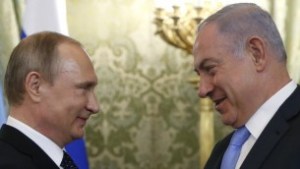
Russian President Vladimir Putin (L) welcomes Prime Minister Benjamin Netanyahu during a meeting at the Kremlin in Moscow on June 7, 2016. (AFP Photo/Pool/Maxim Shipenkov)

Russian President Vladimir Putin (L) welcomes Prime Minister Benjamin Netanyahu during a meeting at the Kremlin in Moscow on June 7, 2016. (AFP Photo/Pool/Maxim Shipenkov)

“We don’t want to see in the aftermath in Syria, whether with an agreement or without an agreement, we don’t want to see an Iranian military presence, we don’t want to see Shi’ite militias which Iran is organizing from Afghanistan, from Pakistan, and we certainly don’t want to see Iranian game-changing weapons being transferred through Syrian territory to Hezbollah in Lebanon,” the Israeli prime minister said.

Another factor was Russian interest in Israeli technology. Putin is “interested in technology and Israel is a global source of technology in many areas that are of interest to Russia — agriculture, dairy production, you name it, the standard fare.”

Finally, Netanyahu said, Israel has a substantial Russian-speaking minority.

“There’s a cultural, a human bridge,” he said. “We have a million Russian speakers in Israel. These and other reasons, I think, inform Russia’s policies. And I think it’s very important that we have this relationship.”

To applause, Netanyahu reasserted that Israel’s premiere alliance is with the United States.

“With the United States, we certainly have shared interests, but it’s the one alliance we have, and there may be one or two others, but nothing like this, that is based on shared values,” he said.

Obama, world leaders to attend Peres’s funeral in Jerusalem

September 28, 2016

German, Canadian, French and Australian heads of state, along with Britain’s Prince Charles, also set to fly to Israel for Friday event; late president’s body to lie in state at the Knesset Thursday

Source: Obama, world leaders to attend Peres’s funeral in Jerusalem | The Times of Israel

September 28, 2016, 10:02 am
US President Barack Obama meets with Israeli President Shimon Peres in the Oval Office of the White House on June 25, 2014, in Washington, DC (AFP/Mandel Ngan)

US President Barack Obama meets with Israeli President Shimon Peres in the Oval Office of the White House on June 25, 2014, in Washington, DC (AFP/Mandel Ngan)

Israeli authorities were gearing up for the funeral of the country’s ninth president, Shimon Peres, who died early Wednesday morning at the age of 93.

US President Barack Obama would attend the Friday event, the Foreign Ministry said, along with Secretary of State John Kerry. Presidential nominee Hillary Clinton will also take a break from campaigning to attend the funeral with her husband, former president Bill Clinton, the ministry said. However, Clinton’s campaign reportedly later clarified that she would not be attending.

In addition, Britain’s Prince Charles, German Chancellor Angela Merkel, French President Francois Hollande, Canadian Prime Minister Justin Trudeau, Australian Prime Minister Malcolm Turnbull and President of Mexico Enrique Peña Nieto confirmed their attendance.

A spokesperson for the Catholic Church in Israel dispelled rumors that Pope Francis would attend.

Also named as attendees were the president of Togo, Faure Gnassingbé; the president of Romania, Klaus Iohannis; and Her Royal Highness Beatrix of the Netherlands.

A former aide to Peres said his body would lie in state at the Knesset from Thursday morning before the state funeral, at Mount Herzl, the country’s national cemetery, in Jerusalem.

Yona Bartal, his former aide, told Channel 10 that the plans were in line with Peres’s wishes.

Ben Gurion Airport was gearing up to receive the many world leaders, guests and journalists who are expected to arrive for the funeral. Workers are preparing additional parking areas for the increased number of airplanes that will arrive.

Meanwhile, the Education Ministry instructed schools throughout the country to dedicate an hour Wednesday morning to talk about Peres’s life and deeds.

Peres died in his sleep at around 3 a.m. local time on Wednesday, Rafi Walden, his personal physician who is also his son-in-law, told AFP.

News of Peres’s stroke earlier this month sent shockwaves through the country, which feared the imminent loss of the last surviving link to its founding fathers.

Over a seven-decade career, the elder statesman of Israeli politics and one of the country’s most admired symbols has held virtually every senior political office, including two stints as prime minister and extended terms as foreign, defense and finance minister. He won the 1994 Nobel Peace Prize for his work in reaching an interim peace agreement with the Palestinians.

Long a divisive personality in politics, Peres finally became one of Israel’s most popular public figures in his later years.

Times of Israel staff and news agencies contributed to this report.

Saudi paper chides Palestinians for rejecting Netanyahu’s Knesset invite

September 28, 2016

Editorial in Saudi Gazette says historic visits such as that of Egypt’s Sadat to Israel ‘can bend the arc of history’

Source: Saudi paper chides Palestinians for rejecting Netanyahu’s Knesset invite | The Times of Israel

September 27, 2016, 1:45 am
Palestinian Authority President Mahmoud Abbas addresses the United Nations General Assembly at UN headquarters, September 22, 2016 in New York City.(Drew Angerer/Getty Images/AFP)

Palestinian Authority President Mahmoud Abbas addresses the United Nations General Assembly at UN headquarters, September 22, 2016 in New York City.(Drew Angerer/Getty Images/AFP)

A Saudi daily newspaper mildly chided the Palestinian leadership and Palestinian Authority President Mahmoud Abbas for “automatically” rejecting an invitation by Israeli Prime Minister Benjamin Netanyahu to address the Israeli Knesset.

Netanyahu issued the invitation to Abbas on Thursday during his address to the United Nations General Assembly in New York. Calling for a return to direct negotiations and a stop to Palestinian incitement, the Israeli leader said he would in turn speak to the Palestinian parliament in Ramallah.

In its editorial published Sunday, the Saudi Gazette wrote that the Palestinians “should not be too quick to dismiss the invitation,” arguing that it was “reminiscent of the one issued by former Israeli Prime Minister Menachem Begin to former Egyptian President Anwar Sadat to visit Israel — and the rest is history.”

The paper said the invite led to the Camp David Accords — and the signing of a peace treaty — which “demonstrated that negotiations with Israel were possible and that progress could be made through sustained efforts at communication and cooperation.”

Egyptian president Anwar Sadat addresses the Israeli Knesset in Jerusalem, November 20, 1977 (photo credit: Flash90)

Egyptian president Anwar Sadat addresses the Israeli Knesset in Jerusalem, November 20, 1977 (photo credit: Flash90)

The editorial also cited then-president Bill Clinton’s 1998 trip to Ramallah to address the Palestine National Council, which the paper argues led to the Palestinian leadership recognizing the right of Israel to exist and approving the removal of clauses from the PLO charter that called for its destruction.

“Despite these two examples of how official visits can bend the arc of history, the Palestinians automatically rejected Netanyahu’s invite to Abbas,” the paper wrote, adding that “it is possible that the aim of the invitation was an attempt by Netanyahu to isolate UN attempts to restart and impose a peace process between Israel and the Palestinians.”

While acknowledging that Netanyahu “rejects a settlement freeze, will not uproot settlements, rejects the 1967 borders as the basis for talks and rejects any division of Jerusalem,” the editorial argued that before Begin’s invitation to Sadat, Israel and Egypt were “mortal enemies, having fought three wars” and that Camp David called for “a five-year transitional period of Israeli withdrawal from the West Bank and Gaza” which would include “the introduction of Palestinian self-government and an end to Israeli settlements in the West Bank.”

“Much of the Arab world derided it as a weak deal. But in hindsight, if the provisions had been carried out, Israel and the Palestinians might not be in the impasse they are in at present,” the Saudi paper argued.

In 2002, Saudi Arabia initiated the Arab Peace Initiative which calls for Israel to cede the territories it captured in the 1967 Six Day War in return for full ties with the Arab world.

Israel has rejected the initiative, though in his address on Thursday Netanyahu said Israel welcomed its “spirit.”

Israel's Prime Minister Benjamin Netanyahu addresses the 71st session of United Nations General Assembly at the UN headquarters in New York on September 22, 2016. (AFP/Jewel Samad)

Israel’s Prime Minister Benjamin Netanyahu addresses the 71st session of United Nations General Assembly at the UN headquarters in New York on September 22, 2016. (AFP/Jewel Samad)

In his speech, Netanyahu also praised developing relations with regional Sunni powers such as Saudi Arabia, saying that they “recognize that Israel is not their enemy but their ally,” and that the “common enemy is Iran and ISIS,” referring to the Islamic State jihadist group based in Iraq and Syria.

“In coming years, we will work together openly,” Netanyahu said Thursday, adding that Israeli relations with these countries were “undergoing nothing less than revolution.”

“The change taking place in the Arab world offers a unique opportunity to advance peace,” he added.


