Iranian Dissidents Visit Israel, View Iran after the Nuclear Deal, Jerusalem Center via YouTube, August 21, 2016
FBI, DOJ launch Probe into Firm of Clinton Campaign Chairman John Podesta, Breitbart, Jerome Hudson, August 20, 2016
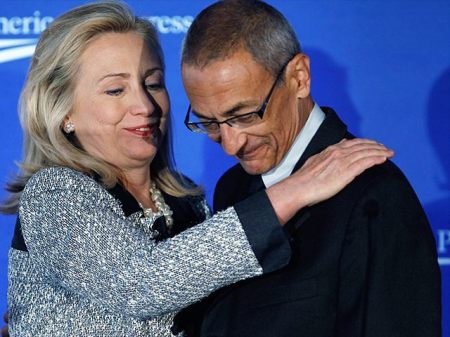 Getty
Getty
The FBI and Justice Department have launched an investigation into whether the Podesta Group, the lobbying and public relations firm co-founded by Hillary Clinton presidential campaign chairman John Podesta, has any connections to alleged corruption that occurred in the administration of former President of Ukraine Viktor Yanukovych.
The federal probe is, CNN reports, “examining the work of other firms linked to the former Ukrainian government, including that of the Podesta Group.”
The Podesta Group, run by John Podest’s brother Tony Podesta, was retained by the Russia-controlled firm UraniumOne in 2012, 2014, and 2015, to lobby Hillary Clinton’s State Department. The lobbying firm was paid a total of $180,000 according to public records.
Yanukovych took office in February 2010. He was forced to flee to Russian after a political uprising in Ukraine. Federal prosecutors are probing the work Yanukovych’s regime paid the Podesta Group to do while he was the head of the Ukrainian government.
As it was first detailed in the New York Times bestselling book Clinton Cash, Uranium One — which hired the Podesta Group — is the firm that funneled millions to the Clinton Foundation as the Russian government gained ownership of the company.
According to the New York Times, Russian President Vladimir Putin had a “goal of controlling much of the global uranium supply chain.”
The Times reported last April:
As the Russians gradually assumed control of Uranium One in three separate transactions from 2009 to 2013, Canadian records show, a flow of cash made its way to the Clinton Foundation. Uranium One’s chairman used his family foundation to make four donations totaling $2.35 million. Those contributions were not publicly disclosed by the Clintons, despite an agreement Mrs. Clinton had struck with the Obama White House to publicly identify all donors. Other people with ties to the company made donations as well.
“And shortly after the Russians announced their intention to acquire a majority stake in Uranium One, Mr. Clinton received $500,000 for a Moscow speech from a Russian investment bank with links to the Kremlin that was promoting Uranium One stock,” the Times report said.
According to the Daily Caller, Uranium One “paid the Podesta Group $40,000 to lobby the State Department, the Senate, the National Park Service, and the National Security Council for ‘international mining projects,’ according to a July 20, 2012 filing.”
Distancing itself from the work it did for an organization with ties to Yanukovych’s pro-Russian regime, the Podesta group said it hired lawyers to examine its relationship with the organization linked to the ousted Ukrainian president.
“The firm has retained Caplin & Drysdale as independent, outside legal counsel to determine if we were misled by the Centre for a Modern Ukraine or any other individuals with regard to the Centre’s potential ties to foreign governments or political parties,” a Podesta Group statement said, according to CNN. The statement continued:
When the Centre became a client, it certified in writing that ‘none of the activities of the Centre are directly or indirectly supervised, directed, controlled, financed or subsidized in whole or in part by a government of a foreign country or a foreign political party.’ We relied on that certification and advice from counsel in registering and reporting under the Lobbying Disclosure Act rather than the Foreign Agents Registration Act. We will take whatever measures are necessary to address this situation based on Caplin & Drysdale’s review, including possible legal action against the Centre.
The FBI and DOJ investigation is also examining former Donald Trump presidential campaign manager Paul Manafort’s firm, according to CNN.
Spokesman from the federal agencies as well as Manafort’s firm have not commented on the ongoing investigation.
Source: Why the Ayatollah Thinks He Won – WSJ
The U.S. hoped that the nuclear deal would boost Iran’s moderates, but after more than a year, Supreme Leader Ali Khamenei and his allies seem to be the big winners

Since the completion last year of a landmark deal limiting Iran’s nuclear program, the country’s supreme leader, Ayatollah Ali Khamenei, has lashed out again and again at the U.S. for its supposed failure to live up to its end of the bargain. But a speech he gave on Aug. 1 in Tehran took his anti-American rhetoric to a new level. He accused the Obama administration of a “bullying policy” and of failing to lift sanctions in a way that benefited “the life of the people.” Mr. Khamenei ruled out cooperation with the U.S. in the fight against Islamic State in Iraq and Syria, telling his audience that Iran’s experience with the nuclear deal “showed us that we cannot speak to [the Americans] on any matter like a trustworthy party.” Many in the crowd chanted anti-U.S. slogans.
Is Iran preparing to walk away from the accord? It’s unlikely. Mr. Khamenei’s speech was classical political posturing intended to rally his hard-line followers. But more than that, his bluster conceals a deeper strategic calculus. For all his complaints about American treachery, Mr. Khamenei and his allies recognize that the nuclear deal has produced significant benefits for their hobbled theocracy and may serve to further entrench the regime brought to power in the 1979 revolution.
President Barack Obama defined the nuclear deal primarily as an arms-control exercise, designed to constrain Tehran’s nuclear program for at least a decade and to keep the U.S. from becoming embroiled in yet another Middle East war. But the White House and its top diplomats, including Secretary of State John Kerry, also quietly suggested that the agreement might open the door to a broader rapprochement between Tehran and Washington and empower Iran’s moderate political forces, particularly its elected president, Hassan Rouhani.
U.S. officials have always cautioned that it would take time for the salutary effects of engagement with Iran to take effect. They have even conceded that, in the short term, the agreement might energize hard-liners opposed to engagement with the West—and that, indeed, seems to be what is happening.
Since the accord was announced last summer, Mr. Khamenei and his elite military unit, the Islamic Revolutionary Guard Corps, have moved to solidify their hold. As international sanctions against Iran have slackened, the ayatollah and his core allies have expanded the Iranian military and pursued new business opportunities for the companies and foundations that finance the regime’s key ideological cadres. Iran has continued to fund and arm its major regional allies, including the Assad regime in Syria, the Lebanese militia Hezbollah and Houthi rebels in Yemen—all of which are at war with America’s regional partners—and the regime has continued to test and develop ballistic missiles. The government has also stepped up arrests of opposition leaders and political activists.
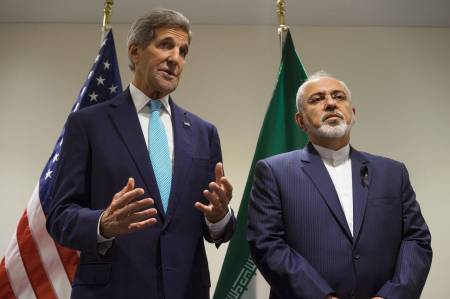
Mr. Khamenei has been deeply involved from the start with his country’s talks with the U.S. After the U.N. Security Council imposed tough sanctions on Iran in 2010, he became alarmed by the drain on Tehran’s finances. In 2012, he backed secret talks in hopes of relieving the crippling financial pressure. A collapse in global oil prices made Iran even more vulnerable. As the talks evolved into public negotiations with the U.S. and its partners, Mr. Khamenei instructed his representatives to ensure that Iran could keep the major infrastructure of its nuclear and military programs.
Today, the 77-year-old ayatollah—who reportedly suffers from cancer—is seeking to cement his legacy and to shape the political transition that will occur once he is gone. The nuclear agreement provides him with the building blocks to do that, and for now, at least, Mr. Khamenei and his allies look to be the deal’s big winners. The next U.S. administration is likely to face an unhappy choice: to continue to work with Iran or to challenge an increasingly entrenched supreme leader and his Revolutionary Guard.
For its part, the Obama administration says that the nuclear deal blocks Iran from all paths to develop an atomic bomb and that the agreement’s success doesn’t depend on political change taking root in Tehran. They note that the deal is still in its early stages and suggest that an opening of Iran’s economy could help reformists over time. They also insist that it has served the cause of peace in the region. “The president and I both had a sense that we were on an automatic pilot toward a potential conflict, because no one wanted to talk to anybody or find out what was possible,” Mr. Kerry said in an interview. “I have no doubt that we avoided a war. None.”
To understand Mr. Khamenei’s perspective on the negotiations and the resulting deal, the best place to start is Iran’s nuclear program. The agreement requires Iran to accept key limitations: Previously, the country had nearly 20,000 centrifuge machines producing nuclear fuel and was on the cusp of possessing weapons-grade uranium. A plutonium-producing reactor was also nearly online.
Today, only 5,000 centrifuges are spinning, the plutonium-making reactor has been made inoperable, and most of Iran’s enriched uranium has been shipped out of the country. Iran also agreed to grant greater access to its nuclear sites to inspectors from the U.N.’s nuclear watchdog, the International Atomic Energy Agency, to prevent the country from diverting fissile materials to banned military purposes. “There are serious constraints on their nuclear program for 15 years,” Energy Secretary Ernest Moniz, an important player in the negotiations, said earlier this year. “Fifteen years, with serious verification measures, should give considerably more comfort to our allies in the region.”
Mr. Khamenei, however, doesn’t appear to share this view of the deal’s constraints. Just as Iran’s negotiators were agreeing to these terms in July 2014, the supreme leader delivered a speech about the nuclear program—without consulting his chief negotiator, Foreign Minister Javad Zarif, according to U.S. and European officials. In the address, Mr. Khamenei said that his oil-rich country needed at least 100,000 centrifuges to power its civilian nuclear program in the coming decades. This was more than 20 times what the Obama administration envisaged. Western diplomats wondered whether Iran’s diplomats really spoke for the supreme leader.

Over the next year, the U.S. and its partners brought the Iranians back down to a capacity of just 5,000 machines. Washington hailed this as a major negotiating victory, but there was a twist: After a decade, the international community would go along with Mr. Khamenei’s vision of an Iran that could develop an industrial-scale, civilian nuclear program without checks on the number or capacity of the centrifuges spinning. The U.S. had won only a short-term pause in the expansion of the Iranian program, and the supreme leader had gained international approval for his longer-term plan.
Indeed, in recent weeks, Iranian officials have talked of their preparations to build 10 new nuclear reactors with Russian help. This will require a steady supply of nuclear fuel from centrifuges that will be allowed to go online in a decade. “The agreement gives us time, provided Iran implements it. But it’s limited,” said Mark Hibbs, a Berlin-based expert on nuclear programs at the Carnegie Endowment for International Peace. “The Revolutionary Guard controls the program, and there’s a risk that in 10 or 15 years, they might decide to restart their [weaponization] activities.”
Mr. Khamenei also came away from the talks with much of what he wanted for reviving Iran’s economy—a longstanding anxiety for the regime. Before the nuclear deal, Iran had been on the financial ropes, especially after the Obama administration ratcheted up international sanctions. The deal relieved that pressure.
The U.S.-led international sanctions campaign against Iran raised alarm bells in the supreme leader’s office in 2013, according to Iranian officials. In just over a year, Iran’s oil exports had been cut by more than half, and its banks were almost completely shut off from the international financial system. Iran’s currency, the rial, fell by two-thirds against the dollar, spurring massive inflation and unemployment. This gave the U.S. an opportunity to extract new concessions from Tehran.
The more moderate Mr. Rouhani was elected president that year with a mandate to improve Iran’s economy and ease the sanctions. His aides say that Mr. Rouhani convinced Mr. Khamenei that sanctions posed an existential threat to the government.

Mr. Rouhani got many of the U.S.-imposed penalties lifted under last year’s nuclear agreement. The impact on Iran’s economy has been mixed so far, stoking charges from Iranian leaders that the U.S. hasn’t lived up to its commitments. Iran’s oil exports have largely returned to their pre-2012 levels, and the World Bank projects that Iran will see nearly 5% growth in its gross domestic product next year. But European and Asian banks remain skittish of financing projects in Iran, and the U.S. Treasury Department maintains its ban on dollar transactions with Iran.
This path of modest growth has worked to Mr. Khamenei’s advantage, Iran analysts say. Far from hoping for a flood of foreign investment, the supreme leader has repeatedly warned his people that Western culture and business could undermine the revolution and its values.
Mr. Khamenei says that Iran must remain economically self-sufficient and independent of the West, running a “resistance economy” fueled by domestic production and capacity. “With its calm appearance, and with the soft and glib tongue of its officials, America is damaging us from behind the scenes,” Mr. Khamenei said in his speech earlier this month.
Mr. Khamenei is managing the economy the way that he wants it—with enough money to avoid a financial crisis but not so much that it might threaten his system. The supreme leader’s “system wants technology, and he wants access to imports,” said a political adviser to President Rouhani. “But his ‘resistance economy’ is a way to keep the West out of Iran.”
In an apparent effort to ward off foreign influence, the Revolutionary Guard has stepped up arrests of dual nationals from the U.S., Europe and Canada over the past year. One of the detained Americans, Siamak Namazi, is an oil-industry executive who has written and spoken about the need for Iran to embrace economic and political reforms. Friends and family of Mr. Namazi say that his arrest was a warning to Iranian expatriates not to return home to pursue business dealings. Many Iranian-Americans have heeded the message. The economy is now dominated by the Revolutionary Guard, which controls many of Iran’s largest companies.
As for conventional military capabilities, the deal didn’t do much to curtail Iran’s ambitions. The supreme leader demanded a provision weakening a U.N. Security Council resolution that prohibits Tehran’s ballistic-missile development—and got it. He wanted the U.N. embargo lifted on Iran’s ability to buy or export conventional arms—and got it, in five years. He wanted to retain Iran’s ability to export arms—and the deal does nothing to interfere with that.
“Ayatollah Khamenei has emerged as the single most powerful man in the Middle East,” said Karim Sadjadpour, an Iran expert and senior associate at the Carnegie Endowment for International Peace in Washington. “It will take years to assess the full impact of the nuclear deal on the Middle East and in Iran internally, but the hope that the deal would weaken Khamenei and the Revolutionary Guards so far hasn’t been borne out.”
Finally, the nuclear deal also seems to have boosted Mr. Khamenei’s ability to influence the region. In the ornate former palaces and six-star hotels where the nuclear talks took place in Austria and Switzerland last year, U.S. and European officials talked optimistically about using the deal to stabilize a roiling Middle East. They hoped that Iran, the region’s great Shiite power, might play a constructive role in ending conflicts in Yemen, Iraq and, above all, Syria.

It hasn’t worked out that way. Even as the talks continued, Mr. Khamenei and his generals were plotting a much broader military campaign in Syria in partnership with Russian President Vladimir Putin, according to European, Arab and Iranian officials. Starting in January 2015, the supreme leader’s top aides began a series of visits to the Kremlin to chart out a plan to bolster the embattled regime of Syrian President Bashar al-Assad.
The result was a highly coordinated operation in Syria that began just weeks after the nuclear deal was completed. Mr. Putin’s air force has pounded Syrian rebels, bombing not just Sunni jihadists associated with Islamic State or al Qaeda but also U.S.-backed fighters. At the same time, Mr. Khamenei’s Revolutionary Guard mobilized thousands of soldiers and Shiite militiamen to launch a ground offensive, with Iranian troops fighting alongside militants from Hezbollah and other Shiite militias. The joint Iranian-Russian operation drove back Syrian rebels who had been advancing on the Assad regime’s stronghold on the Mediterranean coast, according to Arab and U.S. officials, and allowed the minority regime to retake large swaths of territory. The Kremlin announced this week that it has started launching airstrikes in Syria from Iranian territory.
Mr. Khamenei has sworn off any collaboration with the U.S. in the Middle East, even against shared regional enemies like Islamic State. Instead, he has continued Iran’s campaign to control the oil-rich Persian Gulf and weaken the influence of the U.S., Israel and its Sunni Arab allies across the region. U.S. military commanders say that they have seen no tapering off of Revolutionary Guard support for its allies in Yemen, Iraq or the Palestinian territories.
Mr. Khamenei cannot know how the U.S. will respond to his uncompromising stance, especially with a new administration soon to take office. But he may figure that he wins either way. If the deal falls apart, he could call it proof that the Americans never could be trusted and figure that another round of biting U.N. sanctions will prove too difficult to assemble. If the deal survives, he will have his military continue to develop missiles and conventional arms to position Iran to become a latent nuclear weapons power in 10 years.
Either way, it is Mr. Khamenei, not his more moderate rivals, who are acting as if they have been strengthened by the nuclear deal. “Our problems with American and the likes of America…on regional matters and on various other matters are not solved through negotiations,” Mr. Khamenei said in his Aug. 1 speech. “We ourselves should choose a path and then take it. You should make the enemy…run after you.”
Mr. Solomon is chief foreign affairs correspondent for the Journal. His new book, “The Iran Wars: Spy Games, Bank Battles, and the Secret Deals That Reshaped the Middle East,” will be published next week by Random House.
By: Jewish Press News Briefs
Published: August 21st, 2016
Source: The Jewish Press » » Gazan Rocket Hits Sderot

Rocket crossing!
Photo Credit: Asher Schwartz
Two rocket alerts went off in communities near the Gaza border and in Sderot at around 2:25PM on Sunday.
2:35 PM Residents near the Gaza border are reporting that they heard at least one explosion, possibly two.
2:43 PM Confirmed reports that one rocket from Gaza landed in Sderot between 2 houses. No one was injured.
The rocket was launched from Beit Hanoun.
Police are asking citizens to not go to the area where the rocket fell do the the danger.
3:00 PM Arab sources report that the IDF is striking Beit Hanoun area.
There are no reports on why Iron Dome did not take down he rocket.
Southern Turkey: At least 50 killed, 90 injured in suicide bombing A suicide bomber blew himself up in the lobby of an event venue while a wedding was taking place, killing at least 50 people and injuring more than 90. According to the Turkish authorities, ISIS is responsible for the attack. However, no terrorist organization has claimed responsibility yet.
Aug 21, 2016, 9:40AM
Becca Noy
Source: Turkey: At least 30 killed in terror attack – World News | JerusalemOnline

Photo Credit: Sky News/Channel 2 News
At least 50 people were killed and more than 90 were injured when an explosive device detonated last night (Saturday) in the Turkish city of Gaziantep. The explosion occurred in a lobby filled of people who were celebrating a wedding. Turkish officials believe that this was a terror attack carried out by ISIS against Kurdish targets. However, no organization has claimed responsibility for the attack. Turkish President Recep Tayyip Erdoğan sent his condolences to the families of the victims and said that ISIS is most likely the perpetrator.
Gaziantep Governor Ali Yerlikaya said to a local news outlet that the explosion was most likely caused by a suicide bomber who blew himself up in the lobby of an event venue that was filled of guests.
According to some news reports, the wedding was connected to the Kurdistan Workers Party (PKK), a claim that strengthens the Turkish authorities’ assertion that ISIS is responsible for the attack. “There is no difference between ISIS, the likely perpetrator of the attack in Gaziantep, and the PKK or Fethullah Gülen,” stated Erdoğan yesterday.

Horrific pictures and videos documenting the scene of the attack flooded social media. In response, the Turkish authorities banned the publication of the documentations of the area and threatened to sue those who violated this restriction.
“The purpose of terror attacks are to scare people but we will not allow this to happen,” said Deputy Prime Minister Mehmet Simsek. “It’s barbaric to attack a wedding.” Simsek represents the city of Gaziantep in the Turkish Parliament.




 anneinpt
 artaxes
 danmillerinpanama
 davidking1530
 Peter Hofman
 Joseph Wouk
 Peter
Peter Louisiana Steve
 WarSclerotic
Recent Comments