Brexit: What it Means to Have Our Freedom Back, Gatestone Institute via YouTube,June 28, 2016
EXCLUSIVE – Islamic State Supporters Celebrate Deadly Istanbul Airport Attack
29 Jun 2016
Source: EXCLUSIVE – Islamic State Supporters Celebrate Deadly Istanbul Airport Attack – Breitbart
Breitbart Jerusalem has gained insider access to the encrypted Telegraph forum, which consists of known IS leaders, lower and mid-level IS fighters, IS supporters, and propagandists. Some members utilize their own names, while others use screen names. The forum serves as a Twitter of sorts for IS and its supporters.
Inside the forum, users explained with great conviction why they hope and believe the attack was IS “retaliation” against Turkey.
Abu Usama Almagrebi, a Moroccan jihadi, wrote: “Friends, Turkey has become a member of the axis of infidel countries fighting and showing hostility against us. They kill our brothers on a daily basis by launching airstrikes on our country, and the blessed bombings that we hope our brothers are responsible for is a natural reaction and only a small part of the price Turkey has to pay for its policy against our brothers.”
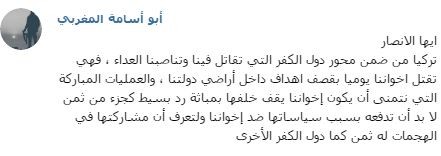
“She (Turkey) should know that she will pay for participating in the attacks against us just like any other infidel country,” he added.
Another IS activist, writing under the pseudonym “Attacking Barriers,” wrote: “Our friends and dearly beloved, the community of mujahedeen, for us an American Muslim is better than an Arab supporting the infidels. Don’t forget the teachings of Ibn Taimiyah [an Islamic cleric who serves as an inspiration to IS] who said: ‘If I side with the infidels kill me, even if I do it carrying the Quran…’ There are Muslims among the infidels.”

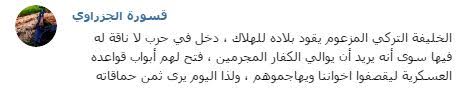
Kassura Aljazrawi wrote: “The Turkish ruler who pretends to be a caliph leads his country to oblivion. He joined a war that’s not his out of support for the infidels, opened the doors to his military bases for them to raid our brothers, and now realizes what price he has to pay for his stupidity.”
Telegraph user “Tyrant Shaker” mentioned the normalization pact Turkey had signed with Israel just one day before Tuesday’s attack. “I think that the operation is a message from our State that if you think you sign a deal with the Jews to help your economy, it actually depends on our suicide bombers.”

“Ironclad Determination” wrote: “Erdogan entered the gates of the world of infidelity and therefore bears the brunt of our Islamic fighters. He started this war by attacking our brothers, and it’s time for him the pay the price. We pray to Allah that this attack was the work of our brothers, and with Allah’s help the mujahedeen will take control of Turkey just like the Prophet promised.”

IS is being implicated in the attack in which three suspected suicide bombers opened fire and then detonated themselves in Istanbul’s main airport.
Aaron Klein is Breitbart’s Jerusalem bureau chief and senior investigative reporter. He is a New York Times bestselling author and hosts the popular weekend talk radio program, “Aaron Klein Investigative Radio.” Follow him on Twitter @AaronKleinShow. Follow him on Facebook.
The Accusations Begin: David Cameron Blames Brexit On Merkel And EU “Immigration Failure”
by Tyler Durden
Jun 29, 2016 2:40 AM
The Brexit vote is history, and so is David Cameron’s reign as Britain’s prime minister whose gamble to allow an EU referendum backfired spectacularly. And today, in what Bloomberg earlier dubbed his “last summer” Cameron had the unpleasant task of telling his Eurocrat peers during what is hist last Brussels summit why he failed. Only he didn’t and instead, as the FT writes, Cameron flipped the tables and told European leaders he lost the EU referendum because they failed to address public concerns over immigration, as tensions rose ahead of looming Brexit negotiations.
The British prime minister said at his final summit in Brussels on Tuesday that fears of mass immigration were “a driving factor” behind the vote and free movement would have to be addressed in Brexit talks. While he did not call her out by name, Cameron was effectively blaming Angela Merkel, whose overly accepting immigration policy in 2015 unleashed a historic refugee wave which ultimately ended up being the deciding factor behind the referendum outcome.

As the FT writes, Angela Merkel, the German chancellor, and other leaders “blocked British demands before the referendum for an “emergency brake” on migrant numbers and the idea remains anathema to many member states. Cameron, who announced his resignation after last week’s referendum, said that he wanted Britain and the EU to retain “as close an economic relationship as possible”. But, at an emotional dinner, he warned that the UK could not continue to accept large numbers of EU migrants, even if that meant losing access to the single market.”
His remarks underscored the hard task facing both sides in reaching a new accord. Addressing the German Bundestag before the Brussels summit, Ms Merkel warned the UK that there would be no “cherry picking” in its Brexit negotiations. European Commission president Jean-Claude Juncker underscored this when he said that he wants the article 50 “letter to be sent as soon as possible.” Giving the UK instructions on how to proceed, Juncker said during a press conference that “if someone from the Remain camp will become British prime minister, this has to be done in two weeks after his appointment. If the next British PM is coming from the Leave campaign, it should be done the day after his appointment.”
Juncker urged the UK “swiftly” to clarify its position regarding its plans to break from the EU, warning that the bloc could not be “embroiled in lasting uncertainty”. He also hit back at criticism of him in some parts of the British press, claiming he was not a “faceless bureaucrat” and “would like to be respected”.
More importantly, Cameron’s resignation – not literal but figurative – suggests that any hope the Remain camp may have had for a redo of the referendum has been extinguished.
It wasn’t just Cameron: even before the session began there had been signs of renewed hostility towards Downing Street. After a heated debate, which at one point degenerated into catcalls and boos for Nigel Farage, the UK Independence party leader, the European Parliament voted for a resolution calling on Britain to begin divorce proceedings immediately.
Some of Mr Cameron’s fellow EU leaders made similar testy remarks. “Married or divorced, but not something in between,” said Xavier Bettel, the Luxembourg prime minister. “We are not on Facebook, with ‘It’s complicated’ as a status.”
As explained over the weekend, the pace and nature of Britain’s exit from the EU together with the triggering of Article 50, have become the most contentious issues in both London and Brussels since last week’s vote. Most of the leaders of the UK’s Leave campaign, who are likely to form the core of a new British government, have said they want to begin Brexit negotiations before invoking Article 50 of the EU treaties, which would formally trigger two-year exit proceedings.
Merkel made it clear that she and other EU leaders have refused to engage in negotiations until Article 50 is invoked, setting up the first of what could be years of difficulties facing Cameron’s successor. Mark Rutte, the Dutch premier and formerly one of Mr Cameron’s closest allies, argued for Britain to be granted “some space”. But he was unforgiving in his reasons why, saying: “England has collapsed politically, monetarily, constitutionally and economically.” Which, incidentally, is what Brussels calls a victory for Democracy.
Manuel Valls, the French prime minister, said it was not for Britain to dictate the pace of talks. “It’s not up to the British Conservative party to set the agenda,” he told the National Assembly in Paris.
What happens next?
On Wednesday, Mr Cameron will be asked to leave the summit while the remaining 27 members hold informal talks on how to approach Brexit negotiations and how to stop them from stretching out over many years.
Addressing the German Bundestag before the Brussels summit, Ms Merkel warned the UK that there would be no “cherry picking” in its Brexit negotiations, her toughest response yet to the Leave campaign’s hopes of securing access to the EU’s internal market while limiting freedom of movement.
She spelt out that the EU’s internal freedoms were indivisible: if Britain, like Norway, wanted access to the internal market then, like Norway, it would have to accept freedom of movement, she said.
Which goes back to the original point Cameron made, namely that it is Merkel’s stickiness on freedom of movement that led to the victory of the Leave camp.
The winner today, however, was Nigel Farage, who stole the limelight when he was booed after he called on the EU to take a “grown-up and sensible” attitude to negotiations with the UK. He claimed the result would offer a “beacon of hope” to “democrats” across Europe and threatened that “the UK will not be the last member state to leave the European Union.”
As we showed earlier, Farage concluded: “When I came here 17 years ago and said I wanted to lead a campaign to get Britain to leave the European Union, you all laughed at me. Well, I have to say, you’re not laughing now, are you?”
Farage’s moment in the spotlight aside and Cameron’s apparent concession on the possibility of a second referendum, the reality is that while all EU leaders would be delighted to see Britain reverse course and choose to stay, most would be loath to offer any concessions for fear that succumbing to blackmail would encourage others.
Cited by the FT, a senior adviser to one the eurozone’s most powerful leaders said that “this is a matter of survival for us. We cannot allow these tactics to succeed.”
Countries such as France and the Netherlands that were once sympathetic to Britain’s plea for curbs on free movement of workers would now be some of the most opposed to further concessions.
As the FT adds, yielding to British pressure would be a gift to anti-EU politicians that the French and Dutch leaders are trying to defeat in elections early next year. Eastern European leaders, meanwhile, appear as implacably opposed to overturning cherished free movement rights.
Then again, as we reported last night, it is now too late, and most likely by design: sensing the Brexit crisis “opportunity”, Italy is already planning how to bend Eurozone rules against the use of public funds for bank bailouts, and is strategizing how to funnel €40 billion of European cash into its insolvent banking system. Should Europe reject Italy’s overture? Then Italy’s PM Renzi will simply threaten with his own referendum, which considering the recent shocking wins by the Euroskeptic 5 Stars Movement in the Rome and Torino mayoral election, will be all he needs to say to get his way.
Or rather not his way, but the way of the person who is quietly covering up all his tracks: after all why are Italy’s banks insolvent? Well, who was governor of the Bank of Italy from 2005 to 2011 when he blessed all of the hundreds of billions of now non-performing loans? Why former Goldman Sachs employee and current head of the ECB, Mario Draghi of course, who just may end up the biggest winner from the Brexit crisis. Because as everyone knows, one should never leave a crisis go to waste.
Turkish airport blast caught on camera (GRAPHIC VIDEO)
Published time: 28 Jun, 2016 21:03
Source: Turkish airport blast caught on camera (GRAPHIC VIDEO) — RT News
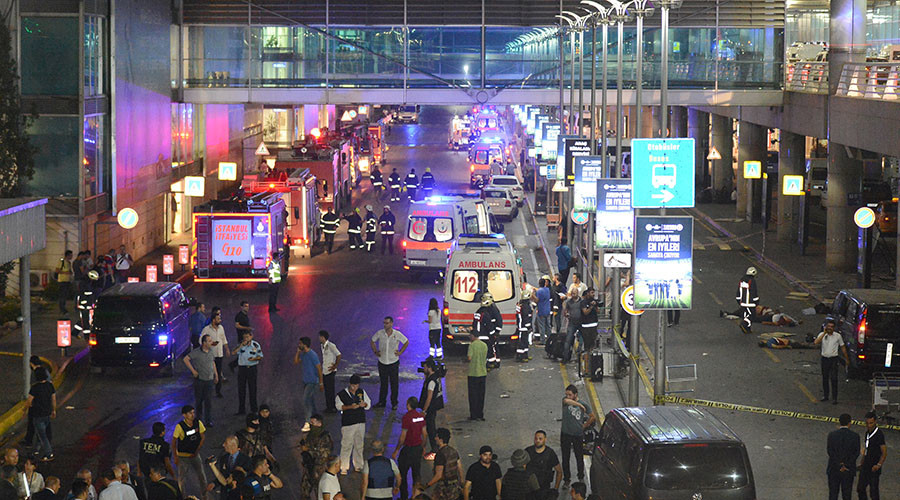
People walk outside Turkey’s largest airport, Istanbul Ataturk, Turkey, following a blast June 28, 2016. © Ismail Coskun / IHLAS News Agency / Reuters
The video shows a bright flash in a crowded terminal, which is followed by a cloud of thick black smoke and panic among the passengers.
https://twitter.com/MahirZeynalov/status/747890126966112256?ref_src=twsrc%5Etfw
The blasts occurred late Tuesday in the airport’s International Arrivals Terminal.
The Turkish media claims that the explosions were terrorist attacks targeting two separate locations in the airport.
READ MORE: At least 2 blasts rock Istanbul’s Ataturk Airport, multiple injuries reported
Al least 10 people were killed and around 60 others injured in the blasts, according to reports.
From FOX
Terrifying moment ISIS suicide bomber blew himself up in Istanbul airport terminal in Brussels-style attack that left at least 41 dead and 239 injured
Source: Turkey airport attack in Istanbul blamed on ISIS with up to 50 dead | Daily Mail Online
Witnesses have described the terrifying moment three suicide bombers launched a co-ordinated attack on Istanbul airport that has left at least 41 dead saying there was blood and body parts everywhere.
Shocking footage has shown an explosion at the door to the arrivals hall by a suicide bomber before another two attackers snuck into the building and dentonated their devices.
Twenty-three of the victims were Turkish citizens and 13 foreign nationals were also among the casualties, an official has said. A total of 41 people have already been confirmed dead, but Turkish officials said that number is expected to rise to 50.
This morning the airport has re-opened while investigators piece together what happened, just hours after the attacks, which also left 239 people injured.
One of the passengers who was travelling through Ataturk airport at the time of the blasts was Laurence Cameron, a British cameraman who was travelling from Latvia to Izmir, on the Turkish coast.

Footage appears to show the moment one of the three bombs was detonated in the devastating suicide attack at Turkey’s Ataturk airport


One of the three terrorists that struck at Turkey’s Ataturk Airport wields an AK-47 as he carries out his killing spree (left), while a man carries a wounded boy away from the airport (right)

Paramedics and special forces officers at the scene help the more than 140 wounded at the airport. At least 41 others were killed

An AK-47 can be seen lying abandoned on the floor, after three suicide bombers set off blasts at the airport as police returned fire

Bodies lie on the pavement outside Istanbul’s international airport after explosions and gunfire shook the terminal

Turkish security agencies and emergency services gathered outside Ataturk airport after it was hit by a suicide bomb attack

Desperate passengers embrace as they gather in shock outside the terminal after the airport was evacuated and all flights were grounded

A wounded girl is carried on a stretcher into the Bakirkoy Sadi Konuk Hospital after being injured in the blasts at Ataturk Airport

Relatives of those who were caught up in the bombings at Ataturk airport wait outside the Bakirkoy Sadi Konuk Hospital for news on their loved ones

A mother who lost one of her children in the attack has to be helped from the ground outside a forensic medicine building close to Istanbul Airport

Another mother of one of the victims is comforted after learning the fate of one of her children after suicide bombers opened fire before blowing themselves up
And he believes believes his plane had arrived just as the bombs began to detonate.
As he walked into the terminal, unaware of what had just happened, he was met with chaos, panic and fear.
‘It must have been just as we touched down,’ he told MailOnline. ‘I did not even hear the explosions, but as I walked out and round the corner, the whole building was running screaming towards me.
‘It was just mass panic, guards running around with guns.’
Mr Cameron, originally from Kent, was stuck for half-an-hour, waiting at customs, before he and his fellow passengers were allowed through and out the terminal.
However, the only way to leave the building was to go through the very place where the bombs had been detonated less than an hour before.
‘There was blood on the floor. It was just horrendous. Debris everywhere. A lot of the ceiling panels had fallen down, smashed all over the floor.
‘Coming out to the taxi rank, it was just full of ambulances. Blood was smeared all up to the car park.
‘People were in tears, especially people with families. They were quite clearly traumatised. There was a lot of uncertainty, no one really knew what was going on. Were we safe where we were?’
He added: ‘There is nowhere to go but out through passport control [if you are in an airport terminal]. It’s not nice – it should be safe, but at that moment it was not.’

An aerial view of the airport shows where the suicide bombers are believed to have detonated their explosives, close to the entrance to the international arrivals terminal
A LOT MORE HERE
From Brexit to Visions of a UN Exit? PJ Media, Claudia Rosett, June 28, 2016
(The UN is a disgrace. The best, if not only, reason I have thought of not to leave it is that, as a permanent member of the Security Council, America has a veto over all of its resolutions. Absent that veto, much could be done to harm us and our allies.– DM)

Britain’s vote last week to leave the European Union — the Brexit — was a vote for freedom, a revolt against an unaccountable bureaucracy in Brussels. Amid the excitement, Fox News briefly reported the story as even bigger than it was, with a TV screen banner proclaiming not that the U.K. was leaving the EU, but “UK VOTES TO LEAVE UN.”
Yes, some things are too good to be true, and this was one.
As parody, it would have been genius. As a piece of news reporting, the Fox mixup of the EU and UN inspired plenty of derision — a bit of comic relief, gleefully seized upon by the stricken members of a pro-EU global elite and commentariat. They cannot fathom why a majority of British voters would choose to reclaim from the commissars of the EU the full freedom to control Britain’s own borders, bananas and vacuum cleaners. In that context, Fox’s botching of a news banner helps feed the narrative that the Brexit vote was some boorish mistake cooked up by a know-nothing mob.
Except that’s false, in ways far more profound than the mistake in the Fox chyron. For an eloquent defense of Brexit, see Roger Kimball’s “Focused on Disaster Narrative, Media Ignores Obvious Benefits of Brexit.” To this I’d add that even in Fox’s erroneous UN-exit caption there was, along with the comedy, some grist for serious thought.
I’m not defending Fox’s proofreaders. Accuracy matters, even on TV. But it’s not completely daft that a copywriter in a hurry would read “EU” and write “UN.” There are some pernicious similarities between the two. Both belong to the clan of multilateral institutions set up with the mission of promoting peace and prosperity, post-World War II. Both have proved better at promoting themselves and their own backroom deals. They are clubs of governments, breeding big, intrusive and unelected bureaucracies; largely self-serving, unaccountable and in various ways damaging to and divorced from the real interests of the populations they claim to serve. As Ambassador John Bolton writes in a piece on “How America Should Answer the Brexit Vote,” peace in Europe since 1945 is a product not of the EU, but of the U.S.-led military alliance of NATO.
Both the EU and the UN have a distinct tilt toward central planning, with all the warped incentives, waste and disregard for free choice that this entails. In the EU, this takes the form of regulation. At the UN, it is packaged as an endless array of UN-orchestrated development goals, capacity-building programs and bureaucratically-directed spending of other people’s money, much of it funneled through despotic governments whose oppressive misrule is the main reason for the poverty and perils the UN proposes to alleviate.
We’ve all read plenty in recent times about the troubles within the EU. Let’s take a moment to reprise just a few of the problems with the UN. A good place to start would be a June 17th article by a former Swedish diplomat and UN whistleblower, Anders Kompass, who recently resigned from the UN Office of the High Commissioner for Human Rights. In this article, headlined “The ethical failure — Why I resigned from the UN,” Kompass writes:
Cholera in Haiti, corruption in Kosovo, murder in Rwanda, cover-up of war crimes in Darfur: on too many occasions the UN is failing to uphold the principles set out in its Charter, rules and regulations. Sadly, we seem to be witnessing more and more UN staff less concerned with abiding by ethical standards of the international civil service than with doing whatever is most convenient — or least likely to cause problems — for themselves or for member states.
Kompass ran afoul of his UN bosses in 2014, when he reported to French authorities that French UN peacekeepers were sexually abusing children in the Central African Republic. The UN accused Kompass of sharing confidential information, suspended him from his job and asked him to resign. Many months later, he was exonerated, but he writes that the UN has done nothing to address the “systemic issues of internal accountability” raised by his case.
But now, he despairs of the UN generally:
I still believe in the defence of human rights. I still believe that a universal organization is needed to improve the chances of world peace and progress. But I also believe that without great changes aimed at resurrecting ethical behavior within the UN, the organisation will not be able to successfully address the challenges of today and of tomorrow.
It would be nice to think that Kompass’s case is unusual. It is nothing of the kind. He joins a long line of disenchanted and mistreated UN whistleblowers, at UN agencies including — to name just a few — the World Meteorological Organization, the World Intellectual Property Organization and the UN’s flagship agency, the UN Development Program — which was exposed in 2007, in the Cash-for-Kim scandal, funneling cash and dual-use goods to North Korea.
That’s just a small sampling of the staggering roster of UN scandals, abuses, cover-ups and failures. Along with the apparently chronic problem of peacekeeper rape (despite a policy of “zero tolerance”), and a bigoted fixation on condemning first and foremost the democratic state of Israel, the UN has gone from the globally corrupt 1996-2003 Oil-for-Food relief program for Iraq, to massive bribery and kickback scandals in its procurement department, to narcotics in the mailroom, to the current drama surrounding a former head of the UN General Assembly, the late John Ashe. Ashe was facing criminal charges in a million-dollar-plus bribery case, accused by U.S. prosecutors of having turned his UN post into a “platform for profit,” when — having pleaded not guilty — he was found dead just last week in his Dobbs Ferry, N.Y. home. According to the medical examiner, he was killed in an accident in which a barbell fell on his neck.
If all this sounds like the saga of a global mafia that happens to have acquired diplomatic immunity, plus an annual multi-billion-dollar entitlement from U.S. taxpayers, plus a luxurious headquarters complex in midtown Manhattan, plus a neo-colonial globe-girdling empire of offices, programs, staff, “public-private partnerships,” trust funds and influence, you’ve got the idea.
Meantime, the UN in its role as promoter of world peace has done nothing to effectively deter turf grabs by Russia and China; has given its eager approval to President Obama’s rotten Iran nuclear deal; has failed despite umpteen Security Council resolutions, sanctions and statements to stop North Korea’s nuclear missile program — or for that matter, North Korea’s hideous human rights abuses. In the UN General Assembly, the second-largest voting bloc, the 120-member Non-Aligned Movement, has been chaired since 2012 by the world’s leading state sponsor of terrorism, Iran.
The UN, for all its trappings of democratic process, is a collective of 193 member states, of which the majority are not free. Their governments do not actually account to the people they pretend to represent. The UN’s system and priorities are such that there is no place for the government of the genuinely democratic Republic of China on Taiwan, but there is a seat, with accompanying privileges, for the totalitarian Kim dynasty of North Korea.
As a rule, the only member state that every so often tries to reform the UN is its chief sugar-daddy, the U.S., with some help from the British and (during the recent tenure of Prime Minister Stephen Harper) the Canadians. As another rule, the UN — with its immunities, opacity and spigots of money flowing as an entitlement from the world’s developed democracies — is pretty much impervious to reform. It’s been tried, over and over. The chief result is a UN that keeps getting bigger, not better.
What is to be done?
Calling for the U.S. to leave the UN sounds unserious. It would be complicated. A leap into the unknown. Any move by a major power, especially the U.S, to massively defund or even exit the UN — mothership of post-World War II multilateral collectives — would meet huge resistance from the same global elite now professing shock and horror over the Brexit. The standard defense of the UN is that it may be imperfect, but it’s all we’ve got.
The real question is, just how imperfect can we afford to let it get, before we start looking quite seriously for a better way? Or, as British voters apparently asked themselves, what are the opportunity costs of sticking with the devil we know? In politics, as in love, getting out of a bad relationship may not be cheap or easy, but in the long-run it can prove a brilliant move. (I’ve been wondering what immediate effect the July 4, 1776 Declaration of Independence had on markets, as they then were).
As the immediate panic over Brexit subsides, it is time for a serious debate not only about the future of the EU, but the UN, and what might replace these corrosive institutions with arrangements more beneficial to the modern world.
Trump’s Declaration of Independence, Power Line,
Today Donald Trump delivered a major speech on the economy in Pennsylvania, titled “Declaring America’s Economic Independence.” You can read the speech, as prepared for delivery, here. These are my thoughts on it:
1) The fact that it is a prepared speech at all is good. Trump’s speeches during the primary season were generally stream of consciousness riffs, and he often has gotten into trouble while ad libbing. He needs the discipline of a prepared text to keep him on message and avoid foolish distractions.
2) The speech previews themes which I think will be highly effective. Those themes aren’t new, of course, but Trump is now honing them and bringing them to a wider audience. Speeches like the one he delivered today will drive the Democrats crazy. They will denounce Trump as a demagogue and xenophobe, which means they are afraid voters will find him persuasive. Trump’s speech tells a story–a personal, populist story, with Hillary Clinton as one of the villains:
We are thirty miles from Steel City. Pittsburgh played a central role in building our nation.
The legacy of Pennsylvania steelworkers lives in the bridges, railways and skyscrapers that make up our great American landscape.
But our workers’ loyalty was repaid with betrayal.
Our politicians have aggressively pursued a policy of globalization – moving our jobs, our wealth and our factories to Mexico and overseas.
Globalization has made the financial elite who donate to politicians very wealthy. But it has left millions of our workers with nothing but poverty and heartache.
3) The speech was mostly about trade. Trump sounds very much like Dick Gephardt, circa 1988. He links the decline in American manufacturing jobs to currency devaluations and cheating by our trade partners, under the benign eye of the globalist financial elite represented by Hillary Clinton. I think Trump’s diagnosis is mostly wrong. The number of manufacturing jobs has declined due to constantly improving productivity, even as the value of goods manufactured in the U.S. is at an all-time high. Trump talks about dealing with “cheating” by trade partners and denounces specific deals (NAFTA and TPP) as bad for the U.S., but to the extent that manufacturing has grown more rapidly in some other countries, like China and Mexico, it is because of cheaper labor and less costly regulation. Trump implies, but doesn’t quite say, that he wants to impose high tariffs on manufactured goods. This would be a highly destructive policy, I think.
4) Still, Trump’s narrative contains a considerable kernel of truth. There is a globalist elite that doesn’t much care about the United States, and Hillary Clinton is its foremost representative in American politics (or will be when Barack Obama steps down). I think it is true that the Trans-Pacific Partnership is a bad deal for America, and, in general, that we would be better served by tough negotiators who care about American interests. Most voters sense this, which is why Trump’s approach could be political dynamite:
[I]f we’re going to deliver real change, we’re going to have to reject the campaign of fear and intimidation being pushed by powerful corporations, media elites, and political dynasties.
The people who rigged the system for their benefit will do anything – and say anything – to keep things exactly as they are.
The people who rigged the system are supporting Hillary Clinton because they know as long as she is in charge nothing will ever change.
The inner cities will remain poor.
The factories will remain closed.
The borders will remain open.
The special interests will remain firmly in control.
Hillary Clinton and her friends in global finance want to scare America into thinking small – and they want to scare the American people out of voting for a better future.
My campaign has the opposite message.
I want you to imagine how much better your life can be if we start believing in America again.
At times, Trump is downright Reaganesque.
5) Once he gets away from trade, pretty much everything Trump says is sound, if vague:
We will make America the best place in the world to start a business, hire workers, and open a factory.
This includes massive tax reform to lift the crushing burdens on American workers and businesses.
We will also get rid of wasteful rules and regulations which are destroying our job creation capacity. Many people think that these regulations are an even greater impediment than the fact that we are one of the highest taxed nations in the world.
We are also going to fully capture America’s tremendous energy capacity. This will create vast profits for our workers and begin reducing our deficit. Hillary Clinton wants to shut down energy production and shut down the mines.
Altogether, it is a powerful message. I would like to see less emphasis on trade and more on regulation, but from a political standpoint, Trump’s formula will be effective.
 Nuruddin az-Zinki fighter with a Tow missile.
A commander of a U.S.-backed Syrian opposition group says his fighters continue to ally on the battlefield with an al-Qaida-tied jihadist group.
The United States continues to arm Nuruddin az-Zinki as it fights dictator Bashar al-Assad’s forces. But in an interview posted online last week, az-Zinki founder Tawfiq Shihab Al Deen acknowledged teaming up “with Al Nusra (an al-Qaida affiliate in Syria), which is a group that proved themselves to be forceful fighters.”
“Our groups, Nuruddin az-Zinki, along with Al Nusra, are the only groups continuously fighting against the regime in the al-Malah area in Aleppo,” Shihab al-Deen told Abdullah al-Muhasayni, a radical Saudi preacher said in an interview posted on YouTube June 21.
Al-Muhasayni interviewed jihadi commanders in Syria during the month of Ramadan. He is known to be the conduit between the Jihadi rebel groups in Syria and their benefactors in the Gulf.
The United States has armed Nuruddin az-Zinki, which has posted many videosshowing their fighters using U.S. TOW missiles.
It is not clear why the United States continues to support Nuruddin az-Zinki despite its alliance with an al-Qaida affiliate.
Muhasayni’s interview with Shihab al-Deen could indicate that this alliance between Nuruddin az-Zinki and Al Nusra extends beyond the battlefield. Muhasayni is considered the spiritual father of al-Qaida in Syria.
The U.S. suspended non-lethal aid to Syrian rebels late in 2014, after jihadists seized warehouses storing supplies. But support for Nuruddin az-Zinki continued, the McClatchy news service reported.




 anneinpt
 artaxes
 danmillerinpanama
 davidking1530
 Peter Hofman
 Joseph Wouk
 Peter
Peter Louisiana Steve
 WarSclerotic
Recent Comments