Archive for February 21, 2016

Off Topic | President Donald Trump and Vice President Ben Carson

February 21, 2016

President Donald Trump and Vice President Ben Carson, Dan Miller’s Blog, February 21, 2016

(The views expressed in this post are mine and do not necessarily reflect those of Warsclerotic or its other editors. — DM)

President Trump and Vice President Carson will be an excellent team. Each has qualities the other lacks: Carson is modest and soft spoken, Trump is not. Trump knows how business works and how to negotiate deals. Carson does not. Both love America and want to help us to make her great again.

Trunp ground game

Donald Trump interview, February 18th:

Not Donald Trump, but how some see him:

Recent speech by Ben Carson:

Not Ben Carson, but how some see him:

All too often, our perceptions of candidates are based, not on what they actually say and do, but on what opposing candidates and their supporters claim.

Oh well.

Here are Newt Gingrich’s remarks on Trump’s future after his South Carolina Republican primary win.

Don’t want Trump/Carson? Then let’s just keep things the way they are because the country’s in the very best of hands. Isn’t it?

Excuse me. I need some medicine.

50 ISIS fighters killed in Syria regime Aleppo advance: monitor

February 21, 2016

50 ISIS fighters killed in Syria regime Aleppo advance: monitor

Source: 50 ISIS fighters killed in Syria regime Aleppo advance: monitor – Al Arabiya English

Residents inspect damage after an airstrike on the rebel held al-Fardous neighbourhood of Aleppo, Syria February 18, 2016. (Reuters)

At least 50 ISIS group fighters have been killed in the last 24 hours in an advance by Syrian government forces east of Aleppo city, a monitor said Sunday.

The Britain-based Syrian Observatory for Human Rights said the fighters were killed in clashes as well as strikes by Russian forces that are waging an aerial campaign in support of government troops.

Since Saturday morning, Syrian government forces have taken more than a dozen villages from ISIS jihadists around a stretch of highway that runs east from the northern city of Aleppo to the Kweyris military base.

The advances have consolidated government control over the stretch of highway leading to Kweyris, which they seized in November.

“The army has encircled ISIS in 16 villages south of the road. The regime wants to take these villages to consolidate its position in the east and southeast of the province,” said Observatory chief Rami Abdel Rahman.

The advances follow a major regime operation in northern Aleppo against rebel forces that has allowed them to virtually surround the opposition-held east of Aleppo city.

Off Topic:  Donald Trump and the New Age of Andrew Jackson

February 21, 2016

Source: Donald Trump and the New Age of Andrew Jackson | Observer

Mr. Jackson put a fire in the belly of the heartland


First there was Ron Paul. Then there was Sarah Palin. Then there was Rick Perry. Now there is Donald Trump.

No, wait. First there was Andrew Jackson.

Andrew Jackson, the seventh President of the United States, might be among the most important of presidents. He gave expression to the common people, the people of the earth and the heartland, in direct opposition to the Colonial establishment from Richmond to Boston, and brought it to an end. Mr. Jackson changed everything.

Today we face a similar paradigm of a broad rural spirit vs. the Eastern Establishment as we did in the day of Mr. Jackson. Birth pains, perhaps, or growing pains, as this time America makes a permanent paradigm shift from an essentially Eastern-based economic culture to a heartland and Western economic culture; the East receding, the heartland ascending.

Commentator Rich Lowry caught the Jackson drift in a recent New York Post article, Donald Trump’s Appeal is as American as Andrew Jackson’s.

“After the Paris attacks, conventional wisdom held that Republican voters would finally turn away from political outsiders and reward candidates representing sobriety and experience. No one stopped to consider that, actually, voters might be drawn to the guy who memorably said of ISIS that he would “bomb the [expletive] out of them,” Mr. Lowry writes.

“In large part, Donald Trump is a Jacksonian, the tradition originally associated with the Scotch-Irish heritage in America and best represented historically by the tough old bird himself, Andrew Jackson. Old Hickory might be mystified that a celebrity New York billionaire is holding up his banner (but, then again, Jackson himself was a rich planter). Trump is nonetheless a powerful voice for Jacksonian attitudes.”

‘He could never speak on account of the rashness of his feelings. I have seen him attempt it repeatedly, and as often choke with rage. He is a dangerous man.’

I made the case about five years ago that the Tea Party at its best was a Jacksonian movement, quite reminiscent of the rural uprising Mr. Jackson brought to Washington in the 1830s. Others suggested at the time that this would be the rising political temperament of the rising American century.

“Since New Hampshire state Rep. Dan Itse brought his challenge to ObamaCare, citing Thomas Jefferson’s Kentucky Resolutions, in February 2009, we have been seeing a new age of Jefferson. Judge Andrew Napolitano now plays primetime “fighting for freedom” five nights a week… a 26-state challenge to the federal government moves to the Supreme Court. But the turning ahead might best belong to Andrew Jackson. It was the rustic warrior from Tennessee who first fired up the common folk west of the New River and laid their claim to governance. He is much misunderstood and occasionally maligned, but Jackson might well be considered the spirit father of the current red-state uprising.”

Two years into the Obama administration America entered a turning. Governors of 26 states followed New Hampshire’s lead and collectively challenged the federal government. They did so again a few years later, against Mr. Obama’s executive order on immigration—and in these past weeks, 25 governors joined to refuse the distribution of Syrian refugees. Following New Hampshire’s initiative, states have begun to think for themselves.

“The most important thing that has happened in the last two years is that the states have learned that they don’t have to do what the federal government tells them to do,” I wrote back then.

Mr. Jackson put a fire in the belly of the heartland; a fire felt in the red states today and a fire that potentially will not go out. He brought a full shift of generational attitudes. When that happens, the generations which are being passed over appear to experience the end of the world. And what they say about the new people rising will be appalling.

“I feel much alarmed at the prospect of seeing General Jackson President,” Thomas Jefferson said in an interview with Daniel Webster in 1824. “He is one of the most unfit men I know of for such a place. He has had very little respect for laws and constitutions, and is, in fact, an able military chief. His passions are terrible. When I was President of the Senate, he was Senator; and he could never speak on account of the rashness of his feelings. I have seen him attempt it repeatedly, and as often choke with rage. He is a dangerous man.”

There’s more. Much more.

This is not far in tone from what was said about Sarah Palin when she first appeared and sent the Establishment press to the fainting couch. And the adolescent ridicule about Mr. Perry’s eye glasses. And despicably, everything about Texan about him. Google Donald Trump today.

Mr. Trump in my opinion is a harbinger of a vast transition occurring in America, which started more than a decade ago and will one day—perhaps soon—hatch. He is the Trickster, like John Brown, like Bob Dylan, who signals a rising of new archetypes ahead and promises “a hard rain gonna fall” on those left behind; like the rise of Abraham Lincoln and the warrior spirit of the North which would follow Mr. Brown, or the rise of the Civil Rights Movement and the Sixties which would follow Mr. Dylan.

And as it was in those periods, from whatever rises here today, there will be no turning back.

Disclosure: Donald Trump is the father-in-law of Jared Kushner, the publisher of Observer Media.

US State Secretary Kerry: Provisional agreement in principle reached on Syria truce terms

February 21, 2016

US State Secretary Kerry: ‘Provisional agreement in principle’ reached on Syria truce terms

Source: US State Secretary Kerry: Provisional agreement in principle reached on Syria truce terms – Daily Sabah

AA Photo

Secretary of State John Kerry said Sunday that a “provisional agreement” has been reached on a cease-fire that could begin in the next few days in Syria’s five-year civil war.

Kerry said he spoke in the morning with Russian Foreign Minister Sergey Lavrov to discuss terms of a cease-fire and the two now must reach out to the parties in the conflict.

He declined to go into the details of the agreement, saying it “is not yet done.” But he said he hoped President Barack Obama and Russian President Vladimir Putin would talk soon and that after that, implementation could begin.

“The modalities for a cessation of hostilities are now being completed,” Kerry said. “In fact, we are closer to a cease-fire today than we have been. A cessation of hostilities … is possible over the course of these next hours.”

The Russian Foreign Ministry seemed to stop short of Kerry’s announcement. The ministry said Lavrov and Kerry spoke on the phone Sunday for a second day in a row and discussed “the modality and conditions” for a cease-fire in Syria that would exclude groups that the U.N. Security Council considers terrorist organizations.

Fighting has intensified in Syria during recent weeks and an earlier deadline to cease military activities was not observed. The United States, Russia and other world powers agreed Feb. 12 on a deal calling for the ceasing of hostilities within a week, the delivery of urgently needed aid to besieged areas of Syria and a return to peace talks in Geneva.

U.N. envoy Staffan De Mistura halted the latest Syria talks on Feb. 3, because of major differences between the two sides, exacerbated by increased aerial bombings and a wide military offensive by Syrian troops and their allies under the cover of Russian airstrikes. The humanitarian situation has only gotten worse, with an estimated 13.5 million Syrians in need of aid, including 6 million children.

“Peace is better than more war,” Kerry said, standing next to Nasser Judeh, the foreign minister of Jordan, which hosts 635,000 Syrian refugees. “A political solution is better than then a futile attempt to try to find a military one that could result in so many more refugees, so many more jihadists, so much more destruction, and possibly even the complete destruction of Syria itself.”

However, he reiterated the long-time U.S. position that any political solution to the conflict will not work if Syrian President Bashar Assad remains at the helm of the nation. “Make no mistake. The answer to the Syrian civil war will not be found in any military alliance with Assad,” Kerry said. “Let me make that clear.”

He said Russia now has to talk with the Syrian government and Iran, which backs Assad, and the U.S. has to talk with the opposition and members of the International Syria Support Group. He said he knows that not every party will automatically agree to the agreement reached for a ceasefire.

“There is a stark choice for everybody here,” Kerry said.

“I know how much work remains and I don’t know if everyone is going to meet their commitments,” Kerry said. “I can’t vouch for that the United States can’t make certain of that.”

He said enforcement issues still need to be resolved in addition to how any breeches will be addressed.

“These are details that have to be determined if it going to be effective,” Kerry said.

Erdoğan to Obama: Turkey to stop shelling YPG only if YPG, Russia, Assad abide by Munich deal

February 21, 2016

Erdoğan to Obama: Turkey to stop shelling YPG only if YPG, Russia, Assad abide by Munich deal

Deniz Zeyrek – ANKARA

Source: Erdoğan to Obama: Turkey to stop shelling YPG only if YPG, Russia, Assad abide by Munich deal – MIDEAST

The fall of the town of Azez in northern Aleppo province where the Turkish military is pushing ahead with its cross-border artillery shelling campaign against U.S.-backed Syrian Kurdish militia positions in Syria would mean emergence of a new refugee influx and security problem for Turkey, Turkish President Recep Tayyip Erdoğan told his U.S. counterpart, President Barack Obama. The People’s Protection Units (YPG), the militia force of Syria’s Democratic Union Party (PYD), and the Assad forces backed by Russia have been acting in cooperation, Erdoğan told Obama in an 80-minute telephone call on Feb. 19.

“Their goal is not fighting against ISIL [the Islamic State of Iraq and the Levant]. If Azez falls, Turkey will face a serious migration and security problem. If [Syrian President Bashar al-] Assad, Russia and the YPG abide by the agreement reached in Munich, then artillery fires will be ceased,” Erdoğan responded, when Obama reiterated the U.S. call for the Turkish Armed Forces’ (TSK) shelling of campaign of the YPG to stop.

The Turkish president was referring to a Feb. 12 deal reached by the 17-nation International Syria Support Group (ISSG) in Munich where many of the key actors in the Syrian conflict, including Damascus ally Russia, agreed on a proposed ceasefire and to increase humanitarian access.

Turkey will not let the continued building of a “corridor” south of its borders, Erdoğan said.

“Our artillery fires have this aim and will continue. We will never sit back and watch formation of such an illegitimate entity at our borders,” he told Obama, according Hürriyet reports citing sources from the Turkish president’s office and Turkish diplomatic sources.

As Obama expressed his condolences to Erdoğan over a Feb. 17 suicide car bomb attack that killed 28 people, many of them soldiers, in the heart of the capital city of Ankara, Erdoğan reiterated that they had “no doubt” that the YPG carried out the attack. As of Feb. 19, the Kurdistan Freedom Hawks (TAK), a group that once had links to the outlawed Kurdistan Workers’ Party (PKK), claimed responsibility for the bombing.

President asks for unconditional US support against YPG

Calling on the United States to give unconditional support in the fight against Syrian Kurdish militants, Turkish Prime Minister Ahmet Davutoğlu said on Feb. 20 he did not rule out the responsibility of the YPG, calling TAK a “proxy” that claimed the bombing to shield the international reputation of the YPG.

The YPG’s political arm has denied the group was behind the Ankara attack and said Turkey was using the bombing to justify an escalation in fighting in northern Syria.

“The only thing we expect from our U.S. ally is to support Turkey with no ifs or buts,” Davutoğlu told a news conference following a five-hour security meeting with members of his cabinet and other officials.

“If 28 Turkish lives have been claimed through a terrorist attack, we can only expect them to say any threat against Turkey is a threat against them,” he said.

Turkish Foreign Minister Mevlut Cavuşoğlu earlier accused the United States of making conflicting statements about the militia group.

Cavuşoğlu has also claimed that U.S. Secretary of State John Kerry told him the YPG could not be trusted, in what Cavuşoğlu said was a departure from Washington’s official position.

“My friend Kerry said the YPG cannot be trusted,” Cavuşoğlu said at a news conference during a visit to Tbilisi on Feb. 19, referring to call with Kerry that took place on Feb. 18.

“When you look at some statements coming from America, conflicting and confused statements are still coming…. We were glad to hear from John Kerry yesterday that his views on the YPG have partly changed.”

As of Feb. 20, Çavuoğlu held telephone conversations with both Kerry and Saudi Foreign Minister Abdel al-Jubair, Turkish diplomatic sources told Hürriyet Daily News on Feb. 21, without elaborating on content of talks or on who initiated the talks.

February/21/2016

Turkey has the right to conduct operations in Syria, elsewhere to combat terror threats:

February 21, 2016

Turkey has the right to conduct operations in Syria, elsewhere to combat terror threats: Erdoğan

ISTANBUL – Anadolu Agency

Sunday,February 21 2016

Source: Turkey has the right to conduct operations in Syria, elsewhere to combat terror threats: Erdoğan – MIDEAST

AA Photo

AA Photo

Turkey has the right to conduct operations not only in Syria but also any other place in which there are terrorist organizations that target Turkey, said President Recep Tayyip Erdoğan.

“Turkey has every right to conduct operations in Syria and the places where terror organizations are nested with regards to the struggle against the threats that Turkey faces,” Erdoğan said Feb. 20, during the event “UNESCO City of Gastronomy: Gaziantep,” which was organized to celebrate the inclusion of Turkey’s southeastern province of Gaziantep on the list of UNESCO’s Creative Cities Network in the gastronomy category.

Erdoğan’s remarks came one day after he and U.S. President Barack Obama talked on the phone for more than an hour regarding the latest developments in Syria and Turkey.

During his address on Feb. 20, Erdoğan said the situation had “absolutely nothing to do with the sovereignty rights of the states that cannot take control of their territorial integrity.”

“On the contrary, this has to do with the will Turkey shows to protect its sovereignty rights,” he said. “We except attitudes to prevent our country’s right [to self-defense] directly as an initiative against Turkey’s entity – no matter where it comes from.”

Erdoğan said the point Turkey has reached is a place of self-defense and that no one had the right to restrict that right.

“The place where we have come is a point of self-defense. No one can restrict Turkey’s right to self-defense in the face of terror acts that have targeted Turkey; they cannot prevent [Turkey] from using it,” Erdoğan said.

Turkey has been shelling targets belonging to the People’s Protection Units (YPG), the military wing of the Democratic Union Party (PYD), which Turkey sees as a terrorist organization due to its links to the outlawed Kurdistan Workers’ Party (PKK), in Syria since Feb. 13.

Turkey and the U.S. differ on the designation of the PYD and YPG and relations between the two NATO allies have been tense for more than a month. While Turkey regards the two groups as a terrorist organization, the U.S. sees the PYD and YPG as an important partner in its fight against the Islamic State of Iraq and the Levant (ISIL) in Syria.

“Turkey will use its right to expand its rules of engagement beyond [responding to] actual attacks against it and to encompass all terror threats, including PYD and Daesh in particular,” Erdoğan said, using the Arabic acronym for ISIL.

His remarks came after a suicide bomb attack in the Turkish capital Ankara killed 28 people and wounded 61 others on Feb. 17.

The Turkish government stated that the Ankara attack was carried out jointly by a YPG member – a Syrian national identified as 1992-born Salih Neccar – and PKK members.

The YPG denied the attack, while the Kurdistan Freedom Hawks (TAK) claimed the attack, saying it was carried out by an operative named Abdülbaki Sönmez.

Erdoğan said that while Turkey was defending itself, they would treat anyone that stands in Turkey’s way as a “terrorist and treat them accordingly.”

“I especially want this to be known this way,” he added.

Erdoğan also lashed out at countries where similar terror attacks have taken place, criticizing them for severely reacting to the attacks when it was their country at stake but “preaching only patience and resoluteness” when it comes to Turkey.

This is “disingenuous,” Erdoğan said.

At least 25 killed, dozens injured in double extremist attack in Homs, Syria (VIDEO, PHOTOS)

February 21, 2016

At least 25 killed, dozens injured in double extremist attack in Homs, Syria (VIDEO, PHOTOS)

Published time: 21 Feb, 2016 07:07 Edited time: 21 Feb, 2016 13:24

Source: At least 25 killed, dozens injured in double extremist attack in Homs, Syria (VIDEO, PHOTOS) — RT News

Dozens of people have been killed and injured in a double bombing attack in Homs, Syria. Talal Barazi, the governor of Homs, said at least 25 people had been killed, but other sources say the death toll was even higher.

The explosions at a traffic light at al-Siteen Street in the al-Zahra neighborhood happened within minutes of each other, witnesses said. One of them may have been triggered by a suicide bomber.

RIA Novosti cites a medical official who estimated a higher casualty number, saying the attack has claimed at least 46 lives and injured as many as 110.

Witnesses said at least one of the two blasts was triggered by a suicide bomber driving a car.

A follow-up bombing after an initial blast is a common terrorist tactic, which allows them to hit first responders, who rush to help victims.

The Syrian Foreign Ministry said the bombing was aimed at derailing the ongoing peace talks between Damascus and rebel forces, and called on the UN Security Council to condemn the attack.

Bombings targeting civilians happen regularly in Syria, which has been riven by a five-year armed conflict. Islamic State claimed responsibility for a bombing in Homs last month, which killed at least 24 people. Another attack in December claimed 32 lives.

EU won’t go to war against ISIS in Libya uninvited

February 21, 2016

EU won’t go to war against ISIS in Libya uninvited – Mogherini

Published time: 21 Feb, 2016 11:40

Source: EU won’t go to war against ISIS in Libya uninvited – Mogherini — RT News

© Goran Tomasevic
he EU will not intervene against the terrorist group Islamic State (IS, formerly ISIS/ISIL) in Libya if it receives an official invitation from a legitimate government of the country, the union’s top diplomat said.

“Defeating Daesh effectively can only happen through a legitimate Libyan government in charge of its own security,” Frederica Mogherini told Journal du Dimanche in an interview published on Sunday.

Mogherini called Islamic State by the Arabic language acronym of the organization. IS has been gaining ground in Libya, seizing the city of Sirte and advancing on the oil-rich regions in the east of the country, which remains split between rival groups in the wake of the toppling of its leader Muammar Gaddafi by a NATO-backed uprising in 2011.

The UN has spent months trying to negotiate a unified government, which would be supported by all major power centers including the Islamist militia alliance Libya Dawn, which currently controls the capital, Tripoli.

“We have supported efforts to create a national unity government for months,” Mogherini said. “If we want to help them, we should trust them because they know their country better than we do.”

The internationally recognized parliament of Libya is to vote on Tuesday on a unity government deal.

The EU’s foreign policy chief was speaking days after the US conducted an airstrike on a suspected IS training camp in western Libya targeting a commander responsible for terrorist attacks in Tunisia. Two Serbian hostages were among the four dozen people reportedly killed in the attack on Friday.

The Pentagon said it was acting with the consent of the Libyan interim government, but the Libyans have denied this and accused the US of violating the country’s national sovereignty.

While Mogherini said Libya’s permission is needed to bomb IS troops on its soil, some EU members are not as picky when it comes to Syria. Several countries, including European heavyweights Germany, France and Britain, have been conducting military missions over Syria as part of the US-led coalition fighting IS, even though neither Damascus nor the UN Security Council mandated such intervention.

Germany: Migrant Crime Skyrockets

February 21, 2016

Germany: Migrant Crime Skyrockets, Gatestone InstituteSoeren Kern, February 21, 2016

♦ The actual number of crimes in Germany committed by migrants in 2015 may exceed 400,000.

♦ The report does not include crime data from North Rhine-Westphalia, the most populous state in Germany and also the state with the largest number of migrants. North Rhine-Westphalia’s biggest city is Cologne, where, on New Year’s Eve, hundreds of German women were sexually assaulted by migrants.

♦ “For years the policy has been to leave the [German] population in the dark about the actual crime situation… The citizens are being played for fools. Rather than tell the truth, they [government officials] are evading responsibility and passing blame onto the citizens and the police.” — André Schulz, director, Association of Criminal Police, Germany.

♦ 10% of the migrants from the chaos in Iraq and Syria have reached Europe so far: “Eight to ten million migrants are still on the way.” — Gerd Müller, Development Minister.

Migrants committed 208,344 crimes in 2015, according to a confidential police report that was leaked to the German newspaper, Bild. This figure represents an 80% increase over 2014 and works out to around 570 crimes committed by migrants every day, or 23 crimes each hour, between January and December 2015.

The actual number of migrant crimes is far higher, however, because the report, produced by the Federal Criminal Police Office (Bundeskriminalamt, BKA), includes only crimes that have been solved (aufgeklärten Straftaten). According to Statista, the German statistics agency, on average only around half of all crimes committed in Germany in any given year are solved (Aufklärungsquote). This implies that the actual number of crimes committed by migrants in 2015 may exceed 400,000.

Moreover, the report — “Crime in the Context of Immigration” (Kriminalität im Kontext von Zuwanderung) — includes data from only 13 of Germany’s 16 federal states.

The report does not include crime data from North Rhine-Westphalia, the most populous state in Germany and also the state with the largest number of migrants. North Rhine-Westphalia’s biggest city is Cologne, where, on New Year’s Eve, hundreds of German women were sexually assaulted by migrants. It is not yet clear why those crimes were not included in the report.

The report also lacks crime data from Hamburg, the second-largest city in Germany, and Bremen, the second most populous city in Northern Germany.

Further, many crimes are simply not reported or are deliberately overlooked: political leaders across Germany have ordered police to turn a blind eye to crimes perpetrated by migrants, apparently to avoid fueling anti-immigration sentiments.

According to the report, most of the crimes were committed by migrants from: Syria (24%), Albania (17%), Kosovo (14%), Serbia (11%), Afghanistan (11%), Iraq (9%), Eritrea (4%), Macedonia (4%), Pakistan (4%) and Nigeria (2%).

Most of the migrant crimes involved theft (Diebstahl): 85,035 incidents in 2015, nearly twice as many as in 2014 (44,793). Those were followed by property and forgery crimes (Vermögens- und Fälschungsdelikte): 52,167 incidents in 2015.

In addition, in 2015, migrants were involved in 36,010 reported cases of assault, battery and robbery (Rohheitsdelikte: Körperverletzung, Raub, räuberische Erpressung), roughly twice as many as in 2014 (18,678). There were also, in 2015, 28,712 reported incidents of fare evasion on public transportation (Beförderungserschleichung).

There were 1,688 reported sexual assaults against women and children, including 458 rapes or acts of sexual coercion (Vergewaltigungen oder sexuelle Nötigungshandlungen).

According to the report, migrants were accused of 240 attempted murders (Totschlagsversuch), in 2015, compared to 127 in 2014. In two-thirds of the cases, the perpetrators and victims were of the same nationality. There were 28 actual murders: migrants killed 27 other migrants, as well as one German.

Finally, the report said that 266 individuals were suspected of being jihadists posing as migrants; 80 of these were determined not to be jihadists; 186 cases are still being investigated. The infiltration of jihadists into the country, according to the report, is “a growing trend.”

The report leaves far more questions than answers. It remains unclear, for example, how German police define the term “migrant” (Zuwanderer) when compiling crime statistics. Does this term refer only to those migrants who arrived in Germany in 2015, or to anyone with a migrant background?

If the report refers only to recently arrived migrants — Germany received just over one million migrants from Africa, Asia and the Middle East in 2015 — this would imply that at least 20% of the migrants who arrived in Germany in 2015 are criminals. But if the number of crimes committed by migrants is actually twice as high as the report states, then at least 40% of newly arrived migrants are criminals. Yet the report asserts: “The vast majority of asylum seekers are not involved in criminal activity.”

Also, for reasons that are not given, the report fails to include offenses committed by North Africans, long known to be responsible for an increase in crimes in cities and towns across Germany.
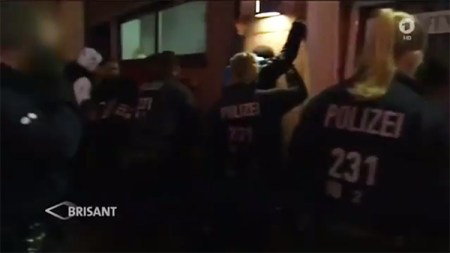
1480Police in Bremen, Germany are shown detaining four young North African criminals who have been terrorizing local shopkeepers. (Image source: ARD video screenshot)

In Hamburg, police say they are helpless to confront a spike in crimes committed by young North African migrants. Hamburg is now home to more than 1,000 so-called unaccompanied minor migrants (minderjährige unbegleitete Flüchtlinge, MUFL), most of whom live on the streets and apparently engage in all manner of criminal acts.

A confidential report, leaked to Die Welt, reveals that Hamburg police have effectively capitulated to the migrant youths, who outnumber and overwhelm them. The document states:

“Even the smallest issue can quickly lead to aggressive offensive and defensive behavior. The youths come together in groups to stand up for each other and also to fight each other…

“When dealing with others, the youths are often irreverent and show a lack of respect for local values ​​and norms. The youths congregate mainly in the downtown area, where they can be seen almost every day. During the daytime, they hang out mostly in the St. George district, but in the evenings they carry out their activities in the Binnenalster, Flora- and Sternschanzenpark and St. Pauli [all across central Hamburg]. They usually appear in groups; up to 30 youths have been observed on weekend nights in St. Pauli. The behavior of these highly delinquent youths towards police officers can be characterized as aggressive, disrespectful and condescending. They are signaling that they are indifferent to police measures…

“The youths quickly become conspicuous, mainly in the domains of pickpocketing or street robbery. They also break into homes and vehicles, but the crimes are often reported as trespassing or vandalism because the youths are just looking for a place to sleep. Shoplifting for obtaining food is commonplace. When they are arrested, they resist and assault [the police officers]. The youths have no respect for state institutions.”

The paper reports that German authorities are reluctant to deport the youths back to their countries of origin because they are minors. As a result, as more unaccompanied minors arrive in Hamburg each day, the crime problem not only persists, but continues to grow.

Meanwhile, in a bid to save the city’s tourism industry, Hamburg police have launched a crackdown on purse-snatchers. More than 20,000 purses — roughly 55 a day — are stolen in the city each year. According to Norman Großmann, the director of the federal police inspector’s office in Hamburg, 90% of the purses are stolen by males between the ages of 20 and 30 who come from North Africa or the Balkans.

In Stuttgart, police are fighting a losing battle against migrant gangs from North Africa who are dedicated to the fine art of pickpocketing.

In Dresden, migrants from Algeria, Morocco and Tunisia have effectively taken control over the iconic Wiener Platz, a large public square in front of the central train station. There they sell drugs and pickpocket passersby, usually with impunity. Police raids on the square have become a game of “whack-a-mole,” with a never-ending number of migrants replacing those who have been arrested.

German authorities have repeatedly been accused of underreporting the true scale of the crime problem in the country. For example, up to 90% of the sex crimes committed in Germany in 2014 do not appear in the official statistics, according to the head of the Association of Criminal Police (Bund Deutscher Kriminalbeamter, BDK), André Schulz. He said:

“For years the policy has been to leave the [German] population in the dark about the actual crime situation… The citizens are being played for fools. Rather than tell the truth, they [government officials] are evading responsibility and passing blame onto the citizens and the police.”

In an apparent effort to defuse escalating political tensions, Germany’s Federal Office for Migration and Refugees (Bundesamt für Migration und Flüchtlinge, BAMF) on February 16 said it was expecting only 500,000 new migrants to arrive in the country in 2016. In December 2015, however, BAMF director Frank-Jürgen Weise told Bild that “this figure [500,000] is only being used for ‘resource planning’ because at this time we cannot say how many people will come in 2016.”

On January 1, the International Monetary Fund (IMF) estimated that 1.3 million asylum seekers would enter the European Union annually during 2016 and 2017.

In a January 9 interview with Bild, Development Minister Gerd Müller warned that the biggest refugee movements to Europe are still to come. He said that only 10% of the migrants from the chaos in Iraq and Syria have reached Europe so far: “Eight to ten million migrants are still on the way.”

Adding to the uncertainty: On February 18, senior security officials from Austria, Croatia, Macedonia, Serbia and Slovenia — all countries along the so-called Balkan Route, which hundreds of thousands of migrants are using to enter the European Union — agreed to coordinate the joint transport of migrants from the Macedonia-Greece border all the way to Austria, from where they will be sent to Germany.

Russia air strikes seal Jebel Druze against attack and refugees

February 21, 2016

Russia air strikes seal Jebel Druze against attack and refugees, DEBKAfile, February 22, 2016

2717545 10/10/2015 Russian Su-25 attack aircraft take off from the Khmeimim airbase in Syria. Dmitriy Vinogradov/RIA Novosti

2717545 10/10/2015 Russian Su-25 attack aircraft take off from the Khmeimim airbase in Syria. Dmitriy Vinogradov/RIA Novosti

While Syrian war reporting focused over the weekend on the battles around Aleppo and along the Turkish border in the north, Russia since Saturday, Feb. 20 has ramped up its air bombardment of southern cities and towns, especially Daraa and Nawa. Thousands of fleeing rebels with their families and other civilians have meanwhile been turned away from the locked Jordanian border and are heading towards the Golan opposite the Israeli border.

The heaviest Russian air strikes seen hitherto in Syria have two strategic goals.

1. To retake the key southern town of Daraa from rebel hands and restore it to Syrian President Bashar Assad’s full control.

2. To crush rebel resistance in the South and force them to accept surrender, collapse or escape in the direction of the Jordanian or Israeli borders.

The intense Russian sorties are opening the door to Syrian, Iranian and Hizballah forces to move into the South and reach the Israeli borders. Prime Minister Binyamin Netanyahu sent Dr. Dore Gold to Moscow last week as his special emissary to explain how this affected Israel’s security. But he was unable to persuade the Russians to scale down their attacks in this sensitive border region.

Those attacks have a third goal, which is to encircle the Jebel Druze region with a “shield of fire” as protection for this ethnic minority of 750,000, most which inhabit mountain villages.

This unusual operation, the first of its kind in the Syrian war, has three objectives:

A. To shield the Druzes villages against ISIS attack from the east, namely Deir az-Zour.

B. To shut the door against fleeing rebels seeking sanctuary in the Druze enclave.

C. To show other Syrian minorities, especially the Kurds in the north, the great advantage of allying themselves with Moscow. Word of Russian protection of the Druzes has undoubtedly spread to Syria’s other minorities.

As for the rebels and refugees, Jordanian troops moved into the border crossings evacuated by Syrian rebels and closed the last crossing at Ramtha.

The exodus from southern Syria is now heading towards the Golan on Israel’s doorstep.

Israel has imposed a media blackout on this development. However, DEBKAfile’s sources warn that it will soon be impossible to keep it dark. Within a few days, many thousands of Syrian refugees will be massing at Israel’s Ein Zivan gate opposite Quneitra. Like Turkey and Jordan, Israel will have to supply large numbers of distressed Syrian refugees with tents, food, water and medicines.


