Archive for February 17, 2016

Russian Magazine: Russia’s Air Force In Syria Is Winning The Battle For Assad

February 17, 2016

Russian Magazine: Russia’s Air Force In Syria Is Winning The Battle For Assad, MEMRI, February 17, 2016

(Please see also, Moscow on the Tigris: Russia Joins the Terror Nexus:

While an exhausted and burned out United States wishes international migraines like the Syrian civil war would just go away, Russia is energized by the prospect of filling the vacuum and thus once again playing a major role on the world stage. Aggressively intervening on behalf of his ally in Damascus, President Bashar al-Assad, and projecting force well beyond even the frontier states in his“near abroad,” Vladimir Putin audaciously aims to change political outcomes in a region that has been out of his country’s sphere of influence for a generation.

— DM)

Recently, the Russian campaign in Syria reached its 100th day. An article in Expert Online, the website of the influential Russian analytical magazine Expert, reviews the state of the Syria war, analyzing the activities on various fronts as well as the Russian involvement. The article, by journalist Pyetr Skorobogatyj, states that, with Russia’s help, the Syrian army is advancing slowly but surely. It stresses that the operation in Syria is not a substantial financial burden for Russia, and that it benefits Russia in many ways – including by allowing it to train pilots, test the performance of various weapons, and target Russian-speaking militants who are fighting in Syria. Most significantly, it allows Russia to establish a permanent presence in the Middle East that has an impact on all the region’s countries.

The article then reviews the military situation in Syria region by region. Focusing first on the north, it stresses that the Kurdish forces there are making headway against ISIS and are laying down the foundations for what may eventually become a Kurdish autonomy or even an independent Kurdish state. The main loser, says the article, is Turkey, who is powerless to stop these developments from unfolding.

The article states further that Russia, using its S-400 missiles, has effectively set up a no-fly-zone in the north of Syria, thus enabling the regime forces to make substantial achievements against the rebels, especially in the Latakia area. It adds that the U.S., too, is planning to establish a military base in northeast Syria, in the Malikia area.

Moving to the southern region, the article states that the stalemate between the sides there – namely the regime forces and rebel groups backed by Jordan – has ended, since Jordan has ordered these forces to stop attacking Assad’s troops. In Damascus, too, the regime is slowly flushing out the rebels, street by street and building by building. As for eastern Syria, the article concedes that ISIS still maintains a strong presence there and will be difficult to defeat.

The following are excerpts from the article.[1]

 “The Air Campaign Is Not Expensive For Moscow, And It Allows Russia To Train Pilots And Test Different Types Of Weapons”

“As the Russian campaign recently reached its 100th day,[2] [Russia’s] main goal appears to be the use of military power to force peace on the ‘rational’ [i.e., non-jihadist] rebel groups. There are a number of small [rebel] groups which have either joined Assad’s military or have stayed independent but coordinate their activities with the Syrian army. [Russia’s] largest partner [apart from the Syrian army] is the Syrian Democratic Army [SDA], a Sunni popular militia which is fighting in the north [of the country] alongside the Kurds and government troops. The Russian Ministry of Defense has confirmed that Russia supports the SDA with weapons, ammunition and airstrikes. ‘For its part, the patriotic opposition [i.e. the SDA] coordinates its military objectives with the Russian aviation group,’ noted Lt. General Sergei Rudskoy, Chief of Main Operations Management in the Russian Army General Staff…

“The joint military campaign of the Russian Air Force and Syrian troops seems to be [progressing] slowly but surely. [The slow pace] is due to the broad spectrum of military goals which must be met, including pressure on all ‘factions’ in order to separate [potential] ‘partners’ from ‘enemies,’ as well as the necessity to return as much territory as possible to the Syrian government’s control, in order to enable it to negotiate from a position of strength about the country’s future. In addition, all the battle fronts seem chaotic, with many parallel ‘seething cauldrons’… and with weather conditions are getting worse… All of these factors together make Russian air operations difficult, especially during the winter period. This week the ‘bad guys’ [i.e. ISIS] used the cover of a sandstorm [which hampered Russian air activity] to mount a major offensive on Deir Al-Zor, a Syrian enclave in the desert. This action resulted in a major defeat for the Syrian side. As prevailing weather conditions worsen, the… intensity of the military campaign will decrease…

“Notwithstanding, during the first 100 days of Russian Air Force and Navy operations, 217 villages and towns were retaken, and 1000 sq. km. of territory. The Russian-Syrian coalition has no need to hurry. The air campaign is not expensive for Moscow, and it allows Russia to train pilots and to test the battle performance of different types of weapons. These benefits are in addition to the political gains and to the main goal, which is to eliminate Russian-speaking fighters in theaters far away from Russia’s borders.

“In addition, thanks to the new Russian air force base in the [the Syrian city of] Latakia, Moscow has established a permanent presence in the region, controlling a very important logistic hub. This modern military base (equipped with Iskander[3] and S-400[4] missiles)… changes the military and political situation in Iraq, Iran, Israel, the U.S… and, of course, Turkey”…”

“Russia Has Set Up A No-Fly Zone Using Its S-400 Surface-To-Air Missile System”

“[Meanwhile] the goals of the main participants in the Syrian battle have become clear. In the north of Syria… the Kurds are winning. They are finally receiving extensive military support from the U.S. and covert support from Russia. They are carrying out offensive operations against ISIS and expanding their territory, which might become a future Kurdish state or an autonomous region within Syria, depending on the final agreement… The main loser is Turkey, who is unpredictable, irresponsible and unable to keep agreements. Currently, [Turkish President Recep Tayyip] Erdogan can only look on as the Kurdish enclave continually grows stronger. [The Turkish President] can initiate military operations only on his own territory…

“The geopolitical value of northern Syria is understood by all parties. Russia has set up a no-fly zone [there] using its S-400 surface-to-air missile system… [while] Syria is strengthening its Al-Bab air base with Russian military advisors and the S-300[5] missile system. The Americans are not napping either, and plan to set up a military base in Malikia in north-east Syria… This will allow the U.S to carry out an independent policy without having to depend on the Kurdish state which is being established…

“The Syrian army, aided by Hizbullah’s brigades, is doing very well in the Latakia governorate. The map [below] clearly shows the movement of the fighting forces over the last few months. The dotted red line represents the front on October 7, 2015. In the first half of January 2016, government troops finally showed fighting ability against the Islamist stronghold of Salma… It was the first time that Russian military experts actively took part in the campaign, probably coordinating the attack on Salma. Support from Russian planes in the northern Latakia province allows the Syrian army to continue its advance at full speed…”
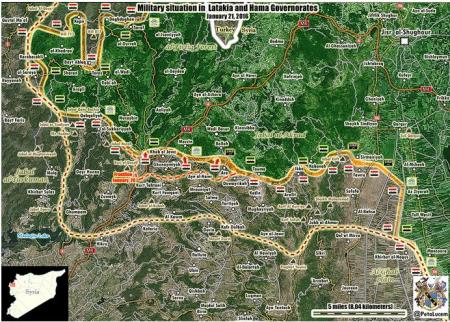
26798Military situation in Latakia and Hama areas, January 21, 2016

In The South, Jordan-Backed Rebels Have Been Ordered To Stop Attacking; In Damascus, The Government Is Flushing Out Islamists; In The East, ISIS Still Holds A Significant Area

“In the Dera province in the south, the opposing sides had [previously] agreed to maintain the status quo. Damascus was avoiding a conflict with Israel as well as with Jordan, which openly sponsored tribal forces and Islamist brigades… [Today, however,] the tactic of constant pressure [by Syrian regime troops on these forces and brigades] is producing results. The Military Operations Command [MOC] in Amman… which is coordinating rebel activities in southern Syria, has ordered [the forces it sponsors] to stop attacking [Syrian] government forces… Jordan’s logic is very simple… Syrian refugees in Jordan now total about 30% of the population, the same number as the Palestinians living in Jordan… so Jordan prefers to try to stabilize the situation in Syria rather than dream about cutting off Syria’s southern territories from the rest of the country. On the other hand, Damascus has begun to raise the issue of Israeli[-sponsored] rebels occupying the [Syrian] Golan Heights.

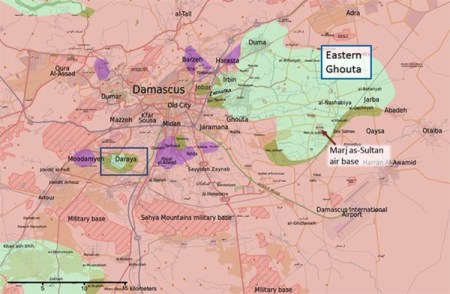
“In the Syrian capital, government troops are continuing to flush out Islamists and ‘bad guys’ from the city. The score is being kept not by counting streets retaken, but by counting buildings… The progress in the Damascus area is noticeable only when viewed over a long period of time. Below is a map showing the balance of forces in 2013, and beneath it a map showing the balance of forces in 2015.
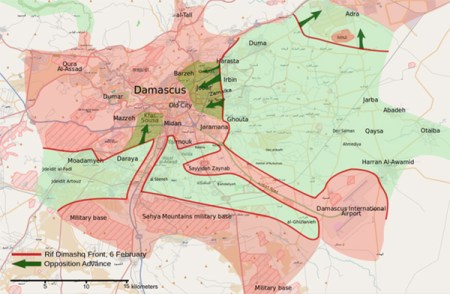
26799Damascus area in 2013
26800Damascus’ area in 2015

“In addition, peace talks between the government and some rebel groups are now underway. Just recently, an agreement was made with a rebel brigade in the Al-Qadam suburb [in Damascus]. Some militants who were disarmed were moved to Raqqa and Idlib, while almost 1,500 others agreed to switch to Assad’s side…

“In spite of the relative success of government troops, ISIS still holds a significant area in the eastern part of Syria… The [ISIS] Caliphate is well-entrenched in the area it controls, with a strong force and command structure, and is not going to withdraw easily.”


Endnotes:

[1] Expert.ru, January, 22, 2016.

[2] The Russian campaign in Syria started on September 30, 2015.

[3] A Russia-manufactured portable short-range ballistic missile system; NATO designation name: SS-26 Stone.

[4] A Russia-manufactured anti-aircraft weapons system; NATO designation name: SA-21 Growler.

[5] A Russia-manufactured long range surface-to-air missile system;  NATO designation name: SA-10 Grumble.
Radioactive Material Stolen in Iraq Raises Security Fears

February 17, 2016

Radioactive Material Stolen in Iraq Raises Security Fears

BY:
February 17, 2016 12:14 pm

Source: Radioactive Material Stolen in Iraq Raises Security Fears

By Ahmed Rasheed, Aref Mohammed and Stephen Kalin

BAGHDAD (Reuters) – Iraq is searching for “highly dangerous” radioactive material stolen last year, according to an environment ministry document and seven security, environmental and provincial officials who fear it could be used as a weapon if acquired by Islamic State.

The material, stored in a protective case the size of a laptop computer, went missing in November from a storage facility near the southern city of Basra belonging to U.S. oilfield services company Weatherford <WFT.N>, the document obtained by Reuters showed and officials confirmed.

A spokesman for Iraq’s environment ministry said he could not discuss the issue, citing national security concerns. A Weatherford spokesman in Iraq declined to comment, and the company’s Houston headquarters did not respond to repeated requests for comment.

The material, which uses gamma rays to test flaws in materials used for oil and gas pipelines in a process called industrial gamma radiography, is owned by Istanbul-based SGS Turkey, according to the document and officials.

An SGS official in Iraq declined to comment and referred Reuters to its Turkish headquarters, which did not respond to phone calls.

The document, dated Nov. 30 and addressed to the ministry’s Centre for Prevention of Radiation, describes “the theft of a highly dangerous radioactive source of Ir-192 with highly radioactive activity belonging to SGS from a depot belonging to Weatherford in the Rafidhia area of Basra province”.

A senior environment ministry official based in Basra, who declined to be named as he is not authorized to speak publicly, told Reuters the device contained up to 10 grams (0.35 ounces) of Ir-192 “capsules”, a radioactive isotope of iridium also used to treat cancer.

The material is classed as a Category 2 radioactive source by the International Atomic Energy Agency, meaning if not managed properly it could cause permanent injury to a person in close proximity to it for minutes or hours, and could be fatal to someone exposed for a period of hours to days.

How harmful exposure can be is determined by a number of factors such as the material’s strength and age, which Reuters could not immediately determine. The ministry document said it posed a risk of bodily and environmental harm as well as a national security threat.

DIRTY BOMB FEAR

Large quantities of Ir-192 have gone missing before in the United States, Britain and other countries, stoking fears among security officials that it could be used to make a dirty bomb.

A dirty bomb combines nuclear material with conventional explosives to contaminate an area with radiation, in contrast to a nuclear weapon, which uses nuclear fission to trigger a vastly more powerful blast.

“We are afraid the radioactive element will fall into the hands of Daesh,” said a senior security official with knowledge of the theft, using an Arabic acronym for Islamic State.

“They could simply attach it to explosives to make a dirty bomb,” said the official, who works at the interior ministry and spoke on condition of anonymity as he is also not authorized to speak publicly.

There was no indication the material had come into the possession of Islamic State, which seized territory in Iraq and Syria in 2014 but does not control areas near Basra.

The security official, based in Baghdad, told Reuters there were no immediate suspects for the theft. But the official said the initial investigation suggested the perpetrators had specific knowledge of the material and the facility: “No broken locks, no smashed doors and no evidence of forced entry,” he said.

An operations manager for Iraqi security firm Taiz, which was contracted to protect the facility, declined to comment, citing instructions from Iraqi security authorities.

A spokesman for Basra operations command, responsible for security in Basra province, said army, police and intelligence forces were working “day and night” to locate the material.

The army and police have responsibility for security in the country’s south, where Iranian-backed Shi’ite militias and criminal gangs also operate.

POLLUTION RISK

Iraqi forces are battling Islamic State in the country’s north and west, backed by a U.S.-led coalition. The militant group has been accused of using chemical weapons on more than one occasion over the past few years.

The closest area fully controlled by Islamic State is more than 500 km (300 miles) north of Basra in the western province of Anbar. The Sunni militants control no territory in the predominantly Shi’ite southern provinces but have claimed bomb attacks there, including one that killed 10 people in October in the district where the Weatherford facility is located.

Besides the risk of a dirty bomb, the radioactive material could cause harm simply by being left exposed in a public place for several days, said David Albright, a physicist and president of the Washington-based Institute for Science and International Security.

“If they left it in some crowded place, that would be more of the risk. If they kept it together but without shielding,” he said. “Certainly it’s not insignificant. You could cause some panic with this. They would want to get this back.”

The senior environmental official said authorities were worried that whoever stole the material would mishandle it, leading to radioactive pollution of “catastrophic proportions”.

A second senior environment ministry official, also based in Basra, said counter-radiation teams had begun inspecting oil sites, scrap yards and border crossings to locate the device after an emergency task force raised the alarm on Nov. 13.

Two Basra provincial government officials said they were directed on Nov. 25 to coordinate with local hospitals. “We instructed hospitals in Basra to be alert to any burn cases caused by radioactivity and inform security forces immediately,” said one.

(Additional reporting by Humeyra Pamuk in Istanbul; Writing by Stephen Kalin; Editing by Pravin Char)

‘Senior Official’ of Iran-Russia-Syria Alliance Brags About Subverting U.S. Diplomacy

February 17, 2016

‘Senior Official’ of Iran-Russia-Syria Alliance Brags About Subverting U.S. Diplomacy, Washington Free Beacon, Morgan Chalfant, February 17, 2016

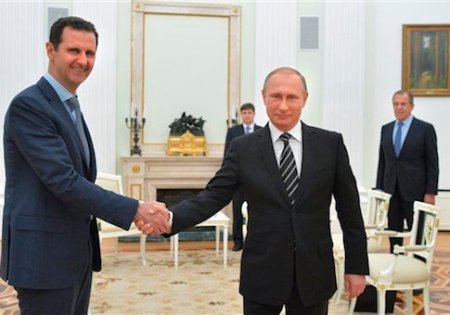
FILE - In this file photo taken on Tuesday, Oct. 20, 2015, Russian President Vladimir Putin, center, shakes hand with Syrian President Bashar Assad as Russian Foreign Minister Sergey Lavrov, right, looks on in the Kremlin in Moscow, Russia. When Russian Foreign Minister Sergey Lavrov said his country is ready to aid Syrian rebels fighting Islamic State militants on the ground, rebel commanders scoffed at the notion, pointing out that Russian aircraft were pounding rebel bases in central and northern Syria on daily basis. (Alexei Druzhinin, RIA-Novosti, Kremlin Pool Photo via AP, File)

FILE – In this file photo taken on Tuesday, Oct. 20, 2015, Russian President Vladimir Putin, center, shakes hand with Syrian President Bashar Assad as Russian Foreign Minister Sergey Lavrov, right, looks on in the Kremlin in Moscow, Russia. (Alexei Druzhinin, RIA-Novosti, Kremlin Pool Photo via AP, File)

A “senior official” of the military alliance between Iran, Russia, and Syria that is currently waging a ground offensive in Aleppo boasted about subverting U.S. diplomacy in a recent interview with an U.S. newspaper.

The official told the Wall Street Journal that military forces from Iran, Russia, and Syria would use a recent ceasefire deal brokered by world powers—including the United States—not to take steps towards a peaceful resolution of the Syrian war, but to consolidate their military gains.

The Journal reported:

“These allies are together in the same command center, working, planning and coordinating their operations in the battlefield,” said a senior official in the Iran-Russia-Syrian regime military alliance. “Retaking Aleppo will restore the regime’s strength and control over Syria; toppling the regime is now a thing of the past.” A cease-fire as proposed by world powers in Munich last week, he said, would simply be a pause for the Iran-led ground forces to consolidate recent territorial gains.

Thousands of fighters organized by Iran—including Hezbollah, the Islamic Revolutionary Guard Corps, and Shia fighters from Afghanistan, Iraq, and other countries—have launched the assault on Aleppo alongside Syrian army forces. Emboldened by Russian airstrikes, the fighters have been able to advance on Syria’s largest city.

There is some doubt regarding whether the ceasefire will be implemented at all. The deal was established by global powers on Friday, though neither Assad nor the Syrian opposition formally signed off on it. The deal was supposed to allow humanitarian aid to be sent to Syria and commence peace negotiations. The United States hoped that the ceasefire would be implemented in a week’s time.

Hours before the ceasefire was announced, Assad vowed to retake Syria in its entirety in an interview published by AFP.

Iran has put billions of dollars toward backing Assad, and Russia has launched a military intervention in Syria to back the Assad regime under the guise of fighting terrorist groups.

While the Obama administration has long said that Assad must be removed from power, the United States has softened that stance since 2011, when the Syrian civil war began. Secretary of State John Kerry said in December that the administration was not seeking a “regime change” in Syria following a meeting with Russian President Vladimir Putin.

“The United States and our partners are not seeking so-called regime change,” Kerry said then, indicating that world powers were focused on achieving a peace process in which “Syrians will be making decisions for the future of Syria.”

Both Russia and Iran have resisted any effort to oust Assad.

Palestinian Leaders: Who Are They Fooling?

February 17, 2016

Palestinian Leaders: Who Are They Fooling?

by Khaled Abu Toameh February 17, 2016 at 5:00 am

Source: Palestinian Leaders: Who Are They Fooling?

  • For Abbas and the Palestinian leadership, the death of more than 170 Palestinians and 26 Israelis in the past five months occurred in the context of a “popular and peaceful uprising.” One can only imagine what the uprising would have looked like had it not been “peaceful.”
  • Abbas assured his people that those who die defending their holy sites would go straight to heaven. “Every drop of blood that is spilled in Jerusalem is pure blood,” he stressed.
  • According to the Palestinian Authority, these youths are acting out of despair — over settlements, checkpoints and lack of progress in the peace process. The attackers are in fact targeting Jews because they have been incited and brainwashed by the same leaders who are now denouncing Israel for protecting itself.
  • Not a single senior Palestinian official has condemned the targeting of innocent civilians in this “peaceful” uprising. They are too busy glorifying the assailants and naming streets after them.
  • The blood of the Palestinians who are being shot and killed while attacking Jews is on the hands of Abbas and his senior officials.

It is a puzzle: are the leaders of the Palestinian Authority (PA) playing dumb, or do they believe their own ridiculous rhetoric?

As the current wave of stabbings, car-rammings and shooting attacks, which began in October 2015, continues and even seems to be intensifying, PA President Mahmoud Abbas and top Palestinian officials insist that we are witnessing nothing but a “popular peaceful uprising.”

Abbas said precisely this to a group of Arab Israeli journalists he invited to his office last week. Abbas voiced his full backing for the “popular and peaceful uprising.” He further explained that Palestinians were using “all peaceful means” to “resist Israeli occupation.”

For Abbas and the Palestinian leadership, the death of more than 170 Palestinians and 26 Israelis in the past five months occurred in the context of a “popular and peaceful uprising.” One can only imagine what the uprising would have looked like had it not been “peaceful.”

Interestingly, Abbas seems to consider knives and automatic weapons “peaceful” tools that Palestinians are entitled to use to “resist occupation.”

Rather than seeking to calm the situation, Abbas and company add fuel to the fire by glorifying the Palestinian assailants — many of whom are under the age of 20 — and encouraging others to join the “peaceful uprising” against Israel.

Let us get things straight. The current Palestinian leadership is incapable of placing any blame whatsoever on the Palestinians, particularly those who have wounded and killed Israelis. In their view, all fault lies with Israel alone, and the international community is duty-bound to step in and stop Israeli “crimes” against Palestinians.

Palestinian leaders have a long history of shirking responsibility for the travails of their people. In doing so, they have brought disaster to generation after generation of Palestinians.

Of course, victimhood is a broad category. The Palestinian youths who are goaded by the Palestinian Authority to murder Jews are also victims. They are victims of failed leaders who push them to their death by lying to them about Israeli and Jewish “conspiracies” against Arabs and Muslims and the Al-Aqsa Mosque.

Not a single senior Palestinian official has condemned the targeting of innocent civilians in this “peaceful” uprising, even when the victim is a 38-year-old mother and nurse. They are too busy glorifying the assailants and naming streets and squares after them.

Palestinian leaders are not denouncing such cases of murder for two reasons.

The leaders themselves are responsible for the massive campaign of anti-Israel incitement that preceded the current wave of attacks. This campaign intensified in the past two years as Abbas and top Palestinian officials began telling Palestinians that Jews were “defiling the Aqsa Mosque with their filthy feet.” Several days before the attacks began, Abbas assured his people that those who die defending their holy sites would go straight to heaven. “Every drop of blood spilled in Jerusalem is pure blood,” he stressed.

Abbas and his henchmen have succeeded: Palestinian minors are going out and “stopping” Jews from desecrating the Al-Aqsa Mosque and thwarting their “scheme” to destroy Islamic holy sites. So the PA and its president have upped the ante, claiming that now Israel is supposedly carrying out “extrajudicial executions” by shooting Palestinians who are in the process of trying to commit murder with knives and automatic rifles — the very Palestinians brainwashed by Palestinian leaders and media outlets.

And so, we come to two unpleasant truths: (1) PA leaders would be hard-pressed to denounce acts of terrorism against Israel when they incited that very violence; and (2) the current wave of anti-Israel attacks provides Abbas and other Palestinian leaders with ammunition to delegitimize Israel and dehumanize Jews in the international arena.

Palestinian leaders are twisting reality to rally the world against Israel and to advance their own political goals. Since the beginning of this round of attacks, Abbas and several senior officials in Ramallah have called for international intervention to stop Israeli “aggression” against the Palestinians. In their view, the shooting of a knife-wielding minor is an act of “aggression” and a “war crime” which requires immediate international intervention.

The Palestinian leadership is now seeking to leverage the violence to call for an international peace conference, toward receiving international “protection” for the Palestinians. Abbas hopes that such a conference would yield an overall solution imposed upon Israel. The Palestinian Authority president is convinced that world pressure on Israel will get him more than a negotiated settlement. That is why he does not want to return to the negotiating table with Israel.

Thus, there is a method here: For five full months, the official Palestinian stance has been that Israel initiated this violence and that Israelis are “deliberately targeting Palestinian children.” The Palestinian Authority leadership argues that only the UN can save those children, by sending troops to the Palestinian territories.

What pass have we come to. Thanks to the poison with which the Palestinian Authority has indoctrinated its people, Palestinians are now unable to condemn the murder of any Jew or even call among themselves to keep their teenagers from becoming deadly attackers. The Palestinian leaders have made it impossible even to talk about peace with Israel. Such is their journey to a healthy and prosperous society and state.

According to the Palestinian Authority, these youths are acting out of despair — with settlements, checkpoints and lack of progress in the peace process. Leaving the dream-world of Abbasland, however, we are privy to a different reality. The attackers are in fact targeting Jews because they have been incited and brainwashed by the same leaders who are now denouncing Israel for protecting itself. It is precisely Palestinian and other Arab television stations, imams and other leaders spurring the youth to take on their deadly missions.

Despite the old saying that you can fool some of the people some of the time but not all of the people all of the time, Abbas and company are doing pretty well fooling many people much of the time. Once again, Palestinians have fallen victim to the lies of their leaders, who encourage them to seek martyrdom and engage in acts of violence instead of building good lives for themselves and their communities. The blood of the Palestinians who are being shot and killed while attacking Jews is on the hands of Abbas and his senior officials. They can be found in Ramallah, thinking up ways to fool more of the people more of the time.

Khaled Abu Toameh, an award-winning journalist, is based in Jerusalem.

  • Follow Khaled Abu Toameh on Twitter


Turkey wants secure line made 10 km within Syria, including Azaz, Deputy PM says

February 17, 2016

Turkey wants secure line made 10 km within Syria, including Azaz, Deputy PM says

DAILY SABAH WITH REUTERS

Source: Turkey wants secure line made 10 km within Syria, including Azaz, Deputy PM says – Daily Sabah

Displaced Syrians fleeing areas in the northern embattled province of Aleppo, walk past tents at the Bab al-Salama camp, set up outside the Syrian city of Azaz on Syrias northern border with Turkey  (AFP Photo)
Displaced Syrians fleeing areas in the northern embattled province of Aleppo, walk past tents at the Bab al-Salama camp, set up outside the Syrian city of Azaz on Syria’s northern border with Turkey (AFP Photo)

Turkey wants a secure strip of territory 10 km (6.2 miles) deep on the Syrian side of its border, including the town of Azaz, to prevent attempts to “change the demographic structure” of the area and for humanitarian purposes, Deputy Prime Minister Yalçın Akdoğan said on Wednesday.

Assad forces backed by Russian air strikes have advanced towards the Turkish border in a major offensive in recent weeks. YPG fighters, regarded by Ankara as terrorists, have taken advantage of the violence to seize territory from Syrian rebels.

Turkey has accused the YPG of pursuing “demographic change” in northern Syria by forcibly displacing Turkmen and Arab communities.

“There is a game being played with the aim of changing the demographic structure. Turkey should not be part of this game,” Akdoğan said in an interview on the AHaber television station.

“What we want is to create a secure strip, including Azaz, 10 km deep inside Syria and this zone should be free from clashes,” he said.

Azaz is the last rebel stronghold before the border with Turkey north of the Syrian city of Aleppo, part of what was, before the Assad offensive, a supply route from Turkey to the rebels fighting Assad.

It has come under heavy assault in recent days, but Turkey has said it will not let the town fall into the hands of the Kurdish YPG militia.

German Chancellor Angela Merkel had also said that she supports Ankara’s proposal for a no-fly zone in northern Syria.

Ankara has been requesting that the U.N. establish “safe zones” in Syria since 2012 but could not find the necessary international support.

Turkey, home to more than 2.6 million Syrian refugees, has long pushed for the creation of a safe zone in northern Syria to protect displaced civilians, avoiding the need to bring them into Turkey.

But the proposal has so far gained little traction with Washington or NATO allies who fear it would require an internationally patrolled no-fly zone which could put them in direct confrontation with Assad and his allies.

Akdoğan said another 600,000 people could flee to the Turkish border if Aleppo falls to the Syrian army.

China Puts Advanced Missiles on Disputed Southeast Asian Island

February 17, 2016

China Puts Advanced Missiles on Disputed Southeast Asian Island Obama: U.S. military will sail, fly freely in South China Sea

BY:
February 17, 2016 5:00 am

Source: China Puts Advanced Missiles on Disputed Southeast Asian Island

President Obama defended U.S. naval and aircraft operations near disputed South China Sea islands claimed by China on Tuesday as new intelligence revealed Beijing recently placed advanced air defense missiles in the Paracels.

“Freedom of navigation must be upheld,” Obama said, adding “the United States will continue to fly, sail, and operate wherever international law allows, and we will support the right of all countries to do the same.”

The remarks followed a meeting of the Association of Southeast Asian Nations, known as ASEAN, in Sunnylands, Calif. Obama and leaders from 10 ASEAN nations agreed to defend the sea from Chinese encroachment.

“We discussed the need for tangible steps in the South China Sea to lower tensions, including a halt to further reclamation, new construction, and militarization of disputed areas,” Obama said.

The president said the United States would continue to help regional states bolster maritime capabilities and resolve disputes peacefully and legally.

Obama said “the United States will continue to stand with those across Southeast Asia who are working to advance rule of law, good governance, accountable institutions, and the universal human rights of all people.”

At the Pentagon, defense officials said recent intelligence revealed that China deployed advanced HQ-9 surface-to-air missiles on Woody Island, in the Paracel island chain in the northwestern part of the sea.

The missile deployment was detected in the past several days, said officials familiar with reports of the deployment.

The buildup of air defense missiles highlights what defense officials said is China’s continuing militarization of disputed islands in the sea.

China has demanded a halt to all U.S. warship transits through the sea, and aerial reconnaissance flights over it.

The HQ-9 is an advanced anti-aircraft system that can also shoot down short-range missiles.

The missiles are likely to heighten tensions as they could be used against U.S. reconnaissance aircraft that frequently fly over the sea.

Retired Navy Capt. Jim Fanell, a former Pacific Fleet intelligence chief, said the HQ-9 is a formidable air defense missile that can cover 125 miles.

“We should not be surprised in the least about this turn of events, as it is in keeping with the strategic trend line of China’s ‘maritime sovereignty campaign’ that has been in place since 2010,” Fanell told the Washington Free Beacon.

China’s Navy chief, Adm. Wu Shengli, announced last month that that China would determine when and how to justify the militarization of new islands. The missiles on Woody appear to be a first step, Fanell said.

“The question now remains whether or not the U.S., Japan, Australia, and the representatives of ASEAN will continue to accede to Beijing’s bullying or will they band together in a ‘unified front’ and begin conducting joint patrols within China’s unofficially asserted territorial seas,” he said. “The time to act is fleeting, each hour, each day of delay will render the situation more dangerous or untenable.”

Rick Fisher, a China military affairs analyst, said the advanced missile deployment is a major military escalation by China in the South China Sea.

“China’s deployment of up to 64 HQ-9 surface-to-air missiles to Woody Island just before the ASEAN summit in California constitutes a major slap against ASEAN and the Obama administration,” said Fisher, who is associated with the International Assessment and Strategy Center.

“It should now be clear that Obama administration diplomacy and freedom of navigation operations are useless in stopping China from militarizing its islands in the Paracel and Spratly island groups,” he said.

China’s military has said the recent passage of a warship near Triton Island in the Parcels could trigger a further military buildup.

Fisher said China could supplement the HQ-9s with long-range YJ-62 anti-ship cruise missiles or DF-21D anti-ship ballistic missiles, which have a range of 870 miles.   

“Nobody is suggesting that the U.S. attack China’s dangerous island bases, but the administration can deploy sufficient counterforce to deter China from using its bases,” Fisher said.

China deployed J-11 jet fighters to Woody Island  last October.

Two months later a U.S. B-52 bomber overflew the disputed Spratly Islands, drawing a sharp rebuke from China’s government.

The commander of the U.S. Pacific Command, Adm. Harry Harris, has rejected China’s expansive South China Sea claims. Harris said in a recent speech that the South China Sea is “no more China’s than the Gulf of Mexico is Mexico’s.”

The Pentagon has said some $5.3 trillion in international trade passes through the sea each year.

China is claiming some 90 percent of the South China Sea as its maritime domain, and has built up some 3,200 acres of new islands where military facilities, including deepwater ports and airfields, are being built.

Woody Island, called Yongxing Island by China, is located about 100 miles southeast of Triton Island, where the guided-missile destroyer USS Curtis Wilbur made a close-in passage on Jan. 30. The Pentagon said the transit was designed to demonstrate freedom of navigation to three claimants to the island, China, Vietnam, and Taiwan.

China has denied it is militarizing the sea and has criticized the United States for what it says are provocative freedom of navigation operations. In addition to the Curtis, the USS Lassen passed within 12 miles of Subi Reef in the Spratlys last October.

The HQ-9 deployment was first reported by Foxnews.com on Tuesday.

The missiles were revealed on commercial satellite imagery along a beach on Woody Island. The missiles were sent there between Feb. 3 and Feb. 14.

During a summit meeting between Obama and Chinese President Xi Jinping, the Beijing leader promised not to militarize newly-created South China Sea islands.

It is not clear if the September commitment included Woody Island, about 1 square mile in size that has had a military garrison since 2012.

The Communist Party-affiliated newspaper Global Times published a commentary Saturday criticizing U.S. military operations in the South China Sea as a serious political and military provocation.

“On the surface, Washington calls for international laws and norms, such as freedom of navigation, to be the guiding principle in the South China Sea,” wrote Zhang Tengjun, a research fellow at the China Institute of International Studies in Beijing.

“In fact, it tries to hype up China’s ‘threat’ to regional security and ASEAN’s interests so more ASEAN members will join a US-led front to counter China.”

‘Operation Sophia’: WikiLeaks releases classified data on EU military op against refugee flows

February 17, 2016

‘Operation Sophia’: WikiLeaks releases classified data on EU military op against refugee flows

Published time: 17 Feb, 2016 12:07 Edited time: 17 Feb, 2016 13:17

Source: ‘Operation Sophia’: WikiLeaks releases classified data on EU military op against refugee flows — RT News


© Reuters
WikiLeaks has released a classified report detailing the EU’s military operations against refugee flows in Europe. It also outlines a plan to develop a “reliable” government in Libya which will, in turn, allow EU operations to expand in the area.

The leaked report, dated January 29, 2016, is written by the operation’s commander, Rear Admiral Enrico Credendino of the Italian Navy, for the European Union Military Committee and the Political and Security Committee of the EU.

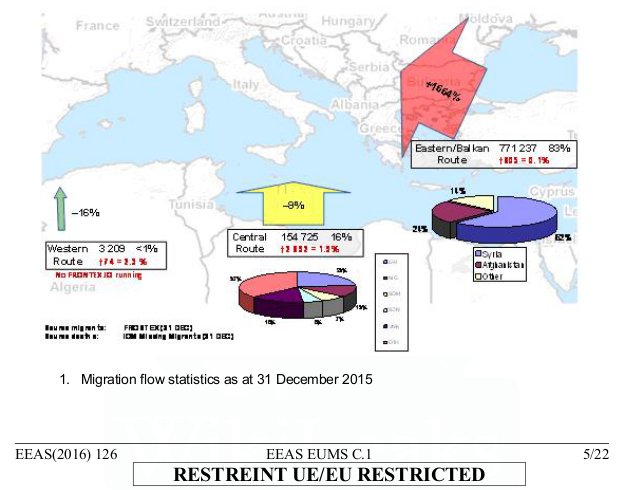
The document gives refugee flow statistics and details of performed and planned operation phases of the joint EU forces operating in the Mediterranean.

RELEASE: Operation Sophia – classified report on EU military ops against flows https://wikileaks.org/eu-military-refugees/ 

The report also places pressure on the responsible EU bodies to help speed up the process of forming a “reliable” government in Libya, which is expected to invite EU forces to operate within its territorial waters, and later give permission to extend EU military operations onshore.

“Through the capability and capacity building of the Libyan Navy and Coastguard we will be able to give the Libyan authorities something in exchange for their cooperation in tackling the irregular migration issue. This collaboration could represent one of the elements of the EU comprehensive approach to help secure their invitation to operate inside their territory during Phase 2 activities,” the document states.

Admiral Credendino writes that the task force is ready to proceed to phase 2B despite political and legal challenges:

“…We are ready to move to phase 2B (Territorial Waters) where we can make a more significant impact on the smuggler and traffickers business model.”

“However, in order to move into the following phases we need to have a government of national accord with which to engage.”

“A suitable legal finish is absolutely fundamental to the transition to phase 2B (Territorial Waters) as without this, we cannot be effective.”

“Central to this and to the whole transition to phase 2B, is an agreement with the Libyan authorities. Ultimately they have the casting vote on the legal finish which will in turn drive the transition to phase 2B and the appetite for Member States to provide assets. As a European Union, we must therefore apply diplomatic pressure appropriately to deliver the correct outcome,” the document states.

Read more

British Royal Navy ship HMS Bulwark © Darrin Zammit Lupi

The leak comes less than five months after it was reported that Operation Sophia would consist of 22 member states and 1,300 personnel which would board and seize suspect vessels in the Mediterranean.

However, the document notes that when the operation progresses into phases 2B and 3, “the smugglers will again most likely adapt quickly to the changing situation. The primary concern for smugglers will likely remain to avoid being apprehended so they can continue their illegal activities.”

The operation’s objective is primarily to disrupt smuggling routes by human traffickers, rather than to stop migration flows, according to the European Union Institute for Security Studies, which wrote in a document that the operation began on July 27, 2015.

The Institute noted, however, that there is a “real uncertainty on whether the operation will ever be able – for either legal or political reasons – to get to the core of its mandate, i.e. neutralising the smuggling networks through deterrence or open coercion, both off the Libyan coast and onshore.”

It went on to note that regardless of the operation’s support for EU member states, only “a very few” are likely to “have the skills and experience for such missions, let alone the will.”

It also stressed that the operation cannot be a “solution” to the refugee crisis, and that “no one in Brussels is contending that it could.”

The document’s release comes as Europe continues to face the worst refugee crisis since World War II, with the numbers of new arrivals expected to grow this year.

Special Israeli emissary to Moscow over Russian Syria air strikes near border

February 17, 2016

Special Israeli emissary to Moscow over Russian Syria air strikes near border, DEBKAfile, February 17, 2016

Israel_near_border_16.2.16

In view of the crisis building up on the southern Syrian-Israeli border, Prime Minister Binyamin Netanyahu decided immediately on his return home from Berlin early Wednesday, Feb. 17, to send a special  emissary to Moscow to ask for clarifications. Tuesday, Intensified Russian air strikes came to within 6 km of the Israeli border, sparking a growing exodus of Syrian refugees heading towards the Qoneitra border crossing to Israel.

DEBKAfile’s sources reveal that the envoy is Dr. Dore Gold, director-general of the Foreign Ministry and one of the prime minister’s few trusted confidantes.

It was still not clear whom Gold will meet in the Russian capital, but it is assumed that it will be one of Moscow’s senior decision-makers in the loop on its military operation in Syria.

The fact that Netanyahu decided to dispatch a top diplomat rather than a senior military or intelligence officer is a sign that the prime minister is not of one mind with the IDF’s intelligence assessments of the situation on the ground.

Netanyahu’s concerns grew after after the Russian air force on Tuesday widened its massive bombing of southern Syria from the city of Daraa to the Golan town of Quneitra, in order to help the Syria army’s 7th armored division push the rebels east, so they will not attempt to cross the border and seek shelter in Israel.

DEBKAfile’s military sources report that that 12 of the 15 targets bombed by the Russian air force across from the Israeli border were new rebel positions that had not been attacked before, even by the Syrian army. Military sources monitoring the war said Tuesday night that there is no doubt that the Russians are in the process of wiping out the rebel positions along the Israeli border by means of an offensive comparable to their operations in the northern Aleppo sector.

Our sources report that Israel’s concerns grew when, as the Russians bombing raids neared the Israeli border, Syrian officials threatened Jordan with serious consequences if Amman gave the Saudi air force a base for attacking eastern or southern Syria.

The threats began Tuesday, after Jordanian forces took over the Syrian-Jordanian border crossings formerly held by Syrian rebels, as a measure to stem the volume of Syrian refugees in search of sanctuary in the Hashemite Kingdom. But this step was interpreted by the Syrians and their Russian ally as clearing the way for Saudi intervention in the Syrian conflict using Jordan as a jumping-off base.

Meanwhile, Western military sources reported a sub substantial presence Tuesday of both Russian and Israeli warplanes in the skies over and around southern Syria.

Exclusive: Whistleblowers Warned Top Spy About Skewed ISIS Intel

February 17, 2016

Exclusive: Whistleblowers Warned Top Spy About Skewed ISIS Intel It wasn’t just the generals who were warned that ISIS intelligence assessments were overly rosy. The office of the director of national intelligence knew, too.

Source: Exclusive: Whistleblowers Warned Top Spy About Skewed ISIS Intel – The Daily Beast

U.S. military analysts told the nation’s top intelligence official that their reports on ISIS were skewed and manipulated by their bosses, The Daily Beast has learned. The result: an overly optimistic account of the campaign against the terror group.

The complaints, lodged by analysts at U.S. Central Command in 2015, are separate from allegations that analysts made to the Defense Department inspector general, who is now investigating “whether there was any falsification, distortion, delay, suppression, or improper modification of intelligence information” by the senior officials that run CENTCOM’s intelligence group.

This second set of accusations, which have not been previously reported, were made to the Office of the Director of National Intelligence (ODNI). They show that the officials charged with overseeing all U.S. intelligence activities were aware, through their own channels, of potential problems with the integrity of information on ISIS, some of which made its way to President Obama.

The analysts have said that they believe their reports were altered for political reasons, namely to adhere to Obama administration officials’ public statements that the U.S.-led campaign against ISIS is making progress and has put a dent in the group’s financing and operations.

Administration officials have denied that the intelligence reports came under political pressure. But Republican lawmakers and presidential candidates have questioned whether the public is being given an honest account of what effect hundreds of U.S. airstrikes have had on ISIS. The allegations of skewed intelligence have come up in several congressional hearings and figured in an early Republican presidential debate.

The analysts made their claims to the ODNI in response to written surveys that were sent out by its Analytic Integrity and Standards Group last year, as part of a “periodic assessment” to take the pulse of the intelligence community, according to U.S. officials.

Director of National Intelligence James Clapper was asked about the defense inspector general investigation in September during a congressional oversight hearing. At the time, he gave no indication that his own office was aware through its own channels of the analysts’ accusations.

“It is an almost sacred writ… in the intelligence profession never to politicize intelligence. I don’t engage in it. I never have and I don’t condone it when it’s identified,” Clapper told the Senate Armed Services Committee.

But Clapper sought to downplay what he called “media hyperbole” about the substance of the analysts’ complaints. “I think it’s best that we all await the outcome of the DOD I.G. investigation to determine whether and to what extent there was any politicization of intelligence at CENTCOM,” Clapper said.

A spokesperson for the defense inspector general declined to comment for this story.

In the survey from the ODNI, the analysts accused their superiors of editing or rejecting reports that cast doubt on whether the U.S.-led campaign against ISIS was dealing a crippling blow, and they accused senior CENTCOM intelligence officials of attempting to delete emails and other reports that provided evidence of their manipulations, according to a source familiar with the survey who spoke on condition of anonymity.

CENTCOM said no emails were deleted.

“It is important to allow the DoD IG investigation to run its course. However, I can tell you that neither Maj. Gen. Grove nor Mr Ryckman deleted any e-mails associated with the investigation. In fact, as a matter of CENTCOM policy, all senior leader e-mails are kept in storage for record keeping purposes. CENTCOM continues to cooperate fully with the DOD IG investigation,” Air Force Col. Patrick Ryder said in a statement to the Daily Beast.

It’s not clear when the survey responses were reviewed by ODNI officials, but they were included in a report that was finished by December 2015.

The ODNI chose not to investigate the claims of impropriety on its own because the Defense Department’s inspector general had already launched an investigation, sources familiar with the matter told The Daily Beast. That investigation, which hasn’t been completed, began after more than 50 CENTCOM analysts filed complaints with the Pentagon watchdog in July 2015.

U.S. Central Command, based in Tampa, Florida, is responsible for U.S. military operations across the Middle East, from Egypt to Afghanistan. There are more than 1,000 analysts assigned to assessing intelligence and other data on the security situation of the region. They include troops and civilian intelligence analysts who work for the nation’s various intelligence agencies.

The ODNI oversees all intelligence agencies, military and civilian, and is ultimately responsible for ensuring that intelligence reports are free from political influence and bias and that they’re based on sound, verifiable sources of information.

The ODNI standards group was set up by law following the botched intelligence community analysis of Iraq’s weapons of mass destruction program in 2002 (PDF), which suppressed dissenting views that doubted Saddam Hussein had a viable chemical weapons program. That report, which has been effectively disavowed, was seized upon by senior Bush administration officials to make a public case for invading the country.

The standards group “conducts regular periodic assessments of finished analytic products” and reviews them “for timeliness, objectivity and independence from political considerations, and ensures that the products are based upon all sources of available intelligence and employ the standards of proper analytic tradecraft,” Timothy Barrett, a spokesperson for the ODNI, told The Daily Beast in a written statement. “Intelligence analysis from CENTCOM was reviewed by [the group] in 2015 as a part of the periodic assessment, and the information is available to Congress and the [Defense Department inspector general],” Barrett said.

It wasn’t clear whether the congressional committees that oversee intelligence activities had seen the comments from CENTCOM analysts. According to one source familiar with the document, it has been classified at the “secret” level and cannot be widely shared with lawmakers beyond the two intelligence committees.

A task force composed of staff from three House committees—on intelligence, armed services, and appropriations—is investigating the analysts’ allegations and whether they reflect any systemic problems with intelligence analysis.

It remains unclear whether the analysts’ complaints to the ODNI led to any corrective actions or halted what they saw as an inappropriate practice of selectively altering reports. Three sources who are familiar with the defense inspector general’s investigation told The Daily Beast that the watchdog had conducted interviews with analysts at CENTCOM’s headquarters in Tampa, and had reviewed documents allegedly showing that senior officials, including Maj. Gen. Steven Grove, the command’s intelligence director, and his civilian deputy, Gregory Ryckman, had deleted emails and files from computer systems before the inspector general could examine them.

“The cancer was within the senior level of the intelligence command,” one defense official told The Daily Beast. The pushback by the analysts has been described as a “revolt.”

One person who knows the contents of the written complaint they sent to the defense inspector general said it used the word “Stalinist” to describe the tone set by officials overseeing CENTCOM’s analysis.

Two officials at CENTCOM told The Daily Beast they were not aware of the ODNI’s efforts or the survey that analysts had completed. They said the biggest changes to intelligence practices came in the days after analysts filed their complaint with the inspector general. Army Gen. Lloyd Austin, the commander of CENTCOM, urged analysts to speak up if they felt their assessments were being altered.

In the wake of the allegations of politicizing intelligence, some of the people who receive CENTCOM reports told The Daily Beast that they read them more skeptically.

But the reliability of CENTCOM’s analysis has only become more important since the accusations first emerged. In Afghanistan, the Taliban is resurgent and both ISIS and al Qaeda are trying to expand their footprint. In Iraq, U.S. and Iraqi forces pushed ISIS out of Ramadi, raising hopes that the two nations could launch a similar campaign in Iraq’s second-biggest city, Mosul, which serves as ISIS’s Iraqi capital.

In Yemen, ISIS is weaker but al Qaeda is stronger. And in Syria, Russian strikes are helping forces loyal to Syrian President Bashar al-Assad reclaim territory in the city of Aleppo. Should that city fall squarely to the regime, Syria would devolve into a war largely between the regime and ISIS, leaving the Western world with no good outcomes for the fate of that state.

Were that to happen, unvarnished analysis on ISIS and the state of the war would be more important than ever.

UNSC urges Turkey to ‘comply with intl law’ in Syria after Russia requests meeting

February 17, 2016

UNSC urges Turkey to ‘comply with intl law’ in Syria after Russia requests meeting

Published time: 16 Feb, 2016 21:01 Edited time: 16 Feb, 2016 22:30

Source: UNSC urges Turkey to ‘comply with intl law’ in Syria after Russia requests meeting — RT News

Following a briefing requested by Russia, the UN Security Council has urged Ankara to comply with international law in Syria. The closed-door meeting was called to discuss recent Turkish shelling of Kurdish YPG militia targets in Syria’s north.

READ MORE: Turkey shells Kurdish forces in Syria for 4th successive day

“UN Security Council members are concerned with the Turkish attacks on a number of Syrian regions,” Venezuelan Ambassador Rafael Ramirez, who now chairs the UNSC, said after the meeting, as cited by TASS.

The UN Security Council received a letter from the Syrian government in which Damascus condemned Turkey’s attacks in the north of Syria, Ramirez explained, noting that the entire council expressed “concern” about these violations.

“All members of the Security Council … agreed to ask for Turkey to comply with international law,” he added.

The UNSC also reiterated its commitment to the Munich agreement, expecting that all parties involved in the discussions will work toward a ceasefire to “allow humanitarian access for every place in the Syrian territory.”

Read more

© Abdalrhman Ismail

When asked if the UNSC discussed the shelling of the hospitals and schools in Northern Syria on Monday which left close to 50 people dead, Ramirez said the Council indeed discussed the issue, but reached “no agreement” or “consensus” because of “different sources” of information on the incidents.

“Everybody is concerned about air strikes over humanitarian installations,” said Ramirez, stressing that the UNSC is trying to get “more information.”

The UNSC president highlighted the need to have Kurds represented in the Syrian peace process, and for Ankara not to escalate the situation even further.

“One of the issues expressed by some countries, including Venezuela, is that the Kurdish people have to be included in the discussion. Now that is the principle concern of Turkey,” Ramirez said during the briefing.

“Something that is important – the Kurds are fighting against the terrorist groups on the ground and this is an important factor for everybody,” Ramirez emphasized.

Turkish artillery units have been shelling targets in Syria for the fourth day in a row, as Ankara maintains its commitment to stopping the Kurdish Democratic Union Party (PYD) from claiming more territory in the north of the country. According to the Russian Ministry of Defense, both government and opposition-held towns over the border from Turkey have fallen under Ankara’s shelling.

While the Kurdish forces remain one of Washington’s main allies on the ground in Syria, Turkey being a NATO member is also a key partner in the US-led anti-ISIS coalition. The US State Department on Tuesday urged all sides to avoid escalation of tensions on the Syria-Turkey border.

“I am aware of the reports… that they [Turkish forces] have struck the YPG affiliated forces,” State Department spokesperson Mark Toner said. “We have urged the YPG to avoid moves that will heighten tensions with Turkey. But at the same time we have also urged Turkey to cease any artillery… its artillery fire across the border.”