Archive for February 15, 2016

Ya’alon: Arabs are developing nuclear weapons

February 15, 2016

Ya’alon: Arabs are developing nuclear weapons Iran deal igniting a Mideast nuclear arms race, warns Defense Minister, saying Arab countries are now pursuing atomic weapons.

By David Rosenberg

First Publish: 2/15/2016, 10:21 PM

Source: Ya’alon: Arabs are developing nuclear weapons – Defense/Security – News – Arutz Sheva

Last year’s controversial Iran nuclear deal has sparked an atomic arms race, claimed Israeli Defense Minister Moshe Ya’alon following a meeting with Jordan’s King Abdullah.

Ya’alon revealed that Israel had indications suggesting that certain Arab countries were now actively pursuing nuclear weapons, reports the Telegraph. The Defense Minister declined to specify which countries or how Israel had ascertained they were working to create their own atomic arsenals.

The Sunni Arab world has long feared the specter of a nuclear capable Iran, and now that the Iran deal effectively permits the Islamic Republic to resume its atomic program with no limits after 15 years, many of Iran’s Arab opponents have been left scrambling for an alternative to contain Iran’s expanding influence across the Middle East.

In Yemen, Iranian-backed Houthi rebel victories have forced Saudi Arabia to directly intervene in support of the Sunni government.  Meanwhile, the fight against Islamic State (ISIS) has brought Iran into close alignment with Russia, and given Iran greater influence than ever in Lebanon and Syria.

With Iran expanding its control far beyond its borders, many in the Arab world fear the implications of an Iran emboldened by a nuclear arsenal.

Ya’alon emphasized the dread felt in the Sunni Arab world, but also the resolve not to be left behind in the emerging arms race. “We see signs that countries in the Arab world are preparing to acquire nuclear weapons, that they are not willing to sit quietly with Iran on the brink of a nuclear or atomic bomb.”

“Autocracy” Vs. “Democracy”: Stunning Before And After Pictures Of Syria’s Largest City

February 15, 2016

Autocracy” Vs. “Democracy”: Stunning Before And After Pictures Of Syria’s Largest City Tyler Durden’s picture Submitted

by Tyler Durden on 02/14/2016 22:44 -0500

Source: “Autocracy” Vs. “Democracy”: Stunning Before And After Pictures Of Syria’s Largest City | Zero Hedge

As we documented last autumn in “Syria Showdown: Russia, Iran Rally Forces, US Rearms Rebels As ‘Promised’ Battle For Aleppo Begins,” Syria’s largest city has been among the hardest hit of the country’s urban centers over the course of the last five years.

Newsweek documented the destruction in a series of stark and profoundly indelible images in 2012, perhaps the most striking of which was this:

Recapturing the city is critical to restoring Bashar al-Assad’s grip on power.

If Aleppo is liberated, the rebellion will be all but crushed. The Alawite government would once again control the country’s urban backbone in the west and, more importantly from a big picture perspective, Iran would have scored a major victory in the effort to preserve the Shiite crescent not to mention its supply lines to Hezbollah.

Likewise, a victory at Aleppo would invalidate US claims that Vladimir Putin was destined to get Moscow into a “quagmire” in Syria and the Russians would score a major geopolitical coup by effectively replacing the US as Mid-East superpower puppet master.

As for the Gulf monarchies, the demise of the Sunni insurgency in Syria would be a bitter blow. The effort to roll back Iranian influence would be forever remembered as an abject failure and Tehran would score sectarian bragging rights over Riyadh just as international sanctions are lifted and Iran ramps up crude production.

So important is the battle for the city that Quds commander Qassem Soleimani himself supervised the initial stages of the push north from Latakia before disappearing into thin air in November only to resurface two days ago at a rally celebrating the Islamic Revolution.

Now that the eyes of the world are on Aleppo which may well go down in history as the site where World War III began, we thought it an opportune time to bring you the following before and after images which depict what life was like in the city under the “brutal dictatorship” of Bashar al-Assad and what life is like now that the US has exported democracy to Syria.

Autocracy:

Democracy:

“Yes we can”… destroy the entire Middle East…

Turkey vows ‘harsh reaction’ if Kurds try to take Syrian town

February 15, 2016

Turkey vows ‘harsh reaction’ if Kurds try to take Syrian town

February 15, 2016, Monday/ 12:05:44/ REUTERS | KIEV | ISTANBUL

Source: Turkey vows ‘harsh reaction’ if Kurds try to take Syrian town

Turkey vows ‘harsh reaction’ if Kurds try to take Syrian town

Prime Minister Ahmet Davutoğlu speaks to reporters on his plane en route to Ukraine on Monday. (Photo: DHA)

Turkey will not allow the northern Syrian town of Azaz to fall into the hands of Kurdish People’s Protection Units (YPG) and its fighters will face the “harshest reaction” if they approach it again, Prime Minister Ahmet Davutoğlu said on Monday.

A major offensive supported by Russian bombing and Iranian-backed Shiite militias has brought the Syrian army to within 25 km (15 miles) of the Turkish border. The YPG has exploited the situation, seizing ground from Syrian rebels to extend its presence along the Turkish border.

Turkey is infuriated by the expansion of Kurdish influence in northern Syria, fearing it will encourage separatist ambitions among its own Kurds. The YPG, which Ankara considers to be a terrorist group, controls nearly all of Syria’s frontier with Turkey.

Speaking to reporters on his plane en route to Ukraine, Davutoğlu said YPG fighters would have taken control of rebel-held Azaz and the town of Tal Rifaat further south had it not been for Turkish artillery firing at them over the weekend.

“YPG elements were forced away from around Azaz. If they approach again they will see the harshest reaction. We will not allow Azaz to fall,” Davutoğlu said.

He said Turkey would make the Menagh air base north of the city of Aleppo “unusable” if the YPG, which seized it over the weekend from Syrian insurgents, did not withdraw. He warned the YPG not to move east of the Afrin region or west of the Euphrates River, long a “red line” for Ankara.

Azaz came under heavy fire again on Monday. At least 14 civilians were killed when missiles hit a children’s hospital, a school and other locations, a medic and two residents said.

Syria’s rebels, some backed by the United States, Turkey and their allies, say the YPG is fighting with the Syrian military against them in the five-year-old civil war. The YPG denies this.

Ankara views the YPG as an extension of the terrorist Kurdistan Workers Party (PKK). Washington, which does not see the YPG as terrorists, supports the group in the fight against Islamic State of Iraq and the Levant (ISIL) in Syria.

NATO member Turkey is now at risk of being dragged ever deeper into the Syrian conflict. Turkish financial markets including the lira currency were weaker on Monday on fears about the situation.

19 killed in Russian bombing of medical facility

February 15, 2016

19 killed in Russian bombing of medical facilities in Syria Despite the international calls to stick to the understandings reached in Munich over the weekend, the fighting in Syria along the Turkish border has worsened. It was reported that two hospitals were bombed by the Russians.

Feb 15, 2016, 2:18PM Rachel Avraham

Source: 19 killed in Russian bombing of medical facility | JerusalemOnline.com

At least 19 Syrians were killed today in two Russian bombings in the framework of the fighting in Syria. In one of the incidents that took place near the Turkish border, 7 Russian missiles hit a compound that was established as a hospital and school for refugees in the area.

Russia accused Turkey today of assisting jihadist terror organizations that infiltrated Syria illegally, among them ISIS: “Moscow expresses its utmost concern with the aggressive actions taken by the Turkish authorities in the neighboring country.” At the same time, there was an exchange of fire this morning between the Turks and armed Kurdish groups. The Turkish Foreign Minister stated that his country’s army is deployed along the border. Meanwhile, the United States and Germany called for relaxing the tensions that presently exist in Syria.

Syrian army advances into Raqqa in major anti-ISIS assault

February 15, 2016

Syrian army advances into Raqqa in major anti-ISIS assault

Published time: 15 Feb, 2016 08:22 Edited time: 15 Feb, 2016 12:58

Source: Syrian army advances into Raqqa in major anti-ISIS assault — RT News

© Valeriy Melnikov
Syrian army units and paramilitary forces are reportedly moving into Raqqa province, seizing strategically important areas along the Salamiyah-Raqqa road which leads directly into the Islamic State stronghold.

On Sunday, Syrian government forces and Palestinian armed militia captured the strategically important Tal Masbah hilltop, the last entrenched Islamic State (IS, previously ISIS/ISIL) position.

Read more

A multifunctional fighter-bomber Su-34 of the Russian Aerospace Forces lands at Hemeimeem air base in Syria. © Dmitriy Vinogradov

The fortified position guarded approaches to the Salamiyah-Raqqa highway, leading to the terror group’s stronghold in the city of Raqqa, Al-Masdar news outlet reported, citing a military source.

Later that day, the Syrian government army launched a massive assault on the village of Zakiyah and seized an important crossroads near the village, cutting IS’s major supply route from Raqqa to nearby Hama province.

The Syrian government army’s 555th Brigade, 4th Mechanized Division, “Desert Hawks” brigade and Golani regiment, as well as the pro-government Palestinian Liwaa Al-Quds militia (Jerusalem brigade) took part in both ground offensives.

A source in the 555th brigade told Al-Masdar that IS militants entrenched at Tal Masbah hilltop were forced to flee northeast towards the desert on the Raqqa-Hama border, where an intense battle between the terror group and government forces is taking place.

© Google  Maps

The Syrian government army is also set to retake the key Tabaqah military airbase in southwest Raqqa province, which was captured by IS in August 2014.

“This is an indication of the direction of coming operations toward Raqqa,” a military source briefed on the battle told Reuters. “In general, the Raqqa front is open … starting in the direction of the Tabqa area.”

The advance into IS-held Raqqa province would allow Damascus to regain control over a region where Syrian government forces have had no presence since 2014. It would also complicate any move by Saudi Arabia to deploy forces to the area.

Previous media reports indicate that Saudi Arabia is considering a full-scale ground invasion into war-torn Syria, where they are backing anti-government rebels battling Syrian President Bashar Assad.

Riyadh has also been threatening that Assad will be toppled if he does not leave during a period of political transition. “Bashar al-Assad will leave – have no doubt about it. He will either leave by a political process or he will be removed by force,” Saudi Arabian Foreign Minister Adel al-Jubeir told CNN.

The possible Saudi intervention as well as recent Turkish artillery shelling of Kurdish and Syrian army positions came amid a successful anti-IS offensive by government forces in Aleppo, another important region.

Jewish leaders: Erdogan is intent on thaw with Israel

February 15, 2016

Source: Jewish leaders: Erdogan is intent on thaw with Israel | The Times of Israel

( Read this in the light of the last post. – JW )

Turkish president moves toward detente as he speaks ‘in a positive way’ about ongoing negotiations

Turkish President Recep Tayyip Erdogan (left) meets with a delegation of the Conference of Presidents of Major American Jewish Organizations, led by Stephen M. Greenberg (right) and Malcolm Hoenlein (center), in Ankara, February 9, 2016. (Courtesy)

Turkish President Recep Tayyip Erdogan (left) meets with a delegation of the Conference of Presidents of Major American Jewish Organizations, led by Stephen M. Greenberg (right) and Malcolm Hoenlein (center), in Ankara, February 9, 2016. (Courtesy)

Turkish President Recep Tayyip Erdogan told US Jewish leaders he intends to improve ties with Israel and confirmed that talks on the subject were taking place in Geneva.

Erdogan met representatives of the Conference of Presidents of Major American Jewish Organizations in Ankara on Tuesday, top officials from the group said Sunday.

“He talked about the fact that there is currently a thaw in the relationship between Turkey and Israel, and his hope is that that thaw will continue to get warmer and the relationship will get closer,” Stephen Greenberg, chairman of the Jewish group, told reporters before a conference in Jerusalem.

Israeli officials have declined to comment, and the Turkish foreign ministry has said it would neither confirm nor deny the new talks in Geneva that were taking place last week.

Turkish President Recep Tayyip Erdogan at an official ceremony in the Presidential Complex in Ankara, on December 24, 2015. (AFP/Adem Altan)

Turkish President Recep Tayyip Erdogan at an official ceremony in the Presidential Complex in Ankara, on December 24, 2015 (AFP/Adem Altan)

Malcolm Hoenlein, executive vice chairman of the Jewish group who also attended the meeting with Erdogan, said the Turkish leader spoke with them about the talks with Israel.

“He certainly talked in a positive way about the negotiations, and he said some of the issues are for the negotiators in Geneva,” Hoenlein said.

NATO member Turkey was a key regional ally of Israel until the two countries fell out in 2010 over the deadly storming by Israeli commandos of a Gaza-bound Turkish aid ship, the Mavi Marmara.

Erdogan further raised hackles in Israel with his sometimes inflammatory rhetoric towards the Jewish state.

The atmosphere was improved following the revelation in December that the two sides had met that month in secret talks to seek a rapprochement.

Malcolm Hoenlein, the executive vice chairman of the Conference of Presidents of Major American Jewish Organizations, at The Times of Israel's Jerusalem offices on February 2, 2016 (Amanda Borschel-Dan/The Times of Israel)

Malcolm Hoenlein, the executive vice chairman of the Conference of Presidents of Major American Jewish Organizations, at The Times of Israel’s Jerusalem offices on February 2, 2016 (Amanda Borschel-Dan/The Times of Israel)

The Geneva talks reportedly began on Wednesday and were thought to be the first since the December meeting. It is unclear if they are still ongoing.

Turkey has repeatedly made clear three conditions for a normalization of relations: the lifting of the Gaza blockade, compensation for the Mavi Marmara victims and an apology for the incident.

Israel has already apologized and negotiations appear to have made progress on compensation, leaving the blockade on the Islamist Hamas-ruled Gaza Strip (designed by Israel to prevent the terror group from importing weaponry) as the main hurdle.

The Jewish leaders also met Egyptian president Abdel-Fattah el-Sissi last week and spoke of cooperation with Israel, particularly on security.

Leaders of the Conference of Presidents of Major American Jewish Organizations meet with Egyptian President Abdel Fattah el-Sissi in Cairo on February 11, 2016 (Courtesy)

Leaders of the Conference of Presidents of Major American Jewish Organizations meet with Egyptian President Abdel Fattah el-Sissi in Cairo on February 11, 2016 (Courtesy)

Time for Arab states to publicize their Israel ties, Netanyahu says

February 15, 2016

Source: Time for Arab states to publicize their Israel ties, Netanyahu says | The Times of Israel

Most moderate countries in region see Israel as ally, not enemy, PM tells visiting US Jewish leaders, urging more openness about covert contacts

February 14, 2016, 10:52 pm 7
Prime Minister Benjamin Netanyahu speaks at the Conference of Presidents of Major American Jewish Organizations, Jerusalem, February 14, 2016. (Kobi Gideon/GP0)

Prime Minister Benjamin Netanyahu speaks at the Conference of Presidents of Major American Jewish Organizations, Jerusalem, February 14, 2016. (Kobi Gideon/GP0)

Prime Minister Benjamin Netanyahu on Sunday said it was time for some Arab states with which Israel has covert ties to publicly acknowledge those relationships.

Addressing the Conference of Presidents of Major American Jewish Organizations, the prime minister maintained that most moderate Arab countries see Israel as their ally, not their enemy, as they share a common struggle against Iran and the Islamic State.

“Major Arab countries are changing their view of Israel … they don’t see Israel anymore as their enemy, but they see Israel as their ally, especially in the battle against militant Islam with its two fountainheads,” he said in English. “Now, this is something that is forging new ties, many of them discreet, some of them open. And I think there too we can expect and should expect and should ask to see a change.”

The prime minister did not elaborate on that issue.

Netanyahu, who was addressing more than 100 leaders from the Conference’s 53 member organizations, thanked the delegates for “taking the message of Israel far and wide” — a reference to recent visits to Turkey and Egypt by Conference members. He emphasized his commitment to the unity of the Jewish people saying, “All Jews must feel at home and welcome in Israel.”
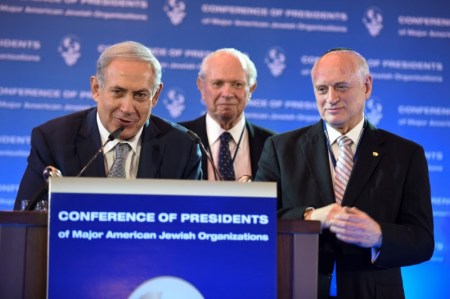
Prime Minister Netanyahu with the Conference of Presidents of Major American Jewish Organizations Chairman Stephen M. Greenberg (center) and Executive Vice Chairman/CEO Malcolm Hoenlein at the opening of the organization’s 42nd Leadership Mission, February 14, 2016. (Avi Hayoun)

Prime Minister Netanyahu with the Conference of Presidents of Major American Jewish Organizations Chairman Stephen M. Greenberg (center) and Executive Vice Chairman/CEO Malcolm Hoenlein at the opening of the organization’s 42nd Leadership Mission, February 14, 2016. (Avi Hayoun)

Netanyahu identified two parallel contradictory trends worldwide. On the one hand, there was an ongoing multinational hostility toward Israel at the UN, ICC, and EU, together with what he termed an “obsession” with Israel in international forums. “We’ve had some efforts to change at least the EU,” he said. “But we know that in many of these multinational forums, Israel is singled out. I hope that one day we’ll receive a double standard because right now, we’re not enjoying a double standard; we are suffering a triple standard… There’s one standard for the dictatorships. They’re usually exempt. The other is for the democracies and there’s still a third standard for the democracy called Israel.

On the other hand, he said, countries like China, India, Russia and Japan were warming their ties to Israel because of their concern with militant Islam and the terrorism it produces and to benefit from Israeli operational experience and intelligence in fighting terror as well as Israeli technologies, such as cyber security, improved water management and desalination, agriculture and biotechnology. “We need these countries who are coming to us to change their votes in international forums,” he said.

“We shouldn’t be shy about it. We shouldn’t accept that there is this strange dichotomy and dissonance between the friendship and the alliances that are being built between Israel and the many countries, and the way they vote about Israel in international forums. I think that’s true of the EU; it’s true of the Organization for African Unity; it’s true in Latin America. And I think we should press this point home, because as interests shift, as Israel becomes such an important country internationally, it’s important that this will be reflected in international forums as well.”

Netanyahu’s remarks came the same day as Defense Minister Moshe Ya’alon said there were open channels between Israel and other Arab states, but the “sensitive” situation prevents him from shaking hands with Arab officials in public. He later publicly shook the hand of Saudi Prince Turki bin Faisal al-Saud.

Turki is the rare Saudi official who has met openly with a number of Israeli officials in the past.

Israel’s covert ties with Sunni Arab states are such that while they cannot display signs of cordiality in public, “we can meet in closed rooms,” said Ya’alon at the Munich Security Conference.

“But we do have channels to speak with our Sunni Arab neighboring countries. Not just Jordan and Egypt — Gulf states, North African states,” Ya’alon said. “For them, Iran is an enemy.”

Ya’alon, speaking in English, maintained that the Arab states are “frustrated and furious at the lack of Western support.”

Defense Minister Moshe Ya'alon (R) shakes hands with Saudi Prince Turki al-Faisal at the Munich Security Conference on February 14, 2016 (Ariel Harmoni/Defense Ministry)

Defense Minister Moshe Ya’alon (right) shakes hands with Saudi Prince Turki bin-Faisal al-Saud at the Munich Security Conference on February 14, 2016 (Ariel Harmoni/Defense Ministry)

Saudi Arabia and other Arab states maintain they will only normalize ties with the Jewish state once a peace deal is reached with the Palestinians via a two-state solution.

Israel has long said there are secret back-channel talks between Jerusalem and Sunni states, which share common concerns over Iranian hegemony in the region.

Netanyahu told the conference Sunday that increased ties with the Arab states could help pave the way toward an agreement with the Palestinians, an oft-repeated claim.

“I think that is very clear given the, what I regret to say is the disfunctionality that I often see in Palestinian politics, and I think that the encouragement of Arab states, leading Arab states, for a more realistic position on the part of the Palestinian Authority might contribute to a stabilizing situation and even advancing to a better future,” he said.

He also highlighted the paramount importance of Israel’s ties to the US. “I want to say emphatically that we have no illusions that America remains the best friend of the State of Israel. The United States and Israel are the greatest allies. And I deeply appreciate the support of President Obama, the Congress, the American people. We’re working together today on an MoU (Memorandum of Understanding on security aid),” he noted. “I hope that we can complete it soon, and we certainly will welcome Vice President Biden, who will come to visit us. I think it’s another reflection of this deep friendship between our countries.

“And I think the American people understand that in this turbulent Middle East and this turbulent world, America has no better friend than Israel and Israel has no better friend than the United States of America,” Netanyahu said.


