Archive for January 4, 2016

Iran Deal Backers Embarrassed By Obama Admin’s Sanctions Blunder

January 4, 2016

Iran Deal Backers Embarrassed By Obama Admin’s Sanctions Blunder, Washington Free Beacon, January 4, 2016

Hassan Rouhani

A last minute delay last week in the implementation of new Iran sanctions has some prominent congressional backers of the nuclear deal accusing the Obama administration of capitulating to Iranian demands, according to sources both on and off Capitol Hill.

Senior Obama administration officials at the White House’s National Security Council told Congress Wednesday morning that new sanctions were coming as a result of Iran’s repeated ballistic missile tests, which violate current United Nations Security Council Resolutions prohibiting such activity.

However, the administration quietly walked back its announcement, telling lawmakers that the sanctions would be indefinitely delayed.

The move sparked a fierce backlash among prominent congressional leaders who have served as chief advocates for the administration’s efforts to ink a nuclear deal with Iran.

Sources who spoke to the Washington Free Beacon about the delay claim that the administration has repeatedly allowed Iran to dictate the terms of the deal out of fear that the Islamic Republic will ditch the deal before it is officially implemented later this month.

Iranian leaders have made clear that any new U.S. sanctions will force it to walk away from the nuclear agreement. In the wake of the new sanctions debate, Iranian military leaders announced over the weekend they are working to increase the strength and destructive power of the country’s arsenal.

The White House’s initial message to Congress on Wednesday morning offered tough rhetoric chastising Iran’s ballistic missile program and its recent test firings.

“Iran’s ballistic missile program poses a significant threat to regional and global security, and it will continue to be subject to international sanctions,” Adam Szubin, the Treasury Department’s acting under secretary for terrorism and financial intelligence, said in an embargoed statement that was forwarded to congressional offices that morning and viewed by the Free Beacon.

“We have consistently made clear that the United States will vigorously press sanctions against Iranian activities outside of the Joint Comprehensive Plan of Action—including those related to Iran’s support for terrorism, regional destabilization, human rights abuses, and ballistic missile program,” Szubin maintained in the statement, which was later scrapped.

Hours after that initial communication was sent to the Hill, the administration nixed the announcement, saying in a subsequent communication that the new sanctions—which were to hit 11 entities and individuals known to be enabling Iran’s missile program—would be indefinitely delayed.

Lawmakers who just that morning had applauded the new sanctions were not pleased.

Rep. Steny Hoyer (D., Md.), a leading supporter of the Iran deal, blasted the move, expressing disappointment with the administration’s efforts to appease Iran.

“I am disappointed that the Administration has delayed punitive action in response to Iran’s recent ballistic missile tests,” Hoyer said in a statement. “We are always in a sensitive moment in our dealings with Iran, and there is never a perfect time to undertake such actions. But Iran must know with certainty that violating U.N. Security Council resolutions, both inside and outside the scope of the Joint Comprehensive Plan of Action (JCPOA), will be met with serious consequences.”

Sen. Chris Coons (D., Del.), another leading deal supporter who initially praised the new sanctions, also expressed dismay at the administration’s move to delay the effort.

“I believe in the power of vigorous enforcement that pushes back on Iran’s bad behavior,” Coons told the Wall Street Journal. “If we don’t do that, we invite Iran to cheat.”

When asked to address the issue on Sunday, a senior Obama administration official told the Free Beacon that there are still “remaining issues” that need to be addressed before new sanctions are announced.

“As we’ve said, we’ve been looking for some time‎ at options for additional actions related to Iran’s ballistic missile program based on our continued concerns about its activities, including the October 10th launch,” the senior official explained, reiterating the White House’s commitment to sanctions.

“We are considering various aspects related to additional designations, as well as evolving diplomatic work that is consistent with our national security interests,” the official said. “As always, we keep Congress informed about issues related to Iran sanctions, and will continue to do so as we work through remaining issues.”

A State Department spokesman echoed this stance, telling the Free Beacon that it continues to explore ways to increase sanctions on Iran’s ballistic missile program.

Sanctions expert Mark Dubowitz, executive director of the Foundation for Defense of Democracies, told the Free Beacon that the administration might reconsider new sanctions once it strikes a “side deal” with Iran.

“I would expect that the administration will return to these sanctions after cutting some kind of side deal with the Iranians offering even more unilateral concessions,” Dubowitz said.

Critics of the move remain skeptical.

“To push back against Iran’s repeated missile and human rights provocations, Congress should pass the Menendez-Kirk bill to immediately renew a critical Iran sanctions law that expires this year,” said Sen. Mark Kirk (R., Ill.), an opponent of the Iran nuclear deal.

One consultant who has worked with Congress on issues pertaining to the nuclear deal told the Free Beacon that the administration fears Iran’s threats to break the deal.

“First the Obama administration strong-armed congressional Democrats into approving a politically toxic nuclear deal, under the pretense that at least the White House would fight Iranian aggression in other ways,” the source said, explaining that lawmakers who have defended the deal were made to look foolish by the sanctions delay.

“People like Coons and Hoyer went home and told constituents that they’d at least make sure Iranian terrorism and missile work was punished,” the source said. “Now the Obama team has deprived them of even that fig leaf. They’re going to have to defend total capitulation to their constituents.”

Meanwhile, Iran announced on Friday that it is working to significantly boost “the destruction power and precision” of its missiles, according to comments carried in the country’s state-controlled press.

Iran President Hassan Rouhani instructed the country’s military leaders to strengthen the missile program following rumors that the United States was contemplating new sanctions.

“Following [on] the president’s letter, we held numerous meetings with the executive officials, commanders, and officials in the missile sector and decided work out appropriate plans as soon as possible to enhance the defensive power and capability as well as the effective deterrence power of our missiles contrary to the will of the hegemonic system which seeks to restrict the Islamic Republic militarily,” Hossein Dehqan, Iran’s defense minister, said.

Saudi Arabia stews in policy hell

January 4, 2016

Saudi Arabia stews in policy hell, Asia Times, January 3, 2016

Last week’s mass executions in Saudi Arabia suggest panic at the highest level of the monarchy. The action is without precedent, even by the grim standards of Saudi repression. In 1980 Riyadh killed 63 jihadists who had attacked the Grand Mosque of Mecca, but that was fresh after the event. Most of the 47 prisoners shot and beheaded on Jan. 2 had sat in Saudi jails for a decade. The decision to kill the prominent Shia cleric Nimr al-Nimr, the most prominent spokesman for restive Saudi Shia Muslims in Eastern Province, betrays fear of subversion with Iranian sponsorship.

Saudi-beheading22-300x183Official Saudi beheading

Why kill them all now? It is very hard to evaluate the scale of internal threats to the Saudi monarchy, but the broader context for its concern is clear: Saudi Arabia finds itself isolated, abandoned by its longstanding American ally, at odds with China, and pressured by Russia’s sudden preeminence in the region. The Saudi-backed Army of Conquest in Syria seems to be crumbling under Russian attack. The Saudi intervention in Yemen against Iran-backed Houthi rebels has gone poorly. And its Turkish ally-of-convenience is consumed by a low-level civil war. Nothing has gone right for Riyadh.

Worst of all, the collapse of Saudi oil revenues threatens to exhaust the kingdom’s $700 billion in financial reserves within five years, according to an October estimate by the International Monetary Fund (as I discussed here). The House of Saud relies on subsidies to buy the loyalty of the vast majority of its subjects, and its reduced spending power is the biggest threat to its rule. Last week Riyadh cut subsidies for water, electricity and gasoline. The timing of the executions may be more than coincidence: the royal family’s capacity to buy popular support is eroding just as its regional security policy has fallen apart.

For decades, Riyadh has presented itself as an ally of the West and a force for stability in the region, while providing financial support for Wahhabi fundamentalism around the world. China has been the kingdom’s largest customer as well as a provider of sophisticated weapons, including surface-to-surface missiles. But China also has lost patience with the monarchy’s support for Wahhabi Islamists in China and bordering countries.

According to a senior Chinese analyst, the Saudis are the main source of funding for Islamist madrassas in Western China, where the “East Turkistan Independence Movement” has launched several large-scale terror attacks. Although the Saudi government has reassured Beijing that it does not support the homegrown terrorists, it either can’t or won’t stop some members of the royal family from channeling funds to the local jihadis through informal financial channels. “Our biggest worry in the Middle East isn’t oil—it’s Saudi Arabia,” the analyst said.

China’s Muslims—mainly Uyghurs in Western China who speak a Turkish dialect—are Sunni rather than Shia.  Like Russia, China does not have to worry about Iranian agitation among Shia jihadis, and tends to prefer Iran to the Sunni powers. As a matter of form, Beijing wants to appear even-handed in its dealings with Iran and Saudi Arabia, for example in recent contacts between their respective navies. Chinese analysts emphasize that Beijing has sold weapons to both—more in absolute to terms to Iran but more sophisticated weapons to the Saudis.

More pertinent than public diplomacy, though, is where China is buying its oil.

Nonetheless, China’s oil import data show a significant shift away from Saudi Arabia towards Russia and Oman (which China considers part of the Iranian sphere of influence). Russia’s oil exports to China have grown fourfold since 2010 while Saudi exports have stagnated. Given the world oil glut, China can pick and choose its suppliers, and it is hard to avoid the inference that Beijing is buying more from Russia for strategic reasons.  According to Russian sources, China also has allowed Russian oil companies to delay physical delivery of oil due under existing contracts, permitting Russia to sell the oil on the open market for cash—the equivalent of a cash loan to Russia.

saudioil1-768x558

China’s interests in Syria coincide with Russia’s. Both have reason to fear the growth of ISIS as a magnet for their own jihadis.  Thousands of Chinese Uyghurs make their way into Southeast Asia via the porous southern border of Yunnan province, with financial assistance from Saudi supporters and logistical support—including passports—from local Turkish consulates. Chinese Uyghurs were implicated in the bombing of Bangkok’s Erawan Temple last August, and have linked up with ISIS supporters as far south as Indonesia. Turkey reported last month that most jihadists crossing its border into Syria to join ISIS are Chinese Muslims.

With Kurdish and allied forces gaining control of Syria’s border with Turkey, aided by Russian air support, Chinese Uyghurs may lose access to Syria. Late in December Kurdish forces crossed to the western bank of the Euphrates River and are in position to link up with Kurdish militias in northwestern Syria, eliminating Turkish hopes of a “safe zone” controlled by Turkey on the southern side of the Syrian border.  For its part, Turkey risks paralysis from a low-intensity civil war with its Kurdish population. The Kurdish-majority southeast of the country is under siege and fighting has spread to Turkey’s western provinces.

It’s an ill wind that blows nobody good, and China seems hopeful that it has contained its jihadist problem. On New Year’s Day, the Communist Party leader in China’s Xinjiang province declared that “the atmosphere for religious extremism has weakened markedly.”

China is extremely reluctant to commit military forces to overseas conflicts, and its military is ill-prepared to do so even if Beijing were to change its mind. The People’s Liberation Army lacks ground attack aircraft like the two squadrons of Russian Su-24 and Su-25 deployed in Syria. Nonetheless, Beijing is happy that Russia is reducing ISIS forces in Syria as well as Saudi- and Turkish-backed Sunni Islamists like the Army of Conquest.

It will be hard to evaluate the success of Russian bombing in Syria until the dust settles, but there is a great deal of dust in the air. According to Israeli sources, Russia is dumping vast amounts of its Cold War inventory of dumb bombs on Syrian Sunnis with devastating effect. The Russian bombing campaign makes up in volume what it lacks in sophistication, killing far more civilians than Western militaries would tolerate, but changing the situation on the ground. That explains Russian President Vladimir Putin’s newfound popularity among world leaders. He is doing their dirty work.

Saudi Arabia’s proxies in Syria are in trouble. Early in 2015, the Army of Conquest (Jaish al-Fateh), a coalition of al-Qaida and other Sunni Islamists backed by the Saudis, Turks and Qataris, had driven the Syrian army out of several key positions in Northwest Syria, threatening the Assad regime’s core Alawite heartland. The coalition began breaking up in November, however, and the Syrian Army recently retook several villages it had lost to the Army of Conquest. One of the Army of Conquest’s constituent militias, Failaq al-Sham, announced Jan. 3 that it was leaving the coalition to defend Aleppo against regime forces reinforced by Russia.

Everything seems to have gone wrong at once for Riyadh. The only consolation the monarchy has under the circumstances is that its nemesis Iran also is suffering from the collapse of oil revenues and the attrition of war. Iran began withdrawing its Revolutionary Guard forces from Syria in December, largely due to high casualties. The high cost of maintaining the war effort as Iran’s finances implode also may have been a factor. Iran’s Lebanese Shia proxy, Hezbollah, has suffered extremely high casualties, virtually neutralizing its whole first echelon of combat troops. And Russia has shown no interest in interfering with Israeli air strikes against Hezbollah.

The oil price collapse turns the competition between Saudi Arabia and Iran into a race to the bottom. But the monarchy’s panicked response to its many setbacks of the past several months raises a difficult question. In the past, the West did what it could to prop up the Saudi royal family as a pillar of stability in the region, despite the Saudis’ support for jihadi terrorism. Soon the West may not be able to keep the House of Saud in power whether it wants to or not.

Iran-Saudi crisis spurs Hizballah strike on Israel

January 4, 2016

Iran-Saudi crisis spurs Hizballah strike on Israel, DEBKAfile, January 3, 2016

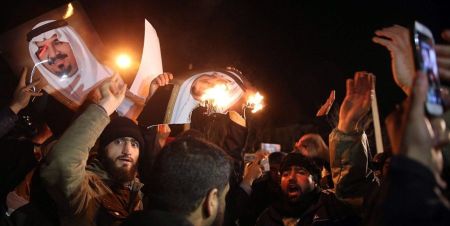
Iranian_protesters_set_fire_to_pictures_of_the_Saudi_royal_family_3.1.16

The heated verbal battle between Tehran and Riyadh over Saudi Arabia’s execution of a Shiite cleric escalated Sunday night, Jan 3, with the severance of diplomatic relations. On the broader front, the repercussions from the quarrel between the two leaders of the Muslim world’s Shia-Sunni split are widely seen in Middle East military and intelligence circles as spurring a fast-track Hizballah attack on Israel.

Among the 47 people executed by Saudi Arabia Saturday on terrorism charges was Sheikh Nimr al-Nimr, Saudi Shiite leader and a prominent Shiite cleric in the region. Put to death with him were several Saudi Shiite and Sunni activists, which enraged Iran’s supreme leader Ayatollah Ali Khamenei to the point of threatening the Saudi royal family with “divine revenge.”

From Iran’s perspective, the Saudis committed the unpardonable act of executing Shiites together with Sunni Al Qaeda and ISIS terrorists. This made the House of Saud the first ruling power ever to treat Shiite and Sunni terrorists alike. This, more than anything, incensed Iran and its Lebanese proxy Hizballah, who are deep in a bloody war against the Sunni Islamic State and the Nusra Front terrorists in Syria. Iran’s Revolutionary Guards are additionally locked in a bitter conflict with ISIS in Iraq.

The Iranian war effort is backed by the US in Iraq and by Russia in Syria.

By the mass executions of both classes of terrorist at the same time, Riyadh issued four messages:

1. Washington and Moscow are wrong. The Iranians and the forces they back in the Persian Gulf, Syria and Iraq are just as much terrorists as ISIS and Al Qaeda.

2. The House of Saud is determined to fight both with equal resolve and severity

3. Riyadh has already taken Tehran on in Yemen, and indirectly in Syria, and is now ready to take the fight against Tehran all the way to the war on terror.

4. Taking off the diplomatic gloves, Saudi Foreign Minister Adel al-Jubeir Monday night severed relations with Iran and ordered all Iranian diplomats to leave the kingdom within 48 hours. The foreign ministry said that by condemning the Nimr execution, Iran was supporting terrorism.

Saudi diplomats were already gone after protesters in Tehran torched and ransacked the Saudi embassy Saturday.

Amid all the sound and fury, Tehran’s attention was drawn to comments made by Israeli Prime Minister Binyamin Netanyahu in the light of a major terrorist attack in Tel Aviv. He pointed out that, in addition to the Palestinians, Israel is threatened by two streams of radical Islam, the Shiites and the Sunnis.

He was clearly referring to Iran and its terrorist arm, Hizballah, on the one hand, and ISIS and Al Qaeda, on the other, inspired less by the Tel Aviv outrage than by the gathering clouds of terror darkening the region, which place the Saudi royal family and Israel on the same side, sharing a similar perception of the two foes facing both countries.

Policymakers in Jerusalem noted the odd statement by Turkish President Tayyip Erdogan to reporters on Saturday, January 1 on the way home from a visit to Riyadh. After years of reviling the Jewish state, he said, “Israel is in need of a country like Turkey in the region. We have to admit that we also need Israel.”

He sounded as though he was urging the resumption of the old political and military alliance binding the two countries years ago.

DEBKAfile’s Middle Eastern sources point out that, since his comment came directly after his talks with Saudi King Salman in Riyadh, it appeared to open a path toward the possible creation of a new Middle East bloc consisting of Turkey, Saudi Arabia, perhaps Egypt, and Israel, bound by the same enemies. This grouping could serve as a counterweight against the Sunni-Shiite bloc of Iran, Iraq, Syria and Hizballah, which has the backing of the US and Russia on one hand, and fights ISIS on the other.

Iran’s leaders may curse the House of Saud without restraint, but they are canny enough not to go from words to deeds, knowing they would be on their own if they attacked the oil kingdom and earn no backing from either Washington or Moscow.

However, it might be easier for Tehran to take advantage of Netanyahu’s tough predicament in his war on terror, by sending Hizballah to strike Israel and, meanwhile, pre-empt the formation of a new anti-Tehran alliance. Speeding up Hassan Nasrallah’s promised revenge for the assassination of its master terrorist Samir Quntar would serve this purpose.

This possibility has prompted the IDF to keep artillery units pounding areas bordering on Israel during the past few days. The IDF says this action is necessary to stop Hizballah exploiting the stormy, snowy winter weather to attack Israel. Its military chiefs appear to be acting on information received of an approaching Hizballah operation as its leader has threatened.

Palestinian Leaders Promise a New Year of Violence and Death

January 4, 2016

Palestinian Leaders Promise a New Year of Violence and Death, Gatestone InstituteKhaled Abu Toameh, January 4, 2016

♦ Instead of wishing Palestinians a happy and prosperous New Year, both Fatah and Hamas are asking their people to prepare for increased violence and “resistance,” including suicide bombings, against Israelis.

♦ Fatah’s armed wing used the occasion to issue yet another threat: “We will continue in the path of the martyrs until the liberation of all of Palestine.”

♦ Masked Palestinians in Bethlehem attacked several restaurants and halls where New Year’s Eve parties were supposed to take place. The assailants, eyewitnesses reported, were affiliated with Abbas’s Fatah faction, not Hamas.

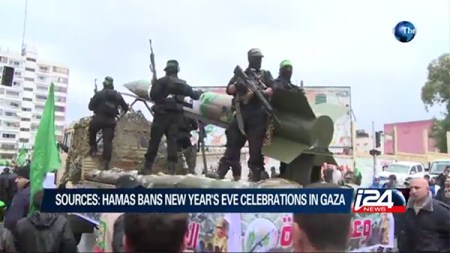
♦ Hamas banned Gazans from celebrating New Year’s Eve, saying such parties are “in violation of Islamic teachings.” Hamas does not want young Palestinians enjoying their time in restaurants and cafes. Instead, Hamas wants them to join its forces, armed and dressed in military fatigues, preparing for jihad against Israel.

After failing to offer their people any hope for the future, Fatah and Hamas are now telling Palestinians that they should expect more violence and bloodshed during in 2016.

In separate messages to the Palestinians on New Year’s Eve, the two rival Palestinian parties pledged to pursue, and even step up, “resistance” attacks against Israel. Needless to say, the messages did not make any reference to peace, coexistence or tolerance.

Instead of wishing Palestinians a happy and prosperous New Year, both Fatah and Hamas are asking their people in the Gaza Strip and West Bank to prepare for increased violence and “resistance” attacks against Israel. The two parties have nothing to offer the Palestinians besides more bloodshed and despair.

Hamas, which has been in power in the Gaza Strip for almost 10 years, is even reported to be preparing for a new wave of suicide bombings against Israelis. The last time Hamas launched suicide attacks in Israel was during the second intifada, 2000-2005, which wrought havoc and destruction to Palestinians.

Various reports have suggested that Hamas was now considering activating its West Bank “sleeper cells,” in preparation for resuming suicide bombings against Israelis. Hamas, according to the reports, is also planning to target Israeli security and political figures.

Hussam Badran, a senior Hamas official in the Gaza Strip, painted a grim picture of what awaits Palestinians during 2016. In a message to Palestinians, Badran announced that the current wave of terrorism, which he referred to as the “Al-Quds Intifada,” would escalate during the coming year. He also hinted that Hamas was indeed considering resuming suicide attacks against Israelis: “The year 2016 will witness a development and escalation of the intifada and all forms of resistance operations.”

His message, like those of many Hamas officials, did not contain any reference to the harsh living conditions of Palestinians under the rule of Hamas in the Gaza Strip. When Badran and other Hamas officials talk about waging “all forms of resistance” against Israel, they are actually referring to plans to launch suicide bombings and other terror attacks against Israelis.

The Hamas New Year’s messages do not offer Palestinians in the Gaza Strip any hope that their leaders are working towards ending their misery and state of despair. There is no promise to help solve the problem of unemployment or poverty in the Gaza Strip. Nor is there any promise to help solve the crisis with Egypt, one which has resulted in the closure of the Rafah border crossing between Gaza and Egypt for most of 2015.

As if that were not enough, Hamas last week banned Palestinians in the Gaza Strip from celebrating New Year’s Eve. Hamas security officers warned owners of restaurants and hotels against holding New Year’s Eve parties, saying that this practice is “alien to our traditions and values and in violation of Islamic teachings.” Hamas also justified the ban by arguing that Palestinians in the Gaza Strip must show solidarity with their brothers in the West Bank, who have been waging a campaign of stabbing and vehicular attacks against Israelis since early October.

By banning New Year’s Eve celebrations, Hamas is following the example of other Islamist terror groups such as the Islamic State, which have denounced such parties as “un-Islamic.” These groups consider New Year’s Eve celebrations as being part of the same Western culture they are seeking to replace with extremist Islam and Sharia law.

Hamas cannot tolerate scenes of Palestinians rejoicing and celebrating the arrival of a new year. It does not want to see young Palestinians enjoying their time in restaurants, cafes and hotels. Instead, Hamas wants young Palestinians to join its forces and prepare for jihad against Israel. Hamas prefers to see young Palestinians dressed up in military fatigues and carrying weapons. It wants the young men, instead of celebrating and rejoicing, to participate in digging more tunnels under Gaza’s borders with Israel and Egypt.

1412Armed Hamas militiamen on parade with a mock rocket in Gaza. (Image source: i24 News video screenshot)

Similarly, President Mahmoud Abbas’s ruling Fatah faction in the West Bank, which this week celebrated the 51st anniversary of its first armed attack against Israel, is hoping that 2016 will witness more violence. Several Fatah officials and groups marked the anniversary by vowing to step up “resistance” against Israelis and urging Palestinians to join the “struggle” against Israel.

Fatah’s armed wing, the al-Aqsa Martyrs Brigades, used the occasion to issue yet another threat to launch terror attacks against Israelis. “We remain committed to the option of an armed struggle,” the group rote in a leaflet distributed in the West Bank. “We will continue in the path of the martyrs until the liberation of all of Palestine.”

President Mahmoud Abbas, who is also head of Fatah, also had nothing to offer his people on New Year’s Eve, other than more messages of hate and defiance towards Israel. In a message to his people, Abbas once again justified the current wave of violence by saying it was the “result of the continuation of occupation and settlements, and the desecration of our holy sites.” He added: “Our people won’t capitulate, surrender or accept humiliation.”

As Abbas was addressing his people, masked Palestinians in Bethlehem attacked several restaurants and halls where New Year’s Eve parties were supposed to take place. Eyewitnesses said that the masked men opened fire at the restaurants, halls and vehicles, to prevent Palestinians from celebrating. The assailants, eyewitnesses reported, were affiliated with Abbas’s Fatah faction, not Hamas.

The leaders of Fatah and Hamas have once again shown they have nothing to offer the Palestinians other than violence, destruction and death. These leaders want their people to remain in a combatant mood in order to pursue the fight against Israel. As such, the year 2016 does not look very promising for Palestinians under the current leadership of Fatah and Hamas.

Hizballah blows up “Mossad” patrol, sparks border clash with Israel

January 4, 2016

Hizballah blows up “Mossad” patrol, sparks border clash with Israel, DEBKAfile, January 4, 2016

Shortly after DEBKAfile’s forecast of a Hizballah revenge strike for the Samir Quntar assassination, a Hizballah roadside bomb blew up against an IDF patrol at the Shebaa Farms on the Hermon slopes Monday afternoon, Jan. 4.  No casualties were caused. The Israeli force responded with tank artillery fire on the southern Lebanese town of Al-Wazzani and was answered by rocket fire from Lebanon

Hizballah announced that it had targeted an Israeli patrol with a bomb on the ceasefire line at the Shebaa Farms targeting a civilian car carrying a “senior Mossad officer”.

The next Hizballah communiqué said: The Martyr al-Quntar Unit blew up a bomb against an Israeli patrol in the Shebaa Farms, destroying a military vehicle and causing casualties.

In a third communiqué, Hizballah said the car attacked carried a “senior Israeli army officer” – amending its previous claim of a Mossad officer.

The Israeli army has closed all northern roads to civilian traffic in case the Hizballah attack spreads into a major clash.

DEBKAfile reported earlier Monday that the rising tension between Tehran and Riyadh may serve Iran and its Lebanese proxy as an oportunity to attack Israel. The leader of that proxy, Hizballah’s Hassan Nasrallah, had repeatedly threatened to punish Israeli for the assassination of its high profile terrorist planner Samir Quntar in Damascus on Dec, 20. Quntar was freed by Israel as part of a prisoner swap in 2008, three decades after he was convicted of killing four Israelis. In September, the United States placed Quntar on its terror blacklist, saying he had “played an operational role, with the assistance of Iran and Syria, in building up Hizballah’s terrorist infrastructure in the Golan Heights.”

Middle East Fires Blaze Hotter Following U.S. Capitulation to Iran

January 4, 2016

Middle East Fires Blaze Hotter Following U.S. Capitulation to Iran, Power LinePaul Mirengoff, January 4, 2016

In a post about the Saudi Arabia/Iran crisis — the Saudi beheading of a Shiite cleric; the Iranian burning of the Saudi embassy — John asked, “the Middle East couldn’t possibly get worse, could it?” At NRO’s Corner, David French examines the crisis and concludes “in the Middle East things can always get worse.”

Things have indeed gotten worse under President Obama. They got worse when Obama withdrew from Iraq and they are getting even worse following his nuclear deal with Iran, an abject capitulation by the U.S.

French explains:

For months, the Saudis have watched with alarm as the Iranians have engaged in the Mideast equivalent of an extended touchdown dance following the conclusion of the so-called nuclear “deal” with the U.S. The Saudis’ chief regional enemy is set to receive a massive economic infusion, access to international arms markets, and permission to further develop its ballistic missile capabilities.

The Iranians have celebrated by reaffirming their support for Shiite terrorists, conducting missile tests in defiance of the U.N., and — most recently — firing a rocket within two kilometers of an American aircraft carrier. In the meantime, the emerging Iran/Iraq/Sryia alliance received a considerable boost in the form of direct Russian intervention on behalf of the Assad regime.

While the U.S. has been largely impotent, the Saudis have responded by forming a multinational alliance to counter Iran (under the laughable pretense of “fighting terror”) and launching an intense air and ground campaign against Iranian-backed Shiite rebels in Yemen. Saudi Arabia’s execution of Shiite Sheikh Nimr Baqr al-Nimr is an act of pure defiance. Iran’s response — permitting a “mob” to burn the Saudi embassy — demonstrated its own lack of regard for the House of Saud.

What’s the lesson?

Nothing is easy or simple in the Middle East, but we can be certain of two things: Power vacuums will always be filled, and things can always get worse.

American passivity has left an enormous power vacuum in the region, and the Iranians and Saudis are rushing to fill the void. The Iranians are our sworn enemies, and the Saudis are among the worst of “friends.” It’s hard to see how the continued aggressive emergence of either regional power advances American national interests, and a direct clash could have dramatic consequences for the world economy.

The Middle East has long been on fire with violence and instability. This weekend, the fire blazed hotter still.

Walter Russell Mead expands on the connection between Obama’s Iran deal and the Saudi/Iran crisis:

The. . .story on Saudi Arabia’s decision to break diplomatic relations with Iran over the destruction of the Saudi embassy in Tehran, read[s] like an epitaph for the Obama administration’s Middle East policy. In 2015, the central conviction of President Obama’s policy in the Middle East, the only element of his original, ambitious agenda (reconciliation with the Sunni world, promotion of moderate Islamist democracy, solving the Israel-Palestine issue) still standing, was that he could stabilize the Middle East by pursuing a nuclear deal with Iran.

The President has his nuclear deal, but so far it isn’t making him, or anybody else, happy. The perceived U.S. tilt toward Iran has inflamed Sunni jihadis, contributed to the meltdown in Syria, and has made regional sectarian conflict hotter and more dangerous than ever. What’s more, the U.S. has lost leverage over Saudi Arabia, Turkey, Egypt, and Israel—without gaining leverage over Iran.

As a result, the U.S. is both less able to persuade the Sunni powers to refrain from steps that could inflame regional conflict and is completely unable to persuade the Iranians to moderate their behavior in the interest of regional peace.

Like John, I find it difficult to reconcile Obama’s policies with a good faith intention to pursue peace in the Middle East or to advance the national security interests of the United States.