Archive for November 6, 2015

Obama Deepening Syria War as Prelude to More War, Based on Lies

November 6, 2015

Obama Deepening Syria War as Prelude to More War, Based on Lies

Friday, 06 November 2015

Written by 

Source: Obama Deepening Syria War as Prelude to More War, Based on Lies

Obama Deepening Syria War as Prelude to More War, Based on Lies

Photo of President Obama: AP Images

Outrage and criticism are growing across the political spectrum after Obama, contradicting his repeated past pledges not to put U.S. troops in Syria, decided without congressional or constitutional authority to deploy some 50 Special Forces operatives to aid Syrian jihadists. At least one U.S. soldier has already been killed, dying last month in what Obama officials claimed was a raid to free prisoners held by the Islamic State (ISIS). More deaths are likely, as are more troop deployments, according to lawmakers and analysts, potentially setting up a broader war in which the United States could become further ensnared in Syria and beyond. Thanks in large part to the administration’s deceit and machinations in recent years, the whole region is likely to end up in flames — a kind of post-Obama Libya on a much larger scale. And Obama’s Republican and Democrat enablers in Congress, despite voicing some complaints and concerns, have done practically nothing to stop it.

The official excuse for sending American forces to Syria is to help various jihadist “rebels” battle ISIS. Yet, based on the statements of Obama’s own top officials, including Vice President Joe Biden and Chairman of the U.S. Joint Chiefs of Staff Martin Dempsey, members of Obama’s “anti-ISIS” coalition have been arming, funding, and training ISIS from the start. In fact, in a public speech at Harvard, Biden said the anti-ISIS coalition had essentially created ISIS in the first place — on purpose. Official U.S. intelligence documents later confirmed that. The notion that Obama is sending U.S. troops to battle the Frankenstein creation of its own “anti-ISIS” coalition, then, sounds far-fetched at best. Far more likely is that the real agenda is not being publicly discussed, with ISIS merely serving as the excuse du jour to wage more illegal war.

The administration, of course, also claims that the U.S. military deployment will remain small, supposedly in a mostly advisory capacity along the lines of what got the U.S. government embroiled in Vietnam. Chief White House mouthpiece Josh Earnest even claimed Obama would “not allow the U.S. to be drawn into a sectarian quagmire in Syria.” As he was speaking, though, Obama was in the process of sinking America deeper into the sectarian quagmire that Obama himself helped create and fuel in Syria. “The president believes that by committing a relatively small number of forces, fewer than 50, that they can serve as a force multiplier and further enhance the efforts of these local forces on the ground,” Earnest continued. The “force” that would be “multiplied” by U.S. forces, of course, is a jihadist force, as Obama’s own top officials have already acknowledged publicly and as U.S. military documents show conclusively.

Either way, there is no reason to believe anything Earnest or anyone else in the administration has to say about the deployment, the purpose of it, or anything else, really — and there are plenty of reasons not to believe it. As The New American reported this week, Obama decided to lawlessly commit U.S. troops into Syria’s civil war after years of repeated promises to not deploy U.S. troops in Syria. Indeed, reporter C. Mitchell Shaw compiled a list of 18 separate instances in which the Obama administration publicly pledged not to deploy U.S. troops in Syria. Instead of keeping its promise and U.S. boots off the ground in Syria, though, the administration announced last week that a contingent of American Special Forces personnel were on the way to help various jihadist groups battle other jihadist groups.

It appears, however, that the administration and its war-mongering allies are having trouble keeping their lies straight on all fronts. For instance, the White House claims it has the authority to deploy U.S. forces in Syria based on an “Authorization for Use of Military Force” (AUMF) passed by Congress in 2001 authorizing military strikes on “al Qaeda and associated forces.” Yet, the Obama administration and various warmongers demanding military action in Syria also claim that al-Qaeda and ISIS are at odds with each other. Indeed, disgraced former General David Petraeus, who oversaw the U.S. wars in Iraq and Afghanistan, even called for a U.S. government alliance with al-Qaeda to fight ISIS. Seriously. Official U.S. documents also show that Washington, D.C., has known from the beginning that the Syrian “opposition” was being led by al-Qaeda, the Muslim Brotherhood, and other Islamist organizations.

Meanwhile, Obama’s unconstitutional “regime-change” plot against Libya also discredits the administration’s false claim that the AUMF against al-Qaeda authorizes U.S. government support for jihad in Syria. In Libya, retired U.S. military generals and others even concluded that Obama had “switched sides” in the terror war when he backed self-declared al-Qaeda leaders against former U.S. terror-war ally Moammar Gadhafi. In that war, which turned what remains of war-torn Libya into a jihadist paradise mired in ongoing civil war, Obama did not cite the AUMF, instead pointing to an illegitimate United Nations Security Council “resolution” as the source of authority. Then-Secretary of State Hillary Clinton even promised to ignore Congress if it tried to stop the illegal war. The U.S. Constitution, of course, requires a declaration of war before the president is authorized to wage war.

Even some congressional Democrats, though, are speaking out against Obama. “It’s hard not to be concerned when the president very clearly ruled out putting troops on the ground in Syria and now they’re on their way into the battle,” explained U.S. Senator Chris Murphy (D-Conn.), adding that he expected Obama to deploy even more U.S. troops in Syria going forward. “We’ve crossed a line here that’s hard to understand.” Another Senate Democrat, Tim Kaine of Virginia, echoed those concerns, saying lawmakers were not convinced. The White House’s efforts “to say, ‘Don’t worry, this is not ground troops,’ people don’t think that’s credible,” he said. Various Republicans have also slammed Obama’s decision. The public, too, is catching on, with a recent Associated Press poll showing that more than 6 in 10 Americans reject Obama’s “anti-ISIS” machinations in Syria.

Unsurprisingly, the warmongering Republican neoconservatives in Congress who supported the disastrous U.S. government invasion, “regime change,” and occupation of Iraq were standing fully behind Obama. Some even demanded that Obama deepen his involvement in Syria’s civil war even further. “Democrats and a few Republicans have absolutely no clue as to the threat we face,” complained Senator Lindsey Graham (R-S.C.), who supports sending even more U.S. troops to the region. “We’re going to get attacked from Syria. That is where the next 9/11 is coming from.” He may be right.

What Graham and his fellow warmongers in Congress failed to mention, though, is that creating a fundamentalist Islamist principality in Syria — known today as ISIS — was official U.S. government policy as far back as 2012, according to a U.S. Defense Intelligence Agency (DIA) report. Top U.S. officials said they warned against such an absurd and deadly policy, but were overruled by Obama and his cohorts desperate for more war. Graham and his neocon sidekick Senator John McCain (R-Ariz.), though, have been cheerleading for Obama’s military support to Middle Eastern jihadists for years. McCain even posed for pictures with them. So if it is true that the next terror attack on U.S. soil comes from Syria, the Republican neocon enablers in Congress and the Obama administration will bear a major part of the blame.

But what is the real purpose of Obama’s latest scheming in Syria? According to Kremlin-backed media voices, it is about using U.S. troops as “human shields” to protect Obama’s anti-government jihadist “rebels” from Vladimir Putin’s air power. “The troop dispatch signals that the U.S. [is] trying to forestall Russian successes in wiping out Washington’s regime-change assets in Syria,” wrote analyst Finian Cunningham in a piece published by the Moscow-controlled RT. “In short, the US Special Forces are being used as ‘human shields’ to curb Russian air strikes against anti-government mercenaries, many of whom are instrumental in Washington’s regime-change objective in Syria.”

Despite Moscow’s ostensible support for Assad, however, it appears that the globalist goals in Syria still include deposing the autocratic dictator, eventually — but not before the nation is reduced to rubble, Libya-style, and the genocide of Syria’s ancient Christian communities by Western-backed jihadist “rebels” is complete. Also apparently on the globalist agenda: exploiting the Syrian war to flood the West with millions of refugees, empowering the UN and its kangaroo “court,” and imposing a European Union-style “Middle-East Union” pushed by the global-government-promoting Council on Foreign Relations.

Hundreds of thousands of innocents are now dead. More are dying every single day. Christians are  where they have lived continuously for almost 2000 years. Millions of Syrians have been forced to flee their homes. And much of the responsibility for the tragedy can be traced straight back to the deadly machinations of Obama and his allies.

Congress must take immediate action to rein in the White House, or the growing rivers of blood drenching the Middle East will be on their hands, too.

Israeli teen seriously hurt in day’s second Hebron shooting

November 6, 2015

Israeli teen seriously hurt in day’s second Hebron shooting 19-year-old suffers wounds to upper body in Friday’s fourth terror attack; large number of troops searching area

By Times of Israel staff

November 6, 2015, 6:47 pm

Source: Israeli teen seriously hurt in day’s second Hebron shooting | The Times of Israel

A wounded Jewish teen arrives at Shaare Zedek Medical Center in Jerusalem on November 6, 2015, after unknown assailants shot and wounded him and another teen in the West Bank city of Hebron. (AFP PHOTO/AHMAD GHARABLI)

A wounded Jewish teen arrives at Shaare Zedek Medical Center in Jerusalem on November 6, 2015, after unknown assailants shot and wounded him and another teen in the West Bank city of Hebron. (AFP PHOTO/AHMAD GHARABLI)

An Israeli youth was seriously wounded Friday evening in a shooting attack at the Beit Anun junction north of the West Bank city of Hebron.

The victim was a 19-year-old Israeli who had been shot in the upper body

Medics and emergency personnel rushed to the scene of the attack, where they administered first aid treatment before evacuating the victim to Hadassah Hospital Ein Kerem in Jerusalem.

This was the fourth terror attack on Israelis in the West Bank in one day. A short time earlier, two Israeli teenagers were wounded, one seriously, in a separate shooting attack in the Hebron area.

The security forces were looking into the possibility that one cell had carried out both the Beit Anun attack and the shooting at the Tomb of the Patriarchs a short time earlier, Channel 10 said.

Large numbers of forces from the IDF and Shin Bet security service were conducting searches in the Beit Anun area, Maariv reported.

The shootings come hours after a Palestinian woman in her 70s tried to drive her car into a group of soldiers in the Hebron area. She was shot and wounded by troops.

Also Friday, an Israeli man was badly hurt when he was stabbed outside a West Bank supermarket north of Jerusalem. A Palestinian from the Jerusalem area later posted a video clip on Facebook claiming responsibility for the stabbing.

Why Does Barack Obama’s White House Hate The United Kingdom?

November 6, 2015

Why Does Barack Obama’s White House Hate The United Kingdom?

By Nigel Farage MEP

6 Nov 2015

Source: Why Does Barack Obama’s White House Hate The United Kingdom?

Farage-for-Breitbart-640x480_final

Ever since President Obama’s first day when he removed the bust of Winston Churchill from the Oval Office I have wondered: Just how anti-British is Obama?

The oil spill in the Gulf of Mexico illustrated his contempt for our country with his repeated references and heavy emphasis to British Petroleum. But he’s gone one better this week. His Trade Envoy Michael Froman said, and was endlessly quoted by the BBC, that the USA would not seek a bilateral trade deal with the UK if we left the European Union (EU).

This is all bizarre. The USA has a trade deal with Oman, so why on Earth would it not want one with its greatest friend in the world? 

It is clear that Obama supports supranational government and the new global order. And I must congratulate Breitbart London for exposing the fact that both Froman and his wife had previously worked for the European Commission. 

Jeb Bush has provided the first counter-punch by making it clear that of course America would favour such a trade deal if the UK were to leave the EU.

I was struck on my last trip to Washington, D.C. just how little American politicians know about the EU. I’m keen to go back in the new year to get some more alternative voices. A UK voting to Remain will before long cease to be able to be the USA’s greatest ally. We cannot allow Obama and now the Bank of America Merrill Lynch to skew the UK debate. 

I want to rally the rational voices.

Oldham By-Election

Six months into this Parliament and the first by-election. The death of left-wing Michael Meacher who had been the MP since 1970 and despite Labour’s weakness had a 14,000 majority, has prompted the first parliamentary battle of this term. 

UKIP had several applicants, some quite high-profile, but we decided that Mancunian John Bickley, who came so agonisingly close in Heywood and Middleton, losing by just 600 votes, should be our candidate again in a constituency that directly neighbours Heywood.

John is a first rate candidate. A real straight talker and a hard worker. 

I’m in no doubt that the battle for this seat is the toughest that we have faced in a northern by-election in recent times. But I’m not downhearted by this, and indeed have visited the constituency twice this week. 

This by-election represents the first real test of Jeremy Corbyn’s leadership. The Labour Party’s choice of an able but Blairite candidate puts their dilemma into focus. 

However weak or strong a local candidate may be, we increasingly vote under the First Past the Post system in a presidential style. The leader mattering far more than the local candidate. And the leader is now Jeremy Corbyn. 

The question that I want to ask the people of Oldham West and Royton is a fundamental one. 

Does this man represent the interests of our national security and long-term viability of our country?

Mr. C has spent decades cosying up to the IRA. He wants to unilaterally abolish Trident, our nuclear defence system. He thinks the Falkland Islands should be surrendered to Argentina. He would like to abolish the British Army. And he thinks the First World War is not worth commemorating. 

For most patriotic old Labour voters, this particular diet is anathema. The traditional northern working class vote are very patriotic. Over the course of the next few weeks we will be asking those questions. 

On the other hand UKIP has been somewhat becalmed over the course of the summer. We now have an opportunity to campaign in a by-election when our key issues now top the national debate. The announcement yesterday by the European Commission that we can expect 3 million more migrants next year demonstrates once again why we must leave the EU and restore proper border controls. On fundamental issues such as this I believe UKIP to be more in tune with public opinion than Corbyn’s Labour. 

In May of this year we beat the Tories and came second in this seat. I am confident that we will give the incumbent Labour Party a serious run for their money. 

Bedfordshire Speed Cameras Go Up A Gear

I hate speed cameras. They exercise no discretion at all. I was done a few years ago doing 36 miles per hour in a 30 mph speed zone at 1:30am in the morning. I was certainly posing no risk to human life but I may have endangered the odd badger, something British hedgehogs would cheer.

Now the head of Bedfordshire Police brazenly announces that he wants to start putting speed cameras to operate on his section of the M1 24 hours a day. He thinks it might raise another £1 million every year for the Bedfordshire police authority. So who will pay the bill? People who get up early in the morning and work late into the night. Small businesses, entrepreneurs, hard working Britons – all of whom would recognise that at the right time of the day and in proper weather conditions the 70 miles per hour speed limit is an anachronism. 

When will we get a police force that actually wants to do its job? I heard recently that the “protestors” who assaulted myself and my family earlier in the year in a local pub faced no further action. 

Nigel Farage MEP is the leader of the UK Independence Party

Putin halts flights to Egypt until “true causes” known for Metrojet crash

November 6, 2015

Putin halts flights to Egypt until “true causes” known for Metrojet crash, DEBKAfile, November 6, 2015

(Please see also, Russia to suspend flights to Egypt until causes of Sinai crash are clear. — DM)

Bomb_evidence_B_5.11.15

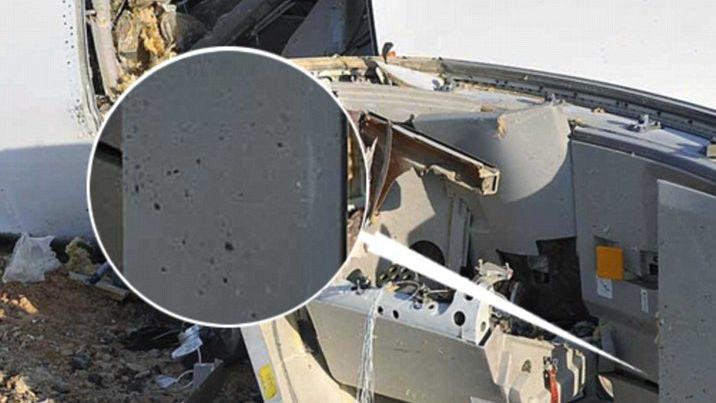
They discovered holes made by iron balls planted inside a bomb and scattered through all parts of the plane (see attached photos), as well as large tears in the outer walls that were caused by a powerful explosion.

****************************

President Vladi­mir Putin halted all Russian flights to Egypt Friday, Nov. 6, “until we know the true causes of the incident” .i.e. the cause of the Russian Metrojet flight crash over Sinai Saturday which killed all 224 people aboard. Several European and Gulf Arab governments suspended flights to Sharm el-Sheikh, but Russia was the first to halt all outbound flights to Egypt. Kremlin spokesman Dmitry Peskov said that Putin acted on the recommendation of the Russian security service chief Alexander Bortnikov.

The language of the statement – “true causes of the incident” – indicates that the Russians have lost patience with President Abdel-Fatteh El-Sisi and don’t trust the Egyptian investigation into the causes of the disaster. For most of the week, the Russians played along with Egypt’s obstinate resistance to any suggestion of terrorism and insisted on waiting for the official investigations before making any determinations. Thursday, Moscow sharply criticized British prime minister for presuming on the strength of intelligence that the plane was most likely downed by a bomb.

Putin abruptly changed course Friday following four developments:

1. Russian investigators collecting samples at the crash scene in Sinai found residue and other evidence of an explosion emanating from inside the plane or externally from a missile. They discovered holes made by iron balls planted inside a bomb and scattered through all parts of the plane (see attached photos), as well as large tears in the outer walls that were caused by a powerful explosion. Samples from the airplane’s wreckage were collected and presented to a meeting of the National Anti-Terrorist Committee Thursday.

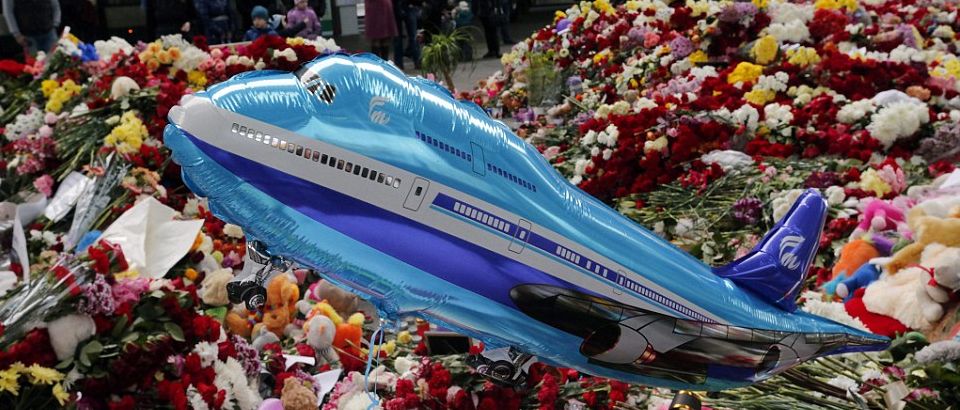
Mourners_memory_5.11.15

2.  Forensic examination of victims’ remains left no doubt that they died as a result of an explosive blast.

These findings spread like wildfire in Moscow and in St. Petersburg among the grieving families. The Russian leader saw he could no longer afford to line up with Cairo’s playdown of the terrorist factor.

3. Moscow received intelligence that the Islamic State plans to follow up on its first “success” with further terrorist attacks on Russian and European passenger jets.

By downing the Russian airliner over Sinai, the Islamist terror group delivered a huge blow to Egypt’s tourism industry. Russia tops Egypt’s tourist market. Last year, 3.1 million Russians visited Egypt, yielding $2.5bn out of the total national tourism income of $7.3bn in 2014.

Sharm el-Sheikh was the scene of havoc Friday, as Russian and British tourists mobbed the airport in an attempt to fly home after the Egyptian authorities limited the number of outbound flights.

Keeping up warm relations

November 6, 2015

Keeping up warm relations, Israel Hayom, Shlomo Cesanam, November 6, 2015

(Please see also, Obama rules out Israeli-Palestinian peace deal before leaving office. — DM)

Two state is deadScience and Technology Minister Ofir Akunis, seen with Defense Minister Moshe Ya’alon in the Knesset, says the two-state solution is “dead.” | Photo credit: Noam Revkin-Fenton

The imminent meeting between Prime Minister Benjamin Netanyahu and U.S. President Barack Obama won’t repair their soured ties, but it’s clear that their face-offs are on hold as Israel and the U.S. prepare to deal with Middle East instability.

*********************

Two weeks ago, Defense Minister Moshe Ya’alon met with his American counterpart Defense Secretary Ashton Carter. The defense secretary accompanied Ya’alon everywhere: to a memorial service at the Israeli Embassy marking 20 years since the assassination of former Prime Minister Yitzhak Rabin, on a visit to the American Cyber Command at Fort Meade, in a dialogue with students and to a laid-back meal at the Pentagon, at which a military choir performed “Jerusalem of Gold” accompanied by a violinist. The Americans promise that the warm welcome Ya’alon received will continue — even if not with the same intensity — for another two days, when Prime Minister Benjamin Netanyahu is scheduled to land in Washington, ahead of a Monday meeting with U.S. President Barack Obama at the White House.

The meeting will not obliterate the soured relations between the two leaders. They “did not have a chance to meet” this year, but they did manage to publicly face off on important issues and policies. The main bone of contention is of course the understandings reached between six world powers on Iran’s nuclear program. Nevertheless, it is clear to everyone that the confrontations are over as is the discussion of whether the tension between the two leaders harmed the relations between their respective nations. Both sides agree that the threats, challenges and mutual interests supersede the various disagreements, and that new arrangements must be made for the future.

The agenda of the meeting will address coordination on a strategic outlook for the region. Two specific issues are up for discussion: Preserving Israel’s qualitative advantage over the rest of the countries in the region, and American aid to strengthen Israel during the next 10 years. The aforementioned edge was created as a result of the nuclear deal with Iran and the “compensation packages” the U.S. handed out to its allies in the Persian Gulf — first and foremost Saudi Arabia, but also countries like Jordan and Egypt. The aid comes in the form of information, technology, financial aid, weapons and ammunition.

The American aid will be provided under a 10-year plan. Former President George W. Bush signed the last aid deal, which expires at the end of 2017. Israel expects to fill up a “shopping cart” with items that already appear on a long list of requests, including a bump in the amount of defense assistance from $3.1 billion to $4 billion.

Since the deal will only take effect two years from now, diplomatic officials are discussing two separate lists: one for the long term, and a second that will give Israel the help it needs to preserve its advantage. The goals of the meeting between Netanyahu and Obama are based on the assumption that the Middle East is unstable, and will remain so for the next decade. That assumption is backed up by reports from teams of professionals in both the U.S. and Israel.

The bottom line, a member of Israel’s Diplomatic-Security Cabinet said this week, is that “the U.S. and Israel are in sync. They see eye to eye on the existing situation and have identical assessments of the changing situation in the region.”

Both Israel and the U.S., for example, agree that even after the Iran nuclear deal, the Tehran regime is no less dangerous. They both know that the Iranian money that was unfrozen when the sanctions were lifted, is already going to fund terrorism.

Netanyahu and Obama are going to talk about strategy, as the proposals for aid to bolster Israel are already known. But because in our region it is hard to know what the day will bring, both sides have built a model according to which “a variety of measures to provide a variety of solutions to a variety of threats” must be offered. The discussion in the White House will deal with all of the security ties between the two countries: Long-term financial aid; cooperation on cybersecurity; air, land, sea, and satellite power; intelligence; technological and defense development, including more Iron Dome batteries and similar defense systems, and the promotion of solutions that are still being developed. On everything relating to the immediate and broad-scale answer, Israel is asking for a way of defending itself against long-range and precision-guided missiles.

Netanyahu and Obama will also have to decide whether the time has come to strike a reciprocity deal — a defense pact between the two nations — that does not include a requirement to inform each other of certain covert actions, such as an attack on Iran. A deal like that would provide an answer for any scenario in which Iran breaks through to a nuclear bomb before the deal on its nuclear program is up.

“We left Gaza — and what did we get?”

But the headaches do not end there. When Netanyahu returns from the U.S., he will be facing two other important events: passing the state budget, which will among other things determine the defense budget, and the scheduled release of convicted spy Jonathan Pollard from a U.S. prison, which will mark the end of a long dispute with the Americans on the Pollard matter.

In Jerusalem, Netanyahu’s meeting with Obama is seen with utmost importance. Many officials at the diplomatic echelon argue that the meeting explains Netanyahu’s conduct these past few weeks: his measured responses to events in the field, the ban on MKs visiting the Temple Mount, the delay on committee discussions about construction in Jerusalem, and his remark that comparatively speaking, he is the prime minister who has allowed the least amount of building in Judea and Samaria.

On the other hand, Netanyahu is not hiding his official policy that Palestinian Authority President Mahmoud Abbas is not a partner with whom a peace deal can be made and that for now, Israel’s security and defense prowess in Judea and Samaria must be solidified without any visible changes.

The opposition and some media outlets have voiced criticism of Ya’alon, who is being accused of wanting to “manage” the conflict with the Palestinians and of directing “a policy of carrots” rather than finding a solution to it. Netanyahu, on the other hand, is accused of marking time and cultivating a vision in which we will “always live by the sword.”

The criticism is local, but it echoes throughout the world. That is why it was important to Netanyahu to issue a reply this week: “I’m not deceiving the public. We are living in the heart of radical Islam, and no policy we adopt will turn our neighbors into Norwegians or Swedes. We withdrew from every last [inch] of the Gaza Strip and didn’t get peace, [we got] rockets and terrorism. Therefore — with an arrangement or without one — we will always need the IDF to protect ourselves.”

Netanyahu is arriving in Washington as the head of a narrow right-wing government, most of whose members oppose a two-state solution. A member of his own Likud party, Science, Technology and Space Minister Ofir Akunis, said twice this week — at a weekend cultural event in Beersheba and at a Likud conference in Kfar Saba — that “the two-state solution is dead.”

According to Akunis, “the idea is irrelevant and is no longer at all possible.”

The understandings and agreements between Israel and the U.S. are also tied into the American and European demand to “end the occupation” at any price and “prevent apartheid.” While the security and defense factor is in place, Israel has no solution when it comes to the world’s demands on the Palestinian issue.

Embedded in Northern Afghanistan: The Resurgence of the Taliban

November 6, 2015

Embedded in Northern Afghanistan: The Resurgence of the Taliban, VICE News, November 6, 2015


According to the blurb following the video,

In late September, the Taliban launched an offensive against Kunduz, a provincial capital in northern Afghanistan, capturing key buildings and freeing hundreds of prisoners from the city’s jail.

The offensive sparked a fierce battle between the militants and government forces, supported by US airstrikes. After several days of fighting, Afghan troops recaptured the city, and took down the Taliban’s flag from the central square.

American planes targeted Taliban positions, but at the beginning of October, a hospital run by medical charity Doctors Without Borders (Médecins Sans Frontières) was hit, killing 22 hospital staff and patients, with many seriously injured. The Pentagon later admitted that the strike was a mistake.

Gaining exclusive access to the Taliban, VICE News filmmaker Nagieb Khaja spoke to fighters that briefly took control of Kunduz — the first major city to fall to the group since it was ousted from power in 2001.

Syria Will be the Next Vietnam-Style War if Obama Doesn’t Learn from History

November 6, 2015

Syria Will be the Next Vietnam-Style War if Obama Doesn’t Learn from History

By A. Trevor Thrall and Erik Goepner

Source: Syria Will be the Next Vietnam-Style War if Obama Doesn’t Learn from History | Cato Institute

yria has the potential to become America’s new Vietnam — so, as Barack Obama sends the first 50 special operations troops to Syria to engage the Islamic State, we must be wary of history repeating itself.

The original mistake with Syria, as with Vietnam, was for leaders in Washington to believe that civil wars and insurgencies taking place halfway around the world represent a critical national security interest. Back then, the illusory “domino theory” — the idea that if one nation went communist it would start a chain reaction leading all the other nations in the region to do the same — justified the decision to engage in a tiny nation that itself represented zero threat to the United States. A version of that logic is at work again.

We’ve been told that it matters a great deal to US security interests whether Assad rules in Syria — but it does not. At last check an Assad has run Syria since 1970 without requiring US intervention. And any successor regime inheriting a destroyed Syria could hardly be a threat. Nonetheless, this assumption creates a powerful bias toward intervention that is difficult to check regardless of the strategic reality.

Before that original “forever war”, President John F Kennedy also told Americans that the United States was only training the South Vietnamese army. But US engagement eventually metastasized into a full-blown military intervention.

Today, after unnecessarily intervening in Syria, the US made things worse by embracing ineffectual and costly relationships with local partners on the ground. After years of arguing that there were no Syrian rebels worth supporting, the Obama administration then decided to try anyway and proceeded to waste hundreds of millions of dollars on perhaps the least successful training effort in US history. As the Centcom commander testified, only “four or five” trained rebels are in the fight.

It’s mystifying why Obama would commit such a colossal mistake when Vietnam provided so many painful lessons in avoiding precisely this kind of situation.

After the fall of Dien Bien Phu in 1954, the Eisenhower administration decided to begin supporting South Vietnam directly. The first casualties of US advisers in Vietnam occurred in 1959. The following year, nearly 700 advisors were operating in Vietnam, with Kennedy tripling the numbers the following year. By 1968, more than 500,000 US service members were in Vietnam.

Vietnam showed that the failure of an initial limited intervention creates political pressures for more aggressive action. In theory, a president should be willing to pull the plug if the initial failure makes clear that intervention is a bad idea. Most often, however, once a president has intervened, his political status is now yoked to the policy; pulling out risks almost certain censure for “losing”.

Regardless of whether things are going poorly, therefore, presidents face tremendous pressure to throw good money after bad. As declassified records later revealed, Lyndon Johnson realized early on that he would not achieve victory in Vietnam. He continued the war, however, in order to preserve the political capital he needed to push ahead with his Great Society programs.

And both the 2007 and 2010 surges in Afghanistan and Iraq are powerful examples of exactly this same kind of reasoning. Neither Bush nor Obama wanted to face the political fallout of withdrawal and perceived failure.

Having promised the world that he would “degrade and ultimately destroy” Isis, Obama now finds himself continually pressed to take more aggressive actions in the Middle East, despite his own doubts about their effectiveness. Most recently, for example, Obama admitted that he had approved the training program for the Syrian rebels even though he never thought it was likely to work.

US military power cannot compel democracy in foreign lands; neither can it force change amongst foreign populations. Only those governments and their people can effect political change if they themselves want it. That is just one of the many lessons that Vietnam can teach the current administration — if, that is, they are willing to learn.

Russia sends anti-aircraft missile systems to Syria

November 6, 2015

Russia sends anti-aircraft missile systems to Syria Russia has sent missile systems to Syria to avert aircraft attacking Russian planes, said a top commander. The “Islamic State” has reiterated claims it downed a Russian civilian plane as retribution for airstrikes.

Source: Russia sends anti-aircraft missile systems to Syria | News | DW.COM | 05.11.2015

The Russian Air Force’s commander-in-chief said in an interview with Russian daily Komsomolskaya Pravda that Russia sent “anti-aircraft missile systems” to Syria to better protect its fighter planes engaged in daily airstrikes in the Middle East country.

“We have calculated all possible threats. We have sent not only fighter jets, bombers and helicopters, but also anti-aircraft missile systems,” Colonel General Viktor Bondarev told the Russian daily Komsomolskaya Pravda.

Bondarev said there were many reasons for the decision, including the possibility of Russian combat aircraft being hijacked or attacked.

“There may be different kinds of force majeure. For example, the hijacking of combat aircraft in the territory of Syria’s neighboring states to strike at us. And for this, we must be prepared,” Bondarev added.

War on terrorism?

The statement comes after more than a month of Russian airstrikes in Syria, which the Kremlin says are aimed at destroying the Islamic State militant group.

 Huge NATO exercise to send signal to Russia

Moscow has been accused by Western governments of propping up the regime of Syrian President Bashar al-Assad, which ignited a civil war when it cracked down on pro-democracy protesters in 2011.

Syrian rebels and activists claim that the strikes specifically target anti-Assad fighters, and rarely hit the militant group’s sites.

However, Russia’s defense ministry said on Tuesday that it reached out to opposition leaders in a bid to bolster cooperation in the fight against “terrorism,” although it was unclear which rebel groups established contact.

Islamic State claims retribution

Meanwhile, the Islamic State on Wednesday reiterated claims that it downed a Russian civilian aircraft last week; a statement that the British foreign minister says could prove likely.

“If you think you can destroy our state by sending your planes, vehicles and soldiers, you are wrong and you will regret that,” a Russian “Islamic State” militant said in a video, reported news site Vocativ.

“The plane we downed is the best proof. We will not be satisfied with downing your planes, but will storm your houses and will slaughter you.”

Russia to suspend flights to Egypt until causes of Sinai crash are clear

November 6, 2015

Russia to suspend flights to Egypt until causes of Sinai crash are clear

Published time: 6 Nov, 2015 13:32 Edited time: 6 Nov, 2015 15:04

Source: Russia to suspend flights to Egypt until causes of Sinai crash are clear — RT News

© Maksim Blinov
President Vladimir Putin has agreed with the Federal Security Service to halt all Russian flights to Egypt following an October 31 passenger plane crash in Sinai that killed all 224 people on board.

FOLLOW RT’S LIVE UPDATES

As long as we haven’t established the causes of the incident, I consider it appropriate to suspend the flights of Russian aircraft to Egypt. This primarily applies to the tourist flow,” FSB director Aleksandr Bortnikov told a meeting of the Russian Anti-Terror Committee on Friday.

Egypt has provided Russian investigators with access to all the fragments of the crashed plane as well as the baggage, he said. There is need for “absolute objectivity” and “confirmed data” to establish the causes of the disaster, he added.

Kremlin spokesman Dmitry Peskov said that Putin agreed with the recommendations of the Federal Security Service (FSB). He added that Putin had instructed the government to ensure the safe return of Russian citizens from Egypt and to cooperate with the Egyptian authorities on establishing air traffic security.

Peskov said that the decision to suspend flights was “solely connected with security” reasons, and doesn’t suggest that Moscow considers the A321 crash to be a terrorist attack.

Russia’s civil aviation regulator has started drawing up plans to suspend flights between Russia and Egypt, the agency’s chief, Alexander Neradko, said Friday.

Around 45,000 Russians are currently on holiday in Egypt, TASS cited figures provided by Russia’s tourism agency.

Swabs and scrapings from all fragments of the [crashed] plane, baggage and soil have been taken by Russian experts,” said the head of the Russian Emergencies Service, Vladimir Puchkov, during the meeting.

I underline once more that the necessary samples have been taken from all the elements that can contain traces of explosives,” he added. “If there were explosives on the plane, we will be able to determine it.”

READ MORE: Cherry-picking facts may lead Sinai crash probe down MH17 lane – Russian aviation agency chief

The Airbus A321 belonging to Russian Kogalymavia, which uses the brand name Metrojet, crashed in Egypt 20 minutes after takeoff from Sharm el-Sheikh airport on October 31. All 217 passengers and seven crewmembers on board died in the disaster, making it the deadliest incident of this kind in Russian aviation history. There was no distress call prior to the crash.

Following the disaster, the head of Russian aviation agency Rosaviatsia, Aleksandr Neradko, said that all the signs suggested that the destruction of the plane occurred “in the air and at a great altitude.” The evidence for that was the remains of the plane and the bodies, which have been scattered over an area measuring about 8 km by 4 km, he said.

The airline of the ill-fated passenger jet said on Monday that the plane must have been damaged by a force in flight and couldn’t have just broken apart.

On Tuesday, US media cited sources in the intelligence community saying that that a US infrared satellite had detected a heat flash in the same vicinity, indicating that an explosion may have occurred on board.

On Thursday, UK Prime Minister David Cameron announced that it was “more likely than not” that a bomb caused the crash. His comments were met with doubts from Moscow. During a telephone conversation between Cameron and Putin on Thursday, the PM was accused of “acting before he knows the facts,” according to tabloid paper the Sun.

On Wednesday, Britain halted flights from and to the resort city of Sharm el-Sheikh over concerns that the Russian passenger jet was downed by a bomb on board.

Earlier in the week, a militant group associated with Islamic State (IS, formerly ISIS) claimed to have shot down the Russian plane, but this claim has been deemed unreliable.

16-year-old seriously hurt in Hebron shooting attack

November 6, 2015

16-year-old seriously hurt in Hebron shooting attack 18-year-old also lightly hurt in attack near the Cave of the Patriarchs

November 6, 2015, 5:05 pm

Source: 16-year-old seriously hurt in Hebron shooting attack | The Times of Israel

Israeli security forces fire tear gas canisters to disperse Palestinian protesters during a demonstration in the West Bank city of Hebron, on October 27, 2015. (AFP Photo/Hazem Bader)

Israeli security forces fire tear gas canisters to disperse Palestinian protesters during a demonstration in the West Bank city of Hebron, on October 27, 2015. (AFP Photo/Hazem Bader)

Two Israeli teens were hurt Friday evening in a shooting attack at the Cave of the Patriarchs in the West Bank city of Hebron.

One of the two, a 16-year-old, was seriously hurt and the other, aged 18, sustained light injuries.

The two were hit by sniper fire, Maariv reported. Both of the victims were said to be conscious at the scene of the attack.