Archive for August 11, 2015

Contentions | The Iran Deal’s Evaporating Logic

August 11, 2015

Contentions | The Iran Deal’s Evaporating Logic, Commentary Magazine, August 11, 2015

Proponents of the Iran nuclear deal are finding the justifications for compelling Congress to ratify the accord, save for preserving Barack Obama’s fragile self-image, are coming apart. As such, the accord’s supporters have increasingly turned to defending the deal with appeals to the president’s stature and authority, as well as by calling into question the motives and character of its opponents. That alone should tell you all you need to know. Though some of the Iran nuclear deal’s remaining backers do still occasionally claim that it will succeed in what was once its singular purpose: limiting Iran’s ability to produce prohibited armaments. One of most convincing precedents supporting this contention has, however, been largely disaffirmed. 

When asked to cite a model to demonstrate how the nuclear deal will not only prevent Iranian from developing a fissionable device but also produce a variety of happy byproducts like the moderation of the Islamic Republic’s destabilizing behavior, the deal’s supporters most frequently point to the 1987 Intermediate-Range Nuclear Forces (INF) treaty with the Soviet Union.

“From the Western perspective, the nuclear deal represents the most important security agreement since the signing of the Intermediate-Range and Shorter-Range Missiles (INF) Treaty between Washington and Moscow during the twilight years of the Cold War,” Al Jazeera columnist Richard Javad Heydarian averred.

Peter Beinart took this contention an ill-advised step further. “By 1987, Reagan had signed the Intermediate-Range Nuclear Forces (INF) treaty, the most sweeping arms-control deal of the Cold War. His rhetoric toward the Soviet Union also radically changed,” Beinart wrote in The Atlantic. “Reagan, in other words, dramatically de-escalated the Cold War long before he knew Gorbachev would let Eastern Europe go free and at a time when prominent conservatives were literally calling him Neville Chamberlain for signing the INF deal.”

That’s true. Graham Allison, also writing in The Atlantic, quoted a few conservatives from the period that feared Reagan was providing the Soviets with a reprieve from the crushing obligations of the arms race. “Reagan insisted that he was capable of brokering agreements to reduce the risks of accidents or unauthorized actions that risked nuclear war with one hand, while redoubling his efforts to undermine the Soviet regime with the other,” he insisted. “And he did just that. The Soviet Union collapsed in 1991.”

This is a remarkable simplification of history. Beinart claims that Regan’s shifting rhetoric (he renounced his “evil empire” comment while standing in the middle of Red Square under the watchful eye of a young Vladimir Putin) provided Mikhail Gorbachev space to make the case to the Politburo that he was not capitulating to Reagan in this accord. But this is a variation of the liberal case that ideational and not material considerations led to the collapse of the Soviet Union. Moreover, the INF effectively marked the end of the arms race, in part because it had already been lost by the Soviets. By contrast, there has been no ideational shift in the theocratic regime in Tehran nor is there any indication in Iran’s behavior that it is desirous of rapprochement with the West. If anything, Iran has behaved in a more bellicose fashion as nuclear negotiations with the P5+1 intensified.

The USSR is long gone, but the INF remains in place. Opponents of the Iran nuclear deal are advised to pay close attention to what that arrangement has become. It is no longer an arms control agreement but a political relic that serves little purpose but to shield from public scrutiny the extent to which Russia has become an irresponsible and revanchist international actor.

Writing in Politico Magazine in April, Foreign Policy Initiative scholars Eric Edelman and Tzvi Kahn outline the scope of the Russian’s efforts to game the INF. In response to Russia’s brazenness, American officials have routinely downplayed Moscow’s cheating. Despite repeatedly warning the United States that it was prepared to violate the INF over the course of the last decade, the Bush administration refused to acknowledge that reality. When Moscow did violate the terms of the INF in this decade, the Obama administration also pretended not to notice. And when this administration finally did address Russia’s violations of the terms of the INF, that acknowledgement was not followed on with any consequences.

That failure of resolve continues even today. According to the Washington Free Beacon’s Bill Gertz, a Pentagon assessment last month revealing the extent of Russia’s violations of the INF paints a damning picture of the Kremlin’s behavior. Unfortunately for anyone who would like to fully understand how Russia has undermined the INF, the White House is allegedly blocking that report’s release.

“Rep. Mike Rogers, chairman of the House Armed Services strategic forces subcommittee, disclosed the existence of the Pentagon assessment last month and said the report is needed for Congress’ efforts to address the problem in legislation,” Gertz reported. “Rogers said the assessment was conducted by chairman of the Joint Chiefs of Staff Gen. Martin Dempsey, and noted that it outlines potential responses to the treaty breach.”

To acknowledge the treaty’s failure would provide additional political legitimacy to an effort by House Republicans that seeks to provide funding for short-range cruise missile defenses in Poland and Romania. That’s a direct repudiation of this White House, which continues to stand by its 2009 rejection of a Bush-era deal that would have provided the Czech Republic and Poland with long-range interceptor and radar technology. In short, politics is dictating American national defense planning and strategy.

“Similarly, for decades, Tehran has violated its nuclear commitments — and the United States has failed to hold it accountable,” Edelman and Kahn observed.

There is no evidence to suggest that regime as demonstrably duplicitous as Iran’s will not cheat on this arrangement. In fact, the terms of this deal would make it difficult to definitively identify cheating, much less to marshal support for an international response to it. Even if such behavior could be identified, though, it’s not entirely clear that this administration (or its successor, presuming the next administration is a Democratic one) will be predisposed to punish Iranian cheating at all. To acknowledge the fact that the nuclear deal with Iran has failed would be to invite searing criticism from the deal’s domestic opponents.

The INF is a treaty in a persistent vegetative state; it’s corporal form remains, but its spirit has long since passed on to another plane. A conventional arms race in Eastern Europe has taken its place. If the West were to acknowledge that arms race, it would be obliged to participate in it. So it simply refuses to acknowledge it. If the Iran deal fails, its proponents in Washington are unlikely to ever say as much. Not until it is too late.

Egypt’s Christians in the Shadow of the Muslim Brotherhood

August 11, 2015

Egypt’s Christians in the Shadow of the Muslim Brotherhood, Washington Free Beacon, August 11, 2015

(Please see also, WFB’s Bill Gertz discusses story on Obama support for Muslim Brotherhood on Steve Malzberg Show. — DM)

Copts view the Obama administration cynically. Egyptians now whisper that the American president who pleased Arab liberals with his speech “A New Beginning” at al-Azhar in 2009 is secretly funding the Muslim Brotherhood and purposefully neglecting the Islamic State. A group of Copts protested outside of the White House in February 2015, demanding more aggressive action against IS following the beheading of the 21 Copts.

Al-Ahram, the largest newspaper in Egypt, published reports in 2013 that the United States diplomatic mission in Egypt, led by Ambassador Anne Patterson, was discouraging Coptic Christians from participating in protests against Morsi. Even though Patterson adamantly denied the accusations, the report sowed more distrust among Copts.

Tensions between the Coptic community and the administration worsened when, in the same year, an Obama Homeland Security adviser named Mohamed Elibiary suggested Copts raising awareness of their persecution were promoting “Islamophobic” bigotry.

**************************
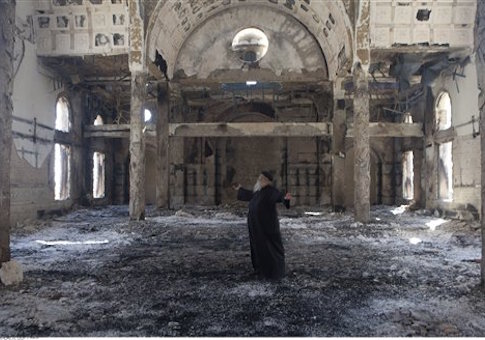
Christian Coptic Priest Father Samuel reacts as he stands inside the burned and heavily damaged St. Mousa church in Minya, Egypt / AP

In the nearly five years of turmoil that have followed the resignation of President Hosni Mubarak in 2011, no group in Egypt has suffered more than the 15 million Coptic Christians. Both a religious and ethnic minority, the Copts are descended from the native population of Egypt who lived and ruled there from the time of the pharaohs until the Roman conquest in 31 B.C. They are the largest Christian community in the Middle East today.

Copts have long been the target of discrimination and persecution in the majority-Arab nation. But this ancient people faced a terrifying new prospect in 2012: Muslim Brotherhood rule.

After Mubarak was ousted, the violence began almost immediately. Churches and schools were burned; peaceful protestors were massacred. When parliamentary elections were held nine months later, they were swept by the Muslim Brotherhood and other Islamist parties. When Mohamed Morsi won the presidential election in May 2012, the party’s victory looked complete. The same year, Morsi gave himself unlimited powers and the party drafted a new constitution inspired by Sharia law.

Morsi benefitted from the organizational advantage of the Muslim Brotherhood. Backed by imams preaching the benefits of religious rule, the previously banned political party was able to defeat the fractured coalitions of the pro-West, liberal, and secular candidates.

“They used thugs to carry out political intimidation against Christians,” a former member of Egyptian Parliament told the Washington Free Beacon. Chants celebrating the Brotherhood victory echoed through the streets of Cairo. “Morsi won! Copts out!”
Ousted president Mohamed Morsi / AP

During Morsi’s rule, Christians were murdered and tortured by the hundreds. Attacks and abductions of Christian children spiked significantly. “Most Americans do not know how vicious and bloody the Muslim Brotherhood is,” Ahmed, a 24-year old secular Muslim, said. “They really can’t understand.”

Pope Tawadros II, Egypt’s Coptic Christian leader, criticized Morsi for negligence after six Christians were killed when police and armed civilians besieged Egypt’s largest cathedral. “We want actions, not words,” the Pope said.

Public accusations of blasphemy also became ubiquitous. A Facebook post interpreted as undermining Islam could bring a mob of fundamentalists with rocks and Molotov cocktails to the homes of Christians, surrounding them with families trapped inside. Sham trials with no legal representation would follow. Anti-Christian terrorism was not punished, but the wrong words often landed Copts in prison, forcing the church to make public apologies and families to leave their towns and villages.

Lydia, an activist who provides relief supplies to torn Christian communities in Upper Egypt, and who requested that only her first name be used to preserve her safety and that of her colleagues, witnessed the Muslim Brotherhood offer the very poorest Egyptians social services that bought their allegiance. “When you have no food or money, you will listen to anyone who gives you the resources your family desperately needs,” Lydia said. “They brainwash the illiterate with extremism so they hurt Christians.”

Still, Morsi’s authoritarian rule—rewriting the constitution, disbanding the Egyptian parliament, tossing potentially obstructive judges into jail—was not long lived. Barely a year after he assumed office, a reported 35 million citizens took to the streets to protest his rule, leading the Egyptian military, under Gen. Abdel Fattah al-Sisi, to remove him from power in July 2013.

Egypt’s ousted President Mohammed Morsi protest at the presidential palace in Cairo, Egypt, Friday, July 26, 2013 / AP

Sen. James Lankford (R., Okla.) told the Free Beacon that had al-Sisi not responded, the promise of Egyptian Democracy would have died. “What it seemed the Egyptian people wanted was more opportunity to be able have some sort of functioning democracy, elections, input into their own government,” Lankford said. “It was the immediate understanding as soon as the Muslim Brotherhood was elected, that was the last election Egypt would have.”

In 2014, al-Sisi was elected Egypt’s new president. He won a solid electoral victory, giving him control of the Egyptian government with the responsibilities of forming a new constitution, a new parliament, and a new judicial system. The Coptic Church fervently supported al-Sisi’s candidacy because the new president promised Copts equality in citizenship, security in their communities, and the ability to build places of worship.

The new Egyptian president challenged the leaders of the Islamic world to push a more moderate message. In December 2014, hundreds of Christian and Muslim theologians gathered at al-Azhar, Egypt’s leading mosque and religious university, participated in a conference to fight “jihad” and promote inclusion. Al-Sisi ambitiously called for a “religious revolution” in January 2015, saying that clerics bear responsibility for the growing extremism in the Middle East.

As president, al-Sisi took many symbolic steps to integrate the Coptic community with the majority Sunni population. In a surprise to most Egyptians, al-Sisi attended a mass at Saint Mark Orthodox Cathedral in Cairo on Christmas Eve, a first for any Egyptian president. Al-Sisi regularly invites Pope Tawadros II to appear beside him when he announces major policy rollouts or requests public dialogue from senior advisers.

Al-Sisi also appointed two Copts as members of his cabinet. Under the constitution, the president of Egypt has the power to select 10 members of parliament. Political observers believe he will select Copts to fill a majority of those appointed seats to offer a more representative parliament.

“Our lives haven’t changed much but one positive result of the revolution is the Egyptian people have politically woken up,” said Hala, a Mubarak-era government official who also wished to be identified by her first name only because she fears political retribution. “We no longer accept what we are told. Egyptians are at least aware of the government’s actions and they are more aware of the troubles Copts face.”

But while al-Sisi’s administration provides a welcome change of tone toward the Coptic community, the day-to-day lives of Copts remain little changed from the Mubarak days.

Coptic Solidarity is a five-year-old public charity organization and advocacy group devoted to advancing equality for Copts in Egypt. Their efforts have helped raise awareness about the persecution Christians face in the Middle East. Alex Shalaby, an Egyptian businessman currently residing in the United States and Coptic Solidarity’s new president, believes Egypt under al-Sisi has continued many of the same practices as previous presidents Sadat, Mubarak, and Morsi.

“Discrimination is rampant, especially in Upper Egypt. We still see reconciliation tactics pressuring the closing of Christian churches and there are still very few Coptic government appointees, he explained. “Coptic Solidarity monitors all developments within Egypt and we are not able to say much has been accomplished in terms of real change to improve Coptic lives in the last 12 months.”

Human rights groups have been critical of al-Sisi’s record. Amnesty International’s Hassiba Hadj Sahraoui accused the president of “employing the same methods of torture and other ill-treatment used during the darkest hours of the Mubarak era.” The Egyptian government received heavy criticism after a court sentenced hundreds of Muslim Brotherhood members to death, intensifying its crackdown on Islamists.

Despite assurances from al-Sisi, sectarian violence still regularly occurs in the rural villages of Upper Egypt where the government has less control.

In Nasreya, Islamists responded to a video of five Christian students making fun of the Islamic State terrorist groups by demanding the students be turned over to the authorities for insulting the religion of Islam. Villagers hurled rocks at Copts and vandalized their property. No arrests were reported for the attacks but the teacher and students were imprisoned for days.

On March 26, 2015, in El Galaa another horde gathered to protest the building of a new church that served 1,400 Christians, also attacking Christian homes in a similar manner. The local government forced the new church to have no outer symbol of Christianity. In Mayana and Abu Qurqas villages, police raided churches, confiscated items from the altar, and shut down reconstruction work.

Lydia, the activist based in Upper Egypt, has witnessed firsthand the damage from these attacks. “I had to console a girl, nine years old, crying because she was afraid her parents were going to be kicked out of their own home,” she said.
“They are poor, illiterate, and now their home is burned and their own community has banned them. All because they are Christians,” she continued.

“The police don’t bother to protect Christians. They do the exact opposite in Upper Egypt,” Lydia said. “The local governments have been loaded with Islamists for years.”

But violence is not exclusive to the country’s outskirts. On June 30, 2015, the two-year anniversary of the popular uprising against Morsi, Islamists detonated bombs by the homes of well-known Christians. Additionally, The Fathers Church in Alexandria was firebombed on July 22, 2015. This summer’s assassination of Egypt’s Attorney General Hesham Barakat in a car bombing, reportedly carried out by a wing of the Muslim Brotherhood, served as an ugly reminder that Egypt’s violence has not passed.

An Egyptian policeman stands guard at the site of a car bombing that killed n Egyptian policeman stands guard at the site of a car bombing that killed Hesham Barakat / AP

Despite these problems, al-Sisi still enjoys support among prominent Copts. Amir Ramzy is a prominent Coptic judge and public figure in Egypt’s legal system, and a loyal defender of al-Sisi’s administration.

“We cannot remove prejudice overnight,” Ramzy said. “We must focus on changing the attitude of the people on the ground first.”

The judge pointed to the dire state al-Sisi found the country in when he took office as reason for slow progress.

“Egypt is fighting Islamists inside and outside our borders. Egypt is fighting a horrid economy with massive unemployment. Al-Sisi is taking on large projects to change these conditions,” Ramzy said. “It is difficult to control chaos and promote social change at the same time.”

The judge referred to the decades it took the United States to implement civil rights reforms. He asked for reasonable expectations out of Egypt’s new president and insists under al-Sisi the country is heading in the right direction. “Just one year after his election, Egypt has new roads, a new canal, new investments, and a new hope for the poor.”

Despite not being content with the pace of progress, Shalaby said al-Sisi is an improvement over his predecessor. As a retired executive, he said he understood national security and economic development should be the president’s priority. “Al-Sisi must do what is best for Egypt first. What is best for Egypt is what is best for Copts. What is good for Copts is good for Egypt.”

Abdel-Fattah al-Sisi / AP

Copts view the Obama administration cynically. Egyptians now whisper that the American president who pleased Arab liberals with his speech “A New Beginning” at al-Azhar in 2009 is secretly funding the Muslim Brotherhood and purposefully neglecting the Islamic State. A group of Copts protested outside of the White House in February 2015, demanding more aggressive action against IS following the beheading of the 21 Copts.

Al-Ahram, the largest newspaper in Egypt, published reports in 2013 that the United States diplomatic mission in Egypt, led by Ambassador Anne Patterson, was discouraging Coptic Christians from participating in protests against Morsi. Even though Patterson adamantly denied the accusations, the report sowed more distrust among Copts.

Egyptians publicly celebrated when Patterson left the country.

Tensions between the Coptic community and the administration worsened when, in the same year, an Obama Homeland Security adviser named Mohamed Elibiary suggested Copts raising awareness of their persecution were promoting “Islamophobic” bigotry. Elibiary, who generated controversy due to views perceived by some to be friendly to the Muslim Brotherhood, released a series of tweets with the R4BIA salute, perceived to be a symbol of hate by many in Egypt.

Elbiary later deleted his tweets and removed the symbol. Bishop Angaelos, Pope Tawadros II’s personal representative called the incident “disturbing.” Elbiary left the Obama administration under pressure from critics in 2014.

Following the ouster of Morsi, the United States canceled weapons deliveries to Egypt and halted all military aid. As the White House took its time to build a relationship with al-Sisi, Russian President Vladimir Putin visited the country and signed a nuclear agreement.

The White House announced in the spring of 2015 that weapons deliveries to Egypt would ultimately be resumed.

Despite the uneasiness in the country, Christians believe they will one day be equal citizens in their homeland. Such progress may be slow and painful, but amidst anxiety there is hope in Egypt.

Much of this hope is derived from the perception of al-Sisi’s decent treatment of the Copts. Ramzy, the judge, told theFree Beacon, “al-Sisi may not be perfect, but he is Copts’ best chance to promote ourselves from second class citizens. He should receive America’s support.”
Captured Hamas Operative Details Group’s Terrorist Plans

August 11, 2015

Captured Hamas Operative Details Group’s Terrorist Plans, Investigative Project on Terrorism, August 11, 2015

A Hamas operative provided a treasure trove of intelligence during Israeli interrogation concerning the terrorist group’s rebuilding efforts and future terrorist plans, Israel’s intelligence agency Shin Bet disclosed on Tuesday.

The terrorist, Ibrahim Adal Shahada Sha’ar, 21, described about Hamas’ tunnel reconstruction efforts, planned terrorist attacks against Israel, military strategy, and coordination with Iran, the Jerusalem Post reported.

He admitted working on rebuilding underground tunnels and described how some would be used in future attacks against Israel. Sha’ar disclosed the location of digging sites, tunnel entrances and underground routes, and reportedly said that a road built along the border with Israel is intended partly for terrorist attacks involving vehicles charging into Israeli territory.

He admitted that he stored several 50 kg explosive charges in his home and said that fighters kept explosives and other material in their own homes since Hamas commanders worried that the organization’s weapons depots would be targeted by Israel.

Israeli authorities arrested Sha’ar last month at the Erez Crossing after he attempted to enter Israel for “personal or humanitarian reasons.” Officers were aware of Sha’ar’s terrorist background and immediately detained him.

During last summer’s war between Israel and Hamas, Sha’ar participated in specific battlefield operations, including field logistics, transferring terrorists and weapons, and even admitted to setting up an anti-tank improvised explosion device (IED).

Sha’ar provided details of Iranian-Hamas military cooperation, including how Iran transfers funds and supplies weapons and electronics to the terrorist group. Those supplies include devices intended to jam radio frequencies to bring down Israeli drones deployed over Gaza. Furthermore, Sha’ar described how Iran trained Hamas terrorists to use hang gliders for attacks against Israel – a tactic revealed by previous Israeli interrogations of captured terrorists.

Critics of the recent Iran nuclear agreement argue that newly released funds to the Islamic Republic will bolster their regional hegemonic ambitions and global terrorist activities, including transferring more money and weaponry to its terrorist proxies.

According to Israeli intelligence, the Sha’ar detailed plans using tunnels to conduct cross-border attacks against Israeli targets, akin to Hamas’ attempts during last summer’s war. The Hamas operative confirmed that the terrorist group is diverting civilian reconstruction material for the purposes of rebuilding its terrorist infrastructure and underground tunnel network.

Sha’ar was indicted July 31 in the Beersheba District Court for being a member and engaging in activities with a banned organization, attempted murder, and forbidden military training.

Obama vs. the Jews

August 11, 2015

Obama vs. the Jews, Front Page Magazine, Daniel Greenfield, August 11, 2015

21obama

Even in the extremely unlikely circumstance that enough Democrats would come together to veto the deal, Obama had already told the agreement’s leading Democratic opponent in the House, “If Congress overrides my veto, you do not get a U.S. foreign policy that reflects that vote. What you get is you pass this law and I, as president, will do everything possible to go in the other direction.”

****************

It was his birthday and Obama was grouchy.

“It’s my birthday and I’m going to be blunt,” Obama told the Jewish leaders meeting with him. When they complained that, “Words have consequences, and when they come from official sources, they can be even more dangerous,” he was unapologetic. 

“If you guys would back down, I would back down from some of the things I’m doing,” he warned.

By that he meant that if they stopped objecting to the Iran deal, he would stop accusing critics of his nuclear sellout to Iran of being money-grubbing warmongers.

Obama complained, “It’s been a really busy day. You’d think they’d be nicer to me on my birthday.”

His busy day had consisted of a meeting with the ineffectual UN Secretary General, lunch with Biden and a photo op in the East Room. But he also had reservations at Rose’s Luxury, an expensive Capitol Hill restaurant where ordinary people wait for hours to get in.

Rose’s doesn’t take reservations, but Obama was an exception.

Shortly after his meeting with Jewish leaders, he and his close Iranian-born adviser Valerie Jarrett skipped the line at Rose’s and got the party started. On the next day, Obama blasted Republican opponents as treasonous allies of those who chant “Death to America,” even though he was the one who had actually made common cause with Iran’s regime.

The day after that, Senator Schumer called Obama to tell him he would oppose the deal and asked him to let him announce it on Friday. The White House instead leaked it to the Huffington Post.  The first response to Schumer’s announcement came from MoveOn, which blew the dog whistle loudly enough to be heard in the next state over, “Our country doesn’t need another Joe Lieberman in the Senate.”

The only obvious thing that both politicians had in common was that they were Jewish.

Obama had lost the argument on the facts. The majority of Americans opposed the deal by 52 to 28 percent. Even among Democrats, support stood at only 52 percent.

His game plan for winning the debate was to get as ugly and dirty as possible.

Despite having just gotten back into Iraq, after contemplating an attack on Syria and coming off an illegal assault on Libya, any Democrat opposing him risked being accused of wanting another Iraq War. Or as White House press secretary Josh Earnest coyly put it, “This difference of opinion that emerged overnight is one that has existed between Senator Schumer and President Obama for over a decade.”

Obama allies emphasized that Schumer had voted for the Iraq War. Obama was once again rerunning his old campaign against Biden and Hillary, even though one was his VP and the other his successor.

Barack Obama had already rolled out the “lonely little guy in the White House” playbook complaining about lobbies and money. He had been irked at his representatives not getting full access to the AIPAC activists who were visiting members of Congress and was reading from Bush I’s old script. But now he began to sound more like Pat Buchanan ranting about Israel’s “amen corner” beating the drums for war.

Having forgotten the time he sent his campaign consultants to defeat Netanyahu in the Israeli election, he complained that Netanyahu was inappropriately interfering. During his speech, he rediscovered a love for the Constitution which he claimed obligated him to sideline Israel. Sadly he lacked the same love for the Constitution’s Treaty Clause which requires two-thirds of the Senate to ratify a treaty.

The complaints about lobbies and money sounded strange coming from a guy who had his own SuperPAC with tens of millions of dollars to spend. Behind him was a network of organizations with hundreds of millions of dollars in cash on hand and billionaire donors to donate on demand.

The Rockefeller Brothers Fund had invested a fortune into the project. Some of the money went into the Ploughshares Fund, which did its own promotion for the deal, and funneled cash to Global Zero, which released a video promoting the deal featuring Jack Black and Morgan Freeman.  His position was backed by George Soros’ J Street, an astroturfed anti-Israel group that was bringing serious money to the party.

Once Schumer came out on the deal, he was targeted by Credo Mobile and MoveOn, among other powerful left-wing groups, determined that nothing would be allowed to interfere with Iran’s nukes.

There was no shortage of lobbies and money in Obama’s corner. The citizen activists opposed to the deal might have the support of the American people, but they were outmatched by the massive wealth and infrastructure of the Democracy Alliance and Obama’s mainstream media allies.

The teachers, mothers, engineers and small businessmen could travel to Washington D.C. and complain to their Congressman. Obama could go on the Daily Show and complain about them to Jon Stewart.

There was no comparing their respective power.

And all that was without mentioning the Iran Lobby which boasted close relationships with Joe Biden and John Kerry.

Obama continued to escalate tensions with the Jewish community, even though he faced no real risk that enough Democrats would come together to override his veto. Even Schumer’s rejection had bent over backward to praise and flatter him. The American people might disapprove of the deal, but they had also disapproved of ObamaCare and his illegal war in Libya. And he had just rolled over them.

The administration wasn’t in this fight because it worried that it might lose. Between the GOP establishment and Obama, the game had already been rigged. Everyone, including Schumer, would play their parts, get their applause and the agreement would move forward. Hundreds of AIPAC members lobbying a few members of Congress wouldn’t stop that. Neither would a few ads.

Even in the extremely unlikely circumstance that enough Democrats would come together to veto the deal, Obama had already told the agreement’s leading Democratic opponent in the House, “If Congress overrides my veto, you do not get a U.S. foreign policy that reflects that vote. What you get is you pass this law and I, as president, will do everything possible to go in the other direction.”

Obama would implement the deal no matter what Congress did. Iran would get its nukes.

But for Obama, scowling and impatiently tapping his fingers while waiting to go for his birthday dinner, musing that he could have already been there if it wasn’t for these old white men whining to him, looking forward to his round of golf and a trip to Camp David, it had become petulantly personal.

For the left, the political is often indistinguishable from the personal, and for Obama it has always been that way. Obama’s view of government is Louis XIV’s “I am the State”. All opposition is personal. All dissent is treason. Enemies have to be punished on the principle of the thing.

It didn’t matter that the Jewish leaders had zero chance of actually stopping his agreement with Iran. Most of them didn’t even want to be there. What mattered was that they had opposed him and they had to be punished for it.

Obama had compared Americans uneasy about Iran’s “Death to America” slogan to schoolyard bullies who wanted to “smack around” the “little guy” who dared to “mouth off.” But he was the one playing the bully, going out of his way to sow tension, using rhetoric condemned even by Jewish supporters of the deal, not because he needed it to win, but because he was angry and resentful.

Millions of Jews around the world saw the specter of an atomic cloud rising into the sky, but Obama had a birthday meal at Rose’s Luxury to go to, a round of golf to play and his feelings were being hurt and his birthday was being ruined by these annoying Jews who wouldn’t take “No” for an answer.

Obama isn’t even stirring up anti-Semitism to defend the Iran deal. He’s lashing out, accusing critics of being traitors and warmongers, because they ruined his birthday party.

Compromised – John Kerry has much to hide on his ties to Iran.

August 11, 2015

Compromised – John Kerry has much to hide on his ties to Iran, Front Page MagazineKenneth R. Timmerman, August 11, 2015

John Kerry has much to hide on his ties to Iran. As I revealed more than ten years ago, Mr. Kerry has long been sympathetic to the Islamist regime in Tehran.

******************

Secretary of State John Kerry is becoming increasingly frantic as he takes his case for the deeply flawed Iran nuclear deal around the country. 

His latest argument, that congressional disapproval of the deal will be the “ultimate screwing” of Iran’s clerical Supremo – and that we should care – verges on hysteria.

Whether it’s hysterically funny or a psychotic condition would be a tough call, if only the stakes weren’t so high for our security and the security of our friends and allies, starting with the Iranian people.

John Kerry has much to hide on his ties to Iran. As I revealed more than ten years ago, Mr. Kerry has long been sympathetic to the Islamist regime in Tehran.

In June 2002 – just nine months after the 9/11 attacks on America – Mr. Kerry headlined a fund-raising gala for the American-Iranian Council, a pro-regime lobbying group seeking to roll back U.S. sanctions and promote U.S. investment in Iran.

The next day, AIC members returned the favor and hosted a fund-raiser for Senator Kerry’s re-election campaign at the Ritz Carlton in San Francisco that netted more than $26,000. Many of those same fund-raisers became bundlers for Mr. Kerry’s failed 2004 presidential bid.

Among those opening their wallets was a stunning 34-year-old Iranian woman named Susan Akbarpour, aka Zahra A. Mashadi. “I am an actor in U.S. politics,” Ms. Akbarpour boasted to a reporter. “I am a fund-raiser for all candidates who listen to us and our concerns.”

The only problem was, her political contributions were illegal because she did not have a green card. The Kerry campaign never returned those contributions and the Federal Election Commission never investigated.

Mr. Kerry has been accused of behaving as “Iran’s lawyer” in the nuclear negotiations, finding excuses for Iran’s bad behavior and justifications for a seemingly endless stream of U.S. capitulations to Iran.

But that behavior is not new. In fact, during a debate with President George W. Bush during the 2004 campaign, Mr. Kerry pledged that had he been president since 2001, he would have “offered the opportunity to provide the nuclear fuel” to Iran, to “test them, see whether or not they were actually looking for it for peaceful purposes.”

Why would the United States appoint as lead negotiator a politician whose long-held views favoring our adversary in those negotiations were well-known?

Much has been made recently of Secretary Kerry’s family ties to Iran, a fact that was never raised during his confirmation hearings as Secretary of State.

Vanessa Kerry tartly dismissed rumors that have circulated in the Iranian-American community in Los Angeles since her 2009 wedding that the son of Iran’s Foreign Minister, Mehdi Zarif, was best-man for her husband, Behrouz Vala Nahed, an American-born neuro-surgeon. “Happy 2 verify. No wedding party when we married. No Zarif’s son. Sorry 2 disappoint,” she tweeted recently.

An Iranian website close to the father, Mohammad Javad Zarif, initially reported that Brian Nahed and Mahdi Zarif had “only” been college roommates, but later changed the on-line version of the article without noting the correction.

Mahdi Zarif attended the City University of New York and lived in the United States for more than a decade while his father was the Islamic Republic’s ambassador to the United Nations (and repeatedly met with U.S. Senators in Washington, DC, including now vice-president Joe Biden). Dr. Nahed took his pre-med undergraduate degree several years earlier at UCLA.

But the presence or not of Zarif the son at Kerry the daughter’s wedding is a side show and detracts from an examination of Mr. Kerry’s fundamental conflict of interest in serving as chief U.S. negotiator with Iran.

The facts are indisputable:

  • Mr. Kerry took illegal campaign cash from an Iranian national who, while claiming to be a political refugee, assaulted anti-regime protesters in Los Angeles, promoted U.S. computer and software investment in Iran in violation of U.S. sanctions, and boasted of influencing U.S. politicians with a pro-Tehran agenda. Taking that illicit cash tainted Mr. Kerry and identified him a “soft target” to agents of the Iranian regime.
  • Mr. Kerry carried through his side of the bargain, embracing the pro-Tehran agenda during his 2004 presidential campaign, while his Iranian backers kicked in substantial fresh cash to his campaign.
  • Mr. Kerry met Zarif at a private reception hosted by George Soros in New York in 2005, shortly after Soros’s Open Society Institute hosted Zarif at a policy luncheon for New York media elites.
  • Mr. Kerry sought to travel to Tehran to jumpstart diplomatic negotiations in December 2009, but was rebuffed by Tehran.

As I wrote earlier this year, a former aide to Iranian president Rouhani, who defected while covering the nuclear talks, revealed that Mr. Kerry and the U.S. delegation were seen by the Iranian negotiating team as secret allies who helped arm-twist reluctant partners such as France into making major concessions.

I know Iranian-Americans who volunteered for U.S. military service who were forced to leave the military when family members traveled to Iran. Why? Because counter-intelligence professionals who understood the Iranian government track record of exploiting family relationships for intelligence or political purposes indicated they could be compromised.

After all, the Soviets used family relationships all through the Cold War to compromise unwilling individuals to collaborate with their cause.

The game is as old as the intelligence business itself: find some string to manipulate or blackmail your adversary, then pull as hard as you can.

When it comes to Iran, John Kerry is about as compromised as they get.

What Iran’s hostile reaction to the Parchin issue means for the nuclear deal

August 11, 2015

What Iran’s hostile reaction to the Parchin issue means for the nuclear deal, Washington Post, David Albright, August 10, 2015

The United States and Congress should clearly and publicly confirm, and Congress should support with legislation, that if Iran does not address the IAEA’s concerns about the past military dimensions of its nuclear programs, U.S. sanctions will not be lifted. To do otherwise is to make a mockery of the nuclear deal.

********************

Chico Marx said: “Who you gonna believe? Me or your own eyes?” Iran’s Foreign Minister Mohammad Javad Zarif said over the weekend that my organization, the Institute for Science and International Security, was spreading lies when we published satellite imagery that showed renewed, concerning activity at the Parchin military site near Tehran. This site is linked by Western intelligence and the International Atomic Energy Agency (IAEA) to past work on nuclear weapons. But like Chico, instead of acknowledging the concern, the Iranians chose to deny the visible evidence in commercial satellite imagery. Iran’s comments would be mirthful if the topic were not so serious.

Zarif is also calling U.S. intelligence officials and members of Congress liars. They are the original source of the information both about renewed activity at Parchin and concerns about that activity. All we did was publish satellite imagery showing this activity and restate the obvious concern.

Moreover, this information about renewed activity at Parchin does not come from opponents of the Joint Comprehensive Plan of Action negotiated between the United States, five other world powers and Iran, as Zarif suggested. We are neutral on whether the agreement should be implemented and have made that position clear for weeks. The U.S. intelligence community is hardly opposed to the deal. Iran’s attempts to dismiss this concern as the work of the deal’s foes also is just wrong.

Concern about Parchin has become more urgent now that there is a debate raging over whether the IAEA will have adequate access to this site under the terms of its deal with Iran. It would be irresponsible not to worry about reports that suggest that Iran could be again sanitizing the site to thwart environmental sampling that could reveal past nuclear weapons activities there. This concern is further heightened because Iran has demanded to do this sampling itself instead of letting the IAEA do it. Such an arrangement is unprecedented and risky, and will be even more so if Iran continues to sanitize the site. In the cases of the Iranian Kalaye Electric site and the North Korean plutonium separation plant at Yongbyon, the success of sampling that showed undeclared activities depended on samples being taken at non-obvious locations identified during previous IAEA visits inside buildings. The IAEA will not be able to visit Parchin until after the samples are taken, and it remains doubtful that the inspectors will be able to take additional samples.

Some of this can be written off to Zarif’s volatility. At one point during the negotiations, he yelled so loudly at Secretary of State John F. Kerry that those outside the room could hear him. He obviously angers easily. But he is also one of the more reasonable Iranian government officials. I can remember in the late 1990s discussions with Iranian government and nuclear officials in New York where the Iranians vehemently stated, despite the overwhelming evidence to the contrary, that they did not have any gas centrifuge programs. I was presenting the evidence that they did, in fact, have a centrifuge program, one in fact aided by Pakistan, and at one of these meetings, Zarif quietly said to me that he had always told me that Iran had the entire fuel cycle — technical language admitting to an enrichment program. His willingness to admit the obvious gave me hope that the crisis over Iran’s program could be solved diplomatically. But on Parchin, his words appear to reflect Iranian government intransigence on its past nuclear weapons program. Its action is an assault on the integrity and prospects of the nuclear deal.

Iran’s reaction shows that it may be drawing a line at Parchin. Resolving the Parchin issue is central to the IAEA’s effort to resolve concerns about Iran’s past work on nuclear weapons by the end of the year, but Parchin is not the only site and activity involved in this crucial issue. The IAEA needs to visit other sites and interview a range of scientists and officials. Instead of allowing this needed access, Iran appears to be continuing its policy of total denial, stating that the concerns are merely Western falsifications and fantasies. The United States recently reasserted that it believes Iran had a nuclear weapons program and stated that it knows a considerable amount about it. So, if Iran sticks to its strategy, one can expect an impasse that includes Iran refusing to allow the IAEA the access it needs to sites and scientists within the coming months.

U.S. officials have stated that the Joint Comprehensive Plan of Action requires Iran to address concerns about its past work on nuclear weapons prior to the lifting of sanctions. However, Iran may argue otherwise, and one could easily conclude that its recent actions are the start of such a reinterpretation of the agreement. The United States and Congress should clearly and publicly confirm, and Congress should support with legislation, that if Iran does not address the IAEA’s concerns about the past military dimensions of its nuclear programs, U.S. sanctions will not be lifted. To do otherwise is to make a mockery of the nuclear deal.

State Department Interferes in Favor of PLO Terrorists

August 11, 2015

State Department Interferes in Favor of PLO Terrorists, Israel National News, Tova Dvorin, August 11, 2015

US President Barack Obama is reportedly seeking to lower that fine – following a series of conflicts between officials from the State Department and the Justice Department over the issue, an official involved in the case told the New York Times Tuesday. 

*********************

Washington asks a judge presiding over terror victims’ compensation case to reduce money paid to Israelis injured during Second Intifada.

The Obama administration has asked a judge Monday to “carefully consider” the size of the bond demanded from the Palestinian Authority (PA) for its role orchestrating years of terror attacks against Israelis and Jews – directly interfering in a US court case.

In February, the Palestine Liberation Organization (PLO) – the terror group behind the PA – was found liable to pay $218.5 million to victims of terror, a figure that was set to be tripled to $655.5 million according to the anti-terrorism laws under which the case was brought.

Legal rights group Shurat Hadin (Israel Law Center) helped represent the 11 families who charge the PA and PLO of inciting, supporting, planning and executing the seven terror attacks which killed American citizens between 2000 and 2004.

In May, the PA admitted it cannot pay such a hefty fine, however – as it is struggling under billions of debt despite an ongoing stream of aid from Israel and other countries – and called the case “political extortion.”

Now, US President Barack Obama is reportedly seeking to lower that fine – following a series of conflicts between officials from the State Department and the Justice Department over the issue, an official involved in the case told the New York Times Tuesday.

In a document entitled “Statement of Interest of the United States of America,” the Obama administration expressed concerns over the payments hurting the PA’s basic government services.

Forcing the PLO to pay “a significant portion of its revenues would likely severely compromise the P.A.’s ability to operate as a governmental authority,” deputy Secretary of State Antony J. Blinken wrote. “A P.A. insolvency and collapse would harm current and future U.S.-led efforts to achieve a two-state solution to the Israeli-Palestinian conflict.”

Blinken stressed in the document, however, that the State Department allegedly values the rights of terror victims to seek “just compensation” and was not taking a position on the case itself, only on the high bond.

“The United States strongly supports the rights of victims of terrorism to vindicate their interests in federal court and to receive just compensation for their injuries,” Blinken claimed.

Justice Department officials have maintained throughout the proceedings that any State Department interference in the case would interfere with the victims’ rights for compensation and justice.


Israeli Scientists Reach Breakthrough in HIV Research

August 11, 2015

Israeli scientists at Ben Gurion University of the Negev have reached a breakthrough in HIV and leukemia research.

By: Hana Levi Julian

Published: August 11th, 2015

via The Jewish Press » » Israeli Scientists Reach Breakthrough in HIV Research.

Soroka Medical Center in Be'er Sheva.
Soroka Medical Center in Be’er Sheva.
Photo Credit: Miriam Alster / Flash 90

Israeli scientists have made a breakthrough in researching the HIV virus, Ben Gurion University of the Negev has announced.

Dr. Ran Taube of the Department of Microbiology, Immunology and Genetics says that his team has found similarities between HIV and leukemia.

The study aims to wipe out AIDS, which is caused by the HIV virus, and also to slow down the development of leukemia as well. The study is aiming specifically at the rare mixed -lineage leukemia (MLL) that occurs mostly in children and hinders the development of cells in the blood.

Taube and his team worked in collaboration with Dr. Uri Rubio, of Soroka Medical Center in Be’er Sheva.

The researchers said the discovery will lead to a “revolutionary diagnosis and the key to the clinical solution that will prevent infection with HIV and will destroy the deadly virus.”