The present deal with Iran poses a threat not only to Israel, but to the U.S. and the world
In Israel, one of the world’s rowdiest democracies, politicians rarely agree on anything. Which is why their reaction to the nuclear arms deal with Iran is so unique. For the first time in living memory, virtually all Israelis – left, right, religious, secular, Arabs, Jews – are together calling the deal disastrous.
The reasons might not be clear to many readers of the agreement. According to preliminary reports, its 100 pages contain bewilderingly complex provisions for supposedly delaying Iran from making a bomb. There are international inspections of the Iranians’ nuclear facilities but none that would actually catch them off guard. There are limits to the number of centrifuges with which Iran can enrich uranium to weapons grade, but only for a decade during which not a single centrifuge will be dismantled. And Iran can continue to research and develop more advanced technologies capable of producing nuclear weapons even faster. Most mystifying still, the deal recognizes Iran’s right to peaceful nuclear power without demanding that Iran cease promoting war throughout the Middle East and terror worldwide.
For Israelis, though, there is nothing mystifying about this picture. We see an Iranian regime that will deceive inspectors and, in the end, achieve military nuclear capabilities. We see an Iranian nuclear program that, while perhaps temporarily curtailed, will remain capable of eventually producing hundreds of nuclear weapons.
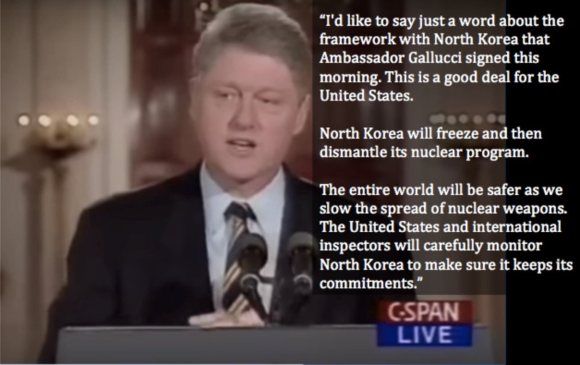
This is a picture that we’ve all seen before. Back in 1994, American negotiators promised a “good deal” with North Korea. Its nuclear plants were supposed to be frozen and dismantled. International inspectors would “carefully monitor” North Korea’s compliance with the agreement and ensure the country’s return to the “community of nations.” The world, we were told, would be a safer place.
It wasn’t. North Korea never forfeited its nuclear plants and the inspections proved useless. The community of nations is threatened by North Korean atomic bombs and the world is anything but safe. And yet, against all logic, a very similar deal has been signed with Iran.
And Iran is not North Korea. It’s far worse. Pyonyang’s dictators never plotted terrorist attacks across five continents and in thirty cities, including Washington, D.C. Tehran’s Ayatollahs did. North Korea is not actively undermining pro-Western governments in its region or planting agents in South America. Iran is. And North Korea – unlike Iran – did not kill many hundreds of U.S. soldiers in Iraq.
So why, then, are only Israelis united in opposing this deal? The answer is that we have the most to lose, at least in the short run. We know that the deal allows Iran to break out and create nuclear bombs in as little as three months, too quickly for the world to react. We know that the Ayatollahs, who have secretly constructed fortified nuclear facilities that have no peaceful purpose and have violated all of their international commitments, will break this deal in steps too small to precipitate a powerful global response. And we know that the sanctions, once lifted, cannot be swiftly revived, and that hundreds of billions of dollars Iran will soon receive will not be spent on better roads and schools. That treasure will fund the shedding of blood – of Israelis but also of many others.
Israelis know that, while the world might weather its deception by North Korea, they cannot afford to be duped by Iran. But neither, in fact, can the United States. Just last week, Iran’s President attended a rally in Tehran where tens of thousands of protesters chanted “Death to America.” The deal will better enable them to carry out that attack – if not today, then against future generations. And Iran’s Supreme Leader has publicly pledged to do just that.
The planned celebrations in Tehran and Iranian declarations of victory contrast starkly with the gloom hanging today over almost all Israelis. We believe that with stronger sanctions and tougher demands, a better deal is still possible. But we also understand that the present deal poses grave dangers not only to us, but ultimately to America and the world.
(UPDATE: Thought I’d throw this in for good measure. – LS):
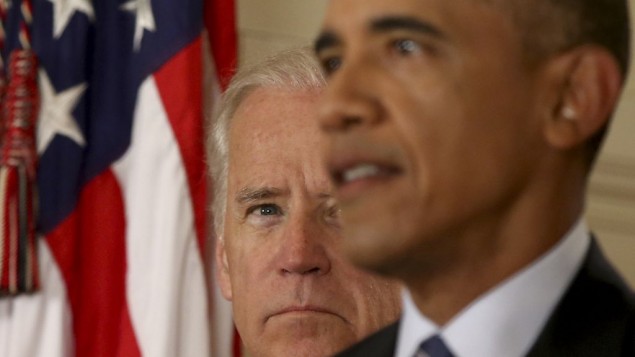
Vice President Joe Biden listens as President Barack Obama delivers remarks in the East Room of the White House in Washington, Tuesday, July 14, 2015, after an Iran nuclear deal is reached. (AP Photo/Andrew Harnik, Pool)
Because of this deal we will for the first time be in a position to verify all of these commitments. That means this deal is not built on trust. It is built on verification. Inspectors will have 24/7 access to Iran’s nuclear facilities. Iran will have access to Iran’s entire nuclear supply chain, its uranium mines and mills, its conversion facility and its centrifuge manufacturing and storage facilities.
Because of this deal, inspectors will also be able to access any suspicious location — put simply, the organization responsible for the inspections, the IAEA, will have access where necessary, when necessary. That arrangement is permanent. And the IAEA has also reached an agreement with Iran to get access that it needs to complete its investigation into the possible military dimensions of Iran’s past nuclear research.
********************
After two years of negotiations, the United States, together with our international partners, has achieved something that decades of animosity has not: a comprehensive long-term deal with Iran that will prevent it from obtaining a nuclear weapon.
This deal demonstrates that American diplomacy can bring about real and meaningful change, change that makes our country and the world safer and more secure.
This deal is also in line with a tradition of American leadership. It’s now more than 50 years since President Kennedy stood before the American people and said, “Let us never negotiate out of fear, but let us never fear to negotiate.” He was speaking then about the need for discussions between the United States and the Soviet Union, which led to efforts to restrict the spread of nuclear weapons.
In those days, the risk was a catastrophic nuclear war between two superpowers. In our time, the risk is that nuclear weapons will spread to more and more countries, particularly in the Middle East, the most volatile region in our world.
Today, because America negotiated from a position of strength and principle, we have stopped the spread of nuclear weapons in this region. Because of this deal, the international community will be able to verify that the Islamic Republic of Iran will not develop a nuclear weapon.
This deal meets every single one of the bottom lines that we established when we achieved a framework this spring. Every pathway to a nuclear weapon is cut off, and the inspection and transparency regime necessary to verify that objective will be put in place. Because of this deal, Iran will not produce the highly enriched uranium and weapons-grade plutonium that form the raw materials necessary for a nuclear bomb.
Because of this deal, Iran will remove two thirds of its installed centrifuges, the machines necessary to produce highly enriched uranium for a bomb and store them under constant international supervision. Iran will not use its advanced centrifuges to produce enriched uranium for the next decade. Iran will also get rid of 98 percent of its stockpile of enriched uranium.
To put that in perspective, Iran currently has a stockpile that could produce up to 10 nuclear weapons. Because of this deal that stockpile will be reduced to a fraction of what would be required for a single weapon. This stockpile limitation will last for 15 years.
Because of this deal, Iran will modify the core of its reactor in Arak so that it will not produce weapons grade plutonium and it has agreed to ship the spent fuel from the reactor out of the country for the lifetime of the reactor. For at least the next 15 years Iran will not build any new heavy water reactors.
Because of this deal we will for the first time be in a position to verify all of these commitments. That means this deal is not built on trust. It is built on verification. Inspectors will have 24/7 access to Iran’s nuclear facilities. Iran will have access to Iran’s entire nuclear supply chain, its uranium mines and mills, its conversion facility and its centrifuge manufacturing and storage facilities.
This ensures that Iran will not be able to divert materials from known facilities to covert ones. Some of these transparency measures will be in place for 25 years.
Because of this deal, inspectors will also be able to access any suspicious location — put simply, the organization responsible for the inspections, the IAEA, will have access where necessary, when necessary. That arrangement is permanent. And the IAEA has also reached an agreement with Iran to get access that it needs to complete its investigation into the possible military dimensions of Iran’s past nuclear research.
Finally Iran is permanently prohibited from pursuing a nuclear weapon under the Nuclear Nonproliferation Treaty, which provided the basis for the international community’s efforts to apply pressure on Iran.
As Iran takes steps to implement this deal, it will receive relief from the sanctions that we put in place because of Iran’s nuclear program, both America’s own sanctions and sanctions imposed by the United Nations Security Council.
This relief will be phased in. Iran must complete key nuclear steps before it begins to receive sanctions relief.
And over the course of the next decade, Iran must abide by the deal before additional sanctions are lifted, including five years for restrictions related to arms and eight years for restrictions related to ballistic missiles.
All of this will be memorialized and endorsed in a new United Nations Security Council resolution. And if Iran violates the deal, all of these sanctions will snap back into place. So there is a very clear incentive for Iran to follow through and there are very real consequences for a violation.
That’s the deal. It has the full backing of the international community. Congress will now have an opportunity to review the details and my administration stands ready to provide extensive briefings on how this will move forward.
As the American people and Congress review the deal it will be important to consider the alternative. Consider what happens in a world without this deal. Without this deal, there is no scenario where the world joins us in sanctioning Iran until it completely dismantles its nuclear program. Nothing we know about the Iranian government suggests that it would simply capitulate under that kind of pressure and the world would not support an effort to permanently sanction Iran into submission.
We put sanctions in place to get a diplomatic resolution and that is what we have done. Without this deal there would be no agreed-upon limitations for the Iranian nuclear program. Iran could produce, operate and test more and more centrifuges. Iran could fuel a reactor capable of producing plutonium for a bomb and we would not have any of the inspections that would allow us to detect a covert nuclear weapons program.
In other words, no deal means no lasting constraints on Iran’s nuclear program. Such a scenario would make it more likely that other countries in the region would feel compelled to pursue their own nuclear programs, threatening a nuclear arms race in the most volatile region of the world.
It would also present the United States with fewer and less effective options to prevent Iran from obtaining a nuclear weapon.
I have been president and commander in chief for over six years now. Time and again I have faced decisions about whether or not to use military force. It’s the greatest decision that any president has to make.
Many times, in multiple countries, I have decided to use force. And I will never hesitate to do so when it is in our national security interest. I strongly believe that our national security interest now depends upon preventing Iran from obtaining a nuclear weapon, which means that, without a diplomatic resolution, neither I nor a future U.S. president would face a decision about whether or not to allow Iran to obtain a nuclear weapon or whether to use our military to stop it.
Put simply, no deal means a greater chance of more war in the Middle East. Moreover, we give nothing up by testing whether or not this problem can be solved peacefully. If, in a worst-case scenario, Iran violates the deal, the same options that are available to me today will be available to any U.S. president in the future.
And I have no doubt that 10 or 15 years from now, the person who holds this office will be in a far stronger position with Iran further away from a weapon and with the inspections and transparency that allow us to monitor the Iranian program.
For this reason, I believe it would be irresponsible to walk away from this deal. But on such a tough issue, it is important that the American people and the representatives in Congress get a full opportunity to review the deal.
After all, the details matter. And we’ve had some of the finest nuclear scientists in the world working through those details. And we’re dealing with a country — Iran — that has been a sworn adversary of the United States for over 35 years.
So I welcome a robust debate in Congress on this issue and I welcome scrutiny of the details of this agreement. But I will remind Congress that you don’t make deals like this with your friends. We negotiated arms control agreements with the Soviet Union when that nation was committed to our destruction and those agreements ultimately made us safer.
I am confident that this deal will meet the national security interests of the United States and our allies. So I will veto any legislation that prevents the successful implementation of this deal. We do not have to accept an inevitable spiral into conflict. And we certainly shouldn’t seek it. And precisely because the stakes are so high this is not the time for politics or posturing. Tough talk from Washington does not solve problems. Hard-nosed diplomacy, leadership that has united the world’s major powers offers a more effective way to verify that Iran is not pursuing a nuclear weapon.
Now that doesn’t mean that this deal will resolve all of our differences with Iran. We share the concerns expressed by many of our friends in the Middle East, including Israel and the Gulf states, about Iran’s support for terrorism and its use of proxies to destabilize the region.
But that is precisely why we are taking this step, because an Iran armed with a nuclear weapon would be far more destabilizing and far more dangerous to our friends and to the world.
Meanwhile we will maintain our own sanctions related to Iran’s support for terrorism, its ballistic missile program and its human rights violations. We will continue our unprecedented efforts to strengthen Israel’s security, efforts that go beyond what any American administration has done before.
And we will continue the work we began at Camp David, to elevate our partnership with the Gulf States to strengthen their capabilities to counter threats from Iran or terrorist groups like ISIL.
However, I believe that we must continue to test whether or not this region, which has known so much suffering, so much bloodshed, can move in a different direction.
Time and again I have made clear to the Iranian people that we will always be open to engagement on the basis of mutual interests and mutual respect. Our differences are real and the difficult history between our nations cannot be ignored. But it is possible to change.
The path of violence and rigid ideology, a foreign policy based on threats to attack your neighbors or eradicate Israel, that’s a dead end. A different path, one of tolerance and peaceful resolution of conflict, leads to more integration into the global economy, more engagement with the international community and the ability of the Iranian people to prosper and thrive. This deal offers an opportunity to move in a new direction. We should seize it.
We have come a long way to reach this point: decades of an Iranian nuclear program, many years of sanctions, and many months of intense negotiation.
Today, I want to thank the members of Congress, from both parties, who helped us put in place the sanctions that have proven so effective as well as the other countries who joined us in that effort. I want to thank our negotiating partners — the United Kingdom, France, Germany, Russia, China, as well as the European Union — for our unity in this effort, which showed that the world can do remarkable things when we share a vision of peacefully addressing conflict. We showed what we can do when we do not split apart.
And finally, I want to thank the American negotiating team. We had a team of experts working for several weeks straight on this, including our secretary of energy, Ernie Moniz. And I want to particularly thank John Kerry, our secretary of state, who began his service to this country more than four decades ago when he put on our uniform and went off to war. He is now making this country safer through his commitment to strong, principled American diplomacy.
History shows that America must lead, not just with our might, but with our principles. It shows we are stronger, not when we are alone, but when we bring the world together. Today’s announcement marks one more chapter in this pursuit of a safer and more helpful, more hopeful world.
Thank you. God bless you and God bless the United States of America.
(The article was written prior to release of the “Joint comprehensive plan of action.” A link to the text of the plan, with quotes from the part about IAEA inspections, is available here. — DM)
Under the terms of the accord, it seems that IAEA inspectors will have to “coordinate” their visits to suspect Iranian sites, “in consultation between Iran and the world powers.” Worse still, Iran will have the right to deny and challenge U.N. requests to send inspectors to suspicious sites. In these cases, an arbitration board composed of Iran and the powers would decide on the issue.
They call this “managed access,” which is a euphemism for nowhere, no-time inspections.
******************
Ahead of the accord reached between the P5+1 and Iran Tuesday, The New York Times reported that it was expected to be a “political agreement,” not a “legally binding treaty.”
Furthermore, Israeli sources said the two sides would “announce understandings” and present a 100-page document, but not “sign” anything. It will take months of additional negotiations to develop the relevant implementation documents.
All of which is meant to obfuscate the details, Israeli officials fear, and cloud the matter enough to confuse or bamboozle Congress. It will also allow the Iranians to (correctly) claim that they never truly “signed away” their nuclear capacities. In the meantime, U.N. and other international mechanisms to lift sanctions on Iran will go into high gear.
However, the root corruption of the agreement is that Iran gets to keep its nuclear facilities, and there will be no truly intrusive international supervision of what goes on deep inside them.
The accord leaves Iran with all its nuclear development facilities intact, including the Fordo underground center, instead of dismantling them. This allows the Iranians to continue refining their nuclear skills. Even at low levels of enrichment (3.5% and 5%, which are not useful for a bomb) this provides a framework with which Tehran can bypass Western restrictions and hoodwink Western inspectors.
After all, Iran has clandestinely crossed every “red line” set by the West over the past 20 years — putting nuclear plants online, building heavy-water facilities, refining uranium, working on explosive triggers and warheads, and generally breaching all of its obligations under the Nuclear Nonproliferation Treaty — and has gotten away with it. It has lied, formally and repeatedly, to the international community about its nuclear efforts.
So any deal that scales back sanctions and allows Iran to keep operating its advanced nuclear development facilities even at a low level is a fatal bargain. So warned Simon Henderson of the Washington Institute and Olli Heinonen, a former deputy director general of the International Atomic Energy Agency, as long as two years ago.
U.S. President Obama’s response to this was to promise that he would accept nothing less than a Western right to conduct “anywhere, anytime” international inspections of Iran’s most secret nuclear and military facilities.
Indeed, veteran investigators have testified in front of Congress literally dozens of times that anywhere-anytime access is a minimum prerequisite to a verifiable deal.
Alas, Obama has now backed down from that. It’s an American collapse.
Under the terms of the accord, it seems that IAEA inspectors will have to “coordinate” their visits to suspect Iranian sites, “in consultation between Iran and the world powers.” Worse still, Iran will have the right to deny and challenge U.N. requests to send inspectors to suspicious sites. In these cases, an arbitration board composed of Iran and the powers would decide on the issue.
They call this “managed access,” which is a euphemism for nowhere, no-time inspections.
This means that Iran will continue to play the negotiation game over every Western inspection request. With lawyers and more lawyers, diplomats and more diplomats. Lots of hotels and endless discussions.
In other words, Iran will be able to delay and delay access to true military or nuclear sites, just as it has done with the Parchin military base, where it is suspected to have experimented with nuclear weapons production.
Only now, under the accord and after at least three years of requests (and after a major Iranian cleanup effort, documented by Western satellite photos) will Iran finally ”grant” access to Parchin. Sometime soon.
Yay. What a great victory for Obama and nuclear containment of Iran.
(It’s worse than Munich. At least Chamberlain was working in a context of military weakness; Obama has been operating in a context of military strength, which he has declined to use. — DM)
The big news of the day is the announcement of the deal with Iran by President Obama and Secretary Kerry. The Washington Post provides the text and video of Obama’s announcement here.
Listening to President Obama this morning, without access to the text of the agreement, I found key concessions made against his previously announced minimum criteria concealed in pleasing formulations presented as great accomplishments. ‘Twas a famous victory.
The deal must be the worst ever entered into by the United States. It is certainly “an historic mistake.” Based in part on Obama’s statement itself and in part on previous news accounts, I think the following summary provided by Omri Ceren provides a useful guide.
(1) The Iranian nuclear program will be placed under international sponsorship for R&D – A few weeks ago the AP leaked parts of an annex confirming that a major power would be working with the Iranians to develop next-generation centrifuge technology at the Fordow underground military enrichment bunker. Technically the work won’t be on nuclear material, but the AP noted that “isotope production uses the same technology as enrichment and can be quickly re-engineered to enriching uranium.” The administration had once promised Congress that Iran would be forced to dismantle its centrifuge program. The Iranians refused, so the administration conceded that the Iranians would be allowed to keep their existing centrifuges. Now the international community will be actively sponsoring the development of Iranian nuclear technology. And since the work will be overseen by a great power, it will be off-limits to the kind of sabotage that has kept the Iranian nuclear program in check until now.
(2) The sanctions regime will be shredded – the AP revealed at the beginning of June that the vast majority of the domestic U.S. sanctions regime will be dismantled. The Lausanne factsheet – which played a key role in dampening Congressional criticism to American concessions – had explicitly stated “U.S. sanctions on Iran for terrorism, human rights abuses, and ballistic missiles will remain in place under the deal.” That turns out to have been false. Instead the administration will redefine non-nuclear sanctions as nuclear, so that it can lift them. The Iranians are boasting that sanctions against Iran’s Central Bank, NIT Co., the National Iranian Oil Company, and 800 individuals and entities will be lifted. That’s probably exaggerated and a bit confused – CBI sanctions are statutory, and will probably not be getting “lifted” – but the sense is clear enough.
(3) The U.S. collapsed on the arms embargo – Just a week ago General Dempsey told the Senate Armed Services Committee that “under no circumstances should we relieve pressure on Iran relative to ballistic missile capabilities and arms trafficking.” Now multiple outlets have confirmed that the embargo on conventional weapons will be lifted no later than five years from now, and that the embargo on ballistic missiles will expire in 8 years. No one in the region is going to wait for those embargoes to expire: they’ll rush to build up their stockpiles in anticipation of the sunset.
(4) The U.S. collapsed on anytime-anywhere inspections – The IAEA will get to request access to sensitive sites, the Iranians will get to say no, and then there will be an arbitration board that includes Iran as a member. This concession is particularly damaging politically and substantively because the administration long ago went all-in on verification. The original goal of the talks was to make the Iranians take physical actions that would prevent them from going nuclear if they wanted to: dismantling centrifuges, shuttering facilities, etc. The Iranians said no to those demands, and the Americans backed off. The fallback position relied 100% on verification: yes the Iranians would be physically able to cheat, the argument went, but the cheating would be detected because of an anytime-anywhere inspection regime. That is not what the Americans are bringing home.
(5) The U.S. collapsed on PMDs – This morning the Iranians and the IAEA signed a roadmap for a process that would see Tehran eventually providing access for the IAEA to clear up its concerns. This roadmap differs in no significant way from previous commitments the Iranians have made to the agency, except now Tehran will have received sanctions relief and stabilized its economy. Administration officials will have to look at lawmakers and nonetheless promise that this time the Iranians will give the IAEA what it needs.
UPDATE: The Islamic Republic of Iran has posted the English text of the deal here. What a relief! “Iran reaffirms that under no circumstances will Iran ever seek, develop or acquire any nuclear weapons.”
The Iranian state press has presented its side of the nuclear talks Tuesday, as both Western and Iranian foreign ministers present the terms of the deal in a historic press conference over the nuclear agreement.
Just before the formal announcement, state-run PressTV revealed, allegedly, some of the terms of the Joint Comprehensive Plan of Action (JCPOA), including:
That economic sanctions on Iran from the United Nations will be lifted immediately “under a mutually agreed framework and through a new UN resolution”;
that none of the Iranian nuclear facilities will be dismantled;
that “nuclear research and development activities on all types of centrifuges, including advanced IR-6 and IR-8 machines, will continue”;
that economic sanctions from the US and the EU will be lifted as soon as the agreement is implemented;
that the arms embargo will be lifted, to a limited degree, immediately; those limits, which remain unspecified, will allegedly be lifted after 5 years;
that tens of billions of dollars in Iranian revenue in offshore accounts will be released;
and that 800 people and legal entities, including “the Central Bank of Iran (CBI), the Islamic Republic of Iran Shipping Lines and the National Iranian Oil Company (NIOC), will be taken off sanctions lists.”
The agreement, PressTV insisted, would be presented to the UN Security Council within the next 7-10 days.
If true, several of terms would point to concessions by the West – and especially by the US – to terms the US deemed “red lines” in a future deal, including the arms embargo lift and the allowance of IR-8 machines, which could allow Iran to produce a nuclear weapon within weeks.
The announcement directly contradicts earlier remarks from an Iranian diplomat to Reuters, who had stated that the terms included more demands made by Western powers. In that report, the diplomat said:
that a UN arms embargo would remain in place for five years;
that UN missile sanctions would stay in place for eight years;
and that Iran has allegedly accepted a “snapback” plan whereby sanctions would be restored within 65 days if it was found that it was violating the agreement.
As of this publication, the exact terms of the agreement have yet to be announced.
However, just as EU, Iran, and the P5+1 meet for a closed session Tuesday afternoon (update: 1:30 pm IST), International Crisis Group Iran analyst Ali Vaez began tweeting tidbits from what appears to be a leaked copy of the deal, according to the Guardian.
Many of the tidbits appear to corroborate the Iranian version of events; the veracity of the leaked document remains unconfirmed.
Prime Minister Binyamin Netanyahu addresses weekly cabinet meeting
Credit: Emil Salman/Flash 90
As talk continues of an imminent deal between Iran and world powers – one which reportedly would see Tehran receive all of its demands – Prime Minister Binyamin Netanyahu has added his voice to a growing number of senior Israeli officials warning that regardless of the outcome, Israel is not bound by the deal.
“Even over the weekend, as Iran continued to receive more and more concessions at the negotiating table, Iranian President Rouhani led a march of hatred in the streets of Tehran in which the masses cried, ‘Death to America! Death to Israel!'” Netanyahu said, describing Iran’s recent “Al Quds (Jerusalem) Day” in an address to the Knesset Monday.
“If the concessions continued even after these unequivocal calls for the destruction of those conducting the negotiations, it seems that there are those who are ready to make an agreement at any price – and this bad agreement is unavoidable,” the prime minister acknowledged.
He noted that Israel was never under any illusions that it could control the outcome of the negotiations, despite Jerusalem’s intensive efforts to explain its opposition to the looming agreement and lobby against major concessions – but that didn’t mean Israel would stand by and allow Iran to acquire nuclear weapons.
“In any case, we never committed ourselves to preventing an agreement, certainly not one that the major powers are ready to sign at any price.
“We did commit ourselves to prevent Iran from arming itself with nuclear weapons – and indeed, were it not for our efforts over the years, Iran would already be able to develop atomic bombs.
“Our commitment is to prevent Iran from arming itself with nuclear weapons and it is valid today more than ever. I call on all those who care about Israel’s security to unite behind this commitment.”
(I chose this short post because it demonstrates the lack of news reporting by our press coming OUT of Iran. Like most, I sat painfully as I watched Obama announce his ‘victory’ over Iran. The coverage was detailed and in real time. Surprisingly, one of the networks, which one escapes me now, actually went live for Rouhani’s announcement to the Iranian people, in Farsi of course. The translator struggled along and said something that struck me. She translated Rouhani saying, ‘Iran has a new cage.’ No one seemed to notice. Then it struck me. What else is he telling his people and how does it reconcile with what the western press is telling us. We may never know. Therein lies the real news, in my humble opinion. – LS)
Tehran (AFP) – Iranian President Hassan Rouhani said in a live televised address Tuesday that “God has accepted the nation’s prayers”, hailing a nuclear deal with world powers that will lift sanctions.
Rouhani spoke minutes after US President Barack Obama’s comments on the agreement struck in Vienna were also broadcast live on state television.







 anneinpt
 artaxes
 danmillerinpanama
 davidking1530
 Peter Hofman
 Joseph Wouk
 Peter
Peter Louisiana Steve
 WarSclerotic
Recent Comments