Archive for July 2015

A deal that will live in infamy

July 15, 2015

Israel Hayom | A deal that will live in infamy.

On July 14, 2015, the leading exporter of global terrorism received a stamp of legitimacy from the international community • The nuclear deal welcomes Iran into the family of nations — and history won’t forgive President Obama for this dangerous gamble.

Boaz Bismuth
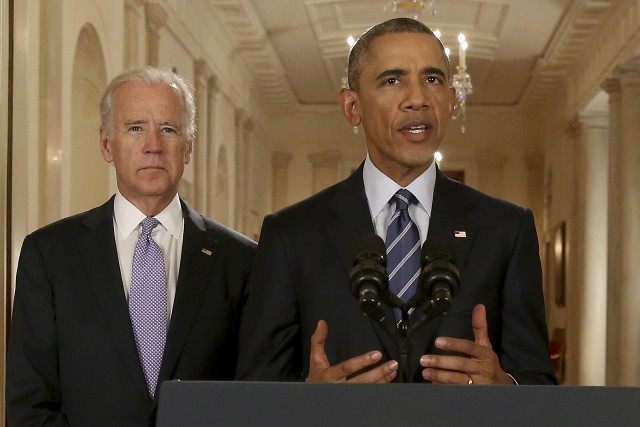
U.S. President Barack Obama announces the nuclear deal with Iran, Tuesday

|

Photo credit: AP

Analysis: Strike sooner or never – Preemptive strike on Iran harder once UN lifts sanctions

July 15, 2015

Analysis: Strike sooner or never – Preemptive strike on Iran harder once UN lifts sanctions – Middle East – Jerusalem Post.

Once preemptive strikes can be undertaken to block an imminent attack, broadening the definition of what is “imminent” to permit a strike even more in advance of a potential threat is less of a jump.

Israel probably has until around mid-December to preemptively strike Iran’s nuclear program before it gets even harder to justify legally than Tuesday’s deal has already made it.

Of course, right now diplomatically, a strike seems unthinkable with the deal representing years of work by the US, EU, China, Russia and Iran and enjoying powerful global support aside from Israel and Sunni Arab nations competing with Iran in the Middle East.

But until mid-December when the IAEA renders its “final assessment” of “all past and present outstanding issues,” as referred to in the around 150 page agreement, the UN will likely not have actually removed most sanctions.

As long as UN sanctions are in place, the legal record of Iran’s history at violating the Nuclear Non-Proliferation Treaty, of UN resolutions and actions framing Iran as a violator and of the failure of those actions to stop Iran’s push for the bomb are still the narrative.

Why does this matter? Some say that preemptive strikes are barred by international law from the outset, as only a real-time armed attack activates the right of self-defense to attack an aggressor.

Those countries, like the US and Israel, who have carried out preemptive strikes in the past largely base their actions on the concept that international law permits preemptive strike to prevent an imminent attack, even if that attack is not yet in progress.

Once preemptive strikes can be undertaken to block an imminent attack, broadening the definition of what is “imminent” to permit a strike even more in advance of a potential threat is less of a jump.

This is especially true concerning weapons like nuclear weapons which can essentially end the game if they are launched.

Still, most scholars find it dicey legally to push the timeline backwards too far, which leaves them with the problem of a covert nuclear weapons move catching Israel or another target-country off-guard.

This is where the UN resolutions could come in to play.

The resolutions do not authorize a preemptive strike on Iran, nor does the current Iran deal. Far from it.

But some argue that legally the reason that individual nations are supposed to hold off from preemptive strikes is that the UN is supposed to handle collective security issues so that individual nations do not need to.

Some have argued that if the UN drops the ball persistently over a long time in protecting an individual nation from a security issue, that there is more justification for that nation to take preemptive action in self-defense.

While there will likely be an initial UN resolution passed in the near future to set the stage for later sanctions removal, until UN sanctions are actually removed and Iran’s violator status is reset by a second round of UN resolutions likely around when the IAEA gives its report, Israel can still argue Iran is a violator which the UN failed to stop even according to its own standards.

All of that changes once sanctions are removed and Iran is no longer a presumed violator.

Also, until the second round of UN resolutions pass, there could be numerous instances of Iranian cheating or foot-dragging on specific obligations.

According to the Iran deal, a Joint Commission vote of the US, UK, EU, France and Germany can override Iran, Russia and China to snap sanctions back on and within Under the deal, this could happen within about 24 days of say, Iran being caught carrying out nuclear activities that were “undeclared.”

What if Iran gets caught, 24 days pass and the five Western powers blink? If this is before the decisive UN resolution, the Israeli argument would actually be stronger because Iran would be in express violation of its most recent commitments, along with past UN resolutions.

Of course the agreement views non-compliance as a reason to snap back sanctions, not for a sudden strike on Iran.

But on the spectrum of legal justifiability, Israel would be better off with a strike than it would after the decisive UN resolution is passed.

There is one other surprising provision in the deal which Israel could try to use to legally justify a preemptive strike if its intelligence services caught Iran cheating in a serious way.

Under the agreement, Iran is bound never to move down a nuclear weapons path, even beyond the life of the deal, let alone during the 10-25 years of the deal.

If Israel felt its intelligence evidence of Iranian cheating was serious enough in violating that commitment, it could try to use that to boost the legal legitimacy of a strike.

At the end of the day, some of this is very theoretical as Israel is not even a party to the deal and when it struck Iraq’s Osirak reactor in 1981, Israel showed a willingness to stand alone even against an angry US President Ronald Reagan.

But in an age when many see the Boycott Divestment and Sanctions (BDS) campaign as a serious challenge to Israel’s legitimacy and continuity, any preemptive strike would likely take into account the best timing and circumstances to boost legality and legitimacy.

Obama’s Iran Deal Has the Makings of a Catastrophe

July 15, 2015

Obama’s Iran Deal Has the Makings of a Catastrophe, National Review Online via Middle East forum, Daniel Pipes, July 14,2015.  Originally published under the title, “Could the Iran Deal Be the Worst International Accord of All Time?”

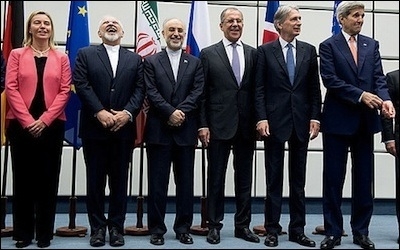
1497Iran’s negotiators (second and third from left) have good reason to be happier than their Western counterparts.

The conduct of the Iran nuclear negotiations has been wretched, with the Obama administration inconsistent, capitulating, exaggerating, and even deceitful. It forcefully demanded certain terms, then soon after conceded these same terms.

*********************

Barack Obama has repeatedly signaled during the past six and a half years that that his No. 1 priority in foreign affairs is not China, not Russia, not Mexico, but Iran. He wants to bring Iran in from the cold, to transform the Islamic Republic into just another normal member of the so-called international community, ending decades of its aggression and hostility.

In itself, this is a worthy goal; it’s always good policy to reduce the number of enemies. (It brings to mind Nixon going to China.) The problem lies, of course, in the execution.

The conduct of the Iran nuclear negotiations has been wretched, with the Obama administration inconsistent, capitulating, exaggerating, and even deceitful. It forcefully demanded certain terms, then soon after conceded these same terms.

Secretary of State John Kerry implausibly announced that we have “absolutely knowledge” of what the Iranians have done until now in their nuclear program and therefore have no need for inspections to form a baseline. How can any adult, much less a high official, make such a statement?

The administration misled Americans about its own concessions: After the November 2013 Joint Plan of Action, it came out with a factsheet which Tehran said was inaccurate. Guess who was right? The Iranians. In brief, the U.S. government has shown itself deeply untrustworthy.

The agreement signed today ends the economic sanctions regime, permits the Iranians to hide much of their nuclear activities, lacks enforcement in case of Iranian deceit, and expires in slightly more than a decade. Two problems particularly stand out: The Iranian path to nuclear weapons has been eased and legitimated; Tehran will receive a “signing bonus” of some US$150 billion that greatly increases its abilities to aggress in the Middle East and beyond.

The United States alone, not to speak of the P5+1 countries as a whole, have vastly greater economic and military power than the Islamic Republic of Iran, making this one-sided concession ultimately a bafflement.

Of the administration’s accumulated foreign-policy mistakes in the last six years, none have been catastrophic for the United States: Not the Chinese building islands, the Russians taking Crimea, or the collapse into civil wars of Libya, Yemen, Syria, and Iraq. But the Iran deal has the makings of a catastrophe.

Attention now shifts to the U.S. Congress to review today’s accord, arguably the worst treaty not just in American history or modern history, but ever. Congress must reject this deal. Republican senators and representatives have shown themselves firm on this topic; will the Democrats rise to the occasion and provide the votes for a veto override? They need to feel the pressure.

How Iran describes the nuclear deal

July 15, 2015

How Iran describes the nuclear deal, Power LineJohn Hinderaker, July 14, 2015

Throughout the negotiation process, Iran’s government has been more forthright and more reliable in characterizing the parties’ interim agreements than the Obama administration. So it is worth noting what the Iranians say the deal entails. This is from FARS, Iran’s news agency:

Iran’s President Hassan Rouhani said his country has achieved all its four goals in the agreement that his foreign minister Zarif signed with the six world powers in Vienna on Tuesday.

President Rouhani said his nation started talks with the world powers in a bid to remove all sanctions while maintaining its nuclear program and nuclear progress as two main goals.

All sanctions, including the financial, banking, energy, insurance, transportation, precious metals and even arms and proliferation sanctions will be, not suspended, but terminated according to the Tuesday agreement as soon as the deal comes into force, he said, adding that Iran will only be placed under certain limited arms deal restrictions for five years.

Meantime, Iran will inject gas into its highly advanced IR8 centrifuge machines, continue its nuclear research and development, and keep its Arak Heavy Water Facility and Fordo and Natanz enrichment plants under the agreement, he said, elaborating on Iran’s gains.

Another goal, Rouhani said, was taking Iran off Chapter Seven of the UN Charter, “and we did it”.

More details on the deal:

The agreement, the Joint Comprehensive Plan of Action (JCPOA), will be presented to the United Nations Security Council (UNSC), which will adopt a resolution in seven to 10 days making the JCPOA an official document.

Based on the agreement, which has been concluded with due regard for Iran’s red lines, the world powers recognize Iran’s civilian nuclear program, including the country’s right to the complete nuclear cycle.

The UNSC sanctions against the Islamic Republic, including all economic and financial bans, will be lifted at once under a mutually agreed framework and through a new UN resolution.

None of the Iranian nuclear facilities will be dismantled or decomissioned.

Furthermore, nuclear research and development activities on all types of centrifuges, including advanced IR-6 and IR-8 machines, will continue.

The nuclear-related economic and financial restrictions imposed by the United States and the European Union (EU) targeting the Iranian banking, financial, oil, gas, petrochemical, trade, insurance and transport sectors will at once be annulled with the beginning of the implementation of the agreement.

The arms embargo imposed against the Islamic Republic will be annulled and replaced with certain restrictions, which themselves will be entirely removed after a period of five years.

Additionally, tens of billions of dollars in Iranian revenue frozen in foreign banks will be unblocked.

I have now read the agreement in its entirety–you, too, can read it here–and I think the Iranians’ description is accurate. I also agree with what Paul wrote earlier today.

Some aspects of the agreement are technical and can’t be well understood without knowledge of nuclear engineering or the history of various sanctions that have been imposed. But those details are immaterial. Loopholes could make the agreement slightly worse, but no technical interpretation can save it.

The mullahs may cheat on the agreement, or they may not. They may decide to walk away from the agreement at some point and openly develop nuclear weapons, or they may not. It makes very little difference. There are no undertakings in the agreement that go beyond 10 years (in most instances) or 15 years (in a few). The Ayatollah takes the long view: ten or fifteen years are nothing. In the meantime, what does Iran get?

First, and most important, it gets in excess of $100 billion in currently-frozen assets. This will happen in the near future, on or about the agreement’s Implementation Date. I think this prospect is what is making Iran’s leaders so jubilant. With that money, they can step up their support for allies in Syria, Yemen and Iraq, and their support for terrorism everywhere. (By way of perspective, the entire United States military budget for the current fiscal year is only $560 billion.) To the extent that they spend some of it at home, it will help cement their position domestically.

Second, the agreement grants Iran international legitimacy. Since the revolution of 1979 and the seizure of America’s embassy in Tehran, Iran has been treated as a rogue state. Under the agreement, that status comes to an end. Investment in Iran will be permitted and likely will flourish. Sanctions will be removed and Iran’s nuclear program will not only be tolerated, it will be explicitly recognized and to some degree supported by the international community. The agreement contemplates that upon implementation, “the Iranian nuclear programme will be treated in the same manner as that of any other non-nuclear-weapon state party to the NPT [non-proliferation treaty].” It is hard to overstate how important this legitimacy is to the regime.

The third benefit to Iran’s rulers is perhaps the most important, and is closely linked to the first two. The agreement guarantees that, at least for the foreseeable future, the mullahs will remain in power. Realistically, the only way Iran could be denied a nuclear arsenal in the long term is through regime change. Early in the Obama administration, that seemed like a plausible scenario, but the administration declined to aid, or even encourage, anti-regime forces when such support might have made a difference. Now, with the mullahs both flush with cash and blessed with international legitimacy, their grip on power is probably stronger than ever. Nuclear weapons will follow, sooner or later, at a time of the regime’s choosing. And in the meantime, Iran’s ability to make mischief in the Middle East and around the world (e.g., through its newfound alliance with Venezuela) has been greatly enhanced.

Everything you need to know about Obama’s Iran deal

July 15, 2015

Everything you need to know about Obama’s Iran deal, BreitbartBen Shapiro, July 14, 2015

ap_barack-obama_ap-photo13-640x427AP Photo/Andrew Harnik, Pool

The deal the Obama administration cut today with the Iranian terrorist regime signals once and for all that the Obama administration considers both the United States and Israel to be the key threats to peace in the world.

Why else would the American president have lifted sanctions and granted the Iranian mullahs decades of American cover in the face of overwhelming evidence they support anti-Western, anti-Semitic, and anti-Sunni terror across the region and the globe?

President Obama’s statements today about the strength of this deal carry no weight, given that he has coordinated with the Iranian regime – which is responsible for the deaths of hundreds of Americans over the past few years – in Iraq, has allowed them to prop up Bashar Assad in Syria, has allowed them to continue their subjugation of Lebanon, watched in silence as they flexed their muscle in Yemen, and attempted to cut off weapons shipments to Israel in the midst of its war with Iranian proxy terror group Hamas.

Obama wants Iran to be a regional power, because Obama fears Israel more than he fears Iran. The same day that Obama announced his deal, “moderate” Iranian President Hassan Rouhani tweeted, “To our neighbours: Do not be deceived by the propaganda of the warmongering Zionist regime. #Iran & its power will translate into your power.”

Obama’s counting on it.

Obama had one motivation in this deal: he believes that any Western attempt to stop Iran’s nuclear development with force is more dangerous and less moral than Iran’s elevated terror support and even its eventual nuclear development.

America and the West, in Obama’s global worldview, are so dangerous that he wouldn’t even make minor requests of Iran, such as releasing American prisoners, if that meant the minute possibility of actual Western action on the horizon. Obama doesn’t care if Iran is lying. To him, that risk is acceptable when compared with the certainty of Western action, no matter how constrained, against Iran.

Obama consistently posed the choice about his nuclear deal as one between diplomacy and war, as though a military strike against Iran would have precipitated World War III. But this deal is far more calibrated to provoke World War III than any targeted strike by Israel, the United States, or anyone else.

The deal pats itself on the back with wording about ensuring that “Iran’s nuclear programme will be exclusively peaceful,” and how the deal will be a “fundamental shift” in the international community’s relationship with Iran. Then it gets to details. And the devil isn’t just in the details; the devils in Iran wrote them.

The deal “will produce the comprehensive lifting of all UN Security Council sanctions as well as multilateral and national sanctions related to Iran’s nuclear programme, including steps on access in areas of trade, technology, finance and energy.” Those sanctions end on the first day of the deal: “The UN Security Council resolution will also provide for the termination on Implementation Day of provisions imposed under previous resolutions.” The EU “will terminate all provisions of the EU Regulation.”

Money will now move between “EU persons and entities, including financial institutions, and Iranian persons and entities, including financial institutions.” Banking activities will resume abroad. Full trade will essentially resume. After five years, the arms embargo against Iran will end. After eight years, the missile embargo against Iran will end.

The deal explicitly acknowledges that Iran is gaining benefits no other state would gain under the Non-Proliferation Treaty. In terms of its nuclear development, instead of dismantling Iran’s nuclear program, that program is now protected:

Iran will continue to conduct enrichment R&D in a manner that does not accumulate enriched uranium. Iran’s enrichment R&D with uranium for 10 years will only include IR-4, IR-5, IR-6 and IR-8 centrifuges as laid out in Annex I, and Iran will not engage in other isotope separation technologies for enrichment of uranium as specified in Annex I. Iran will continue testing IR-6 and IR-8 centrifuges, and will commence testing of up to 30 IR-6 and IR-8 centrifuges after eight and a half years, as detailed in Annex I.

We have no way of knowing what Iran has done additionally, however, since the deal has no provisions forcing them to turn over information about what they’ve already done. There is no baseline.

So who will implement this deal? A “Joint Commission” comprised of the UK, France, Germany, Russia, China, the United States and Iran is charged with monitoring all developments under the agreement – meaning that all the signatories, all of whom have an interest in preserving a deal they signed, will be the “objective” monitoring agents.

The International Atomic Energy Agency will monitor and verify Iran’s nuclear program. But not everywhere. Only at key nuclear facilities will the IAEA have access – military sites were not included in the deal in any real way – and even then, the process for access is extraordinarily regulated:

74. Requests for access pursuant to provisions of this JCPOA will be made in good faith, with due observance of the sovereign rights of Iran, and kept to the minimum necessary to effectively implement the verification responsibilities under this JCPOA. In line with normal international safeguards practice, such requests will not be aimed at interfering with Iranian military or other national security activities, but will be exclusively for resolving concerns regarding fulfillment of the JCPOA commitments and Iran’s other non-proliferation and safeguards obligations. The following procedures are for the purpose of JCPOA implementation between the E3/EU+3 and Iran and are without prejudice to the safeguards agreement and the Additional Protocol thereto. In implementing this procedure as well as other transparency measures, the IAEA will be requested to take every precaution to protect commercial, technological and industrial secrets as well as other confidential information coming to its knowledge.

75. In furtherance of implementation of the JCPOA, if the IAEA has concerns regarding undeclared nuclear materials or activities, or activities inconsistent with the JCPOA, at locations that have not been declared under the comprehensive safeguards agreement or Additional Protocol, the IAEA will provide Iran the basis for such concerns and request clarification.

76. If Iran’s explanations do not resolve the IAEA’s concerns, the Agency may request access to such locations for the sole reason to verify the absence of undeclared nuclear materials and activities or activities inconsistent with the JCPOA at such locations. The IAEA will provide Iran the reasons for access in writing and will make available relevant
information.

77. Iran may propose to the IAEA alternative means of resolving the IAEA’s concerns that enable the IAEA to verify the absence of undeclared nuclear materials and activities or activities inconsistent with the JCPOA at the location in question, which should be given due and prompt consideration.

78. If the absence of undeclared nuclear materials and activities or activities inconsistent with the JCPOA cannot be verified after the implementation of the alternative arrangements agreed by Iran and the IAEA, or if the two sides are unable to reach satisfactory arrangements to verify the absence of undeclared nuclear materials and activities or activities inconsistent with the JCPOA at the specified locations within 14 days of the IAEA’s original request for access, Iran, in consultation with the members of the Joint Commission, would resolve the IAEA’s concerns through necessary means
agreed between Iran and the IAEA. In the absence of an agreement, the members of the Joint Commission, by consensus or by a vote of 5 or more of its 8 members, would advise on the necessary means to resolve the IAEA’s concerns. The process of consultation with, and any action by, the members of the Joint Commission would not exceed 7 days, and Iran would implement the necessary means within 3 additional days.

Obama and Secretary of State John Kerry wrote into the deal provisions designed to hamstring Congress and local authorities:

If a law at the state or local level in the United States is preventing the implementation of the sanctions lifting as specified in this JCPOA, the United States will take appropriate steps, taking into account all available authorities, with a view to achieving such implementation. The United States will actively encourage officials at the state or local level to take into account the changes in the U.S. policy reflected in the lifting of sanctions under this JCPOA and to refrain from actions inconsistent with this change in policy.

And if Iran cheats, the United States and EU will have to take the matter to dispute resolution rather than re-implementing sanctions, as Obama has lied:

The U.S. Administration, acting consistent with the respective roles of the President and the Congress, will refrain from re-introducing or re-imposing the sanctions specified in Annex II that it has ceased applying under this JCPOA, without prejudice to the dispute resolution process provided for under this JCPOA. The U.S. Administration, acting consistent with the respective roles of the President and the Congress, will refrain from imposing new nuclear-related sanctions. Iran has stated that it will treat such a re-introduction or re-imposition of the sanctions…

Obama is already moving on this front. While calling for an open conversation on the Iran deal, President Obama has already said he will veto any attempts to curb the deal by Congress. So feel free to chat, gang, so long as you don’t attempt to do anything.

In brief, the agreement trades enormous amounts of cash for Iran’s pinkie swear that they will not develop nuclear weapons now, and the blind hope that Iran’s regime will magically moderate over the next five to ten years – a hope made even more distant by the fact that this deal reinforces the power and strength of the current Iranian regime. The West has no interest in holding Iran to an agreement since, to do so, they would have to repudiate the deal they cut in the first place. Anything short of actual nuclear aggression will draw no response from the West. No wonder Prime Minister of Israel Benjamin Netanyahu called the deal a “historic mistake for the world,” explaining:

Far-reaching concessions have been made in all areas that were supposed to prevent Iran from obtaining nuclear weapons capability. In addition, Iran will receive hundreds of billions of dollars with which it can fuel its terror machine and its expansion and aggression throughout the Middle East and across the globe… One cannot prevent an agreement when the negotiators are willing to make more and more concessions to those who, even during the talks, keep chanting: ‘Death to America.’ We knew very well that the desire to sign an agreement was stronger than anything, and therefore we did not commit to preventing an agreement.

So here’s what happens next in the region.

Israel Waits. The chances of an Israeli strike on Iran are now somewhere between slim and none. Obama’s deal prevents Israel from taking action without risking sanctions from the European Union and the United States for endangering this sham deal.

Nothing would make Obama happier than to levy sanctions against the Jewish State – and should Israel act in its own interests, undercutting Obama’s Epitaph Achievement, Obama will react harshly. Israel will be busy enough handling all the Iranian proxies on its borders who will now see cash and resources flow to them, all sponsored by the West.

Hezbollah and Hamas Are Strengthened. Terrorist groups across the Middle East rejoice today, knowing that the money Iran just gained through lifting of sanctions will end up restocking their rocket supply. Hezbollah has already destroyed Lebanon as Iran’s arm; Hamas has already taken over Gaza. Both routinely threaten war on Israel, firing ordinance into Israeli territory.

Now they will not only be emboldened – after all, what happens if Israel retaliates against them, Iran threatens to get involved, and the world, seeking to preserve its newfound magical relationship with Iran, puts pressure on Israel? – they will be empowered. Obama just made the next war between Israel and its terrorist neighbors a certainty.

Saudi Arabia and Egypt Go Nuclear. President Obama came into office touting “America’s commitment to seek the peace and security of a world without nuclear weapons.” Given that Iran is months from a bomb, and that there are no real verification techniques and no real consequences for violation, Iran’s enemies will quickly seek to go nuclear in order to establish a deterrent, not just to Iran’s nuclear capabilities, but to their expanded conventional capabilities.

Iran has the largest active military in the Middle East, along with its massive paramilitary terror groups. They’ve built that in the midst of heavy sanctions. With Iran getting active on the borders of Egypt and Saudi Arabia, those regimes would be foolhardy not to attempt to develop a nuclear capacity – especially given that Obama has shown there are no detriments to doing so. What’s he going to do, threaten Egypt’s General Al-Sisi? He’s been doing that for years already.

Bashar Assad Stays In Power. Remember the time Obama said Syrian dictator Bashar Assad needed to go? That’s not happening anytime soon, given that Assad is Iran’s tool in Syria. When Obama drew a red line against Syria based on Assad’s use of chemical weapons, he apparently meant that Assad should stay forever, and that his sponsor state should be rewarded with billions of dollars in relieved sanctions. No wonder Assad called the deal a “major turning point” in world history, adding, “We are confident that the Islamic Republic of Iran will support, with greater drive, just causes of nations and work for peace and stability in the region and the world.”

Iraq Splits Permanently Between Iran and ISIS. Supposedly, the United States opposed Shia exclusionary policy against Sunnis in Iraq, and blamed such policy for the breakdown of security there. The Iranian Revolutionary Guard has now taken over the southern half of the country; the new Iraqi Prime Minister is an Iranian proxy. Meanwhile, Sunnis, seeking some sort of security against the Iranians and having no secular American-backed regime to rely upon, have been turning in increasing numbers to the barbarians of ISIS. President Obama has made ISIS a permanent feature of the world landscape, and has turned Iraq into an Iranian proxy state, just like Syria and Lebanon.

Iran Will Foray Into Iran [?? — DM], Afghanistan. Iran’s expansionist ambitions have been increased exponentially by this deal. The deal does nothing to demand Iran stop its military activities abroad, of course, which means that their sponsorship of the Houthis in Yemen and terrorist groups in Afghanistan will continue apace. Al Jazeera has even speculated at sectarian unrest in Pakistan.

Obama’s defenders today ask his detractors, “If the deal works, isn’t it a good deal?”

Sure. If the Munich Agreement had worked, it would have been a masterpiece of diplomacy.

But promising a unicorn in a diplomatic negotiation isn’t quite the same thing as delivering one. And delivering billions of dollars, international legitimacy, and a protective shield around a terrorist regime in exchange for that unicorn makes you either a fool or an active perpetuator of that terrorist regime.

TIME TO CALL OBAMA AND KERRY WHAT THEY ARE: TRAITORS

July 15, 2015

TIME TO CALL OBAMA AND KERRY WHAT THEY ARE: TRAITORS, Front Page Magazine, Daniel Greenfield, July 14, 2015

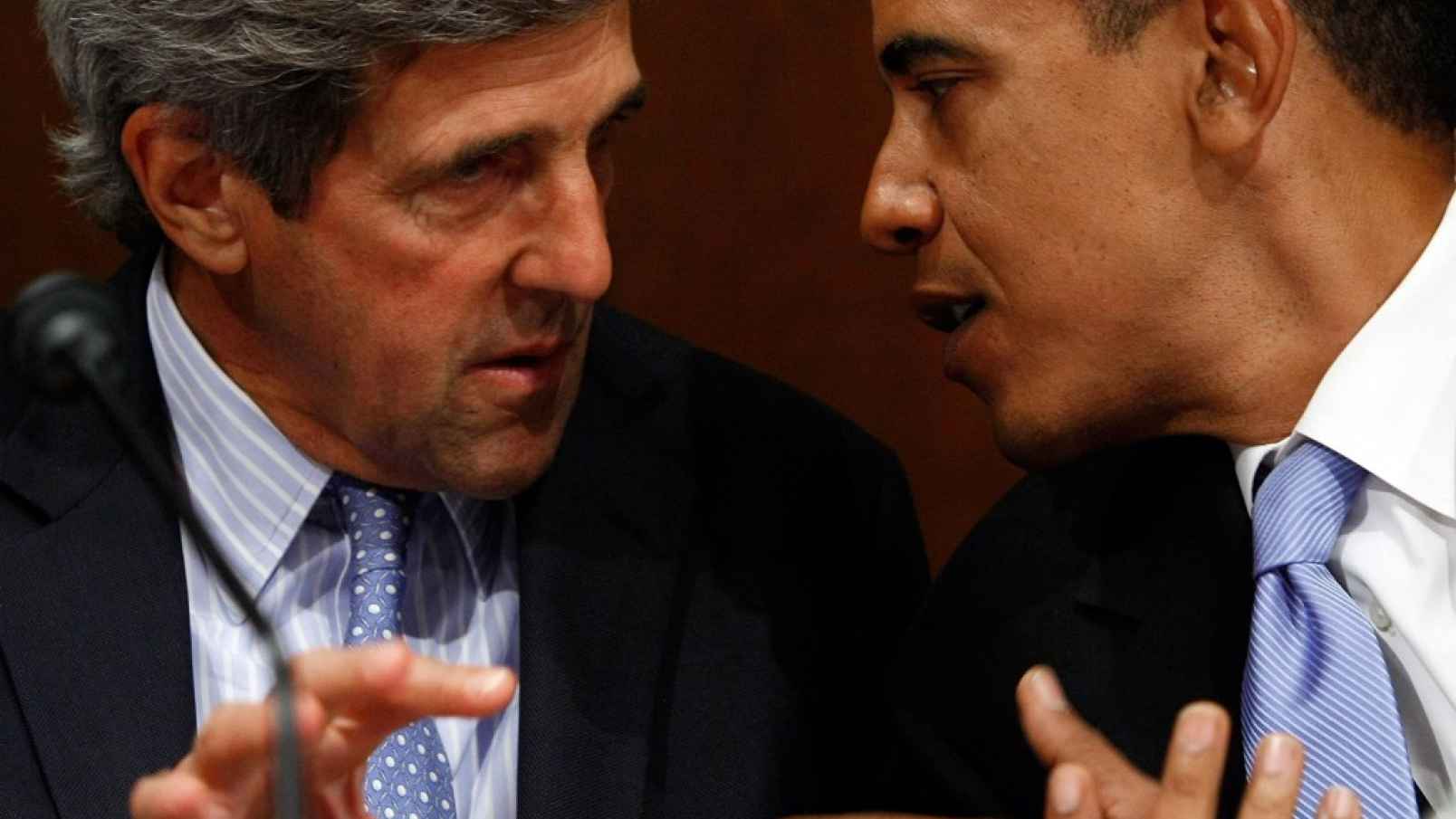
kerry_2

Obama isn’t Chamberlain. He doesn’t mean well. Kerry isn’t making honest mistakes. They negotiated ineptly with Iran because they are throwing the game. They meant for America to lose all along.

******************

The last time a feeble leader of a fading nation came bearing “Peace in our time,” a pugnacious controversial right-winger retorted, “You were given the choice between war and dishonor. You chose dishonor, and you will have war.” That right-winger went on to lead the United Kingdom against Hitler.

The latest worthless agreement with a murderous dictatorship is being brandished by John Kerry, a man who instinctively seeks out dishonor the way a pig roots for truffles.

John Kerry betrayed his uniform and his nation so many times that it became his career. He illegally met with the representatives of the North Vietnamese enemy in Paris and then next year headed to Washington, D.C. where he blasted the American soldiers being murdered by his new friends as rapists and murderers “reminiscent of Genghis Khan.”

Even before being elected, Kerry was already spewing Communist propaganda in the Senate.

Once in the Senate, Kerry flew to support the Sandinista Marxist killers in Nicaragua. Just as Iran’s leader calling for “Death to America” didn’t slow down Kerry, neither did the Sandinista cries of “Here or There, Yankees Will Die Everywhere.”

Kerry revolted even liberals with his gushing over Syria’s Assad. Now he’s playing the useful idiot for Assad’s bosses in Tehran.

For almost fifty years, John Kerry has been selling out American interests to the enemy. Iran is his biggest success. The dirty Iran nuke deal is the culmination of his life’s many treasons.

It turns America from an opponent of Iran’s expansionism, terrorism and nuclear weapons program into a key supporter. The international coalition built to stop Iran’s nukes will instead protect its program.

And none of this would have happened without Obama.

Obama began his rise by pandering to radical leftists on removing Saddam. He urged them to take on Egypt instead, and that’s what he did once in office, orchestrating the takeover of the Muslim Brotherhood in Egypt and across the region. The Muslim Brotherhood was overthrown by popular uprisings in Egypt and Tunisia, but Obama had preserved the Iranian regime when it was faced with the Green Revolution. Now Iran is his last best Islamist hope for stopping America in the Middle East.

Obama and Kerry had both voted against designating Iran’s IRGC terrorist ringleaders who were organizing the murder of American soldiers as a terrorist organization while in the Senate. Today they have turned our planes into the Air Force of the IRGC’s Shiite Islamist militias in Iraq.

Throughout the process they chanted, “No deal is better than a bad deal.” But their deal isn’t just bad. It’s treason.

Obama isn’t Chamberlain. He doesn’t mean well. Kerry isn’t making honest mistakes. They negotiated ineptly with Iran because they are throwing the game. They meant for America to lose all along.

When Obama negotiates with Republicans, he extracts maximum concessions for the barest minimum. Kerry did the same thing with Israel during the failed attempt at restarting peace negotiations with the PLO. That’s how they treat those they consider their enemies. This is how they treat their friends.

A bad deal wasn’t just better than no deal, it was better than a good deal.

Obama did not go into this to stop Iran from going nuclear. He did it to turn Iran into the axis of the Middle East. After his failures in the rest of the region, this is his final act of spite. With the fall of the Muslim Brotherhood and the decline of Islamists in Turkey, supporting Iran is his way of blocking the power of his successors in the White House to pursue a more pro-American foreign policy.

Obama made this deal to cripple American power in the Middle East.

Iran get to keep its nuclear facilities, its reactors, including the hidden underground fortified Fordow facility which Obama had repeatedly stated was, “inconsistent with a peaceful program.”

The deal gives Iran a “peaceful” nuclear program with an equally peaceful ballistic missile program. It puts into place a complicated inspection regime that can be blocked by Iran and its backers. It turns Iran into the new North Korea and the new Saddam Hussein, lavishing money on it while running future administrations through a cat and mouse game of proving violations by the terrorist regime.

And Obama made sure the Iran deal was written to make the proof as hard to obtain as possible.

U.S. Will Teach Iran to Thwart Nuke Threats

July 14, 2015

U.S. Will Teach Iran to Thwart Nuke Threats, Washington Free Beacon, July 14, 2015

> (AP Photo/Ebrahim Noroozi)

The United States and other world powers will help to teach Iran how to thwart and detect threats to its nuclear program, according to the parameters of a deal reached Tuesday to rein in Iran’s contested nuclear program.

Under the terms of a deal that provides Iran billions of dollars in sanctions relief, Iran and global powers will cooperate to help teach Iran how to manage its nuclear infrastructure, which will largely remain in tact under the deal.

Senior Iranian officials, including the country’s president, celebrated the deal as a victory for the country. Iran’s state controlled media quoted President Hassan Rouhani as saying that the deal will “remove all sanctions while maintaining [Tehran’s] nuclear program and nuclear progress.”

In what is being viewed as a new development, European countries and potentially the United States agreed to “cooperate with Iran on the implementation of nuclear security guidelines and best practices,” according to a copy of the agreement furnished by both the Russians and Iranians.

This will include “training courses and workshops to strengthen Iran’s ability to prevent, protect and respond to nuclear security threats to nuclear facilities and systems as well as to enable effective and sustainable nuclear security and physical protection systems,” according to the text.

Additional “training and workshops” would work to “strengthen Iran’s ability to protect against, and respond to nuclear security threats, including sabotage, as well as to enable effective and sustainable nuclear security and physical protection systems,” the text states.

The language was viewed as disturbing by analysts and experts who said such cooperation could help protect Iran against efforts by the Israelis or other countries to sabotage the Islamic Republic’s nuclear program in the future.

“The United States and its partners have just become the international protectors of the Iranian nuclear program. Instead of rolling back the Iranian nuclear program, we’re now legally obligated to help the Iranians build it up and protect it,” said one Western source present in Vienna and who is apprised of the details of the deal.

In addition to teaching Iran how to protect its nuclear infrastructure, world powers pledge in the agreement to help Iran construct next-generation centrifuges—the machines that enrich uranium—at its once-secret nuclear site in Fordow, where Iran has been suspected of housing a weapons program.

Fordow is an underground and fortified military site that is largely immune from air strikes by those seeking to eradicate Iran’s nuclear infrastructure.

While Iran will not be permitted to enrich nuclear material with these centrifuges, the know-how gained from operating these advanced centrifuges could help it advance clandestine nuclear weapons work, experts say.

The Obama administration had once vowed that Iran would have to fully dismantle its centrifuge program. However, this demand was walked back as the Iranians demanded greater concessions over the past months.

“Now the international community will be actively sponsoring the development of Iranian nuclear technology,” Omri Ceren, an analyst from the Israel Project (TIP), wrote in an email to reporters. “And since the work will be overseen by a great power, it will be off-limits to the kind of sabotage that has kept the Iranian nuclear program in check until now.”

Meanwhile, Iranian President Rouhani celebrated the deal in a speech that detailed how the country received everything it was looking for from the United States.

This includes the full rollback on sanctions on Iran’s financial, energy, and banking sectors, as well as others, and the suspension of international resolutions banning the sale of arms to Tehran.

Iran will also move forward with work on its advanced centrifuges and also “continue its nuclear research and development,” according to Rouhani’s comments. “All our goals materialized under the deal,” Rouhani said, according to Fars.

Iran’s nuclear reactors in Arak—which could provide with a second pathway to a nuclear weapon—also will continue to operate under the deal. It will continue in conjunction with the nuclear enrichment plants located in Fordow and Natanz.

Rouhani went on to say that Iran “will scrutinize implementation of the agreement” to ensure that the United States and other world powers uphold their end of the bargain.

The Deal with Iran: How to Make Lemonade out of Lemons

July 14, 2015

The Deal with Iran: How to Make Lemonade out of Lemons, The Times of Israel via Middle East Forum, July 14, 2015

(If all else fails, be sneaky; like Iran. — DM)

1499Iranian hardliners may be justified in fearing that Western intelligence agencies will exploit Iran’s opening to the world to undermine its regime.

The opening to the West is — or should be — a counterintelligence nightmare for Iran and they should be forced to devote scarce resources and increase internal repression to try and stay one step ahead.

**********************

It is always perilous to predict what future historians will say. But regarding the nuclear deal with Iran, it is likely historians will observe the remarkable fact that at the moment of its greatest weakness, Iran’s enemies suddenly reversed course. In the name of enticing it not to build nuclear weapons, they dismantled years of carefully built economic and political sanctions, saved its crumbling economy, and empowered the regime against its domestic and foreign enemies, including the West itself.

Doing so they accepted Iran’s attacks and insults, left its nuclear enrichment program intact and under minimal supervision, guaranteed Iranian threats to neighboring countries and efforts to expand regional hegemony, and did nothing to help the Iranian people, who struggled under harsh repression. Whether it will have succeeded in preventing Iran from building a nuclear weapon is unlikely. What is certain is that a new period of instability will have been created — that period is already upon us.

It is an extraordinary moment in world history, perhaps a turning point, based, as many such moments are, on an extraordinary convergence of lies and self-delusions. But for those interested in the two goals of an Iran free of nuclear weapons and free of religious fascism, perhaps it is also a moment of opportunity. Iran is about to undergo a kind of opening to the world. Taking advantage of that is now a vital goal for Western intelligence and public diplomacy. It is the art of the making lemonade out of lemons.

Western businessmen are already flooding into Iran seeking deals, selling all manner of wares in exchange for Iranian cash. Those businessmen, the various branch offices they will establish, and the goods they will sell, represent an important opportunity for Western intelligence agencies to gather information and to subvert the Iranian regime.

One simple method are thumb drives, containing viruses to disrupt computer networks, encryption tools to evade official Iranian surveillance and firewalls, and perhaps even Western music, literature, and movies to subvert repressive traditional values, and classics of Western political thought to inspire Iranian society toward a liberal democratic future. Jazz and rock, blue jeans and samizdat literature played roles in the collapse of communism; their 21st century analogs should be enlisted to help Iranian society reform itself.

In reality, this sort of ‘subversion’ should have been an important goal for Western public diplomacy and intelligence work all along. But there is no evidence that significant efforts have been made, especially under the Obama administration. Iranian jamming of Western broadcasts and Internet censorship have been extensive and have gone unprotested by the West, as has repression of dissidents and even the imprisonment of American citizens.

New access in Iran means new opportunities to introduce cyber weapons such as Stuxnet into Iran’s strategic computer systems. Stuxnet and its variants were designed to slow and damage computer controlled systems in Iran’s nuclear centrifuges, apparently with success. But they were eventually detected, and bizarrely, the Obama administration leaked information that led the trail back to the US. Iran’s computers were hardened against attack.

New cyber weapons aimed at Iran’s nuclear program, along with missiles, military radars and aviation, regime communications and record-keeping, and much more, are all likely under development in the West — or should be. Certainly Iran is developing its own cyber weapons, and has virtually unlimited access points to introduce them. But its weapons are aimed Western banks and critical infrastructure, such as electric grids. It is in everyone’s interest that more targeted cyber attacks on the Iranian regime and its weapons systems succeed first.

More access to Iran increases its vulnerability, as will more trade. Iran has long acquired items legally and illegally, including computers, industrial machinery, and materials for its weapons programs. With increased trade come more opportunities to sabotage equipment by introducing computer viruses, contaminating materials used in specific industries, and delivering products that do not meet stated specifications. One result may be that nuclear weapons programs can be slowed and that computer and communications systems can be monitored and disrupted. Another is that all imported trade goods become suspect, requiring expensive counterintelligence monitoring and testing. Openness should have a high price for Iran, both real and imagined.

Human intelligence opportunities directed against Iran will also increase, albeit slowly. Businessmen and academics have always been spies, and opportunities to recruit spies and saboteurs. More fundamentally it will increase the opportunity to innocently distribute information about the West through direct contacts. Keeping track of Westerners will in turn require more Iranian counterintelligence efforts. Here, too, the costs of Iran’s opening to the West should be made as high as possible.

Access to Iran’s people also raises the potential to eventually inspire them to overthrow the repressive theocratic fascist regime. Iran’s vulnerability to ethnic uprisings is often underestimated. The Persian-led regime rightly fears Ahwaz Arab tribes in the southwest, ethnic Baluch and Pashtun in the east, and Azeris and Kurds in the northwest. All these have long histories of rebellion against the Persians, and the regime is highly sensitive to the West stirring dissent.

More access will not easily bring such dissent about, much less the arming of ethnic dissidents. Indeed, such activities seem utterly antithetical to the Obama administration, which could not even be moved to support the Green movement that arose after Iran’s corrupt 2009 elections. But putting the regime under stress is an important means to bring about its transformation or demise. At the very least more broadcasts and translations should be aimed at these minorities, bringing them the news that they have not been forgotten by the West.

Even if the territorial integrity of Iran is somehow taken for granted by the West, the values of the regime cannot. The rights of ethnic minorities in Iran, and human rights generally should become a Western demand, supported by tough negotiations and public diplomacy. Such demands featured prominently in American relations with the Soviet Union and should have an equally central place in dealings with Iran. Of course, they will not under Obama, but perhaps they will under the next president.

In all this, Iran’s paranoia should be exploited to the fullest. The opening to the West is — or should be — a counterintelligence nightmare for Iran and they should be forced to devote scarce resources and increase internal repression to try and stay one step ahead. Iran’s youth are already deeply alienated against the regime and to some extent Islam itself. How to increase alienation is a paramount strategic goal for the West.

More positively, the opening to Iran must be seen as an opportunity for the West to promote its own values, of openness, tolerance, liberty and human dignity. If it does not, then those values no longer exist in the West, just as they do not in Iran.

Iran Is Responsible for More Than 1,000 American Military Deaths Since 9/11

July 14, 2015

Iran Is Responsible for More Than 1,000 American Military Deaths Since 9-11

by David French July 14, 2015 12:26 PM Via The National Review


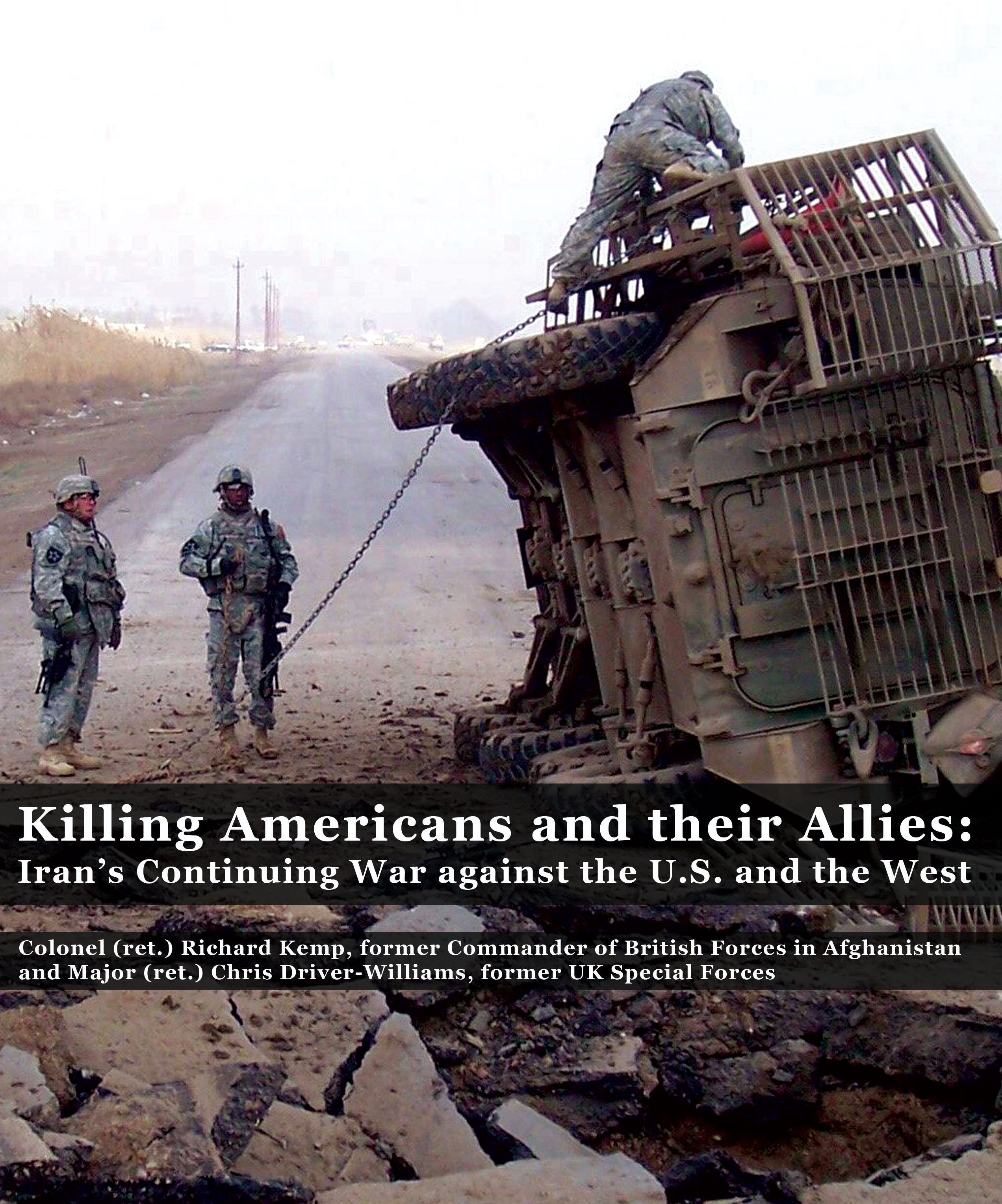
Killing Americans and Their Allies [Source: Jerusalem Center for Public Affairs]

(I encourage you to follow the link in this overview and take a look at the report. – LS)

I’m going to say more about the Iran deal in a piece that will go up shortly on the homepage, but I wanted to highlight this report, by Colonel (ret.) Richard Kemp and Major (ret.) Chris Driver-Williams, that comprehensively outlines Iran’s acts of war against the United States. Some lowlights:

Iranian military action, often working through proxies using terrorist tactics, has led to the deaths of well over a thousand American soldiers in Iraq and Afghanistan over the last decade and a half. Throughout the course of the Iraq campaign, a variety of weapons flowed into the country through direct purchases by the government of Iran. These included Explosively Formed Penetrators (EFPs), a shaped charge designed to penetrate armor. These weapons – often camouflaged as rocks – were identical to those employed by Hizbullah against Israeli forces. In 2006, the British Telegraph revealed that three Iranian factories were “mass producing” the roadside EFP bombs used to kill soldiers in Iraq . . . Iran paid Taliban fighters $1,000 for each U.S. soldier they killed in Afghanistan. The Sunday Times reported that a Taliban operative received $18,000 from an Iranian firm in Kabul as reward for an attack in 2010 that killed several Afghan government troops and destroyed an American armored vehicle.

The Obama administration’s nuclear agreement is nothing more than a stimulus package for jihad. Billions of dollars will flow into the world’s worst terror-exporting country — a sworn enemy of the United States — and it will soon enough even have (legal) access to international conventional-arms markets. It can continue to export terror and even kill American soldiers without breaching the nuclear agreement. Until Iran stops trying to kill Americans and stops imprisoning Americans (including Saeed Abedini, a pastor prosecuted merely because of his Christian faith), how can any rational person trust its good faith?

YOU CAN READ THE REPORT AT: http://jcpa.org/killing-americans-allies-irans-war/

King Barack, Sir John and a great nuke deal — for Iran | Part I

July 14, 2015

King Barack, Sir John and a great nuke deal — for Iran | Part I, Dan Miller’s Blog, July 14, 2015

(The views expressed in this post are mine and do not necessarily reflect those of Warsclerotic or its other editors. — DM)

Oh what a tangled web we weave, when first we practice to deceive.

depleted

Obama has practiced deceit for a long time and His “deal” with Iran demonstrates His consummate mastery of the techniques. Earlier, He announced that the November 2013 Joint Plan of Action would eliminate Iran’s nuke weaponization and that there would be no deal otherwise. As I contended here in January of 2014, He lied. The November 2013 “joint plan of action” contemplated no inspection of any Iranian military or missile site. Quoting from my post linked immediately above,

The text of the English language version of the P5+1 “deal” is available here and the text of the January 16th White House summary of the recent agreement to go forward by reducing sanctions and beginning inspections of some (but not all) Iranian nuclear facilities is available here. I posted articles about the November 24th “deal” here and here and the White House summary here. The first two minutes and eleven seconds of the video embedded below provide a concise summary of what has been happening.

Obama, however, often told us that there would be anywhere, anytime inspections with which Iran could not interfere and which would prevent its development of nuclear weapons.

The “deal” with Iran was announced today, July 14, 2015. The 159 page text of the “Joint Comprehensive Plan of Action” is available here. Here are excerpts from Attachment 1, dealing with IAEA inspections of Iran’s nuke sites:

In line with normal international safeguards practice, such requests will not be aimed at interfering with Iranian military or other national security activities, but will be exclusively for resolving concerns regarding fulfilment of the JCPOA commitments and Iran’s other non-proliferation and safeguards obligations. [Emphasis added.]

. . . .

If the absence of undeclared nuclear materials and activities or activities inconsistent with the JCPOA cannot be verified after the implementation of the alternative arrangements agreed by Iran and the IAEA, or if the two sides are unable to reach satisfactory arrangements to verify the absence of undeclared nuclear materials and activities or activities inconsistent with the JCPOA at the specified locations within 14 days of the IAEA’s original request for access, Iran, in consultation with the members of the Joint Commission, would resolve the IAEA’s concerns through necessary means agreed between Iran and the IAEA. In the absence of an agreement, the members of the Joint Commission, by consensus or by a vote of 5 or more of its 8 members, would advise on the necessary means to resolve the IAEA’s concerns. The process of consultation with, and any action by, the members of the Joint Commission would not exceed 7 days, and Iran would implement the necessary means within 3 additional days. [Emphasis added.]

Hence, if Iran does not agree to permit inspections within fourteen days of an IAEA request, the dispute will be resolved by majority vote of an eight member committee, including Iran, Russia and China. Should those three vote against an IAEA inspection, as they likely would, it would take all of the other five members to grant the IAEA request. That process “would not exceed 7 days” and then, if a majority (five members) of the committee agreed with the IAEA, Iran would have three additional days to comply. In the unlikely event of a majority vote in favor of the IAEA, Iran would have had twenty-four days to prepare for an inspection. Three days, let alone twenty-four days, would give Iran ample time to eliminate evidence of whatever the IAEA sought. It all boils down to trusting Iran.

As observed here, that amounts to no time, nowhere supervision.

Any deal that scales back sanctions and allows Iran to keep operating its advanced ‎nuclear development facilities even at a low level is a fatal bargain. So warned Simon ‎Henderson of the Washington Institute and Olli Heinonen, a former deputy director ‎general of the International Atomic Energy Agency, as long as two years ago. ‎

U.S. President Obama’s response to this was to promise that he would accept nothing ‎less than a Western right to conduct “anywhere, anytime” international inspections of ‎Iran’s most secret nuclear and military facilities. ‎[Emphasis added.]

Indeed, veteran investigators have testified in front of Congress literally dozens of ‎times that anywhere-anytime access is a minimum prerequisite to a verifiable deal. ‎

Alas, Obama has now backed down from that. It’s an American collapse.‎

Deal-Vest

I have not dealt with other aspects of the “deal” here but plan to do so in Part II.