Archive for June 2015

Terror will not be defeated with reports

June 22, 2015

Terror will not be defeated with reports, Israel Hayom, Dr. Gabi Avital, June 22, 2015

(Please see also, US: Iran’s Support for Terror Undiminished. — DM)

Iran is led by rational and calculated religious clerics, whose goals are openly declared and well-defined. The rationality one should expect to find in the State Department has dissipated in a haze of illusions, which are exacting a heavy toll. Meanwhile, only the Islamic State stands to outflank Iran, and that is only under the assumption that these two terrorist entities are on completely divergent paths. To be sure, that is quite the baseless assumption.

Yet those who with one hand sound the alarm over an increase in terror, while with the other help the perpetrators of said terror rule the roost by giving it nuclear weapons, must provide convincing explanations. The United States, with its utter foreign policy failures — from Iraq to Yemen to Syria to Egypt and Iran — is not forthcoming with such explanations.

Where is Michael Moore when you need him? The State Department can see what is happening, but Kerry is on his way to a nuclear deal with the world’s leading sponsor of terrorism. Not much could be worse.

********************

Understanding history is a tricky proposition. Its lessons are sometimes hidden to us for long periods; often only subsequent generations can achieve the proper historical perspective, after a series of fateful events has unfolded. Even so, within less than 40 years we have witnessed global events that many political scientists correctly predicted.

The time is the late 1970s. All signs point to an oncoming revolution in Iran. However, U.S. President Jimmy Carter (whom some call the worst president ever), is instead consumed with the wording for a peace deal that undermines pre-existing agreements and international accords. Egypt wins the entire pot in a peace deal with Israel. Iran rises in prominence; the Soviet Union bolsters its standing across the globe, until the arrival of Ronald Reagan, who in an effort to defeat the Soviet Union in the ongoing Cold War, announces his Star Wars program.

We know the ending. Almost every single international relations expert points to that declaration as the beginning of the fall of the Soviet Union. In 1989, Reagan concludes two terms in office, and the Soviet Union falls apart.

Terrorism spreads across the globe. The leading sponsors are Saudi Arabia, Syria and Iran. An extensive report, examining the dangers of mass terrorist attacks on U.S. soil, is being compiled. The conservative-democratic pendulum in the U.S. swings toward the Democratic candidate, Bill Clinton. The egregious disregard of the report, now collecting dust, brings terrorism to its horrific pinnacle on Sept. 11, 2001. All fingerprints lead back to Saudi Arabia. Everything had already been laid out in the dust-covered Pentagon report. What the democratic Pentagon and State Department cooked up, the Republican George W. Bush was forced to eat.

The State Department has now published its annual report on terrorism. The seeds of this report were planted in the Carter era, when peace at all costs was championed without any understanding of the world in general and the Middle East in particular. Iran is led by rational and calculated religious clerics, whose goals are openly declared and well-defined. The rationality one should expect to find in the State Department has dissipated in a haze of illusions, which are exacting a heavy toll. Meanwhile, only the Islamic State stands to outflank Iran, and that is only under the assumption that these two terrorist entities are on completely divergent paths. To be sure, that is quite the baseless assumption.

So what does the report say? There will be a dramatic 35% rise in global terrorist acts. Iran supports terrorist organizations all over the world and in the Middle East especially; it backs the Shiite fighters in Iraq, Hezbollah in Lebanon and in Syria, with arms, training, money and intelligence. And we haven’t even mentioned Syria yet, or Hamas and Islamic Jihad.

Yet those who with one hand sound the alarm over an increase in terror, while with the other help the perpetrators of said terror rule the roost by giving it nuclear weapons, must provide convincing explanations. The United States, with its utter foreign policy failures — from Iraq to Yemen to Syria to Egypt and Iran — is not forthcoming with such explanations. Russia is back on the Cold War track; the Islamic State group is emboldened by the conduct of the U.S. president and his team at the State Department; Iran is envisioning a nuclear bomb in its arsenal; and Saudi Arabia is looking on nervously as the carpet of reciprocity is being pulled out from under it and its oil fields.

Only a week before Secretary of State John Kerry, one of the pillars of this dangerous U.S. foreign policy, takes off to pursue the deal with Iran, Tina Kaidanow, the State Department’s coordinator for counterterrorism, tells us: “We continue to be very, very concerned about [the Islamic Revolutionary Guard Corps] activity as well as proxies that act on behalf of Iran.”

What then, is Kerry really unaware of the findings in the 388-page report? And does he not understand that the deal with Iran, the seeds for which were planted in the Carter era and now being cultivated by Obama, is terrorism itself, and that there is no need for any report to merely sit and collect dust again in the State Department cellar?

Where is Michael Moore when you need him? The State Department can see what is happening, but Kerry is on his way to a nuclear deal with the world’s leading sponsor of terrorism. Not much could be worse.

US: Iran’s Support for Terror Undiminished

June 22, 2015

US: Iran’s Support for Terror Undiminished, The Clarion Project, June 21, 2015

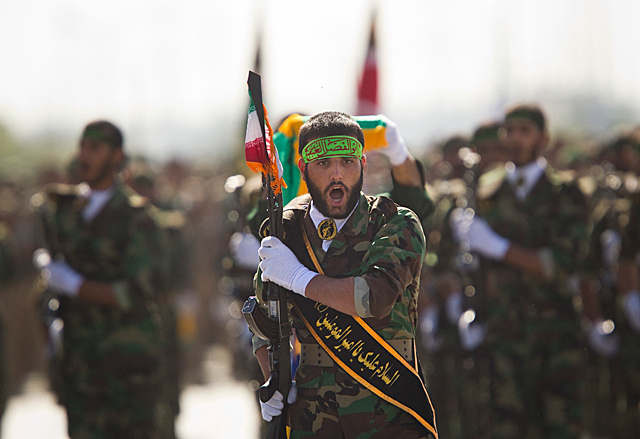
Iran-Basij-March-IP_1The Iranian volunteer Basij militia (Photo: © Reuters)

In an interview with The Atlantic, U.S. President Barack Obamas admitted that some of the money freed up the deal’s proposed sanction relief may up going towards terrorism, although he argued that Iranian government would have to make good on their commitments to improve the country’s economy.

******************

Despite the fact that Iran’s global terror activities were “undiminished” between 2013 and 2014, the U.S. State Department is still entirely committed to pursuing a nuclear deal with Iran.

“We think it’s essential that we pursue those negotiations,” said Tina Kaidanow, the State Department’s coordinator for counterterrorism, as quoted in The Wall Street Journal. “None of that implies that we would be, again, in any way taking our eye off the ball with respect to what Iran is doing as a supporter of terrorism.”

Iran’s support for terror was documented in the State Dept.’s annual report on global terrorism, which was released Friday. The report says “Iran’s state sponsorship of terrorism worldwide remained undiminished,” which makes the State Dept. “very, very concerned,” according to Kaidanow.

While the June 30 deadline for the deal is now fewer than 10 days away, the release of the report shows, “Iran continued to sponsor terrorist groups around the world,” according to Kaidanow.

The report specifically mentions Iran’s continued support for the Shiite terror organization Hezbollah in Lebanon as well as those fighting with embattled Syrian President Bashaar al-Assad.

The Clarion Project reported last week that Iran is supporting more than 100 terrorist organizations in Syria and Iraq alone.

In an interview with The Atlantic, U.S. President Barack Obamas admitted that some of the money freed up the deal’s proposed sanction relief may up going towards terrorism, although he argued that Iranian government would have to make good on their commitments to improve the country’s economy.

“I don’t think …anybody in this administration said that no money will go to the military as a consequence of sanctions relief,” Obama said. “The question is, if Iran has $150 billion parked outside the country, does the IRGC automatically get $150 billion? Does that $150 billion then translate by orders of magnitude into their capacity to project power throughout the region? And that is what we contest …”

The report also showed that between 2013 and 2014, there was a significant rise in global terror attacks, causing an increase in over 80 percent of violent deaths from the previous year (which itself had seen a 43 percent increase from the year before). In addition, the report showed:

  • There was an average of 1,122 attacks per month
  • Kidnappings increased by one-third, with more than with 9,400 people taken hostage
  • The number of global attacks rose by 35 percent
  • 32,727 people were killed worldwide (versus 17,800 in 2013)
  • 34,700 people were injured in attacks in close to 95 countries
  • In Iraq alone,  10,000 people died in 3,360 attacks representing close to a third of all people killed in terror attacks worldwide.

Iran (and Obama) vs. Israel (1)

June 22, 2015

Iran (and Obama) vs. Israel (1), Power Line, Scott Johnson, June 21, 2015

I wondered how I missed the story about Iran’s plot to bomb the Israeli legation [in Washington, D.C.]. In his interview with us on Friday, Oren implied that information regarding the plot had previously been classified. Going through the Israeli government’s prepublication review of his manuscript, he received permission to reveal what remains about it in the book.

That’s quite a crew that President Obama has us crawling into bed with, on a tissue of rationalizations and deceptions and betrayals. Oren’s book sets off a potent alarm. We’re going to hate ourselves on the morning after.

*****************

The Islamic Republic of Iran avows its desire to eliminate Israel. It is an avowedly anti-Semitic terror state. To state the obvious, it wars on Israel because Israel is the Jewish state.

Iran’s war against Israel is of course not simply verbal. It has armed Hezbollah with more than 100,000 missiles to use against Israel on demand. It seeks nuclear weapons that will make the elimination of Israel an afternoon’s work. Yet the United States is about to enter into an agreement with Iran that blesses its nuclear program and facilitates its acquisition of nuclear weapons.

President Obama by turns excuses, discounts and rationalizes the avowed anti-Semitic statements and goals of the Islamic Republic of Iran. Obama asserts, for example: “The fact that you are anti-Semitic, or racist, doesn’t preclude you from being interested in survival. The fact that the supreme leader is anti-Semitic doesn’t mean that this overrides all of his other considerations.”

And: “They have their worldview and they see their interests. They’re not North Korea.” According to Obama, Iran “use[s] anti-Semitic rhetoric as an organizing tool.” The anti-Semitic pronouncements are not to be taken too seriously; they are simply intended for domestic consumption.

Obama’s comments are so stupid and glib it’s hard to believe that he takes them seriously himself. Michael Oren addresses the substance of Obama’s comments in the Los Angeles Times column “Why Obama is wrong about Iran being ‘rational’ on nukes” (bad headline, excellent column).

Oren concludes his column with this understated observation: “Obama would never say that anti-black racists are rational. And he would certainly not trust them with the means — however monitored — to reach their racist goals. That was the message Israeli officials and I conveyed in our discreet talks with the administration. The response was not, to our mind, reasonable.”

Oren also treats the issue of Iran and Obama in his book Ally: My Journey Across the American-Israeli Divide, to be published on Tuesday. Oren’s treatment of the issue is one of the book’s great virtues.

Oren reveals in the book that Iran plotted to bomb the Israeli legation in Washington, D.C., in 2011. He writes: “The terrorists also targeted Saudi Arabia’s ambassador to Washington, planning to murder him with a bomb while he dined at his favorite restaurant, Cafe Milano.” Oren quotes himself asking Prime Minister Netanyahu on October 11, 2011: “Who will protect the embassy?”

We knew about the plot against the Saudi ambassador; the plot was all over the news when charges against two Iranians were unsealed. The Washington Post quoted then Attorney General Holder saying that “the United States is committed to holding Iran accountable for its actions,” but noted that other Obama administration officials indicated that it was not yet clear who in the Iranian government was behind the alleged plot. It’s all a big mystery.

I follow the news. I wondered how I missed the story about Iran’s plot to bomb the Israeli legation. In his interview with us on Friday, Oren implied that information regarding the plot had previously been classified. Going through the Israeli government’s prepublication review of his manuscript, he received permission to reveal what remains about it in the book.

Oren notes that the 2011 plot was the handiwork of “Iran’s elite al-Quds force, in charge of overseas operations directly authorized by the regime’s Supreme Leader.” He continues:

By selling drugs internationally and laundering the profits through used-car dealerships, Iran had financed terrorist attacks in twenty-five cities throughout the world. Now that list included America’s capital. Such brazen aggression should have precipitated an instant U.S. military response. Instead, President Obama called the Saudi king–not Netanyahu–telling him, “This plot represents a flagrant violation of international norms, ethics, and law.” Such abstractions, I assumed, did not appease the desert monarch. And they certainly failed to mollify me. If the administration balked at retaliating for an attempted massacre only blocks from the White House, I asked myself, would it strike nuclear facilities six thousand miles away?

Well, if we were ever in doubt, now we know the answer to that last question. I’ll return to it tomorrow. Before leaving off here, however, I want to pick up Oren’s thread on the reality of Iran’s war against Israel. A few pages after his discussion of the 2011 plot focused on Washington, Oren writes:

[V]icious Iranian words soon translated into murderous actions. Starting in February 2012, when an al-Quds force operative blew off his own legs while trying to bomb an Israeli diplomatic target, Iran masterminded a series of terrorist attacks worldwide. Mossad and foreign intelligence networks subsequently managed to thwart similar strikes against Israelis in Kenya, South Africa, Cyprus, Azerbaijan, and Georgia. But not all of Iran’s aggressions could be stopped. A car bomb wounded the wife of Israel’s military attache in New Delhi. Then, on July 18–exactly eighteen years after explosives killed eighty-five people at a Jewish center in Buenos Aires–Hezbollah terrorists struck a bus carrying Israeli tourists in Burgas airport in Bulgaria. A bomb planted in the luggage compartment blew burning bodies out of the bus, killing seven and wounding thirty-three.

That’s quite a crew that President Obama has us crawling into bed with, on a tissue of rationalizations and deceptions and betrayals. Oren’s book sets off a potent alarm. We’re going to hate ourselves on the morning after.

US rebuffs Israel’s last-ditch bid for nuclear constraints in Iran accord

June 21, 2015

US rebuffs Israel’s last-ditch bid for nuclear constraints in Iran accord

DEBKAfile Exclusive Report June 21, 2015, 7:52 PM (IDT)

Tags: US-Israel, US-Iran, Iran nuclear,

via US rebuffs Israel’s last-ditch bid for nuclear constraints in Iran accord.

Israel’s National Security Adviser Yossi Cohen was invited to join two top US officials for dinner in Washington on June 15 to try and make Israel’s case for amending the disastrous nuclear accord taking shape in Vienna between the six world powers and Iran, before it was too late. This meeting is reported here by debkafile for the first time. It was hosted by US National Security Adviser Susan Rice and senior US nuclear negotiator Undersecretary of State Wendy Sherman.

The occasion was arranged by CIA Director John Brennan at the end of his visit to Jerusalem in the first week of June. He had come to offer senior Israelis, led by Prime Minister Binyamin Netanyahu, a behind-the-scenes briefing on the provisions the Obama administration had accepted for the final nuclear accord with Iran due to be signed by June 30.
This briefing was greeted in Jerusalem with shock and alarm. Very few of the conditions for a deal stipulated by the US upon embarking on the negotiations had survived: Iran would continue to enrich uranium, be allowed to bar international inspections of military facilities suspected of hosting nuclear research activity (where were Obama’s “intrusive inspections?) and – Israeli officials heard this for the first time – the Iranian UCF facility at Isfahan would be expanded. This plant is engaged in the conversion of “yellow cake” to enriched nuclear material.
They also discovered that President Obama, who had originally promised the deal would provide for “snapping sanctions back” in the event of violations, had assured Tehran that once sanctions were lifted, they would not be re-imposed.
Netanyahu asked Brennan for time to digest the full extent of the Obama administration’s retreat in the face of Iran’s nuclear aspirations. He then asked for his national security adviser to be given a chance to propose changes that would allay some of Israel’s concerns.

Brennan quickly set up a date for Cohen to be received in Washington.

debkafile’s Washington sources reveal that at the dinner in Washington, the Israeli official tried a new tack with his hostesses, Rice and Sherman. On the understanding that the main clauses of the nuclear accord had been finalized and gone past the stage of amendment, he nonetheless suggested a number of insertions in the various clauses that would make it a better deal for American as well as Israeli security.
Rice and Sherman politely allowed him to finish talking and then turned his proposals down flat.

US and Israeli official sources agree that the invitation to Cohen had not been intended for any serious discussion between the two governments on the Iranian nuclear issue. The two top American officials dealing with the nuclear question barely heard a word that Cohen said. His journey to Washington was a complete waste of time.

Distinguished pol of the week – The Washington Post

June 21, 2015

Distinguished pol of the week – The Washington Post.

June 21 at 7:45 AM

Israel’s former ambassador to the United States Michael Oren is previewing a new book concerning his years in Washington working with the Obama administration, devastating in its documentation and thoroughly credible coming from a man at the center-left in Israeli politics. It seems he kept a daily diary, and oh, what a story he has to tell. In an interview last week he gave us a peek behind the curtain:

Don’t get me wrong. You can have disagreements. The Obama administration was problematic because of its world view: Unprecedented support for the Palestinians. Reconciling with what Obama calls the Muslim world; even the choice of the term is interesting. And outreach, reconciling with Iran. From the get-go. You see that right from the beginning. He comes into office going after Iran.

But (the administration) is also problematic because the White House jettisoned the two core principles of the alliance, which were “no surprises” and “no daylight.” Obama said it: I’m putting daylight. And proceeds to put daylight, public daylight. And then surprises. I was told that with previous administrations — I’m certainly going back to Clinton — we were always given advance copies of major policy speeches. The Cairo speech (that Obama delivered in 2009) was twice as long as the First Inaugural Address. It touched on issues that were vital to our security. We never had any preview.

His criticism is not limited to Obama, however: “The good news is that America is not just the administration, as you know. America is America. America is the Congress. My biggest fear is not the Obama administration. I am deeply concerned about the future of the Democratic Party, with the progressive wing in the background. I think we have to do much more to reach out to that progressive wing.” This is ironic given that American conservatives were often frustrated with him, finding his willingness to ingratiate himself with Israel’s left-wing critics maddening — as was his refusal to be clear that the failure to maintain bipartisan support of Israel rests with the party that is no longer so supportive, not with the GOP for which support for the Jewish state is a litmus test.

His most devastating criticism concerns a failure of the president that was aided and abetted by the far right and left: “The bottom line is that the day that Obama didn’t act against the Syrians (for their use of chemical weapons in 2013, and thus failed) to maintain the Syrian ‘red line,’ was the day that the debate (over whether Obama was serious about his military option on Iran) stopped here. Did you notice that? Just stopped. Dead. And everyone went quiet. An eerie quiet. Everyone understood at that point that that was not an option, that we’re on our own.” Some lawmakers who were with Obama on that, encouraging a fatal error, will have some explaining to do in 2016.

But for Obama apologists, Oren’s bird’s-eye view and the level of detail he is able to provide must be bracing. He knows what Obama’s critics long suspected: This is a president who doesn’t like the Jewish state all that much.

The administration has a mantra: If you don’t make moves on peace, if you don’t freeze (settlements), you’re going to be isolated, you’re going to be boycotted, you’re going to be sanctioned. We all understood this was a threat. When your parents say if you don’t clean up your room… it’s a threat. I always thought it was the wrong approach. I say in the book, Israelis make concessions when we feel secure. “If you do this, no matter what anybody tries to do to you, we’re going to defend you” — that should have been the approach. But it wasn’t. It was always trying to hit us over the head. Maybe someone thought that if you beat Bibi on the head frequently enough, he’ll give in. After all, they called him “chickens[—].” Until he showed up in Congress and all of a sudden he wasn’t chickens[—] any more.

His book is a challenge to Obama supporters, to the entire Democratic Party (does it want Obama to set a pattern for the party or be a failed aberration?) and to those who flinched when a strong U.S. presence was needed most of all. In that regard — like two former secretaries of defense who served under Obama — he has provided invaluable insight into a failed president and, if voters listen, some measure of accountability. For all that, we can say, well done, Mr. Ambassador.

What the Obama worshippers missed

June 21, 2015

Israel Hayom | What the Obama worshippers missed.

Richarf Baehr

It is not surprising that former Israeli Ambassador to the U.S. Michael Oren is now in the sights of the Obama Defenders Corps, a collection of U.S. administration officials, sycophantic journalists and other obsessive critics of Israel.

The former ambassador has revealed in his new book what most Israelis and many Americans now know to be true: that U.S. President Barack Obama abandoned Israel ever since the beginning of his term in 2009, and that the breach in U.S.-Israel relations is primarily his doing. In fact it was a deliberate policy to create distance between the United States and Israel, since the president was far more interested in making nice to the likes of Iran and the Muslim Brotherhood, and the Muslim world in general. Close U.S. ties with Israel presented an obstacle in Obama’s path toward accomplishing these other goals.

In essence, Obama had swallowed the message of Professors Steven Walt and John Mearsheimer in their book: “The Israel Lobby” in its entirety. Obama was also educated in Third World/academic perspectives on international conflicts, which always tend to favor the weaker or non-Western party. So it was predictable that he would come into office believing Israel was primarily at fault in its conflict with the Palestinians, and so pressure needed to be applied to them.

None of this should have been a surprise to anyone who honestly explored Obama’s history before he became president. That of course excludes the likes of New Yorker editor David Remnick who managed to miss all the essentials despite a multi-pound tome that later filled many remainder shelves. Why would Obama and his family have remained in the church of anti-Semitic, America-bashing Rev. Jeremiah Wright for so many years? What exactly were the connections between Obama and Ali Abunimah, the co-founder of the Electronic Intifada website, or between Obama and Professors Rashid Khalidi and Edward Said? How much of Obama’s autobiography did he write himself and how much was it the work of far more than “casual acquaintance on the street” Bill Ayers, the former domestic terrorist? When Obama declared that his presidency would be transformative, he meant it.

Oren’s new book, “Ally: My Journey Across the American-Israeli Divide” will be formally released on June 23. Oren has already written columns for major American papers on the book, including The Wall Street Journal and the Los Angeles Times, and he has been interviewed by other journalists.

The book is causing severe heartburn in the White House for any number of reasons. The timing of the book’s publication is a particular problem for the White House. As the complete capitulation to Iran on virtually every contentious issue in the negotiations becomes clearer each day, and with a June 30 deadline for a deal approaching, Oren’s book may cause even more skepticism among the growing number of critics of the deal, potentially even among some Democrats in Congress, who are among those who still care about Israel’s survival.

Oren’s Los Angeles Times column attacks the president for arguing that Iran can be anti-Semitic and still behave rationally in regard to its nuclear program. As a historian, Oren is aware that as Nazi Germany was losing World War II, it became even more committed to killing off every Jew it could in Europe. Was this rational?

The president has recently launched a brief campaign to warm the hearts of his liberal Jewish supporters and ease their minds about the Iran deal. He had one more conversation with Jeffrey Goldberg (the semi-official Obama-Jewish translator), and spoke at a synagogue in Washington whose members include prominent officials and journalists, almost all of whom likely voted for him, and always vote for Democrats. These are the Jews Obama knows, and the ones an editor of the Los Angeles Jewish Journal believes should say: “Thank you, Mr. President,” or be considered “ingrates.”

Oren is the worst person the White House could want to be on their case at this time. He is not an Israeli who speaks English poorly. He is not and never has been a “right-wing” member of the Likud or another nationalist party. He is not ultra-Orthodox. He does not live on a settlement. He is an American who made aliyah, as did his wife. Oren is also a noted historian and scholar, with three degrees from two Ivy League schools: Columbia and Princeton. His previous books on the 1967 Six-Day War and American involvement in the Middle East have won the National Jewish Book award and the Los Angeles Times History Book of the Year award. He has taught at Harvard, Yale and Georgetown, and for five years was a contributing editor to the liberal New Republic. He has been published in The New York Review of Books, and the left-of-center newspaper The Forward named Oren one of the five most influential Jewish Americans in the world. In short, Oren cannot be caricatured as a man of the Right, or someone who would automatically be expected to be among those bashing Obama for whatever reason. His new book still remains faithful to the need for a two-state solution. He is, in many ways, the poster boy for Jewish liberals — well-educated at prestigious schools, articulate, a scholar and a moderate who is part of the consensus view on the conflict. More accurately, Oren was a dream Israeli, before he revealed that the emperor (America’s “most Jewish president” in Obama’s own modest view) had no clothes.

It is worth noting that Oren had reached so high a degree of respect and acceptability among liberal American Jews that Obama’s selected Jewish interlocutor, Goldberg, had written a puff piece on Oren’s wife Sally and her connection to rock musicians when she was growing up in San Francisco.

Given Oren’s history, the attacks on him and his new book needed a different angle than the way the Left and the administration regularly go after Prime Minister Benjamin Netanyahu and his allies. The first chosen path was to attack Oren for his venality — he is saying these things just to sell books. The administration naturally argued that Oren was not being honest. Any problems that exist were all Netanyahu’s fault. U.S. Ambassador to Israel Dan Shapiro, a member of the Obama-loving synagogue in Washington, D.C. where the president recently spoke and was received so adoringly, demanded that Netanyahu and other Israeli political figures renounce the book and its history and conclusions. The head of the political party to which Oren now belongs, Moshe Kahlon, was also pressured to dissociate himself and his party (Kulanu) from the book, but he said no more than that the book was a personal memoir and written before Oren was a party member. This was clearly less than Shapiro was hoping for.

The demands made by Shapiro would be more expected to come from commissars in former East Germany than the United States, but control of the narrative matters to this White House. It has twisted itself into a pretzel trying to argue that the April 2 summary of terms with Iran was in fact still an accurate listing of the terms of the deal, when it is now apparent that the Iranian summary was far closer to the real agreement. Oren’s condemnation of the Obama team for bearing the major responsibility for the now greatly weakened alliance between Israel and the United States makes the concessions to Iran and the seeming Captain Ahab-like pursuit of that deal appear even more irresponsible.

Oren’s most telling comment on Obama in the new book was picked up by Joel Pollak:

“More alarming for me still were Obama’s attitudes towards America. Vainly, I scoured ‘Dreams from My Father’ for some expression of reverence, even respect, for the country its author would someday lead. Instead, the book criticizes Americans for their capitalism and consumer culture, for despoiling their environment and maintaining antiquated power structures. Traveling abroad, they exhibited ‘ignorance and arrogance’ — the very shortcomings the president’s critics assigned to him.”

Speaking to Breitbart News last week, Oren recalled his impressions of “Dreams.” Obama said “nothing good about America” in his memoir, Oren says. Here was a man “without a word of praise or gratitude to America” — and yet “no one was listening” to what Obama truly believed.

“That said a lot to me about where America was” when Obama was elected, Oren recalls.

This is the story that the Obama worshippers from 2008, including leadership from major American Jewish organizations, missed, or chose to ignore. If Obama felt this way about his own country, how could anyone take seriously the arguments of those who defended his pro-Israel bona fides with all the countervailing evidence that was available? Of course, if someone like Bill Ayers had a major role in writing “Dreams from My Father,” the anti-American messaging should have been no surprise. Clearly, Obama was not uncomfortable with this message, whether he wrote it himself or approved what was composed by another.

There are too many important or self-important people who still pledge allegiance to Obama, or are steadfast supporters of his political party, for many minds to change as a result of Oren’s book. But the former ambassador has done a public service revealing at this time, before the Iran deal is finalized or reviewed and voted on in Congress, the depth of the hostility toward Israel that now resides in the president, the White House, the State Department and among various other key officials and cabinet departments. This will be a tough one to sweep under the Persian rug. But fear not, the president has a message for you once he leaves the golf course and finishes up his fundraisers today: “Trust me and trust Iran, not Oren.”

Washington up in arms over Michael Oren’s Obama remarks

June 21, 2015

Israel Hayom | Washington up in arms over Michael Oren’s Obama remarks.

( Mike Bornstein was my friend at Columbia College and grad school.  Together with Dore Gold who helped me found a Jewish communal house at Columbia all made Alliah at the same time in 1979.  Mike changed his last name to “Oren” while mine became Wouk Bar-Ze’ev. 

Gold served as Ambassador to the UN and has now been appointed Director General of the Foreign Ministry. Mike wrote the definitive work on the  6 day war, “Six Days in June.” 

As Ambassador to the US he was derided as being too “lefty” for simply doing his job as a diplomat.  Today he is showing us what REALLY was going on beneath the smiles. 

I couldn’t be PROUDER of his courage and forthrightness.  God bless you, Mike. – JW )

After the Kulanu MK sparks storm by saying President Obama intentionally damaged U.S.-Israeli relations, Israeli officials asked to dissociate themselves from the remarks • Source close to PM says no comment from Netanyahu because Oren is not in the cabinet.

Shlomo Cesana
Former Israeli Ambassador to the U.S. and current Kulanu MK Michael Oren

|

Photo credit: KOKO

The wrong side of Z Street

June 20, 2015

The wrong side of Z Street, Power LineScott Johnson, June 19, 2015

[W]hile Z STREET’s application for tax exempt status was pending, the IRS did indeed create a special category of review for organizations seeking such status, if they were engaged in what the IRS called “occupied territory advocacy.”

**************

The pro-Israel group Z Street had its application for tax-exempt status held up at the IRS. When founder Lori Lowenthal Marcus asked why, she was told that IRS auditors had been instructed to give pro-Israel groups special attention and that Z Street’s application had been forwarded to a special IRS unit for additional review. Not to put too fine a point on the legal issues, this isn’t kosher. It’s illegal.

Z Street filed a lawsuit against the IRS in the rosy dawn of the Age of Obama; the lawsuit has failed to get beyond the IRS’s motion for dismissal. The Free Beacon’s Alana Goodman wrote about the lawsuit here last year when the DC District Court denied the IRS motion to dismiss the case. Z Street’s Lori Marcus wrote about it here. John wrote about it in 2013 in the post “The other IRS scandal.”

The legal positions asserted by the IRS are ludicrous. Indeed, they are a pretext to preclude discovery until President Obama and the malefactors serving his pleasure have moved on. The case is a sidebar to the political corruption of the IRS that remains one of the great untold stories of the Age of Obama.

The IRS appealed the denial of its motion to dismiss to the DC Circuit Court of Appeals. Last month a panel of three DC Circuit judges heard the IRS appeal. The hearing did not go well for the IRS. Indeed, it was an exercise in righteous humiliation of the Department of Justice. The Wall Street Journal took a look at the hearing in the reported editorial “The IRS goes to court” (accessible here via Google).

Working with unusual swiftness, the DC Circuit handed down its opinion today. The court unanimously rejected the arguments advanced by the IRS. The court’s opinion is accessible online here.

Z Street is now free to pursue its claim and conduct discovery. Z Street comments:

Z STREET looks forward to the discovery phase of litigation in which it will seek to learn the nature and origin of the “Israel Special Policy” which the IRS applied to Z STREET’s tax exemption application. Z STREET will seek to learn how such a policy was created, who created it, who approved it, to whom it was applied, as well as all other information regarding this policy.

A series of IRS documents called “Be On the LookOut” lists, which were released by Congress in June, 2013, pursuant to the TIGTA investigation, have already established that, as Z STREET alleges, while Z STREET’s application for tax exempt status was pending, the IRS did indeed create a special category of review for organizations seeking such status, if they were engaged in what the IRS called “occupied territory advocacy.”

Z STREET looks forward to using the discovery process to learn more about the precise nature, origin and effect of this policy, which the DC Circuit has now made clear is a violation of essential Constitutional rights.

Perhaps some day there will be a day of reckoning and perhaps some day someone will take note of the array of wrongs committed by the IRS on behalf of the Obama administration.

How Obama Opened His Heart to the ‘Muslim World’ | Foreign Policy

June 20, 2015

How Obama Opened His Heart to the ‘Muslim World’ | Foreign Policy.

How Obama Opened His Heart to the ‘Muslim World’

Days after jihadi gunmen slaughtered 11 staffers of the Charlie Hebdo magazine and a policeman on January 7, hundreds of thousands of French people marched in solidarity against Islamic radicalism. Forty-four world leaders joined them, but not President Barack Obama. Neither did his attorney general at the time, Eric Holder, or Homeland Security Deputy Secretary Alejandro Mayorkas, both of whom were in Paris that day. Other terrorists went on to murder four French Jews in a kosher market that they deliberately targeted. Yet Obama described the killers as “vicious zealots who … randomly shoot a bunch of folks in a deli.”

Pressed about the absence of a high-ranking American official at the Paris march, the White House responded by convening a long-delayed convention on “countering violent extremism.” And when reminded that one of the gunmen boasted that he intended to kill Jews, presidential Press Secretary Josh Earnest explained that the victims died “not because of who they were, but because of where they randomly happened to be.”

Obama’s boycotting of the memorial in Paris, like his refusal to acknowledge the identity of the perpetrators, the victims, or even the location of the market massacre, provides a broad window into his thinking on Islam and the Middle East. Simply put: The president could not participate in a protest against Muslim radicals whose motivations he sees as a distortion, rather than a radical interpretation, of Islam. And if there are no terrorists spurred by Islam, there can be no purposely selected Jewish shop or intended Jewish victims, only a deli and randomly present folks.

Understanding Obama’s worldview was crucial to my job as Israel’s ambassador to the United States. Right after entering office in June 2009, I devoted months to studying the new president, poring over his speeches, interviews, press releases, and memoirs, and meeting with many of his friends and supporters. The purpose of this self-taught course — Obama 101, I called it — was to get to the point where the president could no longer surprise me. And over the next four years I rarely was, especially on Muslim and Middle Eastern issues.

“To the Muslim world, we seek a new way forward based on mutual interest and mutual respect,” Obama declared in his first inaugural address. The underlying assumption was that America’s previous relations with Muslims were characterized by dissention and contempt. More significant, though, was the president’s use of the term “Muslim world,” a rough translation of the Arabic ummah. A concept developed by classical Islam, ummah refers to a community of believers that transcends borders, cultures, and nationalities. Obama not only believed that such a community existed but that he could address and accommodate it.

The novelty of this approach was surpassed only by Obama’s claim that he, personally, represented the bridge between this Muslim world and the West. Throughout the presidential campaign, he repeatedly referred to his Muslim family members, his earlier ties to Indonesia and the Muslim villages of Kenya, and his Arabic first and middle names. Surveys taken shortly after his election indicated that nearly a quarter of Americans thought their president was a Muslim.

This did not deter him from actively pursuing his bridging role. Reconciling with the Muslim world was the theme of the president’s first television interview — with Dubai’s Al Arabiya — and his first speech abroad. “The United States is not, and will never be, at war with Islam,” he told the Turkish Parliament in April 2009. “America’s relationship with the Muslim community … cannot, and will not, just be based upon opposition to terrorism.… We seek broader engagement based on mutual interest and mutual respect. We will convey our deep appreciation for the Islamic faith.” But the fullest exposition of Obama’s attitude toward Islam, and his personal role in assuaging its adherents, came three months later in Cairo.

Billed by the White House as “President Obama Speaks to the Muslim World,” the speech was delivered to a hall of carefully selected Egyptian students. But the message was not aimed at them or even at the people of Egypt, but rather at all Muslims. “America and Islam are not exclusive,” the president determined. “[They] share … common principles — principles of justice and progress, tolerance, and the dignity of all human beings.” With multiple quotes from the Quran — each enthusiastically applauded — the president praised Islam’s accomplishments and listed colonialism, the Cold War, and modernity among the reasons for friction between Muslims and the West. “Violent extremists have exploited these tensions in a small but potent minority of Muslims,” he explained, in the only reference to the religious motivation of most terrorists. And he again cited his personal ties with Islam which, he said, “I have known Islam on three continents before coming to the region where it was first revealed.”

These pronouncements presaged what was, in fact, a profound recasting of U.S. policy. While reiterating America’s support for Israel’s security, Obama stridently criticized its settlement policy in the West Bank and endorsed the Palestinian claim to statehood. He also recognized Iran’s right to enrich uranium for peaceful purposes, upheld the principle of nonproliferation, and rejected former President George W. Bush’s policy of promoting American-style democracy in the Middle East. “No single nation should pick and choose which nations hold nuclear weapons,” he said. “No system of government can or should be imposed upon one nation by any other.” In essence, Obama offered a new deal in which the United States would respect popularly chosen Muslim leaders who were authentically rooted in their traditions and willing to engage with the West.

The Cairo speech was revolutionary. In the past, Western leaders had addressed the followers of Islam — Napoleon in invading Egypt in 1798 and Kaiser Wilhelm II while visiting Damascus a century later — but never before had an American president. Indeed, no president had ever spoken to adherents of a world faith, whether Catholics or Buddhists, and in a city they traditionally venerated. More significantly, the Cairo speech, twice as long as his inaugural address, served as the foundational document of Obama’s policy toward Muslims.

Whenever Israeli leaders were perplexed by the administration’s decision to restore diplomatic ties with Syria — severed by Bush after the assassination of Lebanese president Rafik Hariri — or its early outreach to Libya and Iran, I would always refer them to that text. When policymakers back home failed to understand why Obama stood by Turkish strongman Recep Tayyip Erdogan, who imprisoned journalists and backed Islamic radicals, or Mohamed Morsi, a leading member of the Muslim Brotherhood in Egypt and briefly its president, I would invariably say: “Go back to the speech.” Erdogan and Morsi were both devout Muslims, democratically elected, and accepting of Obama’s outstretched hand. So, too, was Hassan Rouhani, who became Obama’s partner in seeking a negotiated settlement of the Iranian nuclear dispute.

How did the president arrive at his unique approach to Islam? The question became central to my research for Obama 101. One answer lies in the universities in which he studied and taught — Columbia, Harvard, and the University of Chicago — and where such ideas were long popular. Many of them could be traced to Orientalism, Edward Said’s scathing critique of Middle East studies, and subsequent articles in which he insisted that all scholars of the region be “genuinely engaged and sympathetic … to the Islamic world.” Published in 1978, Orientalism became the single most influential book in American humanities. As a visiting lecturer in the United States starting in the 1980s, I saw how Said’s work influenced not only Middle East studies but became a mainstay of syllabi for courses ranging from French colonial literature to Italian-African history. The notion that Islam was a uniform, universal entity with which the West must peacefully engage became widespread on American campuses and eventually penetrated the policymaking community. One of the primary texts in my Obama 101 course was the 2008 monograph, “Strategic Leadership: Framework for a 21st Century National Security Strategy,” written by foreign-relations experts, many of whom would soon hold senior positions in the new administration. While striving to place its relations with the Middle East on a new basis, the authors advised, America must seek “improved relations with more moderate elements of political Islam” and adapt “a narrative of pride in the achievements of Islam.”

In addition to its academic and international affairs origins, Obama’s attitudes toward Islam clearly stem from his personal interactions with Muslims. These were described in depth in his candid memoir, Dreams from My Father, published 13 years before his election as president. Obama wrote passionately of the Kenyan villages where, after many years of dislocation, he felt most at home and of his childhood experiences in Indonesia. I could imagine how a child raised by a Christian mother might see himself as a natural bridge between her two Muslim husbands. I could also speculate how that child’s abandonment by those men could lead him, many years later, to seek acceptance by their co-religionists.

Yet, tragically perhaps, Obama — and his outreach to the Muslim world — would not be accepted. With the outbreak of the Arab Spring, the vision of a United States at peace with the Muslim Middle East was supplanted by a patchwork of policies — military intervention in Libya, aerial bombing in Iraq, indifference to Syria, and entanglement with Egypt. Drone strikes, many of them personally approved by the president, killed hundreds of terrorists, but also untold numbers of civilians. Indeed, the killing of a Muslim — Osama bin Laden — rather than reconciling with one, remains one of Obama’s most memorable achievements.

Diplomatically, too, Obama’s outreach to Muslims was largely rebuffed. During his term in office, support for America among the peoples of the Middle East — and especially among Turks and Palestinians — reached an all-time nadir. Back in 2007, President Bush succeeded in convening Israeli and Arab leaders, together with the representatives of some 40 states, at the Annapolis peace conference. In May 2015, Obama had difficulty convincing several Arab leaders to attend a Camp David summit on the Iranian issue. The president who pledged to bring Arabs and Israelis together ultimately did so not through peace, but out of their common anxiety over his support for the Muslim Brotherhood in Egypt and his determination to reach a nuclear accord with Iran.

Only Iran, in fact, still holds out the promise of sustaining Obama’s initial hopes for a fresh start with Muslims. “[I]f we were able to get Iran to operate in a responsible fashion,” he told the New Yorker, “you could see an equilibrium developing between [it and] Sunni … Gulf states.” The assumption that a nuclear deal with Iran will render it “a very successful regional power” capable of healing, rather than inflaming, historic schisms remained central to Obama’s thinking. That assumption was scarcely shared by Sunni Muslims, many of whom watched with deep concern at what they perceived as an emerging U.S.-Iranian alliance.

Six years after offering to “extend a hand if you are willing to unclench your fist,” President Obama has seen that hand repeatedly shunned by Muslims. His speeches no longer recall his Muslim family members, and only his detractors now mention his middle name. And yet, to a remarkable extent, his policies remain unchanged. He still argues forcibly for the right of Muslim women to wear — rather than refuse to wear — the veil and insists on calling “violent extremists” those who kill in Islam’s name. “All of us have a responsibility to refute the notion that groups like ISIL somehow represent Islam,” he declared in February, using an acronym for the Islamic State. The term “Muslim world” is still part of his vocabulary.

Historians will likely look back at Obama’s policy toward Islam with a combination of curiosity and incredulousness. While some may credit the president for his good intentions, others might fault him for being naïve and detached from a complex and increasingly lethal reality. For the Middle East continues to fracture and pose multiple threats to America and its allies. Even if he succeeds in concluding a nuclear deal with Iran, the expansion of the Islamic State and other jihadi movements will underscore the failure of Obama’s outreach to Muslims. The need to engage them — militarily, culturally, philanthropically, and even theologically — will meanwhile mount. The president’s successor, whether Democrat or Republican, will have to grapple with that reality from the moment she or he enters the White House. The first decision should be to recognize that those who kill in Islam’s name are not mere violent extremists but fanatics driven by a specific religion’s zeal. And their victims are anything but random.
 

Op-Ed: Obama’s Faith in anti-Semites and the Cost

June 20, 2015

Op-Ed: Obama’s Faith in anti-Semites and the Cost, Israel National News, Steve Apfel, June 18, 2015

(Please see also, State Department Report Minimizes Palestinian Incitement to Violence.– DM)

Perhaps it’s more self-deception than ignorance. But it’s atrocious for a leader with the balance of human survival on his shoulders to deal a joker like this: “…The fact that (Iran’s leaders) are anti-Semitic doesn’t mean that this overrides all their other considerations.”

***************************

It is one thing to hate Greeks or Turks, for want of example, and quite a different thing to hate Jews. Likewise, to hate this country or that one is not akin to hating Israel. The faultless logic of a felon explains all. Asked why he robbed banks Willie Sutton explained, “That’s where the money is.” Well, Israel is where six million Jews are, and Iran is not the only power that, day and night, aches to wipe them off the face of the earth.

Clearly there’s more to hating Israel than meets the eye. By ”more” I mean a human condition – the raising of blind hatred to such a power that incendiary rhetoric is not enough to contain an imperative for violence. And right at this point the leader of the free world commits a cardinal error. By papering over this special hatred, American President Obama tilts the globe towards an ultimate catastrophe.

Calculated or innocent, the error is mighty convenient for that do or die Iran deal. To get the piece of paper signed it helps Obama to make light of the risk posed by Jew-mad fanatics. It’s not enough to decouple Tehran’s world-wide web of terrorism from the nuclear talks. To placate mullahs and ayatollahs he must downplay the rabid anti-Semitism from that quarter, already guilty of two heinous attacks on Jewish targets, in Borges and Buenos Aries. Now there’s talk of US complicity. Diplomatic sources told World Tribune that the US pressed Argentina to end, or at least fudge the investigation of Iran’s involvement.

Pacts with the devil come at a price. That  was Tehran’s price, and at the wink of an eye Washington paid it. Lately Obama declared himself an honorary member of the ‘tribe.’ And he has always had “Israel’s back” should Iran’s bite prove to be worse than its bark. A President for whom Democrat Jews voted for twice is duty-bound to give assurances of the kind. Certainly he can’t afford to be seen making a Chamberlain look-alike pact with a bunch of Fuhrers.

To drive his message home, Obama gave The Atlantic’s Jeffrey Goldberg a morale booster to pass onto American Jewry: they needn’t be overly concerned. “There are deep strains of anti-Semitism in the core regime,” Goldberg’s ‘Pres’ conceded, “but they also are interested in maintaining power.”

Even Goldberg was left wide-eyed. “It’s my belief,” he told the President, “that it is difficult to negotiate with parties that are captive to a conspiratorial anti-Semitic worldview; not because they hold offensive views, but because they hold ridiculous views… I don’t believe that the regime can be counted on to be entirely rational.”

The truth is somewhat more profound. True, there’s nothing calculated in verbal attacks of the kind that Iran makes. Like a volcano they seem to emanate from a deep-down superheated disturbance. But when anti-Semites spew vitriol at Israel they do more than distort facts or recite a miscellany of canards. Seldom do anti-Semites react to provocation, to something that Jews did. When a core figure warns that Iran needs only 24 hours and an excuse to wipe Israel off the map, he’s not mad at Israel’s deeds. No, he is passionately in love with hating Jews.

Anti-Semites are not, as the phrase goes, in their right minds. In a real sense they are out of their minds. A passion can do that. And the passion that collects around Israel is like no other. It consumes whole countries. It sweeps up domestic and international affairs in a maelstrom. It distorts trade. Quite sane leaders when it comes to Israel lose their minds. According to Walter Russell Mead, “nations and political establishments warped by this hatred tend to make one dumb decision after another — starting at shadows, warding off imaginary dangers, misunderstanding the nature of problems they face.”

It’s what Goldberg was getting at, and also what left him nonplussed that his revered leader did not get it. Debriefing Foreign Policy Journalafterwards he bemoaned the great man’s obtuseness. “Obama doesn’t seem to fully understand that anti-Semites actually believe the dangerous and idiotic things they say.” Had he not been a died-in-the-wool Democrat, perhaps Goldberg would have paid closer attention to the President’s own ‘take’ on the subject. Had he done so Obama would not have slipped that cardinal error past him. Here it comes.

“The fact that you are anti-Semitic, or racist, doesn’t preclude you from being interested in survival. It doesn’t preclude you from being rational about the need to keep your economy afloat; it doesn’t preclude you from making strategic decisions about how you stay in power; and so the fact that (Iran’s) supreme leader is anti-Semitic doesn’t mean that this overrides all of his other considerations.”

The dead give-away lurks where? We hit on it here, there and everywhere in that snatch from an Obama lecture.  It makes us want to interject with, ‘How about the Third Reich!’ For how can the President be that ignorant about the last word in Jew-mad regimes? No one taught Obama that the extermination of Jews was not a means to an end but an end in itself? He doesn’t know that the Final Solution was not a part of the war effort, it was fully equal to the whole war effort? He’s not aware that resources needed for winning the war were diverted to the higher priority of putting Jews to death? He never read about the failure of Operation Barbarossa, a turning point in the fortunes of the Third Reich, in no small measure caused by the diversion of trains for Hitler’s genocide project? Hitler condemned his own troops to the pitiless Russian winter so that trains to death camps would continue to run and oven chimneys would continue to smoke.

Perhaps it’s more self-deception than ignorance. But it’s atrocious for a leader with the balance of human survival on his shoulders to deal a joker like this: “…The fact that (Iran’s leaders) are anti-Semitic doesn’t mean that this overrides all their other considerations.”

For the good of the world so fatuous a notion ought not to pass muster. Yet Obama-voting Jews passed it. Tehran warns that it will not abide the “Zionist tumor.” The White House says, don’t worry, the mullahs and ayatollahs will keep cool heads. Tehran declares that destruction of Israel is non-negotiable. Obama says ignore it. Maybe Tehran will play ball. Maybe it will behave so as not to ruin the American leader’s pet project.

Iran of course is not Obama’s only pet project. If it’s learning he’s in want of, there’s a textbook case of Jew-hatred and its cost near the top of Washington’s foreign agenda. Everyone knows how desperately Obama wants to secure a state for Palestinians. Hark to the appeal from the President’s very Jewish heart. If your age-old values still mean anything to you, Oh Israel, set the oppressed Palestinians free.

Now here’s the thing. If Jordan was still occupying the “West Bank” and Egypt was still occupying Gaza, the Palestinians would not be pleading to be set free. They’d be as happy as the day was long under the occupying powers. We know, because for nineteen long years, ending in 1967, Palestinians told the world they were happy not to have a state to call their own. They were more than happy; Arafat and his cronies inscribed it in the founding PLO Charter. We like what we have. Life under Egypt is fine; we accept the King of Jordan as our sovereign ruler. As for the Arab world, it would be wrong to say it was happy.

The wants and wishes of subjugated people in Gaza and “West Bank” never entered the mind of the Arab world. No Arab leader offered hisbrothers living on Israel’s doorsteps a home to call their own. Only Jewish leaders did that – a couple of times after 1967. Even then Arafat said ‘Nein! and with his Intifadas bit the Jewish hand that proffered the prize. Abbas said ‘Nein! after Arafat – a few times.

And here are the Palestinians, half a century on, wallowing in self-pity even as they insist they’ll not live with a Jewish state for a neighbour. If that is not a self-inflicted wound from hating the Jew then pigs can fly.


