Archive for May 27, 2015

Al Jazeera Poll: 81% of Arabs Support ISIS

May 27, 2015

Al Jazeera Poll: 81% of Arabs Support ISIS, Truth RevoltBradford Thomas, May 26, 2015

isis_15

An online survey conducted by the Al Jazeera Arabic television channel has found that a huge majority—over 80 percent—of respondents support the Islamic State’s military campaigns. 

Breitbart News provides a summary of the findings of AlJazeera’s “shock poll“:

In a recent survey conducted by AlJazeera.net, the website for the Al Jazeera Arabic television channel, respondents overwhelmingly support the Islamic State terrorist group, with 81% voting “YES” on whether they approved of ISIS’s conquests in the region.

The poll, which asked in Arabic, “Do you support the organizing victories of the Islamic State in Iraq and Syria (ISIS)?” has generated over 38,000 responses thus far, with only 19% of respondents voting “NO” to supporting ISIS.

Last week the Islamic State achieved one of its more significant victories in recent months, seizing control of the city of Ramadi from the ineffectual Iraqi forces. The fall of the strategically important city has heightened pressure on the Obama administration over what is being increasingly perceived as its failing strategy to combat the radical militant group. Meanwhile, the popularity of ISIS—not just in the region, but among sympathetic radical circles worldwide—appears to be only expanding, in part due to the group’s aggressive social media campaign.

Assad pulls air force out of Deir ez-Zour, the third Syrian air base surrendered to ISIS

May 27, 2015

Assad pulls air force out of Deir ez-Zour, the third Syrian air base surrendered to ISIS, DEBKAfile, May 27, 2015

ISIS__fighting__between_Homs_and_Palmyra_27.5.15ISIS in combat between Homs and Palmyra

Just a week after losing the big Palmyra air base to the Islamic State – and with it large stocks of ammo and military equipment – Syrian military and air units Wednesday, May 27, began pulling out of the big air base at Deir ez-Zour. This was Bashar Assad’s last military stronghold in eastern Syria and the last air facility for enabling fighter-bombers to strike ISIS forces in northeastern Syria and the western Iraqi province of Anbar.

His surrender of the Deir ez-Zour base is evidence that the Syrian president has run out of fighting strength for defending both his front lines and his air bases. He is also too tied down to be able to transfer reinforcements from front to front. He is therefore pulling in the remnants of his army from across the country for the defense of the capital, Damascus.

DEBKAfile’s military sources report that the Islamic State now has in its sights the Syrian army’s biggest air facility, T4 Airbase, which is located on the fast highway linking Homs with Damascus 140 km away.

It is home base for the bulk of the air force’s fighters and bombers. In its hangars are an estimated 32 MiG-25 fighters, as well as smaller numbers of MiG-25PDS interceptors, designed for combat with the Israeli air force, MiG-25RBT bombers-cum-surveillance planes; MiG-25PU trainers, which are routinely used to strike rebel forces in crowded built-up areas, and advanced MiG-29SM fighter jets.

Stationed there too are 20 advanced Su-24M2 bombers, the strategic backbone of the Syrian air force.

T4 Airbase also holds the largest Syrian stocks of guided bombs, air-to-air and air-to-ground missiles.

In the last few hours, air crews have been frantically removing these warplanes from T4 and distributing them among smaller bases in central Syria, at the cost of their operational effectiveness.

In the space of a week, therefore, Bashar Assad has lost three of his major air bases, including Palmyra, where Iranian and Russian air freights had been landing regularly with fresh supplies of ordnance and spare parts for his army.

Our military experts say that this bonanza frees ISIS to cut off the eastern, northern and central regions from the capital, and deprive the Syrian and Hizballah units battling for control of the Qalamoun Mts of air support against rebel and Islamist forces.

If they manage to take T4 as well, the Islamists will be able to prevent US jets from taking off for strikes against them in Syria, or bombing the their forces which have seized long stretches of the fast highway from Homs to Damascus.

WH Admits Need To ‘Adapt Our Strategy’ Against IS, Contradicts Previous Admin Statements

May 27, 2015

WH Admits Need To ‘Adapt Our Strategy’ Against IS, Contradicts Previous Admin Statements, Washington Free Beacon via You Tube, May 27, 2015

(“It’s more complicated than that.” Wash, rinse and repeat– DM)


Obama’s Islamic State strategy sparks doubt, resentment among Pentagon officials

May 27, 2015

Obama’s Islamic State strategy sparks doubt, resentment among Pentagon officials, Washington TimesRowan Scarborough, May 26, 2015

Beneath the glowing battle reports about Iraq from U.S. military spokesmen in recent months, there remains a strong undercurrent of dissatisfaction among the Pentagon rank and file with the Obama administration’s Islamic State strategy.

“What strategy?” asked a Pentagon official involved in counterterrorism analysis. “We are now floating along, reacting to ISIS,” using a common acronym for the Islamic State.

This source said the military has a plan for introducing ground troops and defeating the Islamist group, but the belief is that President Obama will never activate it.

Whether this unhappiness has reached the inner sanctum of the Joint Chiefs of Staff is unclear. In public, the military leadership says it is squarely behind the strategy of limited U.S.-led airstrikes coinciding with the rebuilding of the Iraq army for all the ground fighting.

But a Washington Times spot check of department officials and people who interact with the Pentagon reveals deep-seated doubts.

5_262015_iraq8201_s220x143Photo by: © STRINGER Iraq / Reuters  Iraq’s Shiite paramilitaries claimed to have taken charge of driving the Islamic State out from the western province of Anbar. However, Pentagon officials decry what they see as an unfocused White House plan to rout the terror group. (Reuters)

The Islamic State’s rout of Ramadi on May 18 exposed more than the Iraqi army’s lack of will to fight, as Defense Secretary Ashton Carter bluntly put it over the weekend.

After months of U.S. and coalition airstrikes on hundreds of Islamic State targets, after U.S. surveillance and intelligence collection, and with senior American officers advising Iraqis at a joint command center, the battlefield outcome still was no better than the rout of Mosul 11 months ago.

A former official who is frequently in the Pentagon said, “The building is very guarded about what they say, but clearly the White House is running the campaign, which has them furious.”

This source said combat pilots can loiter over a target for hours before approval comes to strike it. Sometimes approval never comes.

“The targeting requires immaculate rules of engagement, which means they cannot drop if there is a possibility of collateral damage [civilian deaths],” the former official said.

U.S. Central Command’s list of airstrikes around Ramadi showed a smattering of tactical strikes, not concentrated air power.

On May 18, the day Ramadi fell, Central Command listed three targets as being struck around Ramadi — two tactical units and an Islamic State staging area. Destroyed there were an armored vehicle, an excavator and a resupply vehicle.

On the previous day, as Islamic State fighters were taking control of Ramadi, eight airstrikes hit targets near the city. They were three tactical units, eight buildings, two armored vehicles, two mortars, an ammunition storage area and a command center.

“This is worse than pathetic,” the former official said.

Another annoying development, the source said, is the lack of American arms making their way from the Shiite-led national government in Baghdad to Iraqi Kurdish forces in the north. They have proven to be one of the few Iraqi units willing to take on the Islamic State.

The former official said a commitment of U.S. special operations forces and some infantry “could defeat the Islamic State in weeks.”

“But then what?” the source asked, noting that the Shiite-dominated government has badly mismanaged the post-U.S. environment.

“I have never seen such disgruntlement before,” the source said of the mood in the Pentagon.

Another official said a constant theme inside the Pentagon is that the White House does not seem committed to winning. The frequent public relations spin is that this will be a long process to take down the Islamic State when, in fact, officers say, it does not have to be.

“They question whether the U.S. has any interests at stake in Iraq,” this official said. “If we do, they expect Obama to make the case.”

The Iraqi government announced Monday that it has launched a new counteroffensive aimed at retaking Ramadi, the capital of the Sunni-dominated Anbar province. U.S. Marines in the mid-2000s, in an alliance with Sunni tribal leaders, fought a protracted counterinsurgency to rid the western region of al Qaeda terrorists.

So far, the Sunni role in trying to expel the Islamic State, a Sunni extremist army, does not seem as robust. That is why Prime Minister Haider al-Abadi is now relying on Iran-directed Shiite militias to fight in Anbar, as he did in the assault on the Sunni-majority city of Tikrit.

The former defense official said that if one wants to get a sense of the unhappiness inside the Pentagon, they should listen to the few retired senior generals who are speaking out.

One is retired Army Lt. Gen. Michael T. Flynn, the former director of the Defense Intelligence Agency under Mr. Obama. Mr. Flynn is urging a much more aggressive approach to the Islamic State and jihadis worldwide.

“Unless the United States takes dramatically more action than we have done so far in Iraq, the fractious, largely Shiite-composed units that make up the Iraqi army are not likely to be able, by themselves, to overwhelm a Sunni stronghold like Mosul, even though they outnumber the enemy by ten to one,” he wrote in Politico. “The United States must be prepared to provide far more combat capabilities and enablers such as command and control, intelligence, logistics and fire support, to name just a few things.”

Globally, he said, “We must engage the violent Islamists wherever they are, drive them from their safe havens and kill them. There can be no quarter and no accommodation.”

Another is retired Marine Corps Gen. James Mattis, who was Mr. Obama’s Central Command chief until May 2013, a time when the Islamic State had not yet established itself in Iraqi territory.

“The bottom line is we do not have a global strategy,” Mr. Mattis said May 13 at the Heritage Foundation. “Right now we have an America that is starting to reduce its role in the world. That’s not good.”

He noted that Mr. Obama last August said “we don’t have a strategy yet” for defeating the Islamic State. Mr. Mattis said that statement still holds true today. “We don’t really have a good strategy right now,” he said.

He added, “This is what would be called a poor grade at the National War College, to say the least. They would have flunked you.”

Robert Gates, Mr. Obama’s first defense secretary, told MSNBC, referring to the U.S. in Middle East, “We’re basically sort of playing this day to day.”

Mr. Carter took a big step over the weekend in beginning to bluntly blame the Iraqis for failing to hold Ramadi.

“What apparently happened was that the Iraqi forces just showed no will to fight,” the defense secretary told CNN. “They were not outnumbered. In fact, they vastly outnumbered the opposing force, and yet they failed to fight.”

The White House immediately launched damage control so as not to offend Mr. Abadi’s government.

“The recent universal statement by the [secretary of defense] that the Iraqis don’t have the will to fight is unhelpful,” said retired Army Lt. Gen. James Dubik, who led the training of Iraqi troops during the war. “‘Will to fight’ is a complex phenomenon. Why do they fight like hell in some circumstances and not others? That is the real issue.”

Mr. Dubik has been playing close attention to starts and stops of the campaign against the Islamic State as an analyst at the Institute for the Study of War in Washington.

“The fall of Ramadi is a blow to the Iraqi counteroffensive, and it complicates resupply and reinforcements to Al Asad [air base],” he said. “It shows how resilient ISIS is, and how difficult the counteroffensive to re-establish the Iraq-Syria border and re-establish Iraq’s political sovereignty will be. There is no guarantee that Iraq will be successful. And if they’re not, U.S. security interests in the region, and beyond, will suffer.”

U.S. Central Command remains upbeat. On Tuesday, Marine Brig. Gen. Thomas Weidley, the war command’s chief of staff, issued a statement referring to recent setbacks as temporary.

“Positive steps and effects are occurring throughout the battle space, which, in combination, are encouraging signs of the operational-level progress to date within the campaign,” he said.


France won’t sign Iran deal without military site inspections

May 27, 2015

France won’t sign Iran deal without military site inspections

Foreign minister says international forces must have access to all facilities; supreme leader refuses to permit entry to sensitive sites

By AFP May 27, 2015, 5:56 pm

via France won’t sign Iran deal without military site inspections | The Times of Israel.

French Foreign Minister Laurent Fabius on March 27, 2015. (photo credit: AFP/JEWEL SAMAD)

French Foreign Minister Laurent Fabius on March 27, 2015. (photo credit: AFP/JEWEL SAMAD)


French Foreign Minister Laurent Fabius said Wednesday that France would oppose a nuclear deal with Iran if it did not allow inspections of military sites.

An agreement “will not be accepted by France if it is not clear that verifications can be made at all Iranian facilities, including military sites,” Fabius told parliament.

Iran’s supreme leader Ayatollah Ali Khamenei last week ruled out inspections at military sites.

But Yukiya Amano, the head of the UN’s atomic watchdog, told AFP on Tuesday that Iran has agreed to implementing the Additional Protocol of the Nuclear Non-Proliferation Treaty (NPT) that allows for snap inspections of its nuclear facilities, and if required, military sites.

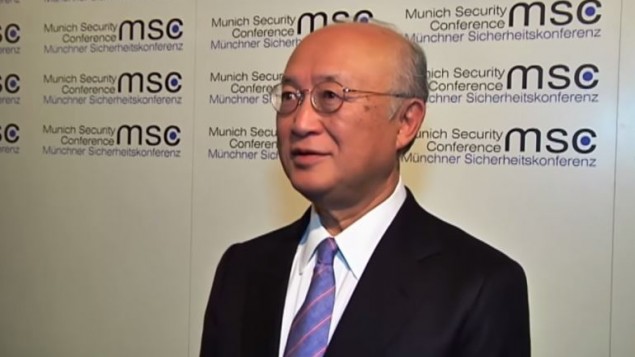
Director-General of the International Atomic Energy Agency Yukiya Amano. (screen capture: YouTube/FRANCE 24 English)

“When we find inconsistency or when we have doubts, we can request access to the undeclared location for example, and this could include military sites,” said the Japanese diplomat.

“Some consideration is needed because of the sensitiveness of the site, but the IAEA has the right to request access at all locations, including military ones.”

But Iran appears to be interpreting the protocol differently. As well as Khamenei’s comments, Foreign Minister Mohammad Javad Zarif has said the protocol allows “some access” but not inspections of military sites, in order to protect national “military or economic secrets.”

Iran and the so-called P5+1 group — Britain, China, France, Russia, the United States plus Germany — have been engaged for nearly two years in negotiations on Tehran’s nuclear program.

The deal is aimed at preventing Iran from developing the atomic bomb in exchange for an easing of crippling economic sanctions.

The two sides signed a framework agreement on April 2 and began meeting in Vienna on Wednesday to start finalizing a deal which is due by June 30.

Iran willing to extend nuclear talks past deadline

May 27, 2015

Iran willing to extend nuclear talks past deadline | The Times of Israel.

Tehran ‘will not be bound by schedule’ if accord is not finalized by June 30, negotiator says

May 27, 2015, 4:13 pm

Iranian Deputy Foreign Minister Abbas Araghchi (photo credit: screen capture/YouTube/PressTV)

Iranian Deputy Foreign Minister Abbas Araghchi (photo credit: screen capture/YouTube/PressTV)

TEHRAN, Iran — Talks between Iran and world powers aimed at finalizing a deal over Tehran’s nuclear program could go beyond a June 30 deadline, a senior Iranian negotiator said Wednesday.

“We are not at the point where we can say that negotiations will be completed quickly — they will continue until the deadline and could continue beyond that,” Abbas Araqchi was quoted as saying by the official IRNA news agency.

Araqchi has been attending a fresh round of talks between Iranian representatives and officials from the P5+1 group — Britain, China, France, Russia, the United States plus Germany — which got under way in Vienna on Tuesday.

The two sides signed a framework agreement on April 2 and aim to seal a final deal by the end of next month to prevent Iran from developing an atomic bomb, in exchange for an easing of crippling economic sanctions.

“We are not bound by the schedule. We are trying to have a good agreement with all the details meeting our expectations,” Araqchi said, describing the efforts to draw up a final text as “hard work.”

Iranian media quoted deputy oil minister Amirhossein Zamani-Nia as saying on Monday that 20 pages of the text had been written “but there are still disagreements and 30 percent of the work remains to be done.”

A similar report last week quoting an Iranian foreign ministry spokeswoman noted that a diplomatic timetable should not get in the way of a “good agreement.”

Israel has warned that the deal in its current form is insufficient and may still enable Iran to to develop nuclear weapons.

Iran insists its nuclear project will be used for peaceful purposes only.

Off Topic: Mazal tov, Herman Wouk, on your 100th birthday! – This Day in Jewish History

May 27, 2015

Mazal tov, Herman Wouk, on your 100th birthday! – This Day in Jewish History – – Haaretz Daily Newspaper | Israel News.

And thanks for the books, starting with ‘Aurora Dawn,’ part of which was penned aboard a U.S. Navy ship during WWII.

By | May 27, 2015 | 1:13 AM
submit to reddit
Herman Wouk at the 2010 LA Times Festival of Books.

Wouk at the 2010 LA Times Festival of Books. Photo by Mark Coggins/Wikimedia Commons


May 27, 1915, is the birthdate of writer Herman Wouk, which means that Wouk – author of “The Caine Mutiny” and “Marjorie Morningstar,” among more than a dozen other novels – is 100 years old today.

Wouk may not be a writer whose work is studied at universities, but he has been phenomenally successful among readers. Not a few people in the 1970s and 1980s learned what they knew about the history of World War II from his two mammoth novels on the subject, “The Winds of War” (1971) and “War and Remembrance” (1978), and from the two TV miniseries based on them. He also has been the rare popular novelist who has always been proud and open about his identity as an observant Jew, and is consistent in advocating a morality of patriotism, discipline and chastity.

Herman Wouk is the son of the former Esther Levine and Abraham Isaac Wouk, both of them Minsk-born Jews who arrived in the United States early in the 20th century. At about the time of Herman’s bar mitzvah, his maternal grandfather, a rabbi, arrived from Russia and took charge of his Jewish education – a development that eventually led to a period during which the grandson rejected the traditional life.

Wouk graduated from Townsend Harris High School in the Bronx, then attended Columbia University, where he studied philosophy and literature. In his free time, he edited the college humor magazine, The Jester, and wrote student musicals.

It was at the time of his graduation, in 1934, that Wouk declared, “To hell with that noise [Judaism]. I’m going to be a funnyman.” For two years, he wrote gags for David Freedman’s firm The Joke Factory, before being hired by the comic radio host Fred Allen for a well-paying writer’s job.

By the time the U.S. entered World War II, in 1941, Wouk had been drawn back to Orthodoxy, so that when he enlisted in the Navy, and was sent to sea, it was as a kashrut-observing midshipman.

He served on two destroyer-minesweepers in the Pacific, the U.S.S. Zane and the U.S.S. Southard, and even though both featured pork as a prominent ingredient on the menu, Wouk still would look back on his years in the Navy as “the great experience of my life.”

Toward the end of his service, Wouk met Betty Brown, an Idaho-born, non-Jewish civilian employee in the Navy. The two fell in love. Betty underwent conversion, taking on the additional, traditional Hebrew name of “Sarah,” and they married shortly after his return to the U.S., at the end of 1945.

Betty Sarah Wouk served as her husband’s literary agent until her death, in 2011. The couple had three children, one of whom died in a swimming accident at age five.

Writing at sea

Wouk began writing his first novel while still at sea, and sent some early chapters to his college philosophy professor, Irwin Edman. Edman read part of it out loud to an editor at Simon & Schuster, and Wouk was offered a contract for his first book.

That book was “Aurora Dawn,” which, after publication in 1947, became a main selection of the Book of the Month Club. Five years later, Wouk’s third book, “The Caine Mutiny,” won him the Pulitzer Prize. The novel, about a World War II naval ship whose senior officers depose their mentally unstable skipper – Captain Queeg – and then stand trial for the mutiny, was later adapted for both stage and screen.

Lesser known Wouk books include nonfiction works about his religious faith, “This Is My God” (1959), and much more recently, “The Language God Talks” (2010) – an attempt to reconcile science and religious doctrine.

Wouk’s last novel, the epistolary “The Lawgiver,” also dealt with Judaism, in the form of a story about an ultra-Orthodox-raised woman, Margolit Solovei, who becomes the writer-director of a Hollywood movie about Moses. A writer named Herman Wouk even makes a cameo appearance, when the studio brings him in as a consultant on the film’s biblical protagonist.

Earlier this month, Simon & Schuster announced that in December, it would be publishing Wouk’s memoir – his first – “Sailor and Fiddler: Reflections of a 100-Year-Old Author.”

Happy birthday, Herman Wouk!

What’s Left ?

May 27, 2015

What’s Left.

By Tabitha Korol — Bio and Archives  May 26, 2015

If we add together the Islamists in our midst, the remorseless willfully blind, and the ignorant by indoctrination, I fear for what’s left

https://i0.wp.com/cdn03.cdn.justjared.com/wp-content/uploads/2014/06/portman-bringher/natalie-portman-will-attend-the-shanghai-film-festival-02.jpg


The Oscar-winning actress Natalie Portman said that she would not use her platform of fame or share her strong leftist opinions inappropriately; therefore, she granted an interview to Steven Galloway, The Hollywood Reporter. Thus begins a peek into a leftist’s psychology.(No sunspecs required.)

Portman identified herself as being “quite leftist,” meaning that she is yet another person of Jewish heritage who has withdrawn from her birthright, and follows a distinct set ofassumptions held by others—also described as “groupthink.” When asked if she feels uncomfortable about her Jewishness while in France, she offered a brief “Yes,” before deflecting to comment about “the danger of being a Muslim in many places.” The identity of whom the Muslims fear was conveniently not broached – it is their own rage and violence, products of their perception of Muslim supremacism.

France is considered the most dangerous country for Jews today and the Muslims the “main instigators of global anti-Semitism.” France’s Jews, 0.75 percent of the population, live in constant peril. Anti-Semitism has increased by 400 percent since the summer of 2014; 40 percent of violent crimes are committed by Muslims against Jews. Although French officials have deployed about 20,000 soldiers to guard the Jewish businesses and schools, crimes persist, such as:

  • the boy who, returning home for Sabbath dinner, was accosted and pummeled by four men with iron pipes—his eye socket damaged, shoes stolen, cell phone intentionally trampled so he could not call for help.
  • the 17 year-old girl who was pepper-sprayed and told, “Dirty Jewess, inshallah (Allah willing)you will die”;
  • the Jewish mother who, while seated on a park bench, was attacked and beaten by three men;
  • the young couple who was robbed in their apartment, the woman raped, her boyfriend restrained;
  • the firebombs thrown at a Jewish community center in Toulouse, another at a synagogue;
  • the three solders standing guard outside Nice’s Jewish center who were attacked and injured by a man wielding a knife;
  • the anti-Semitic riots in Sarcelles (Paris suburb, “Little Jerusalem”), with slogans of death and slaughter.

Portman’s leftism precludes her identifying the criminals and their behavior

These and others were carried out against Jews by Muslims, but Portman’s leftism precludes her identifying the criminals and their behavior.

As noted in The Religion of Peace online, close to 26,000 terrorist attacks were committed in the name of Islam since 9/11, and a recent article by Giulio Meotti cites 100,000 Christians per year. All other religions combined do not equal the terror wrought by Islam and no other religion requires the suffix “phobia” to bully others into silence lest they be accused of harboring “irrational fear” when the fear is perfectly rational.

No other religion demands respect while committing the most abhorrent crimes—and this is because Islam is a political, militaristic ideology couched in religion. Their mandate is to conquer and govern all others: immigrate (to a non-Muslim country), populate (increase and demand accommodation), and eliminate (city becomes Muslim), according to the Muslim Brotherhood’s 100-year plan of 1982. About 62 percent of the Quran curses unbelievers or calls for violence, yet, when oncesharia is established as law, their own are also controlled harshly. In fact, Iran has been systematically purging (genocide) its own Arab population.

Surely, Portman should have noticed the preponderance of armed French soldiers on Paris streets, where once there were accordionists, flower sellers and romance. France’s oldest and second-largest city, Marseille, founded in 600 BC by Greek sailors, was once considered the European Capital of Culture, butis now ranked as Europe’s most dangerous city, having a 30 to 40 percent Muslim population.Portman and the Left will deny the cause of theviolence andthe climate of fear that turned the once-charming, coastal city into ano-go zone, where French law is irrelevant.In fact, the Left denies the existence of no-go zones.

Since the Left adheres to a mantra of multiculturalism and equality of people and religions, Portman calls “endangered Muslims” those who amass weapons, invade, and destroy. While one faction continues to attack Israelis and Jews at every opportunity, another faction is slaughtering Christians, beheading, burning, kidnapping, raping, and selling women and children into slavery. Islam is the only group that continues the slave trade. While Hitler and Nazism were responsible for about 60 million deaths, and Stalin and Communism about 80 million, Islam’s legacy over 1400 years approaches 400 million. The Left and mainstream media remain silent, and Portman proves that she is indeed on the Left by denying Islam’s gory history.

The Quran contains at least 109 verses that call all Muslims to war with nonbelievers for the sake of Islamic rule, some quite graphic. Aloof from historical context, they proudly regard themselves as part of the eternal and unchanging word of Allah.

Portman has generously, but presumptuously, forgiven Dior fashion designer John Galliano for his several public anti-Semitic rants, yet denounces Prime Minister Netanyahu as racist for noting the growing Arab vote—that could credibly destroy the Jewish people’s only homeland. Blindly loyal to her destructive liberal doctrine, she prefers Palestinians have a home that was never theirs at the peril of Jews in the home that had been theirs for centuries. The Left prefers that Israel again cede land to those who already have a land mass one thousand times Israel’s size, and may be mobilized to slaughter Jews at the mere sound of a bugle. The Left is silent when Israelis are attacked from air, earth, and beneath the earth, but speak out for the rights of those who have Natalie Portman in their sight.

The pretty and talented Natalie Portman knows little about her own heritage and displays a shocking amount of ignorance of the facts, and her arrogance for defending the leftist fiction is indefensible.The irony is that her personal life is unacceptable to those she defends. Under Palestinian rule, Sharia, she would be stoned or beheaded for being of Jewish descent, a woman, outspoken, supporting same-sex marriage, believing in educating females, wearing “immodest” clothing, and having a child out of wedlock. She and her family are at risk now in France, in Israel, and in the United States, and the source is Islam. Sadly, our Leftist academia are no longer teaching their students to think and reason, and Natalie Portman is of that generation. If we add together the Islamists in our midst, the remorseless willfully blind, and the ignorant by indoctrination, I fear for what’s left.

Site inspections must be part of Iran deal: IAEA

May 27, 2015

Site inspections must be part of Iran deal: IAEA, Times of IsraelCECILE FEUILLATRE, May 27, 2015

(France’s foreign minister has also stated that France will not back any deal “unless it provided full access to all installations, including military sites.” – DM)

amino-e1432728404999-635x357Director-General of the International Atomic Energy Agency Yukiya Amano. (screen capture: YouTube/FRANCE 24 English)

UN nuclear agency chief Yukiya Amano says months needed to assess military aspects of Iranian nuclear sites.

PARIS, France (AFP) — If Iran signs a nuclear deal with world powers it will have to accept inspections of its military sites, the head of the UN’s atomic watchdog Yukiya Amano told AFP in an interview.

The question of inspections is shaping up to be one of the thorniest issues as world powers try to finalize a deal by June 30 to prevent Iran from developing a nuclear bomb.

Amano said Tehran has agreed to implementing the Additional Protocol of the Nuclear Non-Proliferation Treaty (NPT) that allows for snap inspections of its nuclear facilities, and if required, military sites.

However, differences have emerged over the interpretation of the protocol and the issue is far from resolved.

Iran’s supreme leader Ayatollah Ali Khamenei last week ruled out allowing nuclear inspectors to visit military sites or the questioning of scientists.

And Foreign Minister Mohammad Javad Zarif has said the protocol allows “some access” but not inspections of military sites, in order to protect national “military or economic secrets.”

In an interview with AFP and French daily Le Monde, Amano said that if a deal is reached, Iran will face the same inspections from the International Atomic Energy Agency (IAEA) as any of the 120 countries implementing the additional protocol.

“When we find inconsistency or when we have doubts we can request access to the undeclared location for example, and this could include military sites,” said the Japanese diplomat.

“Some consideration is needed because of the sensitiveness of the site, but the IAEA has the right to request access at all locations, including military ones.”

Iran and the so-called P5+1 group — Britain, China, France, Russia, the United States plus Germany — have been engaged for nearly two years in negotiations on Tehran’s nuclear drive.

The deal is aimed at preventing Iran from developing the atomic bomb in exchange for an easing of crippling economic sanctions.

The two sides signed a framework agreement on April 2 and began meeting in Vienna on Wednesday to start finalizing a deal which is due by June 30.

Possible military dimension

Iran has long asserted its nuclear program is for peaceful energy purposes, and that international concern about it seeking a nuclear bomb is misplaced.

According to the United States, Iran has agreed to cut the number of its centrifuges, used for enriching uranium, by two thirds from 19,000 to about 6,000, and will put excess nuclear equipment into storage monitored by the IAEA.

Iran has also reportedly agreed not to build any new facilities for enriching uranium for 15 years, cut back its stockpile of enriched uranium and mothball some of its plants.

However, Tehran is sensitive over the IAEA’s stringent oversight demands as the agency is at the same time trying to probe allegations that Iran tried to develop nuclear weapons prior to 2003, and possibly since.

Iran denies the allegations, saying they are based on hostile intelligence provided by the US Central Intelligence Agency (CIA) and Israel’s Mossad.

Western officials stress that these claims of “possible military dimensions” need to be cleared up before sanctions can be lifted, but the IAEA’s probe has been stalled since last August.

‘A huge operation’

Amano said that once there is a deal, “several months will be needed” to investigate whether there were any military dimensions to Iran’s research.

“It depends very much on the pace and the intensiveness of the cooperation from Iran. We have identified 12 areas to clarify.”

One notable area the IAEA is interested in is the Parchin military base, where they suspect tests relating to the development of nuclear weapons have taken place.

The IAEA has already visited the sprawling military base near Tehran but wants to return for another look.

Amano said it could take years “to give the credible assurance that all activities in Iran have a peaceful purpose”.

If a deal is reached with the P5+1, the IAEA will be charged with overseeing it and reporting back to the UN Security Council.

“This will be the most extensive safeguard operation of the IAEA. We need to prepare well, we need to plan well, it is a huge operation,” said Amano.

Currently the watchdog has between four and 10 inspectors in Iran at any given time, and if a deal is reached at least 10 will need to be on the ground daily.

The agency will also need to install cameras and seals on sensitive equipment.

U.S. Intelligence: Iran Sending More Fighters to Yemen

May 27, 2015

U.S. Intelligence: Iran Sending More Fighters to Yemen

IRGC Quds Force, Hezbollah back pro-Iran rebels

BY:
May 27, 2015 5:00 am

via U.S. Intelligence: Iran Sending More Fighters to Yemen | Washington Free Beacon.

Iran has dispatched additional paramilitary forces to Yemen to aid pro-Tehran rebels seeking to take control of the strategic southern Arabian state, according to recent U.S. intelligence reports.

The Iranian leadership earlier this month ordered militants from the Islamic Revolutionary Guards Corps’ (IRGC) Quds Force, along with Lebanese Hezbollah fighters, to Yemen, where Saudi Arabia and other Sunni Arab states are seeking to defeat an insurgency led by Houthi rebels that currently control large parts of the country.

The influx of Iranian forces was outlined in several classified intelligence reports circulated within government over the past two weeks, said U.S. officials familiar with the reports.

A State Department official said the Sunni Arabs in nearby states are opposing the Houthis and seeking to prevent Iran from establishing a foothold on the peninsula.

Estimates put the number of both Iranian and Iraqi Shi’ite forces helping the Houthis in Yemen at around 5,000 people. The number of Lebanese Hezbollah members in Yemen is not known.

On Sunday, Quds Force Deputy Commander, Brig. Gen. Esmail Ghani was quoted as confirming the fact that the IRGC is training Yemenis.

“Each one who is with us comes under the banner of the Islamic Republic and this is our strength,” Ghani said, according to Iran’s Mashregh News, an outlet run by the IRGC. “The defenders of Yemen have been trained under the banner of the Islamic Republic and the enemies cannot deal with Yemeni fighters.”

It was the first official reference to Iran’s training of the Houthis in Yemen.

According to several officials, the ultimate goal of the Iranians in Yemen is to control the Red Sea chokepoint of the Bab-el-Mandeb.

“The Iranians’ ultimate target is the strait [Bab-el-Mandeb] and the House of Saud is the other target,” one official said.

The Bab-el-Mandeb is a strategic chokepoint that could be used by Iran to block oil shipments and U.S. warship movements from the Mediterranean to the Indian Ocean and Persian Gulf. Iran already can threaten the region’s other strategic chokepoint, the Strait of Hormuz in the Persian Gulf.

Control over the Bab-el-Mandeb would give Tehran additional regional power to control oil and other passage to and from the region.

A CIA spokesman declined to comment on the Iranians in Yemen. State Department spokesmen did not return emails seeking comment.

The Obama administration is seeking to conclude a nuclear agreement with Iran by the end of June, and is keeping quiet about the Iranian push to control Yemen.

Middle East specialists, however, said the influx of Iranian and Hezbollah fighters is a troubling indicator of a growing Iranian threat to the region.

“It would effectively put the Quds force on the Saudi border and potentially give Iran a naval and air presence near the Bab-el-Mandeb, and the exit from the Red Sea to the Indian Ocean—a key trade route for petroleum and all trade and U.S. naval movements through the Suez Canal,” said Anthony Cordesman, with the Center for Strategic and International Studies.

Cordesman said if the intelligence reports are confirmed, “it is the first real sign that Iran is playing a major role in Yemen.”

The Iranians appear to be targeting both the Riyadh government and strategic Bab-el-Mandeb strait, he said.

Iranian forces in Yemen “could also lead to far more serious tensions between Sunni and Shiite throughout the region,” Cordesman said.

“A struggle where Iran takes real chances to help Yemen’s Houthi and Shi’ite population could deeply divide a country the CIA estimates is 35 percent Shiite and 65 percent Sunni, and increase Sunni and Shiite tensions throughout the entire region,” he said.

Michael Rubin, with the American Enterprise Institute, said Iran is following the Soviet practice of using proxies to advance regional interests.

“There’s no excuse for ignorance; this is right out of Iran’s playbook,” Rubin said. “It’s Tehran’s equivalent of the Brezhnev Doctrine: Once an Iranian proxy takes territory, Iran will use its full array of power to make sure it keeps it.”

Rubin said Iran may not have sparked the Yemen crisis, “but no one can accuse Tehran of letting a good sectarian crisis go to waste.”

Former CIA Middle East specialist Bruce Riedel also said the influx of Iranians would assist the Houthis.

“Small numbers of Hezbollah and IRGC advisers have been in Yemen for the last several years,” Riedel said. “The Houthis very much admire the Hezbollah organization for its successes in fighting the Israelis and have tried to use Hezbollah as a model for their own development. Together the two are a force multiplier for the Houthis.”

On Monday, Yemeni forces opposing the Houthis took control of a southern province held by Houthis and forces loyal to former Yemeni President Ali Abdullah Saleh, who was ousted from power in 2012 following mass protests, the London-based Arabic newspaper Alsharq Al-Awsat reported.

The re-taking of the southern province capped a months-long offensive by Saudi-backed tribal forces loyal to President Abd Rabbuh Mansur Hadi.

The pro-Iran Houthis took control of the Yemeni capital of Sanaa last year and conducted a coup in February.

Saudi Arabia has been conducting air strikes against Houthis in Yemen since March 26 as part of Operation Decisive Storm, a Saudi-led aerial bombing campaign. Most of the air raids have been carried out by Saudi warplanes, but United Arab Emirates bomber jets also have taken part.

Saudi-backed forces now control Yemen’s airspace and most ports, according to reports from the region.

Shahin Gobadi, a spokesman for the Paris-based Iranian opposition group Mojahedin Organization of Iran, said the Quds Force oversees Iranian policy toward Yemen.

Quds Force commanders are assisting the Houthis in conducting military operations and have set up communications with the Quds commanders.

The Quds Force also has dispatched additional Hezbollah fighters and commanders.

“As the war and conflict has intensified, the presence of Iranian forces—non-Arabs and those who do not speak Arabic—has become more difficult in Yemen,” Gobadi said. “As such, Tehran has intensified dispatching more forces from Hezbollah to Yemen. Given the current circumstances, they have more room to maneuver and function.”

Houthi military plans and operation are “completely under the supervision and control of the Quds Force,” Gobadi added.

IRGC Maj. Gen. Qassem Soleimani, the Quds Force commander, directs several special committees to back the Houthis, according to Gobadi. Some 50 tons of Iranian weapons and other aid was sent from Mehrabad airport in Tehran to Sanaa last march March in four shipments, Gobadi said, noting the shipments were disguised as humanitarian aid from the Iranian Red Crescent.

A Gulf intelligence official told the BBC in early May that the intervention against the Houthis by several Gulf states revealed some of Yemen’s estimated 300 Scud short-range missiles under Houthi control had been moved to locations near the Saudi border.

As a result, Saudi and Gulf Arab allies took action to oppose what they viewed as an Iranian threat to the peninsula.