Archive for May 16, 2015

Pope calls Abbas ‘angel of peace’ during Vatican visit

May 16, 2015

Pope calls Abbas ‘angel of peace’ during Vatican visit, Times of Israel, May 16, 2015

(Update: According to an article at PJ Media, the words weren’t precisely as reported. Instead, the Pope said “May the angel of peace destroy the evil spirit of war. I thought of you: may you be an angel of peace.”  For the Pope, in the course of recognizing “Palestine,” even to express a hope that Abbas may be an “angel of peace” seems as odd as expressing a hope that a rattlesnake may be a good and friendly companion for one’s children.  — DM)

********************

(The Pope seems to have an odd sense of humor. — DM)
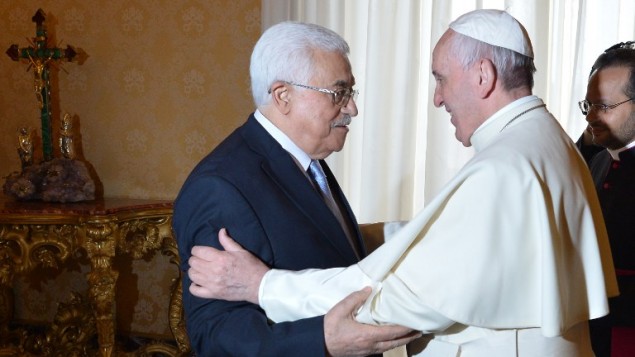
000_DV2030018-e1431765591751-635x357Pope Francis welcomes Palestinian Authority President Mahmoud Abbas during a private audience on May 16, 2015 in Vatican (AFP Pphoto pool/Alberto Pizzoli)

Pope Francis praised Palestinian Authority President Mahmoud Abbas as an “angel of peace” during a meeting at the Vatican.

Francis made the compliment Saturday during the traditional exchange of gifts at the end of an official audience in the Apostolic Palace. He presented Abbas with a medallion and explained that it represented the angel of peace “destroying the bad spirit of war.”

Francis said he thought the gift was appropriate since “you are an angel of peace.”

Abbas is in town for the canonization Sunday of two new saints from what was then Ottoman-ruled Palestine. It also comes days after the Vatican finalized a bilateral treaty with the “state of Palestine,” making explicit its recognition of Palestinian statehood.

Abbas, for his part, offered Francis relics of the two new saints.
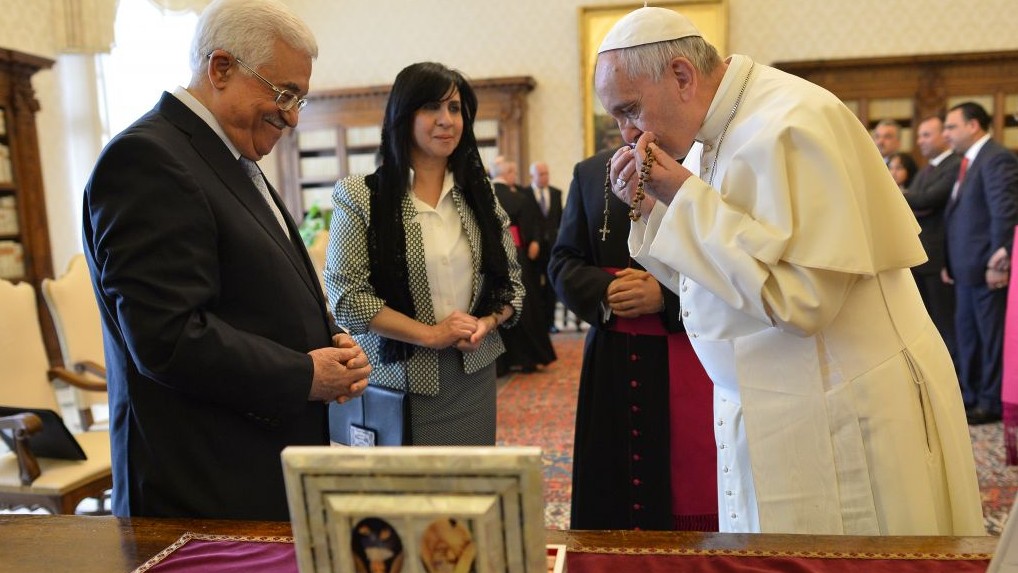
Vatican-Palestinians_Horo-e1431781749661Pope Francis exchanges gifts with Palestinian leader Mahmoud Abbas during an audience at the Vatican Saturday, May 16, 2015. (Alberto Pizzoli/Pool Photo via AP)

The treaty, which was finalized Wednesday but still has to be signed, makes clear that the Holy See has switched its diplomatic relations from the Palestinian Liberation Organization to the state of Palestine.

A bilateral commission is putting the final touches to the agreement, on the Catholic Church’s life and activities in Palestine, which then “will be submitted to the respective authorities for approval ahead of setting a debate in the near future for the signing,” the Vatican said on Wednesday.

Some observers speculated that the agreement could be signed during Abbas’s visit.

The news of the treaty immediately drew ire from Israel.

“Israel heard with disappointment the decision of the Holy See to agree a final formulation of an agreement with the Palestinians including the use of the term ‘Palestinian State’,” said an Israeli foreign ministry official.

“Such a development does not further the peace process and distances the Palestinian leadership from returning to direct bilateral negotiations. Israel will study the agreement and consider its next step.”

The agreement, 15 years in the making, expresses the Vatican’s “hope for a solution to the Palestinian question and the conflict between Israelis and Palestinians according to the two-state solution,” Antoine Camilleri, the Holy See’s deputy foreign minister, said in an interview earlier this week.

In an interview with the Vatican’s Osservatore Romano newspaper, Camilleri said he hoped “the accord could, even in an indirect way, help the Palestinians in the establishment and recognition of an independent, sovereign and democratic State of Palestine.”

The Palestinian Authority considers the Vatican one of 136 countries to have recognized Palestine as a state, although the number is disputed and several recognitions by what are now European Union member states date back to the Soviet era.

Abbas’s visit came a day before two nuns who lived in Ottoman Palestine during the 19th century will be made saints at a Vatican ceremony.

Marie Alphonsine Ghattas of Jerusalem and Mariam Bawardy of Galilee will become the first Palestinian Arabs to gain sainthood.

Ghattas was born in Jerusalem in 1847, and died there in 1927. She was beatified — the final step before canonization — in 2009.

Bawardy was born in Galilee, now in northern Israel, in 1843. She became a nun in France and died in Bethlehem in 1878.

She was beatified by Pope John Paul II in 1983.

Although there are several saints who lived in the region during Christianity’s early days, Bawardy and Ghattas are the first to be canonized from Ottoman-era Palestine.

The canonization of a third Palestinian — a Salesian monk — is still under review by the Church.
First US ground operation in Syria kills ISIS oil chief – as Islamists advance on three new fronts

May 16, 2015

First US ground operation in Syria kills ISIS oil chief – as Islamists advance on three new fronts, DEBKAfile, May 16, 2015

USspecialforcesJoran10.6.14US Special Operations forces in Jordan.

America’s first ground operation in the five years of Syrian war was directed against the Islamic State of Iraq and the Levant – ISIS.  US sources report that Special Operations forces mounted a raid Saturday, May 16, on an ISIS convoy in the Deir a-Zour district of eastern Syria, and killed senior Islamist commander and oil and gas chief, Abu Sayyaf, when he resisted capture. His Iraqi wife, Umm Sayyaf, was taken to Iraq for interrogation by the US troops, all of whom returned safely.

Abu Sayyaf’s importance for the Islamist group cannot be overrated as the man in charge of its commandeered oil fields in Syria and Iraq. He also managed their overseas sales in a thriving black market, netting an estimated $5million a day for bankrolling the group’s wars.

Catching him alive was the preferred object of the raid. Under interrogation, he would have been a valuable source of information on the working of the group’s illicit oil and gas trade, how it was managed, the identities of its customers and routes of payment to the ISIS war chest.

DEBKAfile’s military sources report that the US raid was staged from Jordan, not Iraq. In normal circumstances, the Jordanians don’t permit US ground or air operations to be staged directly from their territory. However, a joint 10-day US-Jordanian war game, Eager Lion, was in progress in the Hashemite Kingdom. Some 10,000 troops from various countries, including the US, were practicing special operations against ISIS. And so the US unit was ready to hand a short distance from a high-value target at Deir a-Zour.

DEBKAfile adds that the operation came just two days after the Arab Gulf leaders’ summit convened by President Barack Obama ended at Camp David Thursday, May 14. The war on ISIS was a key item on their agenda.

Sources in Washington disclose that the order for the raid came directly from President Barack Obama on the advice of national security council heads in the White House. The troops landed in the middle of a hotbed of fighting between the Syrian army and ISIS. They were no doubt lifted in and out of the scene at speed by helicopter.

The Islamists are in full flight on three Syrian fronts (as well as the same number in Iraq). The group has overrun Al-Sina’a, Ar-Rusafa and Al-Omal in this district, as well as seizing Saker Island in the middle of the Euphrates River north of Deir a-Zour, from which it is shelling the largest Syrian air base in eastern Syria.

Islamist fighters are also advancing on Syria’s ancient city of Palmyra (Tadmor). This is a 2,000-old desert site with precious remains of antiquity, but also home to Bashar Assad’s infamous Tadmor prison, notorious for torture and summary executions.

ISIS targets near this ancient town are the biggest Syrian air base in central Syria and more oil fields. Most of the Iranian and Russian air transports delivering military equipment for the Syrian army and Hizballah land at this base.

The Islamists are additionally targeting Syrian military positions in eastern Homs.

Kerry: Iran Nuclear Deal Could Be Lesson for North Korea

May 16, 2015

Kerry: Iran Nuclear Deal Could Be Lesson for North Korea, ABC News, Matthew Lee, May 16, 2015

(Please say that you will stop destabilizing the region, have a good human rights record and become moderate like The Islamic Republic of Iran and we will grant all concessions you seek. Pretty please? — DM)

U.S. Secretary of State John Kerry said Saturday he is hopeful that the successful conclusion of a nuclear deal with Iran will send a positive message to North Korea to restart negotiations on its own atomic program.

Speaking at a joint news conference with Chinese Foreign Minister Wang Yi in Beijing, Kerry said he believed an Iran agreement could have “a positive influence” on North Korea, because it would show that giving up nuclear weapons improves domestic economies and ends isolation. He stressed, though, that there was no way to tell if North Korea’s reclusive leadership would be able to “internalize” such a message.

“I am sure Foreign Minister Wang would join me in expressing the hope that if we can get an agreement with Iran, … that agreement would indeed have some impact or have a positive influence” on North Korea, Kerry said.

Although Wang did not appear to respond, Kerry explained that an Iran deal could help in showing North Korea how “your economy can do better, your country can do better, and you can enter into good standing with the rest of the global community by recognizing that there is a verifiable, irreversible, denuclearization for weaponization, even as you can have a peaceful nuclear power program.”

“Hopefully that can be a message, but whether or not DPRK is capable of internalizing that kind of message or not, that’s still to be proved,” he said, referring to North Korea by the acronym of its official name, the Democratic People’s Republic of Korea.

International negotiators are rushing to finalize a nuclear deal with Iran by the end of June under which Iran’s program would be curbed to prevent it from developing atomic weapons in exchange for the lifting of international sanctions that have crippled its economy.

Nuclear talks with North Korea, which has already developed atomic weapons despite previous attempts to forestall it, broke down three years ago as it has continued atomic tests and other belligerent behavior, including ballistic missile launches.

North Korea conducted its first nuclear test in 2006 and is now believed to have at least 10 such weapons despite some of the toughest international sanctions in existence. It conducted its third nuclear test in February 2013, and U.S.-based experts forecast that it could increase its nuclear arsenal to between 20 and 100 weapons by 2020.

Kerry travels on Sunday to South Korea, where North Korea will be a major topic of discussion.

He said the United States will continue to work with its partners “to make it absolutely clear to the DPRK that their actions, their destabilizing behavior is unacceptable against any international standard.”


