Archive for May 12, 2015

A Preview of ‘Palestine’

May 12, 2015

A Preview of ‘Palestine’, Front Page Magazine, May 12, 2015
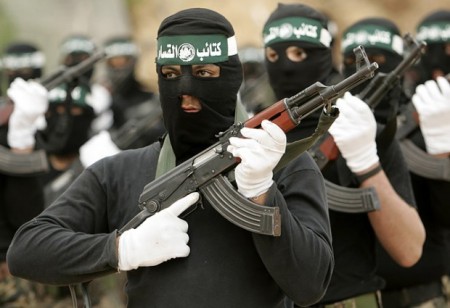
Hamas-450x308

[W]hy is the Obama administration placing mammoth pressure on Israel to cede vital strategic territory and why is it besotted with the idea of dismembering Israel by tearing away parts of its ancestral heartland? The answer lies in a flawed foreign policy that rewards tyrannical regimes while back-stabbing allies; a foreign policy that favors Iranian Fatwas over concrete empirical evidence of malfeasance.

******************

Anyone wishing to get a glimpse of what a future “Palestinian” state might look like, need look no further than recent actions taken and official statements made by both the Palestinian Authority and its rival Hamas this past month. While these two governing entities detest each other (perhaps even more so than the infidel Yahuds), it is difficult to discern why, since both of these governing bodies spew forth nearly identical xenophobic rhetoric and act with typical autocratic ruthlessness to stifle any whiff of internal dissent. In essence, they both act in a manner that is not dissimilar to the 20 or so chauvinistic, anti-democratic Muslim pseudo-states of the Middle East.

Most Israelis harbor deep reservations about the creation of an “independent Palestinian state” for a multitude of reasons. Chief among them is the fear that a Palestinian state would devolve into an entity similar to that found in Gaza and that’s a best case scenario. There are far worse, more frightening scenarios. But while Gaza is contained in the southwest corner of Israel and can, relatively speaking, be monitored and controlled, the same cannot be said about the West Bank with its long, torturous border along the imaginary Green Line (the 1949 armistice lines). Moreover, in contrast to the Gaza periphery, much of Israel’s population and industry faces the West Bank, which juts out like a bone into Israel’s throat.

But even if the Palestinian Authority, headed by its aging, autocratic leader Mahmoud Abbas, succeeds in rebuffing a Hamas takeover – an unlikely prospect – the Palestinian Authority’s leadership has proven to be just as extreme, xenophobic and malevolent as its rivals in Gaza. Palestinian Authority TV and media outlets as well as PA-backed NGOs, routinely spew forth ancient anti-Semitic canards involving ritualistic Passover blood libels and conspiracy theories involving Jewish attempts at world domination.

On April 5, in an official PA television interview, Fatah spokesperson, Osama Al-Qawasmi, invoked the notorious early 20th century Czarist forgery known as the Protocols of the Elders of Zion to back up his spurious claims against Israel. For the sake of perspective, both Hitler’sMein Kampf and the Hamas Charter incorporate the Protocols to buttress repugnant supremacist views and reinforce ancient calumnies.

Al-Qawasmi comments, largely ignored by the West, represent views that are commonplace within the Palestinian Authority. In fact, most high-level officials within the PA subscribe to Hitleresque positions and this comes as no surprise given that the father of the modern “Palestinian” movement and the man who gave birth to Palestinian nationalism, Haj Amin al Husseini, was a Nazi collaborator and a dear friend of the Fuhrer.  In January 2013, “President” Abbas, whose own ventures into Holocaust denial are well known, showered the Hitler-supporting Husseini with acclaim.

The Palestinian Authority has also been known to perpetuate ancient ritualistic Passover blood libels. In July 2014 Mahmoud Abbas’ official PA daily, Al-Hayat Al-Jadida, featured an op-ed which claimed that Jews use the “blood of [Palestinian] children” as a key ingredient in Matzah or unleavened bread used by Jews during the Passover holiday. Shortly thereafter, in a variation of that insidious theme, Palestinian Authority TV claimed that Israel was injecting poison into the Palestinian water supply.

In 2013, a Western funded Palestinian propaganda outfit called MIFTAH (which publishes in both English and Arabic) published an article in Arabic criticizing President Obama for speaking of Passover in a favorable light. The author then went on to invoke the ancient blood libel stating,

Does Obama in fact know the relationship, for example, between “Passover” and “Christian blood”..?! Or “Passover” and “Jewish blood rituals?!’ Much of the chatter and gossip about historical Jewish blood rituals in Europe are real and not fake as they claim; the Jews used the blood of Christians in the Jewish Passover.

Palestinians routinely spew forth revolting babble and nonsensical conspiracy theories in Arabic but are substantially more reserved when addressing Western audiences who would find such utterances disquieting to say the least.

MIFTAH was founded by the Palestinian Authority’s spokeswoman and PLO Central Committee Member Hanan Ashrawi. Incredibly, when confronted with the outrage, Ashrawi, a seasoned politician who makes frequent guest appearances on Western news programs, refused to acknowledge any wrongdoing and actually attacked the blogger who exposed the incident claiming that she was the victim of a “smear campaign.” She also risibly noted that she was committed to “open dialogue” and in any event, a “disclaimer” in the publication absolved her and her organization of any culpability.

To a vile terror apologist like Ashrawi, blood libels are part of her concept of “open dialogue.” Only after drawing the ire of her Western donors did Ashrawi express contrition and posted an apologylaced with the requisite dose of crocodile tears. That served to placate MIFTAH’s gullible Western enablers.

But while Palestinians are free to spew forth the vilest canards against Israel and Jews, any whiff of criticism or dissention directed against any Palestinian body, Hamas or the Palestinian Authority, is ruthlessly dealt with. In April, a Palestinian civil servant was arrested for expressing views on Facebook critical of Yassir Arafat. More precisely, he failed to subscribe to the view that Arafat was a “martyr.” He was charged with “attacking and harming the martyr, eternal leader and symbol of the Palestinian people Abu Ammar,” Arafat’s nom de guerre. His niece was expelled from Birzeit University near Ramallah for expressing similar views and all other Palestinian universities have been instructed to deny her admission.

In Hamas-controlled Gaza, in a rare show of defiance, a group of between 150 to 200 Palestinians demonstrated against the governing authorities. The demonstrators were beaten with sticks and some were herded off in jeeps by thug-like Hamas enforcers.

These two incidents are demonstrative of the complete absence of freedom of speech and freedom of assembly in areas governed by Palestinians. Conversely, Palestinians are completely free to let loose with the vilest canards as long as the objects of derision, defamation and ridicule are Jews.

A Palestinians state, whether governed by Hamas or the “moderate” Palestinian Authority, will almost certainly resemble the 20 or so Arab pseudo-states currently in existence.  It will be dysfunctional, autocratic, xenophobic and unable to survive without massive financial assistance. That will be the nature of the state that lives alongside Israel’s long and tortuous border with the West Bank. That will be the state that will have full view of all commercial airlines that come and go from Ben Gurion International Airport. And that will be the state that juts into Israel’s narrow 9-mile wide waistline overlooking Israel’s heavily populated coastline.

Considering these facts, why is the Obama administration placing mammoth pressure on Israel to cede vital strategic territory and why is it besotted with the idea of dismembering Israel by tearing away parts of its ancestral heartland? The answer lies in a flawed foreign policy that rewards tyrannical regimes while back-stabbing allies; a foreign policy that favors Iranian Fatwas over concrete empirical evidence of malfeasance.

Prime Minister Netanyahu has just formed a governing coalition with a razor thin majority. Yet his coalition partners, cognizant of the dangers they face, both on the battlefield and in the political arena, appear to be solidly behind their Prime Minister. One can only hope that the Prime Minister will stand fast in the face of massive pressure he is sure to encounter from an extremely hostile Obama administration. Good luck Mr. Prime Minister, you’re going to need every bit of it for the next 18 months.

Trading Our Security for Politics and Cash

May 12, 2015

Pentagon Report: China Deploys MIRV Missile
By Hans M. Kristensen Posted on May 11, 2015


(Did campaign contributions influence Clinton’s policy toward China years ago? Given their behavior today, I’d say yes. Now virtually all of the western world is in danger of a nuclear strike from China.  Before the Clintons, China couldn’t even put a satellite in orbit.  Now they’ve got MIRV’s and this constitutes a very serious threat.  Thanks a lot Bill and Hillary Clinton. – LS)

For a little background to this dire situation, check out this article published back in 1998:
Red Face Over China

The biggest surprise in the Pentagon’s latest annual report on Chinese military power is the claim that China’s ICBM force now includes the “multiple independently-targetable re-entry vehicle (MIRV)-equipped Mod 3 (DF-5).”

This is (to my knowledge) the first time the US Intelligence Community has made a public claim that China has fielded a MIRVed missile system.

If so, China joins the club of four other nuclear-armed states that have deployed MIRV for decades: Britain, France, Russia and the United States.

For China to join the MIRV club strains China’s claim of having a minimum nuclear deterrent. It is another worrisome sign that China – like the other nuclear-armed states – are trapped in a dynamic technological nuclear arms competition.

A Little Chinese MIRV History

There have been rumors for many years that China was working on MIRV technology. Some private analysts have even claimed – incorrectly – that China had developed MIRV for the DF-31 ICBM and JL-2 SLBM.

Fifteen years ago, CIA’s National Intelligence Estimate on foreign missile developments concluded that “China has had the technical capability to develop multiple RV payloads for 20 years. If China needed a multiple-RV (MRV) capability in the near term, Beijing could use a DF-31-type RV to develop and deploy a simple MRV or multiple independently targetable reentry vehicle (MIRV) for the CSS-4 in a few years.” (For a review of earlier information and assessments, see here.)

The Pentagon echoed this conclusion in July 2002, when it stated that any Chinese multiple warhead capability will “most likely [be] for the CSS-4.”

Chinese MIRVing of a mobile ICBM such as the DF-31 “would be many years off” the CIA told Congress. This was also the conclusion of the CIA’s National Intelligence Estimate in 2001, which concluded that “Chinese pursuit of a multiple RV capability for its mobile ICBMs and SLBMs would encounter significant technical hurdles and would be costly.”

In an exchange with Senator Cochran in 2002, CIA’s Robert Walpole explained that MIRVing a mobile ICBM would require a much smaller warhead and possibly require nuclear testing:

Sen. Cochran. How many missiles will China be able to place multiple reentry vehicles on?

Mr. Walpole. In the near term, it would be about 20 CSS-4s that they have, the big, large ICBMs. The mobile ICBMs are smaller and it would require a very small warhead for them to put multiple RVs on them.

Sen. Cochran. … [D]o you think that China will attempt to develop a multiple warhead capability for its new missiles?

Mr. Walpole. Over time they may look at that. That would probably require nuclear testing to get something that small, but I do not think it is something that you would see them focused on for the near term.

What makes the Pentagon’s report on the MIRVed DF-5A payload noteworthy is that it was not included in several other intelligence assessments published in the past few months: the prepared threat assessment by the Director of National Intelligence; the prepared threat assessment by the Defense Intelligence Agency; and STRATCOM’s prepared testimony.

Nor were a MIRVed DF-5A mentioned in the Pentagon’s report from 2014 or the Air Force National Air and Space Intelligence Center (NASIC) report from July 2013.

The Pentagon report also repeats an earlier assertion that “China also is developing a new road-mobile ICBM, the CSS-X-20 (DF-41), possibly capable of carrying MIRVs.” STRATCOM commander Admiral Cecil Haney also mentioned this, saying China is “developing a follow-on mobile system capable of carrying multiple warheads.”

“Possibly capable of” and “capable of” are not equal assessments; the first includes uncertainty, the second does not. Assuming CIA’s prediction from 15 years ago is correct, the DF-5 MIRV payload might consist of three warheads developed for the DF-31/31A.

Whatever the certainty, the MIRVed version of the DF-5 – which I guess we could call DF-5B – is not thought to be loaded with warheads under normal circumstances. In a crisis, the warheads would first have to be brought out of storage and mated with the missile.

Moreover, The Pentagon lists two versions of the DF-5 deployed: the DF-5A (CSS-4 Mod 2) and the new DF-5 MIRV (CSS-4 Mod 3). So only a portion of the 20 missiles in as many silos apparently have been equipped for MIRV.

Why Chinese MIRV?

The big question is why the Chinese leadership has decided to deploy MIRV on the silo-based, liquid-fuel DF-5A.

Chinese officials have for many years warned, and US officials have predicted, that advanced US non-nuclear capabilities such as missile defense systems could cause China to deploy MIRV on some of its missiles. The Pentagon report repeats this analysis by stating that China’s “new generation of mobile missiles, with warheads consisting of MIRVs and penetration aids, are intended to ensure the viability of China’s strategic deterrent in the face of continued advances in U.S. and, to a lesser extent, Russian strategic ISR, precision strike, and missile defense capabilities.”

Conclusions

Chinese MIRV on the DF-5 ICBM is a bad day for nuclear constraint.

Seen in the context of China’s other ongoing nuclear modernization programs – deployment of several types of mobile ICBMs and a new class of sea-launched ballistic missile submarines – the deployment of a MIRVed version of the DF-5 ICBM reported by the Pentagon’s annual report strains the credibility of China’s official assurance that it only wants a minimum nuclear deterrent and is not part of a nuclear arms race.

MIRV on Chinese ICBMs changes the calculus that other nuclear-armed states will make about China’s nuclear intensions and capacity. Essentially, MIRV allows a much more rapid increase of a nuclear arsenal than single-warhead missile. If China also develops MIRV for a mobile ICBM, then it would further deepen that problem.

To its credit, the Chinese nuclear arsenal is still much smaller than that of Russia and the United States. So this is not about a massive Chinese nuclear buildup. Yet the development underscores that a technological nuclear competition among the nuclear-armed states is in full swing – one that China also contributes to.

Although it is still unclear what has officially motivated China to deploy a MIRVed version of the DF-5 ICBM now, previous Chinese statements and US intelligence assessments indicate that it may be a reaction to the US development and deployment of missile defense systems that can threaten China’s ability to retaliate with nuclear weapons.

If so, how ironic that the US missile defense system – intended to reduce the threat to the United States – instead would seem to have increased the threat by triggering development of MIRV on Chinese ballistic missiles that could destroy more US cities in a potential war.

The deployment of a MIRVed DF-5 also raises serious questions about China’s strategic relationship with India. The Pentagon report states that in addition to US missile defense capabilities, “India’s nuclear force is an additional driver behind China’s nuclear force modernization.” There is little doubt that Chinese MIRV has the potential to nudge India into the MIRV club as well.

Indian weapons designers have already hinted that India may be working on its own MIRV system and the US Defense Intelligence Agency recently stated that “India will continue developing an ICBM, the Agni-VI, which will reportedly carry multiple warheads.”

If Chinese MIRV triggers Indian MIRV it would deepen nuclear competition between the two Asian nuclear powers and reduce security for both. This calls for both countries to show constraint but it also requires the other MIRVed nuclear-armed states (Britain, France, Russia and the United States) to limit their MIRV and offensive nuclear warfighting strategies.


IDF sees no alternative to Hamas rule in Gaza

May 12, 2015

IDF sees no alternative to Hamas rule in Gaza

Southern commander says more rounds of fighting are inevitable, but status quo preferable to total chaos in the Strip

By Stuart Winer May 12, 2015, 12:47 pm

via IDF sees no alternative to Hamas rule in Gaza | The Times of Israel.

IDF Southern Region Commander Maj. Gen. Shlomo “Sami” Turgeman said on Monday that Hamas remains, effectively, the only option for governance in the Gaza Strip. He further accused Israeli media of handing the terror group propaganda victories during the war there last summer by revealing the number of southerners who left their home during the fighting.

Turgeman met with the heads of local authorities located near the Gaza border, where he reviewed the 50-day war with Hamas, which the IDF dubbed Operation Protective Edge.

He argued against the assertion — espoused by several senior Israeli ministers during the war — that the army should have worked to topple Hamas or take full control of the coastal enclave.

“There is an independent rule in Gaza that behaves like a state,” he said. “Inside that state there is a ruler, Hamas, and at the moment there is no alternative to Hamas. Aside from that, there is no one else who can hold things together. The alternative is the IDF or chaos.”

Turgeman assessed that the residents in Gaza were also not interested in ousting their Hamas rulers.

“Most of the citizens in the Strip see Hamas as the only address for their problems,” he said. “Anyone thinking about a popular uprising — it isn’t in sight. The chances that it’ll happen are not high.”

He said the Palestinian Authority, which rules in the West Bank, was also not a viable alternative to Hamas in Gaza, although he didn’t say why.

The conflict saw over 2,100 people killed in Gaza and tens of thousands more left homeless, according to Palestinian and UN tallies, and 72 people killed in Israel. Israel attributes the high civilian toll to the fact that Gazan fighters embedded their military infrastructure in residential areas. Eleven Israeli soldiers were killed inside Israel by Hamas gunmen emerging from the cross-border tunnels. Destroying the tunnel threat was one of Israel’s stated goals during the campaign.

Hamas also fired over 4,000 rockets at Israeli towns and cities, with the south taking the brunt of the fire. Media reports at the time said officials estimated that 70 percent of the 40,000 inhabitants of the farming communities along the Gaza border had left over the course of the fighting.

Israelis sit and pray together inside a street shelter, in anticipation of the Code Red siren alerting of incoming rockets, in the Southern Israeli town of Nitzan, on the fourth day of Operation Protective Edge, July 11, 2014 (photo credit: Hadas Parush/Flash90)

Turgeman criticized the Israel media for the way it reported events in the war, claiming that headlines reporting on the departure of residents of border towns were a propaganda coup for Hamas.

“There is no army that fights, it is a society that fights. When Channel 2 runs a report about people ‘abandoning the [Gaza] periphery,’ it is a victory for Hamas. Hamas doesn’t have a greater success than a headline like that.”

Turgeman warned that a similar problem existed vis-a-vis Israel’s ongoing conflict with the Lebanese militia Hezbollah in the north.

“It is the same thing with Hezbollah. When civilians and soldiers are being killed and the headline is ‘disaster’ — that is an achievement [for Hezbollah].”

The officer revealed that although the IDF realized that communities close to the Gaza Strip would suffer during a military campaign, he was reluctant to order an evacuation.

“I came to the operation with the preconception that evacuating the population was a victory for Hamas, which is why we didn’t rush to do that,” he said.

However, Turgeman admitted, in a future clash with Hamas it would likely be necessary to pull out “nonessential population” from the area. “There needs to be an organized plan and that is being worked on now,” he said.

Turgeman also hinted at possible developments in dealing with cross-border tunnels, which are very hard to detect and enabled some 45 Hamas fighters to enter into Israel during the conflict.

“Hamas wants to create a perception of victory with the underground mode of operation,” he said. “It is very hard to deal with that method because there is no technology to locate it in time. Happily, we are making some sort of significant advance.”

A photo released by the IDF shows a Hamas tunnel discovered by soldiers from the Paratroopers Brigade in the Northern Gaza Strip on July 18, 2014. (photo credit: IDF Spokesperson/Flash90)

Turgeman explained that Israel had no real interest in interfering in events inside Gaza after the 2005 pullout, when the IDF evacuated all bases and Israeli settlements in the coastal enclave.

“Ever since the evacuation, the country has had a strategy of prevention and deterrence concerning the Gaza Strip,” Turgeman said. “We have no objective that we want to achieve there. The goal is prevention — to prevent chaos and a humanitarian crisis.”

Israel, he advised, should make the best of a bad situation.

“In my opinion we need to find as many quiet periods as possible, with the knowledge that occasionally there will be a [military] campaign, and so there is no need to be surprised when it happens every few years,” he said. “I hope that the period of quiet after Protective Edge will be prolonged.”

More

“Israel and Hamas have shared interests, including in the current situation, which is quiet and calm and growth and prosperity,” said the general, who is in charge of Israeli forces on the Gaza and Egyptian borders.

“There is no substitute for Hamas as sovereign in the Strip. The substitute is the IDF and chaotic rule … and then the security situation would be much more problematic,” he said.

An Israeli military spokesman did not contest the accuracy of the quotes attributed to Turgeman from the private meeting on Monday with the municipal leaders. Netanyahu’s office had no immediate comment. Nor did Hamas officials in Gaza.

http://www.jpost.com/Arab-Israeli-Conflict/IDF-general-sees-common-interests-with-Hamas-402810

America’s Collapsing Alliances

May 12, 2015

America’s Collapsing Alliances | The Weekly Standard.

3:30 PM, May 11, 2015 • By THOMAS DONNELLY

It was a long time ago and a galaxy far, far away: In July 2008, presidential candidate Barack Obama made big, bold news by travelling to Berlin to – as The New York Times triumphantly recorded – “restore the world’s faith in strong American leadership and idealism.” With 200,000 Berliners waving campaign-provided American flags, Obama called for renewing America’s alliances and undoing the cowboy unilateralism of George W. Bush and Obama’s 2008 opponent Sen. John McCain.

Saudi King Salman

The events of recent months are an indication of how spectacularly Obama has failed to fulfill his 2008 promise. This week comes the news that Saudi Arabia’s newly installed King Salman and three of the other six Gulf monarchs are boycotting Obama’s Camp David summit – a meeting called by Obama to reassure the Arab states that the forthcoming nuclear deal with Iran was not a betrayal of their longstanding security relationship with the United States. Beyond their fears of Iran’s nukes, the Gulf states see the rise of an aspiring Persian hegemon – in Yemen, in Syria, in Iraq – taking advantage of, if not actively conspiring with, a retreating America.  In this case “no show” means “no confidence.”

While the Middle East is where Obama has done the most damage to traditional U.S. alliances, the situation in Europe is not much better. The failure to respond to Vladimir Putin’s land grabs – which, to be fair, began with Georgia in the twilight of the Bush years – exposes NATO’s senility. The story of the post-Cold War Atlantic alliance, its late and limp performances in the Balkans, Iraq and Afghanistan, and now in Europe itself, is one of continuous decline. Even with the victory of David Cameron’s Tories, Britain continues to shed whatever elements of greatness it retains; with the nationalists wiping out all opposition in Scotland, another secession vote is more than possible, and Britain’s army is on course to be smaller than the NYPD. While Europe deserves most of the blame for its disarmament and indecision, the Obama Pentagon is pressing forward with plans to further reduce America’s military posture in Europe. The president came to office figuring the peace of Europe was eternal and self-sustaining, and thus there was no need to maintain the alliance that has been the key vehicle for U.S. global leadership since World War II. It is no wonder that Eastern Europeans doubt the credibility of NATO’s Article V, collective-defense guarantees.

Which brings us to East Asia and Obama’s supposed “rebalance” or “Pacific Pivot.” To say that things aren’t quite so bad there would be the soft bigotry of low expectations, except it was the president who raised expectations of more energetic American leadership there. Further, as expressed in the 2012 Defense Guidance, the pivot marks the sole “doctrinal” bit of Obama thinking; it was more than a reaction to Bush-era policies. Our East Asian allies cheered the initiative but now regard more as rhetoric than a strategic reality. It’s not just that the administration’s efforts – such as the repositioning of Marines to northern Australia, the attempt to build a strategic partnership with Burma or to revive the stalled partnership with India – have been underwhelming. Indeed, since trumpeting the rebalance to Asia the administration has distanced itself from allies’ enthusiasms. Obama’s pledge of a “new era” in U.S.-Japan relations barely survived the departure of Prime Minister Abe for Tokyo. The visit of reformist Indian leader Narendra Modi was a decidedly low-key affair. More tangibly, the Chinese have resumed their various encroachments into the South China Sea. At the end of the day, the U.S. position in the region is no better now than in 2008, and arguably worse: an empty pivot is worse than no pivot.

Over six years in office, Barack Obama has gone along way to unraveling the alliances – both formal and informal – that have been the framework for American geopolitical leadership since the end of World War II. Watching the Gulf states, in particular, try to fend for themselves in the absence of American power – as the Saudis are trying to do in Yemen and Syria – is painful and looks as though it will make things worse rather than better. King Salman’s decision to pass up Camp David may be less an insult than a recognition that it would be a waste of time.

With Plane Delivery, Iran Sanctions Collapsing Already – Bloomberg View

May 12, 2015

With Plane Delivery, Iran Sanctions Collapsing Already – Bloomberg View.

With a deadline to end nuclear negotiations less than two months away, the crippling sanctions against Iran are already beginning to collapse. The latest evidence came over the weekend when nine used commercial airliners arrived in Iran to bolster the fleet of Mahan Air.

The U.S. has threatened to sanction western companies that sell planes to Iran, although a prohibition against Iran acquiring airplane spare parts was lifted in an interim agreement signed with Iran at the end of 2013. U.S. officials have also said that sanctions to punish Iran’s support of terrorism and human rights violations will remain in place if the nuclear sanctions are lifted.

Mahan Air has been singled out before — not for its support for Iran’s nuclear program, but for its role in providing weapons and crowd control equipment to the Syrian regime in its brutal suppression of popular unrest. The delivery of the used airplanes comes at a moment when Iran is seeking to rejoin the international economy, even before it signs a final deal. Last month Russia’s president Vladimir Putin announced he would resume the sale of a sophisticated air defense system, known as the S300, to Iran. Western oil companies are already meeting with Iranian officials to discuss how to get back into the country’s lucrative oil and gas markets.

Abbas Akhoundi, Iran’s transportation minister, said Sunday that 15 planes had been acquired by Iran since February, with nine arriving over the weekend. Other Iranian media reported that the planes — which used to be part of the Virgin Atlantic fleet — were headed to Mahan Air. On Monday, the Financial Times reported that Western governments suspect Iraq’s Al-Naser Airlines to have been a front for Mahan to acquire the planes.

The airline, a private company based in Tehran, has come under scrutiny from the U.S. government before. In 2011, it was sanctioned by Treasury for supporting Iran’s Revolutionary Guard Corps and its ballistic missile program. A 2012 press release from Treasury says, “Iran used Iran Air and Mahan Air flights between Tehran and Damascus to send military and crowd control equipment to the Syrian regime.” Those flights were then coordinated with Hezbollah, according to the press release, to re-supply Bashar al-Assad’s government during his attacks against civilians and his opposition that summer.

In 2008, according to a diplomatic cable declassified by Wikileaks, the State Department attempted to ground three Mahan Air planes that were receiving maintenance in South Korea. Eventually, the U.S. was able to recall those planes to the U.S. bases where they were manufactured   The U.S. also collected $15 million in fines from the British company that sold the aircraft to Mahan Air.

A Treasury Department spokeswoman declined to comment on the news Monday about the delivery of airplanes to Iran. Some analysts, however, said the transaction showed how the sanctions against Iran were collapsing ahead of the June 30 deadline for a nuclear deal.

“Mahan Air’s case shows that U.S. sanctions no longer deter Western companies from doing big business with Iran – even with a company like Mahan Air, which Treasury targeted for its support of the Iran’s Revolutionary Guards’ Corps,” said Emanuele Ottolenghi, a senior fellow at the Foundation for Defense of Democracies, a Washington think tank that has advocated for tough sanctions on Iran.

“To preserve the credibility of its sanctions’ regime, the administration must move quickly to punish those companies involved in this blatant breach of U.S. sanctions,” Ottolenghi said. “Otherwise,” he added, “the argument that sanctions are still largely intact and can always be snapped back in the future loses all credibility.”

Avi Jorisch, a former Treasury Department official who has worked on mapping Iran’s illicit activities, said the purchase of the airplanes was a “gross violation” of the interim agreement reached by Iran, the United States and five other great powers at the end of 2013. “Such moves weaken the U.S. government’s ability to negotiate and make a credible case that if a good deal is not signed, Iran’s economy will continue to suffer,” added Jorisch, now a senior fellow at the American Foreign Policy Council.

Despite the announcement last month of an agreed framework for a nuclear deal, much negotiation remains. Iran’s supreme leader has insisted that all sanctions on Iran must be lifted upon the signing of an agreement, and Iranian military leaders have pledged no international inspectors will be given access to military sites. President Obama and other western leaders have hoped that the burden of existing sanctions on Iran might give the U.S. some leverage to pressure Iran on these remaining issues. But it appears that leverage is weakening.

To contact the author on this story:
Eli Lake at elake1@bloomberg.net


