Archive for April 2015

Assad looses ISIS against Palestinians trapped in Yarmouk camp – a sinister new partnership

April 8, 2015

Assad looses ISIS against Palestinians trapped in Yarmouk camp – a sinister new partnership, DEBKAfile, April 8, 2015

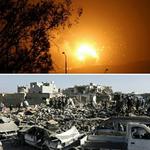
Yarmouk_Palestinian_camp__Damascus_5.4.15The Yarmouk Palestinian camp in Damascus in April 2015

Obama’s rapprochement with Iran and its Middle East allies has produced an incredibly sinister new twist in the Syrian war as it enters its fifth year. The atrocity-ridden conflict finds 16,000 Palestinians trapped in horrible conditions in the Yarmouk refugee camp of Damascus and beset by two enemies: the Islamic State and the President Bashar Assad’s army.

The world has been shown three players in the vicious Yarmouk contest: The Islamic State of Iraq and the Levant, whose jihadis are slashing through the refugee camp and massacring its Palestinian inmaes, the second player, and the Syrian army, the third, which appears to be fighting to keep the Islamists from reaching central Damascus. The camp lies 8.5 km from Assad’s presidential palace.

The Islamists are usually presented as fighting to settle a score with the camp’s inmates, because the Hamas majority is aligned with Iran and Hizballah, ISIS’s deadliest foes.

But even this evil scenario is not crazy enough to cover the new patchwork of alliances revealed here by DEBKAfile’s military and intelligence sources.

Syrian troops were actually directed by Assad to open the roads to Damascus and give the Islamists a free path to their Palestinian victims. This saved ISIS the need to detach substantial strength from other fronts for its Yarmouk operation.

ISIS is winning its cheapest victory yet as a result of a secret understanding reached by the Syrian president with the Islamists’ leader Abu Bakr al-Baghdadi, which evolved from their covert partnership in the oil and gas fields of eastern Syria.

When Al Baghdadi captured 90 percent of those fields last year, Assad was short of military strength to dislodge the invaders without diluting the forces fighting on more important strategic fronts, such as Damascus, the capital, Deraa in the South and Aleppo in the north. So the Syrian ruler cold-bloodedly negotiated an understanding with the ISIS caliph on four points:

1. The Syrian army and air force would abstain from attacking ISIS positions and also refrain from any effort to recapture the fields.

2. ISIS would pump out the oil and gas and transfer these products to Damascus, which would then use its distribution facilities to sell the fuel on the black market after retaining a portion for domestic consumption.

3.  Damascus and the Islamists would share out the revenue between them. Last year, ISIS was earning $2-4 million a day, an income which went far toward bankrolling the terrorist group’s war operations.

4.  Syrian power stations would keep Islamist bases supplied with electricity.

The Syrian ruler then decided, our sources report, to build on this alliance as an opportunity for another move: The outsourcing of some of his war challenges. The plan was for Assad to control from afar the action conducted by the jihadis without having to put Syrian boots on the ground.

The Yarmouk operation was the first tryout of Assad’s battlefield ties with the Islamists.

The Syrian ruler had three goals in mind when he targeted the Palestinians:

(a) To show his closest allies Iran and Hizballah that he was not totally reliant on them for war support, but retained a free hand to fight on without them.

(b) To punish the Palestinian Hamas, which rules the Yarmouk camp, for withholding its support from his regime during the entire civil war.

Hamas needed to understand that the group’s reconciliation with Tehran and Hizballah did not count as absolution in Damascus. Assad had a separate accounting of his own with the Palestinian extremists.

(c)  Assad gained a new lease of life from Washington’s turnabout toward recognizing the legitimacy of his presidency (signaled by US Secretary of State John Kerry’s acceptance of Bashar Assad as part of any peace moves for Syria). He also exploited US acceptance of Iran’s expansionist designs in the region as a point in his favor.

The Syrian ruler decided he felt confident enough to make the Palestinians his high card in his games with Israel, Jordan and the Palestinian Authority in Ramallah. Assad wanted them all to understand that he was riding high enough to control the fate of the Palestinians: It was up to him to decide whether to save them or throw them to the wolves – which he did by letting ISIS loose against them.
 

Iran news report: Tehran will start using fastest centrifuges on day deal takes effect

April 8, 2015

Iran news report: Tehran will start using fastest centrifuges on day deal takes effect, Times of Israel, April 8, 2015

FARS agency quotes Zarif, Salehi telling MPs they’ll inject gas into IR-8 centrifuges, a breach of US-published framework terms that would make a mockery of deal.

Iran will begin using its latest generation IR-8 centrifuges as soon as its nuclear deal with the world powers goes into effect, Iran’s foreign minister and nuclear chief told members of parliament on Tuesday, according to Iran’s semi-official FARS news agency.

If accurate, the report makes a mockery of the world powers’ much-hailed framework agreement with Iran, since such a move clearly breaches the US-published terms of the deal, and would dramatically accelerate Iran’s potential progress to the bomb.

Iran has said that its IR-8 centrifuges enrich uranium 20 times faster than the IR-1 centrifuges it currently uses.

According to the FARS report, “Iran’s foreign minister and nuclear chief both told a closed-door session of the parliament on Tuesday that the country would inject UF6 gas into the latest generation of its centrifuge machines as soon as a final nuclear deal goes into effect by Tehran and the six world powers.”

It said that Foreign Minister Mohammad Javad Zarif and Atomic Energy Organization of Iran (AEOI) head Ali Akbar Salehi made the promise when they briefed legislators on the framework agreement, and claimed the move was permitted under the terms of the deal.

“The AEOI chief and the foreign minister presented hopeful remarks about nuclear technology R&D which, they said, have been agreed upon during the talks (with the six world powers), and informed that gas will be injected into IR8 (centrifuge machines) with the start of the (implementation of the) agreement,” FARS quoted Javad Karimi Qoddousi, a member of the parliament’s National Security and Foreign Policy Commission, as saying.

Qoddousi said the Iranian Foreign Ministry plans to release a fact sheet presenting Iran’s version of the framework understandings in the next few days. “Those issues that have stirred serious concern among the Iranians will be revised and released in this fact sheet,” he said.

Earlier Tuesday, Israel Radio reported that Zarif told the lawmakers that Iran was capable of producing an atomic bomb at any given moment, but will refrain from doing so due to religious Islamic injunctions against such a move.

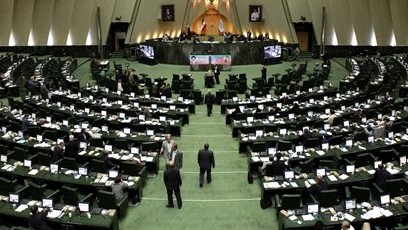
Iranian parliament1A general view of Iran’s parliament in Tehran, Aug. 28, 2013 (photo credit: AP/Ebrahim Noroozi)

Major differences have emerged between the P5+1 powers and Iran over what was agreed in the framework deal.

“Parameters” detailed by the US leave no doubt whatsoever, however, that the use of anything other than the most basic, first generation IR-1 centrifuges is barred for 10 years, and that even R&D on advanced centrifuges will be severely constrained.

“Iran will only enrich uranium at the Natanz facility, with only 5,060 IR-1 first-generation centrifuges for ten years,” the US parameters state. “Iran has agreed to only enrich uranium using its first generation (IR-1 models) centrifuges at Natanz for ten years, removing its more advanced centrifuges… Iran will not use its IR-2, IR-4, IR-5, IR-6, or IR-8 models to produce enriched uranium for at least ten years,” the US document adds. “For ten years, enrichment and enrichment research and development will be limited to ensure a breakout timeline of at least 1 year. Beyond 10 years, Iran will abide by its enrichment and enrichment R&D plan submitted to the IAEA, and pursuant to the JCPOA, under the Additional Protocol resulting in certain limitations on enrichment capacity.”

A French fact-sheet seen by The Times of Israel takes a similar position. It provides for Iran to gradually introduce the use of IR-2 and IR-4 centrifuges to enrich uranium after 12 years. It does not provide for the use of IR-8 centrifuges. The French fact sheet does specify that Iran will be allowed to continue R&D work on the advanced IR-4, IR-5, IR-6 and IR-8 centrifuges.

A document issued by the Iranian Foreign Ministry on Friday also does not assert an Iranian right to use IR-8 centrifuges. Its only reference to the IR-8 is as follows: “According to the reached solutions, Iran will continue its research and development on advanced machines and will continue the initiation and completion phases of the research and development process of IR-4, IR-5, IR-6, and IR-8 centrifuges during the 10-year period of the Comprehensive Plan for Joint Action.”


Obama: In future, Iran could build nuclear bomb almost immediately

April 8, 2015

‘Obama: In future, Iran could build nuclear bomb almost immediately’
Yoni Hersch, Eli Leon, Israel Hayom Staff and News Agencies


(At what point do they breakout? Is having a fully functional nuclear device minus the ‘fuse’ considered on the verge of a breakout? If so, then merely inserting the ‘fuse’ only takes a few minutes. Think about it. – LS)

U.S. President Barack Obama: In years 13, 14 and 15 of nuclear deal with Iran, the breakout times would be shrunk almost to zero • House Speaker John Boehner: It is clear that the deal with Iran is a direct threat to global peace and security.

U.S. President Barack Obama is persisting with his effort to rally support for the framework nuclear agreement reached between six world powers and Iran last week, but on Tuesday he admitted that Iran could have the capability to build a nuclear bomb almost immediately after the first 13 years of the deal, if it is finalized.

Under the framework for a final deal, Iran would be kept at least a year away from a nuclear bomb for the first decade, Obama said, as he pressed ahead in his campaign to sell the deal to skeptics. Pushing back on criticism that the deal allows Iran to keep enriching uranium, Obama told NPR that enrichment is not the prime concern, because Iran will be capped for a decade at 300 kilograms — not enough to convert to a stockpile of weapons-grade material.

“What is a more relevant fear would be that in year 13, 14, 15, they have advanced centrifuges that enrich uranium fairly rapidly, and at that point, the breakout times would have shrunk almost down to zero,” Obama said.

Yet Obama insisted that the world would have better insight into Iran’s capabilities because of extensive inspections in the earlier years of the deal.

“The option of a future president to take action if in fact they try to obtain a nuclear weapon is undiminished,” Obama said.

In response to Obama, International Relations, Intelligence and Strategic Affairs Minister Yuval Steinitz said, “If [Obama] says we have insurance here for 10 years, I say we don’t have insurance here for even one or two years, unless the loopholes are closed, and only then could it become a more reasonable agreement.”
Republican House Speaker John Boehner also criticized Obama’s statements, saying, “President Obama himself today confirmed exactly what critics of the deal have argued: his ‘deal’ would pave the way for a nuclear-armed Iran in the near future. The Iranian regime has consistently taken a long view on its regional — indeed global — ambitions of exporting its revolution. After multiple evasions of international inspections to date, no one should believe that the proposed inspections and verification are bullet-proof. It is clear that this ‘deal’ is a direct threat to peace and security of the region and the world.”

In the NPR interview, Obama was asked about Prime Minister Benjamin Netanyahu’s demand that any final nuclear deal with Iran include an explicit Iranian commitment to Israel’s right to exist.

“Well, let me say this — it’s not that the idea of Iran recognizing Israel is unreasonable,” Obama replied. “It’s completely reasonable and that’s U.S. policy. And I’ve been very forceful in saying that our differences with Iran don’t change if we make sure that they don’t have a nuclear weapon — they’re still going to be financing Hezbollah, they’re still supporting Assad dropping barrel bombs on children, they are still sending arms to the Houthis in Yemen that have helped destabilize the country. There are obvious differences in how we are approaching fighting ISIL in Iraq, despite the fact that there’s a common enemy there.

“So there’s still going to be a whole host of differences between us and Iran, and one of the most profound ones is the vile, anti-Semitic statements that have often come out of the highest levels of the Iranian regime. But the notion that we would condition Iran not getting nuclear weapons, in a verifiable deal, on Iran recognizing Israel is really akin to saying that we won’t sign a deal unless the nature of the Iranian regime completely transforms. And that is, I think, a fundamental misjudgment.

“I want to return to this point. We want Iran not to have nuclear weapons precisely because we can’t bank on the nature of the regime changing. That’s exactly why we don’t want to have nuclear weapons. If suddenly Iran transformed itself into Germany or Sweden or France, there would be a different set of conversations about their nuclear infrastructure.

“So, you know, the key here is not to somehow expect that Iran changes — although it is something that may end up being an important by-product of this deal — but rather it is to make sure that we have a verifiable deal that takes off the table what would be a game-changer for them if in fact they possess nuclear weapons.”

Directly addressing the citizens of Israel, Obama said, “What I would say to the Israeli people is, you are right to be suspicious of Iran; there’s no reason why you should let your guard down with respect to Iran. We have to make sure that Israel has the capabilities to protect itself not only from Iran, but also proxies like Hezbollah. But ultimately, Iran is deterrable, and it is deterrable not just because of Israel’s superior military and intelligence capabilities, but also because you got a really strong ally in the United States of America.”

Meanwhile, Central Intelligence Agency Director John Brennan said Tuesday that opponents of the framework nuclear agreement with Iran are being “disingenuous” when they say the deal could still allow Iran to build nuclear weapons.

Speaking to an audience of students and faculty at Harvard University, Brennan said the framework deal was likely the most realistic one that could be reached. “The individuals who say that this deal provides a pathway for Iran to a bomb are being wholly disingenuous, in my view, if they know the facts and understand what is required for a program,” Brennan said. “I certainly am pleasantly surprised that the Iranians have agreed to so much here.”

Brennan, who has headed the CIA since 2013, said he understood that some critics of the deal were wary that even with a final nuclear deal, Iran would have still the ability “to cause more trouble” in the Middle East.

“That’s a legitimate issue, concern and argument, but that’s why I say what they shouldn’t be doing is trying to pull apart this deal … that’s as solid as you’re going to get,” Brennan said. “You’re not going to get the Iranians to just totally dismantle everything and say, ‘OK, we’re not going to pursue any type of nuclear capability from a peaceful perspective.”

Brennan claimed it was a hopeful sign that the Iranian regime had been willing to engage in eight days of talks in Switzerland, noting that Iranian President Hassan Rouhani had “much greater reasonableness.”

(Now that is complete and utter BS – LS)

Yemen war: Saudis prevented Russian evacuations by air, bombed Moscow’s spy center in Aden

April 7, 2015

Yemen war: Saudis prevented Russian evacuations by air, bombed Moscow’s spy center in Aden, DEBKAfile, April 7, 2015

Russias_Yemen_consulate_damaged_in_Saudi-led_airstrikes_1.4.15Russia’s bombed out consulate in Aden

Saudi Arabia has gone head to head with Russia as Iran’s ally in Yemen.

Moscow claims to have evacuated hundreds of Russian nationals from Yemen by an air lift running out of Sanaa airport, but DEBKAfile’s exclusive intelligence and military sources reveal that not a single Russian plane has taken off from any Yemeni airport since March 27, when Saudi Arabia launched its military offensive against the pro-Iranian Houthi rebels.

The Saudiis warned Russia that they would not be responsible for the safety of any flights landing at a Yemeni airport or the passengers assembled there for evacuation, while their air force conducted strikes against the rebels. Having achieved control of Yemen’s skies in the early stages of their intervention, the Saudis declared its air space a no-fly zone.

This warning gained substance when, on April 1, Saudi F-15 warplanes bombed the Russian consulate in the second largest Yemeni city, Aden. A Russian witness said that not a single window was left in the building and all Russian citizens would have to leave the town.

According to DEBKAfile’s sources, the building was in fact completely demolished in order to dismantle Russia’s regional intelligence-gathering center which operated out of the consulate building and fed Iranian intelligence with data on military movements in the neighborhood.

It functioned according to the same system as Russian spy stations in Syria, which routinely keep their Iranian colleagues au fait with military activities, including Israeli army movements.

The intelligence gathered by the Aden facility was no doubt passed on by Iranian agents to the Houthi commanders, certainly after Al Qods Brigades chief Gen. Qassem Soleimani arrived in Sanaa to direct the rebel offensive after the Saudi offensive was launched.

In normal times, the Russian spy facility would have been responsible for surveillance over navigation through the Bab el-Mandeb Strait and the warships sailing between Red Sea, the Gulf of Aden and the Indian Ocean.

The next chapter of the Russian evacuation story unfolded on Thursday, April 2, the day after the consulate was razed: The Russians tried activating their connections in Cairo to obtain Saudi permission to land a plane in Sanaa, where hundreds of Russians had crowded to await passage to safety.

The Saudis relayed their refusal to Moscow through Cairo.

Then, on Friday, April 3, a flight landed at Moscow’s Chkalovsky Airport carrying Russian evacuees from Yemen, followed by a second flight which landed at an unnamed Russian military airport.

DEBKAfile’s sources report that neither of those planes were actually permitted to take off from Sanaa, but flew in from Cairo. After the Saudi ban on flights through Yemeni airports, Moscow had no choice but to rescue its nationals from the embattled country by sea aboard ships that carried them to Egypt.


‘Messing’ with Israel

April 7, 2015

‘Messing’ with Israel, Israel Hayom, Elliott Abrams, April 7, 2015

(“If you like your country you can keep it.” Even if Obama’s phrasings were not ambiguous, and they are, he could not be trusted. Moreover, since Obama’s talking points about the “once in a lifetime deal” and those of his Iranian counterparts are very different, there is no way of knowing now whether there will be a deal, whether the U.S. Congress will block it, or what it will be. — DM)

In his lengthy interview with Thomas Friedman of The New York Times, President Obama makes many statements about Israel’s security and how the proposed deal with Iran enhances it. These words from the interview are key:

“I have to respect the fears that the Israeli people have,” he added, “and I understand that Prime Minister Netanyahu is expressing the deep-rooted concerns that a lot of the Israeli population feel about this, but what I can say to them is: Number one, this is our best bet by far to make sure Iran doesn’t get a nuclear weapon, and number two, what we will be doing even as we enter into this deal is sending a very clear message to the Iranians and to the entire region that if anybody messes with Israel, America will be there.”

What does “messes with Israel” mean? No one has the slightest idea. The president unfortunately uses this kind of diction too often, dumbing down his rhetoric for some reason and leaving listeners confused. Today, Iran is sending arms and money to Hamas in Gaza, and has done so for years. Is that “messing with Israel?” Iran has tried to blow up several Israeli embassies, repeating the successful attack it made on Israel’s embassy in Buenos Aires in 1992. Fortunately Israel has foiled the more recent plots, but is attempting to bomb Israeli embassies “messing with Israel?” Iranian Revolutionary Guards, along with Hezbollah troops, are in southern Syria now near the Golan. Is that “messing with Israel?” And what does the president mean by “America will be there?” With arms? With bandages? With the diplomatic protection his administration is now considering removing at the United Nations?

Later in the interview, the president says this:

“Now, what you might hear from Prime Minister [Benjamin] Netanyahu, which I respect, is the notion, ‘Look, Israel is more vulnerable. We don’t have the luxury of testing these propositions the way you do,’ and I completely understand that. And further, I completely understand Israel’s belief that given the tragic history of the Jewish people, they can’t be dependent solely on us for their own security. But what I would say to them is that not only am I absolutely committed to making sure that they maintain their qualitative military edge, and that they can deter any potential future attacks, but what I’m willing to do is to make the kinds of commitments that would give everybody in the neighborhood, including Iran, a clarity that if Israel were to be attacked by any state, that we would stand by them. And that, I think, should be … sufficient to take advantage of this once-in-a-lifetime opportunity to see whether or not we can at least take the nuclear issue off the table.”

This is not much help. For one thing, the president says “attacked by any state,” presumably leaving out Hamas and Hezbollah, and for that matter the Islamic State group and al-Qaida. One has to assume he means “attacked by Iran,” but what does “we would stand by them” mean? It doesn’t add much to “America will be there.” There will be no conventional war between Israel and any Arab state in the foreseeable future, so Hezbollah is the most likely problem and is presumably excluded from the president’s formulation. What Israel worries about today is a nuclear attack by Iran or a terrorist group like Hezbollah to which Iran has given the bomb. No doubt that qualifies as “messing with Israel,” but were that to occur what exactly would “America will be there” and “stand by them” mean? Take in refugees from the destroyed State of Israel after the nuclear attack on it? The president’s language about “commitment” suggests that he may envision a formal defense commitment by the United States to Israel. Israel has not wanted such a treaty because it has always said it wants to defend itself, not have Americans dying to defend it. That position has served the U.S.-Israel relationship well for 67 years. Should it really be changed now, and would that really help Israel? What would the value of such a commitment be? To ask the question another way, are not Poles and Estonians wondering right now about the value of their membership in NATO, if Mr. Putin “messes” with them?

There were other problems in the interview, such as this language:

“There has to be the ability for me to disagree with a policy on settlements, for example, without being viewed as … opposing Israel. There has to be a way for Prime Minister Netanyahu to disagree with me on policy without being viewed as anti-Democrat, and I think the right way to do it is to recognize that as many commonalities as we have, there are going to be strategic differences. And I think that it is important for each side to respect the debate that takes place in the other country and not try to work just with one side. … But this has been as hard as anything I do because of the deep affinities that I feel for the Israeli people and for the Jewish people. It’s been a hard period.”

“You take it personally?” Friedman asked.

“It has been personally difficult for me to hear … expressions that somehow … this administration has not done everything it could to look out for Israel’s interest — and the suggestion that when we have very serious policy differences, that that’s not in the context of a deep and abiding friendship and concern and understanding of the threats that the Jewish people have faced historically and continue to face.”

“Respect the debate?” “Personally difficult?” This is the White House whose high officials called the prime minister of Israel a “chickens—” and a “coward,” in interviews meant to be published — not off the record. And the officials who said those things remain in place; no effort was ever made to identify and discipline them.

But the deeper problem is that the reassurances the president is offering to Israel … are simply not reassuring. Iran is already, right now, while under sanctions that are badly hurting its economy, spending vast amounts of money and effort to “mess with Israel.” This administration’s reaction has been to seek a nuclear deal that will give Iran more economic resources to dedicate to its hatred and violence against Israel, but will in no way whatsoever limit Iran’s conventional weapons and its support for terrorism.

Several times in this interview the president went out of his way to suggest that he fully understands Israel’s security problems, but the full text suggests that he does not — because he believes that his statements that “if anybody messes with Israel, America will be there” and would “stand by them” actually solve any of those problems. Time alone undermines the value of those statements, because he will not be president in 22 months. The words he used are sufficiently vague to undermine their value as well. It is hard to believe that many Israelis will be reassured by the interview, especially if they read the Iranian press and see what, in their own interviews, Iranian officials are claiming they got out of the new nuclear agreement.

Obama Nukes Own Iran Deal in NPR Interview

April 7, 2015

Obama Nukes Own Iran Deal in NPR Interview

by Joel B. Pollak7 Apr 2015

via Obama Nukes Own Iran Deal in NPR Interview – Breitbart.

President Barack Obama has granted an interview to National Public Radio in an attempt to sell the Iran “framework” to a skeptical public. In the process, he compares the agreement to a real-estate deal–a poor analogy for a man who called his own last property purchase deal “boneheaded” after involving indicted (now convicted) bag Chicago man Tony Rezko. Obama also provided at least five big reasons that Congress–whose opposition is growing–should reject the Iran deal.

1. Iran could have a nuclear weapon after 12 years. Obama volunteers to NPR’s Steve Inskeep “that in year 13, 14, 15, they [Iran] have advanced centrifuges that enrich uranium fairly rapidly, and at that point the breakout times would have shrunk almost down to zero.” Obama argues that would be better than the current breakout time of 2-3 months and that the world would at least know more about the Iranian nuclear program when it did detonate a nuclear weapon.

2. Obama admits the Iranian regime is not going to change. At the outset, Obama says that “this is a good deal if you think Iran’s open to change.” Later, however, in dismissing Israeli Prime Minister Benjamin Netanyau’s demand that a final deal include Iranian recognition of Israel’s right to exist, Obama says that would preclude a deal “unless the nature of the Iranian regime completely transforms.” By his own standard–Iranian openness to change–the deal is dead on arrival.

3. Obama admits Iran will not stop supporting terrorism. Obama admits that sanctions relief will allow Iran to keep funding terror throughout the region and the world. However, he says, Iran does that anyway, even under significant financial pressure. Amazingly, Obama actually offers the example of North Korea as a country that causes mischief despite being isolated. North Korea is the best example of why a nuclear deal like the Iran framework has no chance of success.

4. Russia could stop the UN Security Council from inspecting Iran. The fact that Russia holds a veto on the UN Security Council means that it can effectively protect Iran from international inspections. Obama says he is “trying to design” a system in which nuclear inspectors from the International Atomic Energy Agency (IAEA) do not have to report to the Security Council. The problem? Russia is one of the P5+1 powers. (Obama admits the problem is not yet “resolved.”)

5. There is no way to resolve differences over sanctions. Iran only came to the negotiating table, Obama admits, because of international sanctions (which he opposed, but for which he now takes credit). Yet Iran claims the deal will include an immediate end to sanctions, while Obama says that sanctions will only be lifted later. And Obama acknowledges that he needs Russia’s support to “snap-back” sanctions if Iran violates the deal–a problem for reasons described above.

French fact sheet differs from US on Iran’s centrifuge use, R&D

April 7, 2015

French fact sheet differs from US on Iran’s centrifuge use, R&D

Raising new questions, internal Paris document seen by Times of Israel also shows discrepancies over sanctions relief, inspectors’ access

By Times of Israel staff April 7, 2015, 3:28 pm

via French fact sheet differs from US on Iran’s centrifuge use, R&D | The Times of Israel.


Fact is nobody knows what the real facts are, but still a deal of the century.

it is a freak show


French government fact sheet on the Iran framework deal, which has not been made public by Paris but which has been seen by The Times of Israel, provides for Iran to gradually introduce the use of advanced centrifuges to enrich uranium after 12 years, in contrast to the US official parameters, which make no such specific provision.

The use of the more advanced IR-2 and IR-4 centrifuges, as permitted according to the French fact sheet, would enable Iran to more rapidly accumulate the highly enriched uranium needed to build nuclear weapons, accelerating its breakout time to the bomb.

The French fact sheet also specifies that Iran will be allowed to continue R&D work on the advanced IR-4, IR-5, IR-6 and IR-8 centrifuges, the last of which can enrich uranium at 20-times the speed of Iran’s current IR-1 centrifuges, whereas the American parameters are less specific.

Differences between the texts issued by Paris and Washington also extend to the question of inspection and supervision of Iran’s activities, with the French document indicating that the IAEA, the International Atomic Energy Agency, will be able to visit any suspect site in Iran — so-called “anywhere, anytime” access — whereas the US document is less far-reaching.

The two documents also differ in their terminology as regards the scale and timing of sanctions relief as the deal takes effect.

From left, Head of Mission of the People's Republic of China to the European Union Hailong Wu, French Foreign Minister Laurent Fabius, German Foreign Minister Frank Walter Steinmeier, European Union High Representative Federica Mogherini, Iranian Foreign Minister Javad Zarifat, Russian Deputy Political Director Alexey Karpov, British Foreign Secretary Philip Hammond and US Secretary of State John Kerry arrive in Lausanne, Switzerland, Thursday, April 2, 2015, after the United States, Iran and five other world powers on Thursday announced an understanding outlining limits on Iran's nuclear program. (AP Photo/Brendan Smialowski, Pool)

Ever since the framework agreement was announced last week, the various parties have set out sometimes sharply differing accounts of what has been agreed, provoking escalating controversy and criticism over a deal that President Barack Obama has hailed as historic and Israel’s Prime Minister Benjamin Netanyahu has warned is “very bad” and paves Iran’s path to the bomb.

The Iranian Foreign Ministry on Friday issued its own fact sheet, which differs starkly with the official American parameters and with the French fact sheet seen by The Times of Israel.

Six key discrepancies between the US and Iranian documents, some of them at the very heart of the framework agreement announced in Lausanne, Switzerland, last Thursday, were highlighted by an Israeli expert on Saturday.

Iranian Foreign Minister Mohammad Javad Zarif claimed earlier on Saturday that, under the deal, Iran has the right to continue working on more of the advanced IR-8 centrifuges. “Some said Iran can have no R&D, but we now have the right to develop IR-8, which has 20x the output of IR-1,” he said.

The Israeli government on Monday issued a series of demands intended to transform the non-signed framework agreement into a more reasonable deal by the scheduled June 30 deadline, and asked 10 key questions about the terms, several of which related to the emerging discrepancies between the various players’ accounts of what was decided in Lausanne.

Hours later, in two interviews with Israeli television stations, Ben Rhodes, a senior adviser to Obama, quashed the notion that the final deal would be markedly more stringent on Iran than the terms of the framework agreement, declaring that the deal as it now stands meets the US’s “core objectives.

“We believe that this is the best deal that can emerge from these negotiations,” Rhodes said.

Lead Iran Negotiator: We Haven’t Agreed On How Much Pre-Inspection Notice Iran Gets

April 7, 2015

Lead Iran Negotiator: We Haven’t Agreed On How Much Pre-Inspection Notice Iran Gets

by Ian Hanchett7 Apr 2015

via Lead Iran Negotiator: We Haven’t Agreed On How Much Pre-Inspection Notice Iran Gets – Breitbart.


Obama call it the deal of the century

One year break out time for inspections ?


Under Secretary of State for Political Affairs Amb. Wendy Sherman, the lead US negotiator in the P5+1 talks with Iran, said that the amount of notice Iran gets before its nuclear sites are inspected hasn’t been determined yet on Tuesday’s “Morning Joe” on MSNBC.

“Well, I’m not going to go into the specific details of each and every element of this negotiation because…we do not yet have an agreement, or an understanding as the lawyers call it. What we have is a framework. We are now negotiating those details, those details are absolutely crucial for all of the reasons that you all are discussing, and we have until June 30th to reach that. What we wanted to do, and the instructions we had from the president is get a framework, where we know, at least the top line–and actually, we got several more lines, of each of the major elements so that I, in fact, can tell Congress, I, in fact, can tell the American people that we can move ahead” Sherman stated when asked how much notice Iran would have to be given before any inspections.

When asked what her understanding of the framework regarding inspections, she responded “I think what the framework means is we will have the access we need to ensure that we have the time to make the decisions that we need. It’s why the one-year breakout time that we’ve talked about so much, the amount of time that it would take them to get enough fissile material for a nuclear weapon is so critical. Because in a year you have more than enough time to make other decisions about sanctions, or about other kinds of actions, to make sure that America’s national security, and the world’s national security is indeed secure.”

Follow Ian Hanchett on Twitter @IanHanchett

Obama admits: Deal will give Iran ‘near zero’ breakout time in 13 years

April 7, 2015

Obama admits: Deal will give Iran ‘near zero’ breakout time in 13 years

President concedes Iran framework nuclear agreement’s shortcomings amid growing chorus of objections

By Josh Lederman April 7, 2015, 1:46 pm

via Obama admits: Deal will give Iran ‘near zero’ breakout time in 13 years | The Times of Israel.


WASHINGTON (AP) — Defending an emerging nuclear deal, President Barack Obama said Iran would be kept a year away from obtaining a nuclear weapon for more than a decade, but conceded Tuesday that the buffer period could shrink to almost nothing after 13 or more years.

Obama, whose top priority at the moment is to sell the framework deal to critics, was pushing back on the charge that the deal fails to eliminate the risk because it allows Iran to keep enriching uranium. He told NPR News that Iran will be capped for a decade at 300 kilograms — not enough to convert to a stockpile of weapons-grade material.

“What is a more relevant fear would be that in Year 13, 14, 15, they have advanced centrifuges that enrich uranium fairly rapidly, and at that point, the breakout times would have shrunk almost down to zero,” Obama said.

Breakout time refers to how long it would take to build a bomb if Iran decided to pursue one full-bore — in other words, how long the rest of the world would have to stop it. The framework deal expands Iran’s breakout time — currently two to three months — to at least a year. But that constraint would stay in place only for 10 years, at which point some restrictions would start phasing out.

Although Obama acknowledged that Iran’s breakout time could shrink, he said at least the world would have better insight into Iran’s capabilities because of extensive inspections in the earlier years.

“The option of a future president to take action if in fact they try to obtain a nuclear weapon is undiminished,” Obama said.

The stark admission came as the president seeks to quiet a growing chorus questioning whether the deal he and world leaders have negotiated merely delays the certainty of a nuclear-armed Iran. Obama has insisted confidently that Iran will not get a nuclear weapon on his watch, which ends in roughly 20 months, but has made no similar assurances about his successors.

Tehran has always maintained it doesn’t want a nuclear bomb, but the international community has been skeptical, and America’s close ally Israel considers a nuclear Iran an existential threat. U.S. lawmakers and foreign policy hawks have questioned how Obama can strike a diplomatic deal with a country that continues to threaten Israel and tops the US list of state sponsors of terror.

Copyright 2015 The Associated Press

Verifying Iran Nuclear Deal Not Possible, Experts Say

April 6, 2015

Verifying Iran Nuclear Deal Not Possible, Experts Say

Past Iranian cheating to be codified by future accord

BY:
April 6, 2015 5:00 am

via Verifying Iran Nuclear Deal Not Possible, Experts Say | Washington Free Beacon.


Despite promises by President Obama that Iranian cheating on a new treaty will be detected, verifying Tehran’s compliance with a future nuclear accord will be very difficult if not impossible, arms experts say.

“The Joint Comprehensive Plan of Action will not be effectively verifiable,” said Paula DeSutter, assistant secretary of state for verification, compliance, and implementation from 2002 to 2009.

Obama said Saturday that the framework nuclear deal reached in Switzerland would provide “unprecedented verification.”

International inspectors “will have unprecedented access to Iran’s nuclear program because Iran will face more inspections than any other country in the world,” he said in a Saturday radio address.

“If Iran cheats, the world will know it,” Obama said. “If we see something suspicious, we will inspect it. So this deal is not based on trust, it’s based on unprecedented verification.”

But arms control experts challenged the administration’s assertions that a final deal to be hammered out in detail between now and June can be verified, based on Iran’s past cheating and the failure of similar arms verification procedures.

A White House fact sheet on the outline of the future agreement states that the new accord will not require Iran to dismantle centrifuges, or to remove stockpiled nuclear material from the country or convert such material into less dangerous fuel rods.

The agreement also would permit continued nuclear research at facilities built in violation of the Nuclear Non-Proliferation Treaty (NPT), which Iran signed in 1970 but has violated repeatedly since at least the early 2000s.

The centerpiece for verifying Iranian compliance will be a document called the Additional Protocol of the International Atomic Energy Agency (IAEA), according to the White House.

However, the State Department’s most recent report on arms compliance, made public in July, states that Iran signed an IAEA Additional Protocol in 2003 but “implemented it provisionally and selectively from 2003 to 2006,” when Tehran stopped complying altogether.

“The framework claims that Iran will once again execute an Additional Protocol with IAEA,” said William R. Harris, an international lawyer who formerly took part in drafting and verifying U.S. arms control agreements. “This might yield unprecedented verification opportunities, but can the international community count on faithful implementation?”

Harris also said Iran could cheat by shipping secretly built nuclear arms to North Korea, based on published reports indicating Iran co-financed North Korea’s nuclear tests, and that Iranian ballistic missile test signals reportedly showed “earmarks” of North Korean guidance systems.

“So what would prevent storage of Iranian nuclear weapons at underground North Korean sites?” he asked. “If there is to be full-scope inspection in Iran, the incentives for extraterritorial R&D and storage increase.”

U.S. intelligence agencies, which will be called on to verify the agreement, also have a spotty record for estimating foreign arms programs. After erroneously claiming Iraq had large stocks of weapons of mass destruction, the intelligence community produced a 2007 National Intelligence Estimate that falsely concluded that Iran halted work on nuclear weapons in 2003.

The IAEA, in a restricted 2011 report, contradicted the estimate by stating that Iran continued nuclear arms work past 2003, including work on computer modeling used in building nuclear warheads.

White House officials who briefed reporters last week on the new framework agreement said the key to verification of the future pact will be the new IAEA protocol. The protocol will provide greater access and information on the Iranian nuclear program, including its hidden and secret sites, they said.

The nuclear facilities at Fordow, an underground facility where centrifuges will be removed, and Natanz, another major centrifuge facility, were both built in violation of the NPT and will not be dismantled.

Additionally, the nuclear facility at Parchin, where Iran is believed to have carried out most of its nuclear weapons work, is not mentioned in any of the fact sheets by name.

The sole reference to Iran’s work on nuclear arms is the reference in the fact sheet to a requirement that Iran address “the possible military dimensions” of its nuclear program.

Officials who briefed reporters also said that under the new agreement inspectors would have access to Iran’s nuclear “supply chain”—the covert system used to circumvent global sanctions and procure materials and equipment.

DeSutter, the former State Department arms verification official, said the transparency measures announced after talks in Lausanne, Switzerland, on Thursday at best could detect quantitative excesses at known locations, but not secret illegal activities, like those that Iran carried out on a large scale in violation of its obligations under the NPT.

The transparency regime for the new deal also will “undermine the already challenging verifiability of the Nuclear Nonproliferation Treaty by legitimizing Iran’s illegal enrichment and reprocessing programs,” DeSutter said.

Thomas Moore, former professional staff member of the Senate Foreign Relations Committee who specialized in arms control matters, also said Iran’s past cheating on the NPT makes verifying a new agreement nearly impossible.

Iran, in its statement on the framework, also denied it would sign a new IAEA protocol. Tehran said of the protocol that it will be implemented on a “voluntary and temporary basis” for transparency and confidence-building.

The imprecise language is a sign “Iran is keeping its weapon option open but refuses required openness to confirm it no longer wants one,” Moore said.

“Iran would not divert centrifuges or the material they make from a declared site,” Moore said. “Rather, it will instead cheat at an undeclared site.”

Because Iran will not ratify the new protocol, the IAEA will be unable to verify the completeness and correctness of Iran’s declarations, Moore said, both declared and undeclared materials and activities.

Iran is already the single most IAEA-inspected nation in the world and additional IAEA inspections are not expected to be better, although Iran’s nuclear expertise will grow, he added.

“The deal is silent on Iran’s actual military dimensions, except to the extent that its supporters claim the IAEA will be able to verify the absence of a weapons program in Iran. They won’t,” Moore said.

“Contrary to the imprecise political rhetoric, this deal does not yet contain the ‘most intrusive’ inspections ever tried,” he said.

David S. Sullivan, a former CIA arms verification specialist and also a former Senate Foreign Relations Committee arms expert, said confirming Iran’s compliance with new nuclear obligations will be difficult.

“U.S. national technical means of verification is always difficult, fraught with the political process of monitoring, collecting, analyzing, and [achieving] consensus on usually ambiguous evidence of cheating that opponents are trying to hide,” Sullivan said.

“These difficulties are even greater for the UN’s IAEA, which is a multinational political agency.”

Past cheating by Iran, confirmed as recently as July 2014 raised questions about why there are negotiations with Tehran, Sullivan said.

“Why are we negotiating for a new agreement, when existing Iranian NPT violations remain in effect, ongoing, and unresolved, suggesting that Iran is unlikely to comply with any new agreement?” Sullivan said.

“Iran alarmingly is officially within three months of having nuclear warheads, according to the international negotiators, and is therefore about to become another nuclear-armed North Korea,” he said, noting that Pyongyang also cheated on the NPT and now has nuclear-tipped missiles.

By not requiring Iran to correct past violations of the NPT, the new agreement will in effect codify its current cheating. “The negotiations started as an attempt to stop Iran’s nuclear weapons program, but now they have legitimized it,” Sullivan said