Archive for April 30, 2015

Shia Militia Leader Explodes Over Possibility of U.S. Support for Kurdish Forces

April 30, 2015

Shia Militia Leader Explodes Over Possibility of U.S. Support for Kurdish Forces, Center for Security PolicyKyle Shideler, April 30, 2015

In the United States, the Obama Administration finds itself on the same side of the argument as Moqtada Al-Sadr, opposing the bill to permit arms for Kurdish forces.

******************

Shia leader Moqtada Al-Sadr, head of the Jaish al-Mahdi (JAM), issued a stark denunciation of the U.S. Defense Bill currently in front of the U.S. House of Representatives this week, threatening to fight U.S. interests both in Iraq and overseas, in the event that the bill passed.

Al Sadr opposes the bill, because it would authorize the direct transfer of military aid to Kurdish Peshmerga and Sunni tribal forces in order to fight the Islamic State, outside of the direct control of the central government in Baghdad.

“The U.S. House of Representatives intends to pass a draft law on Iraq making each sect independent from the other, and this will be the beginning of Iraq’s division,” Sadr said in a statement. If the U.S. passes such law, “then we will be obliged to lift the freeze on the military wing which is tasked with (fighting) the American side, to start hit the U.S. interests in Iraq and even abroad possibly,” Sadr warned.

Al Sadr’s JAM was one of the primary Shia militia forces used by Iran during Operation Iraqi Freedom, and responsible the deaths of numerous American fighting men and women. Iraq has primarily leaned on the use of Shia militias, operating under the rubric of the Popular Moblization Forces, but many of the 30,000+ militia fighters operate under direct command and control from the Iranian Islamic Revolutionary Guards Corps.

The Baghdad government, which is heavily supported by Iran, has also vocally opposedthe measure:

We will reject the arming of the Peshmerga directly by the US,” Iraq’s Defense Minister Khalid Al-Obeidi, told Rudaw on Thursday.

Kurdish forces have repeatedly complained that aid designated for use by their forces has repeatedly been redirected by the Baghdad government to Shia militias, some of whom are responsible for sectarian war crimes. Kurdish forces have also expressed concern over the entry of Shia forces into areas viewed by the Kurds as traditionally Kurdish, such as Kirkuk.

Supporters of the Peshmerga took to twitter to complain about the double standard:
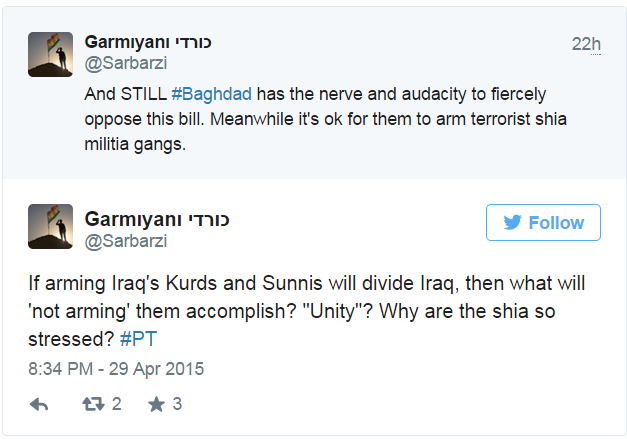
garmiyani-tweet

In the United States, the Obama Administration finds itself on the same side of the argument as Moqtada Al-Sadr, opposing the bill to permit arms for Kurdish forces. As State Department Spokeswoman Marie Harf confirmed yesterday:

QUESTION: Yes. Do you have any comment about this draft resolution at the Armed Services Committee that calls for the recognition of the Sunni fighters and the Kurdish Peshmerga forces as a country, and so they can be – directly receive aid and weapons from the U.S., not through the central government?

MS HARF: I saw that. I saw that. And to be very clear: The policy of this Administration is clear and consistent in support of a unified Iraq, and that we’ve always said a unified Iraq is stronger, and it’s important to the stability of the region as well. Our military assistance and equipment deliveries, our policy remains the same there as well, that all arms transfers must be coordinated via the sovereign central government of Iraq. We believe this policy is the most effective way to support the coalition’s efforts.

So we look forward to working with congress on language that we could support on this important issue, but the draft bill, as you noted, in the House – this is very early in the process here for the NDAA – as currently written on this issue, of course, does not reflect Administration policy.

By opposing the direct arming of Sunni and Kurdish forces (and the Kurdish forces in particular), the administration is continuing a policy arc in the region that continues to serve the interests of the Iranians because it creates a dynamic where the only viable players are either Sunni jihadists (whether Islamic State, or in the case of Syria, Al Qaeda-linked groups such as Jabhat al-Nusra), or Iranian-backed forces, such as Assad and the Shia militias operating in Iraq, who are no less committed enemies of the United States.  Bringing supplies directly to Kurdish forces will give the United States a third option to positively affect the outcome of events in Iraq without requiring the modus vivendi with the Iranians.
Recognize Israel or Take This Deal and Shove It

April 30, 2015

Rubio Has Just Aligned With Netanyahu In Protecting Israel Against Obama’s Nuke Deal With Iran
Norvell Rose April 30, 2015 at 7:31am Via Western Journalism

(Excellent candidate for POTUS.  I strongly recommend everyone watch Mr. Rubio’s eloquent speech…without a teleprompter.  Of course, Iran would have nothing to with such a thing. – LS)

A writer for Time magazine says it could be a potential “killer” — a proposed change to the bill now being debated in the Senate that would give Capitol Hill lawmakers a big say in whether President Obama’s emerging nuke deal with Iran goes forward. According to the lead paragraph in the Time article: “Sen. Marco Rubio has proposed a change to the Iran nuclear review bill that could unravel a carefully crafted compromise and kill the Obama Administration’s negotiations.”

There are certainly those who would challenge Time‘s assertion that the arrangement contemplated with Iran’s theocratic regime is a “carefully crafted compromise,” in part because it doesn’t include what Rubio wants to help protect Israel. The Republican senator and 2016 GOP candidate for president has introduced an amendment to the proposed review bill in the Senate insisting that any deal contains Iran’s official recognition of Israel’s right to exist as a Jewish state.

Time notes that a similar proposal was put forth by Israeli Prime Minister Benjamin Netanyahu, who has been harshly critical of the Obama administration’s concessions to Iran in the negotiations intended to prevent the country from obtaining a nuclear weapon. Obama has previously indicated his opposition to the sort of amendment Rubio has introduced with a passionate floor speech.

“Israel is not just a country,” Rubio said. “It has a special and unique purpose that sets it apart from any other nation on Earth. It was created as a homeland for a persecuted people.”

By clicking on the video above, you can see Sen. Marco Rubio’s speech on the floor of the Senate in which he urged his colleagues to approve his one-page amendment protecting Israel’s future.


Off topic | Britain’s Labour Party Vows to Ban Islamophobia

April 30, 2015

Britain’s Labour Party Vows to Ban Islamophobia, Gatestone InstituteSoeren Kern, April 30, 2015

  • “In Miliband’s Britain, it will become impossible to criticise any aspect of Islamic culture, whether it be the spread of the burka or the establishment of Sharia courts or the construction of colossal new mosques. … If he wins, Miliband will ensure that the accelerating Islamification of our country will go unchallenged.” — Leo McKinstry, British commentator.
  • The report shows that Britain’s Muslim population is overwhelmingly young and will exert increasing political influence as time goes on. The median age of the Muslim population in Britain is 25 years, compared to the overall population’s median age of 40 years.

The leader of Britain’s Labour Party, Ed Miliband, has vowed, if he becomes the next prime minister in general elections on May 7, to outlaw “Islamophobia.”

The move — which one observer has called “utterly frightening” because of its implications for free speech in Britain — is part of an effort by Miliband to pander to Muslim voters in a race that he has described as “the tightest general election for a generation.”

With the ruling Conservatives and the opposition Labour running neck and neck in the polls just days before voters cast their ballots, British Muslims — who voted overwhelmingly for Labour in the 2010 general election — could indeed determine who will be the next prime minister.

In an interview with The Muslim News, Miliband said:

“We are going to make it [Islamophobia] an aggravated crime. We are going to make sure it is marked on people’s records with the police to make sure they root out Islamophobia as a hate crime.

“We are going to change the law on this so we make it absolutely clear of our abhorrence of hate crime and Islamophobia. It will be the first time that the police will record Islamophobic attacks right across the country.”

Miliband appears to be trying to reopen a long-running debate in Britain over so-called religious hatred. Between 2001 and 2005, the then-Labour government, led by Prime Minister Tony Blair, made two attempts (here and here) to amend Part 3 of the Public Order Act 1986, to extend existing provisions on incitement to racial hatred to cover incitement to religious hatred.

Those efforts ran into opposition from critics who said the measures were too far-reaching and threatened the freedom of speech. At the time, critics argued that the scope of the Labour government’s definition of “religious hatred” was so draconian that it would have made any criticism of Islam a crime.

In January 2006, the House of Lords approved the Racial and Religious Hatred Act 2006, after amending the text so that the law would be limited to banning only “threatening” words and not those that are merely abusive or insulting. Lawmakers also said that the offense would require the intention — not just the possibility — of stirring up religious hatred. They added that proselytizing, discussion, criticism, abuse and ridicule of religion, belief or religious practice would not be an offense.

Miliband’s renewed promise to make “Islamophobia” (a term he has not defined) an “aggravated crime” may signal an attempt to turn the 2006 Act — which already stipulates a maximum penalty of seven years in prison for stirring up religious hatred — into a full-blown Muslim blasphemy law.

According to British commentator Leo McKinstry, “Miliband’s proposal goes against the entire tradition of Western democracy, which holds that people should be punished only for their deeds, not their opinions.” In an opinion article, he added:

“In Miliband’s Britain, it will become impossible to criticise any aspect of Islamic culture, whether it be the spread of the burka or the establishment of Sharia courts or the construction of colossal new mosques. We already live in a society where Mohammed is now the most popular boy’s name and where a child born in Birmingham is more likely to be a Muslim than a Christian. If he wins, Miliband will ensure that the accelerating Islamification of our country will go unchallenged.”

McKinstry says Miliband is currying favor with Britain’s three million-strong Muslim community to “prop up Labour’s urban vote.”

Muslims are emerging as a key voting bloc in British politics and are already poised to determine the outcome of local elections in many parts of the country, according to a report by the Muslim Council of Britain, an umbrella group.

The report shows that Britain’s Muslim population is overwhelmingly young and will exert increasing political influence as time goes on. The median age of the Muslim population in Britain is 25 years, compared to the overall population’s median age of 40 years.

An extrapolation of the available data indicates that one million British Muslims aged 18 and above will be eligible to vote in this year’s election. According to one study, Muslims could determine the outcome of up to 25% of the 573 Parliamentary seats in England and Wales.

Others say that although Britain’s Muslim community is growing, it is also ethnically diverse and unlikely to vote as a single group. One analyst has argued that the potential for Muslim influence in this year’s election “will remain unrealized because the Muslim vote is not organized in any meaningful way on a national level.”

A study produced by Theos, a London-based religious think tank, found that although Muslims consistently vote Labour, they do so based on class and economic considerations, not out of religious motives.

Indeed, a poll conducted by the BBC on April 17 found that nearly one-quarter of “Asian” voters still do not know which party they will support at the general election. Some of those interviewed by the BBC said that economic issues would determine whom they vote for.

In any event, Muslim influence in the 2015 vote will be largely determined by Muslim voter turnout, which has been notoriously low in past elections: Only 47% of British Muslims were estimated to have voted in 2010.

Since then, several grassroots campaigns have been established to encourage British Muslims to go to the polls in 2015, including Get Out & Vote, Muslim Vote and Operation Black Vote. Another group, YouElect, states:

“A staggering 53% of British Muslims did not vote in the 2010 General Election, such a high figure of Muslim non-voters indicates that many Muslims feel ignored by politicians and disillusioned by the political process.

“With the rise of Islamophobic rhetoric in politics and an ever increasing amount of anti-terror legislation which specifically targets Muslims, it is now more important than ever that Muslims use the vote to send a message to politicians that their attitudes and policies must change.

“YouElect wants to get the message across that there is something you can do about the issues you care about. We have launched a new campaign using the hashtag #SortItOut, which calls on Muslims to use the political process to address the issues that concern them most.

“With 100,000 new young Muslims eligible to vote this year and 26 parliamentary constituencies with a Muslim population of over 20%, the Muslim community has a very real opportunity to make an impact on British politics.”

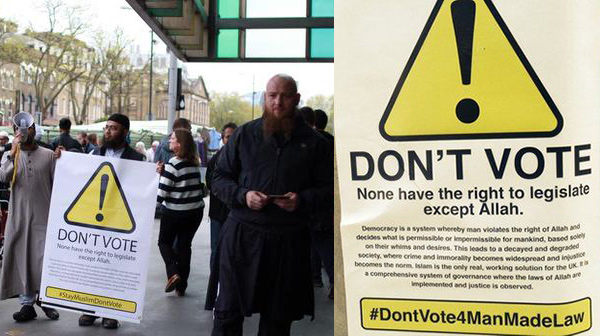
Not all Muslims agree. The British-born Islamist preacher Anjem Choudary is actively discouraging Muslims from voting. In a stream of Twitter messages using the #StayMuslimDontVote hashtag, Choudary has argued that voting is a “sin” against Islam because Allah is “the only legislator.” He has also said that Muslims who vote or run for public office are “apostates.”

1050Despite several grassroots campaigns to encourage British Muslims to vote in greater numbers, some prominent Islamists in the UK claim that voting is a “sin.”

Other British Islamists are following Choudary’s lead. Bright yellow posters claiming that democracy “violates the right of Allah” have been spotted in Cardiff, the capital of Wales, and Leicester, as part of a grassroots campaign called #DontVote4ManMadeLaw.

One such poster stated:

“Democracy is a system whereby man violates the right of Allah and decides what is permissible or impermissible for mankind, based solely on their whims and desires.

“Islam is the only real, working solution for the UK. It is a comprehensive system of governance where the laws of Allah are implemented and justice is observed.”

The Bad Deal That Could Lead to Nuclear War in the Mideast

April 30, 2015

Senator Warns That Zarif’s Comments Show Iran ‘Cannot Be Trusted,’ Challenges Him to Debate
by TheTower.org Staff | 04.30.15 10:10 am


(Iran seems to be saying it will do an end-run around the US and go directly to the UN if sanctions are not lifted, deal or no deal. – LS)

Shortly after Iranian foreign minister and chief nuclear negotiator Mohammad Javad Zarif spoke at New York University, Senator Tom Cotton (R-Ark.) responded, criticizing Zarif’s demand that U.N.-imposed sanctions on Iran must be lifted immediately upon completing a nuclear deal and challenging Zarif to a debate.

On his website, Cotton pointed out that Zarif’s remarks contradicted President Barack Obama, who has insisted that sanctions can only be lifted once Iran complies with the obligations of any future deal:

“President Obama promised sanctions would only be lifted when Iran’s compliance with restrictions on their nuclear program were verified. But earlier today, Iranian Foreign Minister Javad Zarif once again contradicted the President’s interpretation saying:

If we have an agreement on the 30th of June, within a few days after that, there will be a resolution before the UN Security Council under Article 41 of Chapter 7 which will be mandatory for all member states whether Senator Cotton likes it or not.

“Sanctions relief isn’t about what I like, but what will keep America safe from a nuclear-armed Iran. But I suspect Foreign Minister Zarif is saying what President Obama will not because the President knows such terms would be unacceptable to both Congress and the American people. The repeated provocative statements made by members of the Iranian leadership demonstrate why Iran cannot be trusted and why the President’s decision to pursue this deal and grant dangerous concessions to Iran was ill-advised from the beginning. These aren’t rhetorical tricks aimed at appealing to hard-liners in Iran; after all, Mr. Zarif was speaking in English in New York. Rather, they foreshadow the dangerous posture Iran will take and has taken repeatedly—including as recently as yesterday with the interception of a U.S.-affiliated cargo ship—if this deal moves forward.

In addition to pointing out Zarif’s contradiction of the president, Cotton, a graduate of Harvard Law School, responded to Zarif’s mention of his name by challenging him to a debate on Twitter, and to discuss Iran’s support of “tyranny, treachery, & terror.”

In his talk yesterday, Zarif also defended Iran’s seizure of a cargo ship in an internationally recognized shipping lane, as well as the espionage trial of Washington Post reporter Jason Rezaian.

Cotton was the lead author of an open letter, signed by 47 senators last month, that asserted that Congress would have a Constitutionally-mandated role in ending any American-imposed sanctions on Iran. In response, Zarif revealed that Iran intended to have sanctions first lifted by the United Nations Security Council as a means of pressuring the United States to lift the sanction it had imposed on Iran.

In an interview earlier this month, Cotton asserted that moderates in Iran were not being empowered through the negotiations, and that a bad deal could lead to nuclear war in the Middle East.

IDF Mission Commander in Nepal Motivates his Soldiers

April 30, 2015

IDF Mission Commander in Nepal Motivates his Soldiers – YouTube.


