Archive for April 26, 2015

IDF Eliminates Terror Cell Planting Bomb on Syrian Border

April 26, 2015

IDF Eliminates Terror Cell Planting Bomb on Syrian Border, Israel National News, Kobi Finkler, Ari Yashar, April 26, 2016

IDF forces on Sunday night eliminated a terrorist cell as it was trying to place an explosive on the Israeli-Syrian border on the Golan Heights.

Reportedly four terrorists were killed in the incident; no IDF soldiers were wounded in the exchange.

A senior IDF source said that an army surveillance patrol located the terrorists who had arrived at the border from Syria, and tracked them as they advanced.

When they reached the border and placed an explosive on it, IAF aircraft fired missiles at them, taking out every single terrorist member of the cell.

The IDF reports that the incident took place on Israeli territory just east of the security barrier.

The last security incident involving an attempted border bombing similar to this one took place last March, when an explosive was placed on the border. As a result of the explosion, an IDF paratrooper officer was critically wounded.

Earlier on Sunday Defense Minister Moshe Ya’alon (Likud) warned that Israel will strike Iranian attempts to smuggle advanced weapons to the Hezbollah terrorist organization in Lebanon, following Arab reports that an IAF airstrike the day before took out a Scud missile depot in Syria transferring weapons to Hezbollah.

According to the reports in Arabic media, a Scud depot in the Qalamoun mountain region rife with smuggling to Hezbollah was targeted, after a weapons convoy was hit last Wednesday.

“Iran continues to try and arm Hezbollah, even in these very days, and it hopes to equip the Lebanese terrorist organization with advanced and precise weapons,” said Ya’alon. “We won’t allow Iran and Hezbollah to establish a terrorist infrastructure on our border with Syria, and we will know to put our hands on all those who threaten citizens of Israel, along all our borders and even far from them.”


Large-scale Egyptian army massed for operation to capture eastern Libya from ISIS

April 26, 2015

Large-scale Egyptian army massed for operation to capture eastern Libya from ISIS, DEBKAfile, April 26, 2015

IS in LibyaISIS in occupation of Libyan town of Derna

Brennan leaned hard on the Egyptian president to follow Washington’s line, but El-Sisi refused.

*************

The Middle East is on the brink of its fourth war (after Syria, Iraq and Yemen). DEBKAfile’s military and intelligence sources report that Egypt is massing large-scale ground and air forces in the Western Desert along the Libyan border, in preparation for a military campaign to capture eastern Libya – Cyrenaica – from the Islamist State of Syria and Iraq – ISIS – occupation.

The substantial naval and marine forces assembling at Egypt’s Mediterranean ports indicate the possible launching of the offensive by dropping Egyptian marines on the Libyan coast around Derna (pop: 100,000), which ISIS has made its provincial capital. They may be accompanied by simultaneous landings of paratroops from the air.

For President Abdel-Fatteh El-Sisi, ISIS’s presence in eastern Libya (as well as Sinai) poses an unacceptable peril to his country. He has been warned in a number of intelligence reports that the Islamic State’s terrorists have already penetrated some Egyptian towns and even infiltrated certain army units.

To counter the Egyptian plan of campaign, ISIS is rushing reinforcements to eastern Libya from Syria and Iraq. From Syria, they are traveling by air or sea through the Mediterranean; from Iraq, through the Sinai Peninsula, whence oil and drug rings smuggle them across the Suez Canal and Egypt.

DEBKAfile’s sources reveal that Egypt’s projected invasion of Libya was high on the agenda of American CIA Director John Brennan’s unannounced visit to Cairo on April 19 for a meeting with the president.

In reply to his visitor’s demand for precise information on Egypt’s Libyan campaign. President El-Sisi offered an assurance that he had no intention of keeping the Egyptian army in Libya. He would pull the troops out after defeating and disarming the jihadis and hand power to the Libyan government, which has established its seat in the eastern town of Tobruk near the Egyptian border and home to Libyan military bases and oil terminals.

The Tobruk government was set up by Libyan members of parliament who fled the capital Tripoli when it was overrun by a group of extremist Islamist militias, known as the Libyan Dawn, which included elements associated with Al Qaeda in the Islamic Maghreb – AQIM.

The head of the this government is Abdullah al-Thinni, who is recognized by the United States and most Western governments as the legitimate prime minister of Libya.

President El-Sisi was not surprised to hear from the CIA director that the Obama administration objects to a direct Egyptian invasion of Libya, but would not oppose Cairo acting through local Libyan militias. Brennan put forward the name of Gen. Khalifa Hifter, a Libyan-American, who set up a militia in the eastern Libyan town of Benghazi to fight the Islamists, aided by Libyan army units based in the region.

On March 2, Prime Minister al-Thinni and the Tobruk parliament appointed Gen. Hifter commander-in-chief of the Libyan army, promoting him to the rank of lieutenant general. He was entrusted with two missions: To liberate Libya from the clutches of the Islamic militias and to rebuild the national army.
DEBKAfile’s military sources disclose that, for the past six months, the Egyptian president has given Hifter his support and even supplied him with weapons. But he does not see him as a sufficiently powerful and emblematic figure to unify the Libyan nation.

Brennan leaned hard on the Egyptian president to follow Washington’s line, but El-Sisi refused.

Their differences on the Libyan campaign were reflected by omission in the joint communiqué they issued after their conversation: After discussing “regional issues, terrorism and ways of enhancing bilateral relations, the two sides agreed to continue consultation and coordination on issues of mutual interest.”

Interestingly, Egypt is ready to throw ground, sea and air forces into its offensive in Libya, while at the same time abstaining from deploying air or ground power in the Yemeni conflict, although it is a member of the Saudi-led coalition fighting Iran-backed rebels.

Egypt is already fighting the Islamic State’s branch in Sinai. It is now gearing up to tackle the Islamist peril on its western border.

British council candidate says she will never support ‘the Jew’ Ed Miliband for PM

April 26, 2015

British council candidate says she will never support ‘the Jew’ Ed Miliband for PM

via British council candidate says she will never support ‘the Jew’ Ed Miliband for PM – Diaspora – Jerusalem Post.

A British politician sparked outrage over the weekend by referring to the Labour Party’s prime ministerial candidate Ed Miliband as “the Jew,” in comments made in Arabic, according to British online publication, Jewish News.

In remarks made in a Facebook exchange Saturday, Gulzabeen Afsal, a Tory council candidate running in Derby, wrote that she would never support “the Jew,”  apparently referring to Miliband.

The exchange began when Afsal wrote on her Facebook page: “Just can’t take Mr Ed Miiband seriously!! DC (David Cameron) has what it takes to be the future PM.”

When a respondent suggested that Afsal should have some respect “for the future PM”, she responded: “Nah bro! never ever will I drop that low and support the al yahud [Arabic for Jew] lol.”

This marks the first time a candidate running for elected office has brought up the religion of Labor’s choice for prime minister in the upcoming UK elections, according to Jewish News.

In response to the remarks, a Derby Labour Party spokesman said:“With anti-Semitism on the rise across Europe it is abhorrent and terrifying that a prospective Conservative politician would say something like this.

“Derby Conservatives should launch an immediate investigation into this incident and take the appropriate action. Derby must be free from prejudice, especially from those seeking elected office.”

A spokesman for Tory added: “Her comment was offensive and wrong. She has removed it and apologized.”

Palestinians Vote for Iran’s New Ally: Hamas

April 26, 2015

Palestinians Vote for Iran’s New Ally: Hamas

by Khaled Abu Toameh

April 24, 2015 at 5:00 am

via Palestinians Vote for Iran’s New Ally: Hamas.


Hamas’s crushing victory in the April 22 student council election at Bir Zeit University shows that the Islamist movement continues to maintain a strong presence in the West Bank.

Hamas supporters on campus won 26 seats, compared to 16 for their rivals in the Fatah faction, headed by Palestinian Authority (PA) President Mahmoud Abbas.

The results of the election mean that Bilal Barghouti, who is serving 16 life terms in prison for his role in a series of suicide attacks against Israel, has become the “Honorary Chairman of the Bir Zeit University Student Council.”

The Hamas victory came less than 48 hours after its supporters scored a major achievement on another campus: Palestine Polytechnic University in Hebron. There, Hamas supporters won the same number of seats as their rivals in Fatah – a move hailed by leaders of the Islamist movement as a “huge achievement.”

Hamas supporters are shown in this video screenshot marching during a student council election rally at Bir Zeit University, near Ramallah, on April 20, 2015.

Besides being a political and moral victory for Hamas, this is a vote of no confidence in Abbas and Fatah.

The outcome of the election on both campuses shows that many Palestinians do not believe in Abbas’s political program, particularly the peace process with Israel. Moreover, the results show that many Palestinians still do not consider Fatah a better alternative to Hamas.

In 2006, Fatah lost the Palestinian Legislative Council elections to Hamas largely because of its failure to reform and combat financial and administrative corruption. Since then, Fatah has done almost nothing to draw the conclusions from that defeat.

The same leaders who led Fatah to the 2006 defeat continue to hold key positions in Fatah, ignoring demands for reforms and transparency.

The landslide victory of Hamas at Bir Zeit University came in spite of an ongoing security clampdown by Abbas and Fatah on supporters of the Islamist movement in the West Bank.

In recent months, the crackdown reached university and college campuses, where dozens of students affiliated with Hamas have either been detained or summoned for interrogation by Palestinian Authority security forces.

The results of the Bir Zeit University election show that the crackdown has failed to weaken or deter Hamas supporters in the West Bank.

It is evident, in fact, that Abbas’s campaign against Hamas has had a boomerang effect, resulting in increased support for the Islamist movement among Palestinians, especially those living in the West Bank. When you tell your people that the Jews are awful, and do not want peace, and just want to kill Arabs and destroy their homes and holy sites, then people say, “This means Hamas is right. We should be killing the Jews and not making peace with them.”

Hamas sees its electoral triumph as a “victory for the project of resistance” against Israel. “This is a referendum that shows the strength of Hamas (in the West Bank),” said Hamas spokesman Sami Abu Zuhri. “It’s also a victory for our project of resistance.”

Another Hamas official, Hussam Badran, said that the results of the university student council election “prove that the Palestinian people in general, and the youth in particular, have endorsed our program of resistance.” He said the results also showed that Hamas continues to enjoy widespread support among Palestinians.

What the Hamas officials are saying is that many Palestinians continue to prefer the option of an armed struggle to peaceful negotiations with Israel.

Shortly after the Bir Zeit University results were announced, Hamas supporters took to the streets in various parts of the West Bank and Gaza Strip to celebrate their victory. On April 24, Hamas supporters are also planning a “victory rally” at Bir Zeit University to celebrate the results of the election.

The Hamas victory at Bir Zeit University shows why it is not a good idea, at this stage, to hold parliamentary or presidential elections in the Palestinian territories. Abbas himself has long been aware that a free and democratic election would result in another Hamas victory. That is why he has been in no rush to call on Palestinians to head to the ballot boxes.

But Abbas is not the only one who should be worried about the Hamas electoral victory. This is also bad news for efforts to revive the stalled peace talks between Israel and the Palestinians. In wake of the Hamas victory, it is hard to see how Abbas or any other Palestinian leader would sign any peace agreement with Israel.

The Hamas victory did not come as surprise to those who have been closely following the anti-Israel messages coming from the Palestinian Authority. The PA’s incitement against Israel is one of the main reasons Palestinians have been turning to Hamas.

Hamas has apparently now realigned with Iran, which is “rebuilding relations with the military wing of Hamas.” Iran also, it seems, has sent Hamas millions of dollars over the past few months. Hamas shares “the same long-term objectives as the ayatollahs: the complete destruction of the state of Israel,” and to that end, wants to undermine and destroy anyone who recognizes Israel.

To avoid this, the Palestinian Authority must first stop its ongoing campaign to delegitimize and isolate Israel. This campaign is being waged through the media, mosques and public rhetoric.

The Palestinian Authority must also maintain security coordination with Israel. The coordination is vital to the PA itself, not just Israel. Without Israel’s help, the PA will not be able to prevent Hamas from taking over the West Bank.

Finally, to stop the Palestinians from rallying around Hamas, the Palestinian Authority in general — and Fatah in particular — need to embark on comprehensive reforms. Above all, they need to stop blocking the emergence of new leadership, and get rid of all the icons of corruption and bad government.

Unless the PA does these three things, Hamas’s popularity among Palestinians will continue to rise, bringing the Islamist movement closer to taking over the West Bank.

The Palestinian Authority is shooting itself in the foot.

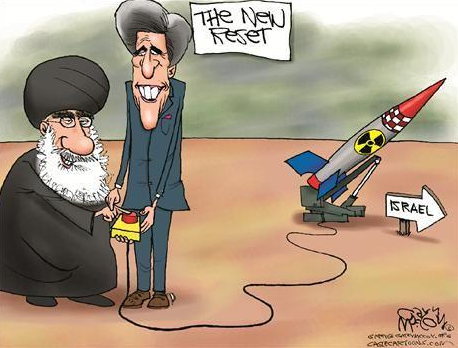
Cartoon of the day

April 26, 2015

(Tip of the hat to Joopkiepzeiker — DM)

Kerry reset with Iran